



Abstract
Family function reflects the operating status of the family system, which plays a vital role in children’s mental health. The current meta-analysis examined the association between family function and post-traumatic stress disorder (PTSD) in children and adolescents for the first time. Studies published from 1980 to 2021 were identified via searching and screening. We identified 31 studies (91 unique effects) with 8,684 children. A three-level meta-analysis revealed that overall family function was negatively associated with PTSD (r = −0.205). Among elements of family function, family affect (r = −0.251), communication (r = −0.221), and cohesion (r = −0.184) were associated with less PTSD, whereas family conflict (r = 0.228) was associated with more PTSD in children. Family flexibility (r = −0.103) was not associated with PTSD. Moderator analyses revealed differences between various types of trauma events and family function scales. The findings highlight the differences in the roles of the elements of family function and suggest that interventions should be focused on targeting specific elements of family function.
Introduction
Traumatic events can trigger a range of negative psychological reactions (Baryshnikova & Pham, 2019), among which post-traumatic stress disorder (PTSD) is relatively common, particularly in children and adolescents. PTSD can negatively affect their physical health, mental health, and academic and social development (Alisic et al., 2011). To help children and adolescents recover from traumatic experiences and undergo social adjustment, developing effective psychological interventions for treating PTSD is critical. To date, numerous intervention strategies have been developed to relieve the severity of PTSD symptoms. These include cognitive-behavioral therapy (e.g., Kowalik et al., 2011), eye movement desensitization and reprocessing (e.g., Rodenburg et al., 2009), narrative exposure therapy (e.g., Mørkved et al., 2014; Robjant & Fazel, 2010), and prolonged exposure therapy (e.g., Foa et al., 2013; Mørkved et al., 2014). Although these approaches have been found to be effective, a previous study reported that more than 60% of adolescents continue to report PTSD following long-term intervention (Jaycox et al., 2010). This can be attributed to two possible reasons. First, most interventions were designed to treat children and adolescents individually and emphasize personal motivation and cognition, but overlooked their family members. Second, limited research that considered and intervened PTSD in children and family members (e.g., Berkowitz et al., 2011; Cohen & Mannarino, 2008) failed to recognize the importance of the dynamics and situations of families in children’s mental health. In fact, poor family dynamics may aggravate children’s PTSD (e.g., Deane et al., 2018; Olson, 2000a), and treatments involving the family members who contributed to the child’s PTSD may not be beneficial; rather, it may negatively affect children with initial trauma exposure (e.g., Lambert et al., 2014). Therefore, interventions should consider not only the family members of the child but also improving family function.
Family function refers to the operating status or process of the family system and is one of the most important family factors for providing the necessary conditions for the healthy development and maintenance of family members in terms of social, psychological, and biological characteristics (Guerrero-Munoz et al., 2021; Minuchin, 2018; Scully et al., 2020; Wedding & Corsini, 2019). However, recent studies have only examined the relation between family factors, such as family socioeconomic status and family structure, and PTSD (e.g., Gallo et al., 2019; Koirala et al., 2020). Research has also assessed the relation between factors outside of the family system (e.g., social class, custom, mass media, and social welfare) and post-traumatic reactions (Bronfenbrenner, 1992; Shelton, 2018). Emphasis on these factors did not significantly relieve PTSD in some traumatized individuals (e.g., Mora et al., 2022; Peverill et al., 2021). This urges us to consider family function as a proximal and underlying family factor that affects children’s and adolescents’ mental health (Minuchin, 2018; Pereda & Díaz-Faes, 2020; Wedding & Corsini, 2019).
Relevant empirical studies have found that good family functions, such as family communication and cohesion, have positive effects on relieving children's PTSD when they experience a crisis or traumatic event (Acuña & Kataoka, 2017; Mora et al., 2022), whereas dysfunctional family dynamics naturally are a risk factor of PTSD in children (e.g., Deane et al., 2018; Olson, 2000a). Therefore, clarifying the role of family function in PTSD in children is an important prerequisite for developing the most effective family interventions.
Although several recent meta-analyses have attempted to explore the relations between family factors and PTSD to address the above-mentioned issue (Birkley et al., 2016; Pinquart, 2020; Trickey et al., 2012), the studies have various limitations, such as (1) the inclusion of mainly male participants (Birkley et al., 2016); (2) small sample sizes (Trickey et al., 2012); (3) PTSD in children being ignored (Birkley et al., 2016); and (4) the inclusion of only a single type of traumatic event (Pinquart, 2020). Systematic and comprehensive evaluations of this issue are scarce; thus, a comprehensive understanding of the relation between family function and PTSD is limited. We sought to fill this gap by conducting a meta-analysis synthesizing existing theories and empirical articles to elucidate the relation between family function and PTSD in children. This would not only extend the research field of family and trauma theory, but also provide support for the development of psychological interventions and family education for children and adolescents to prevent the transmission of the negative impacts of trauma within the family, relieve children’s mental health problems, and help children achieve post-traumatic growth.
Theoretical Perspectives on the Elements of Family Function
Family function is an important variable in family research. We have summarized the main theories of family function (see Supplemental Appendix A), which can be divided into outcome orientation and process orientation, which provide different perspectives on crisis situations. The Circumplex Model (Olson, 2000a, 2000b) and the Beavers Systems Model (Beavers & Hampson, 2000) represent outcome-oriented theories and emphasize the results of family operations. According to these theories, the family system changes in response to crises, and a balanced family possesses the resources and skills to change the system appropriately to deal with crises more effectively (Olson, 2000a). In contrast to outcome-oriented theories, process-oriented theories emphasize the process of family operations, which is represented by the McMaster Model (Epstein et al., 1978) and the Process Model (Skinner et al., 2000). It has been suggested that therapists need to pay more attention to the process because the failure of the family to achieve the basic functions during the operation process can lead to the development of various mental disorders (e.g., PTSD) in family members. Both models propose that a primary goal of a family system is to complete various crisis tasks (e.g., diseases and accidents) and that the processes involved in dealing with these tasks are important. The process of completing these tasks enables the continuous development and cohesion of all family members to maintain the effective operation of their families (Skinner et al., 2000). It should be noted that each theoretical orientation focuses on only one aspect of the family, and neither fully evaluates the complete picture of family function. Furthermore, the applicability of these theories to traumatic and crisis events remains to be tested.
Nevertheless, we found that various theories of the two orientations exhibit different compositions and conceptualizations of the elements of family function, as shown in Supplemental Appendix A. These elements can be differentiated into cognitive components and affective responsiveness, which include positive components (e.g., family cohesion) and negative components (e.g., family conflict). In the current study, we conceptualized the elements proposed by various theories (Beavers & Hampson, 2000; Epstein et al., 1978; Olson, 2000b; Skinner et al., 2000) and reviewed in previous studies (e.g., Holtom-Viesel & Allan, 2014) and evaluated the status of reports included in the current analyses (e.g., sufficient effect size for analysis). In addition, we combined the relevant sub-dimensions into broader elements and coded family function at the effect size level using six elements: family conflict, family cohesion, family flexibility, family communication, family norms, and family affect. The conceptual basis of each element is shown in Supplemental Appendix B.
Family Function and PTSD in Children and Adolescents
Previous studies have established a longstanding and robust association between family function and PTSD in children and adolescents (Lee et al., 2018; Trickey et al., 2012). After suffering traumatic events, family function becomes disrupted (e.g., Walsh, 2007), and poor family function significantly positively predicts PTSD with medium to large effect sizes (Trickey et al., 2012). A family that functions poorly may show disunity in tasks, have difficulty adapting to stress factors, and have no clear family rules or boundaries (Beavers & Hampson, 2000; Skinner et al., 2000), which results in family members being prone to developing adjustment problems (Vliem, 2009), such as PTSD. However, some previous studies reported that family function was not significantly correlated with PTSD (e.g., Nelson et al., 2019), which suggests that the relations are not stable and can be easily influenced by various factors. We suggest that this inconsistency in findings may be attributed to the following two factors.
First, the relations between the key elements of family function and PTSD in children and adolescents vary in terms of direction and strength. Different elements reflect various aspects of family function and play distinct roles in coping with problems (Epstein et al., 1978). For example, positive elements of family function, such as family cohesion, enable children to feel a sense of support and connection with family members during a traumatic event and facilitate positive responses to their family members’ emotions and behaviors, thereby reducing mental problems (Gorman-Smith et al., 2004) and protecting children from the negative impacts of PTSD (Deane et al., 2018). In contrast to the effects of cohesion, greater family conflict is associated with more severe trauma reactions in sexually abused children (Bal et al., 2004), tornado survivors (Danielson et al., 2017), and survivors of multiple traumatic events (Daniunaite et al., 2021). Regarding other elements of family function, Ozono et al. (2007) conducted a univariate analysis and detected significant correlations among the elements of family function (e.g., family norms and family affect) and PTSD in children with cancer; however, these correlations disappeared in the multivariate model. Taken together, these previous findings indicate that the effects of different family function elements on PTSD are varied and unstable and are affected by numerous other factors that require further exploration.
Second, the type of traumatic event, gender, assessment sources or measurement, publication status, and other factors may have moderating effects on the relation between family function and PTSD in children and adolescents. For example, numerous previous studies have reported significant relations between family function and PTSD following different types of traumatic events, including disease (Nelson et al., 2019), abuse (Bal et al., 2004), and accidents (Lee et al., 2018). Differences in parent–child perceptions of family function (Ohannessian et al., 2000), PTSD, and family function measurement scales (Gallo et al., 2019) may also contribute to the inconsistent findings on the relations between family function and PTSD. Furthermore, the relation between family function and PTSD may vary depending on publication status, where significant associations are accepted for publication (e.g., Lee et al., 2018), whereas non-significant findings remain unpublished (e.g., Hildenbrand, 2016). However, previous quantitative and cross-sectional studies have not comprehensively explored changes in the relation between family function and PTSD in children and adolescents because of differences in moderators.
Current Study
To address the gaps described above and integrate the findings of previous studies, we conducted a systematic review and meta-analysis to assess the associations between family functions, including overall family function, general family function, and its key elements (i.e., family conflict, family cohesion, family flexibility, family communication, family norms, and family affect) and PTSD, and to elucidate the moderating effect of various factors (e.g., type of traumatic events and gender) on these relations. We sought to address the following questions: (a) how does family function affect PTSD? (b) which elements of family function are most strongly related to PTSD? (c) what are the relations between the family function of outcome/process orientations and PTSD? and (d) what are the boundaries or moderators of the relation between family function and PTSD? Our study aimed to clarify the key elements of family function that have a significant impact on PTSD, integrate previous empirical studies and family function theories, verify the applicability of these theories to traumatic and crisis events, and provide targeted and operable theoretical guidance for interventions for children and adolescents in clinical practice.
Methods
This study followed the Preferred Reporting Items for Systematic Reviews and Meta-analyses guidelines (Moher et al., 2009; see Supplemental Appendix C).
Search Strategy
Two strategies were used to search articles. First, a systematic search of the literature was conducted in six databases: PsycINFO, Web of Science, PubMed, Medline, Embase, and PsycNet (see Supplemental Appendix D). For this process, both published literature and unpublished manuscripts (e.g., Master’s and Ph.D. theses) were included. The search terms included PTSD in children and adolescents and family function: (a) PTSD in children and adolescents: (child* OR boys OR girls OR juvenil* OR minors OR adolesc* OR preadolesc* OR pre-adolesc* OR pre-school OR preschool OR paediatric* OR pediatric* OR pubescen* OR puberty OR school* OR campus OR teen* OR young OR youth*) AND (post-trauma* OR posttrauma* OR PTSD OR PTSS OR psychotrauma*); (b) Family function: (family func* OR family conflict OR family cohesion OR family communication OR family flexibility OR family problem-solving OR family adjust* OR family maint*). We then searched for meta-analyses of family factors associated with PTSD in children and adolescents (Birkley et al., 2016; Pinquart, 2020; Trickey et al., 2012), and the references of the articles included in these meta-analyses were included in this study. All searched and included literature was limited to those published in English. The preparatory work took 1 week, the search took 1 day, and the complete search was completed on October 30, 2021. The searched articles were published between 1980 (when PTSD was first defined in the DSM) and October 30, 2021.
Screening and Eligibility Criteria
Figure 1 shows the process of article inclusion. First, 2,245 articles were obtained through a database search, and a further 34 articles were identified from other related meta-analyses (Birkley et al., 2016; Pinquart, 2020; Trickey et al., 2012). After removing 1,036 duplicate articles, 1,243 articles remained and underwent screening. Two authors independently assessed the titles and abstracts of 1,243 articles according to the inclusion and exclusion criteria, after which 145 relevant articles remained. These authors downloaded the full text of the included articles and conducted independent evaluations according to the inclusion and exclusion criteria. In this process, the inter-rater reliability was 0.92, which indicated good inter-rater agreement (Cooper et al., 2019). For any inconsistencies, the original article was reviewed and discussed until a consensus was reached. Finally, 31 articles were unanimously included in our meta-analysis (see Supplemental Appendix E). During the screening, we found that no correlation coefficients were reported. Thus, the corresponding authors of the studies were contacted via email; however, we only received one reply (Daniunaite et al., 2021).

Flow diagram of identification and selection of included studies.
To be considered for inclusion, studies had to include the following: a direct measure of family function; a standardized measure of PTSD in children and adolescents (e.g., self-report); statistical testing of the association between family function and PTSD; and a sample of children and adolescents with a mean age below 18 years. Studies meeting the following criteria were excluded: review, meta-analysis, commentary, case study, interview, and studies with n < 10; studies where the sample was not exposed to a traumatic event that met DSM-5 diagnostic criteria for PTSD (American Psychiatric Association, 2013); studies not written in English.
Data Extraction
During the data extraction/coding process, we adopted a more dynamic coding approach to achieve inter-rater agreement. Specifically, we conducted three rounds of discussion to address inconsistent coding during the coding process. For example, after a few days of independent coding, two coders discussed their coding results. Inconsistencies and disagreements were discussed and resolved at each round of discussion. The following study design characteristics were extracted: (a) author information; (b) year of publication; (c) publication type; (d) country; and (e) study design (i.e., cross-sectional or longitudinal study). Child characteristics were extracted: (a) mean (M) and standard deviation (SD) of the sample age; (b) percentage of female participants; and (c) sample type (e.g., clinical or comorbid). The traumatic experiences of the family members were also extracted: (a) trauma exposure; (b) traumatic events; (c) the individual who experienced the trauma (i.e., child, parent, or both); (d) duration of the traumatic events; and (e) type of traumatic event (e.g., group or individual, or intentional or unintentional). The following PTSD and family functions were extracted: (a) assessment of variables (e.g., child, parent, or diagnostic interview); (b) scale of the variable (see Supplemental Appendix F); (c) correlation coefficient (r) between PTSD and family function; (d) correlation coefficients (rs) among PTSD and the key elements of family function; and (e) the orientation of family functions (according to the concept of family function theories and scales). The main extracted information for variable coding is shown in Table 1.
Characteristics of Included Studies.

Note. Design type: C = cross-sectional; L = Longitudinal. Reporter: P = parent; C = child; D = diagnostic interview; NA = not available. PTSD measures in children and adolescents: CPSS = child post-traumatic symptom scale; TSCC = trauma symptom checklist for children; CSDC = child stress disorders checklist; PTSD-RI = PTSD reaction index; CPTS-RI = child post-traumatic stress reaction index. Family function measures: FAD = McMaster family assessment device; FES = family environment scale; FACES = family adaptation and cohesion evaluation scales; FFQ = family functioning questionnaire; FFS = family functioning scale.
Dissertation.
Quality Assessment
After extracting the article data, the raters independently performed a quality assessment of each article. The raters then discussed and agreed on the final results of the quality assessment. The quality assessment of studies was conducted using a modified version of the Newcastle–Ottawa Scale (Modesti et al., 2016; Wells et al., 2001), which is commonly used for the quality assessment of cross-sectional studies (Modesti et al., 2016; Velotti et al., 2021). The quality of research methods was evaluated as good, fair, or poor, based on the three aspects of the scale (i.e., selection, comparability, and outcome) and included the representativeness and size of the sample, reliability of the measures used, and appropriateness of statistical analyses (see Supplemental Appendix G).
We included 31 studies that were evaluated as having adequate quality (M = 7.71, SD = 1.16). For the selection score (M = 4.00, SD = 0.82), 10 of the 31 included studies examined representative samples with satisfactory sample size and response rate and used verified measurements, 11 studies used unvalidated measurements (although the tool was available or described), and 10 studies had limitations in terms of sample representativeness, sample size, response rate, or measurements. For the comparability score (M = 1.71, SD = 0.46), 22 of the 31 included studies controlled for all confounding factors, whereas the remaining nine controlled for the most important factors. For the outcome score (M = 2.00, SD = 0.26), 29 of the 31 included studies implemented appropriate statistical analyses, reported relevant indicators, and provided convincing interpretations, one study provided incomplete results, and one study provided rigorous descriptions of the analysis and results.
Statistical Analyses
Main analysis and heterogeneity test
Traditional univariate meta-analytic approaches require that all effect sizes be independent of each other (Assink & Wibbelink, 2016); thus, only one effect size can be extracted from each study. However, most of the included articles in this study reported multiple effect sizes, which violated the assumption that the effect sizes are independent (Lipsey & Wilson, 2001). In such cases, applying a three-level structure to a meta-analytic model is more suitable for dealing with the dependency of effect sizes than traditional methods (Assink & Wibbelink, 2016). In this method, the sources of variance are divided into three levels: the sampling variance of the effect size (level 1), the variance between effect sizes within studies (level 2), and the variance between studies (level 3; Assink & Wibbelink, 2016; Cheung, 2014). In contrast to traditional univariate meta-analyses, the three-level meta-analysis method enables the extraction of all effect sizes from articles without reducing the number of effect sizes, thereby retaining all of the information and improving statistical efficiency (Assink & Wibbelink, 2016).
Referring to the method described by Assink and Wibbelink (2016), the metafor package in R (version 4.1.2) was used to conduct the three-level meta-analyses. The sampling variance (level 1) of the meta-analysis was estimated according to the formula reported by Cheung (2014). To determine whether the within-study variance (level 2) and the between-study variance (level 3) were significant, two separate log-likelihood-ratio tests (LRTs) were performed by comparing the deviance of the full model and the deviance of models excluding the variance at either level 2 or 3 (Assink & Wibbelink, 2016). We use the restricted maximum likelihood approach to estimate all model parameters and calculate the regression coefficients and corresponding confidence intervals (CIs) (Assink & Wibbelink, 2016).
For the main analysis, we computed the weighted mean effect sizes and heterogeneity of the included studies. The correlation coefficient (r) was used as the effect size, which was the most appropriate effect size calculation for this meta-analysis. The correlation coefficients between family functions and PTSD were transformed to Fisher’s z scores (Fisher, 1925) for analysis to control for variance (Borenstein et al., 2009). These scores can be transformed back to rs when reporting effect sizes points estimates (Lipsey & Wilson, 2001). Correlation effect sizes were interpreted as: 0.10 = small; 0.30 = medium; and 0.50 = large (Cohen, 1992). However, the effect size guidelines were based on qualitative impressions, rather than a systematic quantitative analysis of the data. Gignac and Szodorai (2016) recommended that r = 0.10, r = 0.20, and r = 0.30 are, respectively, regarded as low, medium, and strong correlation, which is more suitable for interpreting meta-analysis results and enables systematic analysis of the correlation coefficients of 708 meta-analyses.
For the heterogeneity test, the relation between family function and PTSD was easily affected by other variables and the relatively high randomness. Therefore, we used random-effects models to combine the effect sizes. This method not only accounted for sampling errors, but also the within-study and between-study variance in the three-level meta-analyses; moreover, it was stricter than the fixed-effects model (Assink & Wibbelink, 2016; Brockwell & Gordon, 2001; Kontopantelis & Reeves, 2010). We constructed a forest plot and computed heterogeneity statistics (i.e., the Q test and I2) to examine the amount of variance across studies for all analyses. Although forest plots allow research results to be presented intuitively, they are not sufficiently objective. Thus, we determined the significance of the effects using the Q test and I2. Cochran’s Q statistic is widely used for assessing heterogeneity caused by sampling error, but the test efficiency is low. The I2 statistic is more sensitive and is suitable for cases with small effect sizes and provides information on the percentage of the variance in the observed effects that is caused by the variance in the true effects (Borenstein et al., 2009). If the Q test is significant (i.e., p < 0.05) or I2 is higher than 75%, the random-effects model can be accepted (Higgins et al., 2003). One-study-removed sensitivity analysis was carried out for the main meta-analysis to assess the potential influence of each study on the combined effect size.
Moderator analyses
To further assess the effects of other variables on the relation between family function and PTSD in children and adolescents, we included moderators (e.g., gender and trauma types) in the analysis. Here, we coded trauma type based on multiple classification considerations: (1) causes of trauma: interpersonal violence (e.g., sexual abuse), humanly caused (e.g., community violence), naturally caused (e.g., hurricane), and multiple; (2) population affected: group (e.g., hurricane), individual (e.g., acute burn), and multiple; (3) intention of injury: intentional (e.g., sexual abuse), unintentional (e.g., hurricane), and multiple; (4) ways of induction: contextual (e.g., community violence), physical (e.g., acute burn), sexual, and mixed. In the three-level meta-analysis, if there was heterogeneity within and between studies, two forms of moderator analyses were conducted to identify the variables that contributed to the heterogeneity (Assink & Wibbelink, 2016): (a) univariate meta-regression analysis for a continuous moderator and (b) a subgroup analysis for a categorical moderator, which is a specific form of univariate meta-regression. To ensure that the moderators in the subgroup analysis represented each level, the number of effect sizes at each level was required to be not fewer than five (Card, 2016).
Publication bias
Publication bias tests are conducted to address the problem of significant results being easier to publish and prevent the published literature from fully representing the overall research conducted in the field (Rothstein et al., 2006). Both published journal articles and unpublished dissertations were included to minimize the impact of publication bias on the results of the meta-analysis. To assess publication bias, we used the modified Egger’s regression method to test the asymmetry of funnel plots (Egger et al., 1997), which enables the detection of selective reporting in the presence of dependent effect sizes (Rodgers & Pustejovsky, 2021). Specifically, we conducted a multilevel meta-regression of effect size estimates on standard error (SE). Duval and Tweedie’s (2000) trim-and-fill method analysis was then used to assess whether small extreme studies or missing studies biased the summary effect.
Results
Study Characteristics
In all, 31 studies were included in the current meta-analysis, with a minimum of one effect and a maximum of 14 effects in each study, providing 91 unique effects in total (see Table 1). Of these studies, 25 were published in journals (80.64%) with publication years ranging from 1994 to 2021, and six were doctoral dissertations conducted between 1997 and 2018. Data were collected in 11 countries, and 19 of the 31 studies (61.29%) were conducted in the United States. Moreover, 27 studies were cross-sectional (87.10%). Children aged 3–18 years constituted 8,684 participants. Regarding the types of traumatic events, contextual trauma (35.48%) was studied most often, followed by mixed trauma (32.26%). Most studies included participants who experienced trauma caused by humans (54.84%), those who experienced trauma of an intentional nature (45.16%), and those who experienced trauma individually (e.g., sexual abuse, acute burns; 61.29%), rather than those who experienced trauma collectively (e.g., hurricane, political violence). Participants took part in studies 3–69 months after experiencing the traumatic event. None of the 31 studies specifically focused on participants who were diagnosed with PTSD, although some studies did report the clinical symptoms of their participants.
Association Between Family Function and PTSD in Children and Adolescents
The current study used random-effects models to test the main effects of the associations between family function and PTSD using a three-level meta-analysis. Relevant statistical results are shown in Table 2. The aggregated association between overall family function and PTSD was significant and negative (r = −0.205, p < 0.001; forest plot presented in Supplemental Appendix H). Heterogeneity analysis suggested that the heterogeneity of the correlation between overall family function and PTSD was significant (Q = 227.16, p < 0.001). The three-level model fit (Akaike information criterion [AIC]full = −57.91, Bayesian information criterion [BIC]full = −50.45) was better than the fit of the within-study variance constrained to zero two-level model (AICreduced = −30.34, BICreduced = −35.32, LRT = 24.59, p < 0.0001). Although the three-level model fit did not differ significantly from the between-study variance constrained to zero two-level model fit (AICreduced = −58.91, BICreduced = −53.93, LRT = 1.00, p = 0.32), among the total sources of variance, the between-study variance (I2 in level 3) was 11.81%. The comprehensive consideration indicated that the three-level model was most appropriate for this study. In addition, the sampling variance (I2 in level 1) was 33.23%, and the within-study variance (I2 in level 2) was 54.96%. Sensitivity analysis revealed that r fluctuated between −0.214 and −0.199 after excluding any sample, indicating high stability of the results.
Three-Level Meta-Analysis of the Association Between Family Function and PTSD in Children and Adolescents.
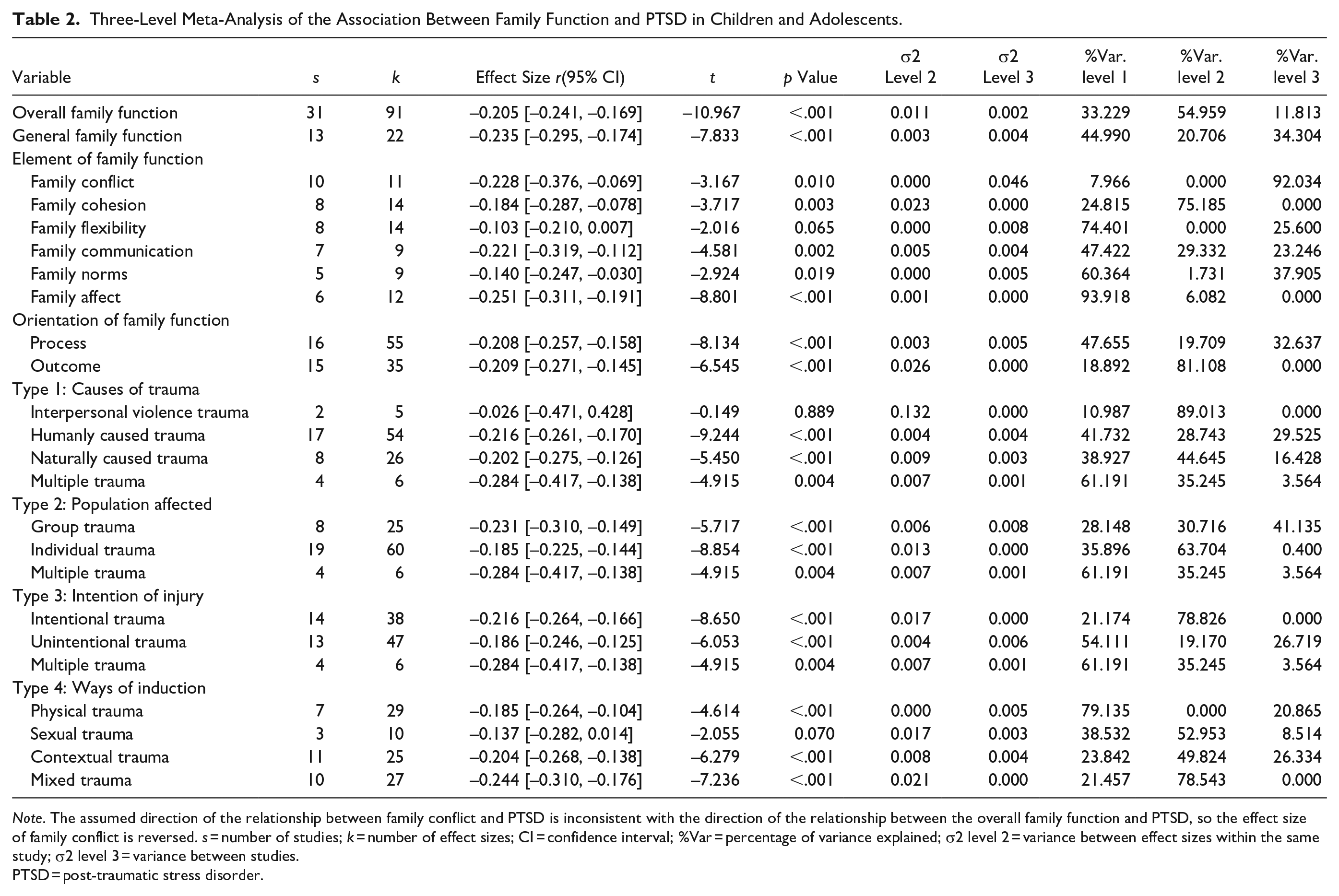
Note. The assumed direction of the relationship between family conflict and PTSD is inconsistent with the direction of the relationship between the overall family function and PTSD, so the effect size of family conflict is reversed. s = number of studies; k = number of effect sizes; CI = confidence interval; %Var = percentage of variance explained; σ2 level 2 = variance between effect sizes within the same study; σ2 level 3 = variance between studies.
PTSD = post-traumatic stress disorder.
To evaluate the correlation between family function and PTSD in different conditions (i.e., general family function, family function elements, orientations of family function, and trauma types), separate meta-analyses were performed. Results revealed that general family function was significantly negatively correlated with PTSD (r = −0.205, p < 0.001). For the elements of family function, correlations ranged from large to small: family affect, family communication, family cohesion, and family norms were all significantly negatively correlated with PTSD (rs = −0.251 to −0.140, ps ≤ 0.019). The relation between family conflict and PTSD was significantly positively correlated (r = 0.228, p = 0.010); however, the association between family flexibility and PTSD was not significant (r = −0.103, p = 0.065). For the different orientations of family function, process-oriented and outcome-oriented family functions were both significantly negatively correlated with PTSD (rs = −0.208 to −0.209, ps < 0.001). Regarding different trauma types, the correlation coefficients between family function and PTSD ranged from −0.026 (interpersonal violence trauma) to −0.284 (multiple trauma), and the significance of the correlation coefficients ranged from non-significant (interpersonal violence trauma) to significant (e.g., humanly caused trauma, and group trauma).
For the publication bias tests for the above-mentioned relations described above, we conducted a three-level meta-regression of effect sizes on SEs (weighted by the inverse of the variance of the effect sizes). Results suggested that the SE significantly moderated the relation between the two variables, indicating the presence of publication bias (SE = 0.920, t = 2.935, p = 0.004). In addition, regardless of the effect sizes from within studies, there was publication bias for the relation between overall family function and PTSD (Egger’s regression intercept = −0.298, 95% CI = [−0.366, −0.231], p = 0.003; see Supplemental Appendix I).
Because of significant publication bias, we used Duval and Tweedie’s (2000) trim-and-fill method to adjust the results. The adjusted overall effect size was relatively unaffected (z = −0.244, 95% CI = [−0.279, −0.209], p < 0.0001; see Supplemental Appendix J), which indicated that publication bias had little effect on the results and that the results of the meta-analysis were accurate and reliable.
Moderator Analyses
The heterogeneity of the relation between overall family function and PTSD was significant. Thus, we conducted subsequent analyses of the moderator effects to identify the factors that caused the variation. In all, 17 moderation models were constructed to test whether moderators significantly impacted the relation between overall family function and PTSD. Different types of moderators require different analysis methods. For categorical variables (i.e., elements of family function, orientation of family function, trauma types, trauma experiencer, PTSD reporter, family function reporter, PTSD scale, family function scale, publication status, and study design), we used subgroup analyses. For continuous variables (i.e., publication year, age, proportion of female participants, and duration of traumatic events), we used univariate meta-regression analyses. The results of the moderating effect tests are shown in Table 3. Results revealed that most variables non-significantly moderated the relation between overall family function and PTSD.
Three-Level Meta-Analysis of the Moderator Analysis Between Family Function and PTSD in Children and Adolescents.
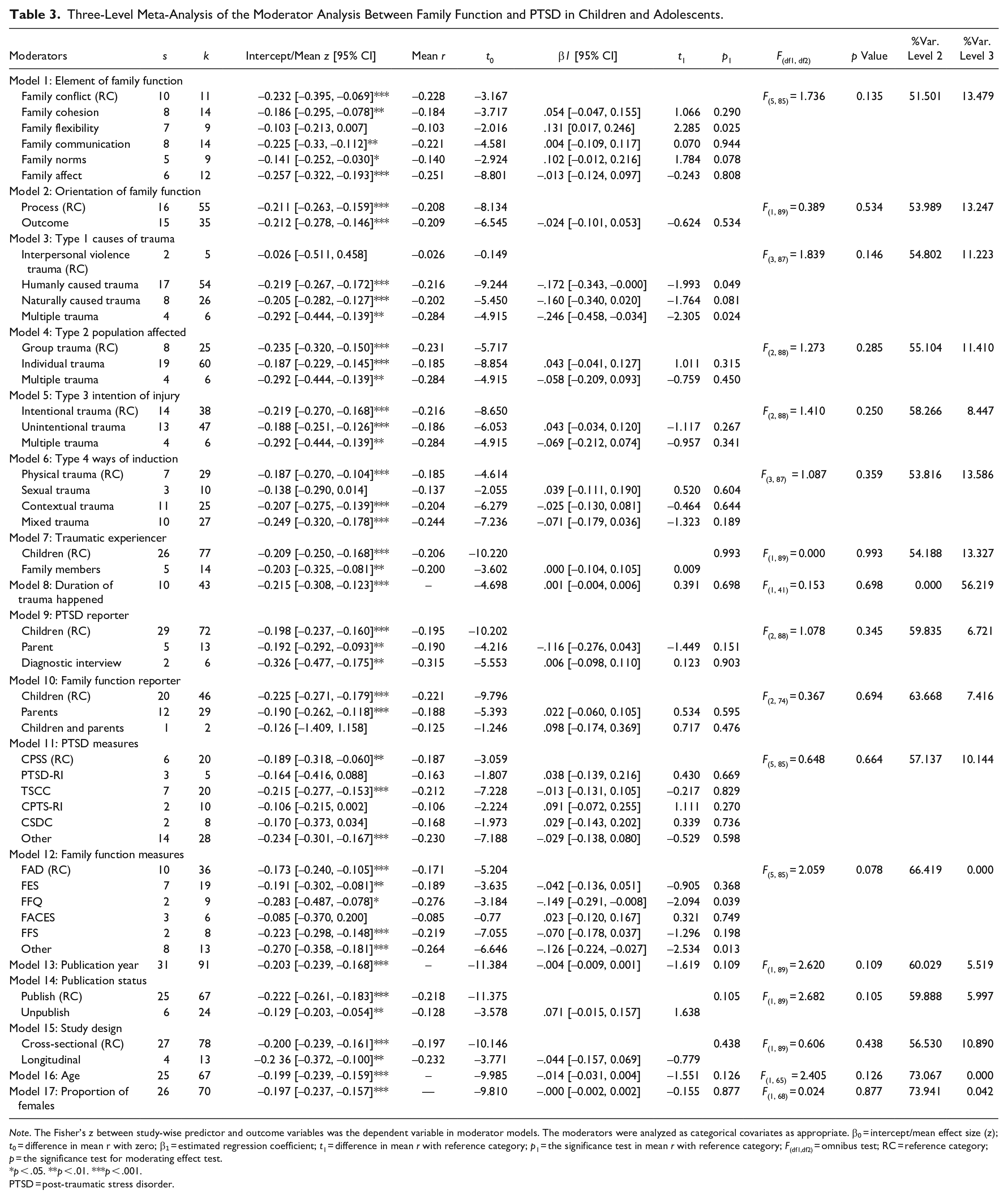
Note. The Fisher’s z between study-wise predictor and outcome variables was the dependent variable in moderator models. The moderators were analyzed as categorical covariates as appropriate. β₀ = intercept/mean effect size (z); t₀ = difference in mean r with zero; β₁ = estimated regression coefficient; t1 = difference in mean r with reference category; p1 = the significance test in mean r with reference category; F(df1,df2) = omnibus test; RC = reference category; p = the significance test for moderating effect test.
p < .05. **p < .01. ***p < .001.
PTSD = post-traumatic stress disorder.
It should be noted that the subgroup analysis revealed that significant differences between individual categories. For example, for the elements of family function, compared with the correlation between family conflict and PTSD (r = 0.228), the correlation between family flexibility and PTSD was weaker (r = −0.103, β = 0.131, p = 0.025). Among the different trauma types, the correlation between interpersonal violence trauma and PTSD was significantly weaker (r = −0.026) than that for humanly caused trauma (r = −0.216, β = −0.172, p = 0.049) and multiple trauma (r = −0.284, β = −0.246, p = 0.024). Among the different family function scales, FAD (r = −0.171) exhibited a greater change in slope relative to FFQ (r = −0.276; β = −0.149, p = 0.039) and other family function scales (r = −0.264; β = −0.126, p = 0.013). It is worth noting that the associations between process orientation (r = −0.208) and outcome orientation (r = −0.209) of family function and PTSD were not significantly different (β = −0.024, p = 0.534), and that the diagnostic interview of PTSD had a particularly strong effect size (r = −0.315).
Discussion
To the best of our knowledge, this is the first study to carry out a meta-analysis of the relation between family function and PTSD in children and adolescents. The results indicated that the relations between overall family function and general family function separately had moderate negative correlations with PTSD. Moreover, certain elements of family function (e.g., family affect, conflict, and communication) were correlated with the severity of children’s PTSD symptoms; thus, these should be considered when developing PTSD interventions for children and adolescents. A further novel finding was that the degree and direction of associations between elements of family function and PTSD are diverse and unique. Specifically, family affect, family communication, family cohesion, and family norms, as positive elements of family function, were negatively correlated with PTSD. Family conflict, a negative element of family function, was positively associated with PTSD, whereas family flexibility was not significantly related to PTSD.
Regarding the positive elements of family function, consistent with previous studies, the current results support the perspective that positive family affect (McCarthy & Thompson, 2010), family communication (Bal et al., 2004), family cohesion (Deane et al., 2018; Rowe et al., 2010), and family norms (Sadeh et al., 2020) were negatively associated with PTSD. In this regard, when a family encounters a stressful event, negative family affect is directly induced as a short-term unstable factor, such as irritable distress or worry (Gallo et al., 2019; McCarthy & Thompson, 2010), and has a temporarily strong relation with PTSD. Family cohesion allows children to feel a sense of support and connection with family members (Gorman-Smith et al., 2004) and buffers the separation and cognitive shock caused by trauma (Kaur & Kearney, 2013). In addition, open communication among family members can help when traumatic experiences are encountered by increasing the understanding of the meaning of the traumatic events (McCarty & McMahon, 2003). However, problematic family communication has a greater impact on PTSD due to the increase in avoidance and arousal and the inhibition of the potential protective effects of open communication (Acuña & Kataoka, 2017). In addition, family norms of rigidness and closure may limit disclosure, hinder trauma processing, and promote PTSD-related distress, which can worsen the severity of PTSD (Belsher et al., 2012; Whealin et al., 2015). In contrast, a stable family structure and ample family resources as family norms are correlated with a lower prevalence of PTSD, possibly because of lower sensitivity and alertness to danger among children living in environments of higher socioeconomic status (Sadeh et al., 2020).
As a negative long-term family function element, family conflict was positively associated with PTSD in children and adolescents, which is consistent with previous studies (Bal et al., 2004; Bokszczanin, 2008; Danielson et al., 2017; McCarthy & Thompson, 2010). Families that have experienced traumatic events may experience more arguments and conflict, possibly because of difficulties coping with the stress and impact of the traumatic event. Such circumstances constitute negative social support (Gaipa, 1990), which can weaken children’s family support and hinder children’s recovery from the trauma (Bal et al., 2004; Bokszczanin, 2008; Danielson et al., 2017; McCarthy & Thompson, 2010). In addition, of the long-term and stable elements, the negative element of family function (e.g., family conflict) had a stronger and longer-lasting relation with PTSD than the positive elements of family function (e.g., family cohesion, family communication, family norms). Specifically, family conflict may be associated with different stages of PTSD development and play a vital role in the onset, resolution, continuous exacerbation, or fluctuation of symptoms over time (Layne et al., 2018). Following the occurrence of a crisis or trauma, family conflict may be considered a long-term risk factor for the development of PTSD symptoms in children.
In the current study, compared with family conflict, family flexibility had a smaller relation with PTSD, which was non-significant and the most distant among the long-term elements. This finding is consistent with most previous studies and may be attributed to the differences in functional directions at various time points following trauma (Berkman, 2005; Kiliç et al., 2003). For example, overprotection, a component of family flexibility, has been reported to harm children’s emotional state 26 months after trauma (McFarlane, 1987), although it is also considered to function as a protective and supportive factor 1 month after trauma (Gallo et al., 2019). Thus, the lack of significant effects of family flexibility may still have important effects on other aspects of family members or may function differently at various times following a traumatic event.
Regarding the different orientations of family function theories (Beavers & Hampson, 2000; Epstein et al., 1978; Olson, 2000b; Skinner et al., 2000), the current results revealed that both process- and outcome-oriented family functions were significantly negatively related to PTSD. The findings support both orientations of family function theories and extend the applicability of family function theories to traumatic events. Specifically, according to outcome-oriented theories of family function (Beavers & Hampson, 2000; Olson, 2000a, 2000b), dysfunctional families tend to be either rigid or chaotic and have difficulty in obtaining the necessary resources for adapting to a crisis. This leads to more stress and problems for the long-term development of family members, which subsequently affects children’s PTSD (e.g., Mora et al., 2022). The process-oriented theories of family function (Epstein et al., 1978; Skinner et al., 2000) suggest that if families are no longer able to effectively deal with dangerous events during the process of family operations, chronic dysfunction and various mental disorders (e.g., PTSD) may emerge in children and adolescents (e.g., Al-Krenawi & Graham, 2012). Our results demonstrated that the correlations between PTSD and the two orientations of family function were consistent; thus, both orientations effectively explained family function.
For traumatic events with humanly or natural causes, whether individual or group, or intentional or unintentional, family function has a continuous impact on PTSD; such events include diseases (Nelson et al., 2019), abuse (Bal et al., 2004), and accidents (Lee et al., 2018). However, for children who have experienced interpersonal violence trauma or sexual abuse, PTSD may not be affected by family function. This phenomenon may be caused by the personal impact of these traumatic events on children being greater and more profound than the relatively weak protective effects of family function. For type 1 traumatic events (causes of trauma), trauma caused by humans and multiple traumatic experiences were more strongly related than interpersonal violence trauma to PTSD. In addition, our results revealed that, compared with a single traumatic event, family function was more strongly correlated with PTSD after experiencing multiple traumatic events, which reflected the cumulative effects of trauma, confirming previous findings (e.g., Green et al., 2000). This may be because, compared with experiencing a single traumatic event, after experiencing multiple traumatic events, children have more PTSD symptoms (Green et al., 2000), show greater alertness and sensitivity, and become more susceptible to changes in family function.
In addition to testing the theoretical orientations and elements of family function and trauma types as moderators, we also evaluated the moderating effects of measurements of PTSD and family function and investigated the characteristics of these relations. We found that most factors played a non-significant moderating role in the relation between overall family function and PTSD, which indicated that the relation is relatively stable under most conditions.
The moderating effect of duration since a traumatic event was not significant, indicating that family function has a lasting relation with PTSD and plays an important role in all stages of the development of PTSD. Our findings suggested that the individual who experienced the traumatic event (i.e., children or family members) did not impact the relation between the two. Thus, family function is associated with PTSD, regardless of which family member experiences the traumatic event. PTSD in children may originate from themselves or under the influence of family members. For example, parents who experience excessive pressure and carry significant burdens when coping with and recovering from traumatic events may exhibit negative emotions and behaviors, which may present difficulties in providing their children with necessary help, warmth, and attention (Bokszczanin, 2008). In turn, this may lead to PTSD in children and adolescents (e.g., Lambert et al., 2014). Notably, the diagnostic interview of PTSD had a particularly strong effect size, although this was based on only two studies. Taken together, our findings suggest that family function is strongly associated with PTSD.
The individual who reported PTSD and overall family function (via self-report or reported by parents) had no impact on the relation between PTSD and family function. Parents can typically understand their children’s feelings relative accurately; thus, parents’ reports of their children’s symptoms are generally consistent with children’s perceptions. For example, when children exhibit mental health problems, what they report is the same as what their parents report (e.g., Lambert et al., 2014). The moderating effects of different scales of PTSD were not significant, indicating that there was no difference in the effects measured between the different PTSD scales. This suggested that the scales have adequate reliability and validity and can serve as suitable research measurement tools. For the family function scales, we found that the correlation between family function and PTSD was stronger using the FFQ (McFarlane, 1987) than with the FAD (Epstein et al., 1983). However, the family adaptation and cohesion evaluation scale (Olson, 2000a, 2000b), which is commonly used to measure the relation between two variables, did not yield a significant effect. This finding suggests that a standardized and unified measurement tool that integrates the core points of different family function scales is needed to enable comparisons, references, and generalizations between relevant studies.
In addition, our findings revealed that, regardless of the age and gender of children, the design of the study (i.e., cross-sectional or longitudinal), the publication status, and the year of publication, the intermediate correlation between family function and PTSD was relatively stable. This illustrates the consistency of the relation between family function and PTSD, which was also unaffected by publication bias.
Limitations and Implications
Several limitations of this study should be noted. First, because only four longitudinal studies (12.90%) were included, we were unable to make any casual inferences. Future studies should use longitudinal or experimental designs to examine the bidirectional relations between family function and PTSD in children and adolescents. Second, although our moderation analysis took into consideration clinical characteristics, trauma types, reporters, and scales, it would be valuable for future studies to explore other moderators, such as clinical samples, parents’ PTSD, and different PTSD symptom clusters. Third, mediation analysis was not performed in the current study due to the small number of articles and because the underlying mechanisms between family function and PTSD were unclear. This issue requires further exploration in the future. Fourth, several subgroups (e.g., interpersonal violence trauma, k = 5; family norms, k = 9) had relatively low effect sizes; thus, these results should be interpreted with caution.
Despite these limitations, the current study has important theoretical, clinical, and practical implications. Regarding theoretical contributions, our results demonstrated that the two different orientations of family function theories similarly explain the relieving effects of family function on PTSD. Furthermore, the current study is the first to comprehensively investigate family function as a protective factor for children with PTSD. We also revealed that family affect, communication, cohesion, and norms were positively associated with PTSD, whereas family conflict exhibited a significant negative association, and family flexibility had no association with PTSD. Our findings suggest that future research should focus on specific elements of family function that have important relations with PTSD. In addition, moderating effects were not found for most conditions (e.g., trauma experiencer or the PTSD reporter), which suggested that family function and PTSD are interrelated negatively without distinction, providing support for the collection of family and trauma data in future studies. We also clarified the boundaries of the effects of family function on PTSD. Furthermore, all of these findings promoted the convergence of the fields of trauma and family research and further expanded the application of family function theories to trauma, which will be valuable for future research and the development of a more integrated perspective for future investigations.
In clinical practice, given that family function is negatively related to PTSD, it may be valuable to develop relevant intervention protocols. However, most previous studies have used more “general” intervention approaches to relieve PTSD, such as trauma-focused cognitive-behavioral therapy (Kowalik et al., 2011). Moreover, few studies have considered family function in interventions. Thus, we suggest that future studies place greater emphasis on family function when developing intervention protocols. Specifically, our findings may encourage psychotherapists to treat children and adolescents with PTSD by promoting the positive role of a well-functioning family, such as by increasing positive affect and open communication within the family, encouraging family cohesion, helping to establish appropriate family rules, and promoting the expression of emotions. In addition, psychotherapists can prevent the exacerbation of PTSD in children by limiting the negative effects of a dysfunctional family, such as by easing family conflicts and reducing problematic communication among family members. For certain types of traumatic events, interventions and treatments for severe mental disorders should consider the cumulative effects of multiple traumatic experiences.
Critical Findings
Overall family function was negatively associated with children’s PTSD.
Family function elements correlated with PTSD in different directions.
The effects of trauma types and family function scales varied in the relation between family function and PTSD.
Intervention protocols based on family function are needed.
Implications for Practice and Research
Future studies should place more emphasis on family function when developing intervention protocols.
Future research should focus on specific elements of family function (e.g., family affect, conflict, and communication) that significantly impact PTSD and develop specific intervention programs for different elements.
More attention should be paid to the negative elements of family function to prevent the exacerbation of PTSD symptoms.
Results further expanded the application of family function theories to trauma and provided evidence to inform future research.
Supplemental Material
sj-docx-1-tva-10.1177_15248380221126182 – Supplemental material for Family Function and Post-Traumatic Stress Disorder in Children and Adolescents: A Meta-Analysis
Supplemental material, sj-docx-1-tva-10.1177_15248380221126182 for Family Function and Post-Traumatic Stress Disorder in Children and Adolescents: A Meta-Analysis by Yingying Ye, Yifan Li, Shuxian Jin, Jiali Huang, Rong Ma, Xuan Wang and Xiao Zhou in Trauma, Violence, & Abuse
Footnotes
Acknowledgements
We would like to thank the authors who provided additional information and data for the meta-analysis. We also wish to thank associate professor Tengfei Wang, who shared valuable research suggestions with us.
Contributors
Y.Y. and X.Z. conceptualized and designed this meta-analysis. Y.Y. and J.H. conducted the literature search and screening. Y.Y., Y.L., R.M., and X.W. independently coded all studies and assessed the study quality. YYY and SXJ performed the data analysis. Y.Y. and Y.L. completed the first draft of the manuscript with supervision from X.Z. All authors contributed to and approved the final manuscript.
Declaration of Conflicting Interests
The authors declared no potential conflicts of interest with respect to the research, authorship, and/or publication of this article.
Funding
The authors disclosed receipt of the following financial support for the research, authorship, and/or publication of this article: This study was supported by the General Project for National Social Science Fund of China (Grant No. 20BSH167).

Supplemental Material
Supplemental material for this article is available online.
Author Biographies
References
Supplementary Material
Please find the following supplemental material available below.
For Open Access articles published under a Creative Commons License, all supplemental material carries the same license as the article it is associated with.
For non-Open Access articles published, all supplemental material carries a non-exclusive license, and permission requests for re-use of supplemental material or any part of supplemental material shall be sent directly to the copyright owner as specified in the copyright notice associated with the article.
