



Abstract
Violence against children (VAC) in the home, or by household members, is a human rights and social problem with long-lasting consequences for individuals and society. Global policy instruments like the INSPIRE package have proposed strategies to prevent VAC, including Implementation and enforcement of laws, Norms and values, Safe environments, Parent and caregiver support, Income and economic strengthening, Response and support services, and Education and life skills. This systematic review of reviews aimed to synthesize the recent evidence base (i.e., published since 2000) for each INSPIRE strategy to reduce VAC in the home or by household members. We searched four databases using controlled vocabularies and keywords and searched for additional records in prior reviews of reviews. A total of 67 studies were included in this review, including literature reviews, meta-analyses, systematic reviews, and other types of reviews. We found extensive evidence supporting the effectiveness of parent and caregiver support interventions. However, reviews on other INSPIRE strategies were scarce. We also found a vast underrepresentation of samples from low- and- middle-income countries, children with disabilities, and families affected by forced displacement and conflict. In sum, this systematic review suggests that there are several promising strategies to prevent VAC (e.g., home visiting and parent education), but further research is necessary to strengthen the current body of evidence and effectively inform the implementation and scale-up of evidence-based interventions to protect children from violence globally.
Keywords
Violence against children (VAC)—the intentional use of physical force or power, threatened or actual, against people under 18 years old that results in, or has a likelihood of resulting in, harm, death, psychological injury, or deprivation (World Health Organization [WHO], 2016)—is widespread. Evidence also suggests VAC has been exacerbated amid the COVID-19 pandemic (Bhatia et al., 2021), and it may further increase as the climate crisis intensifies (Cuartas et al., 2023). VAC occurs in multiple contexts, but children typically experience violence first, and most often, in their homes (UNICEF, 2017). This violence is frequently inflicted by child’s parents or main caregivers and includes physical punishment, psychological aggression, and neglect, among other forms (UNICEF, 2017). All forms of VAC can interfere with children’s neural and skill development and compromise lifelong learning, health, and wellbeing (Shonkoff & Garner, 2011). Therefore, VAC has costly consequences for individuals and societies and hampers progress on global policy objectives like the Sustainable Development Goals, specifically target 16.2: “end abuse, exploitation, trafficking and all forms of violence against and torture of children” (United Nations Development Programme, 2015).
The etiology of VAC in the home is complex, but there is general agreement that it is a multifaceted issue with drivers in societal, communal, familial, and individual levels (van IJzendoorn et al., 2020; WHO, 2016). Reflecting this knowledge, global tools like the INSPIRE framework (WHO, 2016) advocate for ecological and multidimensional strategies to tackle the widespread roots of VAC, including the Implementation and enforcement of laws (I), change in harmful Norms and values (N), promotion of Safe environments (S), the provision of Parent and caregiver support (P), Income and economic strengthening (I), the improvement of Response and support services (R), and the promotion of Education and life skills (E). Several countries have implemented INSPIRE strategies to prevent VAC in the home, but few have established monitoring and evaluation systems, making it difficult to identify effective interventions to inform policy decisions (WHO, 2020).
In the last few years, several systematic reviews and meta-analyses on interventions to prevent VAC have been published, most focusing on parenting interventions in high-income countries and with substantially fewer focusing on the full range of INSPIRE approaches in low- and middle-income countries (LMICs, as categorized by the World Bank Country and Lending Groups; e.g., Knerr et al., 2013; McCoy et al., 2020; World Bank, 2022). Indeed, a recent evidence gap map on VAC interventions in LMICs highlighted a scarcity of evidence in various INSPIRE domains (Pundir et al., 2020), such as the implementation and enforcement of laws and promotion of safe environments. However, in line with the goals of an evidence gap map, this review did not aim to assess or synthesize the effectiveness of the interventions. As such, a new review of reviews is needed to assess existing evidence and inform policy, practice, and research moving forward. This is particularly important considering that past reviews of reviews (e.g., Mikton & Butchart, 2009) may be outdated, have included very few interventions conducted in LMICs, and have raised concerns about the methodological quality of studies.
This study reports findings from a systematic review of reviews that had three aims: (a) To summarize evidence from reviews on the effectiveness and characteristics of both universal and selective interventions across all INSPIRE categories to prevent VAC in the home or by household members; (b) To evaluate key aspects of the methodological quality of the reviews; and (c) To identify and report the geographic distribution and basic characteristics of the primary studies included in the reviews. Collectively, these objectives aimed to provide evidence to identify gaps in literature and inform policy, practice, and future research.
Methods
This review of reviews was conducted following a peer-reviewed protocol (Cuartas, McCoy, et al., 2022) based on the Preferred Reporting Items for Systematic Reviews and Meta-Analysis for Protocols (PRISMA-P), which was registered in the International Prospective Register of Systematic Reviews (PROSPERO; registration number CRD42022304784).
Inclusion and Exclusion Criteria
This study focused on reviews of reviews, systematic reviews, meta-analyses, and other reviews (including rapid, scoping, comprehensive, and literature reviews; Grant & Booth, 2009) of universal (i.e., aimed at the general population) and selective interventions (i.e., aimed at populations at higher risk) to prevent VAC or address drivers of VAC in the home or by household members that were published in peer-reviewed journals and the gray literature between 2000 and June 2022, when we concluded the searches. We included reviews that considered at least some experimental and non-randomized quantitative studies that used pre–post comparisons or a comparison group (e.g., treatment and control group) and aimed to prevent any form of violence (e.g., physical, sexual, psychological, neglect) directed at a child in the home or by household members. The main outcomes considered in the review were (a) VAC in the home and (b) the proximal/direct drivers or risk factors for VAC, including caregivers’ knowledge about parenting, attitudes toward VAC, parenting stress and mental health, and parenting self-efficacy, among others. This study had no language or geographical restrictions.
We excluded previous reviews that focused solely on indicated interventions (i.e., aimed at responding to actual exposure to VAC) or on interventions targeting VAC in settings other than the home or by adults other than the main caregivers (e.g., violence by teachers, bullying from peers, etc.). We also excluded interventions targeting indirect forms of VAC, such as intimate partner violence (IPV) (although we fully recognize IPV as a major threat for children’s rights and development). In addition, we excluded reviews that included multiple adverse childhood experiences unless they specifically noted a focus on VAC. Finally, we excluded reviews of qualitative studies to focus exclusively on reviews of quantitative studies assessing the potential effectiveness of interventions and those published before 2000 to include most recent evidence, which may be more generalizable or relevant to modern conditions.
Search Strategy
We searched studies published in PubMed, Embase (Elsevier), PsycInfo (EBSCO), and ERIC (EBSCO) using controlled vocabularies and key words in titles and abstracts in English. We used specialized terms and key words related to violence (e.g., abuse*, maltreatment, neglect), children (e.g., child, infant*, kid*), and prevention (e.g., program, strategy, interven*) (see Supplemental Appendix A and Cuartas, McCoy, et al., 2022 for more details). We filtered the results to keep review studies published after 2000, following the search filter presented by Salvador-Oliván et al. (2021). We searched for additional records in three selected reviews of reviews that were especially relevant to the current topic (i.e., Arango et al., 2014; Mikton & Butchart, 2009; van IJzendoorn et al., 2020). We conducted the searches between April and June 2022.
Screening and Full-Text Review
We exported 3,728 records from the databases and 49 additional studies from hand-searched reviews of reviews mentioned above to Covidence (https://www.covidence.org/), which was used to conduct the screening, full-text review, and data extraction process to ensure transparency and reproducibility (Figure 1 presents the flow diagram of the search process). A total of 804 duplicated records were excluded. In order to reduce bias in the study selection process, the first two authors (J.C. and A.S.) independently screened titles and abstracts for the remaining 2,973 records, considering the inclusion criteria. The same two authors then independently assessed the full text of the 134 articles that passed the title and abstract screening. In both the title/abstract and full-text reviews, discrepancies between reviewers were resolved by consensus. A total of 67 studies met the inclusion criteria and were included in this review of reviews.
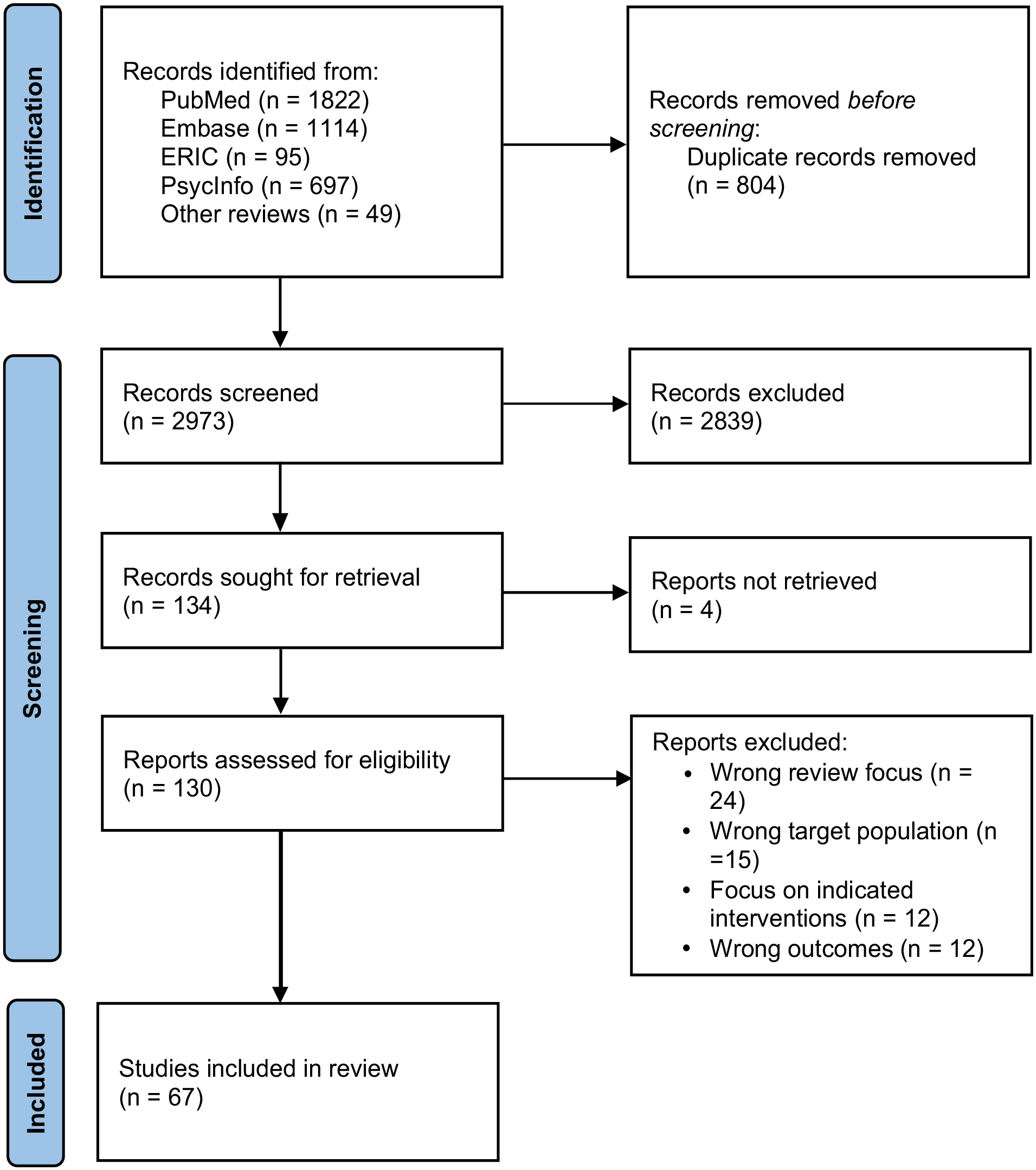
PRISMA flow diagram of the literature search process.
Data Extraction and Quality Assessment
The first two authors (J.C. and A.S.) independently extracted data for the 67 included studies in Covidence, using a pre-piloted extraction template, and resolved disagreements through discussion, and S.B. and M.L. subsequently extracted additional information from individual studies when required. Data included the number of studies included, types of interventions considered, main outcomes, and main results. In addition, J.C. and A.S. independently rated key aspects of the methodological quality of each study using A MeaSurement Tool to Assess systematic Reviews (AMSTAR) 2 critical appraisal tool of reviews (Shea et al., 2017). AMSTAR 2 comprises 10 domains and 16 items regarding protocol registration, adequacy of the literature search, justification for study exclusion, and assessment of publication bias, among other characteristics. We decided to use the AMSTAR 2 given that our study includes reviews of both randomized and non-randomized studies. In addition to extracting data for the reviews themselves, two trained research assistants extracted basic characteristics of the primary studies included in the reviews, including the country where the study was conducted, sample characteristics, and methodological approach.
Data Synthesis
We conducted a narrative review of the evidence, including a synthesis to organize the findings regarding the INSPIRE category, the effects of the interventions on specified outcomes, and an assessment of the robustness and quality of the evidence. We also conducted a quantitative assessment of the distribution of the primary studies’ country, sample characteristics (e.g., urbanicity, caregiver who was targeted), and methodological approach. We used the narrative synthesis to critically assess the key findings from the literature, identify the limitations highlighted in the reviews, and identify key implications for policy, practice, and research.
Results
Study Characteristics
A total of 67 reviews met the inclusion criteria outlined in the protocol and were therefore included in this review of reviews. The reviews were published between 2000 and 2022, including primary studies published between 1968 and 2019. More than one-quarter of the reviews (19, 28%) were published in the last 5 years (after 2017). A total of 7 (10%) of the studies were other reviews of reviews (e.g., scoping, comprehensive), 19 were meta-analyses (28%), 31 (46%) were systematic reviews, 7 (10%) were comprehensive reviews, and 3 (4%) were scoping reviews. A total of 20 studies reported average effect sizes quantitatively, including the 19 meta-analyses and 1 review of reviews (van IJzendoorn et al., 2020). Eight (or 12% of) studies reported or discussed some information about the actual content or curricula of the included primary studies (Bacchus et al., 2017; MacIntyre & Carr, 2000; McCoy et al., 2020; Poole et al., 2014; Segal et al., 2012), including three meta-analyses that assessed the potential effectiveness of specific program contents (Gubbels et al., 2019, 2021; van der Put et al., 2018). Finally, seven reviews reviewed information about costs from the interventions reported in the primary studies (Bilukha et al., 2005; Dalziel & Segal, 2012; Elkan et al., 2000; D. Olds et al., 2000; D. L. Olds et al., 2007; Peterson & Kearns, 2021; Sampaio et al., 2024).
Quality appraisal revealed three key issues in published reviews (see Supplemental Table S1). First, most included reviews (58 or 86.6%) did not have explicit mention of review methods being established beforehand via a registered protocol or similar mechanism (AMSTAR 2 item 2). Second, more than half of the studies did not report screening/selecting studies (49 or 73.1%) and/or extracting data (42 or 62.7%) in duplicate (AMSTAR 2 items 5 and 6). Finally, most of the included studies did not have an appropriate risk of bias assessment and/or did not account for risk of bias (43 or 64.2%) when interpreting study results (AMSTAR 2 items 9, 10, and 14). The lack of pre-registered protocols, duplicate study selection and data extraction, and risk assessment raise some concerns about the replicability and validity of findings from prior reviews.
Outcomes
The most reported VAC outcomes were physical punishment (reported in 60 or 89.6% of reviews), harsh parenting (reported in 59 or 88.1% of reviews), and psychological aggression (reported in 56 or 83.6% of reviews). For the outcomes reflecting risk factors for VAC, the most reported were parent-child relationship (reported in 35 or 52.2% of reviews) and caregiver attitudes and beliefs (reported in 33 or 49.3% of reviews). Conversely, the least commonly reported VAC outcome was sexual VAC (reported in 7 or 10.4% of reviews). Most reviews reported on multiple outcomes, often considering both VAC and risk factors (or drivers) of VAC.
Interventions
In this section we report a narrative review of the studies included in the review of reviews by INSPIRE category. Table 1 summarizes the critical findings from the review of reviews and Supplemental Tables S2 to S7 present a summary of findings for each study, by INSPIRE domain.
Critical Findings.

Note. See Supplemental Tables S2 to S7 for a narrative summary of findings from the included studies, by INSPIRE domain. VAC = violence against children.
Implementation and Enforcement of Law
Three out of 67 (i.e., 4.5% of) reviews included studies on the effects of the implementation and enforcement of laws to prevent VAC (Supplemental Table S2). Findings were limited and mixed for legislative changes in reducing VAC and its risk factors. One review that included exclusively observational studies focused on changes in support and use of corporal punishment after banning corporal punishment (Zolotor & Puzia, 2010). The majority of studies included in this review demonstrated that general support of and the practice of corporal punishment declined after the enactment of anti-corporal punishment legislation. Yet, these studies did little to control for potential confounders, therefore raising concerns about causality (i.e., internal validity). The other reviews had a wider intervention focus but included studies focusing on the effects of laws to reduce VAC. These reviews found a scarcity of studies examining the effectiveness of law enforcement on reducing VAC (Krugman et al., 2007). No review in this category reported a quantitative synthesis; therefore, little is known about the magnitude of the potential effects of legislation on reducing VAC or risk factors for violence.
Norms and Values
Seven out of 67 (10.4% of) reviews included studies that assessed the effects of interventions focusing on changing norms and values (Supplemental Table S3). Media campaigns are a common approach to target community-wide social norms (Gershoff et al., 2017); thus, we describe here particularly the effectiveness of campaigns on reducing VAC in the home. Of the six reviews reporting on the effectiveness of media campaigns, three found overall positive effects on reduction of VAC (e.g., Barlow, Simkiss, et al., 2006), and three found mixed results (e.g., Yount et al., 2017); similarly, three reviews found desirable outcomes related to risk factor reduction (e.g., Coore Desai et al., 2017) and three reviews found mixed results (e.g., Poole et al., 2014). While most reviews did not solely focus on norm change interventions, one review included only universal campaigns targeting child physical abuse prevention (Poole et al., 2014). The review authors found overarching reductions in abusive head injuries and child maltreatment, coercive parenting, and parental anger (two out of four primary studies found significant decreases). Multiple reviews included various norm change interventions that have significant evidence of effectiveness, such as Strong Communities (in Admon Livny & Katz, 2018) and SASA! and REAL Fathers (in Bacchus et al., 2017). Regarding the content of norm change interventions, Daro and McCurdy’s (2007) review found an improved societal understanding of the different types of child maltreatment associated with public-awareness campaigns, but mixed results on the effects of educational campaigns that aimed to influence societal beliefs about parenting. A WHO (2010) review noted that the few existing evaluations of media-based interventions indicate that they can play a role in preventing VAC. No review in this category reported a quantitative synthesis.
Safe Environments
We could not identify any reviews that included evaluation studies focusing on the effects of creating safe environments (e.g., addressing neighborhood “hotspots”) to prevent physical, emotional, or sexual violence at home. While an evidence gap map (Pundir et al., 2020) identified 11 studies focused on creating safe environments, it is likely that these interventions focused on other outcomes. For example, Yount et al. (2017)’s review identified two studies that examined the impact of creating safe community spaces on the prevention of child marriage, an outcome that did not fit our inclusion criteria. Consequently, it remains unknown whether interventions that create safe spaces can prevent physical, emotional, and sexual violence experienced at home. Other INSPIRE interventions seek to create safe environments outside of the home, such as the Good Schools Toolkit for fostering safe schools, which is outside the scope of this review. One may argue that enrollment in kindergartens, pre-schools, or primary schools provide children with a safe space (WHO, 2016), yet these services are not typically evaluated for their potential to prevent VAC in the home.
Parent and Caregiver Support
Nearly all (64/67 or 94.0% of) reviews focused on interventions targeted to parents and caregivers for reducing or preventing violence in the home (Supplemental Table S4), including home (e.g., the Nurse Family Partnership model; D. L. Olds et al., 2007) and group-based parenting programs, making this most popular intervention type covered in existing reviews. Several reviews reported positive effects of specific types of interventions on VAC. Specifically, 28 reviews reported on home visiting interventions, of which 17 found positive impacts on reducing VAC (e.g., Dalziel & Segal, 2012; Selph et al., 2013), 7 found mixed results (e.g., Segal et al., 2012), and 4 found these interventions to be ineffective in preventing or reducing VAC (e.g., Casillas et al., 2016). A total of 17 reviews reported the effects of parent education/parent training programs besides home visiting, with 15 concluding that these interventions led to reductions in VAC (e.g., McCoy et al., 2020; Pontes et al., 2019) and 2 finding mixed effects (Bull et al., 2004; Flynn et al., 2015). Further, 22 reviews reported effects of multiple parent-focused prevention interventions on VAC. Of these, 15 reviews reported reductions in VAC (e.g., Peterson & Kearns, 2021; van IJzendoorn et al., 2020) and 7 reported mixed results (e.g., Sampaio et al., 2024; Viswanathan et al., 2018). Reviews in this domain including a quantitative synthesis (e.g., Casillas et al., 2016; Chen & Chan, 2015; Clark, 2001; Gubbels et al., 2019; Leijten et al., 2018) reported average effect sizes ranging from d = 0.11 to 0.61 for VAC.
Similarly, results related to risk factors or drivers for VAC were also reported for preventative interventions targeted to parents. A total of 20 reviews reported results for interventions in general, with 14 finding these to be related to reductions in risk factors for VAC (e.g., St-Germain et al., 2016) and 6 finding mixed results (Mikton et al., 2014; Moreland & McRae-Clark, 2018). Home visiting interventions were associated with decreases in risk factors for VAC in 15 reviews (e.g., Levey et al., 2017; Lines et al., 2018) and were found to have mixed results in five reviews (e.g., Krugman et al., 2007; Segal et al., 2012). Parenting programs were linked to reduced risk factors in 11 reviews (e.g., Admon Livny & Katz, 2018; Pontes et al., 2019), while only one found mixed results (McCoy et al., 2020). Quantitative syntheses reported average effect sizes ranging from d = 0.03 to 0.52 for risk factors for VAC.
Income and Economic Strengthening
Three out of 67 reviews (or 4.5%) focused on income and economic strengthening interventions (Supplemental Table S5). One review focused solely on the effects of economic support programs for families on VAC (Maguire-Jack et al., 2021). The authors identified three interventions in the United States that effectively prevented child maltreatment, including direct cash assistance (Temporary Assistance for Needy Families), subsidized childcare services (Child Care Subsidy), and tax-system-based income support (Earned Income Tax Credit). However, there were unclear effects in the United States from food benefits (Supplemental Nutrition Assistance Program) on child maltreatment. Klevens and Whitaker (2007) identified two conflicting studies examining the impact of mandating work in cash support on child maltreatment, with one finding slight increases in neglect as a result of mandating work in cash support and another showing large decreases in neglect but small increases in abuse. Finally, the review by Geeraert et al. (2004) included a few interventions for parental unemployment, but the primary studies could not be identified due to insufficient documentation. No review conducted a quantitative synthesis of income and economic strengthening-related interventions, so there is need for further research to understand the magnitude of effects.
Response and Support Services
Twelve of the 67 reviews (or 17.9%) included response and support service interventions (Supplemental Table S6). These include home visiting, which can be categorized both as a parent support intervention and as a response and support service (WHO, 2016), family preservation and reunification services, psychotherapy, screening for child abuse, substance abuse services, crisis interventions, and a range of services for families such as Sure Start or the Chicago Parent Center. Four out of six reviews suggested that home visiting programs effectively reduced VAC (Chaffin & Schidt, 2006; MacMillan, 2000; Peterson & Kearns, 2021; van der Put et al., 2018), whereas two reviews found no or uncertain evidence on their effectiveness (Barlow et al., 2006; Viswanathan et al., 2018). Two reviews included family preservation and reunification services and found inconclusive and limited evidence for their effectiveness (Barlow, Simkiss, et al., 2006; Chaffin & Schmidt, 2006). Five reviews found positive effects for various forms of psychotherapy on reducing VAC (Barlow, Simkiss, et al., 2006; Lalor & McElvaney, 2010; Peterson & Kearns, 2020; van der Put et al., 2018; WHO, 2010). One review examined the effects of screening tests for child maltreatment to identify those at risk for potential perpetration or victimization, and it found a high false-positive rate; as such, this approach was not recommended by the review authors due to potential harms (MacMillan, 2000). One review examined the effects of services for substance-abusing parents and found strong effects of these types of interventions for reducing child maltreatment, with an average effect size of d = 0.36 (van der Put et al., 2018). The same review examined the effects of crisis intervention services and found no effects, likely due to low statistical power (van der Put et al., 2018).
Lastly, three reviews examined the effects of interventions providing multiple services to families. Admon Livy and Katz (2018) suggested that parent centers providing a multitude of services are effective in reducing child maltreatment and negative parenting behaviors. Flynn et al. (2015) included a study that found significant reductions in child abuse and neglect by applying the Safe Environment for Every Kid (SEEK) model, which supported primary care providers to identify risk factors for VAC. West et al. (2020) included the evaluations of two multicomponent interventions that delivered a range of services to families; one intervention (support for basic needs, psychoeducation, psychotherapy, referral to services) had no impact on time to referral for child protection services, while another intervention (support for basic needs, recovery services, health services, crisis nursery) found favorable effects for infants placed in foster care.
Education and Life Skills
Education and life skills interventions in the INSPIRE framework are typically child-focused (e.g., child assault prevention programs in schools or public settings). However, we identified two reviews, including interventions that aimed to promote teachers’ and healthcare providers’ knowledge of violence prevention, and are thus included in this INSPIRE domain (Supplemental Table S7). Flynn et al. (2015) included one study evaluating the SEEK model, which provides along with other components training to health care providers focused on improving knowledge of child maltreatment. This study found significant reductions in reported child abuse and neglect in families enrolled in the service. MacIntyre and Carr (2000) included various interventions for teachers or parents targeting the prevention of sexual abuse in children. They found that all programs increased teachers’ knowledge about child protection, yet none improved parental knowledge about child protection. Furthermore, actual rates of sexual abuse victimization were not examined.
Six reviews included evaluations of child-focused education and life skills interventions. The evidence on these programs appears to be mixed. While various reviews found children had increased knowledge and protective behaviors as a result of school-based educational interventions (Krugman et al., 2007; Lalor & McElvaney, 2010; Mikton & Butchart, 2009), there was no evidence that programs reduced actual sexual abuse victimization. Yount et al. (2017) identified two school-based educational interventions and found inconsistent impacts on child abuse, whereas another review found favorable evidence for school-level sexual abuse prevention programs in reducing abuse and neglect (Daro & McCurdy, 2007). One review found that two media campaigns targeting children increased disclosure of sexual abuse by children and improved response to reporting by children of sexual abuse (Lalor & McElvaney, 2010). We did not find reviews conducting quantitative syntheses in this domain.
Characteristics of Primary Studies
We identified 645 unique primary studies of interventions in the reviews (the data extracted from the primary studies are available in the Open Science Framework, osf.io/dh3xj). Most of these studies (426; 66%) were conducted with samples from the United States, followed by samples from other high-income countries (in total, 566, or 90.9% of studies used samples from high-income countries), whereas fewer than 10% of studies provided any evidence for at least one LMICs (Figure 2). Within countries, 75% of studies used samples from urban areas, 5% from rural or semirural areas, 11% from both urban and rural, and 9% did not specify. Most interventions reported in the studies targeted mothers (54%), followed by parents in general (36%). Regarding representation of diverse groups, 57% of studies targeted families living in poverty, 50% included racial/ethnic minority groups, 6% focused on children with disabilities, and 2% focused on migrant or refugee populations. Regarding methodological approaches, 52% of studies reviewed were experimental and have the strongest internal validity, whereas 19% reported pre–post analyses, 13% were quasi-experimental, and 5% were other observational studies; the methodological approach for the remaining studies (11%) was not clear. Finally, 49% of studies evaluated the effects of interventions for short periods of time of up to a year, 41% for up to 2 years, and 5% for 5 years or more; for the remaining studies (5%) the information was not presented.
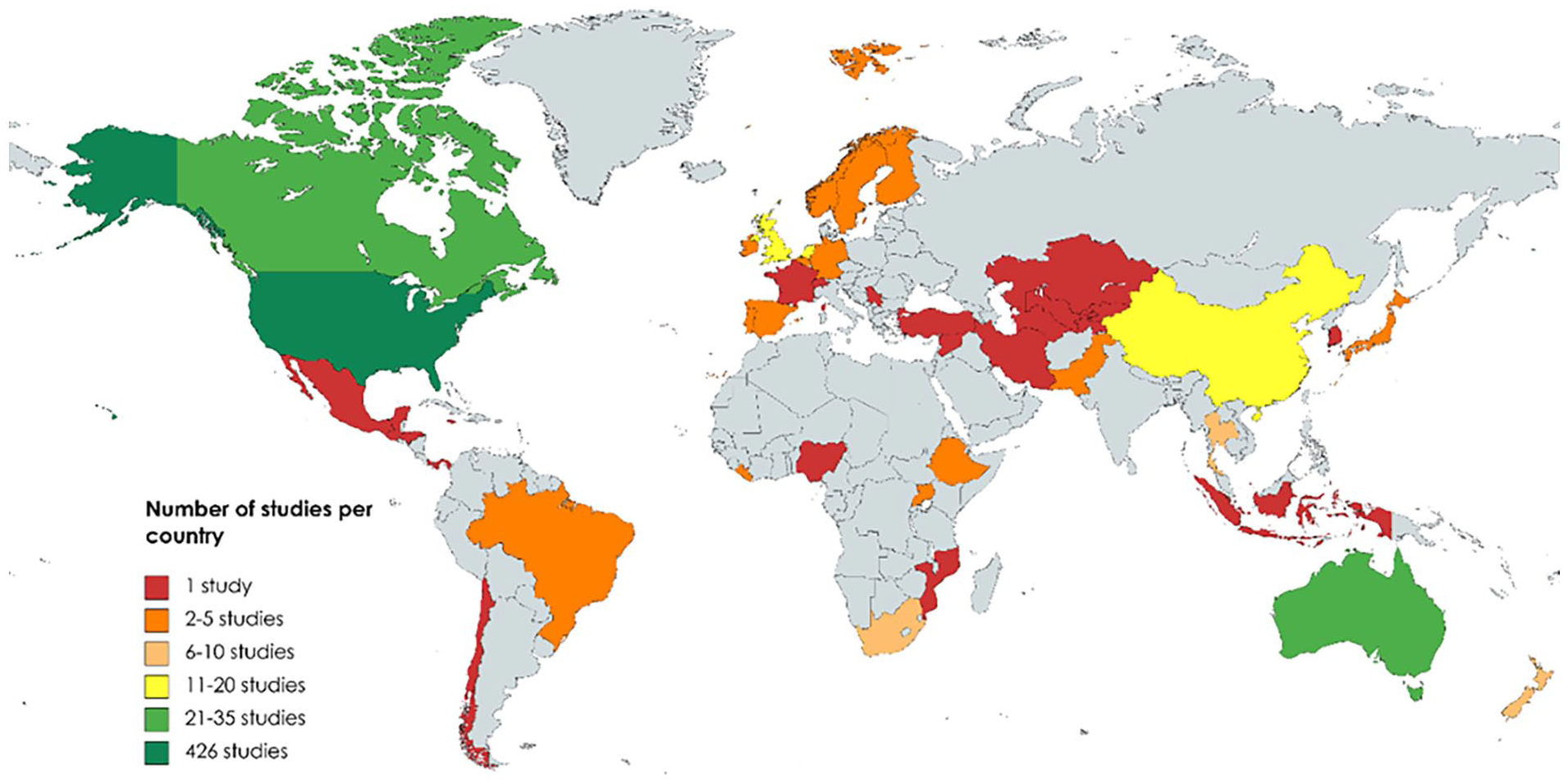
Number of primary studies per country.
Limitations Reported in Prior Reviews
The reviews included in this study identified several limitations in prior research, including (a) a substantial focus on home visiting programs but an underrepresentation of other types of interventions (e.g., media-based), (b) few studies with sufficient methodological quality, as the experimental evidence is mostly focused on parent and caregiver support and less so in other strategies, (c) few studies with long-term follow-up assessments, which limits our understanding on the potential persistence versus fade-out of effects, (d) few studies with measures of VAC (as opposed to only risk factors of VAC) or comparable measures of VAC across studies, and (e) other measurement issues like surveillance and social desirability bias (e.g., Admon Livny & Katz, 2018; Coore Desai et al., 2017; Efevbera et al., 2018; Knerr et al., 2013; Maguire-Jack et al., 2021; Mikton et al., 2014; Zolotor & Puzia, 2010). In addition, some reviews discussed the lack of information about the actual interventions/programs and the need for improved reporting on the content, implementation, and mechanisms to ensure the replicability of interventions in other settings (e.g., Chen & Chan, 2016; Gubbels et al., 2021; van der Put et al., 2018). Relatedly, there are few economic evaluations of programs and analyses identifying cost-effective intervention components to prevent VAC (Bilukha et al., 2005; Bull et al., 2004; Peterson & Kearns, 2021; van der Put et al., 2018). Another reported limitation is the absence of efforts to engage fathers and other household members, with most interventions targeted to mothers (Bacchus et al., 2017; Pinquart & Teubert, 2010; Smith et al., 2012). Research on preventative interventions for older children was limited relative to the number of interventions for children younger than five (Knerr et al., 2013). Finally, several reviews noted that there is a vast underrepresentation of samples from LMICs, which raises significant questions about the external validity—or generalizability—of the current body of evidence (Altafim & Linhares, 2016; Coore Desai et al., 2017; Mikton et al., 2014; Santini & Williams, 2016).
Discussion
The prevention of VAC is a global priority given the pervasive and costly consequences of VAC on children’s rights, health, and developmental trajectories, as well as on the development of communities and societies (Shonkoff & Garner, 2011; UN Committee on the Rights of the Child, 2007; United Nations Development Programme, 2015; WHO, 2016). Given the high prevalence of VAC globally, its increase during the COVID-19 pandemic, and potential worsening as the climate crisis deepens (Cuartas et al., 2023), there is an urgent need for effective and scalable prevention strategies. The present review of reviews aimed to synthesize evidence from the last 20 years on what works to prevent VAC in the home and to discuss key limitations in the current body of evidence to inform future research and action (Table 2 presents implications for policy, practice, and research).
Implications for Practice, Policy, and Research.
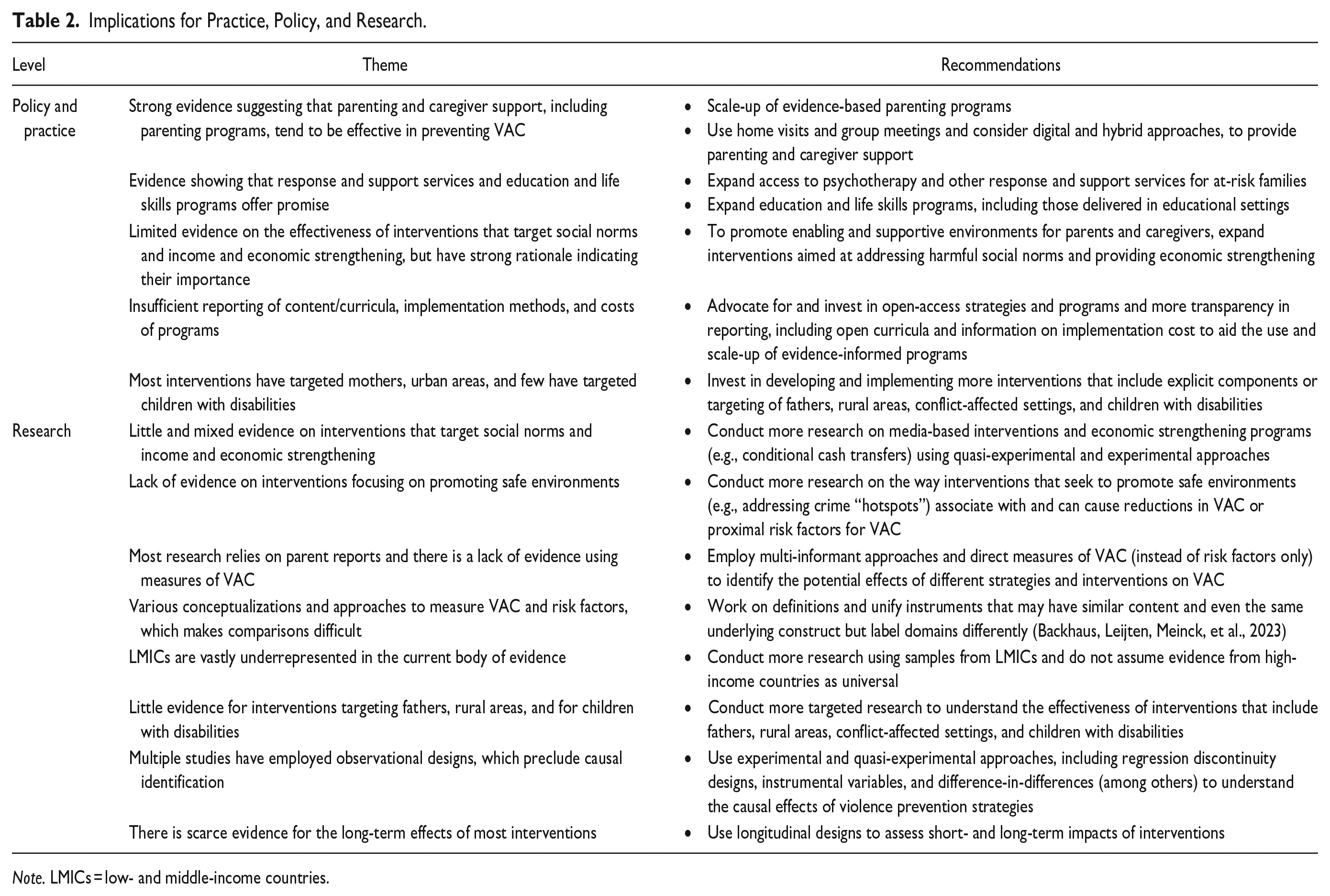
Note. LMICs = low- and middle-income countries.
The reviews included in this study reported as main outcomes both VAC and its risk factors. Regarding VAC, most reviews examined physical punishment and psychological aggression, which are the most prevalent form of violence in childhood worldwide (UNICEF, 2017), but there was very little evidence on sexual violence. Moreover, most reviews note that there are very few studies with direct measures of VAC, and most research relies on parent-reported measures or other administrative data that might be prone to surveillance and/or social desirability bias. Furthermore, the reviews have employed diverse approaches to measure VAC and its risk factors, which makes meaningful comparisons between studies difficult.
Reviews showed that parent and caregiver support, including home visiting, parent education programs, and response services like psychotherapy had positive effects on VAC or risk factors for VAC across settings. For parent and caregiver support, in particular, the meta-analyses included in this review report effect sizes ranging between d = 0.11 and 0.61 for reductions in VAC and between d = 0.03 and 0.52 for reductions in risk factors for VAC. These findings support several recent calls to scaling parent support strategies, including parenting programs, globally (Britto et al., 2022; UNICEF et al., 2022). Parenting programs are social and behavioral interventions aimed at improving caregivers’ knowledge, attitudes, beliefs, skills, practices, and daily interactions with children to prevent VAC and promote young children’s safety and development (Jeong, Franchett, et al., 2021; Scott & Gardner, 2015). In general, these programs can be implemented through home visits or other community spaces and have a common set of components, including content on child development, self-regulation and communication skills, and non-violent discipline, as well as delivery approaches like demonstrations and modeling, positive feedback, and homework (Cuartas, Baker-Henningham, et al., 2022; Francis & Baker-Henningham, 2020; Lachman et al., 2016). Some research also demonstrates the importance of including content related to caregivers’ mental health and wellbeing in parenting programs (Cuartas, Baker-Henningham, et al., 2022), which may relate to the observed effectiveness of psychotherapy considering the importance of caregivers’ mental health in determining their parenting behaviors, in particular in stressful settings such as low-resource and humanitarian contexts (Moya et al., 2021; Sánchez-Ariza et al., 2023).
Despite these findings showing promising approaches for preventing VAC, there are still several unsolved questions due to a significant imbalance in the distribution of evidence across the INSPIRE domains and methodological issues. Indeed, the interventions most represented in the reviews were parent and caregiver support, response and support services, and education and life skills programs, which is consistent with findings from a recent evidence gap map (Pundir et al., 2020). Similarly, there is less evidence (and with higher heterogeneity) on interventions that target norms and values and income and economic strengthening, which conceptually offer promise by targeting change in harmful social norms and supporting the wellbeing of families, both of which contribute to reducing parental stress and other key risk factors for VAC (Bornstein, 2015; Ward et al., 2021). Finally, we did not find any review focused on safe environments (e.g., addressing neighborhood “hotspots”), which might be important in the prevention of violence considering ecological perspectives; the broader developmental ecology can mitigate or exacerbate the risk of violence through multiple mechanisms that cascade into the family system (Bronfenbrenner & Morris, 2007; Cicchetti et al., 2000).
Furthermore, there is a vast underrepresentation of evidence using samples from LMICs, or the “Majority World,” relative to high-income countries, or the “Minority World” (Khan et al., 2022). We found that only 10% of primary studies included in the reviews employed samples from LMICs. This finding echoes recent discussions on the limited generalizability of current theory and evidence about human development and health due to variability across settings and cultures and scarce evidence produced and conducted in the Majority World, likely due to challenges in access to funding for and publishing research from LMICs (Draper et al., 2022). Similarly, there is unequal distribution of evidence across groups within countries. Within country settings, most primary studies exclusively used samples from urban areas and targeted mothers, which raises questions about the generalizability of findings to rural and disperse areas and leaves unanswered questions on how prevention programs can support fathers and other caregivers who are actively engaged in childrearing in LMICs (Cuartas et al., 2020). Finally, only about 6% of primary studies included children with disabilities and 2% included migrants or refugees, despite the fact that about one-fifth of all children worldwide were living in fragile, conflict, and violence settings in 2018 (Save the Children et al., 2019) and conflicts and climate disasters are increasing forced displacement globally (Romanello et al., 2022).
There are also some limitations regarding the methodological approaches used in existing literature. Several studies employed observational methods that are prone to selection bias. For example, most evidence about the implementation and enforcement of laws relied on pre–post and other observational approaches (e.g., Zolotor & Puzia, 2010), making it impossible to know whether the law led to decreases in VAC or whether these decreases resulted from other factors that correlate with the enactment of laws, such as decreases in social norms supporting physical punishment. Despite these limitations, few reviews conducted risk of bias assessments or accounted for risk of bias in their analyses, which raises concerns about the internal validity of their conclusions. Furthermore, very few studies have assessed the medium (more than 1 year) and/or long-term (5 years or more) effects of interventions, which is especially limiting in light of nascent evidence suggesting effect fade-out in general parenting programs (Backhaus, Leijten, Jochim, et al., 2023; Jeong, Pitchik, et al., 2021).
A final limitation of the current literature on VAC is the insufficient reporting of the actual content/curricula, implementation methods, and costs of programs, which is a barrier to replicating and scaling successful interventions. Indeed, recent reviews indicate that, for example, effective parenting programs have rarely been scaled-up, perhaps due to lack of access to program materials and information on implementation (Britto et al., 2022; Shenderovich et al., 2021). The fact that several primary studies and reviews did not provide information about content, delivery approaches, and costs might be due to the fact that multiple programs are proprietary and have high access costs, impeding assessments of their components and, ultimately, imposing barriers to implementation, specifically in lower-resourced settings with stronger budget constraints (Cuartas, Baker-Henningham, et al., 2022).
This review of reviews has some limitations that inform future research. First, while we did not exclude any study based on language, we conducted searches only in English. While some evidence suggests that excluding non-English publications does not change the main conclusion of meta-epidemiological reviews (Nussbaumer-Streit et al., 2020), we may have missed some important studies, particularly those common in LMICs. Second, as pointed out in the review of reviews conducted by Barlow, Simkiss, et al. (2006) and Coore Desai et al. (2017), many of the reviews included data from the same studies, so there may be an overrepresentation of findings from similar programs and studies. Similarly, there was little quantitative evidence for all INSPIRE frameworks except parent and caregiver support, which makes it difficult to understand the magnitude of effects of interventions and impedes conducting cost-benefit analyses to inform policy decisions. Moreover, while INSPIRE places strong emphasis on the ecological roots of violence, there is need to include a more explicit focus on how to address VAC amid pandemics and the growing climate crisis in INSPIRE and other frameworks and policy work aimed at preventing VAC. Finally, there is significant variation in the scope and quality of included reviews, which compromises the comparability and interpretation of findings. The variability in quality of the reviews indicate the need for additional reviews of the literature that aimed to address existing limitations around lack of quantitative syntheses, measurement, costing, and information on the content and delivery approaches that may be most effective.
Conclusion
To our knowledge, this study is the first to apply the INSPIRE framework to a review of reviews to understand what works to prevent VAC in the home and what knowledge gaps remain in the literature. Findings from this review of reviews echo the conclusions of prior reviews of reviews regarding the prevention of VAC (Coore Desai et al., 2017; Mikton & Butchart, 2009; van IJzendoorn et al., 2020), showing that parent and caregiver support, response and support services, and education and life skills strategies offer promise. At the same time, existing evidence is weakened by less representation of other INSPIRE domains, measurement problems, issues of causality, and little generalizability of findings. Moving ahead, there is need for further work on measurement to increase the specificity, reliability, and comparability of measures (Backhaus, Leijten, Meinck, et al., 2023), stronger methodological designs and further discussion on risk of bias in published research, and more research in LMICs and with children with disabilities and in fragile settings. There is also need for long-term follow-ups in future studies to understand the short and long-term effects of interventions and identify ways to sustain impacts to transform families, communities, and societies. Similarly, considering lessons from the COVID pandemic and recent discussions on how the growing climate crisis may further exacerbate VAC (Cuartas et al., 2023), there is need for novel research to understand how to effectively prevent VAC amid pandemics and in climate hazard settings.
Collectively, existing evidence indicates that policymakers and practitioners around the globe should continue working on the design, implementation, and scale-up of home visiting, parent education, media-based, legislation, and economic support, among other ecological strategies, to prevent VAC. Parent support interventions, including parenting programs, offer promise and should be implemented at-scale in more settings. “Simultaneously, there is an urgent need to move away from proprietary, licensed programs toward more low-cost strategies with open-access materials in order to effectively expand these programs and facilitate replication across settings. This is particularly important in LMICs, where children frequently experience violence and other adverse childhood experiences.” Doing so is critical to ensure the expansion and scalability of evidence-based strategies to protect children from violence and support the health and development of children worldwide.
Supplemental Material
sj-docx-1-tva-10.1177_15248380241247018 – Supplemental material for Strategies to Prevent Violence Against Children in the Home: A Systematic Review of Reviews
Supplemental material, sj-docx-1-tva-10.1177_15248380241247018 for Strategies to Prevent Violence Against Children in the Home: A Systematic Review of Reviews by Jorge Cuartas, Ana Salazar, Sophia Backhaus, Madison T. Little, Dana McCoy, Hirokazu Yoshikawa, Michelle Bass, Nicholas Metheny and Felicia Knaul in Trauma, Violence, & Abuse
Footnotes
Acknowledgements
We would like to thank Joann Seunarine and Bella Marie Tomassetti for supporting the data extraction for the primary studies. We are also thankful to the members of The Lancet Commission on Gender-Based Violence and Maltreatment of Young People, Sabine Rakotomalala, Alexander Butchart, and three anonymous reviewers for their feedback.
Declaration of Conflicting Interests
The author(s) declared no potential conflicts of interest with respect to the research, authorship, and/or publication of this article.
Funding
The author(s) disclosed receipt of the following financial support for the research, authorship, and/or publication of this article: Funding for this systematic review of reviews comes from internal funds of the Lancet Commission on Gender-Based Violence and the Maltreatment of Young People. The sponsor had no role in the design of this study and did not have any role during its execution, analyses, interpretation of the data, or decision to submit results.

Supplemental Material
Supplemental material for this article is available online.
Author Biographies
References
Supplementary Material
Please find the following supplemental material available below.
For Open Access articles published under a Creative Commons License, all supplemental material carries the same license as the article it is associated with.
For non-Open Access articles published, all supplemental material carries a non-exclusive license, and permission requests for re-use of supplemental material or any part of supplemental material shall be sent directly to the copyright owner as specified in the copyright notice associated with the article.
