




Abstract
Recent reviews of the literature have indicated that a number of health communication campaigns continue to fail to adhere to principles of effective campaign design. The lack of an integrated, organizing framework for the design, implementation, and evaluation of health communication campaigns may contribute to this state of affairs. The current article introduces an audience–channel–message–evaluation (ACME) framework that organizes the major principles of health campaign design, implementation, and evaluation. ACME also explicates the relationships and linkages between the varying principles. Insights from ACME include the following: The choice of audience segment(s) to focus on in a campaign affects all other campaign design choices, including message strategy and channel/component options. Although channel selection influences options for message design, choice of message design also influences channel options. Evaluation should not be thought of as a separate activity, but rather should be infused and integrated throughout the campaign design and implementation process, including formative, process, and outcome evaluation activities. Overall, health communication campaigns that adhere to this integrated set of principles of effective campaign design will have a greater chance of success than those using principles idiosyncratically. These design, implementation, and evaluation principles are embodied in the ACME framework.
Health mass media campaigns are a critically important tool used to influence the health of the public. Recent large-scale examples include the Truth antismoking campaign (Farrelly, Davis, Haviland, Messeri, & Healton, 2005), VERB physical activity campaign (Huhman et al., 2005), and the National Youth Anti-Drug Media campaign (Hornik, Jacobsohn, Orwin, Piesse, & Kalton, 2008). Recent reviews chronicle the scores of both large and small campaign efforts undertaken to influence numerous health indicators in the United States and internationally (Bertrand, O’Reilly, Denison, Anhang, & Sweat, 2006; Hornik, 2002; Noar, 2006; Randolph & Viswanath, 2004; Snyder et al., 2004). Given the behavioral health challenges that exist at the beginning of the 21st century (Mokdad, Marks, Stroup, & Gerberding, 2004), campaigns will likely continue to be a widely used tool.
To maximize the potential of campaigns, campaign developers and evaluators should use the sets of principles and generalizations for guiding effective campaign design (Backer, Rogers, & Sopory, 1992; National Cancer Institute, 2001; Randolph & Viswanath, 2004; Rogers & Storey, 1987; Salmon & Atkin, 2003) and evaluation (Hornik, 2002; Noar, Palmgreen, & Zimmerman, 2009). Recent reviews of campaigns, however, reveal a disconnect between effective campaign design and evaluation principles on the one hand, and campaign practice on the other. For instance, recent reviews have found that (a) more than half of campaign efforts report no formative research efforts (Noar, Palmgreen, Chabot, Dobransky, & Zimmerman, 2009); (b) a majority of campaigns are not theory based (Noar, 2006; Noar, Palmgreen, Chabot, et al., 2009; Randolph & Viswanath, 2004); (c) typical campaigns only achieve 36% to 42% audience exposure to campaign messages (Snyder et al., 2004); and (d) most campaigns use weak outcome evaluation designs that are incapable of reducing or eliminating threats to internal validity (Bertrand et al., 2006; DeJong, 2002; Noar, 2006). These findings indicate that typical campaigns have failed to consistently apply principles of effective campaign design. Given this, it is not surprising that a number of health communication campaign syntheses have concluded that typical campaigns achieve only limited impact (Bertrand et al., 2006; Snyder et al., 2004).
Why is there such a disconnect between the principles on the one hand and practice on the other? One explanation may be that although numerous treatments of campaign design principles exist (Backer et al., 1992; DeJong, 2002; Maibach, Kreps, & Bonaguro, 1993; National Cancer Institute, 2001; Randolph & Viswanath, 2004; Rogers & Storey, 1987; Salmon & Atkin, 2003), with some delineating as many as 27 campaign principles (Backer et al., 1992), what is lacking is discussion of how these principles operate together (and influence one another) in an integrated framework. Given that the linkages between the principles have not been well articulated, campaign designers may believe that they can pick and choose which principles they view as important and ignore or downplay others.
The purpose of the current article is to introduce a proposed audience–channel–message–evaluation (ACME) framework for health communication campaign design, implementation, and evaluation. The word ACME is commonly defined as “the highest point, as of achievement or development” (it has also been defined as “a company that makes everything”). ACME goes beyond previous treatments of campaign design and evaluation by not only presenting a key set of campaign design, implementation, and evaluation principles but also explicating the relationships and linkages between the principles. It is also demonstrated how failure to use or effectively implement one principle may make it difficult or impossible to use other principles. Finally, although evaluation is often treated as a topic separate from campaign design, the ACME framework is inclusive of evaluation and is thus able to make transparent the important linkages between design, implementation, and evaluation aspects of campaigns.
Principles of Effective Campaign Design and Evaluation
Although the health communication campaign literature is diverse in many ways, definitions of what campaigns are as well as what principles make for effective campaigns remain quite universal. Campaigns aim to generate specific effects among a large number of individuals within a specified period of time through an organized set of communication activities (Rogers & Storey, 1987). Principles regarding what makes for the effective design, implementation, and evaluation of campaigns embody decades of research. The ACME framework organizes the principles into four major categories: audience, channel, message, and evaluation. Each of these areas will be discussed next (also see Table 1 and Figure 1).
Audience–Channel–Message–Evaluation (ACME) Domains, Key Concepts, and Considerations in Each Area
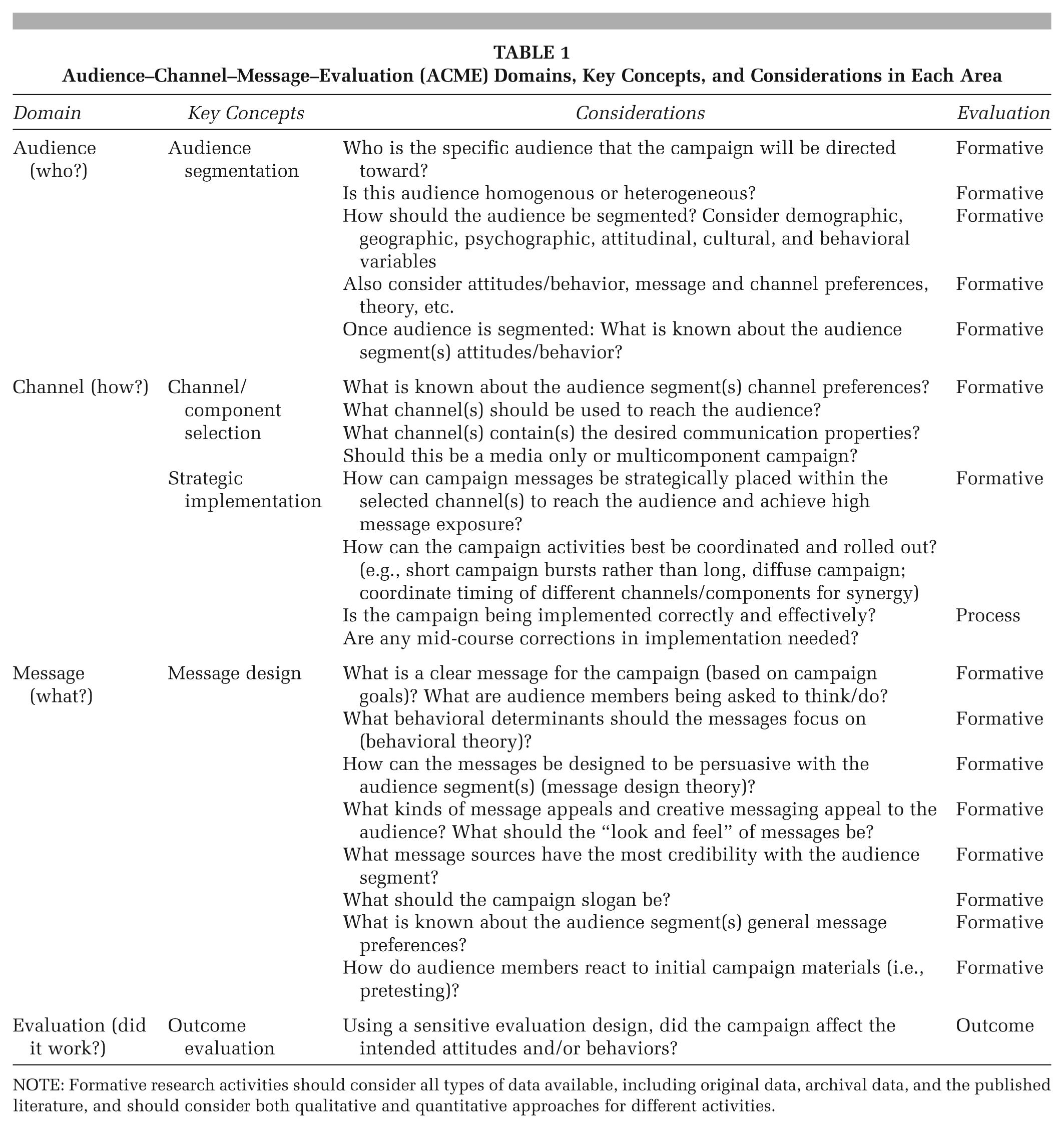
NOTE: Formative research activities should consider all types of data available, including original data, archival data, and the published literature, and should consider both qualitative and quantitative approaches for different activities.

The Audience–Channel–Message–Evaluation (ACME) Framework for Health Communication Campaigns
Audience
Many writings in the literature indicate the need to develop a campaign with a defined audience in mind (Atkin, 2001; DeJong, 2002; Rogers & Storey, 1987), but the critical nature of this step is not always emphasized. It could be argued that choosing the audience segment(s) to focus on in a campaign is the single most important decision made by campaign developers. Why is this decision so important? The decision regarding audience segment(s) will in large part drive other decisions regarding message strategy, channel selection, and evaluation decisions. For example, if the intended audience is too broad, it will be difficult (or impossible) to develop messages that are effective with the entire audience segment. Similarly, it will be difficult to arrive at the most promising channels (and placement within those channels) and components to use in the campaign. Said another way, a campaign that is designed for everyone will be successful with virtually no one. Thus, if audience segmentation decisions are made without careful consideration of both data and (preferably) a theoretical foundation, the entire campaign project may be off to the wrong start.
Formally defined, audience segmentation refers to the practice of dividing a population into groups whose members are more similar to one another than members of other groups (Grunig, 1989). As will be discussed below (under the message category), creation of a homogenous group makes the design of messages that resonate with that group possible. Research suggests that although segmentation on simple demographic variables is the most commonly used method (Slater, 1995), it may also be the least effective (Backer et al., 1992). Audiences can be divided and defined in many ways, including using demographic, geographic, psychographic, attitudinal, cultural, and/or behavioral variables (Albrecht & Bryant, 1996; Slater, 1995). Different behavioral areas, different populations, and different contexts will necessitate different segmentation decisions, and thus there is no overriding segmentation scheme that works in every situation. With other factors held equal, however, the more homogenous the audience segment is, the more successful one will be with effective message design and channel placement.
Audience decisions should also be informed by data as much as possible—qualitative, quantitative, original, archival, and so forth, rather than making these decisions in the absence of data. These data can and should inform issues related to the behavior under study, the theory being applied, the message and channel preferences, and other factors (Hornik & Ramirez, 2006). As will be discussed more below, the decision on exactly what audience segment(s) to direct the campaign toward has implications for all other areas within the ACME framework.
Channel
Key considerations here involve selecting the channels and components to be used in the campaign as well as devising a strategic implementation plan to effectively carry out the campaign. The key question here is which channels and components will have the greatest opportunity to reach the intended audience and with multiple exposures. To make this decision, data on audience use of a variety of channels are needed.
Different communication channels also have different communication properties, and channel selection decisions should be made with message design in mind. Every media channel has pros and cons, with channels varying on features such as access, reach, specialization, depth, credibility, and potential for agenda setting (National Cancer Institute, 2001; Salmon & Atkin, 2003). Channels selected for a particular campaign should be those that (a) are widely viewed by the audience segment and (b) include features that are consistent with the message approach being applied. As an example of this latter point: For campaigns in which messages are intended to be “hard hitting” (Farrelly et al., 2005) or high in “message sensation value” (Palmgreen, Donohew, Lorch, Hoyle, & Stephenson, 2001), television (which has features, such as sound, fast cuts, etc.) is much better suited to this message strategy than print media. On the other hand, if campaign messages are intended to be more “cerebral,” in depth, and detailed, the reverse of this is likely true.
Many authors suggest that multichannel and multicomponent campaigns are more likely to be effective than single channel campaigns (Backer et al., 1992; Rogers & Storey, 1987), particularly with complex or habit-driven behaviors (Flay, 1987; Flora, Maibach, & Maccoby, 1989). Increasing the number of channels used is also likely to have the effect of increasing exposure to campaign messages. It has long been a mantra in the communication field that interpersonal communication is more effective in achieving persuasion than mediated communication, and for that reason it is not surprising that campaigns often incorporate interpersonal components (Noar, 2006). In particular, campaigns attempting to impact behavior change may want to consider such components (Noar, Palmgreen, Chabot, et al., 2009). However, downsides to multicomponent campaigns include increased cost, the difficulty in separating out the effects of each channel/component, and the challenge of disseminating a complex campaign effort.
The advent and impact of newer communication technologies should be mentioned at this juncture. In particular, the Internet has been described as a “hybrid channel” with the reach of mass media and persuasive properties of interpersonal communication (Cassell, Jackson, & Cheuvront, 1998). Recent meta-analyses of computer-delivered interventions find such interventions to be efficacious in changing a variety of health-related behaviors (Portnoy, Scott-Sheldon, Johnson, & Carey, 2008). Although its potential is still being understood and realized, the Internet offers an exciting new channel for health mass media campaigns, as do other new technologies such as cell phones and smart phones. The current challenge, however, is to advance an understanding of how to most fruitfully integrate such “new media” channels into health communication campaigns.
In addition to selecting appropriate channels, strategically placing messages in those channels is critical. For example, if one’s audience segment consumes much television, but the campaign airs on television programs that the audience does not watch (or at the wrong times), exposure to the campaign will be low. The aim here is achieving high audience exposure to campaign messages—an important goal that many campaigns have failed to achieve (Snyder et al., 2004). Indeed, both high reach (proportion of audience exposed to campaign messages) and frequency (number of exposures per audience member) of exposure are necessary for an effective campaign. Given that campaigns that rely on free public service media air time are likely to have low audience exposure, funded campaign efforts typically use a mix of paid and donated media (Farrelly et al., 2005; Huhman et al., 2005).
Finally, campaign messages and activities should be rolled out in a strategic manner. A long, diffuse campaign is less likely to be successful than a shorter, intensive one (DeJong, 2002; Snyder et al., 2004). With this in mind, many campaign efforts have been launched in “flights,” with intensive campaign periods followed by breaks (or lower levels of activity) between periods (Farrelly et al., 2005; Palmgreen et al., 2001). Campaigns using multiple components should also strategically time the rollout of components so that synergy among them can be achieved.
Message
As already discussed, the primary reason to segment an audience is to create a homogenous group for which persuasive messages can be designed. When a segment is clearly defined, a message strategy that will resonate with a particular group can be devised. The campaign should clearly think through and develop what the message is in the campaign, and then examine how to best communicate this message. For example, the message may be “become more physically active” or “use condoms consistently.” Once a clear message is developed, a variety of types of theories can help in designing effective messages to persuade individuals to think about and ultimately do what the message asks them to do.
Behavioral theory can help in identifying determinants of the behavior that can be used in campaign messages. Behavioral theories help us gain an understanding of factors that are associated with the behavior under study. These factors (e.g., attitudes, norms, beliefs) can then provide much of the content for campaign messages (Fishbein & Yzer, 2003), which may lead to particular types of messages such as negative or positive appeals (Salmon & Atkin, 2003). Although behavioral theories (such as theory of reasoned action, social cognitive theory, stages of change model) are the most used theory type in campaign development (Noar, 2006), and theory use has increased in some campaign literatures (Myhre & Flora, 2000; Noar, Palmgreen, Chabot, et al., 2009), many campaigns continue to be developed without any theory at all (Noar, Palmgreen, Chabot, et al., 2009; Randolph & Viswanath, 2004).
Although behavioral theory is a necessary part of any behavior change campaign, it is not sufficient. This is the case because although such theories tell us what behavioral determinants are in need of change (e.g., beliefs, attitudes, norms, etc.), they tell us little about how to change those determinants. For guidance on this, communication and persuasion theories are germane (Cappella, 2006; Slater, 2006). Unfortunately, theories that inform message design have often been underutilized in campaigns efforts (Noar, 2006; Randolph & Viswanath, 2004), but many such theories do exist. These include message framing, message tailoring, the activation model and sensation-seeking targeting, the elaboration likelihood model, and the extended parallel process model, among others (Cappella, 2006; Devos-Comby & Salovey, 2002; Slater, 2006; Witte, 1992). Related to this, an important consideration in any campaign has to do with source credibility with the audience (Who should deliver the message?).
It should be noted that although there is certainly a science to message design, it is also an art. Various types of creative and unconventional messaging can be important to attracting and keeping the attention of certain audience segments, as well as ultimately being persuasive (Farrelly et al., 2005; Palmgreen et al., 2001). It is important, however, that the core arguments made in the messages are not diluted through creative messaging. A key part of message development, then, involves such creative messaging, which includes ultimately pretesting messages to garner reactions and input from the audience segment. This audience feedback can be invaluable in terms of revising such messages to make them acceptable as well as potentially effective with the segment.
Evaluation
Evaluation is not a one-time activity but rather should be thought of as a set of activities that are interwoven throughout campaign development and implementation. Throughout campaign development, a variety of formative evaluation activities are carried out (see Table 1 and Figure 1). Then, while the campaign is being implemented, process evaluation is carried out. Finally, an outcome evaluation is implemented, with data often being collected before, during, and after the campaign in the campaign region and, where possible, in a control region. These are each now briefly discussed in turn.
Formative evaluation
As has been discussed throughout this article, formative evaluation (also called formative research) is critical to making several key campaign-related decisions. There are many formative research activities that are important (Table 1), including (a) studying the behavior of interest, including correlates and predictors of the behavior; (b) research assessing audience message and channel preferences; and (c) pretesting initial campaign messages to garner audience reactions (Atkin & Freimuth, 2001). These kinds of activities can be carried out through archival research and searching the research literature, although they almost invariably require some original research in the form of focus groups, structured interviews, and/or quantitative surveys. This research ensures that campaign designers clearly understand the audience and its motivations for behavior, as well as ensuring that message strategies to be used resonate with the audience segment. This research ensures that proposed channels are a good fit to the audience segment and that placement of messages within those channels has a great likelihood of reaching the audience segment.
Process evaluation
Process evaluation is concerned with monitoring the implementation of campaign activities. Having a plan is one thing—but ensuring that a plan is correctly (and effectively) put into action is quite another. If formative research activities are thoroughly carried out, it is likely that the messages are well suited to the audience segment. A key consideration in process evaluation, then, is ensuring that the audience is being adequately exposed to campaign messages. This includes asking questions such as “Did campaign spots air as they were intended to air?” and “What proportion of the audience was reached with the campaign spots?” If process evaluation results show that the audience is not being adequately reached, mid-course corrections can be made. If formative research helped in crafting potentially effective campaign messages, and process evaluation demonstrated that a large proportion of the intended audience was exposed to the campaign with great frequency, then the chances of the campaign ultimately being successful are much higher than in the absence of these.
Outcome evaluation
Outcome evaluation is the most challenging form of evaluation in the campaigns arena. Given that campaigns are effectiveness trials that take place “in the field,” they often do not lend themselves to the “gold standard” research design—the randomized controlled trial (RCT). This is particularly true of national campaigns where no natural control group exists. This combined with the fact that many campaigns have little funding for outcome evaluation has resulted in scores of campaigns being evaluated using weak research designs (Bertrand et al., 2006; Noar, 2006).
In the absence of the ability to use an RCT, those conducting community-level campaigns and interventions should use the strongest quasi-experimental design available. A variety of examples of such stronger evaluation designs in the campaign literature exist, and include quasi-experimental pretest–posttest control group designs, panel designs, and interrupted time series designs (Noar, Palmgreen, & Zimmerman, 2009). Designs for evaluating campaigns are strong to the extent that they rule out alternative explanations for campaign effects. Unfortunately, popular designs such as the one group pretest–posttest design and the posttest-only design are significantly flawed in their ability to provide strong causal data regarding campaign impact (Noar, 2009).
In the case of behavior change campaigns, evaluation should take into account not only whether the “ultimate outcome” was impacted but also the behavioral theory that was applied, in particular whether mediating variables (derived from theory) changed. If a campaign’s strategy was to change particular beliefs that in turn were hypothesized to change particular behaviors, the outcome evaluation should examine (a) whether beliefs changed, (b) whether behavior changed, and (c) whether behavior change was mediated by belief change. These kinds of data can yield valuable insights into whether the campaign had its intended impact on the audience segment(s) as well the mechanisms through which the campaign was successful or unsuccessful.
How ACME Principles Work Synergistically
Throughout this article, the way in which ACME principles work synergistically has been implied. The first choice often made in campaign design—on audience segmentation—has clear implications for channel, message, and evaluation. Decisions made regarding channels also have implications for message (as different channels have different properties), whereas decisions made regarding message have implications for channel (particular types of message appeals may require particular types of channels). Thus, a major purpose of the ACME framework is to make transparent the relationships of these principles to one another, in order to explicate how decisions with regard to one domain affect other domains of ACME. Decisions will also affect campaign evaluation, of course, as evaluation should be interwoven throughout the campaign development and implementation process. Indeed, although campaign evaluators are sometimes (for purposes of objectivity) completely separate from the campaign designers, the ACME framework implies that if this is the case, evaluators must become intimately familiar with the campaign design and objectives to properly evaluate the effort.
Conclusion
Health communication campaigns remain a critical tool in sparking and reinforcing healthy behavior change across a spectrum of health problems and in a variety of populations. As noted above, reviews of the literature make it clear that campaigns continue to be a widely used tool for influencing health behaviors. This is no surprise, as a great strength of campaigns is their ability to quickly transmit health-related messages to large audiences. Campaigns that follow a set of idiosyncratic principles, however, are unlikely to be successful in reaching their goals. Instead, to maximize their chances of being successful, campaigns should adhere to a commonly held set of principles, embodied in the ACME framework. Adhering to all of the domains in this framework will ensure that careful thought is given to each step in the campaign design process and will increase the chances of a campaign having its intended impact.