




Abstract
Background. Failure to engage in emergency preparedness, response, and recovery contributes to the differential outcome experienced by limited English proficiency (LEP) populations. Little is known about how psychosocial factors influence LEP individuals’ perception of emergency and their process of understanding, collecting, and synthesizing information. The purpose of this exploratory study is to understand how LEP conceptualize an emergency situation to determine when help is needed. Methods. The authors conducted 4 focus groups with 36 adult Chinese LEP speakers living in Seattle. All discussions were audio-taped, translated, and transcribed. Coded text passages were entered into Atlas.ti for data management and model generation. Results. Perception of an emergency situation affects LEP individual’s ability to manage the crisis. Self-efficacy may be an important psychological variable that positively shapes an individual’s response to an emergency situation by improving their confidence to handle the crisis and ability to connect to resources. Response to emergency resulting from this series of information gathering, synthesis, and utilization may not always result in a positive outcome. Discussion. Self-efficacy in risk communication messages should be included to engage LEPs in emergency preparedness. Effective communication can increase LEPs’ awareness of emergency situations and connecting LEP individuals with existing community resources may enhance LEPs’ level of self-efficacy in emergencies.
Background
The United States is becoming an increasingly diverse society. Over the past three decades, the population of non-English-speaking immigrants grew by 140% (U.S. Census Bureau, 2010). In 2008, this group increased to almost one fifth of the population, with nearly half of this group reporting speaking English less than “very well” (U.S. Census Bureau, 2007). Next to English and Spanish, Chinese is the third most common language spoken at home (U.S. Census Bureau, 2010). In 2009, there were 3.62 million Chinese living in the United States. Among all Asian American subgroups, the Chinese have the highest proportion of individuals reporting speaking English less than
Limited English proficiency (LEP) communities are disproportionately at risk during emergencies and disasters. LEP individuals face unique challenges as they are less likely to be able to understand most emergency communications unless information is disseminated in languages other than English. Broad disparities in health status and social factors such as socioeconomic status, low health literacy, cultural barriers, and lack of access to and use of health care adversely affect the capacity of ethnic minority populations to engage in emergency preparedness, response, and recovery (Hutchins, Fiscella, Levine, Ompad, & McDonald, 2009). LEP populations have greater vulnerability because of disparities in exposure, susceptability, and treatment, which may have a synergistic effect causing unnecessary mortality and morbidity (Blumenshine et al., 2008). Hurricane Katrina confirmed the unique challenges faced by Vietnamese LEP individuals in accessing resources and obtaining support during evacuation and in the aftermath. Social networks such as friends and family served as important resources to turn to for help before and after Hurricane Katrina (Chen et al., 2007). We have not found any published studies investigating emergency communication and response in Chinese LEP communities.
Conceptual differences in the risks and threats embedded in an emergency situation may affect an individual’s response behaviors (Fothergill, Maestas, & Darlington, 1999). Specifically, the process of an individual making sense of an emergency situation may affect communication, the primary process by which an individual acquires information to make choices and adjustments in crisis, thereby increasing the sense of mastery of the emergency situation (Veil, Reynolds, Sellnow, & Seeger, 2008).
Self-efficacy is the belief in one’s own ability to accomplish a task successfully (Hayden, 2009). Perception of self-efficacy is influenced by four factors: mastery experience, vicarious experience, verbal persuasion, and somatic and emotional state (Bandura, 1994). When applied to emergency response, previous success or modeling from others’ success in dealing with crisis sitauations will increase an individual’s self-efficacy. Social persusaion can also positively influence the level of self-efficacy. Having others provide verbal support boosters a person’s belief in one’s own self. A person’s emotional state during an emergency sitation also affects self-efficacy. The better the emotional state, the more self-efficacious one feels, leading to a better decision making. Anxiety, stress, worry, and fear may negatively affect an individual’s pecevied ability to cope in an emergency situation.
Considerable research has focused on socioeconomic and health factors influencing vulnerability in vulnerable populations, especially in recovery (Bouye et al., 2009; Hutchins et al., 2009). However, few studies have investigated psychosocial factors that may affect an individual’s ability to mitigate and respond to an emergency. In particular, little research has focused on understanding LEP individuals’ perception of emergency situations and their process of understanding, collecting, and synthesizing information to determine whether help is needed during an emergency.
The Northwest Preparedness and Emergency Response Research Center (NWPERRC) at the University of Washington focuses on research to improve community emergency preparedness in LEP populations. The first phase of this project used focus group methods to elicit information about the decision process of the communication channels used in emergencies by Chinese LEP individuals. Focus group findings suggested the development of a model that was used to develop a survey questionnaire. The questionnaire was used in Phase 2 of the study involving a community-based telephone survey. This article describes a model developed for Chinese LEP individuals to respond to emergencies based on the focus group findings (see Figure 1).

Model Showing LEP Individuals’ Response to Emergency
Method
We performed four focus groups in Mandarin and Cantonese in Spring 2009. Applying convenience sampling method, adult Chinese LEP men and women who self-reported speaking English “not well” or “not at all” were recruited to participate in this study by the Chinese Information and Service Center (CISC), a community-based organization that provides cultural orientation and social services to immigrants. The University of Washington Institutional Review Board approved all the study procedures. Participants were offered an honorarium as a token of appreciation for their time. A moderator guide for the focus groups was designed to elicit information on participants’ experiences and thoughts about emergencies, use of public emergency systems and other resources, and perceived level of preparedness. The Chinese version of informed consent was signed, and basic demographic data were obtained.
Focus group interviews have been extensively employed as a primary qualitative method to seek opinions, values, and beliefs in a collective context (Beaudin & Pelletier, 1996; Cote-Arsenault & Morrison-Beedy, 1999; Krueger & Casey, 2000). They have also been used with culturally and linguistically diverse populations as well as immigrant populations (Carter-Pokras, Zambrana, Mora, & Aaby, 2007; Devlin, Roberts, Okaya, & Xiong, 2006; Whittaker, Hardy, Lewis, & Buchan, 2005). In public health, the focus group method is a useful tool for needs assessment, information gathering, and program development (Ruff, Alexander, & McKie, 2005).
The moderator used the “funnel” approach to frame the structure of the questions, allowing individuals to express their experiences at the initial stage and then move forward to ask specific questions (Halcomb, Gholizadeh, DiGiacomo, Phillips, & Davidson, 2007). For example, the moderator started the discussion by making a general request, “Please tell me a word or image that comes into your mind when you think about emergency situations.” This was then followed by specific questions, “What triggers you to call for help or information?” or “Do you have concerns about using 9-1-1?”
Data Analysis
All four focus groups were conducted in the participants’ native dialects. The first author, who is bilingual in English and Cantonese, conducted the two Cantonese focus groups. A trilingual interpreter (English, Mandarin, and Cantonese) interpreted for the two Mandarin groups, which were also conducted by the first author. Each focus group consisted of 8 to 10 participants, and the discussions lasted 1.5 hours. All focus group discussions were tape-recorded, translated to English, and transcribed verbatim. An independent trilingual translator (English, Mandarin, and Cantonese) first listened to the Chinese audio recording multiple times and then did the translation and transcription. The transcripts were then checked against the tapes for accuracy.
Each transcript was independently reviewed and coded by three members of the research team who later met to discuss the codes. At coding meetings, the coders discussed the content of each transcript, codes, emerging themes, key concepts, and any new information. Differences of opinion were resolved through discussion and consensus.
A codebook was developed using an iterative process, where modifications were made to the codes as themes and concepts emerged from each transcript. The purpose of coding is to enable researchers to note relevant phenomena, collect examples of the phenomena, and analyze the phenomena to find commonalities, differences, patterns, and structures with the goal to facilitate understanding of the emerging phenomena and to generate theory grounded in the data (Basit, 2003; Seidel & Kelle, 1995). Atlas.ti was used to assist in data management for text analysis and modeling (Muhr & Friese, 2004). Codes were thematically grouped together, and new codes were created for new information. Eventually, all data were coded into exhaustive and exclusive categories. Major themes based on the relationships between code, text passages, or memos were developed using the graphic network editor in Altas.ti. The networking features allow visual display of the relationships with respect to the frequency of node occurrences and connections between codes. Finally, a conceptual model was created based on predominant themes that evolved from the data.
Results
Study Group Characteristics
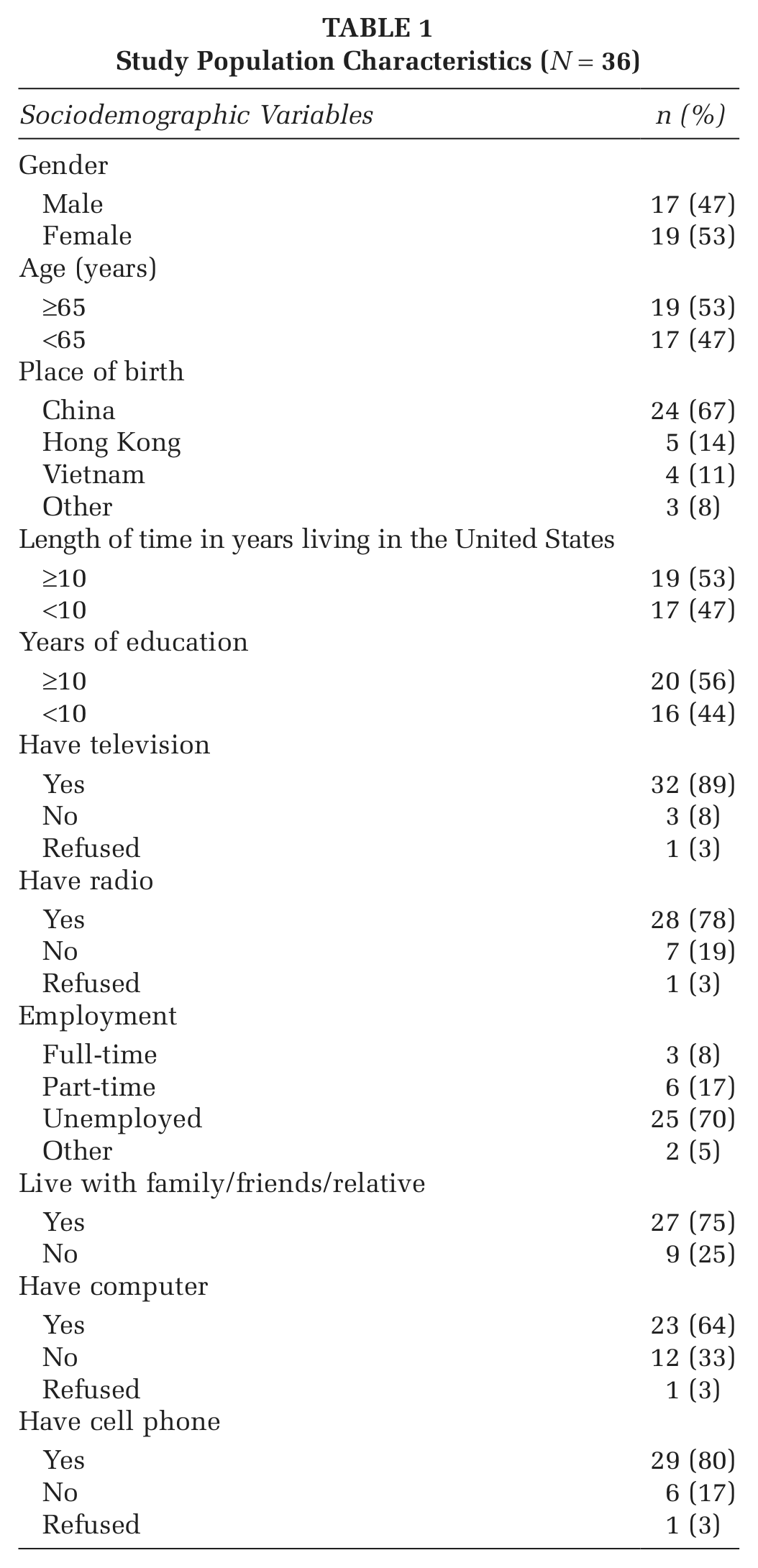
A total of 36 men and women participated in our study. Of these, six (17%) had experienced calling 9-1-1. All participants were immigrants from Asia. They had lived in the United States for an average of 14 years. More than half of the participants originated from China (67%); others came from Hong Kong (14%), Vietnam (11%), and other Asian countries (8%). About 40% of the study participants had attained more than 12 years of education. Most participants lived with friends or family. Table 1 shows the demographics of the study participants.
Study Population Characteristics (N = 36)
Emergencies Identified by Chinese LEP Individuals
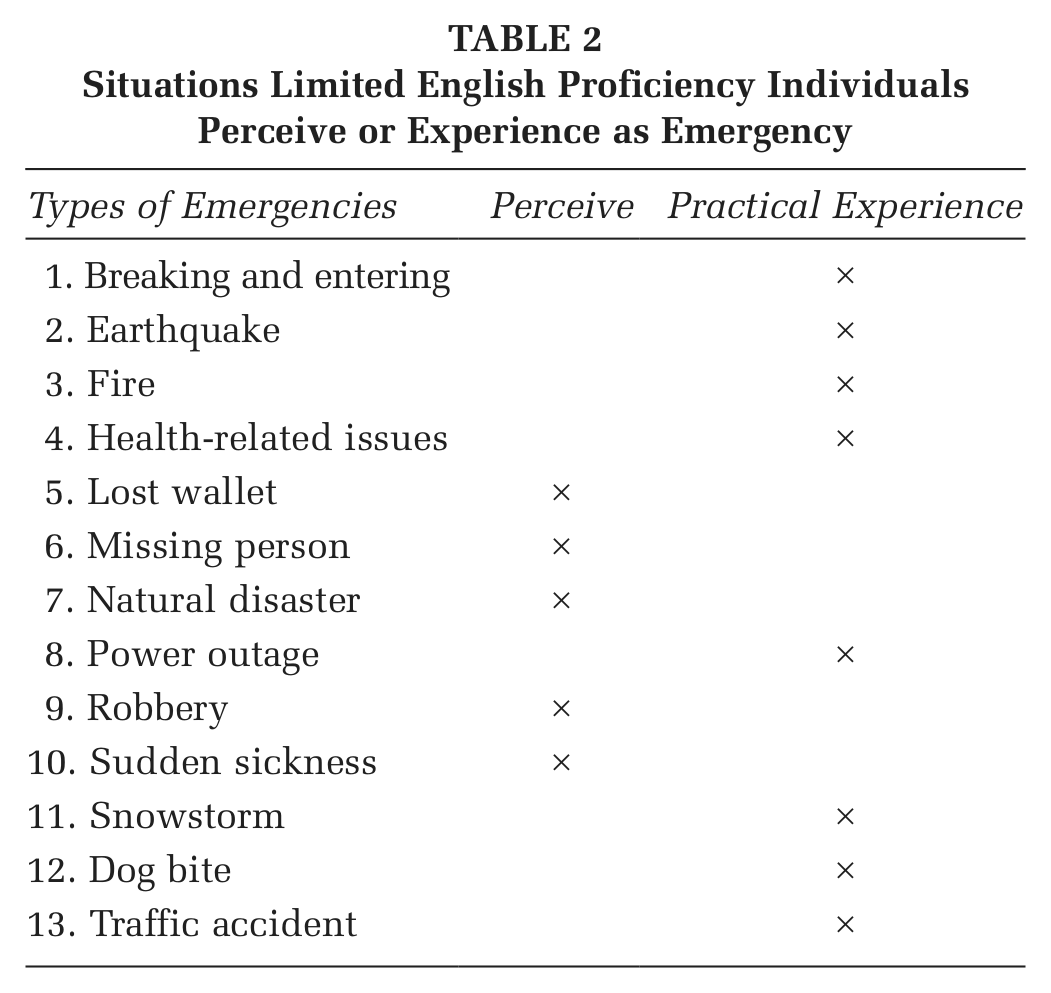
Most participants believed that a situation that puts a person’s life or property at risk constituted an emergency, especially when a life is in danger and help is needed to save a life. Earthquake, one of the more frequently occurring natural disasters in the Northwest region, was the most commonly cited emergency situation that they had experienced. The majority of the emergency situations described were routine daily emergencies rather than public health hazards such as pandemic influenza or bioterrorism. Table 2 gives the list of actual encounters and perceived emergencies identified.
Situations Limited English Proficiency Individuals Perceive or Experience as Emergency
Perception of an Emergency
When participants were asked how they determined if an event was an emergency, two main contextual features emerged. Participants considered urgency and seriousness as essential components to making a determination. The presence of these two features will trigger individuals to respond, regardless of the nature or the magnitude of damage caused by the event. One participant explained how he determines if a situation is an emergency: I think you have to judge how serious the situation is . . . it means someone’s life is in danger. Like that gentleman [another participant] said when you’re being robbed and your life is threatened. Another example is if someone gets injured in a car accident.
Another participant gave an example of an actual experience: One night I was working at the store [bakery]. While I was working [making donuts], a big guy knocked on the door, yelling at me to open it. I didn’t let him in and motioned for him to leave, but he kept yelling, kicking, and knocking. In that situation, I had to call 9-1-1, even though I do not speak English well. I wouldn’t call my family first given that this is an urgent situation. I asked for help [by calling 9-1-1] and the police came in a few minutes.
Ability to Manage the Situation
Immediate response is required in an emergency situation to minimize further threats and damage. Action taken often results from a quick evaluation of the situation and the existing resources a person has. For LEP individuals, perceived ability to manage the situation determines whether external help is needed. When LEP individuals feel capable of managing the situation themselves, they are unlikely to seek outside assistance. One participant shares her story: Dialing 9-1-1 is a last resort. It doesn’t matter whether you think it’s necessary; if you feel helpless then you should call. For example, if my daughter got sick I wouldn’t call 9-1-1, I’d just take her to the emergency room myself. I live with my in-laws and if they collapsed and I couldn’t wake them up or carry them, then I would need to call 9-1-1. If they were walking around at home and fell but were able to move, I could still drive them to the hospital. I would only call 9-1-1 if they were unconscious.
The ability to manage the situation is twofold: personal preparedness and the ability to use available resources. In emergency situations where communication with available resources fails and one perceives that no help will be received, the ability to control the situation is reduced. One participant described her feeling of hopelessness when she felt unable to manage a situation when help was not available.
I remember when I was walking in my neighborhood; a big dog jumped over and chased me. At that time I just resigned myself to fate. I had no way [to get out] or means [to get help]. I wanted to escape. I cried out loudly and there was no one nearby. Who would hear even though I yelled loudly? I could only cover my eyes with my hands. I could do nothing. If that dog was going to bite me I could only let him do it. I could be dead.
Evaluation of Available Channels or Resources for Help
On recognizing that help is needed, the next step is to identify the best existing channel or resource. Whether a particular channel or resource will be used depends on the LEP person’s perception of the resource that the person believes he or she can successfully communicate through. The majority of our participants were resigned to seeking help from family members and friends rather than outside help. One participant shared his story of how an LEP Chinese elder asked for his family’s help: My daughter [who speaks English] helped her [an old lady] call 9-1-1. It happened when my wife got a call in the middle of the night from the old lady she takes care of. She said she did not feel very well. My wife is a home helper and she takes care of this lady during the day. This old lady called my wife for help. Neither this lady nor my wife speaks English. So, my daughter helped us make the call. We [the family] immediately drove to where the old lady lives to check on her. When we arrived at her home, they [Emergency Medical Service] were already there.
An elderly participant shared his thoughts: Our daily lives [referring to himself and his wife] depend on our apartment manager. One day we heard someone scream loudly outside of our unit. We were scared to death. We do not speak English and only two of us are Chinese [among the residents]. We walked out of our unit and followed other residents who were running out of the building. To a large extent, our lives depend on the apartment manager who is on duty. I have to rely on him.
LEP participants also mentioned that resources such as hospital emergency rooms and community-based organizations can help them respond to an emergency. Though 9-1-1 is the only public emergency response service, some LEP individuals may not consider it to be the most appropriate resource for dealing with an emergency. Some participants hesitate to use the service even though it is accessible, efficient, and effective. One participant made this comment about his lack of understanding about 9-1-1: No one ever taught me how to call 9-1-1, neither in the community, nor in a class does that teach you what to do when you call 9-1-1. I have been [residing] here for decades and have not seen anything [public education] in the newspaper telling new immigrants what they should do when calling 9-1-1.
Another participant said that she does not know what to say because she has no prior experience calling 9-1-1: Right after I came [immigrated] here, I knew about 9-1-1. Yet I don’t know how to make the call. I haven’t had the need to call yet. My relatives and friends told me if something comes up [emergency] you have to call 9-1-1, but I really don’t know what to say.
Self-Efficacy in Accessing Resources or Channels
Confidence in using a particular channel or resource (such as family members or friends) among other available resources stems from the belief that in a crisis, individuals will only attempt to do what they believe will successfully help achieve the perceived outcome, like resolving a crisis, offering protection and support, or alleviating danger or harm. Family members or friends are the preferred sources for help or access to other resources because they can provide the interpretation that is needed by the LEP. Also, they are trusted resources. One participant shared that his strategy to access help is through family members: I will look for family members first to make that call [calling 9-1-1]. If they are not at home, I will call myself.
Another participant agreed, Yes. That’s exactly what I think. Since my English is not good, I will notify my son first [who speaks English and Chinese] if I have an emergency. Then my son will call my daughter. That’s the way [to communicate].
Facilitators and Barriers
A language barrier is identified by many LEP individuals as the main stumbling block to receiving information or accessing resources during an emergency. One participant expressed his information needs: English is common all over the world and in the U.S. But in this community, the government should allocate more funding [to disseminate emergency preparedness information] to the local community. We are talking about emergencies. It is not language [whether the individual speaks English] that matters, it is information that should be available to all.
Despite the language barrier, some look for ways to expand their resources to obtain information. Another participant said, Ultimately you have to realize that this is an English speaking country. You have to live with the system [English being the most common language used]. You won’t be able to use your own language. You have to ask your friends [for information] or go to school [have the kids ask for information]. You have to find more resources [to inform yourself]. You cannot just sit there and wait.
Response to Emergency
Emergency situations vary by nature, magnitude, and stages. This highlights the importance of being adaptable during times of crisis. Yet previous exposure will help an individual be prepared, know what to do in times of crisis, and what strategies are effective. This indicates that besides learning ahead of time about disaster preparedness, mastery of previous experience also enhances one’s confidence in dealing with an emergency. A male participant showed how he learned from experiencing an earthquake twice.
This was the second time I had experienced an earthquake. It was around 10 a.m. and I had not opened my business yet. I had just arrived [at the restaurant] when I saw a pole shaking. I quickly dashed out the back door. This time I became smarter. I tried to call [9-1-1] using my cell and also the phone in my restaurant, but I could not get through.
Success in handling a previous emergency enhanced one’s confidence when faced with a similar event. Another participant shared how she applied her experience calling 9-1-1 to help a stranger in an emergency situation: I have been here for seven years. We Chinese people like to stir-fry food and since my husband has many brothers and sisters, we love to get together to eat. Once while we were cooking, there was a lot of smoke which set off the smoke detector. At first we didn’t know it was because of the smoke from our cooking. We wondered if there was a fire. I was very scared. I called 9-1-1 and the person who answered spoke English. I don’t understand English and I didn’t know what to say so I hung up. They [the dispatcher] called me back and had someone [interpreter] who speaks Chinese talk to me, so I could tell them what had happened. Then two years later, one day when my husband got off the bus after work, a woman who also got off the bus suddenly collapsed. My husband called me [on his cell phone] asking me to call 9-1-1 because he cannot speak English. This time, I called 9-1-1 and could tell them the intersection, the street name, and that a person had fallen down. I knew what to say this time.
Discussion
This exploratory study reveals the response processes of Chinese LEP individuals in emergency situations that may also be applied to other LEP populations. An LEP individual’s perception of his or her ability to manage an emergency depends on two contextual factors: the urgency and seriousness of the situation. When an LEP individual believes he or she cannot handle the crisis, help is sought. This triggers further response by searching for the best available channel. During this stage, prior experience, either shared or personal, in using a specific channel and the channel characteristics such as credibility, effectiveness, and efficiency play a crucial role in helping individuals decide which way to go. Among all available resources, an LEP individual will select the one that he or she believes can connect to. Barriers such as a low level of literacy or facilitators, such as availability of an interpreter, will influence the action taken. Of importance, response to emergency as a result of this series of information and resource gathering, synthesis, and use may not always result in a positive outcome (Figure 1).
Our focus group findings suggest that self-efficacy plays an important role for Chinese LEP individuals in deciding when, where, and how to seek help during an emergency. Self-efficacy may be an important psychological variable that positively shapes an individual’s response to an emergency situation by increasing his or her confidence in handling the crisis and in communicating to access resources. Perceived level of self-efficacy both in managing the situation and accessing a specific channel may encourage an individual to exercise his or her best judgment in unusual circumstances. Individuals with higher levels of self-efficacy are more likely to succeed in accomplishing the task at hand (Bandura, 1997). If individuals believe they can act effectively in an emergency, they are more likely to do so, regardless of whether they are LEP or non-LEP individuals. This is consistent with previous literature that self-efficacy and sense making are fundamental to the process of crisis response. Self-efficacy has been used as one of the theoretical constructs in the crisis and emergency risk-communication framework (Veil et al., 2008).
Several implications from this model are worth considering in helping the Chinese LEP individuals prepare and respond to emergencies. First, designing risk communication messages to include the concept of “urgency” and “seriousness” and align them with preparedness planning (such as “3 days/3 ways”) may engage more Chinese LEP individuals in emergency preparedness. As Chinese LEP individuals understand when a situation is urgent and serious, they become aware of the importance of being prepared (such as stocking up and having an evacuation plan).
In times of crisis, effective communication with the LEP population is vital to increasing their awareness of the situation, allowing them to assess the situation precisely and respond appropriately. The increasing occurrence of novel hazards such as H1N1 or terrorist events adds another level of uncertainly to the complex nature of disasters. Thus, delivering accurate, credible, and timely information during crisis and disasters becomes even more important. A sudden change in the course or stage of a disaster may change the individual’s perception of the “seriousness” and “urgency” of the situation, resulting in an over- or underestimation of the impact of the disaster to his or her well-being. Therefore, when communicating with LEP populations, it is important to accurately represent the situation. Messages must be framed and delivered appropriately to avoid unnecessary fear.
The LEP individual’s confidence in accessing a specific channel or resource to receive information or seek help during emergency also depends on the number of existing resources. Similar to other study findings, both Latino and Chinese LEP respondents felt they received inadequate information for emergency preparedness (Carter-Pokras et al., 2007; Yip et al., 2009). Lack of awareness of existing community resources may lead LEPs to think that they have few options, thereby lessening their capability to respond. Community resources such as the local health department, Red Cross, or city emergency management division need to make themselves known to the LEP community to disseminate emergency preparedness information. The Vulnerable Population Action Team and Community-Based Public Health Practice at Public Health–Seattle & King County have done excellent work in establishing contacts and partnerships, as well as developing a “Community Communications Network” to enhance public response to a pandemic. This type of program may increase knowledge of the LEP individuals about community resources, thereby improving confidence in reaching these agencies in the time of crisis.
Further research is needed that incorporates self-efficacy into communication and educational strategies for preparing LEP communities. More efforts are needed to design interventions geared toward these three areas that ultimately promote the LEP individual’s self-efficacy in dealing with emergency situations. Additional research needs to be carried out to test the relevance of the suggested model to other LEP populations.
Footnotes
Authors’ Note:
This study was supported by Cooperative Agreement Number 1P01TP000297-01 from the Centers for Disease Control and Prevention. Its contents are solely the responsibility of the authors and do not necessarily represent the official views of the Centers for Disease Control and Prevention.