




Abstract
The purpose of this article is to provide a brief background of quality assurance efforts in health education, provide a brief overview of the new Council on Education for Public Health (CEPH) accreditation process for stand-alone baccalaureate public health programs that prepare health education specialists, and describe the experience of two academic programs in reviewing their curricula for coverage of the newly approved CEPH requirements. The University of Alabama and the University of North Carolina Wilmington undertook a curriculum mapping exercise identifying which courses in their programs Introduced, Reinforced, and/or Covered each of the Critical Components Elements identified by CEPH. The mapping process is described, and recommendations for other programs considering accreditation under the newly adopted CEPH standards are provided.
Quality assurance in higher education means that there is a planned and systematic pattern of training that will provide confidence that students, upon graduation and certification, will be able to perform the competencies in a given field, in our case, as a public health education specialist. The purpose of this article is to provide a brief background of efforts to ensure quality in health education, provide an overview of the new Council on Education for Public Health (CEPH) accreditation for freestanding undergraduate public health programs that prepare health education specialists, and describe the experience of two academic programs in reviewing their curricula for coverage of the newly approved CEPH curricular requirements. The scope of this article is limited to the required elements of coverage for the public health domain.
Health education has a long and exemplary history of establishing quality assurance mechanisms, and this has been well-documented in the literature (Cleary, 1995; Cottrell, Auld, et al., 2012; Taub, Birch, Auld, Lysoby, & Rasar King, 2009). Credentialing is the means by which professions such as health education demonstrate quality assurance at both the individual practitioner level and the academic program level. Typically, individual professionals are certified or licensed and academic professional preparation programs are approved or accredited (Cottrell, Girvan, & McKenzie, 2012). The concept of individual certification was conceived in the late 1970s and became a reality in the late 1980s via the Role Delineation Project (Cleary, 1995). Individual certification of health education specialists has been available through the National Commission for Health Education Credentialing (NCHEC) since 1988 (Cottrell, Girvan, et al., 2012). The Society for Public Health Education and the American Association for Health Education collaborated in 1984 to establish the Society for Public Health Education/American Association for Health Education Baccalaureate Program Approval Committee (SABPAC) as a means of program approval for undergraduate community and public health education programs (Bernhardt et al., 2003). Overviews of all credentialing mechanisms in health education, at both the individual and programmatic levels, have been published by Cottrell and colleagues (Cottrell, Auld, et al., 2012; Cottrell et al., 2009).
Several important recommendations for improving quality assurance, including the recommendation to move from SABPAC program approval to accreditation, were made by the National Task Force on Accreditation in Health Education (Allegrante et al., 2004). A second task force, the National Transition Task Force on Accreditation in Health Education convened a profession-wide meeting in 2006 to discuss quality assurance, and the results of that meeting have been published (Taub et al., 2009). In 2008, the National Implementation Task Force on Accreditation in Health Education was established and is still functioning (Cottrell, Auld, et al., 2012). Early efforts to establish an accreditation system and criteria for stand-alone baccalaureate public health programs as well as the processes for core curricular definition within those criteria have been well described in the literature (Barnes, Wykoff, King, & Petersen, 2012; Cottrell, Auld, et al., 2012; Wykoff, Petersen, & Weist, 2013).
Stand-Alone Baccalaureate Public Health Program Accreditation
In June 2013, after extensive input from a variety of undergraduate public health programs, the Accreditation Criteria for Standalone Baccalaureate Programs were adopted by the CEPH Board of Councilors (CEPH, 2013). The Council intentionally framed the criteria broadly so that they would be attainable by programs of all types, including those with a preprofessional, liberal arts focus as well as those, like health education, with a professional focus around a specific area and function within the public health system. To be inclusive, the criteria allow programs to cover a broad understanding of public health as well as specific competencies in those specialty fields that require them for certification now, like health education, or in the future.
Although the criteria for stand-alone baccalaureate programs address many aspects of program functioning, one of the most important influences on the development of curricular criteria for stand-alone baccalaureate program accreditation was the development of the critical component elements (CCEs) of an undergraduate degree in public health (Barnes et al., 2012; Wykoff et al., 2013). These CCEs include basic domains (typically covered in the general education program of any undergraduate experience), core public health domains (those areas of knowledge specific to public health), cumulative experience and field exposure (integration of knowledge and skill developed throughout the program along with exposure to field-based public health practice at an appropriate level for the goals of the program), and crosscutting areas (e.g., professionalism, teamwork, and interprofessional practice). These elements, as well as the process for refining and vetting them for broad-based acceptance, are described fully in Wykoff et al. (2013). Importantly, these elements were defined to describe what should be covered during formal education programs in public health (including programs specializing in the preparation of public/community health education [CHE] specialists), not how that coverage should occur. Due to the widespread acceptance among various sectors of the public health community, and the general and flexible nature of the CCE recommendations, CEPH proposed them as the “core public health” curricular requirements in its criteria for stand-alone baccalaureate programs.
In January 2013, CEPH convened focus groups of faculty members and designated leaders from stand-alone baccalaureate programs. Following significant revision to the draft criteria for stand-alone baccalaureate programs based on feedback from focus groups, CEPH distributed the draft criteria for public comment. In June 2013, CEPH considered all comments and ultimately adopted the criteria and an implementation plan. CEPH will consider its first applicants for accreditation of stand-alone baccalaureate programs in February 2014, with the first site visits in fall 2015 and the first accreditation decisions anticipated in spring 2016 (CEPH, 2013).
The current research was undertaken, in part, due to a call by Barnes et al. (2012) to “survey the various ways in which the core public health elements described by the CCEs are being achieved in existing undergraduate health education programs” (p. 723). However, it also can serve as a pilot for programs that are preparing community/public health education specialists and may intend to pursue accreditation through CEPH in the future. Barnes et al. posit that the CCEs and the NCHEC competencies are likely to be complementary in many areas, but they also acknowledge that some revisions to existing health education curricula may need to be made in order to fully address the curriculum in all areas. The current mapping project undertaken by the CHE programs at The University of Alabama, Tuscaloosa (UA), and the University of North Carolina, Wilmington (UNCW), will provide lessons learned as well as identify what may be common gaps in coverage. These two programs were selected because UA is a large, comprehensive program with both master’s-level and doctoral-level professional preparation in health education, whereas UNCW is a smaller, stand-alone program with no graduate offerings.
The University of Alabama
The University of Alabama, located in Tuscaloosa, is a student-centered research institution and is considered the flagship campus among the state universities in Alabama. A total of 34,852 undergraduate, professional, and graduate students were enrolled during the fall 2013 semester (The University of Alabama, 2013). The Carnegie Foundation for the Advancement of Teaching classifies UA as a Research University–High Research Activity (Carnegie Foundation for the Advancement of Teaching, 2013a).
UA’s Department of Health Science offers an undergraduate degree in health studies with two concentrations: prehealth professions and health education and promotion. For the fall 2013 semester, approximately 160 undergraduate students were classified as health studies majors. The prehealth professions concentration is designed to prepare students to enter graduate programs in health-related fields such as medicine, dentistry, physician’s assistantship, and physical therapy. The health education and promotion concentration is designed to prepare students to enter the public health education profession or to pursue graduate study in health education and promotion.
Prior to the fall 2012 semester, the department did not offer concentrations. All students were in the undergraduate health studies program, and the singular focus of the program was professional preparation in health education and promotion. The development of the two concentrations was also deemed necessary to best meet the future aspirations of students
One of the initial steps in the 2011 review was to assess the required courses for coverage of the NCHEC competencies and subcompetencies. Based on this assessment, it was determined that although some content adjustment was necessary in required courses, overall coverage of the competencies and subcompetencies was adequate. However, based on the graduate-level CEPH accreditation requirements at that time, a decision was made to require courses in four of the five public health core knowledge areas: biostatistics, environmental health sciences, epidemiology, and health services administration. Because the department offered multiple health education and promotion courses, faculty members felt no course additions were needed to address the fifth core area: social and behavioral sciences. In addition, a course was developed that focused on health disparities. A three-credit culminating experience course was also added to the curriculum.
Further review of the undergraduate program in health studies was initiated in spring 2013 after CEPH announced the adoption of new criteria for accreditation of stand-alone baccalaureate degree programs in public health, including those programs that prepare community/public health education specialists. Since these new curricular standards required coverage of the CCEs, this effort focused on assessing their coverage in the course requirements in the health education and promotion concentration. Using a matrix that listed the CCEs in rows and the required courses in columns, department faculty members reviewed the individual courses for which they had responsibility as the course instructor (Table 1). The review was primarily based on an analysis of course syllabi, assignments, and summative assessments. If necessary, contact was made with graduate assistants and adjunct faculty members to clarify course content beyond the syllabus. As faculty members reviewed courses, if a CCE was covered in a course, the specific level of coverage was designated at one of three levels: introduced (I), covered (C), or reinforced (R). The definitions for these levels are presented in Table 2.
Sample Matrix Used for the University of Alabama Curriculum Review of Critical Component Elements
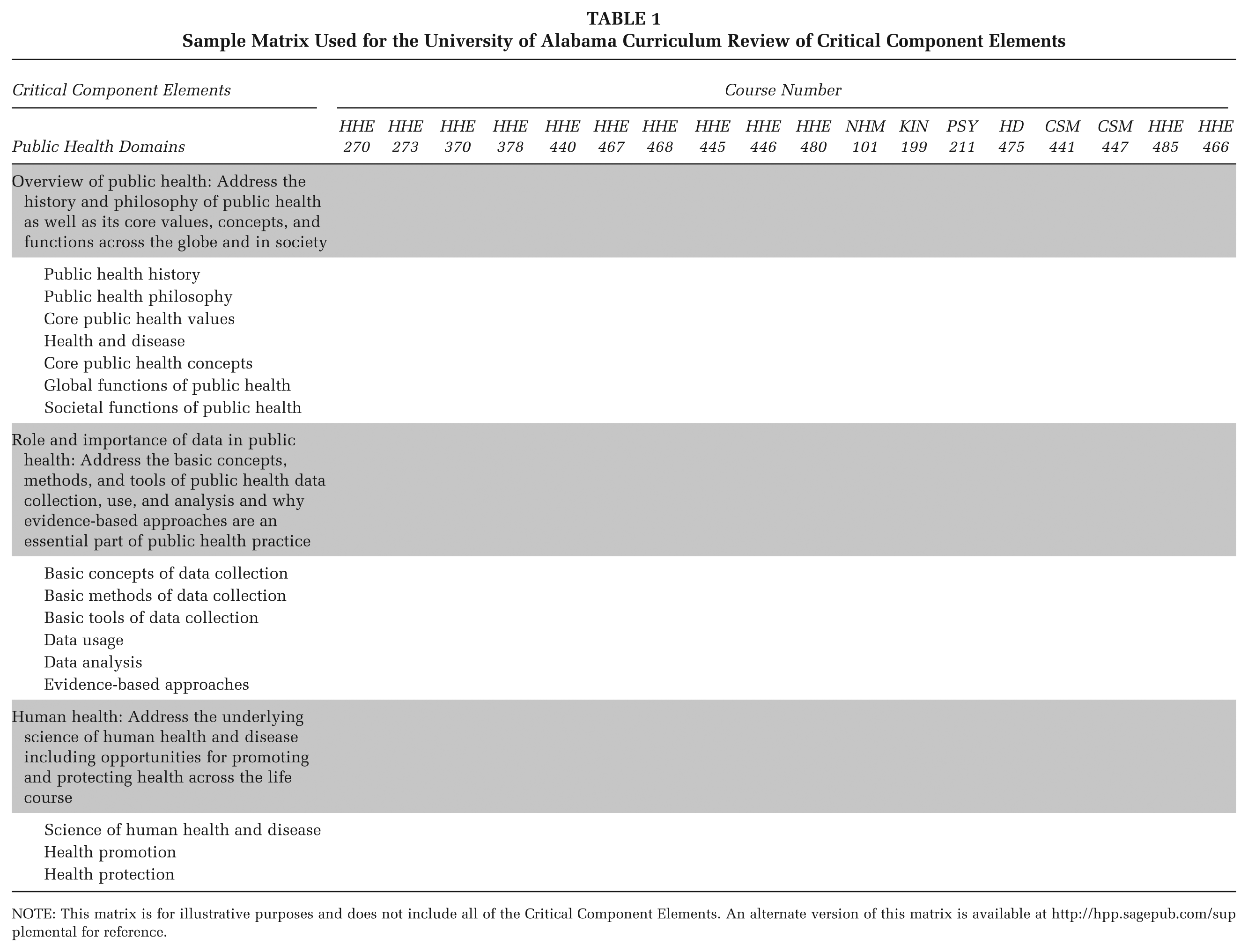
NOTE: This matrix is for illustrative purposes and does not include all of the Critical Component Elements. An alternate version of this matrix is available at http://hpp.sagepub.com/supplemental for reference.
Definitions Used In Identifying Levels of Instruction for the Curriculum Reviews of The University of Alabama, Tuscaloosa, and the University of North Carolina, Wilmington

In six of the nine public health domains, all elements were introduced, covered, and reinforced through instruction, in various courses. In two of the domains, Overview of the Health System and Health Policy, Law, Ethics, and Economics, elements were introduced and reinforced but no courses were reported as covering the elements. In the third domain, two elements were covered and reinforced (i.e., use of mass media and use of electronic technology) without any apparent introduction of the areas. The other two areas in that domain, technical writing and professional writing, were reported as being reinforced but not introduced or covered in courses.
The review of the coverage of the CCEs provided direction for further curriculum review and revision by the Department of Health Science faculty members. Course content and instructional strategies must be reviewed to supplement instruction in those CCE areas that do not appear to be introduced, covered, and reinforced though current course work.
University of North Carolina, Wilmington
UNCW is considered a “4-year or above, public institution with a very high undergraduate enrollment” (Carnegie Foundation for the Advancement of Teaching, 2013b.) The university has a total enrollment of approximately 13,500 students. It is a highly selective university with approximately 14,000 applications to fill 2,000 freshman admissions. There are approximately 110 health education majors.
Historically, school health education was an offering in the physical education program at UNCW. Eventually, a community health concentration was added to physical education. In 2008, the community health concentration evolved into a BS degree in CHE within the Department of Health and Applied Human Sciences. The curriculum for the new CHE degree was based on the SABPAC standards (National Implementation Task Force for Accreditation in Health Education, 2013).
Although the CHE program at UNCW was eligible for SABPAC approval, it did not wish to initiate the approval process given the apparent transition that was occurring in public health education credentialing. The work of the various accreditation task forces had clearly recommended that the health education profession move to accreditation instead of SABPAC program approval and that CEPH be the recognized accrediting body. Given the major undertaking a review/revision of the existing curriculum entailed, there was little support for securing what might soon be an obsolete program approval. With this in mind, the faculty began to investigate adding more general public health content to the degree in order to complement the specific CHE focus.
Determining the content and structure of the developing undergraduate program requirements proved to be more difficult than anticipated. Despite the seemingly inevitable transition to accreditation, in 2011 no clear guidelines were available with which to establish an “accreditable” stand-alone undergraduate public health education program.
In an effort to better facilitate the development of an undergraduate public health education curriculum, an outside consultant was brought in to assist the faculty. With the consultant’s guidance, the faculty identified competencies that would likely be included in a CEPH-accreditable undergraduate public health education program rather than specific courses, understanding that additional program changes would likely have to be made when CEPH adopted its finalized accreditation requirements. In addition, the faculty established a framework for the public health competencies based on an integration of competencies and content proposed by various national professional public health organizations. In 2012 the CHE program changed its name to Public Health Studies to better reflect its evolving focus.
The guiding goals were to establish a competency-based curriculum that would (a) prepare UNCW undergraduates to competently enter the health education/public health workforce at an entry level, (b) provide a solid foundation (both field experience and academic preparation) for students to be competitive candidates in pursuing related advanced degrees, and (c) be comprehensive enough to meet/ exceed whatever accreditation criteria were ultimately approved and implemented.
After the core public health competencies to be addressed in the curriculum were identified, some existing courses were eliminated or modified and new courses were developed where needed. Ten courses were identified as the “core” that together would provide the competencies for all students pursuing the BS in public health studies degree. Many of these courses were already offered for CHE students (i.e., global health, health administration and organization, epidemiology and an internship requirement). However, to meet the anticipated competencies, courses that had not previously been offered were developed (e.g., introduction to public health, social and behavioral determinants of health, environmental health, health ethics, policy, and law). Due to limited faculty resources, the addition of the new courses resulted in eliminating some electives.
A common course syllabi template was developed and used for all courses in the program. The syllabi were structured around the competencies that each course would cover and identified specific artifacts to demonstrate that the competencies had been met. The needed artifacts for each course were determined by consensus among the faculty prior to course assignments being determined. This approach was taken to enhance a competency-based curriculum that was independent of individual faculty interests.
In April 2013, UNCW began a pilot mapping project to assess how UNCW’s BS in public health studies’ curriculum aligned with the 36 “critical component elements” announced by CEPH in its evolving undergraduate public health accreditation process. The CCEs were significantly different in structure and intent from the competencies that had been used by UNCW. A matrix of CCEs and the UNCW public health studies required courses was generated. Each CCE was categorized as having been introduced (I), covered (C), reinforced (R), or not covered (left blank) for each course.
In applying the matrix to the existing curriculum, all 36 CCEs were “introduced” and “covered” in at least one course. CCEs ranged from being “reinforced” once to being reinforced in four different courses. One CCE was identified as not being reinforced. The ultimate format developed by CEPH for accreditation of undergraduate programs in public health was based on documentation of the coverage of critical elements rather than competencies. As a result, the curriculum developed by UNCW contained many specific competencies that were not required in the standards. Although it is always acceptable to exceed accreditation standards, UNCW faculty plan to further review and consider its competency-based curriculum.
The curricular transition undertaken at UNCW was arduous but worthwhile. Courses that did not cover required competencies were eliminated, which made room for new courses. The faculty are now aware of what is covered in each course, and duplication of content has been eliminated except where it is being intentionally used to reinforce concepts previously taught. The process has made the public health studies program at UNCW ready to initiate CEPH accreditation for stand-alone undergraduate public health education programs.
Discussion and Recommendations
The completion of this mapping exercise in two disparate university settings demonstrates that CEPH accreditation requirements can be readily met by a variety of health education programs. In conducting their reviews, the program coordinators and faculty at both UA and UNCW learned valuable lessons that are shared below:
Prior to the initiation of the review, all participating faculty members should discuss definitions of the “introduce,” “cover,” and “reinforce” levels used in evaluating CCEs for CEPH accreditation. A specific, operational definition should be developed and used for each level of coverage. To help ensure validity and reliability in this process, specific examples of all three levels should be reviewed and agreed on before examining any course materials. Not all CCEs were introduced, covered, and reinforced. Some, for example, were only covered in one course with no introduction and no reinforcement. All of the CCEs, however, were “covered” at some point in the curriculum.
Through the mapping process, the authors noted that the “introduce, cover, and reinforce” sequencing does not always occur as planned. Students often take courses out of sequence. They may, for example, be in a course in which a CCE is covered before taking a course in which it is introduced or in a course in which a CCE is reinforced before a course in which it is covered. Although it is not feasible to rigidly sequence every course in the curriculum, departures from the I-C-R progression should be minimized whenever possible.
If possible, more than one faculty member should review individual courses to ensure agreement on CCE coverage. During the accreditation process, self-study reviewers and site visitors will be making this same determination, and the more people that review and agree on coverage the better.
For those CCEs that are addressed through courses outside of the department, especially through the university core curriculum where students will have a range of course choices, CCE coverage may vary from one course to another and thus coverage may vary for individual students within a program.
Coverage of CCEs within a specific required course may vary from student to student. For example, in a research methods course or statistics course taught outside of the department, students may have the option of selecting a topic for an assignment or course project. Students who apply a public health topic to the assignment or course project may address the CCEs in a different manner than those who do not apply a public health topic to the assignment.
The mapping process indicated that there is significant overlap between the CCEs and the NCHEC competencies, on which both the UNCW and UA programs’ curricula were based. Minor changes may need to be implemented to the overall curriculum or to individual courses, but these should not require significant additional resources in most situations.
Even though the accreditation criteria do not require the use of artifacts to demonstrate coverage, it is still recommended that artifacts be identified for each course and that those artifacts be included in a portfolio just as the NCHEC competencies should be demonstrated through a variety of artifacts. A portfolio showing the CCEs and NCHEC competencies would be valuable in documenting coverage to self-study reviewers and site visitors. Furthermore, such a portfolio would be valuable for program evaluation purposes and for students to demonstrate accomplishments to potential employers.
It is important to make sure that all curricular requirements for accreditation are covered in classes that are required of all undergraduate public health majors, regardless of concentration. It is especially important to be aware of this if there are course options offered to students or multiple concentrations within the major.
An advantage of the mapping exercise is that it helps coordinate the entire curriculum so that content presented in more than one course can be more deliberately managed. In cases where the content merits reinforcement, faculty can refine the material to minimize redundancy and maximize the integration of the material.
In summary, this was a positive experience for both UA and UNCW. The mapping process helped determine where weakness or gaps existed in the programs’ curricula, helped demonstrate readiness for accreditation, and provided valuable time to review and reflect on the curriculum. For CEPH, the mapping process conducted by UA and UNCW identified issues that could be resolved prior to implementing the accreditation process and helped confirm that accreditation would be feasible for most public/CHE programs.
Footnotes
Supplemental Material
An alternate version of the sample matrix illustrated in Table 1 is available at  for reference.
References
Supplementary Material
Please find the following supplemental material available below.
For Open Access articles published under a Creative Commons License, all supplemental material carries the same license as the article it is associated with.
For non-Open Access articles published, all supplemental material carries a non-exclusive license, and permission requests for re-use of supplemental material or any part of supplemental material shall be sent directly to the copyright owner as specified in the copyright notice associated with the article.
