



Abstract
Cultural competence is an important aspect of health service access and delivery in health promotion and community health. Although a number of frameworks and tools are available to assist health service organizations improve their services to diverse communities, there are few published studies describing organizational cultural competence assessments and the extent to which these tools facilitate cultural competence. This article addresses this gap by describing the development of a cultural competence assessment, intervention, and evaluation tool called the Cultural Competence Organizational Review (CORe) and its implementation in three community sector organizations. Baseline and follow-up staff surveys and document audits were conducted at each participating organization. Process data and organizational documentation were used to evaluate and monitor the experience of CORe within the organizations. Results at follow-up indicated an overall positive trend in organizational cultural competence at each organization in terms of both policy and practice. Organizations that are able to embed actions to improve organizational cultural competence within broader organizational plans increase the likelihood of sustainable changes to policies, procedures, and practice within the organization. The benefits and lessons learned from the implementation of CORe are discussed.
Keywords
Introduction
Providing inclusive and appropriate services that meet the varied needs of racial/ethnic minorities can be a challenge for health and social services in Western countries, particularly due to changing demographics (Australia Bureau of Statistics, 2013; Batalova & McHugh, 2011). Cultural competence is an approach used to promote the improvement of health care service access and delivery for racial/ethnic minorities. It began with a focus on the interpersonal domain of the practitioner–patient/client interactions, however, its scope has expanded to include organizational and systemic strategies. Cultural competence is recognized by leading institutions such as the World Health Organization (Wahoush, 2009) and Institute of Medicine (2009), as well as various organizations and branches of governments in countries such as the United States, Australia, and Britain (Bhui, Ascoli, & Nuamh, 2012; National Health and Medical Research Council, 2006; Office of Minority Health, 2013).
Previous research has shown a relationship between the cultural competence of organizations and the cultural competence of staff (Darnell & Kuperminc, 2006; Paez, Allen, Carson, & Cooper, 2008). Darnell and Kuperminc’s (2006) study of public mental health agencies, showed that agencies had significantly higher employee perceptions of organizational cultural competence in the presence of culturally competent mission statements and cultural competence training requirements. A U.S. study of primary care providers and their clinics by Paez et al. (2008) found that providers who reported that their clinics had adopted recommendations made in the Culturally and Linguistically Appropriate Services (CLAS) standards (e.g., culturally diverse staff, cultural diversity training) were more likely to have attitudes and behaviors that were culturally competent. As such, staff may be influenced by an organization’s commitment and actions in relation to cultural diversity.
Existing Organizational Cultural Competence Tools
The increasing recognition of the importance of cultural competence has led to the burgeoning number of cultural competence frameworks and tools available to assist health practitioners and health organizations assess the provision of culturally appropriate services (Multicultural Mental Health Australia, 2010; Olavarria, Beaulac, Belanger, Young, & Aubry, 2005). However, many organizational assessment tools are limited by their narrow focus on individuals as opposed to organizations (Trenerry & Paradies, 2012).
There are few published studies describing organizational cultural competence assessments and the extent to which these tools facilitate the adoption of cultural competence in practice. Recent research describes organizational cultural competence evaluations at a single community health center in a Canadian city (Cherner, Olavarria, Young, Aubry, & Marchant, 2015) and 125 hospitals in California (in the United States; Weech-Maldonado et al., 2012). Cherner et al.’s (2015) in-depth evaluation of a community health center used multiple data sources and included the perspectives of multiple stakeholders, while Weech-Maldonado et al.’s (2012) study describes the development and validation of a survey tool. Neither of these studies report whether there was the creation and/or implementation of a plan to address the findings of the cultural competence assessment(s). On the other hand, Fung, Lo, Srivastava, and Andermann (2012) developed a multiyear cultural competence plan following an organizational review at a large mental health care institution in Ontario; however, the outcomes of implementing the cultural competence plan were not reported. Reviews of cultural competence interventions and assessment tools have found that more research is needed to determine the impact of organizational tools and the extent to which they facilitate organizational change (Harper et al., 2006; Truong, Paradies, & Priest, 2014).
This article describes the development of a cultural competence assessment, intervention, and evaluation tool called the Cultural Competence Organizational Review (CORe). A case study is used to describe the implementation of CORe at three different organizations as part of the Teeth Tales study (Gibbs et al., 2014). During the early stages of the Teeth Tales study, the need for a reorientation of health services to better deliver dental and family services to racial/ethnic minorities in the community was identified. Following a review of the literature, no suitable tool was found that could be used to help facilitate the reorientation. A new tool was developed in an attempt to address this gap. A key aim of developing the tool was to move beyond assessment only and to provide a mechanism to facilitate service reorientation.
Method
Context/Setting
Community health is a model for the provision of comprehensive and affordable primary health care that supports flexibility in service delivery to meet the needs of the local community. In Australia, community health organizations operate from a social model of health with principles of social justice, health promotion, and equity to guide efforts to improve the health and well-being of local community groups (Telford, Maddock, Isam, & Kralik, 2006). Community health has a strong foundation in community development, having direct links to local groups, developing strong relationships with ethnospecific and multicultural agencies, and engaging in capacity building. Therefore, it is essential that any organizational cultural competence tool used in this context also captures the features of the community health model for it to be effective and useful.
Development of the Cultural Competence Organizational Review (CORe)
The CORe was developed in partnership by Merri Health (MH) The University of Melbourne, and the Centre for Culture, Ethnicity and Health (CEH). The CORe consists of (1) measures to assess an organization’s cultural competence, (2) templates and guidelines for planning and implementing actions to enhance organizational cultural competence, and (3) resources to guide action planning, that is, best practice statements, CEH tip-sheets, and a list of relevant literature, documents, and recommended websites.
The CORe aims to increase an organization’s capacity to be culturally competent to improve health service access and appropriateness for people from racial/ethnic minorities. The CORe is particularly suited to organizations within the health sector that have a service delivery component, such as community health. However, it has potential for use in other contexts with services and programs involving racial/ethnic minorities such as local government agencies (e.g., councils).
Conceptual Framework Underpinning the CORe
Three key cultural competence frameworks provided guidance for the development of the CORe: the Cross (Cross, Bazron, Dennis, & Isaacs,1989) cultural competence model, the Australian National Health and Medical Research Council cultural competence guidelines and the Lewin Group’s (2002) “Organizational Cultural Competence Assessment Profile.” The Cross model and National Health and Medical Research Council guidelines (2006) view cultural competence as being more than an awareness of cultural difference, but bring focus to the capacity of an organization or system to improve health and well-being by integrating culture into all aspects of health service delivery. The Lewin Group’s (2002) assessment profile was used to guide the development of the document audit template in particular. It emphasizes the use of multiple data collection methods and different response formats in organizational assessments to demonstrate rigor in conducting organizational reviews.
Measures
The CORe assesses the quality and responsiveness of an organization’s current practices and policies in relation to its services to clients and communities from racial/ethnic minorities. It comprises a staff survey and document audit to assess an organization’s overall cultural competence along seven domains: Organizational Vision and Values; Governance; Planning, Monitoring, and Evaluation; Communication; Organizational Infrastructure and Partnerships; Staff Development; and Services and Interventions. For example, the staff survey contains questions including “To what extent do you think the organization’s vision and values reflect the diversity of the community?” The document audit contains cultural competence indicators such as “Individuals at executive level have responsibility for implementing and monitoring cultural competence initiatives.” (A copy of the survey and document audit is available at http://www.ceh.org.au/culturalcompetence/cultural-competence-organisational-review-tool-). See Table 1 for a summary of the components of the CORe.
Summary of Components of the Cultural Competence Organizational Review (CORe)

NOTE: CEH = Centre for Culture, Ethnicity and Health.
Staff survey
The survey for staff and managers captures their perspectives of the organization’s cultural competence. It consists of closed- and open-ended questions and takes approximately 15 minutes to complete. The survey is anonymous and confidential.
Document audit
Organizational policies, procedures, plans, and practices are checked and identified against a list of cultural competence indicators. The audit is conducted through a guided interview process with one or more senior managers and takes approximately 2 to 3 hours to complete.
Process for Implementing the CORe
The process of implementing CORe consists of four phases as outlined in Figure 1.
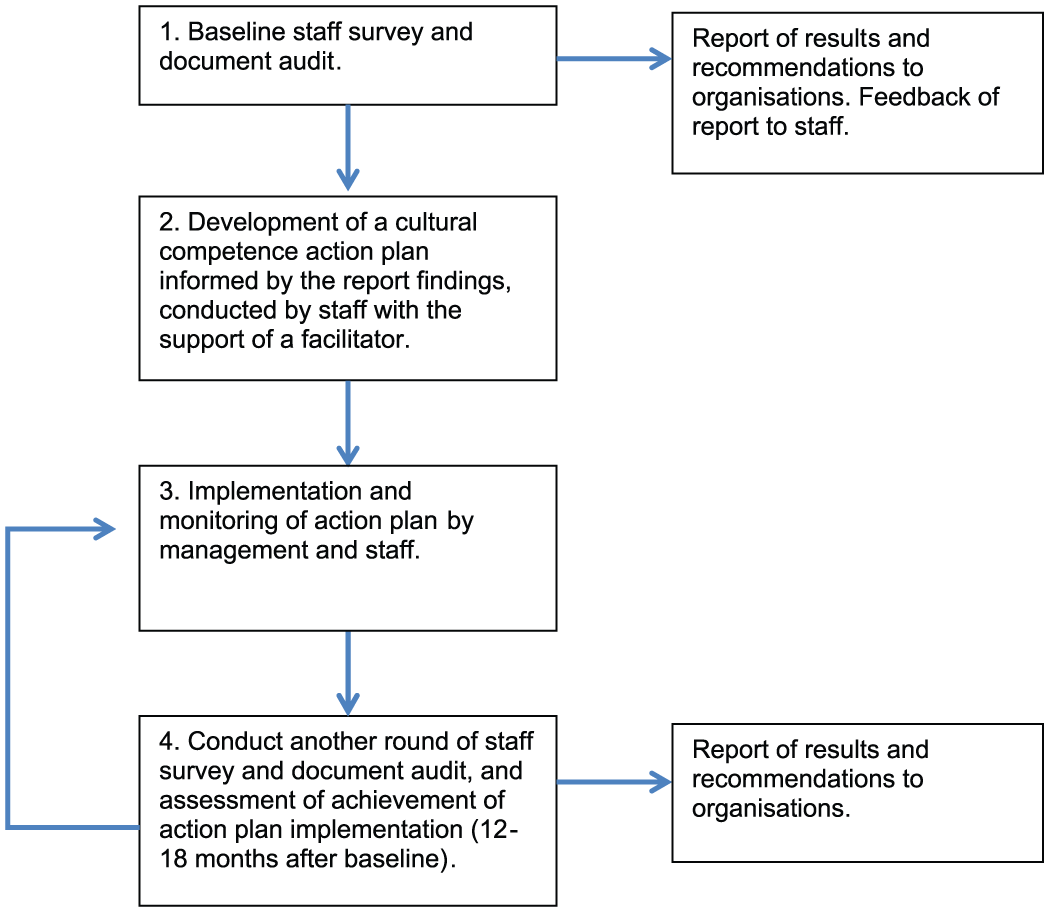
Flow Diagram of Cultural Competence Organizational Review (CORe) Phases
In the first “assessment” phase, the staff survey and document review is conducted by the organization. The responses provide the organization with feedback regarding practice and policy aspects of organizational cultural competence and identify areas for improvement. Results may be compiled in the form of a report, with recommendations for strengthening organizational cultural competence.
During the second “planning” phase, the results of the staff survey and document audit are used by the organization to develop and implement an organizational cultural competence plan to strengthen the organization’s cultural competence. The CORe planning templates can assist with this process. The organization is required to form an action planning committee/working group to facilitate the action planning process. This process can be managed internally but may be aided by an external contributor/facilitator. The CORe action planning process consists of three steps:
Selection of cultural competence strategies: The action planning committee reviews the CORe results and decides which strategies are appropriate, relevant, and achievable for the organization. Some strategies will be identified as “quick wins,” and some strategies likely to be complex and difficult to implement across the organization will be identified. A combination of a few initial “quick win” strategies and then a focus on more complex or longer term strategies is recommended.
Organizational alignment: The committee identifies whether other existing organizational policy, planning, and reporting requirements align with the chosen strategies. Identification of alignment with existing requirements can support sustained organizational change, increase likelihood of implementation and promote consistency in processes.
Action plan for implementation: The committee develops the action plan listing each of the chosen cultural competence strategies and outlining key implementation factors such as allocation of responsibility, resources, and key milestones.
The third “action” phase refers to the implementation and monitoring of the cultural competence action plan by management and staff.
The final, fourth “repeat assessment” phase, occurs approximately 12 to 18 months after the first assessment, whereby the staff survey and document audit are conducted again to assess achievement of action plan(s) and provide feedback for future action planning and implementation.
Data Analysis
Organizations self-administering CORe can analyze the staff survey cross-sectional data using descriptive statistics to describe participant characteristics and provide frequency distributions to each question. The CORe document audit data may be reviewed by an internal staff member(s) and/or external consultant to determine the extent to which the organization’s documented policies and procedures meet the CORe cultural competency indicators within the seven domains. The results of CORe can be used to provide broad indicators of the strengths of the organization in relation to cultural competence and areas that require improvement.
Assessments are conducted for each domain, and each domain has two ratings, one for the staff survey and one for the document audit. There are four possible rating categories to select “performing well,” “could be strengthened,” “suggested area for action,” and “action strongly recommended.” For example, a domain is categorized as “performing well” if all questions from the staff survey receive highly positive responses from participants (i.e., above 80%) or evidence provided for the document audit demonstrates that there is an organization-wide response to cultural competence that incorporates both planning and reporting directives. A domain is categorized as “action strongly recommended” if the majority of staff survey questions received low responses (i.e., below 30%) or there is a lack of evidence in all indicators for the document audit. For more detail regarding assessment of CORe results, see www.ceh.org.au/culturalcompetence/cultural-competence-organisational-review-tool-.
Case Study: Implementation of Core
The CORe was piloted at North Richmond Community Health (NRCH) between May and July 2011, refined and then implemented at MH and Moreland City Council’s Social Policy and Early Years Branch (MCC-SPEY). MCC-SPEY is a branch within a local government organization (council) that provides primary health services in a community setting. All participating organizations provide health care services and are located within culturally and linguistically diverse areas of Melbourne, Australia. The pilot at NRCH was an important step as it allowed for a review of the methods and processes including timelines between baseline and follow-up, methods of data collection, and scoring methods, before rolling out to other sites.
NRCH has over 140 staff members, MH over 320 staff members, and MCC-SPEY over 70 staff members. Response rates for the staff survey were as follows: NRCH = 30% at baseline and 48% at follow-up; MH = 48% baseline and 33% follow-up; MCC-SPEY = 59% baseline and 47% follow-up. Across all organizations, the majority of respondents were born in Australia, had completed a postsecondary school qualification (e.g., technical apprenticeship, university degree), only spoke English, held nonmanagement staff roles, and had direct contact with clients/the community (see the Appendix for more details.).
The baseline CORe assessment was conducted at MH and MCC-SPEY between September 2011 and November 2011. The follow-up staff survey and document audits were conducted approximately 18 months after baseline. Process data were collected through regular partner (fortnightly) and committee (quarterly) meetings and organizational documentation (e.g., meeting minutes and monitoring reports) to monitor the experience of CORe within the organization and if the cultural competence strategies was being implemented as intended. The action planning process was directed by an action planning committee/working group within each organization. Partner organization CEH supported the organizations participating in the CORe by conducting the document audits, helping to identify gaps in service delivery, and providing evidence and guidance toward the development and implementation of cultural competence action plans.
Case Study Results
Following the CORe assessment, each organization took steps toward improving organizational cultural competence. At NRCH a cultural competence plan was developed within the organization’s 4-year strategic plan. Strategies chosen included review of the organizational language services policy, implementation of multilingual health literacy “Ask-me-three” initiative, review and adaption of intake questions and protocols to better record client data, cultural competence identified within strategic planning, and cultural competence training as part of staff induction.
MH incorporated the findings and recommendations into the organization’s Diversity Plan, which is a component of the organization’s strategic plan. The strategies chosen included, piloting and evaluation of staff cultural awareness training, participation in diversity initiatives, greater engagement with community groups, and including questions related to cultural competence in the Client Satisfaction Survey. Some actions are ongoing, such as strengthening of partnerships and collaborations with racial/ethnic minority groups and Aboriginal and Torres Islander agencies to improve service access for their members.
A number of strategies were implemented by the branch management team of MCC-SPEY to raise awareness of the importance of cultural competence in their staff’s work practices and to build knowledge and capacity in relation to cultural competence. Access to cultural competence training for staff when required was ensured and regular information exchange between staff teams (e.g., changing demographic trends) was facilitated so that Moreland City Council and other services were made available to newly arrived families in the area.
The results of the follow-up CORe assessment indicated an overall positive trend in organizational cultural competence at each organization in terms of both policy and practice (see Figure 2 for staff survey and document audit results). The increase appeared greatest at MH, showing improvement in four (out of seven) domains from the survey and all domains except one from the document audit. The incorporation of strategies into an organization-wide plan with senior management support and reporting accountability assisted timely implementation. Many of NRCH’s improvements were “works in progress,” such as updating organizational policies to include more explicit reference to cultural competence. Finalization of the CORe action plan was delayed due to disruptions with moving offices and staff changes during the time of the intervention. More concrete and broad changes were a challenge for MCC-SPEY as they operate as a branch within a large local government organization. Therefore, any potential changes to organization-wide policies and procedures were not captured at in the survey and document audit at MCC-SPEY at 18-month follow-up.

Comparison of Baseline and Follow-up Staff Survey Results at North Richmond Community Health, Merri Health, and Moreland City Council’s Social Policy and Early Years Branch
Experience of Core Within Organizations
Feedback at staff meetings indicated that CORe was acceptable and feasible at the organizations. Conducting the staff survey raised awareness among staff of the value and importance of cultural competence. The partnership underpinning the development and implementation of CORe ensured that the principles of CORe aligned with community health values. It also provided opportunity for community sector organizations with limited resources to undertake an organizational assessment. Findings from the CORe assessment demonstrated the extent to which culturally competent practices and policies were already present while highlighting areas for improvement.
Completion of the survey and document audits were relatively quick and easy. During the process of implementing CORe, particularly during the action planning process, the participating organizations all independently contemplated cultural competence within a broader framework of “diversity.” Staff from the organizations reflected that other groups in the community may also have difficulty accessing services, such as GLBTI (gay, lesbian, bisexual, transsexual, intersex) people and that addressing different aspects of diversity, not only “cultural,” would be more appropriate. This may be due in part to the increasing momentum within the Australian health care policy context toward addressing diversity and discrimination in the community (Department of Health, 2011). The organizations also found that aligning or embedding the CORe within other central organizational plans, in addition to having reporting accountability and senior management support, would result in longer term change and enable the provision of resources to implement the improvements in cultural competence.
Discussion
This article addresses an important gap in the evidence base about organizational cultural competence assessment and intervention. Despite the importance of organizational assessment, there is relatively little known about the outcomes of implementing an organizational cultural competence assessment and the extent to which conducting such an assessment facilitates steps to improve organizational cultural competence.
The CORe has been implemented at three different organizations and although extended time is needed to assess concrete organizational change, follow-up assessment indicated a positive trend toward improvement in organizational cultural competence at all participating organizations. A key learning for organizational cultural competence sustainability was demonstrated when organizations embedded strategies within broader plans. This increased the likelihood of sustainable changes to policies, procedures, and practice within the organization. It is important that cultural competence is viewed as a fundamental part of an organization’s core business, and not just an add-on or accommodation to certain groups (Fung et al., 2012). According to feedback from the participating organizations, implementation of the CORe raised awareness among staff of the value and importance of cultural competence and showed a commitment by the organization’s management to improving service delivery to racial/ethnic minorities in the community.
Although there is no shortage of available organizational cultural competence tools and instruments, the few studies that reported an evaluation had developed their own tools. This shows the importance of organizational context and the need for tools to be adaptable and flexible for different organizations. Our findings indicate that CORe is a suitable tool for facilitating organizational competence in organizations within the community health sector that provide services to racial/ethnic minorities. It was effectively used at the three different organizations, which varied in size (from approximately 70 staff to over 320 staff), and type of workplace (community health service and a branch within local government).
The CORe also provides an opportunity for regular monitoring and review as the staff survey and document review can be repeated at subsequent time points to monitor and evaluate organizational change. A strong feature of CORe is its foundation in community development, participatory methods, and capacity building.
Strengths and Limitations of CORe
The CORe is designed to be a pragmatic tool that guides self-assessment of organizational cultural competence—as such it is not exhaustive or a comprehensive assessment. The staff survey is designed to capture staff perceptions of organizational cultural competence rather than provide an objective measure and representativeness of an organization depends on participation rates. It is cross-sectional rather than longitudinal to maintain anonymity and in recognition of high turn-over in many community-based organizations. Staff survey results are a simple summation of scores in each section that are not weighted to reflect potential differential impacts of each section. The document audit is limited by the senior staff member’s knowledge of the range of organizational policies and procedures. It provides a checklist of the presence of policies or procedures, not a content analysis of actual documents/plans or an assessment of the extent of implementation of policies and procedures. This makes the CORe straightforward to administer but only limited information is collected. Furthermore, the staff member may provide examples of policies and plans rather than an extensive list. There are also possible limitations due to staff availabilities and therefore time to complete the survey and document audit, and size of the organization. A more comprehensive assessment of workplace cultural and practice could be conducted by an external agency but this is often beyond the resources and capacity of community service organizations.
A key strength of the CORe assessment is that it can be self-administered by an organization. Another strength is that it uses several data sources, including surveys with quantitative and qualitative items, and a document audit. A clear limitation of the CORe assessment is that the ratings assigned to each domain are not precise and require some subjective determination by the person/s conducting the assessment; however, its aim is to provide organizations with a profile of current policies and practices and highlight areas for improvement rather than a numerical score or rating.
Recommendations
Further research is needed to determine the strength of influence of items within each domain and to accurately measure the extent of organizational change in cultural competence over time. It would be beneficial to review the participating organizations at future time points, for example, 5 years postimplementation to track their progress. Developing a mechanism for community feedback as a part of monitoring and evaluation should be a priority to determine whether the organizational changes make a difference to the client experience and subsequent health outcomes.
Conclusion
Effective and appropriate tools are needed for community health organizations that wish to strengthen their organizational cultural competence. A process and tool for assessing organizational cultural competence was presented that can be used and adapted by organizations within the community health sector. The CORe has been designed to be a flexible and pragmatic tool with potential for self-assessment. It contains resources to assist with action planning and provides capacity for regular monitoring and review to monitor and evaluate organizational change. This article furthers our understanding of the utility of CORe within community service organizations, thus providing a useful guide to organizations that are contemplating assessment and action in this area.
Footnotes
Appendix
Characteristics of Participants in Staff Survey and Responses Rates

| Characteristic | NRCH |
MH |
MCC-SPEY |
|||||||||
|---|---|---|---|---|---|---|---|---|---|---|---|---|
| BL |
FU |
BL |
FU |
BL |
FU |
|||||||
| n | % | n | % | n | % | n | % | n | % | n | % | |
| Participants (response rate) | 40 | 30 | 70 | 48 | 170 | 57 | 109 | 33 | 43 | 59 | 37 | 47 |
| Role in organization | ||||||||||||
| Board/executive | 2 | 4 | 2 | 3 | 3 | 2 | 1 | 1 | n/a | n/a | 0 | 0 |
| Management | 12 | 26 | 12 | 17 | 34 | 23 | 22 | 22 | 3 | 7 | 0 | 0 |
| Staff—permanent | 32 | 70 | 52 | 74 | 110 | 73 | 73 | 72 | 39 | 91 | 35 | 95 |
| Staff—casual | — | — | 4 | 6 | 3 | 2 | 6 | 6 | 1 | 2 | 1 | 3 |
| Place of birth | ||||||||||||
| Australia | 32 | 62 | 31 | 38 | 108 | 72 | 74 | 73 | 33 | 77 | 30 | 81 |
| Overseas | 20 | 38 | 51 | 62 | 42 | 28 | 28 | 27 | 10 | 23 | 7 | 19 |
| Have contact with community | ||||||||||||
| No | 15 | 29 | 20 | 24 | 21 | 12 | 21 | 19 | 2 | 5 | 1 | 3 |
| Yes | 31 | 60 | 50 | 61 | 129 | 76 | 81 | 74 | 41 | 95 | 36 | 97 |
| N/A | 6 | 12 | 12 | 15 | 20 | 12 | 7 | 6 | 0 | 0 | 0 | 0 |
| Time at organization (years) | ||||||||||||
| <2 | 15 | 33 | 24 | 34 | 42 | 28 | 39 | 38 | 12 | 28 | 5 | 14 |
| 2-5 | 16 | 35 | 18 | 26 | 58 | 39 | 23 | 23 | 15 | 35 | 10 | 27 |
| 6-10 | 9 | 20 | 14 | 20 | 27 | 18 | 22 | 22 | 9 | 21 | 8 | 22 |
| >10 | 6 | 13 | 14 | 20 | 23 | 15 | 18 | 18 | 7 | 16 | 14 | 38 |
| Years of education | ||||||||||||
| Year 10 or less | 1 | 2 | 0 | 0 | 6 | 4 | 3 | 3 | 0 | 0 | 0 | 0 |
| Year 11 | 0 | 0 | 0 | 0 | 3 | 2 | 2 | 2 | 1 | 2 | 0 | 0 |
| Year 12 or equivalent | 1 | 2 | 5 | 7 | 13 | 9 | 7 | 7 | 3 | 7 | 1 | 3 |
| Technical apprenticeship | 8 | 17 | 11 | 16 | 20 | 13 | 17 | 17 | 5 | 12 | 7 | 19 |
| University degree | 18 | 39 | 26 | 37 | 57 | 38 | 29 | 28 | 11 | 26 | 10 | 28 |
| Postgrad degree | 18 | 39 | 28 | 40 | 51 | 34 | 44 | 43 | 23 | 53 | 18 | 50 |
| Speak LOTE at work | ||||||||||||
| No | 39 | 75 | 51 | 62 | 123 | 72 | 85 | 78 | 41 | 95 | 35 | 95 |
| Yes | 7 | 13 | 19 | 23 | 27 | 16 | 17 | 16 | 1 | 2 | 2 | 5 |
| N/A | 6 | 12 | 12 | 15 | 20 | 12 | 7 | 6 | 1 | 2 | 0 | 0 |
NOTE: NRCH = North Richmond Community Health; MH = Merri Health; MCC-SPEY = Moreland City Council Social Policy and Early Years Branch; BL = baseline; FU = follow-up; LOTE = language other than English; N/A = not applicable.
Acknowledgements
The authors would like to acknowledge the following people for their contributions to the study and/or provided helpful comments on previous drafts of this article: Barry Hahn and Jane Foy (from Moreland City Council), Christine Armit (formerly from Merri Health), Britt Johnson (formerly from University of Melbourne), and Pamela Rodriguez (formerly from the Centre for Culture, Ethnicity and Health). We also wish to acknowledge all our colleagues involved in the Teeth Tales study and in particular the organizations involved in CORe: Merri Health, North Richmond Community Health, the Centre for Culture, Ethnicity and Health, and Moreland City Council’s Social Policy and Early Years branch.
This project was funded by an Australian Research Council Linkage grant (LP100100223), with cash and in-kind contributions from Linkage partners—Merri Health, Dental Health Services Victoria, Moreland City Council, Victorian Arabic Social Services, Arabic Welfare, and Pakistan Australia Association Melbourne. Additional funding support was also provided by Merri Health. Separate funding grants contributing to the overall research activities were also received from Dental Health Services Victoria and Moreland City Council. Mandy Truong was supported by an Australian Postgraduate Award and Lisa Gibbs received salary support from the Jack Brockhoff Foundation. Elisha Riggs acknowledges support of the Victorian Government’s Operational Infrastructure Support Program.