



Abstract
The purpose of this study was to explore the feasibility of sit-to-stand desks in a middle school classroom. Participants used sit-to-stand desks during health class. Momentary time sampling was used for physical activity and behavioral observations. Results indicate students sat 37%, stood 59%, and walked 4% of the time. Misbehaviors occurred 4% of the observed period. The following themes emerged: focus, freedom, distractions, and design. Sit-to-stand desks appear to encourage standing during instruction while simultaneously limiting misbehaviors. Students indicated some distractions but were generally positive toward desk implementation and suggested they supported learning behaviors. The teacher echoed most of the student themes.
In adults, prolonged sitting may increase the risk of a range of negative health consequences (e.g., cardiovascular disease, type 2 diabetes, and premature mortality; Biswas et al., 2015), which participation in physical activity (PA) may not fully protect against. The evidence base is unfortunately less developed in children (Chinapaw, Altenburg, & Brug, 2015), and a recent systematic review of objectively measured sedentary time and health in children and adolescents found limited support for associations between sedentary time and health outcomes (Cliff et al., 2016).
However, the majority of children’s weekday waking hours are spent in school, and children typically spend most of their school day in the classroom—potentially sitting for extended periods. While evidence on sitting and health in children is equivocal, research suggests that sedentary behaviors may track into adulthood (Biddle, Pearson, Ross, & Braithwaite, 2010; Busschaert et al., 2015), where negative health sequela have been shown (Biswas et al., 2015). Furthermore, standing in the classroom has been hypothesized to have a positive impact on outcomes associated with learning, for example, cognitive functioning and engagement (Dornhecker, Blake, Benden, Zhao, & Wendel, 2015; Mehta, Shortz, & Benden, 2015). The classroom is therefore an opportune setting for implementing strategies to reduce or break up periods of prolonged sitting in children.
Altering the physical environment of the classroom may be an effective means of reducing children’s sitting time. An environmental alteration that has seen significant research interest in recent years is the replacement of traditional school desks/tables with height-adjustable (or fixed-height) standing desks (Benden, Blake, Wendel, & Huber, 2011; Benden, Zhao, Jeffrey, Wendel, & Blake, 2014; Blake, Benden, & Wendel, 2012; Clemes et al., 2016; Dornhecker et al., 2015; Hinckson et al., 2013; Mehta et al., 2015). The majority of studies have been conducted with elementary students, and most have used standing-only desks in which the height is not easily adjustable. In these instances, children with similar heights have been grouped together (Benden et al., 2014; Hinckson et al., 2013). Researchers have also reported challenges determining the appropriate height of student desks (Blake et al., 2012). Another study implemented six sit-to-stand desks in elementary classrooms in the United Kingdom and Australia and reported reductions in classroom sitting in the Australian cohort (Clemes et al., 2016). Studies have also been conducted at the secondary level where it has been found that standing desks are nonintrusive (Koepp et al., 2012) and may have positive academic outcomes for students (Mehta et al., 2015).
Recent systematic and narrative reviews have reported small increases in energy expenditure, and reductions in sitting, through the implementation of standing desks in the school classroom (Hinckson et al., 2016; Minges et al., 2016; Sherry, Pearson, & Clemes, 2016). The evidence base is, however, in its infancy, and most studies identified are pilot studies with low statistical power and a diverse range of assessments and methods being used (Sherry et al., 2016).
Clearly, there is potential for the implementation of standing desks in the classroom to break up or reduce children’s sitting time. It is, however, particularly important to recognize that for this environmental alteration to be suitable for schools it should be practical and not detrimental to classroom behavior, learning, or teachers’ pedagogic behavior. The studies identified in the aforementioned reviews (Hinckson et al., 2016; Minges et al., 2016; Sherry et al., 2016) have largely focused questions of efficacy/effectiveness on health and educational outcomes, and not practicality or acceptability. Emerging quantitative data are available to support that standing desks in classrooms may, in some cases, be efficacious for limiting sitting time, but very limited qualitative data exist regarding their feasibility and acceptability to children and teachers. For wider scale implementation, a better understanding of challenges posed by using these desks in classrooms, how they can be used effectively by teachers, and how to successfully engage students with their use is needed. In-depth qualitative research is required to develop a more detailed understanding of the experiences and thoughts of teachers, pupils, and parents in relation to the scope, feasibility, and acceptability of implementing standing desks in classrooms. Additionally, understanding what types of PA and classroom behaviors that students exhibit when using the desks may shed further light on their viability. For example, through contribution to meaningful amounts of PA during class time or curbing of off-task behavior, they may become a more viable/attractive classroom tools for teachers to use in future. Therefore, the aim of this study was to explore the acceptability and feasibility of sit-to-stand desks in a middle school classroom from the perspectives of the students and teacher.
Method
Participants
All sixth- to eighth-grade students (two classes per grade level) from one health classroom in a southeastern public middle school in the United States were invited to participate. The school and classroom were selected to participate due to the teacher’s willingness to collaborate and because she already had six sit-to-stand desks situated in her classroom. The teacher had the desks for a 9-week period prior to observations being conducted. The students who participated in the study had just started their quarter (9 weeks) in this classroom. Demographics of the whole school population were 54% free and reduced-price lunch, and ethnic distributions of 56% White, 26% African American, 9% Hispanic, 4% Asian, and 4% other. Of the total eligible students (n = 152) invited, 76 students (50%) provided parental consent and assent and were able to participate. Due to the research schedule and students using the sit-to-stand desks on those days, 46 total participants (n = 18 sixth grade, n = 14 seventh grade, n = 16 eighth grade) were observed one to three times each. No data on gender or age were collected from the students. The university’s institutional review board approved all procedures.
Classroom Setup
Six sit-to-stand desks (Ergotron LearnFit® Adjustable; http://www.ergotron.com/ProductsDetails/tabid/65/PRDID/981/Default.aspx) were placed around the perimeter of the classroom for students to use during class time of their own volition. Each desk had a normal height chair as an option to use when the desks were used in the sitting position. Only students who returned their consent forms used the standing desks on days researchers were present.
Instrumentation and Procedures
Momentary Time Sampling
Four participants from each class period (n = 46) were randomly selected from the six sit-to-stand desks for in-depth PA and behavioral observations using momentary time sampling (MTS; see Fedewa & Erwin, 2011; Rapp, Colby-Dirksen, Michalski, Carroll, & Lindenberg, 2008). MTS is a procedure wherein every 10 seconds an observer codes the PA and behavior of a participant based on several classifications. Observers listened to a prerecorded audio recording with a cadence indicating when to begin observing and when to record. Observers marked their observations on a recording sheet assigned for each class period. The occurrence of a behavior was recorded during each interval. Partial interval recording was used, meaning the behaviors were recorded if they occurred at all during the interval. This has been demonstrated as more appropriate for recording disruptive behaviors that occur for brief periods of time (Mahar, 2011). For the present study, interrater reliability was conducted on 3 of the 20 total observation periods, with results showing a 99% rate of agreement between observes across observations.
In this study, four participants were coded during every class period, with one participant observed each 4-minute interval. The PA and behavior outcomes were observed for the same participant simultaneously. The PA codes followed those of the System for Observing Fitness Instruction Time (McKenzie, Sallis, & Nader, 1992). The codes were lying down (1), sitting (2), standing (3), walking (4), and very active (5). Only students using the sit-to-stand desks were observed.
For behavioral observations, the codes were negative verbal behavior, physical aggression toward others, physical aggression toward objects, disruptive behavior toward others, out of seat behavior, and “other.” These behavior definitions have been used in previous classroom studies in which behavior was observed using systematic observation (see Fedewa, Davis, & Ahn, 2015; Fedewa & Erwin, 2011).
PA and behavioral observation data were collected during six different class periods per day for approximately 45 minutes each. The lead researcher (n = 12 observation periods) and one graduate student (n = 11 observation periods) who was trained in MTS observed participants over the course of 5 weeks. These data were collected for a total of 20 observation periods including 46 participants. Observers were as discrete as possible (i.e., to ensure that the targeted students were not aware they were being observed). These observation data were collected in spring 2016.
Focus Group Interviews
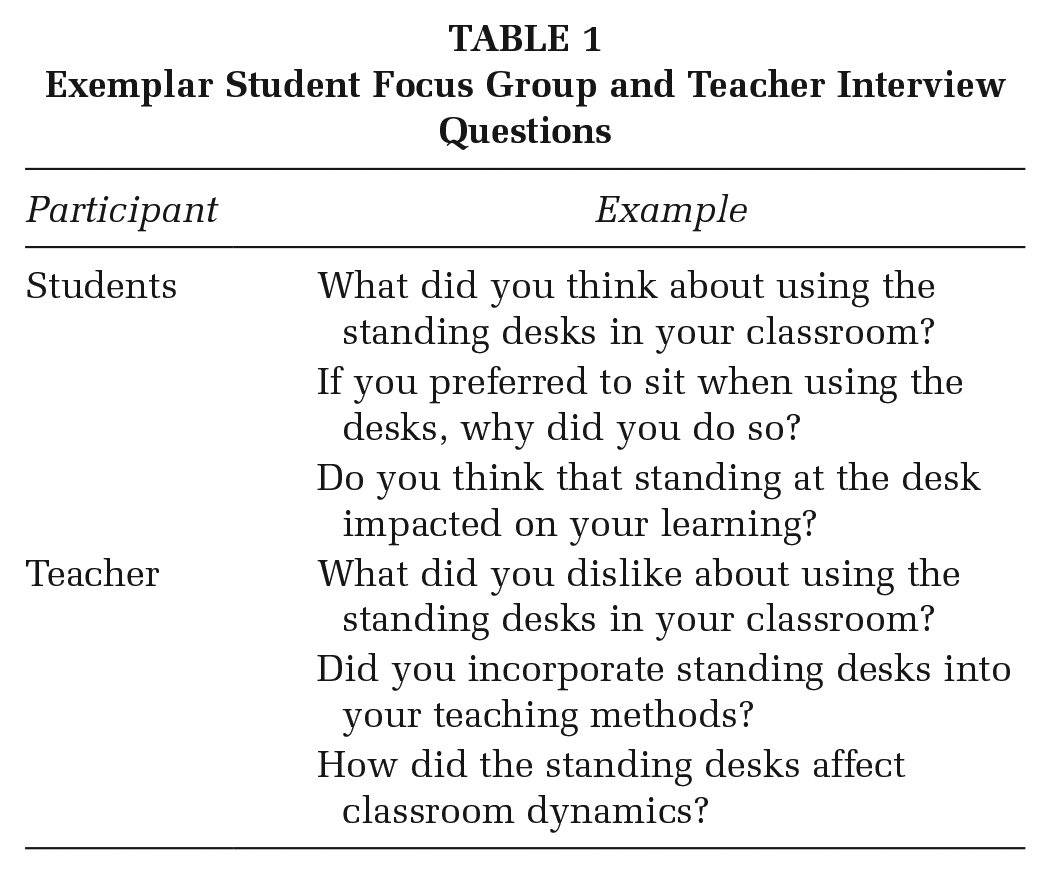
Semistructured focus group interviews were conducted with all 46 student participants in groups of 4 to 8. The interview was conducted by one male researcher, using a semistructured interview guide to ensure consistency across interviews. This included open-ended questions relating to students’ feelings regarding use of the sit-to-stand desks, how much of the time they spent standing versus sitting when at the desks, what they liked/disliked about the desks, whether they thought the desks affected their learning, and their suggestions for changing the desks, if at all (see example questions in Table 1). The duration of focus group interviews ranged between 5 and 10 minutes per group.
Exemplar Student Focus Group and Teacher Interview Questions
Teacher Interview
A semistructured qualitative interview was conducted with the teacher (female, age 44, 17 years teaching experience), using an interview guide. Questions (see Table 1) included perceptions and concerns about the desks to their implementation in the classroom. Ensuing questions asked about current perceptions of students using the desks, dislikes/likes, how the desks were incorporated into the classroom, how they might affect learning, and if specific training was necessary for other teachers who might use the desks in the future.
Data Analysis and Trustworthiness
Descriptive data were reported using frequency counts and percentages to determine PA and behavior outcomes. All interviews were recorded using a digital audio recorder and transcribed verbatim into a word processed document. Qualitative data sources included 10 student focus groups and one teacher interview. Initially the first author read and reread the transcripts to become familiar with the data. Following, constant comparison techniques were used to identify preliminary themes (Corbin & Strauss, 1990). The first author analyzed data for each interview question using open coding, and then the fourth author assisted using selective coding to determine final themes. Color codes were applied to represent the preliminary themes, and frequency counts were conducted to see patterns in responses. Trustworthiness was established through triangulation of data (focus group interviews, teacher interview, behavioral/PA observations), peer debriefing, multiple researchers to analyze data, and ongoing meetings among researchers during coding periods (Lincoln & Guba, 1985).
Results
Descriptive Statistics
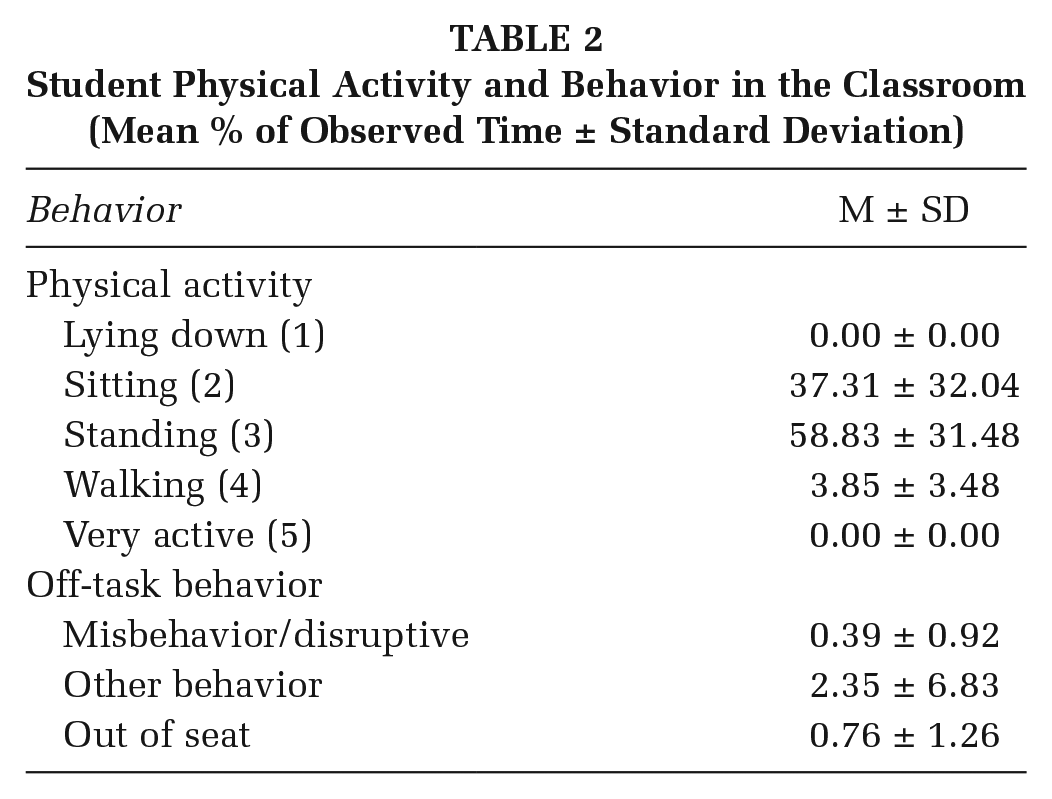
Results indicated that when using the sit-to-stand desks, students sat 37%, stood 59%, and walked 4% of the time (see Table 2). No lying down or very active behavior occurred. Off-task behavior (e.g., disruptive behavior toward others, out of seat behavior) occurred for a total of 4% of the observed period. Behavior defined as “other” occurred the most often, for a total of 2.35% of time. Notes indicated these behaviors involved sharing answers with others, playing on cell phone, and talking to other students in the hallway. Out of seat behavior occurred less than 1% of the time, as did misbehavior or disruptive behavior toward others. Out of seat behavior was defined as the student leaving his or her seat without asking permission from the teacher or classroom assistant. Student participants were not considered out of seat if they were standing at the sit-to-stand desk.
Student Physical Activity and Behavior in the Classroom (Mean % of Observed Time ± Standard Deviation)
Themes From Student Focus Groups
Focus group interview data became saturated after five interviews, as similar responses to questions were continuously repeated by the student participants. The following themes were inducted: focus, freedom, distractions, and design. Pseudonyms have been used for all participants.
Focus
A recurring comment (n = 22) throughout the interviews was the role the desks may have played in helping students focus and be more attentive in the classroom. The majority of students who used the desks agreed that they made them “more awake and alert,” “helped me work better,” and “made them less distracted.” Carlton stated, “When I sit down for a long period of time, I get a little fidgety.” Traynor added, “You could stay more focused on learning, and you could keep your eyes on the board better. Plus you could move closer to it if you wanted to because you could roll closer to it.”
Freedom
Another common point made throughout the interviews was the freedom the desks provided for the students. The teacher had the room set up with three or four students per table, so students were used to sitting down and sharing their space with others. The students suggested that the sit-to-stand desk gave them more freedom to stand up and ambulate when they felt the need to do so of their own volition. There were multiple comments made regarding having their own space and the ability to choose to either sit or stand. Sharone said, “When you are sharing with someone else, it is really crowded. I like being by myself.” Jayden added, “I didn’t have to be confined by sitting down.” Jason mentioned, “You could be by yourself at a single desk.” A number of other comments related to being away from others or feeling too close to other students when at the tables.
Distractions
Responses regarding dislikes were fairly infrequent (n = 5), suggesting most students did not perceive there to be anything particularly negative regarding their experience of using the desks. Those who had dislikes toward the use of the sit-to-stand desks indicated that students rolled them around a lot and that some students would lay on them while they stood, causing distractions for others during classroom instruction time. For example, Edrick said, “People were always rolling around, bumping them into each other, I think. It annoyed me.” Some students suggested the desks have better, stronger locks in place to prevent rolling.
Design
There were particularly unanimous responses when asked what potential alterations students would make given the choice. Changing the color of the desks was a resounding consensus, with over nine specific responses directly related to it. There were a number of additional students in the interviews who also agreed but did not directly verbalize this themselves. In particular, something brighter was suggested, as the way they, “look a little boring” and “color would help them stay awake.” Other suggestions regarding the design of the desks included making the desktop area bigger and including more holding options for cell phones and/or binders and books.
Themes From Teacher Interview
The teacher interview was fairly brief, but coupled with informal conversations the two observing researchers had with her, two themes evolved: a “good” distraction and freedom. By “good” distraction, the teacher suggested that using the desks in her classroom had a predominantly positive impact on the students’ levels of engagement. She noted, “I love it. Gives kids a choice to be more engaged if they are ‘busy’ [off-task].” With regard to additional positive factors related to the desks, she stated, “They gave kids something to look forward to. There were only six desks in my class, so it gave them an incentive and they were more excited when it was their day to use the desk.” The only distraction the teacher noted was that sometimes the students rolled the desks. She followed up that it was a challenge to remind them not to lean on the desks, but her expectation for them was that they either sit or stand when using them. While rolling may have been problematic or annoying for some, she thought the desks were a positive overall:
I did not have to change my teaching style. They fit right in. If you are a very traditional or conservative teacher, it may be bothersome to you. More and more teachers are looking for opportunities for kids to move because they come to you bottled up with energy, so how can you help them? It is a win-win for a teacher
With regard to the freedom theme, she said, “I like that they had a choice of sitting or standing because they spend most of their day sitting.” This notion was supported by the student interviews, as they indicated having the option and that standing allowed them to focus/concentrate more.
Discussion
This study explored the acceptability and feasibility of sit-to-stand desks in a middle school classroom from the perspectives of the students and teacher, which has only been explored qualitatively in one study to our knowledge (Aminian, Hinckson, & Stewart, 2015) and that study was conducted with elementary children. Sit-to-stand desks appear to encourage standing for middle school students during instructional time while simultaneously limiting potential occurrences of misbehavior. Students stood most of class time and were only off-task for 4% of time. Compared to other traditional classroom studies, students using sit-to-stand desks in the current study were more on-task (Mahar et al., 2006). However, it should be clear that this comparison is made to a study sample of upper elementary children in the United States. Another study with upper elementary children in three separate classrooms in the United States found 68%, 69%, and 73% of students were on-task during a normal class period (Richards, Heathfield, & Jenson, 2010). It is hypothesized that the opportunity for students to stand could have reduced their urge to bother other individuals or make distracting noises or movements. Students appreciated the opportunity to choose whether to sit or stand; most of them took advantage of the opportunity and stood the majority of the time they were at the sit-to-stand desks. The teacher reverberated the students’ desires and how she was pleased with the desks because the students sit for such long periods throughout the day, and the desks offer them the opportunity to stand if they want.
Students indicated that while there were some distractions from having the desks in the classroom, they were generally positive toward them and suggested they supported their learning behaviors. Similar findings have been shown in New Zealand primary school children, who reported that the use of standing workstations facilitated group work and made writing easier (Aminian et al., 2015). The distractions were mostly other students rolling the desks around, but the comments indicating that the desks helped them focus and concentrate and made them less fidgety far outweighed the negative. The teacher’s take on the desks was that they were a “good” distraction, meaning the benefits overshadowed the barriers. This was also comparable to the teacher’s perception in a standing desk study with children aged 9 to 11 in New Zealand (Aminian et al., 2015). She believed students behaved better in the dynamic environment due to being happier and more motivated.
Students suggested making the desks more colorful, as well as altering size so binders/other equipment could also be housed within the desk. Making the desks brighter was mentioned, unsolicited, in every focus group interview except one. Almost unanimously the students said the grey tones of the desks were unappealing. “If they were a different color, students would want to use them because it’s cool.” One suggested a hot pink color. Thus, appearance of the desks themselves, along with practicality (large surface space and cubbies/holders for materials) seemed to be important for students in a middle school setting to want to use them.
The teacher echoed most of the student themes and indicated that she wished she had a room full of these types of desks. She did not note any barriers except that cost of desks may be an issue for some teachers. Having half of the room full of sit-to-stand desks and half with traditional desks would be ideal for this particular teacher, however, she did note that it would be “cool” to have a room full of standing desks, if money was not an issue.
Limitations
Limitations included the short duration of data collection and the lack of a randomized control design. Because of the short time frame for data collection (5 weeks), we are unable to determine long-term perceptions or effects of their use in a classroom. Additionally, no baseline data with traditional desks were collected, so comparisons of PA levels, behavior, and perceptions over time were unable to be made. Future research should include studies that last an entire semester or full year with middle school and high school students. Those that compare students in classes using sit-to-stand desks and traditional desks would be of most value.
Conclusions
Overall, using sit-to-stand desks in a middle school classroom setting is feasible, and they appear to benefit the students in terms of focus and concentration, as well as provide them with freedom to work alone and not be bothered by others. Potential downfalls of using sit-to-stand desks include distractions if the students roll them around or lay/lean on them during class. Appearance and practicality of the desks themselves are notable in terms of students’ desire to use them. One statement summarized most of the students’ experiences with the desks: “Standing desks are really good. They should have them in every classroom. They made me look forward to coming to class.”
Several implications for practicing teachers appeared. First, while having one sit-to-stand desk per student may seem optimal, more research and utilization with teachers is necessary before definitive decisions can be made. The teacher said she would love to have a classroom full of the desks. However, students reported some distractions, specifically having students in the front of the classroom standing while students in the back might be sitting. In the current study, the sit-to-stand desks were in the back of the room around the perimeter. Thus, it is essential that teachers gradually integrate the sit-to-stand desks experimenting with a variety of strategies. For instance if only half the students have the sit-to-stand desks, students in traditional desks could have the freedom to move the back of the room and stand during lessons when appropriate. Or if desks are available for each student, when students in the front decide to stand, they can roll the desk to the back of the room as to not obstruct the view of classmates. A variety of protocol similar to these could be developed based on the specific learning environment, number of sit-to-stand desks, and teaching styles.
When integrating the desks into a classroom, rotating students between traditional and sit-to-stand desks seems to be effective. While a limitation of the current study was the length of the observations, to maintain student excitement and interest, it may be best not to have students using the desks during every class. The teacher suggested that students were excited to find out if they got to use the desk each class. This practice may help enhance the sustainability and student enthusiasm for using the desks.
Interestingly, the current study findings suggest that students do not like pods of desks (four desks pushed together to make a group). When discussing the freedom obtained when using the sit-to-stand desks, several students reported the pods of desks were too confining. While not specific to sit-to-stand desks, providing more freedom and space for middle school students may be a more conducive environment for learning.
While manufacturers may consider using brighter colors, a more feasible strategy may be to allow students to decorate them with stickers and artwork specific to course content. For instance, for a health classroom, a ChooseMyPlate.gov sticker on the top of the desk with foods on the support post may make the desks more appealing and could be incorporated into a lesson.
Footnotes
The Ergotron LearnFit® Adjustable desks used in this study were supplied via an in-kind donation from Ergotron Inc., USA. The company did not have any role in the study design, data capture, and analyses or in the preparation of this article. The University of Kentucky Institutional Review Board has approved this study involving human participants.