



Abstract
Purpose. To describe the application of the Community-Based Collaborative Action Research (CBCAR) framework to uplift rural community voices while conducting a community health needs assessment (CHNA) by formulating a partnership between a critical access hospital, public health agency, school of nursing, and community members to improve societal health of this rural community. Method. This prospective explorative study used the CBCAR framework in the design, collection, and analysis of the data. The framework phases include: Partnership, dialogue, pattern recognition, dialogue on meaning of pattern, insight into action, and reflecting on evolving pattern. Discussion. Hospital and public health agency leaders learned how to use the CBCAR framework when conducting a CHNA to meet Affordable Care Act federal requirements. Closing the community engagement gap helped ensure all voices were heard, maximized intellectual capital, synergized efforts, improved communication by establishing trust, aligned resources with initiatives, and diminished power struggles regarding rural health. Conclusion. The CBCAR framework facilitated community engagement and promoted critical dialogue where community voices were heard. A sustainable community-based collaborative was formed. The project increased the critical access hospital’s capacity to conduct a CHNA. The collaborative’s decision-making capacity was challenged and ultimately strengthened as efforts continue to be made to address rural health.
Keywords
Introduction
Rural communities and critical access hospitals have limited resources to conduct a community health needs assessment (CHNA) as mandated by the 2010 Affordable Care Act. The Internal Revenue Code section 501(r) mandates that all 501(c)(3) hospitals must conduct a CHNA and adopt implementation strategies at least once every 3 years to maintain their charity care and tax-exempt status (Internal Revenue Service, 2013). In this project, a critical access hospital’s service area was the community of concern. The hospital was challenged to complete the new federal regulation but lacked the requisite resources and knowledge of how to conduct a CHNA. The hospital sought support from university faculty who were knowledgeable and had the necessary resources. Not only can hospitals collaborate with nurse educators, they can also use the expertise and best practices and principles identified by public health agencies as they conduct a CHNA (Sabin & Levin, 2015).
Background
Community health improvement efforts are most successful when they are grounded in collective impact where multiple agencies collaborate in an intentional manner to improve societal health (Rosenbaum, 2013). Steps to facilitate collective impact include the following: shared commitment and motivation, shared measurement to assure consistent data and results, alignment of agency strengths and resources for a mutual plan of action, continued dialogue to build trust, and developed infrastructure for collaborative work (Rosenbaum, 2013). According to Klemm, Rempusheski, and Teixeira (2013), a collaboration of multiple agencies helps to support the health of communities. Furthermore, the American Association of Colleges of Nursing (2012) suggests that strong partnerships provide support for vulnerable families in communities. Academic partnerships can also stimulate research at the point of care in the population or community to generate new knowledge in practice and service (Hendrix, Matters, West, Stewart, & McConnell, 2011).
The value of academic–health system partnerships in strengthening nursing education and practice has been described in nursing literature (Hendrix et al., 2011). Benefits to nursing education often focus on meaningful student learning experiences while increasing implementation of evidence has value to educators and practice partners. Creating partnerships with community services and public health nursing (PHN) have potential to benefit nursing students through community collaborations that support family and community health promotion. Academic–PHN practice partnerships show promise in advancing community health and educating nurses for excellence in practice (as cited in Davis & Travers Gustafson, 2014).
Even though the intent of the Affordable Care Act mandate is to require hospitals to engage with public health agencies, many hospitals complete a CHNA independently. Hospitals working in isolation put collective impact at risk, which may lead to a duplication of services, resources not being used to their fullest extent, lack of communication of initiatives, and lack of transparency of what is being done (American Hospital Association’s Center for Healthcare Governance, 2016; Walker, 2016).
The goals of community engagement, as identified by the Centers for Disease Control and Prevention (2015), are to establish trusting partnerships, garner human and financial resources, enhance communication processes, and improve societal health outcomes (Pavlish & Pharris, 2012; Rosenbaum, 2013). Colleges of nursing, PHNs and community partners can be powerful advocates for promoting healthy families and communities.
To promote community engagement, the community-based collaborative action research (CBCAR) framework developed by Pavlish and Pharris (2012) was applied to foster on-going community–academic partnerships with a shared goal of enhancing health care equity and quality. These partnerships aligned resources and identified key stakeholders to conduct a CHNA (Krumwiede, Van Gelderen, & Krumwiede, 2015). The CBCAR framework values community narrative, validates concerns, and engages communities of people to understand health patterns and their meanings. Whether used as a formal research process or a community-based needs assessment process, the CBCAR framework identifies how to unearth underlying assumptions and barriers to health and “creates an opportunity for community-academic partnerships to form and collectively analyze how systems and structures contribute to and/or detract from people’s health and well-being” (Pavlish & Pharris, p. 7). The CBCAR framework allows nurses, community leaders, and nurse educators to create a process where community voices and ideas can be heard, blended, and understood (Baird et al., 2015).
While a gap in the literature exists for using the CBCAR framework (Pavlish & Pharris, 2012; Pharris, 2005), it has been applied with African American women living with diabetes to understand patterns of health problems and inequities from an ecological perspective (Pierre-Louis, Akoh, White, & Pharris, 2011). The CBCAR framework was also used to support Sudanese refugee women in addressing the health challenges associated with their resettlement transition to the United States (Baird et al., 2015). Krumwiede et al. (2015) report its utilization through service learning in higher education. While the CBCAR framework has been used with underserved communities, its application in context with a CHNA is limited.
There are a few typical models used for CHNAs such as the PRECEDE-PROCEED model (Rural Health Information Hub, 2017), Mobilizing for Action Through Planning and Partnership (MAPP; National Association of County & City Health Officials, 2017), and CBCAR (Pavlish & Pharris, 2012). When comparing the three approaches, there are many similarities and differences as described in Table 1. Each of the three models include an assessment, implementation, and evaluation process. One significant difference is the structured steps of the MAPP and PRECEDE-PROCEED models compared to the back–and-forth community dialogue approach of CBCAR. Within CBCAR, the action plan and ideas arise from the community voices (Pavlish & Pharris, 2012). All three models focus on improving community health. However, CBCAR is grounded in the assurance of human rights and social justice, not in Essential Public Health Services as is MAPP (National Association of County & City Health Officials, 2017; Pavlish & Pharris, 2012).
Comparison of Approaches

NOTE: CBCAR = Community-Based Collaborative Action Research; MAPP = Mobilizing for Action Through Planning and Partnership.
Purpose Statement
The purpose of this project was to describe the application of the CBCAR framework to uplift rural community voices while conducting a CHNA by formulating a partnership between a critical access hospital, public health agency, school of nursing, and community members to improve societal health of this rural community.
Theoretical Approach
CBCAR is rooted in Newman’s (1994) unitary transformative paradigm, where one assumes that the answers to important questions and the power for change already reside within the community. The community does not need to be acted upon from the outside to be empowered or changed (Pavlish & Pharris, 2012). Essential aspects of Newman’s theory focus on identifying patterns of interactions and energy flow, engaging in dialogue about the meanings of the emerging patterns, and envisioning transformative actions (Pavlish & Pharris, 2012). Understanding a community problem within its context and fully comprehending the complexity of the entire issue are more likely to happen when employing carefully constructed data collection and analysis methods (Pavlish & Pharris, 2012). Because the phenomenon of public health is so multifaceted, one can use the CBCAR framework to fully engage community members and stakeholders in the process that results in a collective impact on societal health outcomes. CBCAR supports long-term commitments with ongoing social action processes within rural communities (Pavlish & Pharris, 2012).
Key assumptions of the CBCAR framework are that people and communities have the best insight into their own situations. CBCAR invites community members into the decision-making process to ensure that all voices are given the opportunity to be heard (Pavlish & Pharris, 2012; Sagor, 1992). The framework generates context-relevant knowledge while engaging people in creating meaningful systems change (Pavlish & Pharris, 2012).
Method
This prospective exploratory study used the CBCAR framework in the design, collection, and analysis of data. The protection of human subjects’ rights is an important issue in community-based research, and while this article does not report individual data, human subjects were protected throughout the project by the nurse educators, as the university granted permission (IRB #531572-1) for the project to proceed. Because little is known about the community’s needs, CBCAR allowed the project to unfold in stages. The CBCAR process provides a framework for the community–academic partnership to achieve common goals (Pavlish & Pharris, 2012). Table 2 describes the CBCAR research process. The partnership identified the process for the CHNA, which included focusing on key health concerns, strengths of the community, and barriers to healthy living, potential family- and community-focused interventions, and an evaluation plan. The entire CHNA project evolved over an 18-month period.
CBCAR Framework Description

NOTE: CBCAR = Community-Based Collaborative Action Research.
Sample
Community members identified key participants for the initial phase of the CHNA. The city population consisted of 62.4% Caucasian, 35% Hispanic, and 2.6% are other or more than one race. Males consisted of 48.7% of the population, while females consisted of 51.3%. Student dyads were assigned to locations of participant recruitment and developed data collection tools specific to the participants. Partnership members, nurse educators, and nursing students recruited a convenience sample of participants (N = 401) who participated in interviews, questionnaires, and focus groups. Nursing students also completed windshield questionnaires and observations of the community at large and at specific facilities. Table 3 describes the sample and data collection tools used.
Data Collection Tools Used

Application of the CBCAR Framework
This section illustrates the application and outcomes of the six phases of the CBCAR framework: partnership, dialogue, pattern recognition, dialogue on meaning of pattern, insight into action, and reflecting on evolving pattern.
Partnership
A critical access hospital in a small rural town was responding to the new federal requirement and to its concern for population health as the community demographics shifted from 100% to 65% Caucasian with an increased elder population. In March 2012, administrators from the hospital called on nurse educators to discuss conducting a CHNA to meet the requirements for the Affordable Care Act. As the nurse educators became involved, they invited community members, representatives from the local County Human Services, employees from the local manufacturing plant, and a nursing institute to become involved in the planning of the CHNA. The Glen Taylor Nursing Institute for Family and Society is a research and practice institute that focuses on “developing, testing, and disseminating nursing practice models that will advance family and societal health and healing” (Glen Taylor Nursing Institute for Family and Society, 2013). These organizations formed a partnership to address the needs of the community by creating the Madelia Community-Based Collaborative (MCBC).
MCBC was formed with a long-term investment of time and resources by the members with no desire to terminate the relationship at a specified date. MCBC was inclusive, yet at times there was difficulty in trust and power dynamics of who should run the meetings and decide how the members would invest their time to create significant change and measurable outcomes within the community. Members from within the collaborative provided insight into the culture of the community and what methods may or may not be successful within this particular community.
Dialogue
MCBC met monthly, and within 6 months the members had a mutual understanding of goals and direction. In December 2012, the members developed mission and vision statements and began collectively determining where to start maximizing their time with projects that would benefit the community. Critical friends such as community members and an action research expert were invited to give input into the development of the mission and vision for the collaborative.
The collaborative meetings provided opportunity for MCBC members to discuss goals, interests, and concerns. These initial meetings were important to understand perspectives of all involved early in the collaborative. It was apparent that the community members and hospital and nursing home staff wanted to create meaningful, sustainable programs that would enhance community member knowledge acquisition and decrease barriers to a healthy lifestyle. The academic partners were interested in providing and sustaining meaningful real-world learning opportunities for nursing students and establishing long-term relationships with community members. The active engagement of senior level nursing students enrolled in a Community-Oriented Nursing Inquiry course during the 2012-2013 academic year enabled them to apply the principles of public health throughout this CBCAR project. Students learned to bring about social change within a rural setting to promote healthy behaviors of individuals, families, and community. The sustainability of the collaborative is enhanced by the human resource provided by the 24 nursing students and 2 faculty. As the dialogue continued, this real-world teaching and learning strategy exposed future nurses to the health care needs of rural dwellers.
Pattern Recognition
During the pattern recognition phase, it is imperative to scientifically collect data that are oriented toward deeper understanding of problem situations and their potential solutions. In March 2012, MCBC members used television and newspaper media to raise awareness within the rural service area regarding the CHNA. MCBC gained entry to the key populations through media and personal communication among MCBC members and key stakeholders within the community organizations. Several data collection strategies were used to ensure multiple voices were being heard: questionnaires, windshield and foot questionnaires, observations, interviews, focus groups, secondary data, field notes, and narrative reflections. All participants were asked to identify the strengths of the community, barriers to health, and what they felt were the community’s priority health concerns. Additional questions were asked of the participants based on the specific population.
Nursing students consulted with nurse educators and key stakeholders when developing questionnaires. All data collection tools were reviewed by community insiders. The Hispanic population questionnaire was reviewed, revised, and translated by the community health educator who worked closely with the population to decrease the risk for biased language. Nursing students used the feedback from home care nurses to make appropriate changes to the elderly population questionnaire. The nursing home director provided feedback on the questionnaire for the residents and staff. The team that collected data reflected on the experience through weekly journaling.
Quantitative and qualitative data analysis occurred for each of the seven populations in April 2012. Nurse educators guided students to analyze data and determine how the data would be presented to the community. Deductive data analysis was completed using descriptive analysis techniques.
Qualitative data analysis is complex and involves making comparisons and looking for similarities as well as differences. The research team read and reread the data, coded and categorized the data, and interpreted the meaning of the data while circling back to ensure the trustworthiness of the findings and reflect on the patterns. Inductive data analysis was used to unfold the data line by line to identify meaningful themes and patterns.
The findings were blended and interpreted into meanings, matched against the data, and brought back to the population to ensure accuracy. Triangulation of multiple sources was used during the analysis process and pattern recognition phase. Gaps in the data were identified as the voices of 30- to 50-year-olds, and families with toddler and/or preschool-aged children were not included.
Dialogue on Meaning of Pattern
Following the pattern of recognition, nursing students developed a presentation that included the CHNA findings, recommended interventions, and an evaluation plan. Nursing students and nurse educators presented the CHNA findings to the community through an open forum. Nursing students asked the audience for further dialogue on the findings and suggested interventions. In June 2012, the nurse educators wrote an initial CHNA report, which was disseminated to MCBC. A decision was made to gather further community insights through discussion groups to identify any changes needed within the report. Overarching findings were confirmed by community members: obesity, diabetes, heart disease, chronic disease management such as medication adherence and need for reducing sugar-sweetened beverages, cancer, poor sleep habits, high rate of teenage pregnancy, elderly risk for falls, and depression.
Insight Into Action
MCBC discussed the CHNA results and developed a plan to verify key findings. In October 2012, another group of nursing students returned to the seven populations to verify the data collected during the initial assessment. Community voices were once again heard through dialogue during focus groups. Community members provided feedback and suggestions on how they would like to see the needs addressed. This was one of many opportunities for the community members to be involved in the decision-making process. Based on identified data gaps, two additional populations: 30- to 50-year-olds and families with toddler/preschool-aged children were assessed. Data collection of these two groups included written questionnaires with a variety of items: Likert-type scale, multiple-choice, and open-ended questions focusing on community strengths, barriers to healthy living, and priority community health inequities. Quantitative and qualitative techniques were used to analyze the data.
The new and verified data were presented to the community through another open forum in December 2012. Invitations were sent to community members, key stakeholders, and collaborative members. Within the invitation was a puzzle piece made from a Wordle that showcased important aspects of the collaborative. Invitees were encouraged to come to the forum with their piece to increase participation and complete the puzzle. The Wordle puzzle is illustrated in Figure 1.
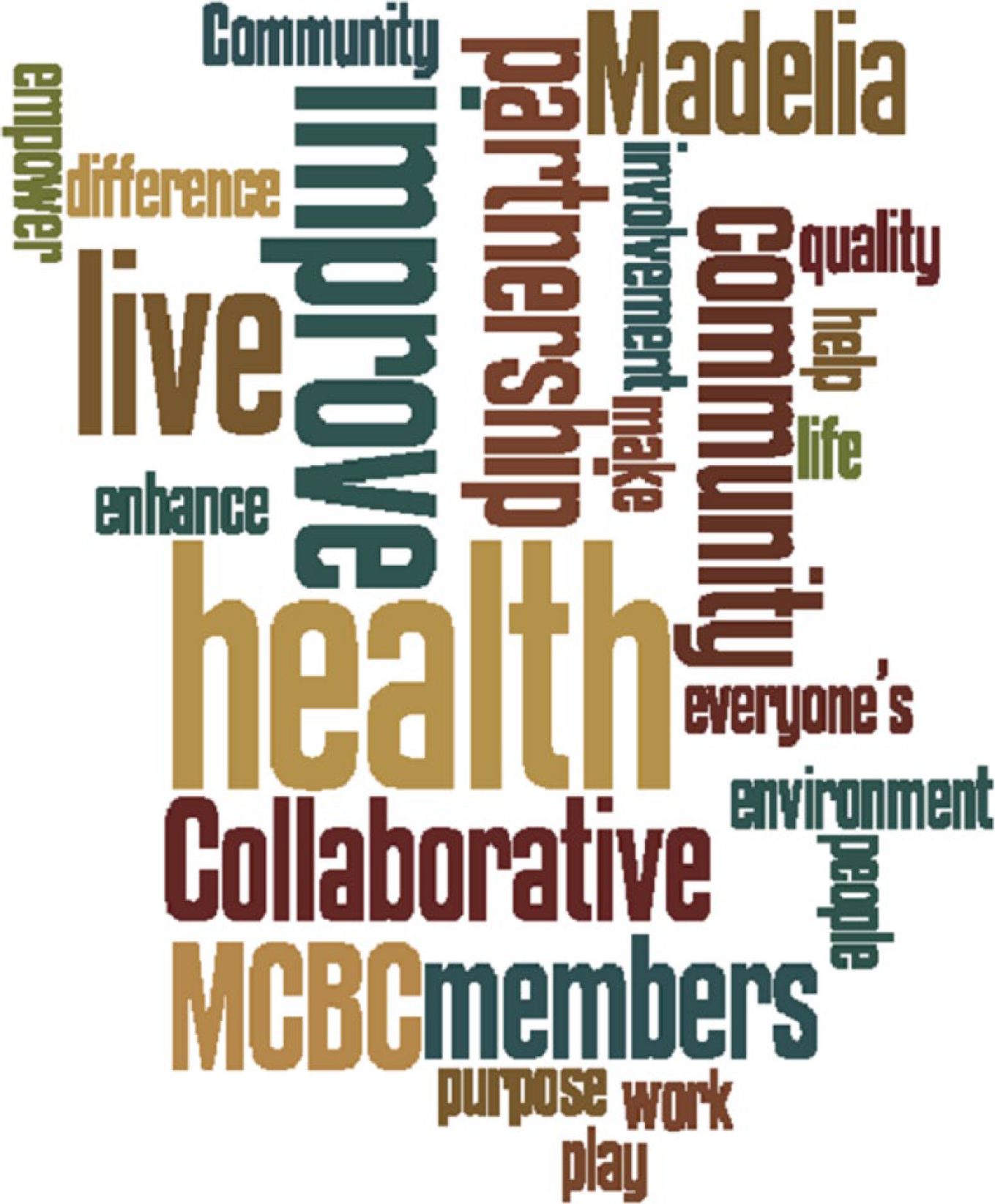
Madelia Community-Based Collaborative Wordle Puzzle
Following the open forum, a community meeting and meal were held to discuss key health concerns and develop an action plan. One of the authors of CBCAR, Dr. Dexheimer Pharris, served as the consultant during the community meeting. Community dialogue and decision making among the community members resulted in creating an action plan. Decision making involved brainstorming ideas, identifying resources and gaps in the community, and prioritizing key interventions. No idea or suggestion was disregarded during the dialogue. The action plan focused on creating the following:
Healthy Family Events
“Commit to Get Fit” Public Service Announcements (PSAs)
Survey Design and Data Mining
Work groups were developed to implement the described action items. Members of MCBC joined groups based on interest and expertise. Missing key stakeholders were invited to participate in the planning groups and join the collaborative.
Reflecting on Evolving Pattern
MCBC members reflected on the action plan outcomes, processes, and future direction. The first action plan, the Healthy Family Event group, targeted the Hispanic population by hiring an international expert on Hispanic health who provided education on diabetes and reducing sugar-sweetened beverages. Many Hispanic families attended the event and were surprised by the hidden amount of sugar in their drinks. Families also enjoyed making healthy snacks and exercising during a Zumba class. Participants reported an increase in knowledge and level of confidence in exercising and preparing healthy snacks in the post surveys (Krumwiede, Van Gelderen, & Krumwiede, 2013).
The “Commit to Get Fit”’ PSAs were made by nursing students focusing on community members that demonstrated healthy behaviors and utilization of community resources such as walking trails, parks, and community pool. The PSAs were advertised on the local television and radio stations in both English and Spanish languages.
The third work group focused on survey design and data mining. This group analyzed data received and identified questions for future CHNAs. The group reported to MCBC and provided suggestions for future projects.
During the collaborative processes reflection, it was identified which collaborative members were invested and which key stakeholders were missing within the group. Over the past 2 years, there has been a consistent 20 core members within MCBC. Additional new members including an elementary school student and parent, community member, and pastor have joined MCBC.
Ensuring that collaborative members have an equal voice within MCBC has required the leaders to facilitate intentional dialogue and equal representation of decision making. Whenever this balance is threatened, the originating partners from the hospital and university meet to discuss the situation. One year after establishing MCBC, the question of “Who should lead the meetings?” became an area of contention. Ideas mentioned were to have MCBC members rotate responsibilities or continue having nursing educators lead the meetings; however, after several MCBC members denied wanting the responsibility of preparing and running the meetings, it was decided to have nursing educators continue to lead the scheduled meetings with encouragement of other members to add to the agenda and needs on a monthly basis.
Based on the experiences during the three action plans, the future direction discussion, and commitment of the members, it was determined to begin seeking external resources to address health disparities. Several grants were written in collaboration with the State Health Improvement Program coordinator to focus on reducing consumption of sugared-sweetened beverages within the community to reduce rates of obesity and diabetes.
Discussion
The CBCAR framework was trialed to decrease the community engagement gap and uplift community rural voices. Guided by CBCAR, multiple agencies were grounded in collective impact through shared commitment, motivation, and resources. This sustained and deeper collaboration between the hospital, public health agency, and academia was not in place prior to this project. This 5-year, ongoing community–academic partnership continues to have shared goals of enhancing health care equity and quality.
The strengths of the CBCAR framework are that it is flexible and supports rural community initiatives that have the potential to enhance health outcomes, promote social justice, and reduce health disparities. The phases of the CBCAR framework provided a process for developing a partnership, continual dialogue and reflection to identify the strengths of the community, barriers to healthy living, and primary health concerns and for developing a health promotion action plan to address the priority health issues identified through the CHNA. The team continues to implement action plans to address societal health issues for this community. The CBCAR framework lifts up the community voices in this shared collective effort providing meaningful changes.
Trust was earned among the collaborative members after a significant investment of time, open communication, and repeated interactions with members (Baiardi, Brush, & Lapides, 2010; Cohn, 2007; Corbie-Smith, Thomas, & St. George, 2002; Pavlish & Pharris, 2012; Shaya, Gharayor, Yang, Agyeman-Duah, & Saunders, 2007). Communication that identifies and deconstructs power differentials is an important part of the CBCAR process and supported community voices. Historical, political, and sociocultural underpinnings are important for members to understand so forces of confusing societal privilege and oppression do not arise and impede the process (Pavlish & Pharris, 2012). These conversations helped analyze power dynamics within the group and recognized which voices were not being heard and who should be invited to the table. This community engagement process encouraged oppressed voices such as Hispanics, elders, youth, and families with toddlers and/or preschool children. This process facilitated new unfolding patterns, incorporated emergent methods, and raised questions by identifying evolving needs within the rural community.
An important outcome of using this framework was that it provided significant learning opportunities for students. Community engagement was evident in the garnering of human resources with the nursing students’ many activities in the CBCAR process and CHNA. Rather than merely an assignment, this CBCAR project presented students with real-life experiences to influence the health of the community. This deeper level of engagement assisted students’ understanding of multiple public health and nursing concepts (Krumwiede et al., 2015). Students felt appreciated and respected during their involvement, which promoted their sense of feeling valued. The collaboration also resulted in a CHNA report for the hospital that has been made public on the hospital’s website. This collaboration assisted the hospital to meet the requirement for the Affordable Care Act and resulted in multiple interventions to promote healthy behaviors within community members.
While using the CBCAR framework, MCBC members learned that the data analysis process is ongoing and continues to unfold. However, one weakness was the difficulty of believing in the CBCAR process and letting the data develop and findings evolve. The active exchange between the community and MCBC members was time-consuming and will continue to shape the future direction of improving community health. It is necessary to be patient and allow patterns to connect and meanings to emerge. The biggest lesson learned about using the CBCAR framework was that it was not a linear or rigid process but rather fluid and dynamic. The challenge is to trust the CBCAR process.
The CBCAR framework is not for everyone. Nurse educators must learn to relinquish power and make a long-term commitment. This action will empower communities and enhance their decision-making ability to improve health because the solutions to the problems already reside in the community. The framework provides gratifying work that benefits community growth and meaningful long-term relationships.
Conclusion
The CBCAR framework was used to facilitate community engagement and promoted collective impact where community voices were heard. The CBCAR framework offered a triple benefit: (1) The critical access hospital was able to meet federal requirements, (2) CBCAR provided a mechanism for improved community engagement and uplifting of community voices, and (3) the process created meaningful public health education for nursing students. The CBCAR framework proved to be an effective and practical tool to meet the goals of community engagement, as identified by the Centers for Disease Control and Prevention; establish trusting partnerships; garner human and financial resources; enhance communication processes; and improve societal health outcomes (Baird et al., 2015; Pavlish & Pharris, 2012; Rosenbaum, 2013). CBCAR framework provided a process to develop a sustainable partnership that has developed into an interprofessional collaboration. MCBC members identified and mobilized resources and continue to serve as catalysts for making policy, system, and environmental changes.