



Abstract
A theory-driven tailored intervention developed in partnership with the community used evidence-based practices to (a) increase knowledge about colon cancer and screening and (b) assist patients in completing screenings. During the 16 months of delivery screening, patient navigators integrated into gastroenterology clinics met all goals, which included (a) enrolling an ethnically diverse group of participants (N = 415) through inreach (clinic-referred patients who did not schedule appointments) and community outreach, (b) facilitating screening completions for 217 of the 358 (61%) patients identified as needing screening, and (c) obtaining satisfaction ratings from 89% of participants. A random sample (N = 214) of nonnavigated patients matched on gender and age revealed no differences between navigated and nonnavigated patients on polyps detected. Navigated males (but not females) were significantly less likely than nonnavigated males to have either poor or only fair bowel preparation quality (odds ratio = .418, p = .020, 95% confidence interval [.197, .885]). Low-quality bowel preparation can lead to incomplete readings of the colon or cancelling a colonoscopy. This intervention demonstrates that evidence-based patient navigator programs are effective in increasing screening among a hard-to-reach population and improving bowel preparation quality for males.
Keywords
Introduction
Colorectal cancer (CRC) is the second leading cause of cancer deaths in the United States from cancers affecting both men and women (Centers for Disease Control and Prevention, 2013); however, colon cancer screening has been shown to reduce mortality (Zauber et al., 2012). Patient navigation programs can be effective in increasing screening (DeGroff, Coa, Morrissey, Rohan, & Slotman, 2014; Green et al., 2013) including in underscreened populations such as people with low income, low education, and language barriers (Lasser et al., 2011; Percac-Lima et al., 2009; Rice et al., 2017). Navigators typically provide culturally appropriate education, assistance with scheduling colonoscopies, patient reminders, and emotional support (DeGroff et al., 2014). The use of navigators can help reduce racial disparities in cancer screening and outcomes (Coughlin, Blumenthal, Seay, & Smith, 2016).
Although the knowledge base on navigation programs has been increasing, fewer studies have examined their impact on patient bowel preparation for colonoscopy screening using comparison groups. Bowel preparation typically involves adhering to a diet of clear liquids the day before the procedure and ingesting four liters of a bowel-cleansing laxative (Johnson et al. 2014). Low-quality bowel preparation is a concern for gastroenterologists as it leads to incomplete readings of the colon, incorrect assessment, or canceling a colonoscopy (Rex, Imperiale, Latinovich, & Bratcher, 2002). Yet rates of poor bowel prep range from a quarter to over a third of patients and is influenced by gender (e.g., males have higher rates of poor prep), socioeconomic status, racial/ethnic status, and whether patients are hard to reach because they are not responsive to communication contacts (Hassan et al., 2012; Kazarian, Carreira, Toribara, & Denberg 2008; Lebwohl, Wang, & Neugut, 2010; Miller, Itzkowitz, Shah, & Jandorf, 2016; Ness, Manam, Hoen, & Chalasani, 2001).
Studies that have examined navigation’s impact on bowel preparation often have used a restricted population in one setting (e.g., patients with a payment source, Rice et al., 2017; Medicaid enrollees, Lebwohl et al., 2011), did not find an effect (DeGroff et al., 2017), or have found an impact of patient navigation but did not use a control group and therefore could not make specific comparisons within the data (Miller et al., 2016). These programs often require an investment of time and resources as well, which may not be available. For example, Miller et al.’s (2016) successful intervention used a face-to-face navigation program and recruited patients directly following a doctor visit that included a recommendation for screening. The goal of the present study is to build on this literature and examine the impact of a screening patient navigator (SPN) program on screening completion and preparation for screening. Our study adds to the literature by (a) examining more than one clinic setting, (b) focusing on a minority population and a hard-to-reach group who are unresponsive to clinic attempts to schedule their colonoscopy yet are not typically prioritized for interventions, (c) engaging the community as a full partner throughout the process, and (d) testing a less resource-intensive intervention using a randomized matched comparison group.
Method
Navigator Program and Settings
Using a community engagement process (Khodyakov et al., 2012), a screening navigator program was established in a midsized urban area. The program was designed using best practices in the literature, which included using a theoretical framework, identifying program targets and settings for navigation, and instituting navigator training and program evaluation (DeGroff et al., 2014). The community engagement process consisted of gastroenterologists, nurse navigators, community health educators, and academic researchers working in partnership to identify the community need for screening and determining which groups should be prioritized. Together, the community team then designed the intervention, which built on existing relationships and strengths in the community. For example, there was already a well-established cancer patient navigator program, and based on recommendations from the community partners, the program was redesigned by the community group to include cancer screening. The goal was to increase CRC screening among adults age 50 to 85. The community also collaborated on designing the evaluation methodology, collecting the data, and reviewing and disseminating the results to community stakeholders and for publications.
The SPNs were female and male community health workers from the local community and integrated into two gastroenterology clinics. The ambulatory endoscopy clinics agreed to provide navigators with office space, e-mail addresses, and the ability to schedule patients. Because Hispanics are the largest minority group in the region (representing over 20% of the population), one navigator was a male bilingual leader from the Hispanic community. Two of the three navigators had been previously screened for CRC. The navigators were trained to understand predictors of behavior change using the health belief model (HBM) theoretical framework (Champion & Skinner, 2008). Following the model’s predictions, navigators addressed patients’ perceived barriers, self-efficacy, and susceptibility to cancer, for example, while attempting to increase perceptions of screening benefits and cancer severity. Navigators were trained to respond to specific patient concerns using the HBM constructs. During training, role-playing and scripts (see Supplemental Material, available in the online version of this article) were used to counter a particular barrier. For example, if a patient mentioned he or she did not think cancer was survivable, navigators discussed the survival benefits of screening.
Navigators recruited participants in two ways: (1) Clinic staff identified patients who had been referred to the clinic for screening but had not yet scheduled a colonoscopy. These patients were referred to the navigator program after the clinic had completed its usual procedures of attempting to schedule the patient, which consisted of three contact attempts followed by letters to the patient and provider. (2) Navigators recruited participants through 30 community outreach events, which included health fairs and presentations about CRC screening at worksites, churches, and health-related community events. The outreach presentations typically lasted less than an hour and included visual aids demonstrating the importance of a high-fiber diet and videos showing the screening process. The navigator program lasted 16 months and to be eligible for the program, a person must be age 50 and older, not have colon cancer symptoms such as rectal bleeding or chronic diarrhea, and have insurance that would cover the procedure. The program offered assistance with scheduling, paperwork, arranging transportation, answering questions, and providing education about screening and CRC. Navigators encouraged colonoscopy screens, but for patients who did not want to complete a colonoscopy or had access barriers like high copays, the fecal immunochemical stool test screen option was offered.
Evaluation Design and Analyses
A random sample (n = 214) of nonnavigated patients who were screened at the two gastroenterology clinics during the same time period and matched on the navigated sample’s gender and age was used as a comparison. All clinic data were de-identified prior to being released to the study investigators. Similar to Lebwohl et al. (2011), bowel preparation quality was judged by the gastroenterologist performing the colonoscopy as (a) excellent, (b) good, (c) fair/adequate, or (d) poor/obstructed/inadequate. We collapsed the last two categories as suboptimal prep “fair/poor” and compared them to prep judged as “excellent/good.” A standardized split-prep was used.
To determine what factors influence screening preparation and completion, program participants completed either a mail or telephone survey (depending on their preference). The survey assessed type and amount of assistance received from the navigator program. Perceptions of CRC screening and cancer were measured using HBM constructs (see Table 1 for measures). The study was reviewed and approved by the university’s institutional review board.
Survey Instrument’s Health Belief Model Measurement

Odds ratios, t tests, and chi-square tests of associations (or Fisher’s exact test if expected cell size was violated) were conducted to compare the main outcomes of bowel prep quality and polyp detection between the navigated and nonnavigated samples and other group differences among the SPN program participants. Cramer’s V was calculated to provide effect size estimates. Mann–Whitney U nonparametric comparisons were used to examine ordinal-level outcomes or subgroup comparisons with small sample sizes (<40 cases). Descriptive statistics were used to present information about the sample and program, and to compare means among subgroups with small sample sizes. The alpha level for statistical significance was .05
Results
Program Reach
Through the outreach and inreach efforts, the program recruited 414 people who were interested in services. Of these 414, 56 were not eligible for the program, which left 358 who met the program’s eligibility criteria. Table 2 presents demographic information on the eligible program participants. Reasons for being ineligible ranged from being too young, not having insurance, having symptoms or cancer, and not needing screening at this time. The SPNs did provide help to the ineligible group when possible. For example, if a person was ineligible due to a lack of insurance, he or she was recontacted when a future grant to help pay for screening costs for under- and uninsured populations was obtained. Of the 56 ineligible, 13 were screened (some paid for screening out of their pocket). Removing the 56 who were not eligible for the program, 61% of the enrollees were screened (217/358). The most common reasons given for not getting screened were lack of money, lack of time, and high cost (e.g., copays) even with insurance coverage. Fifteen percent (24/358) of the eligible sample the SPNs coded as lost to follow-up because participants could no longer be reached were actually screened according to clinic records.
Program Participant Characteristics (N = 358)
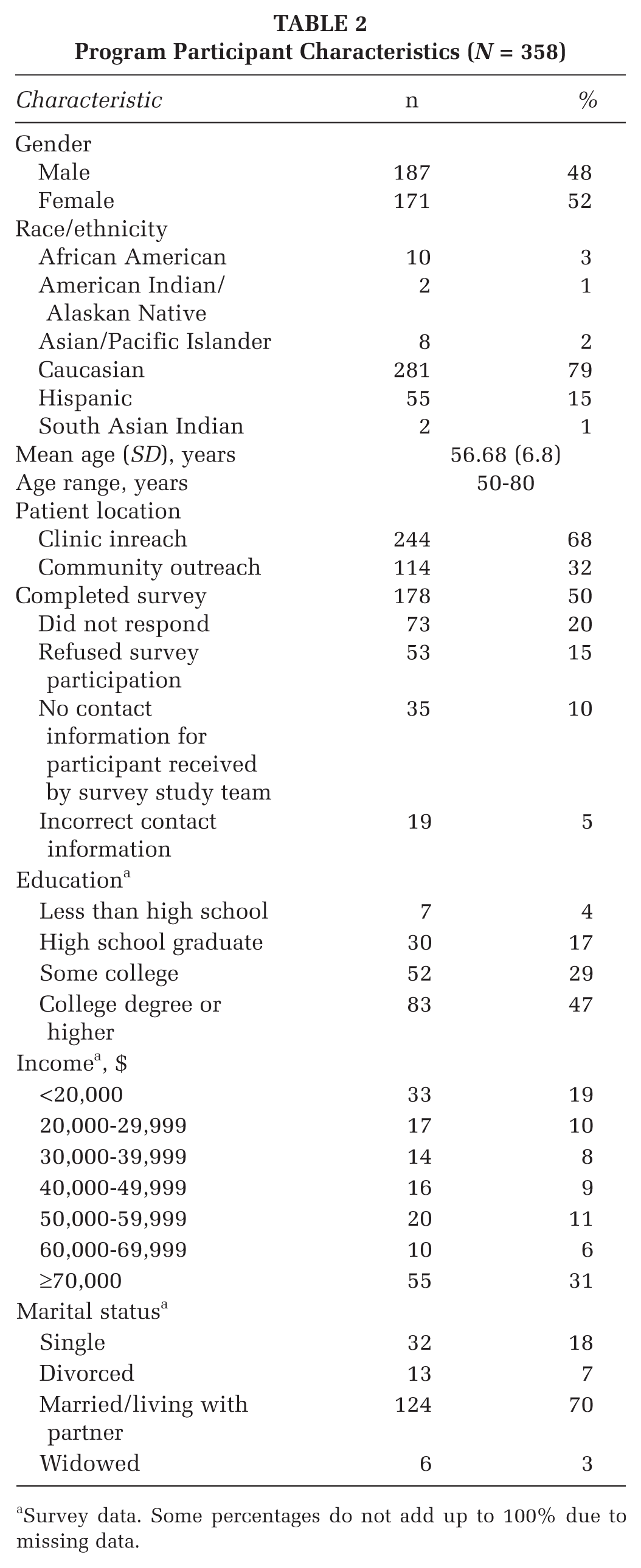
Survey data. Some percentages do not add up to 100% due to missing data.
Bowel Prep Quality and Polyp Detection Outcomes
Bowel prep quality data were available for 100% of the comparison sample. Three SPN program participants did not have colonoscopy prep data available so, 200 of the 203 participants who obtained a colonoscopy had outcome data (99%). Of the three, two participants without data obtained their screening after the outcome data were provided by the clinics, and one person was incorrectly coded as not screened and therefore prep outcome data were not obtained for that case. Table 3 presents comparisons and outcomes for the navigated and nonnavigated samples.
Comparisons and Colonoscopy Outcomes for the Screened Navigated and Matched Nonnavigated Samples
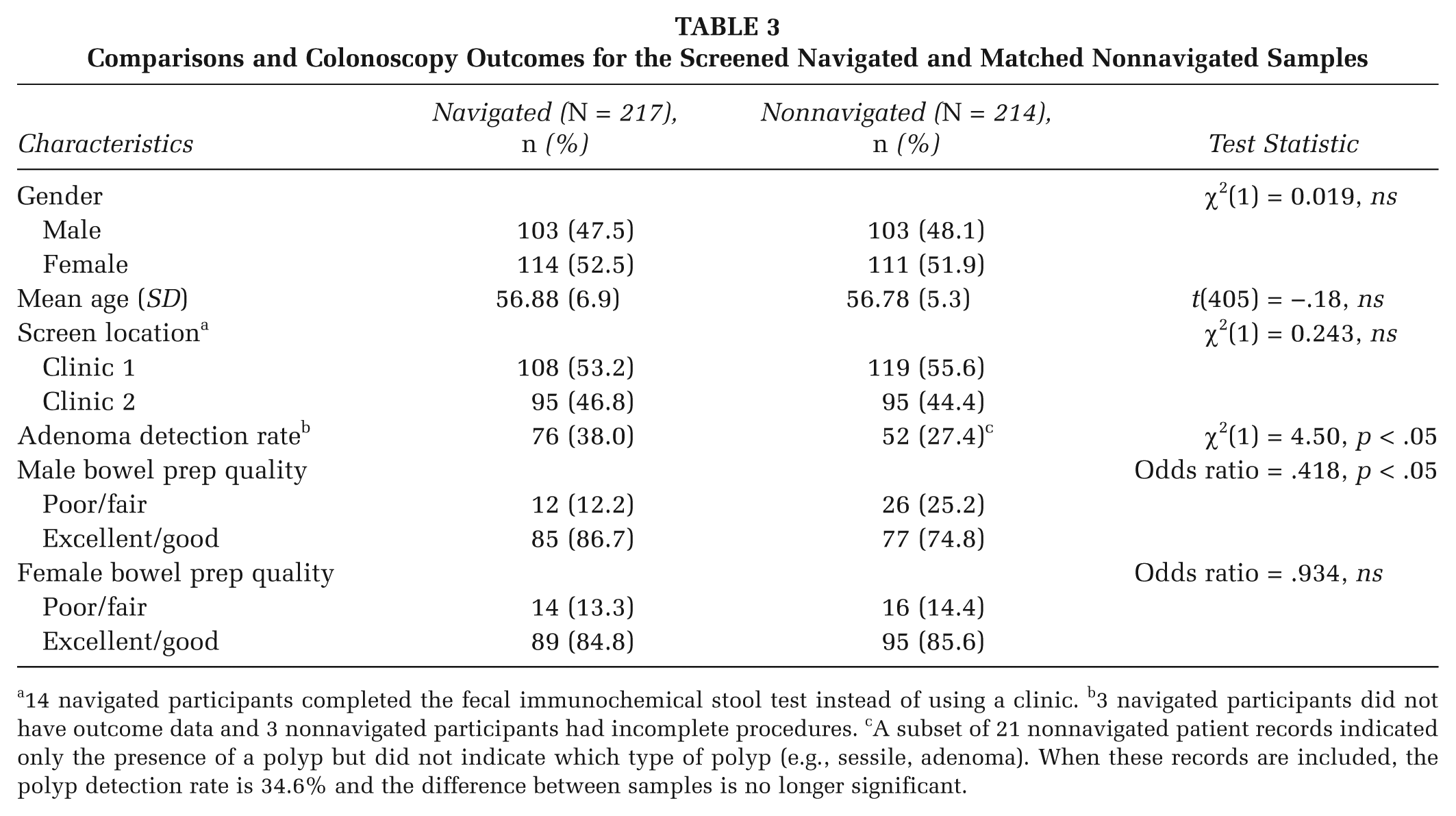
14 navigated participants completed the fecal immunochemical stool test instead of using a clinic. b3 navigated participants did not have outcome data and 3 nonnavigated participants had incomplete procedures. cA subset of 21 nonnavigated patient records indicated only the presence of a polyp but did not indicate which type of polyp (e.g., sessile, adenoma). When these records are included, the polyp detection rate is 34.6% and the difference between samples is no longer significant.
The overall adenoma detection rate was 32.8% (128/390): 40.4% for males (76/188) and 25.7% (52/202) for females. There were no differences overall between navigated and nonnavigated patients on polyps detected. Navigated males were significantly less likely than nonnavigated males to have fair/poor bowel preparation quality (12% vs. 25%, respectively, odds ratio = .418, p = .020, 95% confidence interval [.197, .885]; Table 3). There was no difference between females. In addition, there were no differences in prep quality between the two clinics, by age, marital status, or education or income (all ps > .05). More contact with a navigator was associated with better bowel prep: People with excellent/good prep had on average 2.65 contacts with an SPN versus an average of 1.78 times for those with fair/poor prep (Mann–Whitney U = 720, z = −2.17, p < .05).
Survey of SPN Program Participants
Of the 358 eligible program participants, 178 (50%) completed the survey to examine perceptions of the SPN program and factors that influence screening completion (see Table 4 for a comparison of screened and nonscreened survey participants). Six participants completed the survey in Spanish. Comparing the survey completers and noncompleters, there were no differences by gender, race/ethnicity, or age (all ps > .05). However, 68% of the participants who were screened completed the survey (n = 147/217) compared with only 22% of the not screened group (n = 31/141). The most common reasons why participants in the not screened group did not complete the survey were nonresponse (29%; n = 41) and refusals (25%; n = 35).
Comparison of Screened and Nonscreened Navigator Program Survey Respondents (n = 178)

In total, 217 participants were screened and 141 participants were not screened. bSome cell totals do not equal survey sample size due to missing data. cRespondents reporting being “very” or “somewhat” satisfied. dOf those who responded to the question.
The most frequent type of contact with an SPN was telephone only (72%), followed by face-to-face contact (9%, most typically meeting the SPN at an outreach event like a health fair), and 17% of participants had both types of contact. The most common services provided were scheduling the appointment (52%), answering questions (49%), and providing education about CRC and screening (40%). The respondents reported that the most helpful service was education. On average, participants had two contacts with the navigators (M = 2.69, SD = 1.96) with a mean time of 14.28 minutes (SD = 14.21, Mdn = 10) spent with an SPN.
Characteristics of Screened Program Participants
Of the survey respondents who were screened, 89% reported satisfaction with the program (Table 4). Participants mentioned being unsatisfied about copays and lack of information about procedure costs, which can differ depending on the outcome of screening. Ninety-seven participants (66%) had not been screened before, and 18 respondents (12%) who were screened reported that a first-degree relative had been diagnosed with CRC. More non-Hispanics (64%) were screened than Hispanics (43%), χ2(1) = 8.77, p < .01, Cramer’s V = .156. This difference is confounded with income, however. There were more Hispanics of lower income (42%) than non-Hispanics (29%), and when controlling for income, the differences in screening by ethnicity disappear (p > .05). Participants who were screened were more likely to report that CRC is preventable, more likely to have a doctor recommendation, and more likely to talk to others (besides the SPN or medical professionals) about getting screened.
Participants with higher incomes were more likely to be screened (86% vs. 72%, p = .031). College-educated participants were more likely to be screened compared to those with less education (90% vs. 75%, p = .009). However, when stratified by income, there was no difference in screening rates by education level among participants making less than $30,000 per year. Among participants with incomes higher than $30,000, those with more education were more likely to get screened compared with participants with lower education (92% vs. 78%), χ2(1) = 4.5, p = .033, Cramer’s V = .20.
There was no difference between screening completion and whether one’s spouse/partner had been screened too. However, when controlling for screening status, we found that among the screened group, more women who had been screened also had a partner who was screened (76%) compared to men who were screened (only 54% of men reported having a partner who was also screened), χ2(1) = 5.25, p = .022, Cramer’s V = .22. We did not find a comparable gender difference in the rates of spouse/partner screenings within the subsample who were not screened.
Otherwise, there were no differences whether an eligible participant was screened or not by gender, age, time spent with navigators, first-degree relative with CRC, close friend with any type of cancer, or contact location (all ps > .05). The navigators did have more contacts with nonscreened participants than screened (p < .001), which in part reflects more follow-up contact needed for people who did not initially follow through with screening.
Examining Gender Differences That May Influence Bowel Prep Quality
We next compared navigated males and females to identify differences that might contribute to the better bowel prep observed in males. Males reported receiving more help with paperwork (28% to 12% for females), χ2(1) = 4.8, p < .05, Cramer’s V = .20, and scheduling their screening appointment than females (77% vs. 60%, respectively), χ2(1) = 3.9, p = .05, Cramer’s V = .18. There was no difference on perceived severity of CRC between men (M = 6.0) and women (M = 6.4) who were screened. However, unscreened males perceived CRC as less severe (M = 3.8) than unscreened females (M = 6.0), t(28) = 2.18, p < .05.
Males were more likely to say they now know more about CRC than before contact with the program (82% vs. 61%), χ2(1) = 6.41 p < .011, Cramer’s V = .234. Separating this finding by screening history, the gender difference remained significant only among 1st time screeners (p = .015). Although not statistically different, males were less likely to correctly identify that the statement “Colon cancer is one of the leading causes of cancer deaths” is true (70% of males correctly responded true; vs. 83% of females), χ2(1) = 1.55, p = .08.
Otherwise, there were no gender differences for demographic characteristics (age, income, education, Hispanic ethnicity, family member with CRC, family/close friends with any type of cancer), doctor recommendation for screening, conversations with family or others, previous screening, belief whether CRC is preventable, and contact location (outreach vs. inreach). Likewise, no significant gender effects were found for time with SPN (although males spent slightly more time with navigators: 15 minutes on average vs. 13 minutes for females), program satisfaction, self-efficacy, relative and absolute susceptibility, or changes in perceptions of barriers or benefits toward screening.
Discussion
The SPN program was able to successfully enroll and screen a diverse group of participants. More than half of the participants had never been screened for CRC previously. Nearly 90% of the screened reported satisfaction with the program and perception of navigator quality is associated with satisfaction with cancer-related care (Jean-Pierre et al., 2013). The development of both the program and study used a community engagement process, built on community strengths, and hired navigators from the affected community who were matched on the community’s demographics. The program was unique in that it involved two ambulatory clinics outside of a health care system whereas most studies use only one location. It included both inreach activities at the clinics focused on their harder to reach patients, and outreach in the local community. We also conducted surveys with participants about their experiences and perceptions of the screening process and obtained outcome data from the clinics on a randomly selected matched comparison sample.
The results show that it did not take much time with the SPNs or require face-to-face meetings for successful screening completion. The median amount of time a participant spent with a navigator was 10 minutes. However, participants reported that the repeated phone calls by the SPNs helped keep CRC screening a priority for them. The clinics have reported that about 40% of referred patients never schedule an appointment. In our results, 57% of this group completed screening. The likelihood of this outcome happening without the SPN program is doubtful because the clinics no longer were attempting to reach the patient. More extensive in-person navigation can increase screening rates (Lebwohl et al., 2011), but our study showed that a less costly option that persistently makes contact with patients can be effective.
We found similar or better rates of bowel prep quality as in other studies using private insurance patients and had higher quality levels than studies with Medicaid patients (Chen et al., 2008; Miller et al., 2016). Lebwohl et al. 2011 found that private insurance nonnavigated patients had poor or fair prep rates at 20% for both men and women. Comparatively, the current study’s navigated and nonnavigated female participants had nearly equal poor or fair prep rates (13% and 14%, respectively). Furthermore, 25% of nonnavigated males in this study had poor or fair bowel preparation quality whereas only 12% of the navigated men had poor/fair prep. As this difference indicates, we found that navigated men had better bowel preparation quality compared to a random matched sample of nonnavigated men. This finding supports previous research showing men benefit more from navigation (Jean-Pierre et al., 2013). The survey data showed that educating males appears effective in increasing screening rates and improving bowel prep quality. Although not a significant difference, we did find a trend that more time spent with a navigator was associated with better bowel prep.
Miller et al. (2016) found lower income was associated with poorer prep quality whereas we did not find an association between income and prep quality. However, we did find a significant influence for education by income level on screening. In particular, we found that at higher (but not lower) income levels, education was associated was screening. It may be then that if a person cannot afford a colonoscopy, educational influences are not as influential. Unlike Lebwohl et al., 2010, we did not find that unmarried individuals had worse prep. We did find that women who were screened were more likely to have a spouse/partner who was also screened, and so a partner influence was found for women but not for men.
Limitations
We did not have data on comorbidities that could influence the rate of screening completion and that might influence bowel prep (Lebwohl et al., 2011). Neither did we have additional clinical outcome data on variables such as colonic location of polyps or histology.
We obtained data from the clinics on patients who did not show for their appointments; however, the data were not reliable as records were changed when a new appointment was scheduled without maintaining the original record noting the missed appointment.
Our survey response rate for nonscreened participants was low, and the survey sample had a high education level overall, which limit generalizability. The SPNs could not reach participants who did not get screened and neither could the survey team. We did not obtain survey data on our clinic comparison sample and could have learned more about perceptions of screening that affected bowel prep quality in that sample.
Other than as noted, we did not find many differences between males and females so there may be other factors influencing bowel prep quality that were not examined in this study. We also did not find a difference for Hispanics and non-Hispanics in bowel prep quality or in screening after controlling for income. However, the Hispanic sample was small, which limited our analytic options and therefore future studies should continue to examine differences by race/ethnicity. Finally, the community outreach recruited a number of participants ultimately determined to be ineligible for the program, which was not an effective use of resources.
Implications for Practice
The results of this study show that prevention education about CRC is effective as people who were screened were more likely to correctly identify that colon cancer is preventable. The importance of doctor recommendations for screening is supported in this study too as higher rates of screening completion were seen among those with a recommendation. Patient’s income and education remain as barriers to screening. In particular, we found that higher education was predictive of screening at higher income levels. Because CRC screening is a covered benefit under the Affordable Care Act, it will help address income barriers unless the law is repealed, which could make screening unaffordable again (Weintraub, 2017). A patient’s education level remains an important determinant for screening, and whereas most studies have focused on low-income populations, it is helpful to identify differences among higher income groups too and tailor messages by education level within those groups. Finally, one explanation offered by the SPNs for the program’s success was the close relationships with the clinics. Navigators were given an e-mail account, desk space, and access so they could immediately schedule willing patients. For future clinic-based SPN programs, developing close relationships with navigators and ensuring access to relevant clinic operations should be important considerations.
Future Research Directions
We have shown that males’ perceptions about, and knowledge of, colon cancer and screening can be changed, which may have helped improve their bowel preparation. Yet males were less likely to correctly identify that colon cancer is one of the leading causes of cancer deaths. Future research should examine explicitly which educational messages are more important for motivating screening and adherence to bowel prep regimes. For example, in this study, perceptions of the severity of CRC was lowest among nonscreened men and therefore education targeting the impacts of cancer may be more effective than other education efforts.
This article adds to the literature demonstrating the efficacy of navigation but also shows specifically that hard-to-reach populations who do not follow through with scheduling appointments can complete screening and that men’s bowel preparation quality can be improved. Good bowel prep increases the rate of adenoma detection and reduces the need for repeat procedures, which saves time and money (Lebwohl et al., 2011).
Supplemental Material
HPP757485_Supplemental_Material – Supplemental material for Using Community Engagement and Navigators to Increase Colon Cancer Screening and Patient Outcomes
Supplemental material, HPP757485_Supplemental_Material for Using Community Engagement and Navigators to Increase Colon Cancer Screening and Patient Outcomes by Paul G. Devereux, John Gray, Susan Robinson, Janie Galvin and Jesse Gutierrez in Health Promotion Practice
Footnotes
This project was supported by grants from the National Center for Research Resources (5P20RR016464-11) and the National Institute of General Medical Sciences (8 P20 GM103440-11) from the National Institutes of Health.

References
Supplementary Material
Please find the following supplemental material available below.
For Open Access articles published under a Creative Commons License, all supplemental material carries the same license as the article it is associated with.
For non-Open Access articles published, all supplemental material carries a non-exclusive license, and permission requests for re-use of supplemental material or any part of supplemental material shall be sent directly to the copyright owner as specified in the copyright notice associated with the article.
