



Abstract
Background. HIV is one of the primary causes of death in Guatemala, and during the period 2005 to 2013, Guatemala exhibited a 95% increase in such deaths. HIV transmission rates are nearly 3 times higher among the indigenous Mayan population than nonindigenous Guatemalans. Guided by the community-based participatory research approach, this article demonstrates the iterative formative research process necessary to develop a deeper and more informed understanding of HIV prevention attitudes and behaviors in the priority population. This project extends preliminary formative research that demonstrated the applicability of the health belief model (HBM) in examining risk, stigma, and barriers and facilitators to condom use and HIV testing. Method. Using an integrated mixed-method design, data were collected from heterosexual adults 18- to 25 years old (N = 250), including 50 in-depth interviews and 200 rapid assessment surveys. Results. HBM concepts of risk and stigma were confirmed. Data also revealed low rates of condom negotiation and high embarrassment in purchasing and discussing condom use. Furthermore, data yielded very low uptake rates and reduced levels of comfort with getting tested. Conclusion. This research informs refinement of a culture-specific intervention prioritizing indigenous Mayans. We highlight how community-based research and engagement enhance community health promotion.
Keywords
Introduction
Guatemala is a diverse Central American country of just over 16 million citizens (World Bank, 2015), where estimates of people living with HIV range from 49,000 (UNAIDS [United Nations Programme on HIV and AIDS], 2014) to 150,000 (Rhodes et al., 2014), and new HIV infections have increased by 167%, while AIDS-related deaths have increased by 23% (UNAIDS, 2016). Indigenous Mayans represent nearly 40% of the population (Population Council, 2010) and comprise a fifth of HIV cases (21%; SIPI, 2014). Unfortunately, accurate data about this population are unavailable (UNAIDS, 2013), and underreporting has been estimated to be as high as 50% to 70% (Ministerio de Salud Publica Y Asistencia Social de Guatemala [MSPAS], 2007).
Despite advances in treatment and in implementation, HIV assessments and interventions have not reached all population groups equitably, leading to insufficient attention prioritizing indigenous populations. Indigenous Mayans are considered a vulnerable population that is marginalized and excluded from the social policies of basic health services (including the national strategic plan on STI/HIV/AIDS), education, roads and transportation, electricity services, and drinkable water (UNAIDS, 2013). In addition, they are negatively affected by high levels of migration, violence, and racism. Furthermore, disparities in HIV transmission knowledge, difficulties in accessing HIV prevention and care services, limited access to HIV testing, and limited access to culturally sensitive approaches to prevention have increased the vulnerability among this priority population (UNAIDS, 2013).
These risk factors contribute to the HIV transmission rate being nearly 3 times higher in the indigenous Mayan population than in nonindigenous Guatemalans (Cohen, 2006) and suggest vulnerability to a potential HIV epidemic experienced in similar indigenous communities (Butt, 2013; Duan et al., 2013). Recognizing the necessity to assist national estimation among the indigenous, we began investigating HIV prevention perceptions and behaviors in Santiago Atitlán (98% indigenous), using a community-based participatory research (CBPR) approach. Our overarching goal is to develop, implement, and evaluate a culturally appropriate and evidence-based HIV intervention. We began by conducting two waves of formative research. This article describes Wave 2 of our efforts. Our project can make an important contribution to the larger yet poorly resourced national health information system by providing relevant prevention indicators (Barczyk, Garcia, & Casabona, 2010).
Background
HIV prevalence data among the indigenous are starkly missing and are much needed (Mendizabal-Burastero & Yancor, 2017). A literature search and dialogue with local partners also revealed no comprehensive assessment or prevention campaigns prioritizing this town. To address this void, researchers used a CBPR approach coupled with the health belief model (HBM) framework to uncover barriers and facilitators to HIV testing and condom use. Our formative work began by forming an advisory board that reflected collaborations across community partners, researchers, and the priority population. Given the insular and remote population, we recognized the necessity of using a mixed-method design for data collection that would facilitate breadth and depth of understanding as well as demonstrate data corroboration (Creswell & Clark, 2017). Knowing that formative research is an iterative process (Blumenthal, Hopkins, & Yancey, 2013), we conducted two waves of formative research, resulting in an integration of in-depth interviews, a focus group, and a quantitative survey findings documenting multiple standpoints on what is important and valued in our priority population regarding HIV prevention. This article describes Wave 2 findings and confirms preliminary Wave 1 results, enabling us to move forward confidently to campaign content pilot testing.
In brief, the first wave of data collection consisted of 50 in-depth interviews (25 female, 25 male) of young heterosexual adults, ages 18 to 25 years, eight interviews from cultural informants (community opinion leaders, teachers, and health educators), and a focus group of 15 female Mayan birth attendants, known as comadronas. Results demonstrated the applicability of HBM for this priority population; however, we did find a reluctance to discuss personal susceptibility, mixed levels of HIV transmission knowledge, unfamiliarity with HIV treatment, as well as several cultural factors impeding condom use and HIV testing (see Orrego Dunleavy, Phillips, & Chudnovskaya, 2018). We also found conflicting perceptions regarding stigma toward people living with HIV/AIDS and obtained initial information on campaign message sources, themes, and preferred media platforms. Therefore, to seek congruity and refinement we conducted a second wave of data collection in the form of 50 in-depth interviews corroborated by 200 quantitative surveys.
Community-Based Participatory Research
The current HIV prevention intervention is firmly rooted in community partnership, using CBPR (Neuhauser, Syme, & Kreps, 2014). CBPR encourages the close cooperation of researchers and the local community population in an attempt to create community empowerment and knowledge to improve health outcomes (Amendola, 2013; Guta, Flicker, & Roche, 2013). Through involvement in each stage of the campaign (development, implementation, and evaluation), the priority population recognizes its own capacity to respond to health threats such as HIV (Kakietek et al., 2013; Muturi & Mwangi, 2011; Tynan et al., 2013).
Health Belief Model
Previous scholars have successfully used the HBM to understand sexual behavior and to determine intentions and barriers to HIV testing in many countries (Li, Lei, Wang, He, & Williams, 2016; McCoy et al., 2009; Westmaas et al., 2012; Zhao et al., 2012). The HBM predicts that perceptions of susceptibility, severity, benefits, and barriers (to a behavior) directly influence health-related actions (see Champion & Skinner, 2008). The model also addresses the benefits and barriers to the proposed action that affect the likelihood of taking action. Finally, the HBM includes a cue to action component, conceived as external stimuli (e.g., media campaigns) or internal stimuli that prompt an individual to perform the health behavior (Champion & Skinner, 2008).
Research Questions
Our preliminary research demonstrated the applicability of HBM; however, given the remote location and initial entry into this community, it was necessary to conduct an iterative follow up to facilitate breadth and depth of understanding as well as verify corroboration. Accordingly, the following research questions are proposed:
Method
Data Collection
Data were collected through (1) rapid assessment surveys (RASs) and (2) qualitative interviews. We retained and trained local staff consisting of a local coordinator and four (two female, two male) interviewers who helped with recruitment, conducted in-depth interviews, and administered the RAS. All staff worked for the local health center and were active community health advocates with experience in discussing sensitive topics like HIV. Criteria for study inclusion were (1) heterosexual adults 18 years or older and (2) participants living in Santiago and of Mayan descent. The interview guide used was similar to the one used in Wave 1 (see Orrego Dunleavy et al., 2018) that measured HBM concepts, transmission knowledge, stigma, perceptions surrounding HIV testing and condom use, as well as queries on the campaign logo and message strategy. The RAS was developed by researchers specifically for this project and consisted of 20 questions used in UNAIDS HIV prevention measurement.
Procedure
In public areas populated with the priority population (community centers, church centers, town center square, outside Internet outlets, and the health center), local staff invited volunteers to participate in data collection. Volunteers were not allowed to participate in both the interview and RAS. RAS was quickly administered on location while in-depth interviews were scheduled in the participants’ homes at their convenience.
Participants
The priority population was young adults 18 to 25 years old, recognized by Santiago Health Center as a high-risk group. The priority population also represents a mobile and technologically savvy group that is open to new information and are currently social change agents in their community. Data collection was conducted in the language preferred by the participants (Spanish or Tz’utujil Mayan dialect).
RAS participants (49% males, 47% females, 4% N/A) reported age (M = 22.12, SD = 2.12) and relationship status (49% single, 32% in relationships, 19% married, 1% widowed). Regarding in-depth interviews, 49 were analyzed (49% female, 51% male), as one could not be transcribed. Participants reported faith affiliation (91.7% Catholic or Evangelic, 8% Christian), and employment status (78% were employed, 15% were students, and 6.5% were unemployed).
Data Analysis
Our integrated mixed-method design was used to determine the extent of convergence between quantitative and qualitative data in order to expand our understanding of HIV prevention among indigenous Mayans. The interviews and RAS responses were translated and transcribed into English. NVivo 9.0 was used to sort and analyze interview data. Constant comparative analytical method was used to identify interview themes (Corbin & Strauss, 2008), guided by HBM. Descriptive statistics of RAS data are reported. The common concepts described below provide a comprehensive and an insightful analysis of the priority population.
Findings
Perceived Susceptibility
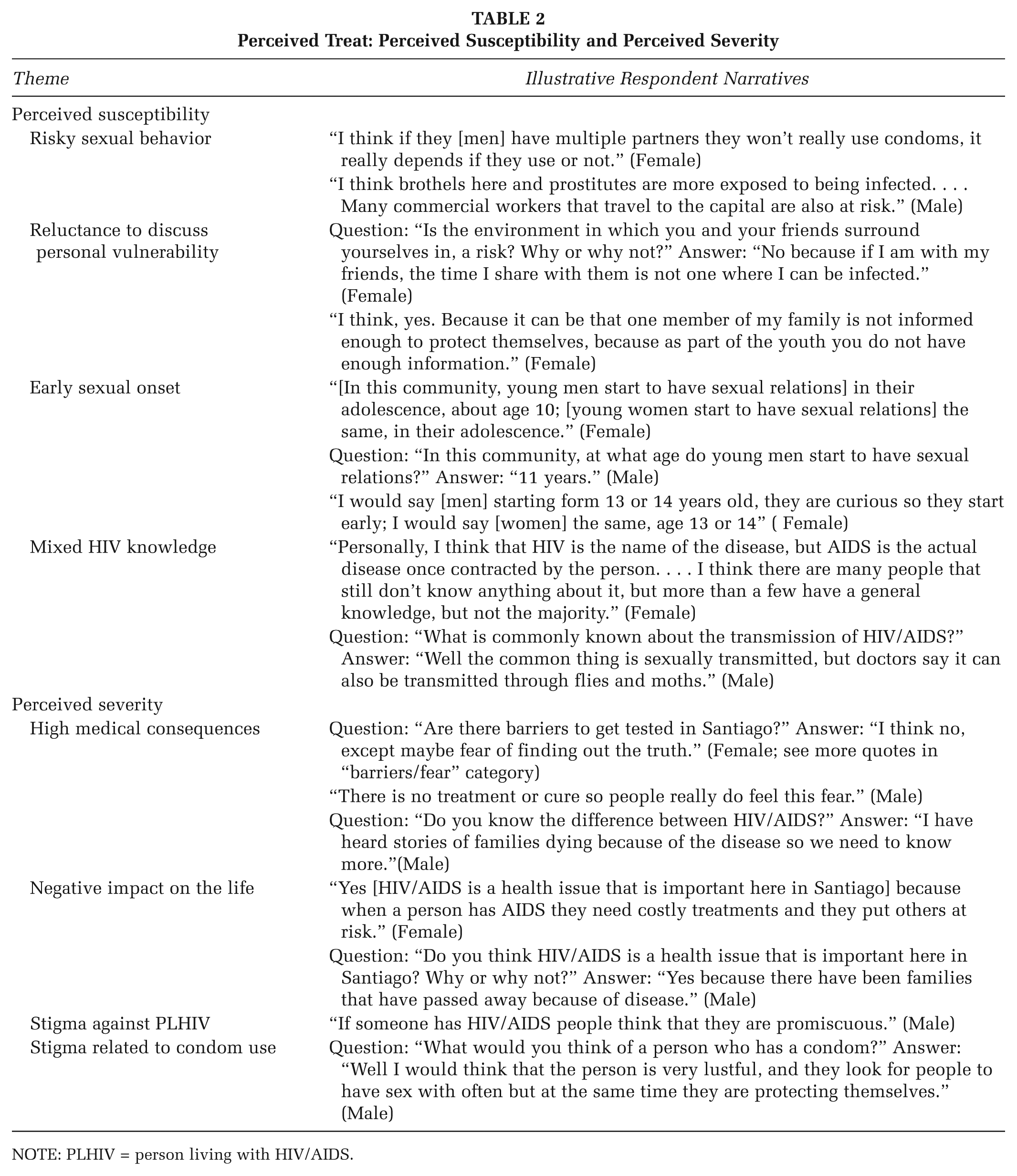
Results confirmed Wave 1 findings, indicating that concurrent partnerships, commercial traveling, premarital sex, and availability of brothels and prostitutes in Santiago encourage risky sexual behaviors. First, the interview participants acknowledged that many engage in multiple and concurrent sexual partnerships. One of the reasons is lack of employment opportunities for men in Santiago, and when “the man goes to work, the man has two or three partners” (female). Moreover, if a married man is not satisfied sexually with his wife, he can frequent brothels, or seek other women, which is acceptable in the community, “. . . for society it is normal that men go to these places [brothels] because they are men and simply they have necessities” (female). This behavior places men at high risk for HIV infection, because “they [men] do not think about carrying condoms” (male).
Next, many participants were unaware of their risk for acquiring HIV, and they did not identify themselves with the associated risks, “I am with my friends, the time I share with them is not one where I can be infected” (female). One of the explanations was the lack of information about HIV in the community, because talks about sexual relations, including STDs and condoms, are not culturally acceptable, “In our culture, we are not allowed to hear . . . information on condom usage, people think it is vulgar” (male). Additionally, according to participants, youth engage in sexual relationships as early as age 10. Unsafe sexual practices among youth was attributed to lack of sexual education. One female participant stated, “Currently I would say many young people use technology wrongly and so they are promiscuous . . . they start to have sex at age 14 or 15.”
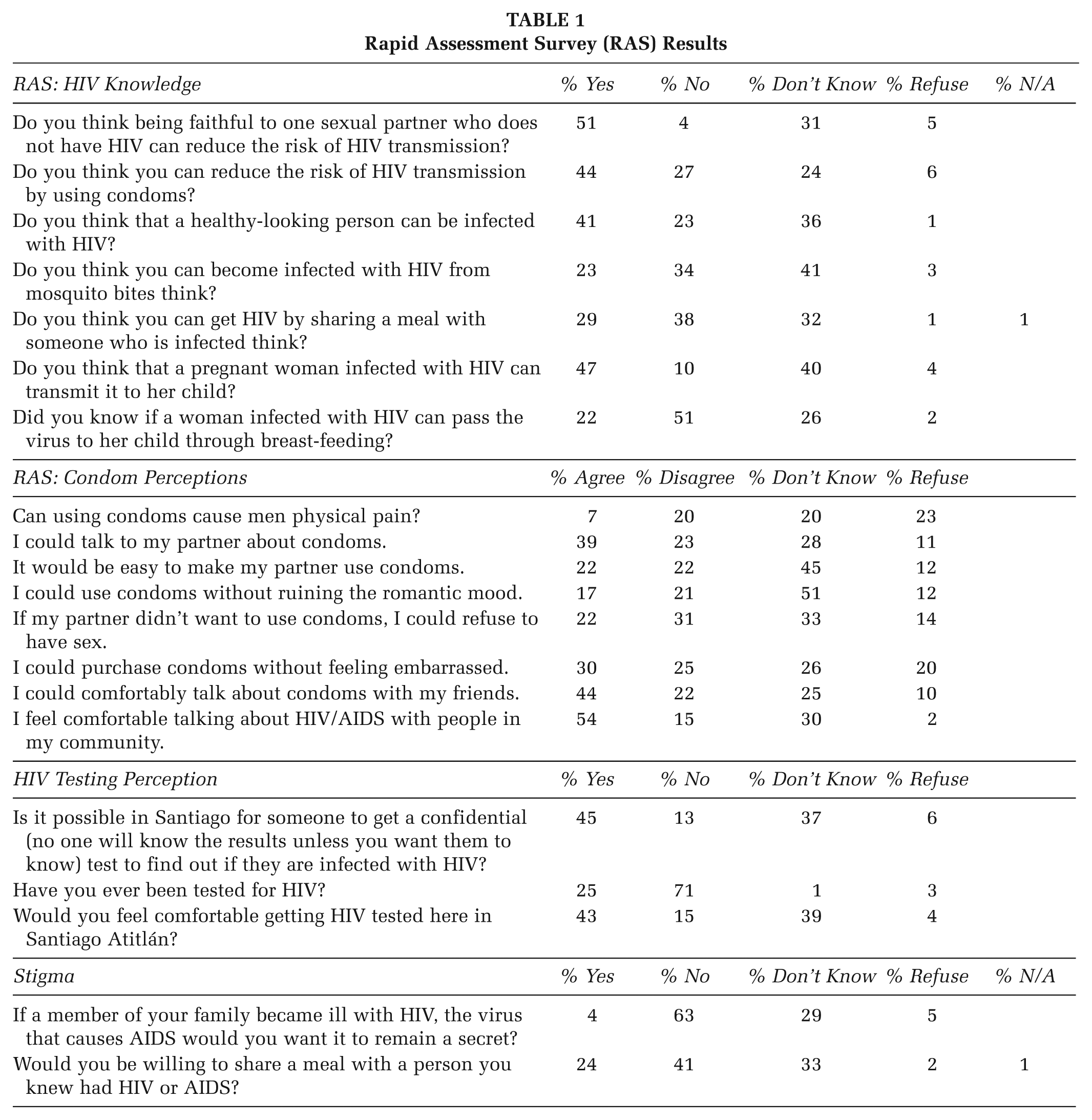
Finally, minimal sexual education and a reluctance to discuss consequences of unsafe sexual practices contributed to mixed HIV knowledge among the local community. Similarly, RAS findings indicated that 23% of participants believed that an individual can contract HIV from mosquito bites, 29% stated HIV can be transmitted via meal sharing with an infected individual, 47% believed in mother-to-child transmission during pregnancy, and 22% reported mother-to-child transmission via breast-feeding (see Table 1). Thirty-two percent of RAS participants possessed no knowledge of HIV transmission. A female interviewee commented on the low level of HIV knowledge in the local community, “I think there are many people that still don’t know anything about it, but more than a few have a general knowledge, but not the majority.”
Rapid Assessment Survey (RAS) Results
Perceived Severity
Results confirmed our Wave 1 data regarding perceptions of high medical consequences, and stigmatization against persons living with HIV/AIDS (PLHIVs), but also revealed additional severity themes (see Table 2). Participants viewed HIV as a serious community threat affecting not only the life of an individual but also his or her family. Many interviewees expressed fear discussing HIV as an incurable deadly disease, which may heighten stigma around those living with HIV. RAS results confirmed that only 24% were willing to share a meal with a PLHIV. However, 63% of participants reported they would support a family member who became infected with HIV. The collectivistic character of the community could explain this, as family and caregiving to family members are highly valued.
Perceived Treat: Perceived Susceptibility and Perceived Severity
NOTE: PLHIV = person living with HIV/AIDS.
Perceived Benefits
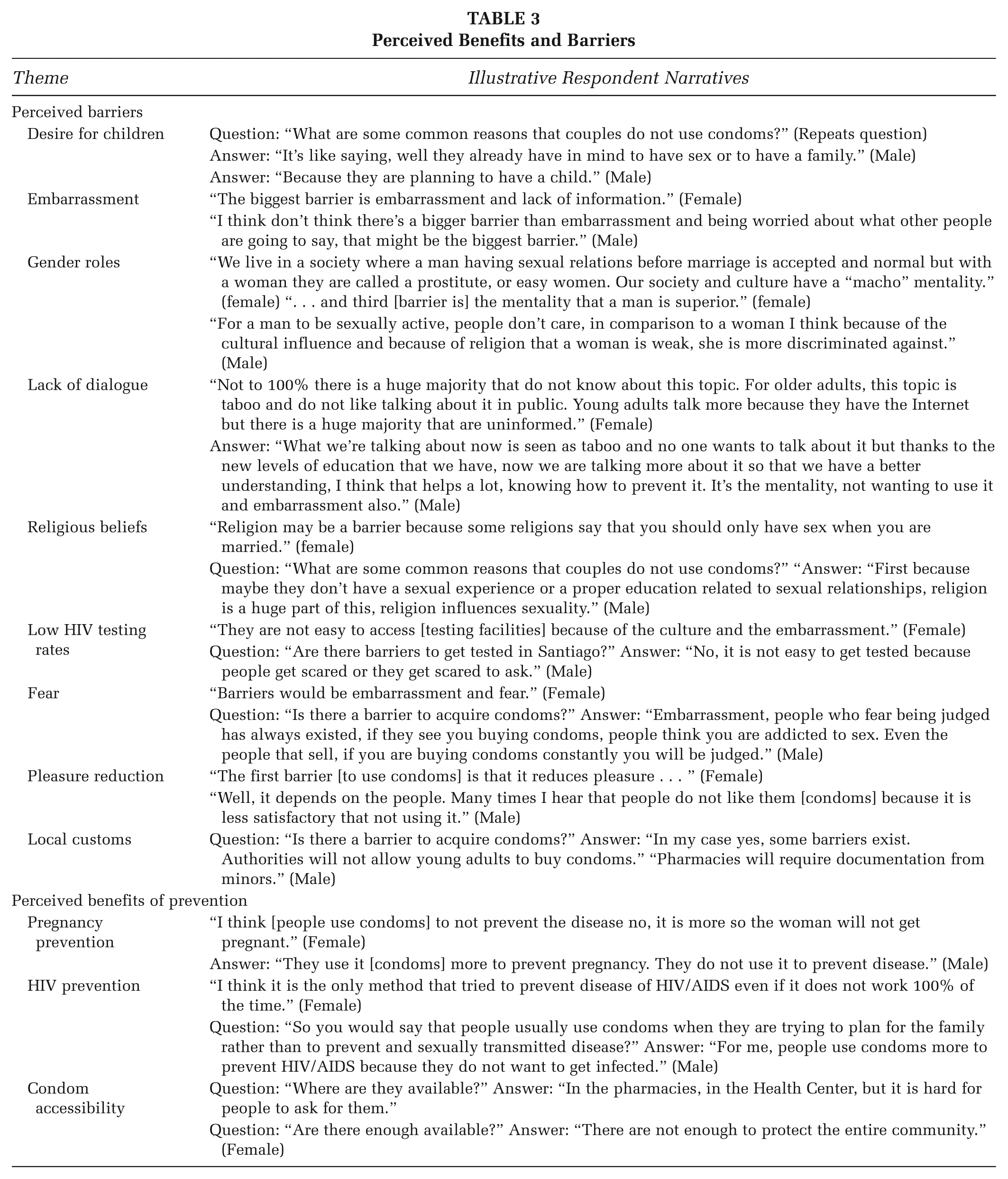
Results converged with Wave 1 data regarding condoms and HIV testing (see Table 3). Some interviewees reported that many people used condoms for family planning purposes due to cultural norms and religious beliefs, “I think [people use condoms] to not prevent the disease; it is more so that the woman will not get pregnant” (female). While others did recognize an HIV prevention role, “For me, people use condoms more to prevent HIV/AIDS because they do not want to get infected” (male). Regarding HIV testing, RAS participants reported a moderate level (43%) of comfort in obtaining an HIV test in their community.
Perceived Benefits and Barriers
Perceived Barriers
Wave 1 data were also confirmed regarding cultural barriers: desire for children, embarrassment, gender roles, lack of dialogue, religious beliefs, and low HIV testing rates (see Table 3). Additionally, results identified “pleasure reduction” as a barrier to condom use, and “fear” of positive results as a barrier to HIV testing. Lack of knowledge was identified as a key contributor to these assumptions. Thus, less than half of RAS participants (44%) believed in condom efficacy for HIV prevention. Consequently, only 22% would refuse to have sex if his or her partner did not want to use condoms, while 31% would still have sex, and 33% reported being unsure.
Cultural factors had a strong influence on decision-making processes in the local community. A primary influencer in relationships is machismo, where a man exerts his superior role within relationships. One female participant acknowledged, “The ‘machismo’ still exists, men want to impose their authority with a woman, and they don’t listen to the woman if she wants to protect herself. . . . He ignores the possible dangers of having sexual relations.” Machismo is also reflected in males’ primary concern for pleasure, in which they perceive they “may feel less satisfaction when having sex while using condoms” (female). Furthermore, interviewees acknowledged religion as “a huge part of sexual relationships” that “influences sexuality.” The church promotes having big families encouraging married couples to reproduce. The use of prophylactics to impede natural reproduction is considered sinful; subsequently, many local people do not use condoms. A female participant reported, “Because many people here are religious and using condoms is a sin so they will frown on this method.”
Cultural and religious factors influenced the lack of dialogue about condom use, efficacy, and purchase. Some young adults discussed these topics and sought information via the Internet, nonetheless, majority of young people were uninformed, “I think here in Santiago, no one talks about AIDS . . . in school and in the home . . . no one tells you directly that you have to use a condom . . . or how to use condoms” (male). Only half of RAS participants demonstrated some level of comfort to discuss condoms with their friends or community members: 44% could comfortably talk with their friends and 54% felt comfortable talking about HIV/AIDS with people in the community. Only 39% of the survey participants would talk about condoms with their partners, and only 22% agreed that it would be easy to make their partners use condoms. Cultural norms and existing stigma perpetuated embarrassment associated with purchasing condoms. Only 30% of RAS participants could purchase condoms without feeling embarrassed. A male participant stated, “I would be embarrassed [to buy condoms], it is like when you commit a sin.” Other participants noted, individuals who buy condoms fear stigmatization or being considered as sex addicts. Additionally, religion denounces premarital sex; therefore, unwed individuals are embarrassed to obtain condoms.
Only 25% of RAS participants reported getting tested for HIV. In addition, some interview participants were unfamiliar with the availability of HIV testing centers, with some participants reporting concern about accessibility. One female participant commented, “I don’t know about those. I would imagine you can get tested in clinics or labs . . .” Anticipated stigma and fear of positive test results were also barriers. One of the male participants shared a story he observed at a testing center, “A group of young adults wanted to give the tests . . . and nobody wanted . . . to take the test. . . some were embarrassed and others were scared.”
Cue to Action
Wave 1 data were also confirmed regarding effective channels for the HIV prevention campaign, including a community-designed logo, a slogan, and multimedia outreach stressing use of radio and social media platforms (see Table 4). Regarding radio, “Well here in Santiago, almost half of the people don’t have access to television, and I would say radio first.” Social media was also suggested as an effective channel for reaching young people. Participants approved of the current campaign slogan encouraging sexual personal responsibility. A female participant commented,
My message would be that we all have a responsibility to take care of our health, if we are knowledgeable of our actions we will have a rich and healthy life, if we ignore these messages, we will be negatively affected.
Cues to Action

Additionally, participants confirmed that intervention messages should also promote abstinence and monogamy. Furthermore, due to cultural norms of labeling sex talk as taboo, many respondents suggested interpersonal dialogue and use of education centers to discuss such sensitive topics. Finally, when asked about the logo, participants approved of the logo, “because it reflects love, . . . and the coyotal, which is a symbol of the community, and [it] has a strong message, “my body my responsibility” (male). Some interviewees offered some design improvements, including use of the Lake Atitlán image to reflect the pride for the local society.
Discussion
Culture plays a vital role in determining the level of health of the individual, family, and community as one’s behaviors depend on one’s history and experiences with self, family, and community (Airhihenbuwa & Webster, 2004; Dutta & Basu, 2011). Therefore, it is important to examine personal actions in health-related decision-making processes in social-cultural contexts. Our work in Santiago reflects this perspective as we have integrated the CBPR approach within the HBM framework to actively engage our priority population in HIV prevention. We have sought and obtained formative data convergence via mixed-methods research that has provided a depth and breadth of understanding guiding then refining our campaign plan.
Regarding condom perceptions, our Wave 2 data revealed additional beliefs surrounding reduced sexual pleasure, low rates of condom negotiation between partners, and levels of embarrassment in purchasing and discussing condom use. Regarding HIV testing, data yielded very low uptake rates, uncertainty on where to get tested, and reduced levels of comfort with getting tested. In addition, the results of the study confirmed the choice of communication channels—radio and small group talks—to serve as cues to action in an HIV awareness and prevention campaign.
Iterative data collection led to a community-based, grassroots collaborative that is reflected in the campaign slogan, “Mi Cuerpo, Mi Responsibilidad: Atitlán contra VIH/SIDS” (My Body, My Responsibility: Atitlán Against HIV/AIDS), reflecting community empowerment through learning about HIV. The logo was designed by a local artist and displays the colors of Santiago Atitlán (see the Appendix). Researchers will also partner with a local media planning/producing group, “Yo Respondo,” who will produce, disseminate media content, and organize community events, including three community festivals. Specifically, a weekly 1-hour informative radio program will be broadcasted on a local radio station and via social media platforms. The messages should include (1) promoting abstinence and monogamy (when working with churches) and (2) promoting monogamy, condom use, and HIV testing (when working with comadronas, civic groups, and LGBT [lesbian, gay, bisexual, and transgender] people). Participants also stressed that messages must be conveyed in both Spanish and Tz’utujil languages so all messaging will be communicated in both languages to enhance cultural acceptance and impact. Interactive small group sessions facilitated by our local partners in the Santiago Atitlán health center and the civic youth office will reinforce mediated messages. Sociocultural factors such as stigma, gender, inequality, and sex communication will also be addressed. Each event will promote collective cultural participation.
Conclusion
Findings of the present study advance the development of a culturally tailored HIV prevention campaign plan enhancing condom use and HIV testing uptake. The first step in HIV prevention is documenting HIV status. To date, rural communities, like Santiago Atitlán, lack resources for such surveillance. Our goal is to bridge this gap in health disparity by partnering with the Guatemalan Ministry of Public Health and Social Welfare (MSPAS) to carry out HIV prevention and health promotion in this hard to reach indigenous community. We have worked with the local branch of MSPAS in Santiago and are the first researchers to empirically study prevention perceptions and behaviors in a culturally sensitive manner. Our goal is to continue documenting risk, prevalence, and to heighten condom use and HIV testing uptake. We will share our findings with the indigenous population unit of MSPAS, CDC-CAR (Center for Disease Control and Prevention-Central American Region), UNAIDS, and USAID (United States Agency for International Development) with the larger goal of empirically documenting need and obtaining requisite funding to address the need. Our campaign plan and subsequent implementation is an example of a culturally sensitive and grassroots collaboration prototype that may be used in similar surrounding lake communities.
Recently MSPAS has introduced their “inclusive model of health” (Modelo Incluyente en Salud [MIS]) that is a proposal to strengthen the country’s first level of health care by recognizing that health–illness is a process, which includes many elements and not just a cause–outcome relationship. MIS recognizes the great amount of health disparity and poverty among indigenous communities. This inclusive conception of the health–disease points to four pillars of health that the health system should include, which recognize perceptions of health and illness from individuals, families, and local communities. The four pillars are as follows: right to health, gender perspectives, intercultural awareness, and environment/mother nature (Instituto de Salud Incluyente, 2010). Our CBPR approach directly complements MIS and is a reason for the continued partnership and receptivity. We have successfully established bidirectional community partnerships, which comprise our advisory board. Moreover, through strategies such as employing local youth, training them on interview and focus group data collection, media planning, and intervention management we have empowered youth to contribute to their community and to their health care. We recognize the power of culture and engagement to enhance community health promotion.