



Abstract
Authentic youth engagement was a central component of the Food & Fitness (F&F) Initiative, a 9-year community-based intervention, whose goal was to ensure that all children have equitable access to healthy food and built environments that promote safe physical activity. The youth engagement component focused on strategies and structures that would support a model framework for youth involved in F&F community partnerships. These strategies empowered youth by providing the leadership and technical skills needed in collaborative efforts to sustain change in communities with inequities, where structural racism and inequities result in poor health outcomes for children. This article describes the models that the diverse urban and rural communities across the United States employed to successfully engage youth in the vision and work of F&F and discusses overall lessons learned, challenges, and best practices/recommendations for effectively engaging youth in community-determined change.
Keywords
Introduction/Background
Successful community change takes a shared vision, time, resources, and changes in policies, systems, and infrastructures. Effective community change requires an investment in people—that is, skill building, technical assistance (TA), and leadership development. Sustainable community change requires that the human investment extend beyond adult community members to include youth, as they will ultimately be responsible for maintaining the changes and leading future efforts. The theoretical foundation for youth engagement (YE) draws from both positive youth development (Alicea, Pardo, Conover, Gopalan, & McKay, 2012; Lind, 2008) and social justice youth development (Cammarota, 2011; Iwasaki, 2016; Ross, 2011) frameworks, which honor youth voice, take a bottom-up approach to working with youth, and emphasize social change.
There are many reasons to engage youth in community change work. When young people get involved in advocating for a healthier community, they become more aware of their own behaviors and take steps to get healthier. Youth partners influence other young people as well as their own families and exhibit a willingness to stand up and push for change (Campbell & Erbstein, 2012; Campbell, Erbstein, Fabionar, Wilcox, & Carrasco, 2010; Nitzberg, 2005). A University of Southern California study found that young people who get involved in activism in high school are five times more likely to remain committed as young adults to civic involvement than uninvolved youth and three times more likely to be employed and attend college (Rogers, & Terriquez, 2013). The research shows that when a community invests in youth leadership, it reaps the rewards for years to come (Armistead & Wexler, 2001; Butler, Wharton-Fields, Ferber, & Pittman, 1999; Checkoway & Aldana, 2013).
Engaging youth through activities and experiences that develop social, ethical, emotional, physical, and cognitive competencies prepare them to meet the challenges of adolescence and adulthood and achieve their full potential (Brennan & Barnett, 2009; Damon, 2004; McGrath, Brennan, Dolan, & Barnett, 2009).
The Food & Fitness (F&F) community partnerships, funded by the W.K. Kellogg Foundation (WKKF) between 2007 and 2016, were established to create community-determined approaches to increase access to locally grown food and healthy places for physical activity for children and families in communities with inequities across the United States. A critical focus of this initiative has been to create changes in policies, infrastructures, and systems that will lead not only to change but also to sustainable change. Also central to the F&F work has been the importance of engaging and creating capacity for individuals living in these communities so that the work derives from and is directed by the community.
F&F communities were identified based on the following criteria: passionate leaders, including youth leaders; involvement of critical partners like schools and churches; a network of community-based food enterprises; and past and current foundation investments. The innovations that were already occurring in the selected communities were supported and extended with the F&F funding. (Lachance, Carpenter, Emery, & Lulquisen, 2014). As a condition of funding provided by the WKKF, F&F communities were charged with engaging community members so that they would be an integral part of creating the vision and action plan that became a road map for implementation. Thus, communities with inequities and the youth within them felt ownership in the work, had a role to play, and a place at decision-making tables. From the earliest stages of this initiative, WKKF offered grantees TA expertise in communications, active living, the built environment, food system development, planning and organization development, YE, and systems thinking (“Food & Fitness: Lessons Learned for Funders,” pp. 9S–14S, this issue). It was important from the start that, to be sustainable, F&F community partnerships put strategies and structures in place that would go beyond a youth development framework. Authentic YE is such a strategy. Authentic YE has been defined as an equitable partnership between young people and adults where young people feel that they are valued, respected, and heard and where there is mutuality in teaching and learning with each group seeing itself as a resource for the other and offering what it uniquely can provide (ACT for Youth, 2011).
The purpose of this article is to describe the involvement of youth in the F&F Initiative and several successful models of YE related to improving community food and active living. Four models of YE are presented along with their successes and challenges. Overall lessons learned, YE challenges and best practices are described from 9 years of working with youth on the F&F Initiative.
Methods
The authors used several methods to better understand the process of YE throughout the F&F Initiative. First, data from interviews with youth members representing all the F&F partnerships were reviewed. A total of 73 youth were interviewed between 2008 and 2016 by evaluators from the University of Michigan. Youth were selected to be interviewed by the project director of each partnership. Interviews were conducted over the telephone, at times convenient for youth, and included semistructured, open-ended questions. The purpose of the interviews was to gather youth perceptions on the lessons they had learned, their challenges and successes, and what kept them engaged and motivated. All interviews were recorded and transcribed. Written transcripts were analyzed by two independent evaluators. Data were then entered into NVivo10, a software package designed to help organize and analyze qualitative data (Bazeley & Jackson, 2013). A content analysis was conducted and common codes or themes were identified across all participants and analyzed in relation to specific questions. Evaluators met regularly to discuss codes and resolve any disagreements (Lachance, Carpenter, Quinn, Wilkin, Green, et al., 2014). Second, a review of documents was conducted and included reviewing annual project reports, meeting minutes, and partnership notes summarizing youth activities and involvement. During this review, the lead author (A.J.H) specifically looked for data related to how youth were engaged by each community partnership (e.g., how youth were recruited, what meetings youth attended, whether youth advisory boards (YABs) were created, etc.). Data were then summarized and aggregated across partnerships, and then, authors were allowed to identify several models of successful YE that emerged from the initiative.
Results
This section describes the demographics of the youth members of the F&F partnerships that were interviewed and the YE models adopted by F&F partnerships.
Food & Fitness Youth Members
Each F&F partnership included a core group of youth, primarily high school aged, as a part of their community partnership. Across all partnerships, a total of 100 youth were involved in core (e.g., planning, implementation, evaluation) partnership activities. These young people helped guide several aspects of the work of the partnerships, provided insights into how to reach their peers, and were often responsible for youth outreach and community activities. The demographics of the youth involved in the F&F community partnership, who participated in the key informant interviews, generally reflect the diversity of the communities where the partnerships were implemented. Approximately half of the youth were female and half were male. The majority of the youth identified as African American/Black (32.9%), 21.9% as White/Caucasian, 17.8% as Hispanic, 12.3% as Asian, 12.3% as Native American, and 2.7% as Other. The majority of the youth (63%) were between 16 and 18 years of age, 19.2% were between 19 and 21 years, 9.6% were between 22 and 24 years, and 8.2% were between 13 and 15 years of age.
Models of Youth Engagement
Four models of YE emerged from the F&F work. These models are not mutually exclusive and can be used in various combinations over time.
Models of Youth Engagement

At the beginning of F&F, as the community partnerships grappled with how to engage youth in the work, several models for YE emerged. Many partnerships began to recruit individual youth through schools, after-school programs, and other community-based organizations. Youth initially worked within school-based F&F teams, but later, they found that working with institutional partners was a more sustainable approach to the work. Some of the partnerships found that, due to the constant turnover as youth grew older or moved on in life, rather than convening their own youth groups it was more effective for them to work with existing youth organizations. These youth were asked to serve on planning teams or be representatives on steering committees or YABs. Through these roles, they quickly became integrated into the work of the F&F partnerships. In addition, through the YE TA providers, youth involved in all the partnerships received advocacy training and other built environment and food-specific skill building through a series of youth convenings and summits held over the tenure of F&F.
I’ve seen us succeed and achieved goals. . . . We got a corner store project with the youth, connecting with youth in the community, teaching them, campaign workshops and fitness workshops. These small successes keep me motivated. —Boston youth partner, 2012
Model 1: Work With Institutional Partners
If I wasn’t at this school there’s no way I would be doing this work. There’s no other high school that teaches social justice or inspires youth to pursue leadership positions not only in government, but in the community. But here they do. —Holyoke youth partner, 2016
Covering a vast geographic area, one of the F&F rural partnerships faced challenges related to coordinating activities and transporting youth across long distances. Initially, the partnership formed school-based F&F teams and a workgroup to connect school staff, community members, and youth for experiential learning with the goal of creating a regional movement. However, as youth work progressed, they found themselves working with more than 200 youth in 15 F&F school-based teams. This structure, managed by the partnership’s youth coordinator, became unwieldy, and they realized that they needed to take more of a systems approach to YE. They learned that more sustainable structures needed to be in place to support those systems. Therefore, they chose to partner with a university cooperative extension system, specifically 4-H, to provide institutional support for the community partnership’s YE strategy.
As a result, the F&F school-based teams became 4-H F&F clubs that focused on implementing F&F projects at each school. Members of these youth-led 4-H clubs received school credit for teaching nutrition education to elementary students and became “cafeteria coaches” that encouraged taste testing of local farm-to-school products. They also participated in national F&F youth summits and coordinated community-wide youth events such as fun runs, walkathons, bike races, and quarterly local food dinners using the Food Empowerment Education and Sustainability Team (FEEST) program (Charbonneau, Cheadle, Orbe, Frey & Gaolach, 2014). Representatives from the clubs also sat on a regional youth leadership team that met quarterly, networked with other schools to share experiences, and developed capacity through building their leadership/teamwork skills and knowledge of wellness issues.
Model 2: Create Youth Advisory Boards
We tried to make the youth advisory board . . . more diverse, so having different people from different backgrounds . . . then we can have different perspectives . . . that’s one way that we tried to achieve equity I guess . . . we tried to include everyone. —Boston youth partner, 2009
For community change to happen, and systems and infrastructures developed to support that change, youth need be engaged in ways that not only raise their knowledge and awareness but also advance their capacity for leadership and advocacy. Youth can provide valuable insights and unique perspectives on the realities of their lives and how their food and physical activity environments can be shaped by local systems.
YABs were active in most partnerships (80%), with varying levels of decision-making authority within the partnerships. Some YABs acted as semiautonomous bodies, doing projects—for example, community assessments, PhotoVoice (Nykiforuk, Vallianatos, & Nieuwendyk, 2011), FEEST dinners, and corner store improvement projects. These boards gave youth their own space to talk and work on youth-only projects.
When adequately trained and mentored, these youth can fully participate in decision-making. Unfortunately, many adults have difficulty sharing power with young people (Kaba, 2000; Tarifa, Machtmes, Fox, & Johnson, 2009). F&F partnerships discovered that, along with efforts to train and mentor youth, taking the time to train adults as well to be true allies to youth paid off in the level of quality of YE and input.
In many of these groups, the F&F youth coordinator, who mentored the youth, served as the liaison to the partnership’s steering committee. In other partnerships, YAB representatives actually sat on the steering committee, having an equal voice with adult members.
Model 3: Partner With Community-Based Youth Organizations
Another YE model found F&F partnerships working with preexisting youth organizations that shared a value in community wellness (e.g., 4-H, Future Farmers of America, social justice nonprofits) to solicit youth input and feedback to inform partnership goals and implementation. This model entailed having the organization work with the community partnership to identify shared objectives that could further both the youth organization’s agenda and the goals of the community partnership. Often the youth organization’s agenda became a community change strategy for F&F implementation. For example, the F&F partnership worked with one organization to create gardening and food justice and food empowerment and cooking classes at a local high school. Youth from these classes were recruited to conduct school food assessments; participated in larger, regional youth Food and Wellness summits; learned advocacy and presentation skills; made presentations to community and government leaders; and one even went on to serve on the community’s City Council and their organization’s Board of Directors. An F&F partnership in another locality worked through existing youth groups to plan and host a series of youth F&F summits throughout the city.
Model 4: Host Youth Engagement Summits and Conferences
Capacity was built for youth leadership and advocacy in the F&F partnerships through actively involving youth in summits and conferences, national F&F grantee meetings, and cross-site youth meetings.
Youth summits and conferences
A lot of the meetings were about how youth could be more involved . . . what roles that the youth should play and how youth should facilitate . . . how do you train the youth and how do you get youth to be leaders among other youth. —New York youth partner, 2009
Youth summits and conferences were held throughout the 9 years, with each F&F community partnership hosting its own youth meetings and summits annually. These larger youth gatherings, each attended by 20 to 100 youth, served to build awareness about F&F issues, provided skill-building and leadership opportunities for youth, offered peer-to-peer networking, exposed youth to the larger F&F world, and developed the capacity of youth participants to be effective change agents in the F&F movement (and beyond). In addition, youth representatives from F&F sites participated in two national F&F youth conferences. As one youth revealed, “I learned more these past few days than I did the last 3 months of school.”
National F&F grantee meetings
My favorite thing about the conference was being able to meet new people that were nice and willing to share their culture, their work, their communities and their personal lives with me. —Detroit youth partner, 2010
A benefit of the national F&F grantee meetings was that both youth and adult attendees found the addition of young people to be stimulating, with youth adding new perspectives to the topics. One of the most powerful activities that took place during the conferences was a sharing by both youth and adults about why they do community work and what their passions are around food and fitness. This activity leveled the playing field for the adults and youth present and resulted in an atmosphere of mutual respect. Young people were also given significant tasks and responsibilities during the conferences (e.g., participating in meeting scribing and evaluation), rather than just serving as decoration or performers, as is usually the case when youth participate in adult-focused conferences.
To support youth in having a meaningful experience at these adult-focused national conferences, the YE TA provider, in partnership with F&F youth coordinators, developed a preconference orientation session. Youth were coached on what to expect, given vocabulary terms, assigned an adult ally to be with them in sessions, and had a chance to role-play asking questions and networking with adults. Conference speakers were also coached to make their workshops more youth friendly, interactive, to limit their use of jargon and acronyms, and acknowledge youth if they chose to ask questions.
Cross-site youth meetings
I learned that you can change a policy by . . . doing a big project and showing . . . what you wanna change in your own . . . community or in a city. —HOPE youth partner, 2009
Over the course of the initiative, five national youth meetings were held (in Tucson, Detroit, and the Boston area). The purpose of these meetings was to provide skill building for youth and youth coordinators. In hosting successful youth meetings, it is essential to utilize youth/adult teams. This strategy ensures a cascading mentor approach where adults who are professionals and community leaders support youth of all ages and older youth engage and support younger youth. It is also important to have a gender-balanced team of facilitators, with a good mix of young adults (e.g., 20- to 30-year-olds) closer in age to youth participants, with 1 or 2 older people as advisors. National F&F youth meetings were structured so that youth were involved in the meeting planning, responsible for conducting workshop sessions (giving them specified outcomes to achieve), and exposed to sessions with icebreakers and fun activities to promote group bonding.
Summary of Youth Engagement Models
We all sort of have the same mission but use different tactics. —Boston youth partner, 2012
A reality of YE work is that some adults relate well to youth and others find it more of a challenge. Thus, it is natural for there to be dedicated youth coordinators who serve as a type of liaison between youth and adult partners and excel at interacting and working with young people. However, this structure often sets up a dynamic of separate work environments—that is, youth do their F&F projects and adults do their own. If these situations are not carefully addressed, and youth work is not fully integrated into community partnerships, it can lead to youth work being marginalized. Thus, F&F youth were often most effective when they had both a seat at the larger decision-making table with adults and their own separate space to strategize with youth peers.
In interviews, youth reported that the key to keeping them engaged and motivated in the work was to be involved in “hands-on” projects; seeing, first-hand, the small changes underway in their communities; receiving stipends or incentives; and being allowed to take on leadership roles within their partnerships.
Some of the projects are all youth driven and so we decide whether to go on with a project or not and how . . . we strategize in ways we can do it effectively and with the most output, I guess . . . the youth have a lot of the deciding power. —NE Iowa youth partner, 2013
Discussion
This section describes the overall lessons learned throughout the 9 years of the F&F partnerships related to YE for community change. Challenges related to YE are described, and reflections related to best practices are shared.
Overall Lessons Learned
Over the course of the 9 years, thousands of young people participated in F&F activities, and depending on their level of engagement, they were highly influenced by working toward a system that ensured that everyone in their community had access to affordable, healthy, locally grown food and safe places to be physically active. Even if they went on to pursue careers and jobs outside of food and physical activity, they had been exposed to leadership opportunities, new knowledge, and a systems way of thinking.
In reflecting on their work, partnership members think about the effects of their work in the community and what changes have taken place in people, power, programs, practices, and policies. When thinking about YE in F&F, it is useful to use the same framework. F&F youth have become part of regional and/or national food system/built environment networks. With the leadership development and skill-building opportunities they experienced during their tenure with F&F, they are now positioned to take on more advanced leadership roles. Numerous examples exist of F&F–influenced youth becoming change agents in their community and in the larger F&F movement (see Table 1). Short-term changes focused on trainings, decision-making skills, and development of action plans. Intermediate changes included deepened youth relationships with adults, peer education, youth participation on decision-making bodies, and further expansion into the community with the integration of education programs and policy changes. Long-term changes resulted in career identification, paid positions, new life skills and connections for youth activists, and food justice institutionalized in communities through curricula, programs, new policies, and services.
Examples of Food & Fitness Youth Engagement Community Changes.

NOTE: F&F = Food & Fitness; RYNC = regional youth and nutrition coordinator; CYC = County Youth Coordinator; FEEST = Food Empowerment Education and Sustainability Team.
Specifically, F&F focused on first creating frameworks that allow for collaborative efforts that deliberately create a shared vision, assess community strengths, prioritize efforts, recruit and support youth leaders, and equip partnership members with advocacy and policy change skills. Great effort was made to ensure that those who are in leadership positions reflect the community, monitor resources, and recruit strategic partners who can further influence the decision making to create needed change (Lachance, Carpenter, Quinn, Wilkin, & Clark, 2014).
Recommendations that have been gleaned from the past 9 years of work on the F&F Initiative are to connect youth, provide training, create space for youth voice, develop career opportunities, and provide TA. These recommendations are expanded upon in Figure 1. It is our belief that by following these recommendations, the result will be a well-informed cohort of youth who can contribute the “out-of-the box” thinking needed to support community well-being and improved formal and informal decision-making processes.
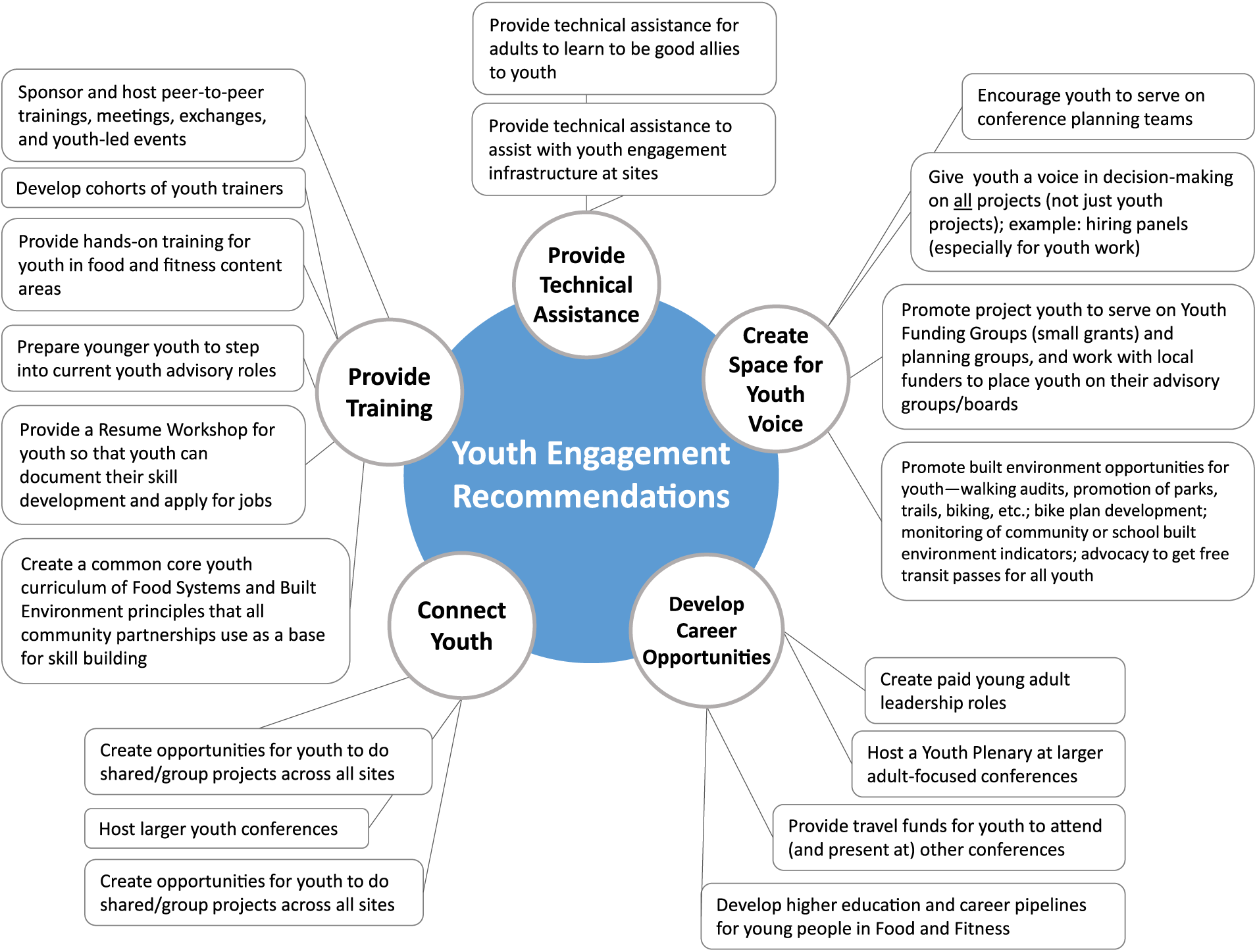
Additional Ways to Foster Youth Engagement for Community Change
We have consolidated the questions that we have found helpful for creating diverse YE in the F&F Initiative. These questions are presented in Figure 2.

Questions for Addressing Inclusion and Racial Equity in the Partnership and Elements that Facilitate Youth as Change Agents
Elements that are important to address in order to facilitate the progression of youth as change agents are also presented in Figure 2. Taken together, these questions and elements provide guidance for those who are actively working to engage youth in community change efforts.
Youth Engagement Challenges
Designated youth coordinators managed the YE work in all the community partnerships. In addition, one of the resources that the funder provided to F&F partnerships was access to a team of TA providers. These TA providers were available to assist on strategy development, skill building, implementation, and advocacy issues. The YE TA providers also delivered several initiative-wide youth summits and meetings to provide a consistent grounding in food systems and built environment issues for all F&F youth. Working with F&F project directors and youth coordinators, the YE TA providers developed a list of short-, intermediate, and long-term indicators of effective YE (see Supplemental Appendix 1, available in the online version of this article). These YE indicators provided a guidepost for F&F implementation.
Even though each F&F community had unique assets, histories, cultures and challenges, they all shared similar challenges inherent to engaging adolescents in large-scale community change work. Since youth and adults communicate and learn in different ways, there had to be intentional efforts made to understand each other’s vocabulary and flexibility in how complex systems-level concepts were translated and conveyed. Issues related to power dynamics and imbalances between youth and adults had to be addressed, and adults learned to “step back” and allow youth to take the lead at times. Youth also learned to “step up and speak up” and not always defer to adults. There were also the practical challenges of meeting logistics and transportation when working with school-aged youth who are not available to meet during the day and with adults who prefer not to hold meetings at night or on weekends. Perhaps most daunting was the lack of continuity as young people grew up, graduated, and often moved on, creating a constant need to bring in (and train) new youth during the tenure of F&F.
Across all community partnerships, a consistent theme was that although engaging youth in the work was time-consuming and challenging, it was also rewarding in terms of long-term benefits to the community. Partnership members often found their interactions with young people involved in F&F to be inspirational and satisfying.
Best Practices
It’s really important [to youth] to do hands-on stuff rather than just meetings all the time. —NE Iowa youth partner, 2008
Successful, sustained YE that is able to “scale up” to encompass larger communities requires training and support for adults and their institutions and constant vigilance and advocacy by youth and their allies. As such, a best practice of F&F was to promote the concept that each community partnership should reflect on the “Ladder of Authentic Youth Participation” (as outlined in Figure 3 below) when designing their YE strategy and assess where their YE activity fits on the rungs of the ladder—from nonparticipation (i.e., manipulation, decoration, tokenism) to the degree of youth participation.

Ladder of Authentic Youth Participation
Another best practice identified within F&F was the provision of adequate resources to support YE work. These resources included dedicated staff, staff development, youth development, TA, transportation, food at meetings/events, and stipends and/or school credit. Although all F&F sites had an initial level of funding, they were able to leverage additional YE resources through community collaborations, partnerships, and systems changes; thus enabling programs to establish a more sustainable infrastructure to support their YE work.
As F&F youth point out, inequity of access to opportunities for health is a critical element of the F&F work: To me I think the biggest injustice in the food system is that people may know what they need to eat to stay healthy and everything, but it’s not always available to them. Due to location, if you’re in a poorer community, then there’s not going to be the best of foods available. —Holyoke youth partner, 2015 I don’t think it’s fair that . . . certain people have to walk miles just to get two fresh tomatoes. . . . I’ve learned that a lot of it has to do with . . . your socioeconomic condition . . . or status rather—because that often affects how much money you have to spend on food and that also can affect whether or not you can get the fresh foods. —Detroit youth partner, 2009
Conclusions
A legacy of the F&F Initiative is that many former youth participants have become resident experts on built environment/food systems in their local communities. Even more important, F&F youth participants can now imagine themselves as change agents in improving their community’s health. For this level of YE to occur, it is critical to have a framework to work from (e.g., Supplemental Appendix 1) and to think beyond project-based activities and instead envision a pathway for youth to acquire skills and experiences that can lead them to successful careers.
We learned from the rich F&F experience with youth and their central role in seeding, developing, and sustaining change in communities with inequities that sharing power and in-depth relationships with adults is critical to long-term success. Authentic YE is a multifaceted process that encompasses many forms of engagement, both formal (conferences, committees, internships, higher education, etc.) and informal (social media, group projects, peer-to-peer trainings, youth advisory roles, etc.). The investment in youth and developing an infrastructure to support their continuous engagement builds a strong foundation from which community collaboratives can flourish.
Supplemental Material
HPP784279_Supplemental_Appendix_1 – Supplemental material for How Food & Fitness Community Partnerships Successfully Engaged Youth
Supplemental material, HPP784279_Supplemental_Appendix_1 for How Food & Fitness Community Partnerships Successfully Engaged Youth by Laurie Lachance, Theresa Kowalski-Dobson, Arnell J. Hinkle, Catherine Sands, Neftali Duran, Lynette Houser, Laura Liechty and Julian Hartmann-Russell in Health Promotion Practice
Footnotes
Authors’ Note:
The authors wish to thank Mario Balcito, Isis Feliciano, Frankie Santos, and John Wolfe who provided additional feedback and suggestions for this article. They are also grateful to the many youth and community partners that made the past 9 years of Food & Fitness so successful. Neftali Duran is an indigenous chef and community organizer living in Holyoke, MA, USA.
Supplement Note:
This article is part of the Health Promotion Practice supplement, “Community-Driven Efforts to Increase Equity in Communities Through Policy and Systems Change: Outcomes and Lessons Learned From 9 Years of Food & Fitness Community Partnerships.” The supplement describes research and practice outcomes from the Food & Fitness project under the direction of The University of Michigan School of Public Health, with funding from the W.K. Kellogg Foundation. The entire supplement issue is available open access at  .
.
References
Supplementary Material
Please find the following supplemental material available below.
For Open Access articles published under a Creative Commons License, all supplemental material carries the same license as the article it is associated with.
For non-Open Access articles published, all supplemental material carries a non-exclusive license, and permission requests for re-use of supplemental material or any part of supplemental material shall be sent directly to the copyright owner as specified in the copyright notice associated with the article.
