



Abstract
Native Hawaiians and other Pacific Islanders (NHPI) suffer disproportionate rates of death from heart attack and stroke; however, little is known about NHPI heart attack and stroke symptoms knowledge. We used multivariable logistic regression to examine associations between heart attack and stroke symptoms knowledge and electronic health (eHealth) use, education, engaging in health risk behaviors, and having an at-risk diagnosis or a past heart attack and/or stroke. The analytic sample included 2,172 NHPI adults responding to the 2014 NHPI-National Health Interview Survey. NHPI reported moderate to high levels of heart attack and stroke symptoms knowledge. NHPI with an at-risk diagnosis were significantly more likely to know three of five heart attack symptoms. Engaging in health risk behaviors increased the odds of knowing one heart attack symptom. Neither a prior heart attack nor a prior stroke increased the likelihood of recognizing most symptoms of heart attack or stroke. eHealth use was associated with increased likelihood for knowing heart attack and stroke symptoms. The findings of this study can be used to inform interventions that support the Healthy People 2020 goals to increase the proportion of adults who are aware of the symptoms of heart attack and stroke and to reduce heart attack and stroke disparities.
Keywords
Introduction
Heart attack and stroke are the leading cause and the fifth leading cause of death, respectively, in the United States (Benjamin et al., 2017; National Center for Health Statistics, 2017a). Diabetes, hypertension, hyperlipidemia, and engaging in health risk behaviors such as unhealthy diet, sedentary lifestyle, overweight/obesity, heavy alcohol use, and tobacco use are prime risk factors for heart attack and stroke (Bauer, Briss, Goodman, & Bowman, 2014; Danaei et al., 2009). Promoting and engaging in healthy practices such as avoiding tobacco, exercising regularly, maintaining a normal weight, and eating a healthy diet can lower one’s risk for heart attack and stroke (Pearson et al., 2002). However, quickly identifying symptoms that could indicate a heart attack or stroke is occurring can help patients seek timely treatment, thereby decreasing their risk of disability and death (Jauch et al., 2013; Lacy, Suh, Bueno, & Kostis, 2001; O’Gara et al., 2013; Wilber et al., 2004). Reducing the number of deaths resulting from heart attacks and strokes are goals set forth in Healthy People 2020 (Office of Disease Prevention and Health Promotion, 2017) and the Million Hearts Initiative (Frieden & Berwick, 2011). Documenting levels of symptom knowledge among high-risk groups can inform health promotion and education interventions to reach those public health goals.
A 2014 U.S. study on awareness of heart attack signs and symptoms showed that Americans were 60% more likely to have the recommended heart attack knowledge compared with 2008. However, significant disparities in having all recommended heart attack knowledge were observed by history of coronary heart disease (CHD), race, sex, age-group, level of education, access to health care, and race/ethnicity (Patel et al., 2018).
One high-risk group that face a number of health disparities are Native Hawaiians and other Pacific Islanders (NHPI). NHPI are people of ethnic descent from Hawaii, Guam, Samoa, or other Pacific Islands (National Center for Health Statistics, 2017b). According to the 2010 Census, 0.4% of all people in the United States identified as NHPI alone or in combination with one or more other races (Hixson, Hepler, & Kim, 2012).
NHPI experience disproportionately high rates of heart attack and stroke, as well as associated risk factors for heart attack and stroke (Aluli et al., 2010; Mau, Sinclair, Saito, Baumhofer, & Kaholokula, 2009; Nakagawa, Koenig, Asai, Chang, & Seto, 2013). NHPI have high rates of obesity, tobacco use, alcohol intake, and daily energy intake (Bitton, Zaslavsky, & Ayanian, 2010; Wong & Kataoka-Yahiro, 2017). Furthermore, they have a higher prevalence of hypertension and diabetes compared with the overall U.S. population (Bitton et al., 2010; Galinsky, Zelaya, Simile, & Barnes, 2017). They are 4 times more likely to die from a stroke (Office of Minority Health, 2017b) and 1.7 times more likely to die from heart disease compared with Whites (Office of Minority Health, 2017a). Hence, there is a need for health promotion programs for the NHPI population to improve diet and exercise levels, maintain a healthy weight, reduce the use of tobacco, and seek regular primary care. In addition to addressing the underlying causes and risk factors for heart attack and stroke, it is also important to ensure that those who are at high risk for heart attack or stroke are aware of heart attack and stroke symptoms and how to respond if they experience any of them. In order for the development and implementation of such programs to be effective, it is imperative to gauge baseline knowledge and practices of the priority group. In this study, we begin this work by assessing levels of knowledge of heart attack and stroke symptoms among the U.S. NHPI population.
Improving health literacy and increasing access to and usage of electronic health (eHealth) information may hold potential for increasing heart attack and stroke symptoms knowledge. However, effective use of eHealth information requires patients to have the skills to navigate and evaluate the quality of electronic resources. This skill is referred to as eHealth literacy, and it has been cited as an important skill to ensure patients understand their conditions (Jacobs, Lou, Ownby, & Caballero, 2016; H. Kim & Xie, 2017; Richtering et al., 2017).
NHPI are one of the fastest growing populations in the United States (Hixson et al., 2012), yet they are underrepresented in health research (Ro & Yee, 2010). Prior research has identified disparities in heart attack and stroke symptoms knowledge among other racial and ethnic minority populations (McGruder et al., 2008; Patel et al., 2018); however, little is known about the knowledge of heart attack and stroke symptoms among NHPI.
Research Objectives
This study aims to document the proportion of NHPI who reported knowing the symptoms of heart attack and stroke and to examine the factors associated with heart attack and stroke symptoms knowledge among NHPI adults in the United States. The study specifically looks at the relationship between eHealth use and level of heart attack and stroke symptoms knowledge to assess it as a possible intervention mechanism to improve levels of knowledge. The study investigates the following research questions:
Answers to these questions will fill gaps in the literature and can help guide health education interventions aimed at increasing NHPI community members’ heart attack and stroke symptoms knowledge, which could ultimately reduce time-to-treatment and deaths from heart attacks and strokes in NHPI persons.
Method
Data Source
This cross-sectional study used data from the 2014 NHPI–National Health Interview Survey (NHIS). The NHPI-NHIS was designed by the Centers for Disease Control and Prevention (2017) and was the first survey designed exclusively to measure the health of the civilian noninstitutionalized NHPI population in the United States. The questionnaire was administered to NHPI adults randomly selected from households and used a complex-stratified-multistage-area-probability design to make the sample representative of the United States NHPI population. A more detailed description of the NHPI-NHIS methodology can be found elsewhere (National Center for Health Statistics, 2017b).
Study Population
Out of the 2,250 NHPI adult respondents, 51% self-identified as NHPI alone and 49% as NHPI in combination with one or more other racial identities. Among adults reporting “NHPI in combination,” those who did not report NHPI as their primary race (n = 78) were excluded from the analytic sample. This resulted in a sample size of 2,172 respondents (i.e., the civilian noninstitutionalized adults in the United States who reported NHPI as their sole or primary race).
Outcomes
Knowledge of heart attack symptoms and knowledge of stroke symptoms were the outcomes of interest. Respondents were asked to identify five heart attack symptoms by answering (yes/no/don’t know) the following question: “Which of the following would you say are the symptoms that someone may be having a heart attack: Pain or discomfort in the jaw, neck, or back; Feeling weak, lightheaded, or faint; Chest pain or discomfort; Pain or discomfort in the arms or shoulder; Shortness of breath?”
For stroke symptoms, respondents were asked, “Which of the following would you say are the symptoms that someone may be having a stroke: Sudden numbness or weakness of face, arm, or leg, especially on one side; Sudden confusion or trouble speaking; Sudden trouble seeing in one or both eyes; Sudden trouble walking, dizziness, or loss of balance; Sudden severe headache with no known cause?”
Main Predictors
Respondents were asked whether they had ever been told by a health care professional that they had diabetes, hypertension, hyperlipidemia, CHD, or other heart conditions. Respondents were categorized as having an “at-risk diagnosis” if they reported a condition that puts them at risk for stroke (diabetes, hypertension, hyperlipidemia) or a condition that puts them at risk for heart attack (diabetes, hypertension, hyperlipidemia, CHD, and other heart conditions). Respondents were categorized as engaging in health risk behaviors if they reported at least one behavior that increased the risk for heart attacks or strokes (sedentary lifestyle, overweight/obesity, cigarette smoking, and heavy alcohol use [i.e., ≥5 drinks per day for men or ≥4 drinks per day for women]). Past heart attack and stroke were categorized by answers (yes/no) to the following questions: “Have you ever been told by a doctor or other health professional that you had: a heart attack or angina pectoris? A stroke?” eHealth use was captured by whether respondents reported use of the internet to gather information about their health, medical treatments, or rehabilitation services. Education was collapsed into less than high school/general educational development (HS/GED), HS/GED diploma or equivalent, and above HS/GED. These predictors were selected as they have been identified in previous research as being associated with level of heart attack and stroke symptoms knowledge (Giardina et al., 2012; Lambert, Vinson, Shofer, & Brice, 2013; Soler et al., 2007; Wahab, Kayode, & Musa, 2015).
Covariates
Covariates that are correlated with heart attack and stroke symptoms knowledge and the predictors of interest were selected: age, sex, English proficiency, employment status, nativity, health insurance status, federal poverty level (FPL), and having a usual source of care (DuBard, Garrett, & Gizlice, 2006; E. M. Kim, Hwang, & Kim, 2011; Lutfiyya et al., 2010; Weltermann, Driouach-Bleckmann, Reinders, Berndt, & Gesenhues, 2013).
Statistical Analyses
We used Stata 14.2 svy procedures to estimate parameters and adjust for the complex sampling design. For Research Question 1, we conducted descriptive statistics to determine the proportion of NHPI who know the symptoms of heart attack and stroke. For Research Questions 2 to 5, we used multivariable logistic regressions to explore associations between the main predictors (having at-risk diagnoses, engaging in health risk behaviors, previous history of heart attack or stroke, education, and eHealth use) and knowing heart attack and stroke symptoms, controlling for the relationships of the covariates. Associations were considered statistically significant at α = .05.
Results
Descriptive Analysis
Half (50.1%) of the NHPI were females. Most (87.3%) NHPI reported speaking English very well. One third (33.1%) were unemployed, 6.2% were uninsured, 15.9% lived below the FPL, 89.8% had at least an HS/GED diploma, 19.3% used eHealth information, and 87.4% had a usual source of care.
Of the five heart attack symptoms, NHPI most frequently identified chest pain or discomfort (91.1%), followed in descending order by shortness of breath (84.8%); pain or discomfort in the arms or shoulder (79.5%); feeling weak, lightheaded, or faint (73.8%); and pain or discomfort in the jaw, neck, or back (54.7%).
The stroke symptom identified most frequently was sudden numbness or weakness of face, arm, or leg, especially on one side (93.4%), followed by sudden confusion or trouble speaking (91.6%); sudden trouble walking, dizziness, or loss of balance (88.9%); sudden trouble seeing in one or both eyes (82.0%); and sudden severe headache with no known cause (74.4%).
Four in ten NHPI (40.9%) reported at least one at-risk diagnosis, 13.1% reported diabetes, 28.9% reported hypertension, 24.7% reported hyperlipidemia, and 9.2% reported heart conditions. Eight in 10 NHPI (84.3%) reported at least one health risk behavior, 74.7% were overweight/obese, 24.4% were sedentary, 17% smoked, and 7.6% heavily used alcohol. For past medical history, 3.7% reported previous heart attack or angina pectoris, and 2.7% reported previous stroke (Table 1).
Population Characteristics

NOTE: HS = high school; GED = general educational development.
SOURCE: National Center for Health Statistics, Native Hawaiian and Pacific Islander National Health Interview Survey, 2014.
≥5 drinks per day for men or ≥4 drinks per day for women.
Predicting Knowledge of Heart Attack and Stroke Symptoms
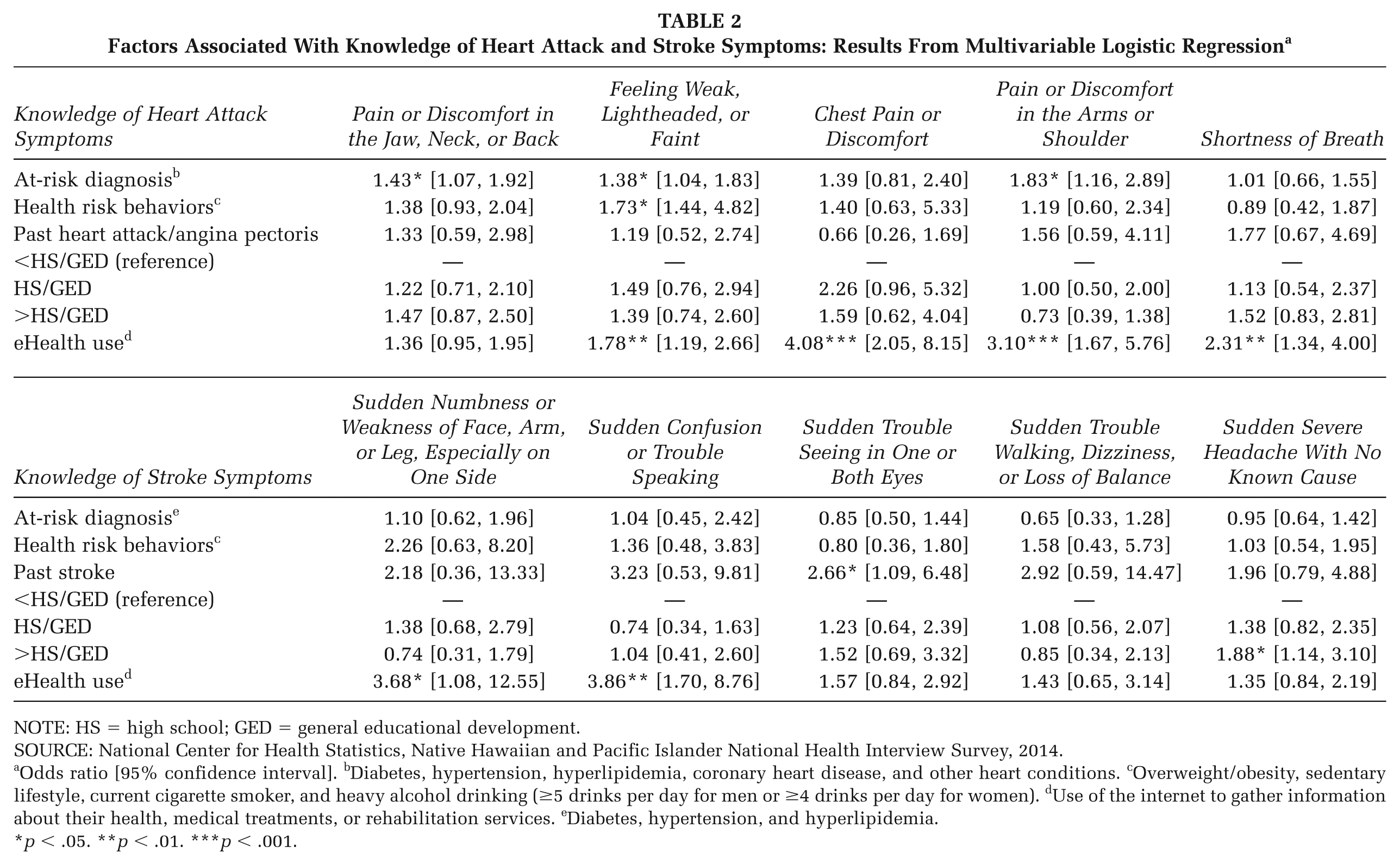
Table 2 presents adjusted odds ratios (ORs) and 95% confidence intervals (CIs) of heart attack and stroke symptoms knowledge among NHPI. Having at least one at-risk diagnosis (diabetes, hypertension, hyperlipidemia, and heart conditions) increased the likelihood of identifying pain or discomfort in the jaw, neck, or back as a heart attack symptom as compared with those without an at-risk diagnosis (OR = 1.43; CI [1.07, 1.92]). NHPI with at least one at-risk diagnosis were more likely to identify feeling weak, lightheaded, or faint as a heart attack symptom (OR = 1.38; CI [1.04, 1.83]); they were also more likely to identify pain or discomfort in the arms or shoulder as a heart attack symptom (OR = 1.83; CI [1.16, 2.89]).
Factors Associated With Knowledge of Heart Attack and Stroke Symptoms: Results From Multivariable Logistic Regression a
NOTE: HS = high school; GED = general educational development.
SOURCE: National Center for Health Statistics, Native Hawaiian and Pacific Islander National Health Interview Survey, 2014.
Odds ratio [95% confidence interval]. bDiabetes, hypertension, hyperlipidemia, coronary heart disease, and other heart conditions. cOverweight/obesity, sedentary lifestyle, current cigarette smoker, and heavy alcohol drinking (≥5 drinks per day for men or ≥4 drinks per day for women). dUse of the internet to gather information about their health, medical treatments, or rehabilitation services. eDiabetes, hypertension, and hyperlipidemia.
p < .05. **p < .01. ***p < .001.
NHPI who engaged in health risk behaviors had increased odds of identifying feeling weak, lightheaded, or faint as a heart attack symptom (OR = 1.73; CI [1.44, 4.82]), compared with those who had not engaged in these behaviors. We did not find statistically significant associations between engaging in a health risk behavior and knowledge of other heart attack symptoms. We did not find significant associations between having a prior heart attack and knowing heart attack symptoms.
We did not find a significant relationship between having an at-risk diagnosis or engaging in health risk behaviors and likelihood of knowing stroke symptoms. Having a prior stroke doubled the odds of identifying sudden trouble seeing in one or both eyes as a symptom of stroke (OR = 2.66; CI [1.09, 6.48]) but was not associated with increased knowledge of other symptoms.
Education was not associated with knowledge of heart attack and stroke symptoms, apart from one exception: Relative to NHPI without an HS education, those with above HS education were nearly twice as likely to identify sudden severe headache with no known cause as a stroke symptom (OR = 1.88; CI [1.14, 3.10]).
We found positive associations between eHealth use and likelihood of identifying most heart attack symptoms, such as feeling weak, lightheaded, or faint (OR = 1.78; CI [1.19, 2.66]); chest pain or discomfort (OR = 4.08; CI [2.05, 8.15]); pain or discomfort in the arms or shoulder (OR = 3.10; CI [1.67, 5.76]); and shortness of breath (OR = 2.31; CI [1.34, 4.00]). eHealth use was also positively associated with likelihood of identifying two stroke symptoms: sudden numbness or weakness of face, arm, or leg, especially on one side (OR = 3.68; CI [1.08, 12.55]) and sudden confusion or trouble speaking (OR = 3.86; CI [1.70, 8.76]; Table 2).
Discussion
Research on heart attack and stroke symptoms knowledge among NHPI, who are at higher risk for heart attacks and strokes, has not received due attention. Overall, NHPI had a moderate to high level of heart attack and stroke symptoms knowledge, with identification of symptoms ranging from 54.7% to 93.4%. NHPI with diagnoses that put them at higher risk for heart attack were significantly more likely to know three out of five symptoms of heart attack.
Engaging in health risk behaviors increased the odds of knowing only one symptom of heart attack. This is a concerning finding, considering we found the vast majority of NHPI persons (84.3%) engage in at least one health risk behavior for heart attack or stroke, with the most common behavior being unhealthy weight; 74.7% of NHPI persons were overweight/obese, a rate higher than that of White and Black Americans (63.2% and 71.4%, respectively; Galinsky et al., 2017). Interventions for primary prevention of heart attack and stroke among NHPI should target obesity, and these interventions should consider incorporating information to improve heart attack and stroke symptoms knowledge, given the higher rate of mortality from these events among NHPI persons (Office of Minority Health, 2017a, 2017b), as well as our finding that those with this high-risk behavior are most likely to have limited heart attack and stroke symptoms knowledge. Additionally, it is important to consider broader policy, systems, and environmental strategies that target health risk behaviors such as obesity in order to help reduce heart attack and stroke disparities in the NHPI community.
Interestingly, being at-risk for stroke—either because of a disease diagnosis or because of health risk behaviors—did not increase an NHPI person’s likelihood to correctly identify stroke symptoms. Previous research has indeed shown that individuals with high risk were less knowledgeable about signs of stroke (Lambert et al., 2013).
NHPI with a prior heart attack were no more likely to recognize symptoms of heart attack compared with those who had not had a heart attack. Similarly, those who had a prior stroke were more likely to identify only one symptom of stroke compared with those who had not had a stroke. In contrast, prior studies with other populations have found patients with a prior history of heart attack and stroke were more likely to have knowledge of symptoms (Bay et al., 2015; Gill & Chow, 2010). NHPI who have had a previous heart attack or stroke are at an increased risk for recurrence. This vulnerable population is in need of high levels of heart attack and stroke symptoms knowledge so they can receive prompt treatment in the event of heart attack or stroke recurrence.
Associations between education level and knowing most heart attack and stroke symptoms were not observed. This is in contrast with prior research that shows that adults with lower educational attainment also had less knowledge of heart attack and stroke symptoms (Lutfiyya et al., 2010). However, our findings are consistent with other studies that showed education to be unrelated to recognition of symptoms or to delay in seeking medical attention in patients with stroke (Chandratheva, Lasserson, Geraghty, Rothwell, & Oxford Vascular, 2010).
While overall eHealth use was modest among NHPI adults, it was associated with an increased likelihood for knowing individual heart attack symptoms (2-4 times) and stroke symptoms (almost 4 times). eHealth interventions have been shown to improve health literacy skills for people with different health conditions, risk factors, and socioeconomic backgrounds (Jacobs et al., 2016), suggesting that expanding eHealth interventions may hold potential for improving heart attack and stroke symptoms knowledge in the NHPI community.
Implications for Research
Our finding that eHealth use was related to higher heart attack and stroke symptoms knowledge warrants further research attention. Researchers should develop and test eHealth interventions specifically focused on improving heart attack and stroke symptoms knowledge among NHPI persons.
Implications for Practice
Two findings have implications for health promotion practice. Given our finding that those with high-risk behaviors were more likely to have low heart attack and stroke symptoms knowledge, practitioners delivering interventions to manage or treat obesity, smoking, and other high-risk behaviors among NHPI persons should consider incorporating information regarding heart attack and stroke signs and symptoms. Although prevention of heart attack and stroke is paramount, ensuring those most likely to experience them have the appropriate knowledge to respond can help reduce the likelihood of disability and death.
Traditionally, health promotion interventions that target the causes and risk factors for heart attack and stroke among ethnic minority populations have relied primarily on communication and education alone (Jacobs et al., 2016). To alleviate the burden of negative health outcomes experienced by NHPI, best practice strategies could rely on the online provision of health information and services that improve health literacy, prevent risk factors associated with heart attack and stroke among NHPI, and promote better overall health. As eHealth information becomes a more common health communication and promotion tool for hard-to-reach populations, it is important for health promotion interventions to address digital disparities that could lead to unequal opportunities to benefit from essential health promotion resources, resulting in less informed decision making and, potentially, deepening the health disparities between NHPI and other racial/ethnic groups.
We found that NHPI persons who have reported previously having a heart attack were no more likely to identify any of the heart attack symptoms, and those who reported previously having a stroke were more likely to identify only one of the stroke symptoms, compared with those who reported never having a heart attack or stroke, respectively. Given that those who have had a heart attack or stroke are at higher risk for another such event, ensuring they recognize whether they are having a heart attack or stroke can improve the time to treatment, which can improve survivability. Practitioners working in acute and rehabilitative care units with NHPI patients who have had heart attacks or strokes should incorporate heart attack and stroke symptoms knowledge into their health education activities.
Limitations
Due to NHIS data restrictions, we were unable to gauge influence of rurality/urbanity on heart attack and stroke symptoms knowledge. The study’s cross-sectional design makes it difficult to assess temporal associations between exposures and outcomes. Moreover, data on heart attack and stroke risk factors and occurrence are self-reported and may be constrained by recall and/or courtesy bias. Although our study was based on a representative sample of NHPI adults in the United States that disaggregated Asians and NHPI, the broader NHPI population is made up of diverse subpopulations, not all of whom may be adequately represented by the present study population, who are predominantly U.S.-born, English-proficient, and earning >199% FPL. Specifically, this sample may not fully reflect the disparities related to social determinants of health that face many NHPI residing in the United States, including limited access to food resources or health care services among Pacific Islanders from Compact of Free Association countries. For example, the Compact of Free Association allows individuals from the Republic of the Marshall Islands to live and work within the United States without approval documents (e.g., work permits or visas) but does not allow them to access federally support public assistance programs, such as Supplemental Nutrition Assistance Program/foods stamps or Medicaid (McElfish, Hallgren, & Yamada, 2015; Weltin & Lavin, 2012).
Conclusions
This is the first article to provide insight into NHPI heart attack and stroke symptoms knowledge and the factors related to that knowledge. This research is also strengthened by the large analytic sample relative to previous research on NHPI.
Our study shows that high-risk individuals with certain metabolic symptoms and unhealthy behaviors were no more likely to know the symptoms—especially stroke symptoms—than their healthier peers. This indicates that special health promotion efforts should focus on NHPI adults with more risk factors that could lead to a stroke. It is important that heart attack and stroke awareness campaigns and public health interventions include tailored components for NHPI audiences. Moreover, while overall eHealth use was modest among NHPI, eHealth use was associated with knowledge of three of the five heart attack symptoms and two of the five stroke symptoms. Since eHealth interventions have been shown to improve health literacy skills for people with different health conditions, risk factors, and socioeconomic backgrounds (Jacobs et al., 2016), this finding suggests that eHealth interventions hold potential for improving heart attack and stroke symptoms knowledge.
Footnotes
Authors’ Note:
Any analyses, interpretations, and/or conclusions based on the 2014 Native Hawaiian and Pacific Islander–National Health Interview Survey data are solely that of the authors and do not necessarily represent the official positions of the National Center for Health Statistics, the Centers for Disease Control and Prevention, or the U.S. Department of Health and Human Services.
