



Abstract
Cigarette smoking is increasingly concentrated in socioeconomically disadvantaged groups, and food insecurity also disproportionately affects lower-income groups. Recent studies have suggested that smoking and food insecurity operate as risk factors for one another, but there is limited understanding of their intersection. This scoping review aimed to synthesize the published literature on the association between food insecurity and tobacco use across population groups in the United States and Canada. We searched PubMed, Web of Science, and PsycINFO using key words. Studies included were published in English between 2008 and 2018, reported empirical findings, measured both tobacco use and food insecurity, and considered either variable as a study outcome. Nineteen articles were identified; 6 examined tobacco use as an outcome variable and 13 examined food insecurity as an outcome variable. Most articles were of studies using cross-sectional designs. Study samples ranged from general populations, clinical samples, and underserved populations. For each article, we extracted information including specific findings related to the association between food insecurity and tobacco use. We synthesized the current research by formulating a model by which food insecurity and tobacco use are bidirectionally associated. This scoping review concludes that the co-occurrence of food insecurity and tobacco use exists across populations in the United States and Canada. As the evidence is largely from cross-sectional investigations, there is a need for longer term, comprehensive assessments of relationships between tobacco use and food insecurity. Such investigations can inform policies and interventions aimed toward addressing the inequitable burden of tobacco use and of food insecurity among disadvantaged populations.
Background
Tobacco use, particularly cigarette smoking, is disproportionately concentrated among populations of lower socioeconomic status (Hiscock, Bauld, Amos, Fidler, & Munafò, 2012; Jamal et al., 2018), and largely contributes to social gradients in health (Stringhini et al., 2010). Causes of socioeconomic disparities in smoking are complex, necessitating a social ecological approach to understand and address such disparities (U.S. National Cancer Institute, 2017). Previous reviews have articulated the multitude of factors that are associated with socioeconomic status and cigarette smoking (Hiscock et al., 2012; Pampel, Krueger, & Denney, 2010). This includes the disproportionate burden of chronic life stressors—such as financial stress—that lower-income smokers face (Siahpush, Borland, & Scollo, 2003; Siahpush, Borland, Yong, Cummings, & Fong, 2012; Widome, Joseph, et al., 2015). Financial stress can maintain smoking behavior (Mulder, de Bruin, Schreurs, van Ameijden, & van Woerkum, 2011) and pose barriers to cessation (Kalkhoran, Berkowitz, Rigotti, & Baggett, 2018).
A particularly prominent financial stressor that disproportionately impacts socioeconomically disadvantaged groups is food insecurity. Food insecurity occurs when access to enough food for an active and healthy life is limited by a lack of money or other resources (Coleman-Jensen, Rabbitt, Gregory, & Singh, 2018), or when there are limitations in the ability to acquire personally acceptable foods in socially acceptable ways (Anema, Vogenthaler, Frongillo, Kadiyala, & Weiser, 2009). In 2017, 31% of U.S. households living at or below 185% of the federal poverty level (FPL) experienced any food insecurity at some point during the year, in contrast to 6% of households living above 185% of FPL (Coleman-Jensen et al., 2018). Racial/ethnic minority households and female-headed households are also more likely to experience food insecurity as compared with the national average (12%), affecting 22% of non-Hispanic Black households, 18% of Hispanic households, and 30% of female-headed households in 2017 (Coleman-Jensen et al., 2018). The overall inequitable experience of food insecurity across socioeconomic status, race/ethnicity, and gender is an important health disparity issue. While there is an important understanding that food insecurity exists alongside other intersecting and structural risk factors such as employment and housing insecurities (Laraia, Leak, Tester, & Leung, 2017), food insecurity is nevertheless considered to have an independent effect on a range of physical and mental health conditions (Gundersen & Ziliak, 2015).
The inverse association between socioeconomic status and tobacco use has been extensively described in the literature (Pampel et al., 2010). Since 2008, studies have highlighted the association between food insecurity and cigarette smoking. Similar to studies examining the phenomenon of smoking-induced deprivation—that is, smokers reporting that they spent money toward purchasing cigarettes that should have been spent on household essentials such as food (Siahpush, Borland, & Yong, 2007), earlier studies largely reported that smoking is a risk factor for food insecurity (Armour, Pitts, & Lee, 2008; Cutler-Triggs, Fryer, Miyoshi, & Weitzman, 2008). Yet given that food insecurity is known to be a stressful experience and that many smokers report smoking for stress relief, more recent studies report that food insecurity may be a risk factor for cigarette smoking (Hosler & Michaels, 2017; Kim & Tsoh, 2016). As cigarette smoking remains a leading cause of preventable disease and death in the United States (U.S. Department of Health and Human Services, 2014), understanding the co-occurrence of food insecurity and tobacco use, including their potential bidirectional association, is crucial for understanding and mitigating health disparities.
Aims
The overarching aim of this scoping review is to examine the current empirical literature on the association between food insecurity and tobacco use. More specifically, we examine the following key questions: In the published literature, is food insecurity considered an explanatory variable for tobacco use, or is tobacco use considered an explanatory variable for food insecurity? What are plausible mechanistic explanations that are offered by current studies? By examining these key research questions, this scoping review examines the range of population groups or study samples for whom the association between tobacco use and food insecurity has been documented between 2008 and 2018, and provides critical summaries of study designs, sample characteristics, and measures of food insecurity and tobacco use. By conducting this review, we aim to offer recommendations for future research and practice aimed at addressing health disparities related to tobacco use, to food insecurity, and the combination of the two. As the context of tobacco use and of food insecurity can largely differ across cross-national contexts, this review specifically focuses on study samples from the United States and Canada.
Method
Data Sources
Published articles were identified using three databases—PubMed, Web of Science, and PsycINFO. Search terms were identical across the databases: ((“food insecur*”) OR (“food secur*”) OR (hunger)) AND ((smoking) OR (cigarette*) OR (tobacco)). Inclusion criteria for articles were as follows: (1) published in English; (2) published in a peer-reviewed journal; (3) presented original research; (4) published between January 1, 2008, through June 1, 2018; (5) study sample was of participants from the United States or Canada; and (6) measured food security/insecurity and smoking/tobacco use within the study. As scoping reviews can be iterative, such that parameters may be added or refined on the basis of the literature itself (Arksey & O’Malley, 2005), we added an additional inclusion criterion, which was that either food security/insecurity or smoking/tobacco use is treated as a dependent variable in the study’s main analysis or any reported subanalyses.
Article Screening and Data Extraction
As an initial screening, we independently reviewed article titles and abstracts from the search results of each database to determine the article’s eligibility. If the study’s relevance was not apparent from the title and/or abstract, the full-text article was retrieved. A data charting spreadsheet was developed to uniformly capture relevant information across all studies reviewed. The variables extracted included information regarding the purpose of the study and the general study design, the geographic location in which study samples were drawn, a description of the sample characteristics (e.g., sample size, gender and racial/ethnic composition, and any special features of the sample), and instruments used to measure food insecurity and tobacco use. As part of the data charting, we summarized findings that were specific to the association between food insecurity and smoking (or vice versa). We noted statistical associations as reported by the study’s analysis (e.g., odds ratios or regression coefficients), also noting any covariates that were included.
This article’s second author conducted the initial extraction, which was subsequently reviewed by the first author. Discrepancies regarding the relevance of the articles were resolved through discussion and mutual agreement. This overall process also allowed us to determine which articles did not ultimately meet the review eligibility after we conducted data extraction based on the full-text article. In some of the articles, the association between food insecurity and smoking was not a primary focus, although an association was reported elsewhere within the findings. These types of articles were excluded, and last, articles were grouped according to whether the dependent variable was food insecurity or tobacco use/smoking.
Results
Figure 1 depicts the study selection criteria. We note that a manual search yielded two additional articles that we included in our review. These studies were published online during the study time frame but did not appear in our initial search.

Flowchart of Article Selection Process for Scoping Review
Overall Study Characteristics
Nineteen studies reported associations between food insecurity and tobacco use status (Tables 1 and 2). Seventeen were based in the United States, and two were based in Canada. Among the U.S. studies, six were based on national samples, four were based in California, four in Eastern states (Connecticut, Delaware, New York, and Pennsylvania), two in Midwestern states (Ohio and Wisconsin), and one in Texas. In the two Canada studies, one was based in Ontario, and the other sampled from eight different provinces. Per inclusion criteria, all studies presented quantitative findings; 16 used cross-sectional study designs, and 3 used longitudinal designs, with follow-up periods spanning 6 weeks, 12 months, and 3 years. Five studies examined study participants with lower income, such as tenants living in subsidized housing, women who were homeless or unstably housed, persons using mobile food pantries, and persons below 200% of the FPL. In terms of special characteristics of the study samples, two were focused on veterans, two were focused on persons living with HIV, and one was focused on youth. In general, the study samples were heterogeneous with regard to sex, age, race/ethnicity, income, and specific community-based populations.
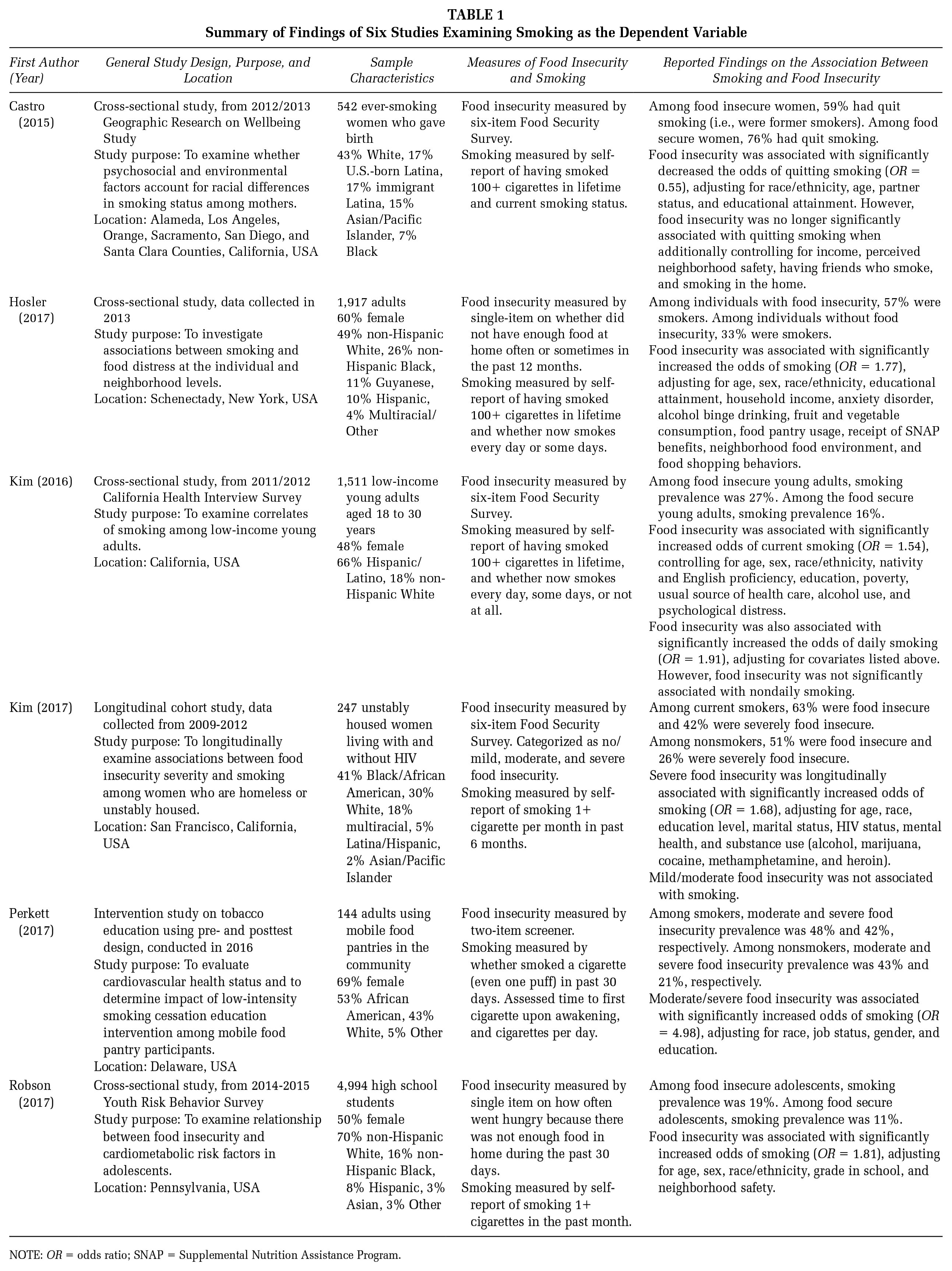
Summary of Findings of Six Studies Examining Smoking as the Dependent Variable
NOTE: OR = odds ratio; SNAP = Supplemental Nutrition Assistance Program.
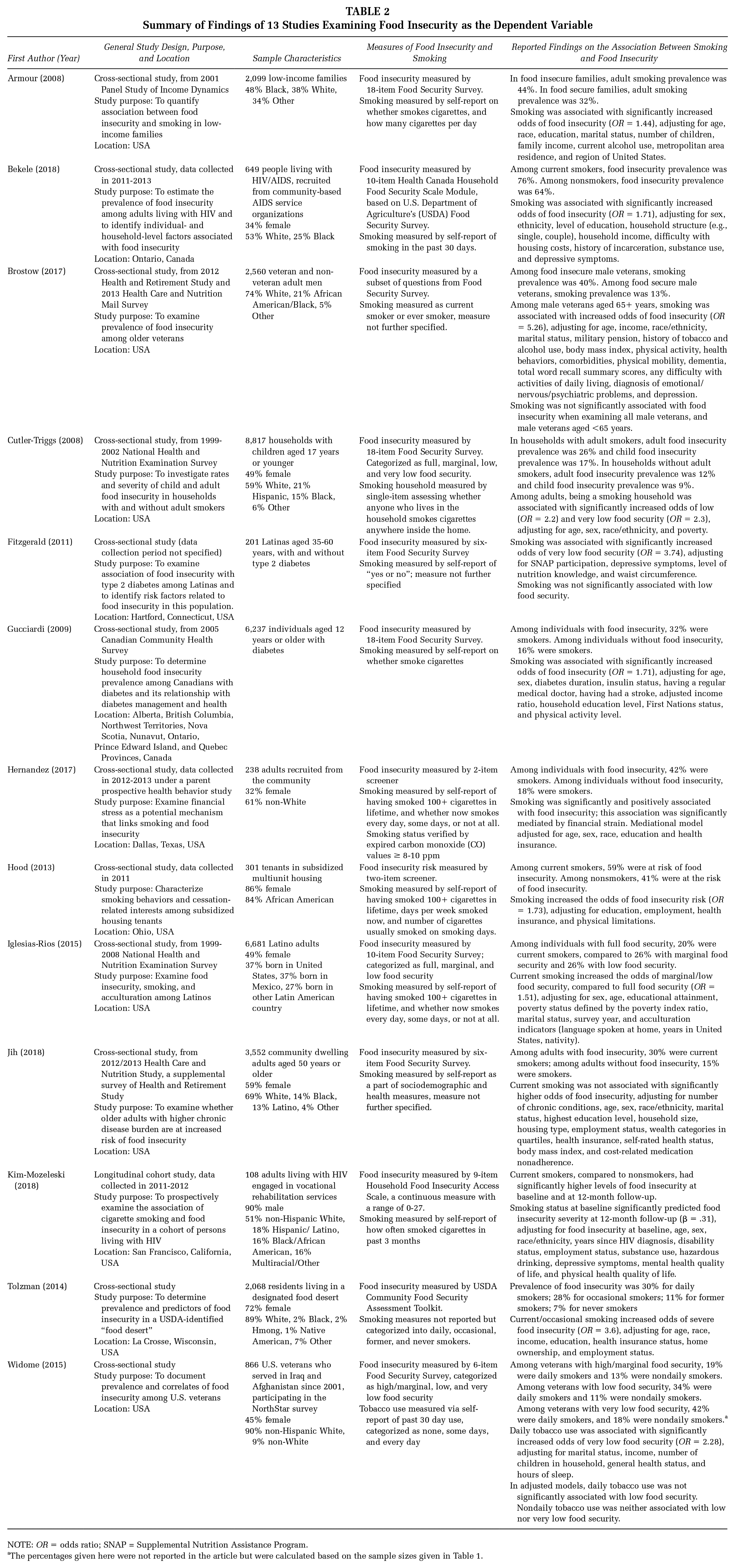
Summary of Findings of 13 Studies Examining Food Insecurity as the Dependent Variable
NOTE: OR = odds ratio; SNAP = Supplemental Nutrition Assistance Program.
The percentages given here were not reported in the article but were calculated based on the sample sizes given in Table 1.
Measures of Tobacco Use and of Food Insecurity
As part of the data charting, we examined instruments used to measure tobacco use and food insecurity. For tobacco use measures, 18 studies were specific to assessing cigarette smoking, and one study assessed tobacco use more generally (Widome, Jensen, Bangerter, & Fu, 2015). All 19 studies used self-report instruments; only one study biochemically verified self-reported smoking status via expired carbon monoxide values (Hernandez et al., 2017). There was notable variability in terms of the self-report instruments used to measure smoking status. Six studies used the standard two-item set of assessing whether the individual has smoked 100 or more cigarettes in entire lifetime, followed by an assessment of current smoking status (Castro, Heck, Forster, Widome, & Cubbin, 2015; Hernandez et al., 2017; Hood, Ferketich, Klein, Wewers, & Pirie, 2013; Hosler & Michaels, 2017; Iglesias-Rios, Bromberg, Moser, & Augustson, 2015; Kim & Tsoh, 2016). The remaining studies used various single-item measures assessing current smoking in reference to the past month, 3 months, or 6 months, or did not provide specific information on the measure used. Six studies discerned patterns of smoking, such as daily or nondaily smoking (Gucciardi, Vogt, DeMelo, & Stewart, 2009; Hood et al., 2013; Kim & Tsoh, 2016; Kim-Mozeleski et al., 2018; Tolzman, Rooney, Duquette, & Rees, 2014; Widome, Jensen, et al., 2015). We note that studies generally did not assess levels of nicotine dependence or readiness to quit.
For measures of food insecurity, 10 studies used the U.S. Department of Agriculture Adult/Household Food Security Survey modules, which assesses food insecurity experienced in the past 12 months (Armour et al., 2008; Castro et al., 2015; Cutler-Triggs et al., 2008; Fitzgerald, Hromi-Fiedler, Segura-Pérez, & Pérez-Escamilla, 2011; Gucciardi et al., 2009; Iglesias-Rios et al., 2015; Jih et al., 2018; Kim, Flentje, Tsoh, & Riley, 2017; Kim-Mozeleski et al., 2018; Widome, Jensen, et al., 2015). However, the studies varied in whether they used the 18-item, 10-item, or 6-item versions of the module. The remaining studies either used the one- or two-item food insecurity screeners that are based on the module, with the exception of one study that used the U.S. Agency for International Development’s Household Food Insecurity Access Scale (Kim-Mozeleski et al., 2018). The majority of the studies categorized responses dichotomously into food secure or food insecure, whereas four studies considered the severity of food insecurity (Cutler-Triggs et al., 2008; Kim et al., 2017; Perkett et al., 2017; Robson, Lozano, Papas, & Patterson, 2017), such as severe food insecurity (or very low food security).
Food Insecurity’s Contribution to Tobacco Use
Table 1 summarizes the study characteristics and findings from six studies in which current smoking status was examined as a dependent variable in the analysis, and food insecurity was examined as an independent or predictor variable. All studies reported in Table 1 conducted analyses using multivariable logistic regression. There was a significant and independent association between food insecurity and odds of current smoking, with one study examining the odds of former smoking (quitting) among ever smoking mothers in California (Castro et al., 2015). In this group of articles, two studies reported more nuanced patterns. For instance, in addition to food insecurity being associated with significantly greater likelihood of current smoking, food insecurity was associated with significantly greater likelihood of daily smoking, but not nondaily smoking, among lower income young adults living in California (Kim & Tsoh, 2016). In a 2-year longitudinal analysis of women in San Francisco who were marginally housed, the severity of food insecurity, rather than any food insecurity, was associated with significantly greater likelihood of being a current smoker (Kim et al., 2017). It is notable that most of the studies in Table 1 reported odds ratios in the range of 1.5 to 1.9, whereas one study of adults using mobile food pantries in Delaware reported that food insecurity was associated with a nearly fivefold increase in the odds of current smoking (Perkett et al., 2017).
Tobacco Use’s Contribution to Food Insecurity
Table 2 summarizes the study characteristics and findings from 13 studies in which food insecurity was examined as a dependent variable and smoking was examined as an independent or predictor variable. In this group of studies, the data analysis also comprised largely of multivariable logistic regression, with two exceptions. One study tested a mediational or indirect effects model and reported that among community-dwelling adults in Dallas, Texas, financial strain significantly explained the positive association between smoking and food insecurity (Hernandez et al., 2017). Another study conducted a linear regression analysis that considered food insecurity as a continuous variable that was measured across two time points and reported that smoking status at study baseline was predictive of food insecurity severity at a 12-month follow-up among persons living with HIV in San Francisco (Kim-Mozeleski et al., 2018).
Similar to the studies reported in Table 1, select studies included in Table 2 reported more nuanced patterns. In a study of veterans, the association between smoking and food insecurity was only significant for veterans aged 65 years or older, whereas there was no significant association for veterans younger than 65 years (Brostow, Gunzburger, & Thomas, 2017). In another study of veterans, daily tobacco use was associated with significantly higher odds of very low food security, but there was no significant association for nondaily tobacco use as an independent variable, nor was there an association for low food security as a dependent variable (Widome, Jensen, et al., 2015). One study assessed smoking at the household level rather than the individual level (i.e., whether any adult in the household smokes anywhere inside the home) among participants in the 1999-2002 National Health and Nutrition Examination Survey and found that smoking households had significantly greater odds of food insecurity (Cutler-Triggs et al., 2008). Notably, there was one study in this group that reported that there was no significant association between smoking and food insecurity in the multivariable analysis; among adults aged 50 years or older in the 2012/2013 Health Care and Nutrition Study, there was a significant bivariate association between smoking and food insecurity that was no longer significant when adjusting for covariates (Jih et al., 2018).
Discussion
This scoping review examined the empirical literature published from 2008 to 2018 on the association between food insecurity and tobacco use, primarily cigarette smoking. About one third of articles examined tobacco use as the outcome variable, and the remaining two thirds examined food insecurity as the outcome variable. Therefore, it has been more common in the literature to examine tobacco use as an explanatory variable for food insecurity. Although most of the studies in this review were cross-sectional studies, and the three longitudinal studies were not necessarily designed to offer conclusions regarding causality, this body of research collectively contributes to knowledge that tobacco use and food insecurity are significantly associated with one another. Many health disparity populations were reflected in the study samples, as were important health care needs such as diabetes. Across study samples, the association between food insecurity and tobacco use were independent of important sociodemographic characteristics such as education and income, as well as factors related to substance use and mental health in the several studies that included such measures. The findings particularly emphasize the disproportionate burden of tobacco use—particularly cigarette smoking—among population groups experiencing food insecurity, and conversely, the disproportionate burden of food insecurity among tobacco users compared with nonusers.
An important objective of this review was to gather plausible mechanistic explanations for the reciprocal association, toward informing future directions in this growing area of research. Figure 2 depicts a working conceptual model of the potential bidirectional pathways. In considering the pathways linking food insecurity with cigarette smoking, psychological stress and negative emotions were mentioned across a number of studies covered in this review (Castro et al., 2015; Gucciardi et al., 2009; Iglesias-Rios et al., 2015; Kim & Tsoh, 2016). Whereas over a third of the studies assessed various mental health-related variables such as psychological distress, depressive symptoms, and mental health–related quality of life (Bekele et al., 2018; Brostow et al., 2017; Fitzgerald et al., 2011; Hosler & Michaels, 2017; Kim et al., 2017; Kim & Tsoh, 2016; Kim-Mozeleski et al., 2018), such variables were mostly regarded as statistical controls to conclude that food insecurity’s effect on tobacco use was independent of mental health measures. Worrying about running out of food is an important screening question for food insecurity, and qualitative findings have delineated the emotional hardship of food insecurity (Canales, Coffey, & Moore, 2015), suggesting a direct or causal effect of food insecurity on one’s perceptions of stress, worry, and anxiety. It is also commonly known that smokers report smoking for stress and tension relief and to regulate overall mood (Berlin et al., 2003; Leventhal & Zvolensky, 2015), and therefore it is plausible that stress is a key mechanism that links food insecurity and tobacco use, particularly cigarette use.

A Working Conceptual Model on the Intersection of Tobacco Use and Food Insecurity
In addition to a psychological pathway, several studies discussed the possibility of a physiological pathway related to nicotine’s effects on hunger and appetite (Iglesias-Rios et al., 2015; Kim et al., 2017; Kim & Tsoh, 2016). Key indicators of food insecurity include cutting or skipping meals, eating less than what would be considered enough, feeling hungry, and losing weight due to lack of money or food-related resources. Prior to 2006, the severity of food insecurity was formally differentiated as occurring with hunger or without hunger; while these terminologies are no longer formally used, food insecurity remains an important risk factor for hunger (National Research Council, 2006). Reduced appetite/hunger suppression is one of the physiological effects of nicotine (Jo, Talmage, & Role, 2002), and nicotine withdrawal is associated with increased eating (Benowitz, 2008). Taken together, this raises the possibility that depending on the severity of food insecurity, smokers experiencing food insecurity use cigarettes to cope with hunger. It is possible that there is also behavioral reinforcement over time of nicotine’s effects on hunger, as suggested by patterns relating to food insecurity and daily smoking (Kim & Tsoh, 2016), and considering that severe food insecurity, but not mild or moderate food insecurity, was associated with smoking (Kim et al., 2017).
In considering the pathways linking tobacco use with food insecurity (Figure 2), numerous studies raised the possibility that tobacco-related expenditures create or exacerbate financial strain by competing with spending on household necessities (Armour et al., 2008; Hernandez et al., 2017; Iglesias-Rios et al., 2015; Kim et al., 2017; Kim-Mozeleski et al., 2018; Widome, Jensen, et al., 2015). In a study of veterans, tobacco use patterns were correlated with the degree of food insecurity, such that daily tobacco use increased the odds of severe food insecurity (Widome, Jensen, et al., 2015). However, nondaily tobacco use had no significant association with food insecurity, whether it was severe food insecurity or any food insecurity. This suggests that more frequent tobacco use worsens food insecurity. One study discussed that dietary behaviors and food acquisition practices may differ among smoking versus nonsmoking households (Cutler-Triggs et al., 2008), which parallels the literature on smoking-induced deprivation (Siahpush et al., 2012). Another study raised the possibility that specific to persons living with HIV, for whom tobacco use may be particularly harmful to health, tobacco use contributes to food insecurity by negatively influencing one’s health status, thereby limiting workforce participation (Kim-Mozeleski et al., 2018).
Alongside these individual-level pathways, studies also applied social ecological lenses to acknowledge the role of structural factors that can affect tobacco use, food insecurity, or both. Gendered experiences were emphasized by studies focusing exclusively on women (Castro et al., 2015; Fitzgerald et al., 2011; Kim et al., 2017). Underlying inequities across race/ethnicity, socioeconomic status, immigration status, and acculturation were highlighted in several studies (Cutler-Triggs et al., 2008; Fitzgerald et al., 2011; Iglesias-Rios et al., 2015), and discussions of built environment and neighborhood-level access to healthy foods were also raised (Hosler & Michaels, 2017). Children in low-income households are exposed to both food insecurity and to secondhand smoke (Cutler-Triggs et al., 2008). As tobacco use becomes increasingly concentrated among populations that are underserved or marginalized, there is a need to consider how multiple health risk factors converge to create a double burden of tobacco use and food insecurity that adversely affects the physical and mental health of affected populations across the developmental spectrum. We emphasize that the conceptual model depicted in Figure 2 is a working model, not meant to be comprehensive of all possible pathways and factors, but that these were candidate pathways and factors raised in the articles that were included in this review.
Limitations
There are several limitations to this review. This review was inclusive of articles that were published in peer-reviewed journals between 2008 to mid-2018, as captured by relevant search terms using three widely used databases. We may not have captured all relevant articles published within the study time frame nor were we able to include studies that were published since mid-2018. We chose 2008 as the starting point because to our knowledge, the first two studies on the topic of food insecurity and tobacco use were both published in 2008, but it is possible that there were earlier studies that were not included here. Our search terms were specific to the concept of food insecurity/security (including hunger), and therefore we were not able to include studies that would be relevant when considering food insecurity in the broader context of economic insecurity. We also restricted the review to studies in the United States and Canada, based on an understanding that the context of tobacco use and of food insecurity can vary widely. As this was a scoping review, we did not evaluate individual studies for the quality of the evidence, evidence of bias, or conduct a meta-analysis of the quantitative findings, which would be relevant to a systematic review. Despite these limitations, to our knowledge, this article provides the most comprehensive review of this area of work to date.
Implications
This review offers several directions and implications for health promotion research and practice. The studies included here largely did not assess important characteristics related to tobacco use, such as readiness to quit and levels of nicotine dependence, nor did they assess characteristics related to food insecurity, such as recency or frequency of the experience (e.g., when or how often in the past 12 months one experienced food insecurity). By the current state of the research, the temporal direction between food insecurity and tobacco use is not well understood, as in whether tobacco use precedes food insecurity or vice versa. It is important to consider that while the majority of smokers initiate smoking during their youth, socioeconomic disparities in smoking tend to emerge during the early adulthood years (Pampel, Mollborn, & Lawrence, 2014). Taken together, applying a life course perspective to investigate the intersection of food insecurity and tobacco use may inform prevention of tobacco-related health disparities. Greater specificity of quantitative measures, and buttressing quantitative studies with qualitative investigations, may also provide important contextual data to identify key next steps for research.
A predominant finding of the current review is that the relationship between tobacco use and food insecurity is robust across study settings and samples. The high prevalence of smoking in persons experiencing food insecurity—and conversely, the high prevalence of food insecurity among smokers—warrants concerted attention given the rising burden of chronic diseases. There are several possibilities for extending health promotion into sectors that are not traditionally focused on health. For instance, the Supplemental Nutrition Assistance Program (SNAP) is the largest federal safety net for food insecurity, and program participation has been demonstrated to reduce levels of household food insecurity (Mabli & Ohls, 2015) as well as psychological distress (Oddo & Mabli, 2015). Alongside supporting existing tobacco control strategies, such as smoke free housing policies and media campaigns, considering partnerships with SNAP, the Special Nutrition Assistance Program for Women, Infants, and Children (WIC), and other social service infrastructures as a means to reach smokers experiencing food insecurity may provide important opportunities to engage with smokers as they seek assistance with food, and offering assistance with cessation.
Community-based food assistance settings (e.g., food pantries, community meal programs, and soup kitchens) may also provide important opportunities for linkages. There are already numerous health promotion programs and interventions being conducted in food pantries, but they largely focus on improving nutrition education and dietary behaviors related to managing chronic diseases (An et al., 2019; Dave, Thompson, Svendsen-Sanchez, McNeill, & Jibaja-Weiss, 2017). Addressing tobacco use is traditionally not a focus of food assistance programs, yet the findings presented in this review illustrate that tobacco use can exacerbate food insecurity. Leveraging food assistance settings to conduct outreach for tobacco cessation may reach low-income smokers who are underserved (Perkett et al., 2017).
More than half of households who use food assistance programs do so on a regular basis (Weinfield et al., 2014), with many relying on emergency food programs as a long-term strategy for procuring food (Holmes et al., 2018). Without undermining the critical need to promote food security through structural and policy level interventions, the current reality presents repeated engagement opportunities with individual smokers to conduct tobacco cessation outreach. For instance, this may involve expanding the Ask-Advise-Connect model—which proactively connects smokers to tobacco quitlines (Vidrine et al., 2013)—to outside of the health care setting and into community-based settings that address food insecurity. The role of lay or community health workers in delivering tobacco cessation has been previously articulated (Lautner et al., 2019; Tsoh et al., 2015) and extending this model to food assistance programs may also be a viable and scalable strategy. In parallel, conducting food insecurity screening and providing food assistance referrals for individuals seeking smoking cessation services would identify individuals who may be contending with food and other unmet needs that can complicate efforts to quit. For example, food insecurity may exacerbate common nicotine withdrawal symptoms (e.g., increased anxiety, greater worries about food and managing appetite), which may be addressed through more tailored methods.
Toward reducing the disproportionate burden of smoking on low-income populations, focusing on the role of food insecurity has implications for developing, implementing, and testing approaches that are scalable and population based. This review has also identified key knowledge gaps, as much remains to be examined and learned toward informing reductions in tobacco use and promotion of food security. Furthermore, future studies are warranted to investigate the reciprocal association, in terms of the extent to which tobacco cessation decreases food insecurity, and the extent to which tobacco cessation outcomes are improved by addressing food insecurity.
Footnotes
Authors’ Note:
The writing of this article was supported by the National Institutes of Health, grant number K01DA043659. The funding agency had no involvement in the design and conduct of the study, interpretations of the data, and preparation and submission of the article. The authors have no conflicts of interests to declare.
Supplement Note:
This article is part of the Health Promotion Practice supplement, “Tobacco and Health Equity: Interventions, Research, and Strategies to Address Tobacco Use Among Diverse Populations,” developed under the guidance of the Society for Public Health Education (SOPHE). SOPHE received funding from the Food and Drug Administration’s Office of Minority Health and Health Equity (Grant number HHSF223201820377A) to support printing and open access dissemination. The views and findings expressed in these manuscripts are those of the authors and do not imply endorsement or reflect the views and policies of the U.S. Government. The entire supplement issue is available open access at  .
.