




Abstract
Implementing tobacco-free policies on university campuses has become increasingly common. However, promoting policy compliance remains a challenge. It is important to develop strategies that can overcome barriers to successful policy implementation and promote compliance. This Practice Note presents a case study of a practical strategy for addressing poor implementation of a newly adopted tobacco-free policy. Following principles of advocacy research, a team of student researchers and a faculty advisor developed a protocol to identify tobacco-related signage and environmental cues for tobacco use (e.g., cigarette-butt receptacles, designated smoking areas) on campus. Ten months after a tobacco-free campus policy went into effect, we identified 153 signs and 65 environmental cues. Of these, only two signs accurately described the current policy. Mapping signage and cues to use tobacco on campus can be an important advocacy tool to improve the implementation of tobacco-free campus policies. Increased adherence to new policies can be achieved through advocacy and outreach to university administrators.
Tobacco-Free Campuses: Why Signage Matters for Implementation
The American College Health Association (2009) recommends that colleges and universities implement tobacco-free campus policies in order to promote the well-being of faculty, staff, and students. Nearly 2,000 campuses have adopted such policies (Wang et al., 2018), and researchers have identified strategies to aid in policy adoption and implementation (Hahn et al., 2012). Several challenges have emerged regarding the promotion of awareness and compliance after policy adoption (Fallin-Bennett, Roditis, & Glantz, 2017). Press coverage can be fleeting, campus police may not want to issue citations, and ambassador programs are expensive. A lasting strategy to convey information about a policy and promote compliance is to place permanent, informative signage and remove cues, such as cigarette butt receptacles, that suggest tobacco use is permissible. Previous studies have shown these approaches influence behaviors (e.g., Harris, Stearns, Kovach, & Harrar, 2009).
In our experience, campus leaders may not have the information needed to effectively implement these strategies, such as the locations or quantities of outdated tobacco-related signs on campus. In this practice note, we describe a strategy designed to overcome barriers encountered in implementing a new tobacco policy at East Carolina University, a large, public southeastern university. Our team worked with a university wellness committee and with funding from the American Cancer Society/CVS Health Foundation Tobacco-Free Generation Campus Initiative. Our university officially adopted the strongest tobacco-free policy permissible by state law in June 2018. This policy went into effect on July 1, 2018, leaving little time for the development of enforcement strategies or changes to the campus environment. Despite substantial press coverage, advertising, and outreach promoting the new policy, signs had not been updated, and cues to smoke, such as cigarette butt receptacles, were still present in no–tobacco use areas 9 months after the policy went into effect.
It became increasingly clear that public health advocacy skills were needed to promote implementation of the policy. Since there are very few recommendations for assessing tobacco-related signs on campuses, we sought to map and categorize all the tobacco-related signage and environmental cues on campus. Our team thought the visual representation of gaps in implementation would be valuable for advocacy with campus leaders. Thus, we used GIS mapping to identify all campus signs and cues to smoke. This Practice Note documents our process for use by others working to address tobacco use on their campuses and highlights the importance of paying attention to policy implementation after successful adoption.
Mapping Signs and Environmental Cues to Inform Campus Policy Implementation
Mapping was completed by a team of student research assistants (n = 6) and a faculty member in the spring of 2019. After training, the team canvassed the campus on foot, following a written protocol (available from the University of North Carolina Dataverse, accession doi: 10.15139/S3/5QA3RW, https://dataverse.unc.edu/dataset.xhtml?persistentId=doi:10.15139/S3/5QA3RW). The campus was divided into segments, and each volunteer surveyed a different segment. Surveyors were trained to walk around the perimeter of every building and along every walkway within their segment to ensure complete coverage of all student-accessible areas on campus. When a surveyor encountered a tobacco-related sign or environmental cue, they used an iPad to record information such as the type of cue, message, and location.
After collection, these data were mapped using free QGIS software (qgis.org). We overlaid the location data onto a map of campus, allowing a viewer to easily see where signs and environmental cues are located relative to buildings. We then calculated a 100’ buffer around buildings to show where environmental cues fell within no–tobacco use areas.
Visualizing Problems with Implementation
Figure 1 shows the location of signs, environmental cues, and the no–tobacco use zone around buildings on the main campus of our university. On this campus, 9 months after the policy went into effect, we found 78 tobacco-related signs and 41 environmental cues to smoke. Combining the data from main campus and the health sciences campus, we located a total of 153 signs and 65 environmental cues. Of these, only two signs accurately describe the current policy. Approximately 97% (n = 63) of the environmental cues were located in no–tobacco use areas. We used these data to develop a brief report (available at Dataverse link).
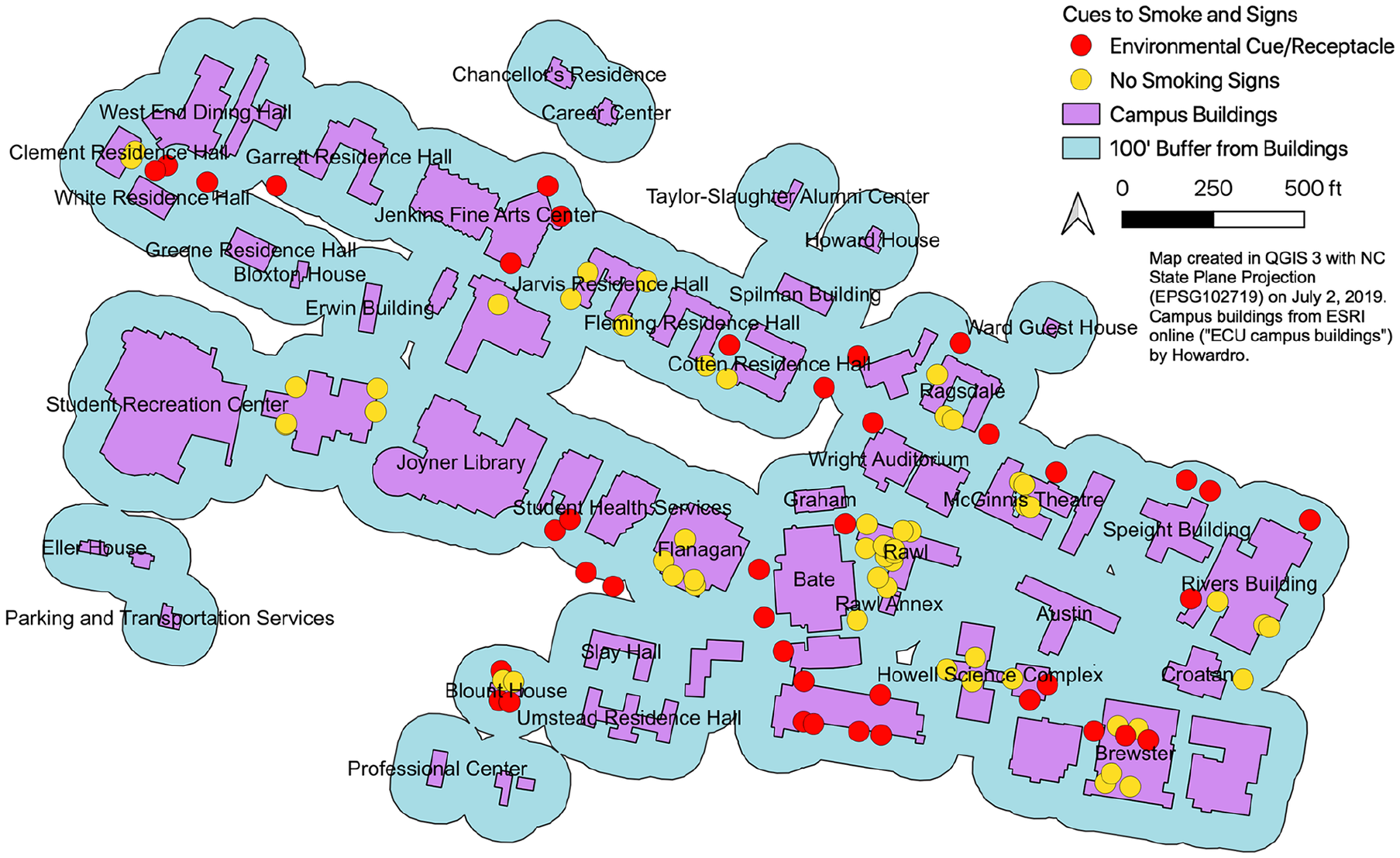
Map of Campus Tobacco-Related Signage and Environmental Cues, 2019
We worked with key stakeholders on campus to disseminate the data. On May 28, 2019, we e-mailed a brief report with maps to key administrators (n = 13), including leaders in student affairs, facilities, and the health sciences. Next, on June 3, 2019, we sent the report to the general campus employee “announce” e-mail list. As a result of this outreach, were able to meet with administrators from campus housing and facilities on June 17. In this meeting, the administrators committed to removing and/or relocating some cigarette butt receptacles and making signage consistent.
Lessons Learned
While the overall process proved feasible, the biggest challenge was the inaccuracy of GPS technology when using iPads for data collection. The level of random error and imprecision in GPS measurements made the collection of latitude and longitude impractical when trying to precisely document the location of some objects, such as door stickers. Thus, we made manual corrections to their positions using paper maps while recanvassing the main campus. To avoid this extra hassle, we recommend providing data collectors with a map on which they can mark the locations of each sign or cue encountered. The collectors can then assign a number or identifier to each point on the map that is linked to data about that point. We used this approach successfully on our health sciences campus.
Our experience shows that policy adoption is necessary but not sufficient to drive meaningful environmental change on college campuses. Once a policy is enacted, public health advocacy tools may be needed to encourage administrators to update or remove items that encourage compliance with new policies, such as signs and environmental cues to smoke. Creating and effectively disseminating a visual representation of the campus environment, and the numerous inconsistencies and conflicting cues therein, may encourage administrators to act. We hope our experience, detailed in this article, can inform public health practice for health advocates and facilities personnel as more organizations and universities adopt tobacco-free policies.
Footnotes
Authors’ Note:
The authors thank Dr. Beth H. Chaney, PhD, MCHES, for her constructive comments and Ms. Martha M. Dartt, RN, FNP, MSN, for her unwavering support for a healthier campus. This work was generously funded by the American Cancer Society and CVS Health Foundation Tobacco-Free Generation Campus Initiative (No. 39660).
