



Abstract
Diet-related chronic disease remains a public health concern, and low intake of fruits and vegetables disproportionately affects low-income populations. Healthy food incentive (HFI) projects can help close the nutrition gap among low-income populations by increasing purchasing power and access to fruits and vegetables. This study aimed to qualitatively explore lessons learned and best practices from Food Insecurity Nutrition Incentive Grant Program (FINI) grantees across the United States. Thirty semistructured interviews were conducted with FINI grantees and stakeholders in 2018, eliciting best practices and promising findings, policy implications, and knowledge gaps and opportunities to pursue that inform program refinement and sustainability. Telephone and in-person interviews were conducted with FINI grant recipients from 2015 to 2016, specifically, recipients of FINI-funded multiyear community-based projects and large-scale projects. Our results highlighted (1) range of projects and scope, (2) program promotion and awareness, (3) community-based partnerships, (4) technical assistance and peer interactions, (5) measurement and evaluation, (6) program challenges, and (7) future directions and recommendations. Grantees reported a “trifecta of benefits” that affects low-income consumers, farmers, and food retailers. Our findings contribute to understanding how to implement HFI programs in a variety of settings and highlight the variations that can exist between programs, as well as the need for increased technical assistance and synergy between programs (communities of practice). Overall, these findings can help to inform implementation and practice of healthy food incentive programs and the Farm Bill and other policy discussions.
Keywords
Background
Recently, diet-related chronic diseases surpassed tobacco as the number one preventable cause of death in the United States (Mokdad et al., 2018). Low intake of fruits and vegetables (FVs) disproportionately affects low-income populations and increases risk of chronic diseases (Aune et al., 2017; Moore et al., 2015). In the United States, poor diet and obesity often coincide with food insecurity, defined as lack of access to nutritionally adequate food, acquired in socially acceptable ways to support healthy lives (Coleman-Jensen, Rabbit, Gregory, & Singh, 2019). Food insecurity rates remain steady, with 11.1% of U.S. households in 2018 being classified as food insecure (Coleman-Jensen et al., 2019). The Supplemental Nutrition Assistance Program (SNAP) provides low-income families (12% of Americans) with funds for purchasing food (U.S. Department of Agriculture [USDA], 2018). SNAP has been linked with reducing food insecurity (Gundersen & Ziliak, 2015), yet lower dietary quality among SNAP participants demands policy and programmatic efforts to encourage healthier diets (Leung et al., 2012).
Healthy food incentive (HFI) projects can help close the nutrition gap among low-income populations by increasing purchasing power and access to FVs. HFI projects have demonstrated increased purchasing of incentivized FVs and improved dietary quality (An, 2013; Olsho, Klerman, Wilde, & Bartlett, 2016). Consequently, the USDA invested more than $47 million in 2015-2016 in the Food Insecurity Nutrition Incentive (FINI) Grant Program (USDA, 2017). FINI’s goal is to increase FV purchasing and consumption among SNAP participants by providing incentives at the point of purchase (USDA, 2017). The social-ecological model appropriately guides this research since it considers the complex interplay between the individual level (e.g., changes in shopping and dietary patterns for consumers), interpersonal level (e.g., awareness of incentive programs among communities), organizational level (e.g., impact of incentive programs for farmers markets, producers, and retailers), community level (e.g., access to sites that offer HFIs such as retailers and farmers markets), and societal/public policy level (e.g., Farm Bill policy; Golden & Earp, 2012; Young, 2013).
Findings of individual HFI projects have mainly described impacts on FV purchasing and consumption (Dimitri, Oberholtzer, Zive, & Sandolo, 2015; Savoie-Roskos, Durward, Jeweks, & LeBlanc, 2016; Young, 2013). Studies have also utilized transaction data to characterize spending on eligible FVs (Polacsek et al., 2018; Steele-Adjognon & Weatherspoon, 2017) and make comparisons between incentive and nonincentive sites (Baronberg, Dunn, Nonas, Dannefer, & Sacks, 2013; Cohen et al., 2018). FINI projects have also been described through receipt analysis at farmers market, including outcomes such as transactions, sales, program participant characteristics, and the combined beneficial impact of incentives and restrictions on FV purchases (Freedman, Mattison-Faye, Alia, Guest, & Hébert, 2014; French et al., 2017). Overall, these previous studies were pilots that were conducted before the FINI funding mechanisms were available, and provided evidence that supported garnering FINI grants in some of these locations. However, no studies have comprehensively examined findings across FINI grantees to capture in-depth information to inform future HFI programs.
Purpose
The purpose of the current study is to report lessons learned and best practices from FINI grantees across the United States to inform implementation and practice of HFI programs and policy discussion.
Method
Participant Recruitment
Qualitative data were collected on HFI programs across the United States—specifically from 2015 to 2016 recipients of FINI-funded multiyear community-based projects and large-scale projects. In 2018, 22 interviews across 19 grantee organizations were conducted (selected for project size, geography, etc.). In terms of regions represented, interviewees included 22% from the Northeast, 17% from the South, 13% from the Midwest, and 48% from the West. Grant year was about half in 2015 (42%) and half in 2016 (58%), while large-scale projects comprised 47% of interviewees and 53% were community-based projects. Additionally, eight interviews with FINI stakeholders were conducted to better understand policy implications. Stakeholders were identified by the research team using a snowball sampling method and included representation across policy advocates, academicians, federal employees, and technical assistance (TA) providers. Interviews were conducted by telephone and in-person when possible (e.g., when interviewees and authors coincided at meetings).
Semistructured Interviews
The semistructured interview guide was developed by the authors and explored the following topics: (1) best practices and promising findings, (2) policy implications, and (3) knowledge gaps and opportunities. Interviews were conducted by three trained researchers by phone interviews, mostly one-on-one, but some with multiple interviewees from a single FINI project. The interviews were iterative, probes and questions were tailored to each interview, and the guide was modified as appropriate throughout the interview process. This study was approved by the University of Nebraska Medical Center Institutional Review Board. Verbal consent was obtained from all interviewees.
Data Analysis
All 38 interviewees (across 30 interviews) provided verbal consent to participate and be audio-recorded; interviews were transcribed verbatim. Thematic content analysis (Patton, 2002) was used within NVivo qualitative software (QSR International, 2018). An initial code list was developed with input from all authors, and several transcripts were coded by multiple coders to establish reliability between coders and reach consensus on disagreements. Next, each transcript was coded for meaning units by one of four authors. Emergent themes were identified through frequency of coding within similar contexts and across interviews. Our thematic content analysis was driven by a priori theoretical understanding of HFI programs and the design of the semistructured interview guide. Thus, themes were common across most interviews, given the structure of the guide and the interest in specific program characteristics. Finally, results were validated by having external experts review reported findings to ensure themes were adequately captured.
Results
FINI grantee organizations interviewed included small, grassroots nonprofits; governmental agencies; food access organizations; and policy advocacy organizations. Stakeholder interviewees spanned across policy advocates, academicians, federal agencies, and TA providers. Themes derived from the data included (1) range of projects and scope, (2) program promotion and awareness, (3) community-based partnerships, (4) TA and peer interactions, (5) measurement and evaluation, (6) program challenges, and (7) future directions and recommendations (Figure 1).

Themes and Subthemes From FINI Project Interviews
Range of Projects and Scope
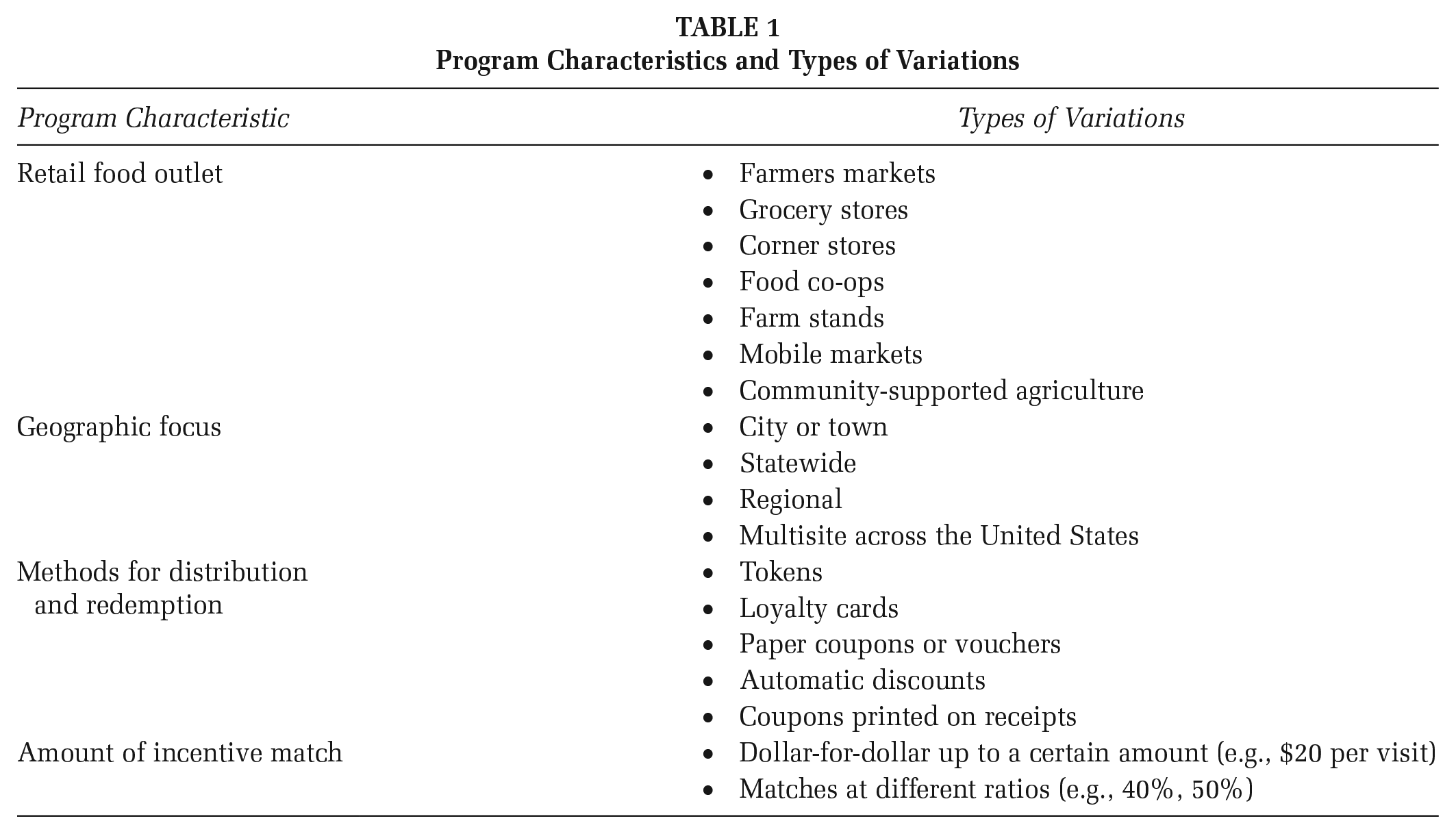
Diversity in project implementation included types of retail outlets, geographic focus, redemption methods, and incentive match amounts (Table 1). Some programs provided a dollar-for-dollar incentive match, commonly up to $20 per visit; others provided incentives for purchases on the next visit, while others included an immediate incentive. Incentives also varied slightly in terms of what items could be purchased using the incentive: some only on locally grown FVs, some only on fresh FVs, and some included canned and frozen FVs without added sugars. Loyalty cards were used in grocery stores and could provide automatic discounts or be redeemed on subsequent visit(s). Program rules also specified which products were eligible for earning and redeeming incentives. Many programs allowed participants to earn incentives with the purchase of locally grown FVs and redeem incentives on any type of FV. One interviewee described the nuance of how their incentive program operates: Double-Up is only for [locally] grown produce. Most produce sold at the farmers markets is inevitably local, but we do have some vendors that might bring in produce from elsewhere, and they’re pretty clear on labeling which products are and are not eligible. (first column in Figure 1)
Program Characteristics and Types of Variations
Program Benefits
Interviewees emphasized the overwhelmingly positive impacts of FINI, typically describing the FINI program in terms of the potential for “a trifecta of benefits.” Perceived strengths of FINI programs cut across three umbrella areas (second column in Figure 1).
Farmers experienced increased sales of FVs and expansion of their customer base. Money generated by FINI programs was often channeled back into the local economy, enhancing vitality of many communities. Several interviewees mentioned farmers were able to expand production as a direct result of increased SNAP and incentive dollars (n = 10). One interviewee cited, “They’re planting more rows of crops. They’re increasing what they’re bringing to market.”
Retailers also saw boosted FV sales and were able to expand their offering of locally sourced FVs. This was important to store owners as was supporting local food systems and members in their communities. One interviewee described the benefit for local retailers, “I think beside the benefits for the local economy, small retailers like corner stores experience a major win for their business.”
Consumers utilizing FINI incentives reported improvements in diet, food security, and perceived health. FINI allowed SNAP participants to stretch food dollars to include more FVs. Increased FV intake may have been spurred by FINI through exposure to new food outlets and trying new FVs. Many interviewees reported changes to recipients’ diets, ability to afford FVs, and subsequent health outcomes, such as reducing chronic disease. Since consumers were not interviewed for this study, this information was reported by the FINI program leads that have conducted evaluations with consumers. One interviewee described feedback they received from participants, “I transitioned away from processed foods and toward fresh FVs as snacks.” The experience of shopping at farmers markets was also reported to have positive social impact: “The sense of community they feel, interacting with neighbors and talking to growers about how the food is grown.”
Program Promotion and Awareness
Interviewees reported a wide assortment of strategies for promoting their HFI programs and creating awareness and buy-in among an often “hard-to-reach” population. Some best practices for promotion of the FINI program that interviewees mentioned included on-site signage; social media; TV, radio, bus, and train ads; and billboards. For some grantees, it was often necessary to translate materials into other languages to reach diverse consumers.
Traditional advertising (e.g., signage, TV, radio) were utilized and viewed as helpful, yet many participants reported hearing about FINI through word of mouth, including via ambassadors, described as community members with firsthand experience using incentives. Some grantees recounted holding trainings for employees of partner organizations to equip them with background knowledge. Community partners also oversaw venues to promote HFI programs (e.g., food pantries). One participant described their range of promotion strategies employed, “Mass media was helpful to raise awareness in the first two years. As far as who is showing up at the market, we found the best resource is word of mouth” (third column in Figure 1).
Community-Based Partnerships
Various community-based partnerships helped to advance FINI in terms of program promotion and awareness as well as facilitating program implementation. Agencies serving low-income individuals and health agencies were identified as valuable community-based partnerships that worked synergistically with FINI programs. These partners included local social service providers, which were effective given the existing relationships with the target audiences. Interviewees emphasized that ensuring case workers and other direct service staff were knowledgeable about FINI was effective in generating program awareness.
Interviewees collaborated with community partners such as food banks/pantries, schools, health care organizations, federal food assistance programs (e.g., SNAP, WIC [women, infants, and children]), nonprofits, and other social service agencies. Some SNAP agencies disseminated program information to eligible households through direct mailers, while others described barriers such as privacy and resource constraints. SNAP-Ed sometimes took a more involved “on-the-ground” role, helping lead coordination with program sites to be equipped to offer FINI programs (e.g., setting up EBT [electronic benefit transfer]) and promotion onsite through cooking demonstrations. One interviewee described the role that SNAP-Ed plays with their program, “We are working with our SNAP-Ed agency here to get incentive information out in the hands of SNAP clients whenever they come into the community service offices. They’re equipping their call centers with information about these programs as well.” Conversely, there were many states with limited SNAP-Ed budgets, and thus other partners (e.g., Cooking Matters) helped fill this role (fourth column in Figure 1).
Interviewees described ways in which health departments contributed to FINI programs, sometimes as the entity that operated and led the program; alternatively, health departments sometimes served as an anchor for the program and a connector to other agencies. Health care providers (e.g., pharmacists, primary care) were also an avenue to introduce individuals to FINI programs.
Technical Assistance and Peer Interactions
Most interviewees indicated that they received TA from leaders in the area of food access (e.g., Fair Food Network, Wholesome Wave). TA was typically provided for those just starting work in HFI or “scaling up” existing programs. Specific TA received included grant application development, branding, working with various food retail outlets, implementation, and measurement/evaluation. Existing, “ready-to-use” branded materials helped when programs were launching. One interviewee described how these tools were helpful, “The program is rolled out fast and furious. Having materials was helpful in the first year. We’ve [subsequently] moved away from original design, but still like the logo so there’s consistency with the rest of the nation.”
TA that helped promote collaboration with various food retail outlets included sharing best practices in working with food retail outlets, point-of-sale (POS) systems, and training for retail staff. TA providers also convened FINI recipients through bimonthly phone calls, webinars, a Web portal with resources, and annual convenings. Interviewees underscored the value of these peer interactions, with one interviewee citing, “The summits are extremely valuable and created a nationwide support network. I know people across the country doing this work, and we’re in constant communication.” A strong desire for more information sharing, from both peers and experts, was described (fifth column in Figure 1).
Measurement and Evaluation
Across all FINI programs, the goal was to demonstrate effectiveness, reach, and process for implementation in order to translate programs to other settings and leverage resources for policy change and sustainability. Interviews revealed a range of what aspects were being assessed and rigor of evaluations. Outcomes that interviewees indicated were important to their programs included redemption rates across site types, sales and volume of FVs distributed through incentives, consumer-level outcomes (e.g., dietary patterns), impact on local economy (e.g., multiplier effect), impact on farmers and retailers, and demand for local foods. As FINI programs are implemented across the country, sharing best practices and valid and reliable measurement tools is a need that could be addressed through TA and coordination across FINI grantees. One interviewee described how they pieced together their evaluation, “Our evaluation was a little ad hoc. There are a lot of different models out there, I think one of the things that FINI helped with is streamlining and sharing techniques” (sixth column in Figure 1).
Program Challenges
HFI programs are a novel approach to promoting healthier diets among low-income consumers and are still evolving. Interviewees reported some nuanced challenges with reaching low-income populations across their geographic regions. At all location types, potential stigma against SNAP benefits and incentives being used created a hurdle that was best addressed through education and continued implementation for stakeholders to recognize multiple benefits for the community. One interviewee described the need to overcome stigma, “There’s perceptions about farmers markets not being for everybody. That they’re for certain demographics’ income levels. So working against some of those narratives.” FINI programs were also occurring in the “real world,” and sites where incentives were offered were not always the primary food shopping location for low-income populations. This also meant that some program sites had to develop new strategies for incorporating more local FVs, as well as managing placement, promotion, and shelf life.
Several challenges were also identified when working with various retail food outlets, including implementation, tracking, and distribution and sourcing of local FVs. One barrier commonly cited was working with existing technology and POS systems. As Table 1 describes, distribution methods included loyalty cards, coupons, or automatic discounts. If a retail outlet had an older POS system, the burden was on FINI grantees to find technology solutions. An interviewee described this challenge, “They’ve changed to a different POS system, which has less flexibility. The system could not recognize an EBT customer in real time and a program had to be written to capture transactions” (seventh column in Figure 1).
Future Directions and Recommendations
All interviewees provided recommendations to help improve their own specific programs, as well as increase traction and synergy between programs across the U.S. Grantees were asked to summarize messages intended for policy makers. The “trifecta of benefits” was reiterated, stressing that the multitude of positive outcomes could be tailored to interests of particular policy makers and audiences. One interviewee stressed the value of stimulating local economies, “It’s important to communicate to policy makers the return on investment of FINI. There is value in keeping those dollars local, the potential for job creation and supporting your neighbor.”
Most grantees mentioned sustainability of funding as an area they are actively working to address. As programs matured and, in some cases, received multiple years of FINI funding, some interviewees mentioned efforts to gain support from state legislation in order to secure dedicated funds for their HFI programs. One interviewee described transition to state-level support, “We are trying to pass state legislation that will dedicate funds to sustain the program, and nurturing relationships with cash match partners to keep them at the table.”
One key lesson learned was that broader food assistance policies (i.e., SNAP operations) tend to dovetail with HFI programs. To promote and sustain HFI programs, interviewees stressed the importance of communicating to policy makers with varying messages that may resonate with different audiences. These messages can be tailored to include benefits for farmers and food retailers, stimulating the local economy, low-income consumers improving diet and health, and supporting local food systems. Finally, HFI programs expand access to fresh FVs for low-income families, as one interviewee described, “[Low-income families] fall into habits of crisis eating (i.e., eating the cheapest foods), which are not the healthiest. Being able to access fresh produce does result in diet and health changes” (eighth column in Figure 1).
Discussion
Previous articles described findings from individual FINI programs with a focus on specific outcomes (Baronberg et al., 2013; Cohen et al., 2018; Dimitri et al., 2015; Freedman et al., 2014; Savoie-Roskos et al., 2016; Young, 2013). A comprehensive literature review concluded that existing evidence of HFI interventions is compromised due to small and convenience samples and results yielding limited generalizability (An, 2013). Our in-depth qualitative data characterizes FINI-funded programs from across the United States and highlights programmatic characteristics, key barriers, implementation best practices, and measurement to inform future investments. These findings helped to inform the 2018 Farm Bill (Parks et al., 2019), which was also in alignment with previous recommendations (Au, Ehrens, Burda, & Zumbrun, 2018). Discussions of these lessons learned and best practices from current and past FINI grantees also have implications for future iterations of the legislation.
Across eight major themes identified, one overarching commonality was the diversity FINI programs had in terms of scope, promotion strategies, types of partnerships, TA, measurement/evaluation, and challenges. Furthermore, the positive impacts of FINI programs consistently have broad appeal, spanning three major areas: (1) farmers experiencing increase in sales, (2) retailers noting increased FV sales and demand for locally sourced FVs, and (3) consumers reporting improvements in diet, food security, and health. The importance of tailored messaging has been identified as a best practice in health promotion when communicating with policy makers and other stakeholders and can effectively be harnessed to further promote HFI programs (Jou, Niederdeppe, Barry, & Gollust, 2014).
Along with receiving monetary incentives for FVs, SNAP participants report being eager to receive more opportunities for nutrition education (Blumenthal et al., 2014), also noted by our interviewees. Participants who receive brief, interactive nutrition education sessions are more likely to be invested in programs and achieve greater increases in FV consumption (Young, 2013). Interviewees reported several strategies employed to build program awareness, from traditional media outlets to in-person outreach. Participants typically learned about the program through word of mouth, which has been identified as an effective recruitment strategy for minority populations, yet can be nuanced and requires more time than typical media-based strategies (Yancey, Ortega, & Kumanyika, 2006). Our results also supported that word-of-mouth communication often came through partnerships with various community-based agencies (e.g., SNAP-Ed). Low-income populations are more likely to interact and follow through on information provided by trusted community institutions (Dennis, 2003).
We identified a web of TA and peer-to-peer interactions that helped to facilitate effective FINI program implementation and evaluation. Building capacity among grantees, which are often grassroots organizations, is imperative to ensure programs can maximize impact of the federal funds distributed (Flaspohler, Duffy, Wandersman, Stillman, & Maras, 2008). Our findings suggest that organization and delivery of TA should be coordinated between those with experience/expertise to allow for equitable access across grantees. Peer-to-peer interactions indicate that a community of practice among HFI programs is critical for collective learning and can help with problem solving, coordination and synergy, maximization of resources, and identifying knowledge gaps (Wenger, 2011).
Interviewees reported varying degrees of rigor in evaluation, which is indicative that coordinated TA and peer-to-peer learning would be helpful. Models of shared measurement have been acclaimed as strategies that allow for complex social issues to be solved with collaborative efforts (Kania & Kramer, 2011). Perhaps through TA and coordination strides can be made toward developing a shared measurement model whereby common metrics are used across grantees. Many organizations did not necessarily have the expertise or funding to conduct comprehensive evaluations and would benefit from additional TA.
It is well recognized that food retail outlets are incorporating increasingly innovative technological solutions to improve customer experience and sales (Inman & Nikolova, 2017). HFI programs could leverage the ever-changing technology in food retail, especially since mechanisms for delivery and tracking are reliant on POS systems. Innovating and working with POS systems was a challenge for FINI grantees due to limited capacity. Academic–practitioner partnerships have worked to facilitate nationwide dissemination utilizing technology at farmers markets (Freedman, Hunt, Merritt, Shon, & Pike, 2017). Perhaps FINI could implement similar models, with technology solutions in partnership with market and academic experts.
Conclusions
These findings underscore the strengths of FINI and highlight need for continued innovations in helping SNAP participants purchase and consume FVs. Our findings contribute to a greater understanding of implementation of HFI programs in a variety of settings and the variations that can exist, as well as need for increased TA and synergy between programs. Specific to FINI, these findings can inform legislative discussions for the Farm Bill. More research is needed to explore specific parameters of HFI programs in diverse populations and settings in a more purposeful way to determine specific impacts on public health. In a federally funded program such as FINI, grantees could be grouped in strategic ways to form natural experimentation utilizing common metrics to yield robust data.
