



Abstract
In response to a number of growing global health challenges, New York University and UNICEF designed a Behavioral Communication Strategies for Global Epidemics course that brings together United Nations professionals, government staff, and MPH (Master of Public Health) students to design innovative social behavior change communication (SBCC) strategies that address disease outbreaks and humanitarian challenges around the world. Applying a systems approach, participants in the course work on interdisciplinary teams to design strategies, develop skills, and engage in global learning. At the culmination of the course, all teams present strategies to UNICEF country offices for implementation. This innovative model for disease outbreak, public health education, and humanitarian response provides professionals with an opportunity to develop a wide range of competencies, including systems thinking, behavior change, and human-centered design and equips them with the necessary tools to develop more novel approaches to SBCC. As the number of outbreaks and humanitarian challenges increase each year, this format for learning can serve as a model for how professionals can effectively address these complex crises.
In response to a series of global health challenges, 77 professionals from UNICEF, WHO (World Health Organization), ministries of health in six countries, and MPH (Master of Public Health) students from New York University’s School of Global Public Health (GPH) convened in Beirut, Lebanon, from March 15–23 of 2019 for the class: Behavioral Communications Strategies for Global Epidemics (BCSGE). The deliverables for the participants and faculty included designing innovative social behavior change communication (SBCC) strategies to reduce the spread of disease in the Middle East, North Africa, and beyond. This unique applied and experiential learning format can serve as a model to help resolve complex challenges in international health and development.
The course was originally designed by GPH in partnership with UNICEF and Anthrologica. It was launched in response to the Ebola virus disease outbreak in 2014, and, since its launch, has been offered four other times—in New York City (2015 and 2016), Ghana (2017), and Nepal (2018), with each iteration of the course bringing new groups of participants together to tackle new challenges. The course requires participants from United Nations agencies, governments, and New York University to work on interdisciplinary teams to apply concepts of anthropology, SBCC, human-centered design, bottleneck analysis, and innovation to respond to disease outbreaks and humanitarian challenges. Through a systems approach, teams chart how these challenges operate within dynamic systems, accounting for their relationships with politics, the economy, the health system, culture, and more. At the culmination of the course, teams deliver comprehensive strategies, which are sent to country offices for implementation. This innovative model of public health education and practice has broad implications for current and future professionals and humanitarian response for the following significant reasons:
It provides participants with a new systems perspective on addressing challenges, equipping them with the necessary tools to develop more effective and novel approaches to behavior change.
It provides an opportunity for professionals to work with students and government staff in a way that highlights their respective strengths, increasing the pipeline of opportunities for all groups.
It provides students and professionals with competencies in epidemiology, behavioral health, and health communication.
It provides country offices with strategies to implement in their countries to affect large-scale change and decrease the spread of disease.
Thus far, the course has brought together over 200 professionals and students from more than 50 countries to address more than 20 outbreaks and humanitarian challenges, demonstrating its growing impact around the world.
Course Design
The course engages participants through a unique curriculum with online and live (in-person) sessions. Systems thinking, mixing of professionals and students, “avatars” or role-playing, and real-life, context-specific challenges make up the core components of the course. Each of these components force participants outside of their normal areas of expertise to adopt new ways of assessing humanitarian challenges.
Online Portion
The first phase of the course occurs online, where almost all of the foundational material exists. This portion of the course covers topics such as systems thinking, epidemiology, risk perception, community and culture, theories of behavior change, disaster preparedness, and communication approaches. During this time, participants are also asked to complete assignments such as building systems maps, creating and analyzing epi curves, and assessing the availability, affordability, approachability, appropriateness, and acceptability of an intervention. Each module included online is designed to prepare participants for the live portion of the course.
Live Portion
During the live portion of the course, professional staff and students are placed on teams to develop strategies for some of the most pressing public health challenges in the world. These interdisciplinary teams allow for each strategy to be addressed from multiple perspectives and respond to the systems-level problems that lead to the spread of disease, such as violence, political turmoil, or lack of basic infrastructure. Once assigned to teams, to encourage innovation and a leveling of the playing field, every member of the team is assigned a role (epidemiologist, anthropologist, environmental scientist, data specialist, external communications specialist, SBCC specialist, etc.) that diverges from each person’s area of expertise. Participants are encouraged to address their challenge through this lens to provide them with new ways of thinking about these complex problems. During each day of the course, participants have the opportunity to interact with lecturers and guest speakers who are some of the most renowned in the field.
In addition to these seminars, intensive exercises push participants to consider the severity of real-life situations and provide insight into what happens during a crisis. Each year, instructors design an outbreak simulation in which students are challenged to brief key players in the government, WHO, and the media on their response. During the 2019 iteration of the course, participants traveled to informal settlements in the Baalbek governorate in Lebanon to assess the current living situation of refugees from Syria and to listen to their stories. On returning to the course site, instructors notified participants of the simulation: a suspected case of cholera in the informal settlements that they had just visited. Participants then had 3 hours to devise a comprehensive and cohesive briefing on cholera. Exercises such as these challenge participants, especially professionals, on how they think about emergency response and the necessity for collaboration between sectors and a systems-level approach.
By the culmination of the course each year, staff, alongside students, develop tangible and implementable strategies to bring back to country and regional offices, thus making this a truly applied course. In 2019, the field challenges included chikungunya in Sudan, monkeypox in Nigeria, Ebola in the Democratic Republic of Congo, and destroyed health systems in Iraq, Syria, and Yemen. Successful teams were required to demonstrate the value of their proposal, how it met the need of the local community, and how it would successfully change behavior.
Discussion
This course fills a substantial gap in public health education for professionals and students, especially as humanitarian challenges become more widespread and complex. One of the major challenges to responding to these crises is the “mismatch of professional competencies to patient and population priorities because of fragmentary, outdated, and static curricula” (Frenk et al., 2010, p. 8; Petrakova & Sadana, 2007). This has been a challenge in nearly all countries, as education programs fail to overcome systems-level failings in fixing inequitable health systems, the isolation of various professional fields, and an overall lack of collaboration and interprofessionalism (Petrakova & Sadana, 2007). The BCSGE course addresses this problem by creating an interdisciplinary environment where various professionals from diverse backgrounds can collaborate on complex issues. This type of interdisciplinary environment also gives way to the development of important skills and insights into collaboration, accountability, and communication, each of which have been defined as necessary components for interdisciplinary courses to be successful (Bridges et al., 2011). In a recent program evaluation of the course, it was reported that participants gained competencies in professional development such as negotiation, multitasking, and communication in addition to technical skills such as systems thinking, bottleneck analysis, and epidemiology. This demonstrates the course’s capability of shaping participants to be more well-rounded and therefore ready to work in real-life settings where collaboration with stakeholders is often the key to successful program implementation.
Systems thinking, a cornerstone of the course, has also allowed participants to view epidemics and humanitarian challenges in their full complexity and as dynamic systems that continuously change. Systems thinking can be applied at the community level through the policy level, and the strategies developed by participants in the course often straddle these multiple levels and domains (Peters, 2014). In recent years, systems thinking has become integrated into the global health landscape, informing practitioners on how to address challenges in providing primary health care to better understand the causes of neonatal mortality (Gilson et al., 2014; Rwashana et al., 2014). It leads to the implementation of cross-sectoral strategies that affect multiple outcomes. During the course, each team is tasked with drawing systems maps to demonstrate the complexity of their issue and to allow them to prioritize areas for intervention. This process ensures that participants develop behavior change strategies that have an impact on the system and allows them to plan for possible unintended consequences. Because they consider the multiple factors that contribute to and inhibit the spread disease, these strategies are robust, feasible, and effective.
Finally, the course promotes global learning by providing students and professionals with a platform to share ideas, experiences, and knowledge both online and in-person. According to Madhok et al. (2018), the core components of global learning include information and communication technology, a global context, multidirectional learning, a focus on further educational developments, and lifelong learning through career progression, which the course accomplishes. Students and professionals take part in rigorous multidirectional learning through which professionals can provide context and expertise to the challenges at hand and where students can provide an academic perspective. The course itself tackles specific, regional challenges, which were chosen by the regional offices, and staff from country offices from over 50 countries have attended the course thus far, demonstrating the truly “global” nature of the course.
Impact
To date, 35 strategies for 23 countries have been created (Table 1), demonstrating the widespread impact that the strategies designed in the course may have. Not only are these strategies of little cost to country offices, but they are also designed to tackle the systems-level barriers to behavior change that can make program implementation often so challenging. In a recent program evaluation, 70% of staff who participated in the study reported that they presented the strategies designed in the course to their country office. Some of these strategies implemented at the country office level have included a polio eradication program, a cholera outbreak response strategy, and a field epidemiology training program. Staff also noted that they adapted the strategies that they designed during the course to other situations and employed systems thinking during critical moments such as disease outbreaks and natural disasters such as flooding. One respondent noted that during a pertussis outbreak, they used systems thinking to bring together various experts to perform roles from clinical care to risk communication. Another participant noted that they adapted systems thinking to design programs to end child marriage in their country. This type of collaborative response, a strategy simulated in the design of the course, is necessary during situations such as these to ensure that the response strategy is well-rounded and addresses the issue in its broader context.
Challenges Addressed in Each Iteration of the Course (2015–2019)
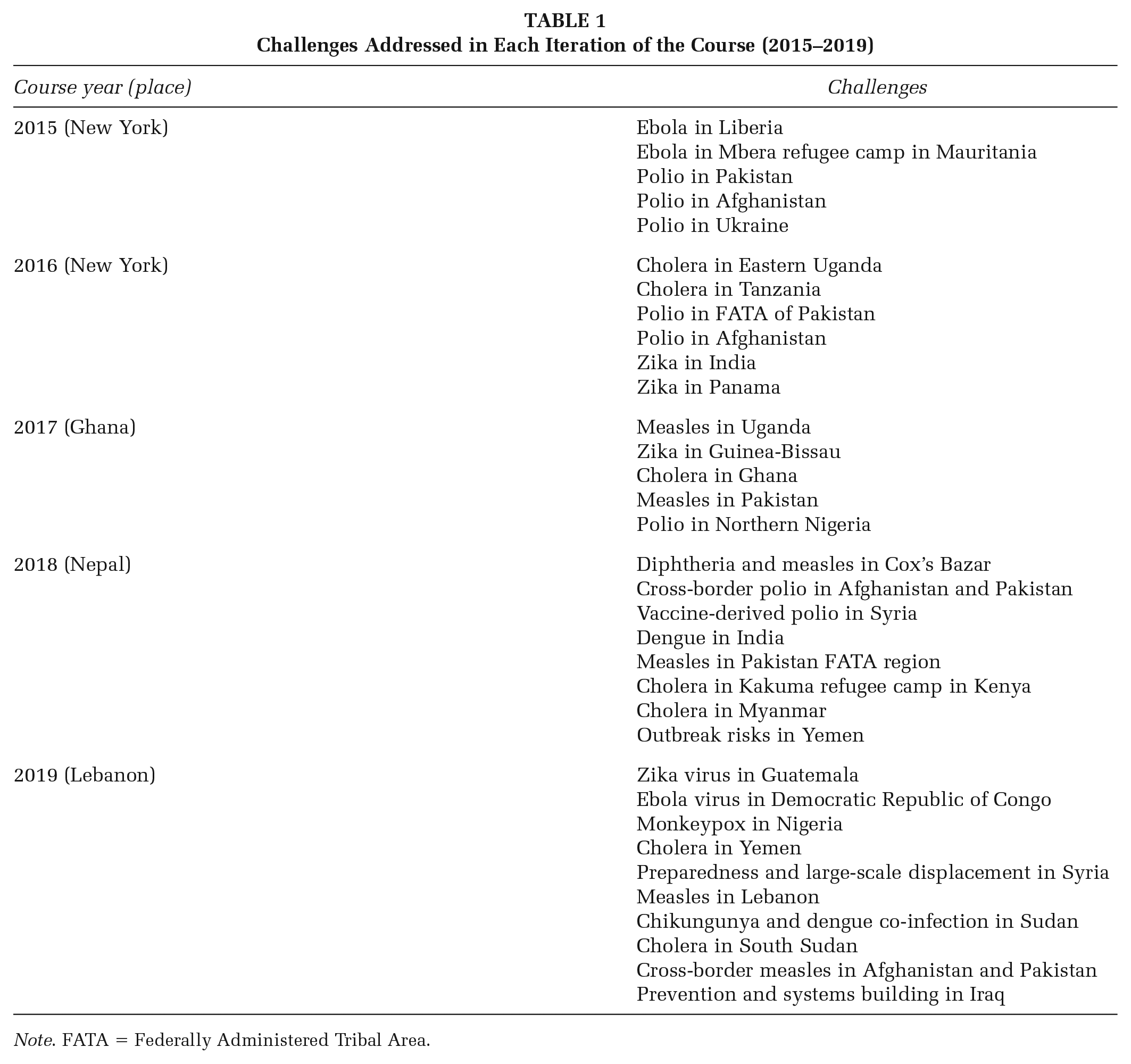
Note. FATA = Federally Administered Tribal Area.
The strategies implemented in country offices have also demonstrated large-scale impact, addressing challenges at the community and policy levels. A colleague from Yemen noted how skills in building community ownership developed throughout the course assisted in the office’s detection and prevention of a cholera outbreak. At the policy level, another colleague discussed how the same strategy designed to address cholera outbreaks in Yemen was adapted into UNICEF Liberia’s country office emergency preparedness platform and the country’s national emergency contingency plan. The adaptability of these inventive strategies to new contexts and how participants utilize systems thinking as a new lens when designing interventions has immense implications for the field of humanitarian response. Each of the innovative strategies developed throughout the course exists within a broad global network that allows them to take on new life when adapted across global contexts. This strategy for SBCC is efficient, is effective, and has not been done before to our knowledge.
Conclusion
Disease outbreaks and humanitarian health challenges around the world are becoming increasingly complex, and it is necessary that practitioners have the skills to address them. The BCSGE course offers the types of invaluable skills needed to tackle and design for systems-level, complex challenges, both for seasoned professionals and for entry-level personnel. For those who take the course, systems thinking and innovative design become lenses that all participants utilize in their daily lives, especially as they adapt strategies from the course to meet local challenges. As the course continues to expand and grow, the goal is to provide the course multiple times a year to meet the increasing demand for these types of skills and continue to cultivate a strong, global network.
