



Abstract
Concerns regarding the continued high prevalence of childhood overweight and obesity have created a need for proactive approaches to behavior change. The Family Nutrition and Physical Activity (FNPA) screening tool was developed for research and clinical use to identify home environments and behaviors that could predispose youth to increased weight. FNPA scores have been shown to correlate with body mass index (BMI) percentiles in first-grade students and to predict unique variance in change in BMI percentiles from first to second grade. The FNPA has been used for family behavior counseling and is now a standard component of well-child visits throughout the Geisinger Health System in Pennsylvania. Parents complete the FNPA prior to annual visits, and providers can discuss areas of concern based on screening results. Children of parents who complete the FNPA have shown smaller increases in BMI z-scores over the following year than children of parents who did not complete the FNPA. The FNPA is also used to inform the arrangement of family-centered obesity treatment for children. Recently, the FNPA has undergone a systematic update to ensure its continued relevance and utility. The updated tool is provided, and current and future users can access more information about the tool at myfnpa.org.
Introduction
The high prevalence of childhood overweight and obesity remains a major problem in the United States and throughout the industrialized world (Fryar et al., 2012). Traditional approaches to the prevention of childhood overweight and obesity involve screening and tracking of body mass index (BMI) throughout childhood and adolescence, with intervention and treatment recommended for individuals who exceed age- and sex-specific BMI percentiles. A disadvantage of this approach is that intervention is typically only initiated after a child has become overweight, and these efforts have typically not resulted in clinically significant or sustainable improvements (Elvsaas et al., 2017). A more proactive, primary prevention strategy is needed to reduce the likelihood of developing overweight and obesity.
In 2001, the American Dietetic Association Foundation (now the Academy of Nutrition and Dietetics) issued a call for a screening tool to identify risk factors for childhood obesity within the home and family environment (Myers & Johnson, 2001). The objective of this effort was to increase attention on identifying home obesogenic environments so that family-based interventions could be initiated before lifestyle patterns become more firmly entrenched. The resulting evidence analysis (EA) summarized factors associated with pediatric overweight, including health behaviors such as eating and physical activity.
The EA process provided the foundation for the development of the Family Nutrition and Physical Activity (FNPA) screening tool (Ihmels, Welk, Eisenmann, & Nusser, 2009), which was designed to address the original goals of the Academy of Nutrition and Dietetics’s call to action. The FNPA is a simple behavioral assessment that captures 10 family-based practices and youth behaviors that were found to have strong evidence in the EA as predictors of childhood obesity. The tool includes 20 items (2 for each behavior construct) that can be used by clinicians and researchers to identify home environments that may predispose youth to obesity. Constructs include family meals, family eating practices, food choices, beverage choices, restriction/reward, screen time, healthy environment, family activity, child activity, and family schedule/sleep routine, with possible scores ranging from 20 to 80. In this article, we provide an overview of the development of the FNPA, a brief review of clinical applications, and a summary of the continued refinement of the tool for future work.
Development and Validation of The FNPA
The initial construct validation of the FNPA was conducted through a participatory research partnership with a large Midwestern urban school district. Trained nurses assessed height and weight data from a sample of more than 2000 first-grade youth from 37 of 39 elementary schools in the district (Ihmels, Welk, Eisenmann, & Nusser, 2009). Parents completed the FNPA tool, and complete data were obtained from 854 families (39%). Children in the lowest tertile of FNPA scores (least favorable) exhibited significantly higher odds for overweight and obesity than did children in the highest tertile. Significant correlations were found between BMI and 8 of the 10 FNPA constructs; however, it is noteworthy that the total FNPA score had a stronger positive correlation with child BMI percentile than any individual construct. These findings have been replicated in other populations (Bailey-Davis et al., 2019; Tucker et al., 2016). The predictive validity of the FNPA tool was examined by capturing 1-year changes in BMI and BMI50 of the participants in this original cohort (Ihmels, Welk, Eisenmann, Nusser, & Myers, 2009). BMI50, also known as percent over BMI, is a proposed alternative to BMI percentile, which expresses a child’s BMI relative to the 50th percentile for their age and sex and is not limited by the ceiling effect seen with BMI percentile. More than half of the participants exhibited increases in BMI percentile with the FNPA score explaining unique variance in BMI50 at follow-up (β = −0.017), suggesting that an increase of 10 points on the FNPA corresponds to a decrease of 0.17 BMI50 units. Tucker et al. (2016) found a slightly stronger relationship when examining a sample of children undergoing treatment for severe obesity. While the independent effect of the FNPA score is small and should be considered in conjunction with other factors such as genetics and environment beyond the home, it does suggest an impact of modifiable home environment factors on child growth trajectories. Obesity prevention may have the greatest preventive benefit if begun early in life, before age 2 years (Blake-Lamb et al., 2016). However, the FNPA tool assesses risk factors more applicable to children older than age 2 years (e.g., snacking, organized play) and has not been systematically evaluated for toddlers.
Use of The FNPA in Practice For Obesity Prevention and Treatment
Several studies have demonstrated the utility of FNPA as a clinical counseling tool. For example, Christison et al. (2014) administered the FNPA as a part of a behavior change intervention utilizing motivational interviewing approaches in primary care. Acceptability of the tool was high among parents and providers. Parents who used the FNPA to help set behavior change goals (e.g., eat breakfast daily or remove television from the bedroom) reported 68% success in meeting those goals 1 month later and 46% success at 6 months. This emphasis on behavioral goal tracking is a benefit of brief action counseling utilizing the FNPA, and additional studies can be found at www.myfnpa.org. The most prominent application of the FNPA in clinical translational research is the integration of the tool into well-child visits within the Geisinger Health System in Pennsylvania (Bailey-Davis et al., 2019).
The adoption of the FNPA as “standard practice” within Geisinger offers important insights about the process of linking research to practice. Parent completion of FNPA in clinical care and provider use of the screening results is grounded in the theory of planned behavior (Ajzen, 2011), based on the belief that FNPA behaviors are determined by parent and provider intentions, which, in turn, are mediated by parent and provider attitudes, norms, and perceived behavioral control related to preventing obesity. Parents, providers, and health system stakeholders collaborated to implement FNPA in care, and it has been sustained since 2013 with adaptions to support value-based care. Parents are provided with online access to the FNPA, receive immediate feedback, and choose whether they want to discuss results with the child’s provider. Parents also set the agenda for preventive counseling by deciding which key topic (one of the 10 FNPA constructs) they wish to discuss. Parents receive a printout of FNPA results that include resource links such as KidsEatRight.org to guide self-directed learning.
More than 50% of well-child visits have completed FNPA, and parents indicated high satisfaction with the FNPA-linked provider discussions for obesity prevention (internal, unpublished Geisinger data). Provider training has focused on FNPA development, validity, and utility, as well as clinical decision support in the electronic health record, and how to tailor preventive counseling using screening results. Providers’ acceptance of FNPA has been optimized by front-desk staff encouraging completion before rooming the child, integrating FNPA results into standardized age-specific well-child templates, highlighting parent’s key FNPA topics of concern, and by highlighting FNPA responses thought to adversely affect adiposity (e.g., child almost always drinks sugar-sweetened beverages). Furthermore, features in the provider’s display of FNPA screening results facilitate her or his documentation of preventive counseling for healthy eating and physical activity.
The integration of the FNPA into standard practice in pediatric care has proven to be an effective, low-intensity, and low-cost obesity prevention approach. Children of parents who completed the FNPA (n = 2724) showed smaller increases in BMI z-scores (−0.05, 95% confidence interval: −0.08, −0.02; p = .0013) over the following year than children of parents who did not complete the FNPA (n = 3324; Bailey-Davis et al., 2019). The effect was greatest among 2- to 5-year-old children of normal weight at baseline, suggesting that parent completion of the tool in association with clinical care and preventive counseling may advance population objectives to prevent childhood obesity.
Effective treatment programs to reduce obesity risk are comprehensive, intense, and have a 6-month duration. While payment models for treatment are numerous and beyond the scope of this paper, preventive counseling is indicated for all, regardless of obesity, at well-child visits. Importantly, there may be utility in treatment models that are tailored to family-centered needs as an alternative to comprehensive programs. FNPA is being used to tailor the arrangement of family-centered obesity treatment for children aged 6 to 12 years with obesity at Geisinger. For example, families with FNPA responses that indicate infrequent family meals and/or low fruit and vegetable intake receive arrangements for remote telehealth counseling with a registered dietitian/nutritionist, cooking supplies, and home meal delivery kits to encourage regular, balanced, and home-prepared family meals. Other families that struggle with high sedentary activity and low physical activity receive arrangements for remote telehealth counseling with an exercise physiologist, personal activity monitors, and family-based memberships to recreational programs of preference. Participation and health outcomes are being evaluated in this single-arm study to inform whether tailoring treatment to risks identified through FNPA screening is feasible and effective. Future studies with more rigorous designs may be needed to compare the effectiveness of FNPA-tailored versus comprehensive treatment programs on obesity treatment.
FNPA collection in clinical care is feasible and acceptable to parents and providers. The FNPA can be efficiently integrated in to clinical workflow and enables pediatric providers to quickly assess children’s risk of obesity. Early evidence suggests that the clinical integration approach may offer protective outcomes for childhood obesity prevention, while treatment outcomes are being evaluated.
Refinements and Future Directions of The FNPA
The work outlined above documents the utility of the FNPA for research and practice related to child obesity prevention. A strength of the FNPA tool has been the foundation provided by the original EA process that identified key constructs. However, some updates have been needed to ensure that the FNPA is capturing behaviors and environments relevant to contemporary life. For example, the ubiquitous use of smartphones and tablets in society has led to different ways to understand screen time. To this end, a comprehensive update was undertaken from 2014 to 2016.
The evaluation and revision of the FNPA was guided by a campus research center with expertise in survey methodologies and interview procedures. Items capturing child screen time were modified to include smartphone use and other screen formats, and items assessing restriction (screen time, consumption of chips, cookies, and candy) were reworded from asking how often parents limit these to how often they monitor them. This differentiates between proactive (and generally desirable) monitoring behaviors and potentially counterproductive restriction practices. Additionally, an alternative version of the FNPA was developed in which nine of the 20 FNPA items were modified to include more objective responses (e.g., days per week that a child eats breakfast). This step led to two versions of the FNPA: one that included only subjective response scales (almost always/often/ sometimes/almost never) and one that included a mix of subjective and objective scales (referred to as the “objective” version in this report; see Table 1).
Items and Responses for the Family Nutrition and Physical Activity
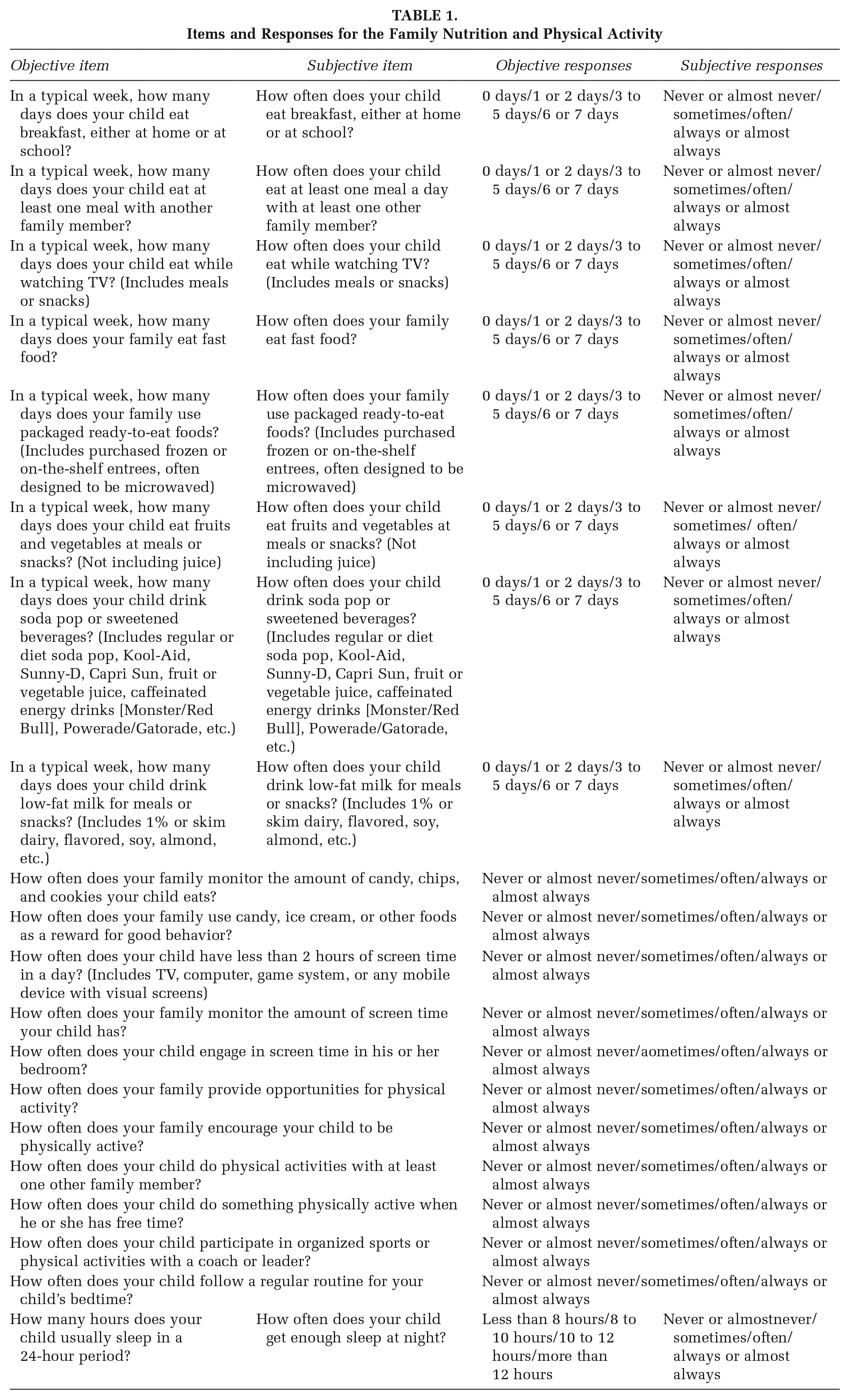
Cognitive interviews were conducted with parents to refine the formats before quantitative evaluation, which led to minor changes in wording. Following cognitive interviews, the test–retest reliability of the Subjective and Objective versions were compared based on two administrations spaced 1 month apart. Parents were randomly assigned to one of four groups, with some parents completing the same online FNPA version twice and others completing each version once (including counterbalanced assignment). The mean scores on the Subjective and Objective versions were statistically equivalent; however, test–retest reliability and internal consistency favored the Subjective version. Contrary to feedback and concerns expressed by practitioners and researchers, this suggests that parents may be able to report behaviors more consistently when not constrained by specific frequency-based responses (i.e., days per week). The Subjective version had an overall internal consistency of α = .76, which is slightly better than the original version (α = .72; Ihmels, Welk, Eisenmann, & Nusser, 2009).
Additional evaluation showed a significant correlation between FNPA scores and BMI50 (r = −0.17, p = .01) in first-grade students, although the relationship was weaker in high school students (Peyer & Welk, 2017). This association between FNPA and BMI50 is similar to that seen in the original validation of the FNPA, providing evidence that the update to the FNPA has not weakened the association between the tool and BMI. It is important to note that no cut points or thresholds have yet been identified to differentiate healthy from unhealthy households. Until future research is completed, clinicians and researchers should use their own discretion when interpreting FNPA scores.
Up to this point, clinical research of the FNPA has not included measures beyond BMI, such as body fat percentage (e.g., dual-energy X-ray absorptiometry or bioelectrical impedance analysis), as these are not routinely assessed at clinical visits. Future studies may examine these measures. Additionally, further validation of the FNPA is needed across diverse samples.
The FNPA has demonstrated value as a screening and intervention tool, including associations with multiple health factors. The tool has shown utility for integration into health system–wide well-child protocols and is sensitive to detect behavior changes resulting from clinical and community interventions. The FNPA has undergone systematic and intentional updates since its original development and publication. The studies presented here represent just a few examples of research that has supported the use of the FNPA. Additional research utilizing the FNPA can be found online at myfnpa.org, as can the updated version of the survey. Future users of the FNPA are encouraged to use the updated version to assess the potential obesogenic properties of the home environment and identify children at risk for future weight gain, overweight, and obesity.
Footnotes
Authors’ Note:
The authors have no conflicts of interest to disclose. New research described in this article was funded by Geisinger Clinical Innovations, Geisinger Obesity Institute, and Geisinger Health Plan. Karissa L. Peyer was a student at Iowa State University at the time research was completed.
