



Abstract
There are socioeconomic and racial/ethnic health disparities that warrant policy change to advance health equity. The purpose of this qualitative study was to elucidate primary activities and/or tangible characteristics that indicate that a policy advocacy campaign has an embedded health equity focus. Researchers interviewed policy advocacy experts (n = 13) and campaign leaders (n = 9), transcribed audio recordings of interviews, and conducted a thematic analysis to examine health-equity-related processes within policy campaigns. Based on experiences of policy advocacy experts and campaign leaders, mostly within the Voices for Healthy Kids initiative, several objective aspects and activities were identified that indicate that a policy campaign, and the coalition that conducts the campaign, has an embedded health equity focus. It should be stressed that these activities are not intended to represent the extent of all campaign activities, only the subset of activities and aspects of a campaign that indicate a health equity orientation. Broadly, aspects identified were related to what had the campaign done to engage with the community, who in the community was providing input about direction of the campaign, and how had that community input been used. Authentic Community engagement was seen as the foundation of a campaign’s health equity focus. A model synthesizing these findings is included in the results. A major strength of this study is that factors associated with health equity in campaign functioning are not typically assessed. These findings support identification of associated constructs to inform measurement development, and can help guide organizations, campaigns, and researchers working to advance health equity.
Over the past several decades, limited progress has been made toward achieving health equity in the United States as evidenced by continued health disparities across income, gender, sexual minorities, rural/urban, and racial/ethnic groups (Singh et al., 2017; Zimmerman & Anderson, 2019). Health equity is defined briefly as when “everyone has a fair and just opportunity to be as healthy as possible” (Braveman et al., 2018). Achieving health equity in practice takes structural change to address the underlying drivers of inequity (Brown et al., 2019). Such drivers include, but are not limited to, wealth inequality, decreased educational opportunities, unsafe neighborhoods, limited access to healthful foods, lack of reliable transportation infrastructure, and limited health care access (Braveman et al., 2011; Singh et al., 2017). These factors affect individuals’ abilities to lead healthful lives, such as eating nutritious foods and regular physical activity (Braveman et al., 2011).
In order to allow individuals and families equitable opportunities to live healthful lives, the conditions driving disparities must be addressed. The social ecological model (SEM; Bronfenbrenner, 1986; Story et al., 2008) guides policy- and/or systems-change efforts to indirectly influence individual health behaviors. SEM posits that in order to influence human behavior (health behaviors in this case), you must also understand the social and environmental context in which the behavior takes place (Bronfenbrenner, 1986; Story et al., 2008). SEM includes concentric environmental levels (e.g., personal, social network, physical environment, and macro /policy-level). If policy change is successful in positively modifying the outer levels (e.g., improving access to healthy affordable foods or places to be physically active), then such a change can influence the inner two levels that relate to behaviors of individuals and their social networks (Bronfenbrenner, 1986; Story et al., 2008). Specifically, within a health disparities context, the SEM serves as a foundation for the National Institute on Minority Health and Health Disparities Research Framework (Alvidrez et al., 2019). The National Institute on Minority Health and Health Disparities outlines domains of influence (e.g., behavioral, built environment, sociocultural, health care, etc.) along various levels of the SEM with the goal of guiding research and intervention for addressing health disparities (Alvidrez et al., 2019). Using a focused policy change approach, or “proportionate universalism,” focusing on macro-level factors that disproportionately affect the highest-need populations has the potential to address current health disparities and promote health equity (Carey et al., 2015; McLaren & Petit, 2018).
Policy change can occur in a number of different ways. The advocacy coalition theory of policy change states that, within policy sectors (e.g., public health policy), there are competing coalitions of organizations and individuals that advocate for policy change based on their own shared belief systems about underlying societal problems and needed solutions (Sabatier & Jenkins-Smith, 1993). Coalitions typically seek to create policy change by driving and leveraging “policy windows” through organized policy campaigns. Policy windows, proposed in John Kingdon’s “Policy Window” theory of policy agenda setting, proposes three main components (i.e., “policy streams”)—problems, policies, and politics—that when aligned, create a window of opportunity to change policy (Kingdon, 1995). Within the Policy Window context, coalitions seek to raise awareness and knowledge of a well-defined problem, generate and promote specific and achievable policy solution(s), educate policy makers, and foster political will to act.
Oftentimes, public interest nonprofit organizations are involved in policy and/or advocacy work within a particular area of interest (Gen & Wright, 2018). These are often large philanthropic foundations with a national reach that support and work with various stakeholder organizations, grantees, and/or affiliates to conduct policy change campaigns. Gen and Wright identified several overarching approaches advocacy organizations take with respect to their activities (Gen & Wright, 2018). Some of the approaches described rely on lobbying (e.g., influencing a decision maker regarding a specific piece of legislation) while some may be strictly nonlobbying (e.g., community mobilization and media advocacy-based activities). For example, a nonlobbying approach is popular power, in which coalitions of stakeholder organizations are formed, media and messaging are utilized, and the public is mobilized to build consensus and exert pressure on policy makers. This is sometimes termed an “outside game” or “grassroots” campaign. Furthermore, a popular power approach may often draw on principles of participatory advocacy where community members are actively involved in, and provide input to, the campaign (Gen & Wright, 2018; Israel et al., 2010).
Policy change is warranted to address underlying social determinants of health and advance health equity. While many large public interest nonprofit organizations are interested in advancing health equity, these organizations need the ability to assess the degree to which the public health advocacy campaigns they support have capacity and inclination to embed health-equity-related campaign activities and processes. For example, coalitions may have varying levels of capacity to implement a campaign to advance health equity, and/or may or may not necessarily be focused on advancing health equity. Therefore, operationalizing health equity embeddedness within the context of a policy campaign would help inform assessment approaches. The purpose of this qualitative study was to elucidate primary activities and/or tangible characteristics that indicate that a policy advocacy campaign has embedded a health equity focus into its work.
Method
Overview
This study was conducted as part of a larger mixed-methods evaluation of the Robert Wood Johnson Foundation’s (RWJF) and American Heart Association’s (AHA) Voices for Healthy Kids (VFHK) initiative. VFHK is a public education and policy advocacy initiative aimed to help all children grow up at a healthy weight with a specific focus on advancing health equity through policy change. VFHK provides funding and technical assistance to a nationwide cohort of coalitions that run advocacy campaigns to push for local- and state-level policy change in the areas of childhood diet and physical activity. These advocacy campaigns generally utilize a nonlobbying popular power approach. The study authors represented one of the organizations serving as third-party evaluators for VFHK.
The qualitative approach of this study can be best characterized as phenomenological research (Moustakas, 1994). We sought to understand the commonalities of the lived experiences of policy advocacy experts and campaign leaders who have been involved in implementing a health equity orientation in policy campaigns. A special focus was placed on identifying key activities and/or tangible characteristics involved in their efforts in order to potentially inform the development of future measures. The Institutional Review Board for Human Subjects Research of the University of Nebraska Medical Center deemed this study exempt from review. All prevailing ethical standards in protecting human subjects were followed.
Interviewees
Interviewees (n = 22) included policy advocacy experts (n = 13) and VFHK grantee campaign leaders (n = 9). Nearly all interviewees were associated with VFHK, including being leaders of a VFHK campaign, VFHK Strategic Advisory Committee members, VFHK evaluation team members, AHA and RWJF policy staff, or external technical assistance providers for VFHK grantees. One interviewee was a policy advocacy researcher from an independent research institute not involved in VFHK. All interviewees who were approached (via email) either agreed to an interview or provided an appropriate alternate within their organization. Participants’ quotes are identified with a unique participant identification (PID) number.
Procedure
Semistructured interviews were conducted from January to June 2016, either by phone (n = 13) or in person (n = 9), each lasting 30 to 60 minutes. The research team (made up of study authors) drafted the interview guide, which covered several advocacy topics (e.g., tactics utilized, organizational capacity, barriers faced, etc.). A portion of the interview guide specifically focused on interviewees’ perceptions and experiences of health equity in a campaign context and activities related to embedding health equity principles into campaigns. Two researchers were in attendance for each interview—one interviewing and one taking notes. Interviews were audio recorded with participants’ permission and transcribed verbatim.
The study utilized a thematic analysis (Boyatzis, 1998) approach with Creswell’s (Creswell & Poth, 2016) “lean coding” technique. Researchers met regularly to discuss preliminary interview findings and emergent themes. Interviews were conducted until thematic saturation was reached. Themes were allowed to emerge inductively. A coding guide was created in three iterative steps. First, three researchers read and open-coded two randomly selected interviews each. During open coding, researchers read transcripts and noted key aspects of interviewees’ advocacy campaign experiences such as recurring elements, experiences that were emphasized, perceptions, key activities, processes, barriers, facilitators, lessons learned. Next, researchers met to discuss open coding lists, including emergent themes and relationships between themes; and modifications to the code list, such as combining and removing codes. This led to an initial list of codes for themes and subthemes. Finally, the team began coding transcripts using NVivo qualitative analysis software and met frequently to discuss the adequacy of the coding list—modifying as necessary (e.g., recategorizing, combining, and removing codes). Member checking occurred following coding. Key themes were described and the model was presented to the interviewees for their feedback.
Findings
The interviewees (n = 22) included 12 women and 10 men. Racial data was not collected formally, but the sample was mostly non-Hispanic White with some representation from other racial/ethnic groups.
Health Equity Through Authentic Community Engagement
When asked to talk about health equity within the context of a policy advocacy campaign, interviewees almost exclusively discussed community engagement—often using the term “authentic community engagement,” which was contrasted with superficial community engagement efforts. Authentic community engagement involved being ideologically, financially, and physically intertwined with those that are intended to benefit from the policy change (hereinafter referred to as community members) with the goal of empowering community members to guide the policy change efforts. One interviewee described advantages of community engagement as, “. . . it has been well documented that community buy-in, input, engagement, is critical to advancing an issue in terms of building visibility, in terms of sustainability, and in terms of crafting a contextually responsive policy” (PID10). To interviewees, authentic community engagement meant that community members were the ones driving key decisions about campaign direction; the community members were sharing in the campaign resources; and the campaign had a physical “footprint” in the areas and/or among the populations that were intended to benefit from the policy. One interviewee described authentic community engagement as, [the community members] need to be a part of the actual decision-making coalition . . . and that they are not just there because they live in the community, but they’re actually involved in and have access to the resources that are going to be used to campaign. (PID14)
Most interviewees viewed authentic community engagement as the foundation for health equity embeddedness in policy advocacy campaigns.
Outreach and Building Relationships
According to interviewees, authentic community engagement efforts needed to start early in campaign planning. Interviewees advised forming early relationships with community leaders, for example, . . . don’t just see whether or not the African-American community in [city name redacted] thinks food access is a problem, but figure out who the leaders are in that community, spend time getting to know them, talking to them before you’re even starting your advocacy program.” (PID2)
Interviewees described that initial steps in achieving authentic community engagement often involved understanding the community (e.g., Who are the influential leaders? What organizations serve the community? What issues are important to the community?) and building trust, especially if an organization is not already well established within the community. Interviewees described making inroads into communities primarily through “boots on the ground” field staff activities. These activities included attending community events, meeting community members door-to-door, and holding community forums. An interviewee described their early outreach activities as, We held three community forums at the beginning of this whole process . . . a lot of different groups showed up. We used [a survey to ask] “would you like to participate further and at what level are you interested in continuing with this campaign?” (PID13)
Another interviewee that had a state-wide campaign discussed their outreach and relationship building efforts, “we hired what we call our field organizers in [state name redacted] in six parts of the state. What they do is they go around to communities. They participate in the local events. They start building the relationships” (PID3). Interviewees suggested partnering with organizations that have existing trusting relationships in the community to organize outreach activities. An interviewee emphasized this by saying “[It is best if] for neighborhood meetings, town meetings, you’re bringing folks together that are invited by the organizations that they trust” (PID9).
Tailoring Policy to Community Needs
Once a relationship is built and nurtured, the organization(s) running an advocacy campaign can begin to understand issue priorities, barriers, and strengths; and can tailor policy solutions more effectively. One interviewee described this as, . . . talking to people to find out what they care about, what they’re interested in . . . How does that tie into the policy change you want to do? Does it at all even tie into the policy change you want to do, or . . . is there something else you need to be thinking about that’s driven by the community? (PID12)
Interviewees conveyed that the campaign objective should stem from expressed desires of the community members. This can ensure that it is responsive to their needs and can be crucial to generating buy-in. One interviewee gave an example of a policy that was well-intentioned but failed to account for community needs, In the city of [city name redacted] there’s all this amazing bicycle infrastructure. And they started building more of this infrastructure in the underserved communities and what the communities have said is, ‘we don’t ride bikes. We walk.’ And so what would be more valuable to them is improved pedestrian infrastructure and transit and connections to transit. (PID18)
Community driven, inclusive, and transparent processes are needed to translate expressed community needs into a campaign’s policy objective.
A Coalition’s Make-Up
Interviewees conveyed that a coalition’s membership and leadership structure can indicate authentic community engagement. These aspects relate to who are the partner organizations involved in the campaign, who are the people with decision-making authority, and who are the paid staff? An interviewee described what they look for in an authentically engaged campaign, “. . . when we’re working on policy efforts . . . that’s going to impact the particular community, I call beneficiaries. So, how many of the beneficiaries of this policy are actively engaged in your work, have a seat at the table, that you actually talk to and get direction from, and it relates to what’s important to them?” (PID14)
Additionally, an interviewee described working with campaign coordinators who not only get direction from community members, but also hire them to help run the campaign, . . . [I talked to campaign coordinators] and they were saying that one of the things that makes their campaigns effective is if they have members of impacted communities on their paid staff . . . It gave them a lot more credibility and it gave them a lot more realism in terms of what they were advocating for. (PID8)
Interviewees discussed that campaign decision makers and paid staff should largely be from the areas where the policy would have effect and/or representatives of organizations that serve those areas. One interviewee talked about organizational partners and the importance of having partners that understand the communities that are intended to benefit from the policy change, We have a lot of coalition partners that are working with impacted communities already, like, the United Way, YMCAs . . . and African American sororities. I think that’s helped us with getting the right people to the table that are leaders in those different communities. (PID19)
It was noted that having campaign staff that are representative of the community (e.g., demographically and geographically) can be an indication that the coalition is more likely to have a first-hand understanding of community members’ needs.
Mobilizing and Messaging
Other indicators of authentic community engagement mentioned by interviewees included mobilizing and messaging. Interviews relayed that organization(s) running an authentically engaged campaign should be able to mobilize community members to act on behalf of the campaign, such as attend campaign events, participate in political actions (e.g., testify at hearings, attend demonstrations, send letters to elected representatives, etc.), and recruit other community members to promote/advocate for the campaign objective. Also, specific messaging campaigns use when interacting with the public, media, and decision makers can indicate authentic engagement if it demonstrates a connection to the expressed priorities of the community intended to benefit from policy change. One interviewee talked about getting community members involved in messaging efforts, [community members] can be subjects of videos and materials that you work on. Give those folks an opportunity to provide testimony in public hearings . . . [Think about] how can they help and how can they be involved in the work? (PID2)
Some interviewees also mentioned that message framing for health equity issues can prove challenging in certain political landscapes. One interviewee described this as, It can be kind of tricky . . . to have a smart strategy on health equity. . . especially in the American Southeast, race is a really incredible touchy subject. The folks who are in control tend to be pretty conservative and White. So you’ve got to develop a strategy that is about influencing those people, but it’s also engaging people who are impacted by the problem in a meaningful way, but if you scare off people you’re trying to influence, you’re not going to be successful. (PID2)
Plans for Sustainability
Finally, having a formal plan integrated to sustain engagement of the community members throughout the implementation phase helps to ensure policy wins are not “rolled back” by the opposition once the main thrust of the campaign ends. One interviewee described this as, . . . the only way that the systemic changes can stay in effect is if those people that are impacted by it understand it and know what that impact is, and they become the watchdogs to make sure they don’t lose that power. (PID14)
Although this last point was seen as especially important, many interviewees did not have a clear plan for sustainability. Some interviewees explained that their job as advocates was to pass policy, rather than see it through implementation; others cited a lack of funding to support sustainability efforts. This latter point was emphasized by an interviewee who said, . . . [we were able to provide] a small amount of money, but they were able to . . . set up a website and community committee that continues to meet today . . . I think in the long term it was helpful, but I think that sustainability without real money is always going to be a challenge. (PID18)
Operationalizing Health Equity Embeddedness
In order to operationalize health equity embeddedness within a policy campaign, we developed and built out a model of key aspects for consideration based on the interview findings (see Figure 1). These key aspects are centered on community engagement and community-based decision making. Following Figure 1 from left to right, the model shows that campaign staff is ideally representative of the communities and areas where the policy change is meant to take effect. Campaigns then conduct outreach with affected communities to identify their wants and needs. Through outreach and relationship building, campaigns identify and recruit community leaders to serve in decision-making roles and engage with organizations that serve the community. Based on the community’s expressed needs, and perspectives of community leaders and organizational partners, a campaign can define their policy objective and develop their messaging approach. Furthermore, through messaging and relationships, an authentically engaged campaign can mobilize community members to become civically active on behalf of the campaign. Finally, a plan to sustain this community engagement can help ensure policy wins are not simply rolled back by opposition after the main thrust of the campaign ends.
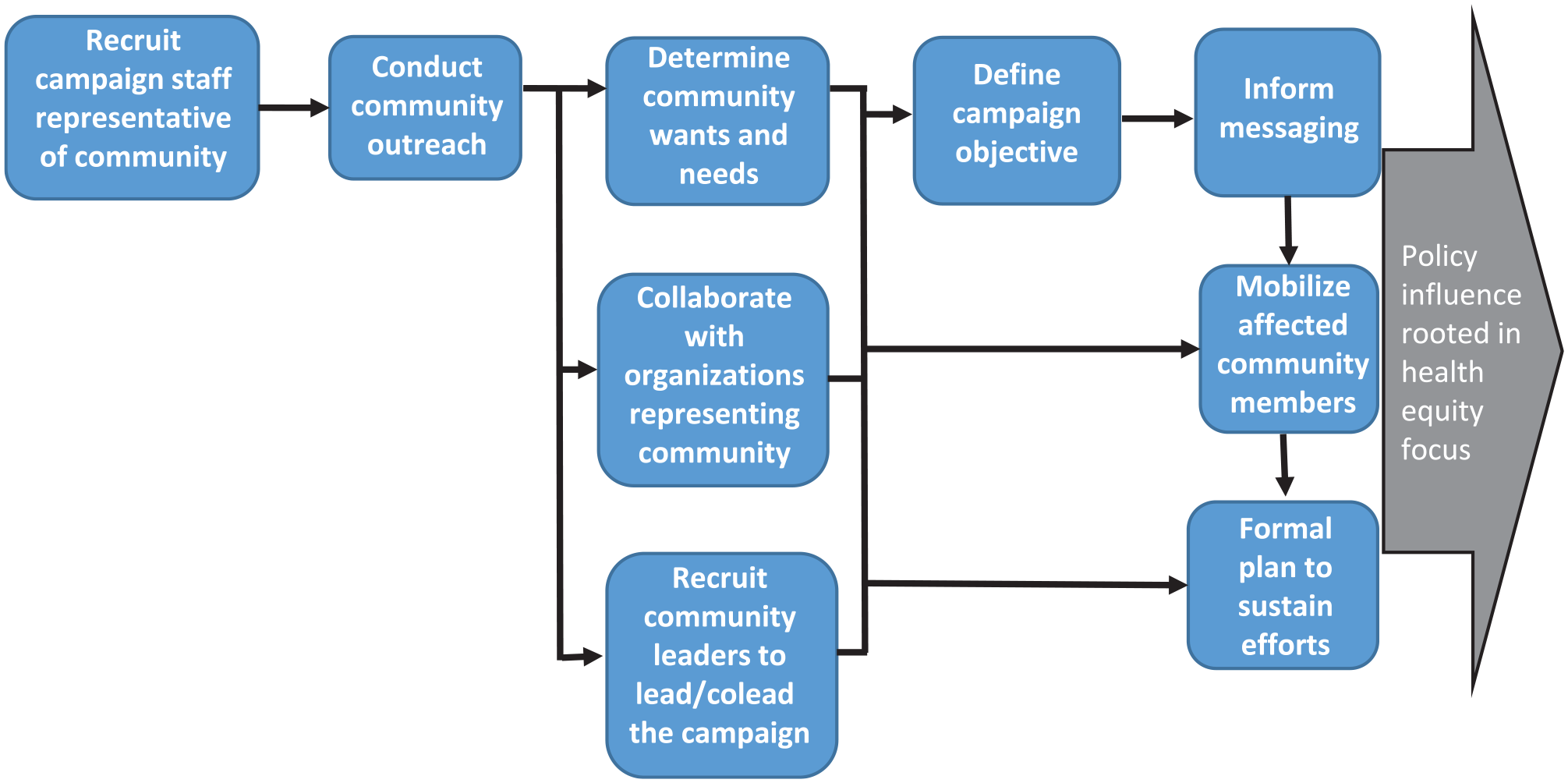
Components of an Embedded Health Equity Focus Within a Policy Advocacy Campaign
According to the interviewees, key activities and/or tangible characteristics that indicate that a policy advocacy campaign is authentically engaged with the community it is intending to benefit include that the campaign has:
Campaign personnel that are representative of the communities in which the policy change is meant to take affect
Conducted outreach with community members and identified needs and wants
Community members that are in decision-making roles and the organizational partners serve the communities that are intended to benefit from policy change
Policy objective(s) and messaging that address the community members’ wants and needs that the campaign identified
The demonstrated ability to influence community members to act on behalf of the campaign
A formalized and feasible sustainability plan for community member engagement in the policy/implementation effort after the initial campaign has ended and/or the policy has been enacted
Discussion
While similar social and economic issues drive health inequities across many disadvantaged communities (Adler et al., 2016), a policy is likely better tailored to meet needs if informed by the community intended to benefit from the policy change (Hossain, 2016; National Academies of Sciences, Engineering, and Medicine, 2017). Accordingly, interviewees brought up the concept of “authentic community engagement” as the foundation of a campaign’s health equity focus. This approach assumes that a community best understands the issues that most affect them, and thus, should lead any policy campaigns that are meant to benefit them, and ultimately promote health equity. In a recent analytic essay, authentic community engagement was highlighted as a critical component for interventions addressing health disparities (Brown et al., 2019). Brown and colleagues defined authentic community engagement as including community stakeholders as “active equal partners in designing and evaluating structural interventions and in the advocacy and policy translation processes needed to sustain and scale these efforts” (Brown et al., 2019). This definition and application aligns well with the findings of this study. Additionally, beyond being advantageous for creating responsive policies, another long-term benefit of authentic community engagement is that civic capacity and buy-in are fostered within the community (Israel et al., 2010). If executed well (and ideally funded), this approach could produce a responsive policy that is backed by an engaged and mobilized community to see the policy through implementation.
Neglecting community engagement within a policy campaign can lead to the policy being vulnerable to opposition. A recent example occurred in Cook County, Illinois (Chicago Tribune Editorial Board, 2017; El-Sayed et al., 2019; Leider et al., 2018). The Cook County Commissioners, at the urging of public health advocates, passed a sugar-sweetened beverage tax. It went into effect but faced public and industry resistance. This tax was not a ballot initiative, and community members were not involved in the identification of the problem or solution. Business stakeholders and beverage industry opponents capitalized on this lack of community cohesion and were able to reframe the dialogue/messaging and mobilize the community to pressure County Commissioners to vote to overturn the tax after 2 months in effect. In this case, public health advocates had already moved on to another campaign, leaving no one to defend the policy through implementation. Chriqui et al. (2020) provide a more detailed and nuanced explanation of this tax policy effort and the lessons learned.
The main findings of this study underscore and help translate principles of participatory action that are often included in popular power or grassroots policy campaigns. Perhaps these principles are most clearly defined in community-based participatory research (CBPR). These include recognizing the community as a unit, emphasizing local knowledge, colearning, power sharing, capacity building, embracing cultural humility, and collaboratively implementing an action (Israel et al., 1998; Israel et al., 2005; Israel et al., 2017). The model shown in Figure 1 illustrates health-equity-rooted authentic community engagement within the context of a policy campaign. Many models of a popular power or grassroots approach to public health policy change (which VFHK utilizes) include some form of community engagement (Butterfoss, & Kegler, 2002; Cacari-Stone et al., 2014; Cullerton et al., 2018; Shilton, 2006). Our model expands on the community engagement aspects of existing policy change models by delineating tangible characteristics that indicate authentic community engagement. The ultimate goal of an authentically engaged campaign is to enact responsive policies. This approach implemented at scale, through many authentically engaged campaigns, and focusing on populations with the most need, may ultimately promote health equity.
A “CBPR-esque” approach to policy advocacy has been utilized successfully among several issue areas, such as environmental justice, education policy, and systemic barriers to healthy food access (Minkler, 2010; Minkler et al., 2008). As described by Minkler et al. (2008) policy advocacy campaigns were most effective when there was “strong, autonomous” community organizations involved with a history of effective community mobilization; mutual respect, trust, and appreciation among partners; commitment to utilizing sound scientific evidence and strategically analyzing relevant policy landscape and opportunities; strong collaborations with diverse stakeholders; and planning, formally or informally, to address steps along the policy change process.
The “authentic community engagement” approach described in this study may face some external barriers. As noted in our study and others, a primary barrier related to health equity is message framing, particularly if the campaign works in an environment characterized by a neoliberal ideology and/or biomedical paradigm (Baker et al., 2018; Cullerton et al., 2016). These viewpoints emphasize self-reliance/individualism and a treatment-based orientation to health, respectively. Such environments are often hostile to ideals related to systemic oppression and a social justice orientation to health (Baker et al., 2018; Cullerton et al., 2016). Effectively framing health equity messaging to decision makers who hold such views will be difficult. Additional barriers include industry opposition and general lack of resources and policy skills among those that advocate for health equity (Chaidez-Gutierrez & Fischer, 2013; Cullerton et al., 2016). While there are barriers to engaging the community in the political process, politicians will not act if there is little apparent public interest for an issue (Cullerton et al., 2016).
This study had some limitations that should be considered when interpreting findings. For instance, important issues that might affect how a campaign implements a health equity focus were beyond the scope of these data, such as differing implementation approaches based on political climate, level of government, and/or campaign capacity and resources. Also, while understanding health equity in a campaign context was a major aspect of the overall project, it was not the sole focus of the interviews. Therefore, themes presented in this study could have benefitted from additional exploration to elucidate more detail and examples. Additionally, the generalizability of the interviewees’ perspectives may be limited given that all but one interviewee was affiliated with the VFHK initiative. Campaigns within the VFHK initiative may be dissimilar from many other campaigns due to funding and access to technical assistance and peer-learning. Their perspectives on health equity in a campaign context are shaped by this largely shared experience and/or access to similar trainings that cover this topic. Finally, the sample was not well representative of racial/ethnic groups (e.g., African American, Latinx) who are often disproportionately affected by health disparities. Also, we do not have detailed backgrounds on the interviewees (such as lived experiences, socioeconomic status, experience living/working in underserved rural/urban areas) and therefore, cannot know if interviewees might be considered “insiders” or “outsiders” with respect to the communities they worked in. One of the key findings from this work was the importance of campaigns/coalitions being representative of backgrounds and lived experiences of those that are from the areas that are meant to benefit from the policy change. It is likely that a more diverse sample of policy advocacy experts and campaign leaders may have yielded additional themes and/or opposing viewpoints.
Implications for Practice and Research
If promoting health equity is a goal, then an approach that largely incorporates bottom-up knowledge, in which communities are trusted to know the issues that affect them, is needed for policy issue identification and tailoring. Of course, scientific evidence for the potential efficacy of prospective policy solutions needs to be weighed prudently, but without authentic community engagement, it is unlikely a policy solution will be tailored to meet community need or that the community will support the policy through implementation. There are campaign characteristics that indicate whether or not a policy advocacy campaign is authentically engaged with the community, and thus, will aim to advance health equity. Some of these characteristics can be measured, allowing evaluators and researchers the opportunity to assess the degree to which a policy advocacy campaign has achieved an embedded health equity focus through authentic community engagement. A major strength of this study is that factors associated with health equity in campaign functioning are not typically assessed. However, more research is needed to understand the perspectives of policy advocacy experts who are from racial/ethnic minority backgrounds that are often disproportionately affected by health disparities and to examine the incorporation of a health equity focus into campaigns outside of the VFHK initiative. While more work is needed, these findings support identification of associated constructs to inform measurement development, and can help guide organizations, campaigns, and researchers working to advance health equity.
