



Abstract
Unintentional injury is a significant worldwide health concern. Researchers have called on several occasions for conceptual frameworks to guide work on unintentional injury. Using conceptual approaches to organize our inquiry is one way to advance our knowledge of injury etiology. To this end, we suggest a risk appraisal framework for examining enactment or avoidance of injury risk behaviors. Our framework comprises broad antecedents, focusing on the evaluative stage preceding behaviors. Four categories influencing efficacy related to injury risk behavior are included: environmental context, experience, social context, and strategy. In this article, we explain the categories and concepts in our framework, discuss each in terms of etiology, briefly discuss interrelations between the categories, and suggest future paths using the framework.
Unintentional injury is a significant health problem worldwide, resulting in approximately 3.4 million deaths annually and many more nonfatal injuries requiring medical attention (World Health Organization, 2018). In the United States, approximately 110,000 people aged 2 to 65 years died in 2018 from unintentional injuries and an estimated 20.8 million required medical attention (National Center for Injury Prevention and Control, 2018). The problem of unintentional injury has a significant financial impact as well, resulting in nearly $388 billion each year in the United States in lost wages and medical costs (National Center for Injury Prevention and Control, 2018).
Researchers have been attacking the health problem posed by unintentional injury for decades and identified many etiological factors. Some risk factors are environmental, such as traffic volume and family size (Ramsay et al., 2003; Roberts et al., 1995). Other are intrapersonal, such as sex differences, personality characteristics, cognitive development, and misperception of affordances (Barton et al., 2012; Kovesdi & Barton, 2013; Gamble & Walker, 2016; Morrongiello et al., 2000; Plumert, 1995; Schwebel, 2004). In spite of our growing knowledge, much more remains to be learned.
Making the best use of our growing knowledge of injury etiology is imperative. With existing literature, we already can arrange risk factors into “intrapersonal models” for injury risk and study such factors in conjunction with one another (e.g., Schwebel & Barton, 2005). Yet, the guidance offered by conceptual frameworks to injury has not been fully exploited. Calls for using conceptual frameworks to guide research on unintentional injury span decades (Barton & Schwebel, 2007; Peterson et al., 1987; Wallander, 1992) and, while health risk theories and models have a place in the literature (Ajzen, 1985; Janz & Becker, 1984), we suggest a need still exists (i.e., Trifiletti et al., 2005). Specifically, we perceive need for an antecedent framework focusing on why people engage in behaviors that could result in injury; or why people do not.
We are not the first to posit examination of a process immediately preceding injury risk behavior. The literature contains several examples of appraisal of risk prior to behavior. Perhaps the earliest and foundational approach was process analysis, in which a person’s appraisal of risk was noted as an etiological antecedent (Peterson et al., 1987). Other research has noted a cognitive evaluation of the risk involved in a given activity prior to engaging in behavior (e.g., risk taking on playgrounds; DiLillo et al., 1998, Little & Wyver 2010). The role of perceived control over risk as a predictor of behavior has been more widely studied in research guided by the theory of planned behavior (e.g., Barton et al., 2016; Wong & Lee, 2016). Self-efficacy also has a place in health literature noted as driving force immediately preceding behavior (Bandura, 1977) and creating a sense of competence related to risk behavior (i.e., health belief model; Gielen & Sleet, 2003). In short, the literature suggests an evaluative phase preceding enactment or avoidance of injury risk behavior but has not delineated the nature of such evaluation. We now turn to a framework describing this evaluative phase.
A Risk Appraisal Framework for Injury Etiology
We suggest a risk appraisal framework to describe the phase preceding injury risk behaviors. Our framework is based on four simple key principles. First, person appraises whether they can manage the risk involved in enacting a given injury risk behavior. Second, the person bases their appraisal on factors in four categories: environmental context, personal experience, social context, and strategy for risk mitigation. Third, appraisal is spontaneous and ubiquitous but may not always be accurate (e.g., in young children or those with little experience with a behavior). Fourth, appraisal leads to a sense of efficacy concerning the risk behavior, which results in enactment or avoidance (see Figure 1). Efficacy concerning risk behavior, in our conceptualization, represents the final motivating force pulling a person past the threshold of behavioral enactment, or preventing them from doing so.
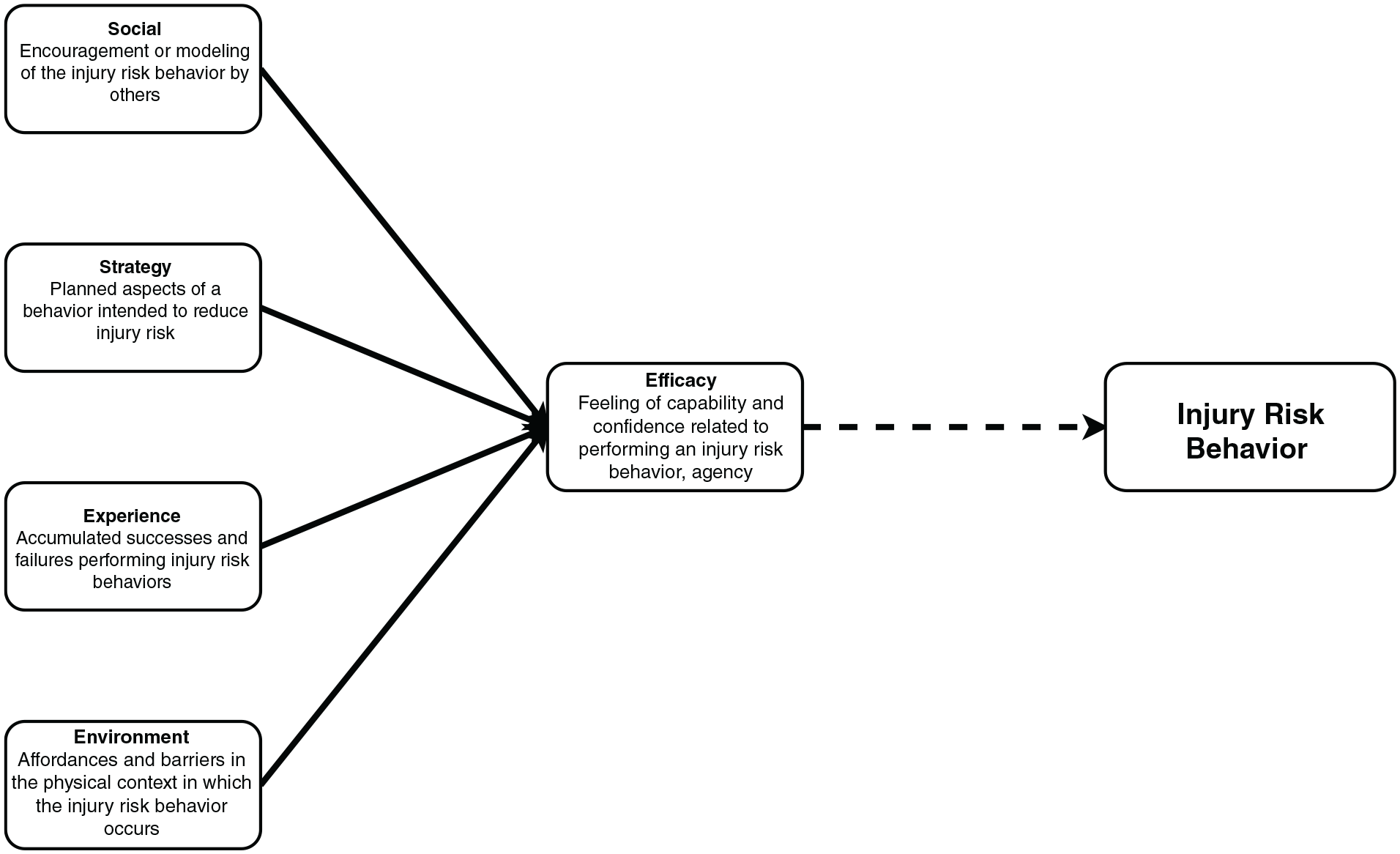
Risk Appraisal Framework
The concepts involved in our framework are not radical. We are also not the first to posit the role of efficacy in health behavior (Bandura, 1977; Gielen & Sleet, 2003). However, an efficacy-based approach to injury risk behavior has not been proposed. We suggest the risk appraisal framework primarily to provide a simple, unifying structure under which we can organize existing knowledge and describe the process preceding unintentional injury risk behavior. Our framework is intended for application across the lifespan to any unintentional injury risk behavior and not to self-harm or aggression. We also believe our framework may enhance injury prevention efforts.
We have several objectives in the following sections. We will first discuss each category in the risk appraisal framework and briefly discuss each in terms of etiology. Second, we will discuss interrelations between categories. Finally, we will offer examples of how factors in each category are operationalized and suggest paths for using the framework in prevention efforts.
Efficacy
We begin with efficacy, the component preceding injury risk behavior in our framework. In general, efficacy comprises a sense of competence and causal effectiveness (Gecas, 1989). Efficacy is widely established in relation to various health risk behaviors (Schwarzer & Fuchs, 1995). Typically, in health research efficacy is examined as a predictor of health improvement behavior, for example, condom use (Basen-Engquist, 1992) or dietary habits (Shannon et al., 1990). However, efficacy also has been linked to enactment of health risk behaviors, for example, onset of smoking (De Vries et al., 1995).
Efficacy, in our use of the concept, is a sense of capability or agency regarding the injury risk behavior (e.g., Ajzen, 2002) or a sense of control over the danger involved in a situation (e.g., Bandura, 1994). Efficacy here is related to the evaluation of doing the behavior rather than attribution and responsibility for consequences (Rotter, 1966). Put simply, our concept of efficacy is a person’s sense of capability of enacting and completing the injury risk behavior without being hurt. The greater the sense of efficacy, the more likely a person will enact the behavior. In Figure 1, the path from efficacy to behavior is a broken line to indicate the appraisal process may or may not lead to enactment. If the behavior is enacted, the likelihood of injury increases to the degree perceived efficacy exceeds actual capability. In other words, “acting on gross misjudgments of what one can do may be costly to one’s psyche, cash flow, and fragile body” (Bandura, 1997, p. 61).
We see the etiological role of efficacy as one of misperception of capability. Sense of efficacy may lead one to overestimate or underestimate one’s capability. For example, individuals may misperceive capability for a given behavior, for example, teen drivers’ tendency to overestimate their driving skill and perceive other new drivers to be at risk but not themselves (Deery, 1999). Another example of misperception of capability has been demonstrated in laboratory work on errors in judgment of affordances (Plumert, 1995). Capability may also be misperceived during an injury event, such as ability to maintain control over the direction one’s vehicle is traveling during a crash. Second, efficacy can be involved in avoiding injury due to feeling less capable, such as through use of compensatory practices (e.g., avoiding driving at night; Stalvey & Owsley, 2000). Examples here are drawn from the driving literature but may easily be derived for other types of injury risk behaviors and for behaviors dependent on developmental ability. Essentially, efficacy in our framework comprises a sense of capability that, when mismatched with the world around us, can lead to enacting a risky behavior or even taking safety precautions.
Environmental Context
Environmental context, or the physical surroundings with which people interact, is our first risk appraisal category to consider in terms of influence on efficacy. Environmental contexts afford or block injury risk behavior (e.g., Barton & Schwebel, 2007; Gibson, 2014) and include the myriad possibilities of energy transfer to the body resulting in unintentional injuries themselves. In terms of etiology, environmental context can encourage or discourage risk behavior. For example, long straight sections of roadway invite drivers to speed, but curved sections result in decreases in speed (Martens et al., 1997; Szplett & Betzier, 1999). We suggest environmental context increases the sense of efficacy by offering opportunities to engage in a behavior seemingly within one’s capability or in contrast decreases sense of efficacy by offering cues not supportive of the behavior.
Experience
In our framework, experience is the accumulation of successes and failures performing a given injury risk behavior. Success and failure here are similar to consequences in other work in the sense that they represent positive or negative outcomes associated with injury risk behavior (Peterson et al., 1987). Success is performing the behavior and not being injured, while failure involves being injured. Additionally, one may narrowly escape injury. For example, crossing a busy street without being struck by a vehicle is a success; being struck is a failure. Nearly being struck could be a success or failure depending on whether the outcome was unwelcome (i.e., the thrill of the risk). Put differently, if a person attempts a risk behavior for the thrill of narrowly avoiding injury and does not get injured, the outcome was welcome and was a success. On the other hand, attempting a risk behavior and narrowly avoiding injury (e.g., nearly being struck by a car) would be an unwelcome outcome and thus a failure.
The cumulative nature of experience provides a foundation for injury risk behavior. A preponderance of positive outcomes will increase probability of engaging in the risk behavior in the future. Accumulated successes with a behavior may also lead to faulty estimation of risk or overconfidence in one’s ability (Puchades et al., 2018). However, lack of experience may be equally dangerous and also lead to misperception of ability (Deery, 1999). Overall, successful completion of a risk behavior should lead to a greater sense of efficacy, regardless of whether the sense of efficacy is in line with reality.
Experience also need not accumulate over a lengthy amount of time. A person may perform an injury risk behavior once and experience an injury. On the other hand, a person may perform a behavior many times across different environmental contexts before being injured (or never be injured at all). For example, a bicycle rider without a helmet may ride many times taking different routes and interacting with various traffic and road characteristics before being injured (cumulative, many successes but one failure) or may be injured the first time they ride without a helmet (immediate failure).
Social Context
The concept of social context rests on the familiar foundation of social learning principles. Specifically, social context comprises encouragement or modeling of injury risk behaviors by others. However, the presence of others may not be required in order for the social component to increase or decrease efficacy. Referencing previously modeled behavior may be sufficient. Thus, we could extend social context to include social norms, family context, peer influences, protection provided by others if an injury were to occur, and safety culture.
Understanding the relation of social context to sense of efficacy can enhance etiological and prevention research. Specifically, both areas can benefit from focusing on the roles of social pressure and modeling in encouraging or discouraging injury risk behavior. For example, one recent study in the child pedestrian literature suggested targeting perception of peer social norms as a method of injury prevention (Morrogiello et al., 2019). Among adults, workplace safety culture can increase or decrease risk (Antonsen, 2017). Supervisors and coworkers serve as strong models and the influences of these types of modeling significantly predict risk taking (Westaby & Lowe, 2005). Still other risk behaviors such as driving while intoxicated (Meesmann et al., 2015) or speeding (Conner et al., 2007) also are influenced by social norms. For younger individuals, the family context also exerts considerable force on enacting and preventing injury risk behaviors (e.g., Morrongiello et al., 2006; Schwebel, 2019). In short, social forces are part of the milieu in which injury risk behaviors occur and already have a place in the literature. Important for etiology, modeling or encouragement of risk behaviors may increase sense of efficacy leading to injury risk behavior.
Strategy
Strategy in our framework is a volitional effort to mitigate injury risk and can be generated spontaneously or learned and polished through experience. We might also think of strategy use as “testing the water” in order to gauge level of risk. For example, testing an apparently slick surface with one’s foot to gauge the amount of traction offered before walking could be generative. In another example, a welder wearing gloves and eye protection is using learned strategy. The risk of eye damage while welding without protection is widely understood and one would rarely attempt such a dangerous activity without protective equipment. In still another example, a parent storing a firearm in a locked case is using a strategy not for themselves but for their child, for whom access to a firearm is part of environmental context. We also perceive some intersection of our concept of strategy with risk homeostasis (Wilde, 1998) in that protective factors are associated with willingness to engage in risky behavior (e.g., eye protection for the welder or a helmet for the football player).
Conceptualizing strategy as we have here is apparently unique among approaches to unintentional injury risk behavior. We view the role of strategy in injury etiology in at least two ways. First, failure to generate and apply strategy increases injury risk. Failure to apply strategy would result from lack of experience or developmental inability. Pedestrians, for example, constantly engage in strategies when crossing roadways, such as looking both ways and selecting gaps. The goal is always to mitigate risk; to make the street crossing a success and never a failure. However, a young child is not developmentally prepared to handle the perceptual demands of a busy street environment (Barton, 2006). Young children therefore often fail to apply necessary street crossing strategies because they lack the experience with the task and are developmentally unprepared to generate strategies on their own.
Second, and more important, possession of a strategy to reduce injury risk should increase sense of efficacy and increase the probability of engaging in the risk behavior. Consider again a parent choosing a storage method for firearms. Many parents choose storage methods they think restrict access (e.g., on a high shelf) because they underestimate their child’s ability to access and operate the firearm (Barton & Kologi, 2015). In such instances, having a basic strategy to prevent access (high shelf) can lead to higher sense of efficacy and thus to selecting a less secure storage method. In other words, if we think of keeping a firearm in the home as an injury risk behavior, the parent feels more capable of enacting the behavior successfully because of their chosen strategy for preventing access to the firearm.
Interrelations between Categories
We offer three ad hoc examples based on unintentional injury scenarios to illustrate how components in the model may work independently or in combination (see Table 1). Our first example is a common injury risk behavior among children on playgrounds: jumping from a moving swing (Boyce et al., 1984; Lillis & Jaffe, 1997). The swings on the playground (environment) provide an opportunity to do something thrilling. We may also include the presence of shock absorbing material on the ground, such as gravel or rubber mats, in the environmental context. If the child has jumped from swings on previous occasions and not been injured, an accumulation of successes is at work (experience). The child observes other children successfully jumping from swings (social context) and determines jumping from a swing without injury in this context is possible. The child further deduces they might use a landing technique to dissipate their forward momentum on contact with the ground (e.g., landing with a running motion; strategy). In this example, we see an environment supporting the risk behavior, previous success, social modeling, and finally a risk mitigation strategy combined to increase a sense the behavior can be completed without injury (efficacy).
Interrelations between Categories Increasing Efficacy
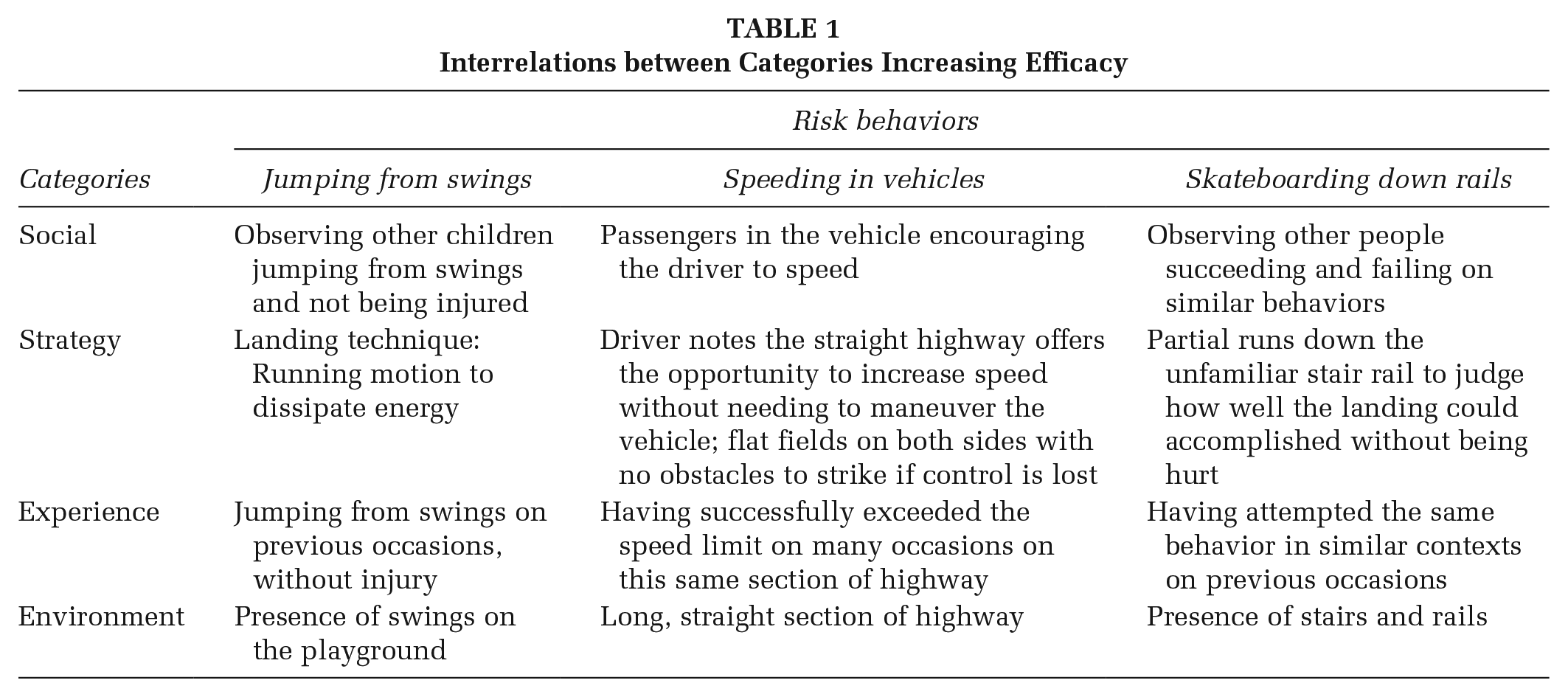
Speeding in a motor vehicle provides a second example. Drivers exceed the speed limit for various reasons, but we offer one scenario based on anecdotal evidence from the first author’s interaction with a young male driver. The driver encountered a long, straight section of highway on which he has successfully exceeded the speed limit on many occasions (experience + environmental context). The driver noted the straight highway offers the opportunity to increase speed without needing to maneuver the vehicle and has flat fields on both sides, and thus no obstacles to strike if control is lost (environmental context + strategy). Passengers were in the vehicle and encouraged the driver to speed on this section of highway (social context). The driver decided to exceed the speed limit in this instance by 20 mph. Here we see environmental context at work in more than one way, experience, strategy, and social context influencing the sense of capability to speed without crashing (efficacy).
As a final example, we offer anecdotal information collected during a conversation between the first author and a 19-year-old male about skateboarding and snowboarding. The man reported sliding down a stair rail on a skateboard, saying: “I worked up to it and did some practice runs. You might land weird and break something. I’ve seen videos of people breaking wrists.” In this first behavior, we see the stairs offering an opportunity to slide down a rail (environmental context). We also see social context in the form of observations of other people succeeding and failing on similar behaviors. We also have an example of a generative strategy. Partial runs down the unfamiliar stair rail allowed a sense of how well the landing could accomplished without being hurt. The strategy was generated in-the-moment rather than from training, although one could argue experience increased the chance such a method would be used. The person in question avoided a similar behavior while snowboarding because they could not test the landing, saying: “It could go either way, but sometimes you land weird. I’ve done it before. You get super confident and that’s when you get hurt.”
Integrating Existing Etiological Factors
Existing knowledge gained from work on identifying and examining predictors can be integrated into the risk appraisal framework. Primarily, we see potential for integrating individual differences related to injury risk into the risk appraisal framework. Temperamental control offers a simple example. Impulsive individuals, by nature, engage in behavior without reflection or consideration of consequences. Among very impulsive people, we are likely to see a disrupted evaluative process, resulting in a sense of efficacy concerning risk behavior that is out of line with reality. Sensation seeking, or the tendency to seek out novel and intense activities, also seems readily embedded in experience. Sensation seeking is, after all, aimed at experiences taking place with the potential for danger but with the intention that they be successes. The thrill of being able to successfully complete a known risky behavior could also pervade the strategic and social categories.
Developmental influences are collectively another example. Our framework is intended for application to any unintentional injury risk behavior across the lifespan, but every category in the risk appraisal framework is open to the influence of human development. Physical development affects the opportunities one has for interacting with environmental context. Experience develops with age. Cognitive development will help with learning and generating strategies for risk mitigation. Social development tempers the influences of modeling and encouragement of risk behaviors. Indeed, the role of risk appraisal in producing injury risk behavior will, like other perspectives (Barton & Schwebel, 2007; Bronfenbrenner, 1977), need to be understood in developmental context.
Injury Prevention
Although our focus has been on etiology, the risk appraisal framework has potential for injury prevention, and we offer some ideas in a broad sense beginning with efficacy. We see at least two ways efficacy can be involved in injury prevention. The first is reducing disparity between actual and perceived capability; for example, helping a driver understand physical forces during a crash exceed their ability for control. We may also restrict behaviors for which people are not prepared for a behavior (e.g., graduated licensing). The two approaches here, reduction of disparity and restriction of behavioral options, may be applied to other injury risk behaviors such as children’s pedestrian behaviors and operating off-highway vehicles, respectively. Each are examples of inherently risky activities potentially amendable to interventions guided by efficacy in the risk appraisal framework.
Environmental context is already ubiquitous in research on unintentional injury etiology. Many examples exist, such as lack of barriers to prevent engagement in risk behavior (e.g., gates to prevent child access to swimming pools) or product design allowing greater transfer of energy to tissue during an injury event. Environmental context for injury prevention is essentially the opposite. Removal of risk factors, installation of barriers, or reduction of energy transfer during an event through design of a product (e.g., energy absorbent bumpers on cars; Frederick & Schuster, 2003) are examples of altering environmental context for prevention of injury.
The literature offers examples of how experience can be harnessed for injury prevention. Child pedestrian safety is one area in which experience-based interventions have been applied. Interventions typically involve giving children opportunities to apply their street crossing skills over several trials either in real (Barton & Schwebel, 2007) or virtual environments (Schwebel & McClure, 2014). Such efforts afford a short accumulation period for successes with a risk behavior or learning from feedback after failures. By extension, training for behaviors involving injury risk can involve accumulating successes and failures with opportunities for feedback. Driver training and graduated licensing (Williams et al., 2016) are examples. Driving is inherently risky and allowing drivers to learn through a haphazard process of successes and failures would be unwise. Instead, from the beginning we want success to far outweigh failure.
The role of strategy in injury prevention centers on supporting learned and generative methods. Inherently risky activities often are associated with special training to mitigate risk. For example, firearm safety training for children (Miltenberger, 2008). For adults using firearms for sporting purposes, the common strategy in training includes four safety rules: always keep your finger off the trigger, always treat a gun as if loaded, always point the gun in a safe direction, and always know your target and what is beyond. The four rules function as a safety strategy of mutually beneficial rules; a strategy dependent on training, human development, and cognition.
However, some situations will require either generative strategy or awareness of when to use a learned strategy. In such cases developing a cautious mindset through awareness of risk factors and personal exposure to risk may be enough to enhancing safety. One example of increasing awareness of risk factors is developing hazard awareness in adolescent drivers (Horswill, 2016). The effectiveness of developing awareness and perceived exposure to health risks also are demonstrated through behavior change theories such as protection motivation theory (Floyd et al., 2000). Work remains to be done demonstrating the role of generative strategies in prevention of specific injuries.
Overall, injury prevention guided by the risk appraisal framework will include familiar ideas. Namely, restricting opportunities for risky behavior, increasing actual capabilities, and bringing inflated efficacy in line with actual capabilities. If we can manipulate the components influencing efficacy, then we can devise interventions to calibrate perceived efficacy to actual risk levels.
We offer several recommendations for injury prevention for scientific and practical communities based on our framework. Our recommendations, some of which are mentioned above, are by no means comprehensive. Practitioners, many of whom have limited time, may target the environmental and social aspects of injury prevention. For example, advocating for environmental contextual changes (barriers, design changes to reduce energy transfer) and counseling caregivers about risks. Researchers perhaps have more freedom to explore the implications of our framework for prevention. Examining the impact of reducing disparity between actual and perceived capability of completing risky behaviors, the roles of social factors, and the more complex nature of strategy are some examples. Researchers also may view existing etiological knowledge through the lens of our framework and expand on what we offer here.
Summary
The literature already shows injury etiology comprises a confluence of risk factors. In spite of what has been uncovered, much remains to be learned about injury etiology. One way of learning more is by allowing our inquiry to be guided by models, theories, and frameworks. Approaches created for health research have already allowed us to see injury etiology in new ways, but the need for structure describing injury etiology remains. We suggest the risk appraisal framework as a readily applicable conceptual tool for new inroads into the understanding of injury etiology and prevention.
