



Abstract
Assault-injured youth have an increased risk of future violence. Identifying firearm access among youth in the emergency department (ED) creates an opportunity for interventions aimed at reducing future violent events. We performed this study to determine the extent to which children with assault-related injuries are screened for access to firearms in the ED. We performed a retrospective chart review of all medical records from adolescent ED visits to an academic, tertiary care pediatric hospital in Washington DC with ICD-10 codes related to assault in a 3-month period. We found that among 252 assault-related encounters, none had any documentation of firearm access in the provider note, social work note, or psychiatry consultant note. Therefore, we concluded that firearm access screening is rarely documented in ED visits among patients who present for an assault, highlighting an important missed opportunity for firearm access screening among this high-risk group.
Assault-injured youth have a 40% higher risk of future violence, both as victims and as perpetrators. They also have a much higher rate of firearm possession, as well as firearm-related aggression and victimization (Carter et al., 2013; Carter et al., 2015; Cunningham et al., 2015). Many violently injured adolescents endorse access to a firearm and many of these adolescents who report access go on to engage in an aggressive act with a firearm (Carter et al., 2015). Screening high-risk youth presenting to the emergency department (ED) with a complaint related to assault for firearm access creates an opportunity for interventions aimed at reducing future violent events. Furthermore, routine firearm access screening is recommended by both the American Academy of Pediatrics and the American College of Emergency Physicians. The objective of this study was to measure the extent to which patients presenting to the pediatric ED with assault-related injuries undergo documented screening for firearm access.
Method
This was a retrospective cross-sectional study of ED visits to an academic tertiary care pediatric hospital in Washington, DC with 90,000 annual visits and to a community affiliate with an additional 30,000 annual visits. Between the two sites, about 2,000 visits are assault-related annually. Institutional Review Board approval was obtained. All visits with ICD-10 codes related to assault (X92-99, Y00-09, Table 1) among patients 12 to 24 years old between September 1, 2018 and December 31, 2018 were included. Provider notes from each encounter were reviewed by a single reviewer to identify whether firearm access was documented in the electronic health record. The reviewer read the provider note in search of the terms “firearm,” “gun,” or “lethal means.” At the time of this study, there was no tool in the electronic medical record to prompt firearm access screening. All available social work documentation and psychiatry consultant notes related to the visit were also reviewed for the same key words, should the provider have consulted social work or psychiatry.
ICD-10 Codes Included in the Study
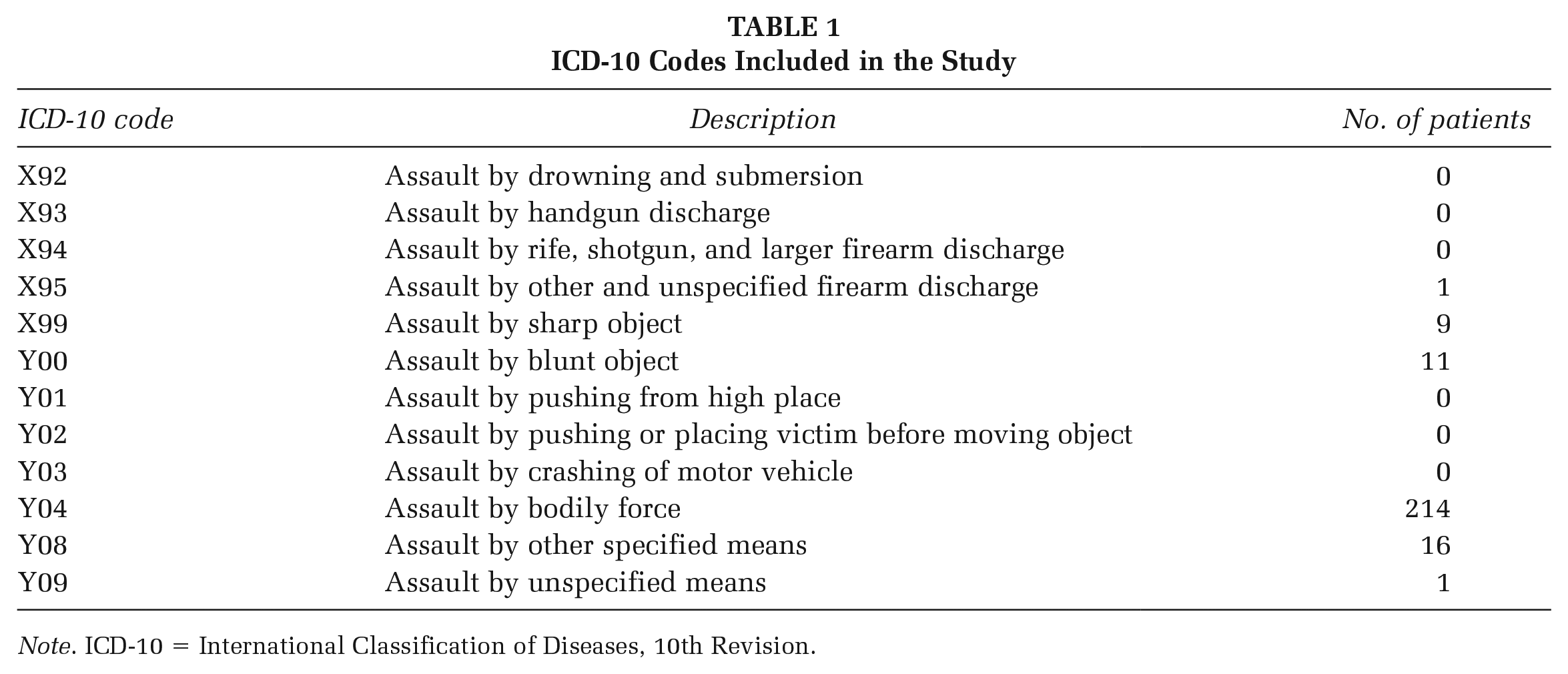
Note. ICD-10 = International Classification of Diseases, 10th Revision.
Results
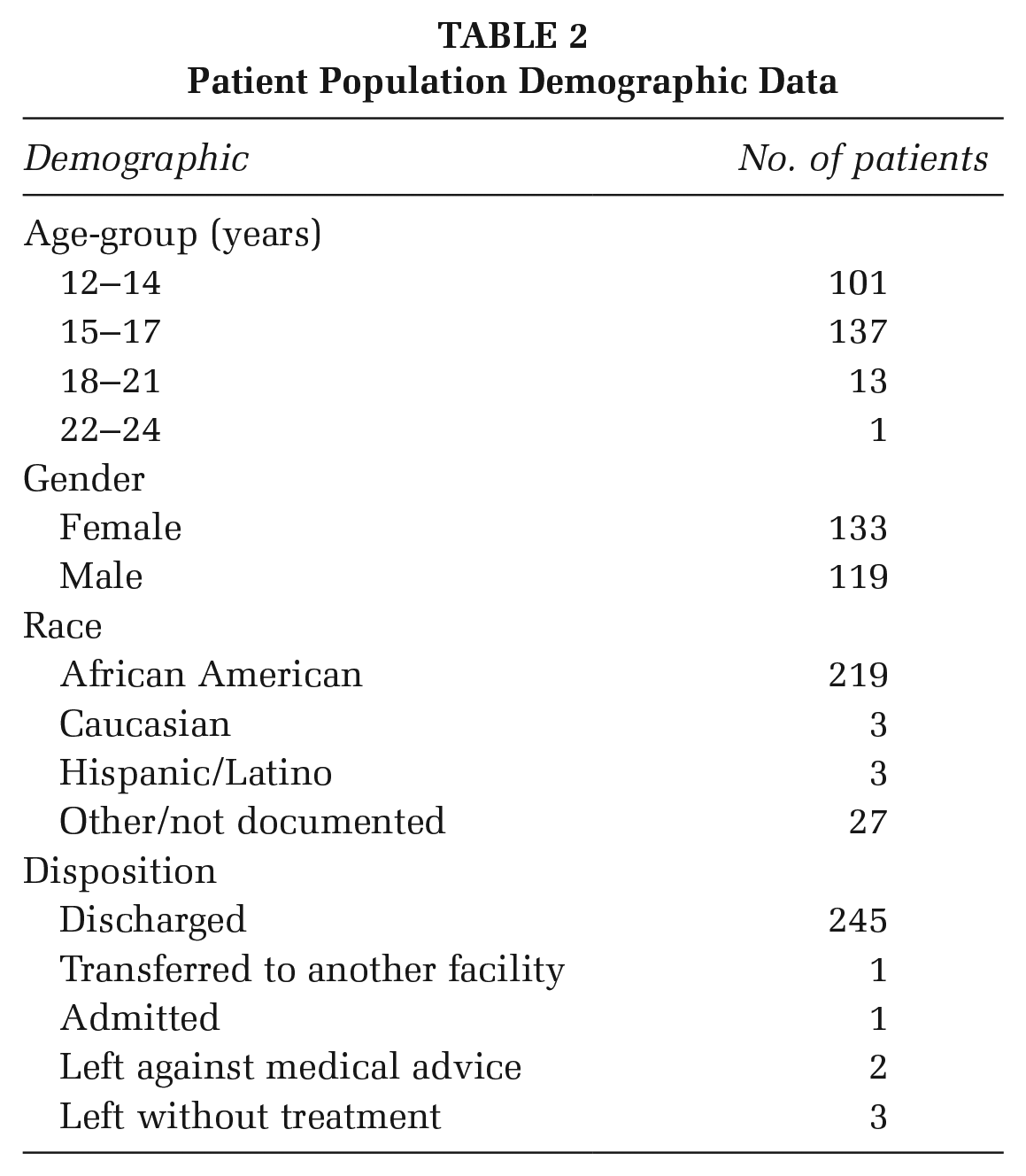
There were 262 assault-related encounters, of which 10 were excluded due to chart duplication or lack of any provider documentation. The mean (±SD) age of the study population was 15.59 (±1.88) years (Table 2). 85.7% were identified as non-Hispanic African American or Black race/ethnicity. A total of 133 (53%) were assigned female at birth and 119 (47%) were assigned male. Ninety-seven percent of patients were discharged home following treatment. Twenty-eight encounters had a documented psychiatric consult and 17 had a documented social work consult. None of the 252 (95% CI [0%, 1.2%]) had any documentation of firearm access in the provider note, social work note, or psychiatry consultant note.
Patient Population Demographic Data
Discussion
In our review of assault-related ED visits over a 3-month period, no encounters had documentation of firearm access by the provider, social worker, or psychiatric consultant. To our knowledge, no similar studies regarding the frequency of firearm access documentation have been reported. However, this is consistent with data relating to suicidal patients who, like assault-injured victims, are at high risk for future lethal injury. Among this adult population, firearm screening is documented in the provider note only 15% of the time (Betz et al., 2018).
In 2019, there were 166 homicides in the District of Columbia and 1,575 assaults with a violent weapon. Many of the victims were minors (Metropolitan Police Department, 2020). Nationally in 2018, there were 7,732 firearm-related deaths among children and adolescents (Centers for Disease Control and Prevention, 2020). Firearm-related homicide is the leading cause of death among African American males ages 15 to 24, the largest population represented in our study (Centers for Disease Control and Prevention, 2020). Barriers to firearm screening include lack of training, time constraints, and concern for personal safety (Damari et al., 2018., Fein et al., 2000). Additionally, in the busy ED setting, many providers may assume that other members of the care team, including a social worker or consultant, may screen patients for firearm access. Importantly, our study showed that despite multiple consultants being involved with a patient, firearm access was still not documented.
The ED provides an opportunity to screen and provide counseling for restricting firearm access and promoting firearm safety, which has shown to be effective in improving firearm behaviors and potentially preventing future firearm violence (Roszko et al., 2016). Next steps at our institution include initiating an electronic medical record–based tool to prompt the provider to screen for firearm access.
There are many significant limitations to this study. First and foremost, this was a retrospective study using medical records. It is possible that providers are screening patients for firearm access and not documenting appropriately. However, given that there were zero encounters with firearm access documentation, we believe it is more likely that our patients are being underscreened, and there are missed opportunities for preventing future firearm violence. Additionally, inclusion criteria were based on ICD-10 charges, so it is possible that a patient following an assault may have had a different primary diagnosis, inappropriately excluding them from our study.
Conclusion
Despite firearm access screening and safety counseling recommendations from the American Academy of Pediatrics and the American College of Emergency Physicians, screening is rarely documented in the pediatric ED during visits for an assault related complaint who are inherently at an increased risk of firearm violence.
