



Abstract
In response to disproportionately high rates of infant mortality and preterm birth among women of color and women in poverty in Fresno County, California, community and academic partners coordinated a community-based participatory research (CBPR) project with local residents. Social isolation and stress, inaccessible prenatal care, and dissatisfaction with care experiences were identified as leading predictors of poor birth outcomes. The PRECEDE-PROCEED framework was used to lead the CBPR effort that resulted in the development of a model of group prenatal care, named Glow! Group Prenatal Care Program (Glow! Program). Group prenatal care (GPNC), which focuses on pregnancy health assessments, education, and peer support, has the potential to address the health and social priorities of women during pregnancy. As a result of the employed CBPR process and the extensive participation from stakeholders, this modified GPNC model responds to the unique needs of the at-risk community members, the agencies aiming to improve maternal-child health experiences and outcomes, and the prenatal care providers offering it to their patients. The methods from this study can be applied in the design and implementation of community-based health care interventions. Returning to community partners throughout the design, implementation, and evaluation phases underscored that health care interventions cannot be designed in silos, and require flexibility to respond to factors that promote improved maternal and infant outcomes, which affect the end goal for the intervention.
Keywords
Background
In 2015, a robust community effort began in Fresno County to address elevated and disparate preterm birth rates. County-level preterm birth rates were 10.3% in 2015, with African American rates at 14.6%, down from 17% in 2011 (Fresno County Department of Public Health, 2015). The community efforts began with the “African American Infant Mortality Report” (AAIM), which indicated that the preterm birth was the precursor to infant mortality in Fresno County. Affecting roughly 10% of all U.S. deliveries, with low-income and Black women bearing the highest burden, preterm birth is a persistent issue across the country (National Center for Health Statistics, 2019). Fresno County has one of California’s highest rates of infants born prematurely (National Center for Health Statistics, 2019). Furthermore, in Fresno County, over 70% of women utilize Medicaid for prenatal care, compared with 50% at the state level (California Department of Public Health, 2018). Disparities in socioeconomic and racial/ethnic preterm birth rates/outcomes are well established and persist in Fresno County and are highlighted in Table 1 (Blumenshine et al., 2010; Culhane & Goldenberg, 2011; Lu & Halfon, 2003; National Center for Health Statistics, 2019).
Comparison of Preterm by Race/Ethnicity in Fresno County and California: 2015–2017 Average

The AAIM report recommended that a group prenatal care model be implemented to address these disparities (Lessard & Bengiamin, 2015). This article highlights the CBPR process utilized in the development, implementation, and feasibility assessment of the Glow! Program, a group prenatal care model that intentionally addresses social determinants of health. This process may be helpful when applied broadly to the design of community-based interventions meant to address health disparities and as such, this article makes a unique contribution to the existing literature. The implementation feasibility of this model, referred to as the “Glow! Feasibility Study,” was funded by the UCSF California Preterm Birth Initiative. The process reported here did not produce outcome data on participants but informed the development of a large-scale randomized comparative evaluation of the effectiveness of the Glow! Program in improving birth outcomes that is ongoing.
Literature Review
In the United States, prenatal care is typically provided by obstetricians or certified nurse midwives who offer one-on-one care to expectant mothers, optimally starting in the first trimester. In contrast, group prenatal care (GPNC) replaces most individual prenatal care appointments with a group context of 8 to 12 expectant women with similar due dates. In the group setting, the provider and a trained facilitator co-lead a session that includes pregnancy health assessments and education on relevant topics, both standard components of individual prenatal care, and peer support. This promising strategy addresses the priorities of women who may be experiencing complex health and social concerns during their pregnancy (“ACOG Committee opinion no. 731: Group prenatal care,” 2018; Brown et al., 2014; Chen et al., 2017).
However, the literature on the effectiveness of GPNC models in preventing preterm birth has not produced unequivocal findings, with a lack of randomization and small sample sizes limiting outcome data. Several recent studies indicated that GPNC may reduce the risk of preterm delivery, small for gestational age and/or low birth weight newborns (Crockett, et al 2017; Crockett et al., 2019; Cunningham et al., 2019; Gareau et al., 2016; Tubay et al., 2019). Several meta-analyses have also been conducted and summarize the mixed results in the field with preterm birthrate not being significantly different for group care compared with individual care (Carter et al., 2016). Subanalyses have shown promising findings for women at high risk of poor birth outcomes, including Black women, pointing toward the need of evaluating birth outcomes among high-risk populations as primary outcomes (Carter et al., 2016; Catling et al., 2015).
Investigators continue to call for further research to identify possible mechanisms by which GPNC improves maternal and child health outcomes (Byerley & Haas, 2017; Carter et al., 2016; Catling et al., 2015; Mazzoni & Carter, 2017; Novick et al., 2012; Sheeder et al., 2010; Trudnak et al., 2013). Drawing from the AAIM report recommendation to implement GPNC, the Fresno County Preterm Birth Initiative (PTBi), a newly formed cross-sector coalition of health care, social service, and other community partners, prioritized the scale-up of this promising intervention as part of a common agenda to reduce population-level preterm birth rates and close the gap on racial and ethnic disparities (Smith et al., 2018). It was determined that based on the variability of results surrounding GPNC, particularly among low-resource patient populations and communities of color, that additional design and evaluation was needed for a GPNC model to be implemented locally and that incorporating community based participatory research methods was critical. Involving community members and stakeholders creates buy-in and builds capacity, key to creating a sense of ownership of the intervention (Kwon et al., 2017).
Method
Community-Based Participatory Research and Proceed-Precede Framework
To ensure the priorities of the community were addressed in the design of the Glow! Program and in the methodology for the Glow! Feasibility Study, an ongoing CBPR approach was utilized. The process was guided by the first six phases of the PRECEDE-PROCEED framework (Center for Community Health and Development, 2017). PRECEDE (“Predisposing, Reinforcing, and Enabling Constructs in Educational/Environmental Diagnosis and Evaluation”) is the participatory process of developing an intervention. After the design of the intervention the framework then PROCEEDs (“Policy, Regulatory, and Organizational Constructs in Educational and Environmental Development”) to evaluation (Green & Kreuter, 1992). The CBPR process involved in the design and implementation of the GPNC intervention occurred through four separate processes described below.
Component A: Background Work
This CBPR process began during the work to investigate an increase in African American infant mortality. The AAIM report investigated women’s experiences during pregnancy and contributed to the design of the future components of the CBPR process and intervention (Lessard & Bengiamin, 2015). It included two focus group discussions, with 26 participants in total, to engage Black women of childbearing age living in Fresno County’s most distressed neighborhoods in a dialogue about the social determinants of reproductive and infant health. These conversations were continued in interviews with nine representatives from social service and clinical agencies over a year. Finally, a large community meeting was coordinated to share findings, gain consensus on recommendations, and continue to build community-researcher rapport.
Together with health system leaders, the PTBi Care and Support During Pregnancy Workgroup reviewed the existing evidence surrounding GPNC and brainstormed ways to enhance the model to facilitate its ability to address other important factors that may contribute to improved pregnancy outcomes such as food insecurity and behavioral health. Mothers with lived experience of preterm birth actively participated in the Workgroup to focus on what the intervention could do to improve care and support, particularly for low-income pregnant women. This Workgroup also discussed how a GPNC model could be integrated into the existing local prenatal care delivery landscape.
Component B: Exploration Phase
An Exploratory Component was launched to define the needs of a GPNC program and to determine the acceptability of research with pregnant women prior to the launch. The Exploratory Component included formally creating a stakeholder advisory group, consisting of academics, women with lived preterm birth experience, women with GPNC experience in past pregnancies, prenatal care providers, Women, Infant, Children (WIC) leadership, managed care payers, Department of Public and Behavioral Health staff, March of Dimes, PTBi Care and Support of Pregnant Women Workgroup representatives, and PTBi staff. This group aided in the identification of GPNC model components that would address factors contributing to stress during pregnancy (a cause of preterm birth) (Cole-Lewis et al., 2014), refining the research design, and synthesizing themes from focus groups.
This advisory group continued to meet quarterly throughout the project. A total of five focus groups, involving 49 participants that had recent previous pregnancies, were held during the Exploratory Component. Each focus group addressed one of the following topics: pregnancy-related learning needs and curriculum, marketing of GPNC, support and core components of a GPNC model (e.g., resources to be made available, session flow), recruitment and informed consent process. To ensure all audiences were represented, one focus group was Spanish language and one was exclusive to Black women. All focus group participants were compensated for their time.
Component C: Mid-Study Focus and Advisory Groups
One year into the Glow! Feasibility Study, four focus groups were conducted with 31 women who were either participating in or had previously participated in the Glow! Program. The first three focus groups were asked to review and evaluate the Glow! Program. Recognizing that experiences and perspectives differ, each of the three focus groups consisted of a different audience: Black women, women who opted for the Spanish language group care sessions, and women who had experienced routine prenatal care in past pregnancies. The fourth focus group was open to all current and prior Glow! Program participants and addressed curriculum enhancements. All focus group participants were compensated for their time. The results were shared with the advisory group who aided in incorporating the suggested changes into the Glow! Program.
Component D: In-Depth Interviews With Participants and Providers
In addition to focus groups, we conducted in-depth qualitative interviews throughout the Feasibility study with six Glow! Program participants, four stakeholder advisory group members, four prenatal care providers, and three medical office staff. These interviews were conducted periodically to respond to concerns, feedback, or changes in the prenatal care landscape. Health care providers and office staff represented an important community perspective throughout the CBPR process, specifically related to the sustainability of implementation. Topics included Glow! Program model adaptation, additional logistical barriers that needed to be addressed, maternal stress and mental health, and barriers to provider participation and feedback.
Component E: Ongoing Comparative Effectiveness Study
The CBPR efforts described in this article continue in Fresno County. The Glow! Program is a comparator in a large ongoing comparative effectiveness study to assess enhanced prenatal care. Stakeholder involvement has been critical in designing that study and implementing community voices remains a priority for the community and research teams involved.
Results
The Glow! Program was designed iteratively, allowing for the continuous incorporation of findings from CBPR Feasibility study activities. Community engagement, through CBPR, was central to the design, implementation, evaluation, and re-design of the Glow! Program, and ultimately, the large-scale implementation of the Glow! Program throughout Fresno County. Findings from CBPR efforts and PRECEDE-PROCEED framework led to thoughtful and immediate modifications throughout the program. Each phase of the PRECEDE-PROCEED framework contributed a unique set of findings and feedback, more details can be seen in Table 2.
CBPR Findings and Group Prenatal Care Model Design
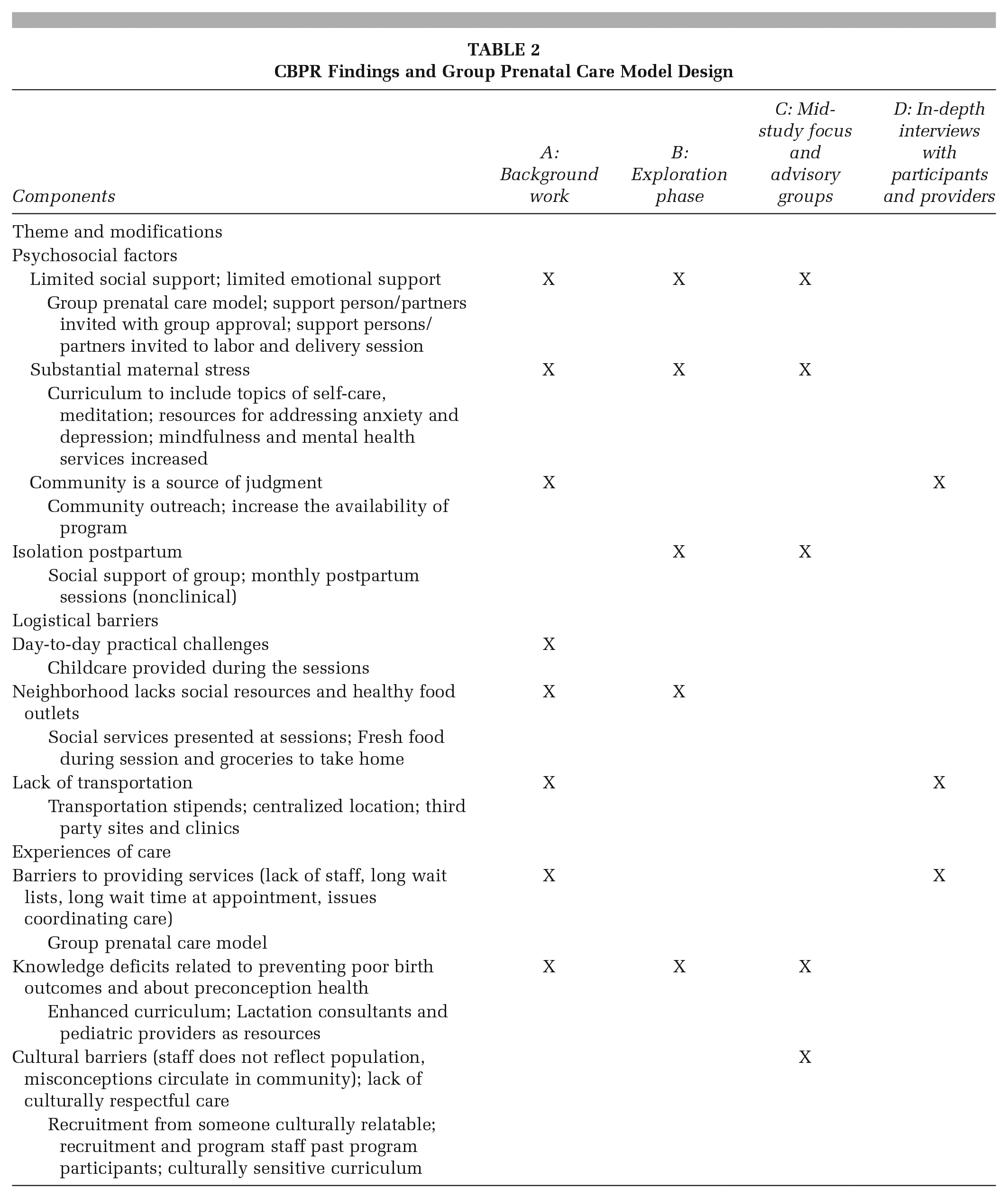
PRECEDE Phase 1: Identify Desired Result
Component A reinforced previous work in the region, acknowledging social isolation and stress, negative experiences of care, and lack of accessible care affected birth outcomes (Lessard & Bengiamin, 2015). This confirmation resulted in the decision that an enhanced GPNC model could authentically meet the needs of the community and that it should be formally evaluated for acceptability (by potential participants and prenatal care providers) and feasibility (for large-scale implementation).
PRECEDE Phase 2: Set priorities
Priorities for the components of a GPNC intervention evolved throughout the project. Component A identified priorities that would reduce logistical barriers of receiving prenatal care including offering the GPNC program at a centralized location and that childcare be offered during sessions. It further emphasized that the GPNC model should select an initial geographic focus with residents of low educational attainment and economic opportunity. This focus would allow the program to be implemented and feasibility to be assessed with all racial and ethnic groups, including the African American and American Indian/Alaskan Native populations that are most at risk for preterm birth but represent too small of a proportion of the local population to offer the program to exclusively. Priorities identified also included addressing psychosocial factors that might contribute to poor pregnancy outcomes.
Component B identified community resources that should be brought to GPNC participants to reduce the burden of access to these services, including perinatal mental health, lactation, and WIC services. Component C clarified which services participants utilized the most and which were less prioritized. As a result, mental health services were increased, the food delivery process was modified, and the delivery of transportation stipends remained in the form of cash as participants revealed that was the most helpful form of a stipend for them.
PRECEDE Phase 3: Identify Social Factors
Social isolation and stress were identified as priorities in Component A and the group nature of the intervention addressed the isolation. Maternal stress was addressed with mindfulness activities and supplemental mental health curriculum. Local perinatal mental health services were incorporated early on in the Glow! Program to ensure women were aware of services and able to connect while in session, and throughout of their pregnancies. Participants reported “the material we cover helps us learn what we need to see, like mindfulness. This is something that Black women don’t normally talk about, so it’s helpful to have a space to discuss this topic that we aren’t exposed to.” Based on feedback in Component B, a closing mindfulness activity was added to each session and perinatal mental health services were added to an additional session near the end of the pregnancy to reemphasize resources and discuss mental health during pregnancy and postpartum.
To address social isolation between sessions, an online communication platform was utilized as recommended during Component B. However, participants did not have high rates of utilization and shared in Component C that they did not want a new communication platform but rather to utilize one that was already incorporated into their daily routines. As a result, groups utilized existing social media platforms or text messaging groups to stay connected between sessions. Participants in Component C also shared that they would like to continue to offer social support to one another after the end of their pregnancies. A recurring evening session open to all program participants was initiated to address the social priorities of participants and continue to offer support with community resources during the postpartum period.
PRECEDE Phase 4: Identify Policy Factors
Identifying policy factors that affected the development and implementation of the intervention was an ongoing process and extended from Components A through D. Prenatal care in a group setting was a significant practice change for local providers and hesitation surrounding patient privacy, practice disruption, and reimbursement practices were factors to be addressed. A key component of the intervention that was determined in Components A and B was to have the bulk of the intervention be coordinated by a third-party community-based organization so that prenatal care providers that have limited capacity for increased workload would be able to offer it to their patients.
Hosting the Glow! Program at a centralized location was a core component of the model at its inception. Credentialing that location for each participating provider presented several policy-related barriers. Throughout the Glow! Feasibility Study, it was revealed that sites closer to the provider’s offices offered more convenience than a centralized location for providers and participants and eliminated administrative burdens that allowed for more providers to offer Glow! Program to their patients. This discovery aligned with an increase in Federally Qualified Health Centers, which have restrictions for offering care off-site, offering the Glow! Program. As a result of these findings, the Program protocol was modified to include offering the Glow! Program at various locations.
To support providers’ decision to offer GPNC, a novel approach for many, support of managed care payers was necessary. As stakeholders involved in Components B and C, the managed care plans offered a letter of support that lent legitimacy to the intervention for hesitant providers.
PROCEED Phase 5: Implementation
The Glow! Program implementation process was continually reviewed with stakeholders and participants throughout the Feasibility Study in Components B, C, and D. The process of participant recruitment was reviewed during focus groups and interviews with participants and recruitment practices were modified to include incorporating outreach at local events, using past Program participants for recruitment and modifying graphics used on Program and Study materials.
Implementation occurred over 3 years with 139 participants, 13 group care cohorts, and 7 providers. Challenges with recruitment of providers, which directly affected implementation, were identified and addressed at advisory group meetings and in interviews with providers.
PROCEED Phase 6: Process Evaluation
The ongoing CBPR process allowed for the continual assessment of the Glow! Program. The Program was well received by participants with 100% agreeing that if they got pregnant again in the future, they would be somewhat likely or extremely likely to join Glow! again. The Program was sought out by women who were interested and had heard about it from sources outside of their prenatal care providers. Many of these individuals were not eligible to join but expressed an interest, demonstrating the acceptability of the intervention.
Providers that participated did so despite administrative and policy challenges. They reported reasons for joining included a desire for improved patient outcomes, desire to contribute to the research, and personal joy from the interactions with patients in a group setting. Providers also noted that participating in GPNC helped decrease their levels of burnout.
Challenges in incorporating a group session into a clinic flow with individual patient care were reported and with the study advisory group Program modifications were made. Flexibility in the number of GPNC sessions was incorporated to respond to the burden on participants (time and excess appointments) and providers (time and cost-effectiveness). To ensure participants had positive experiences of care and in response to reports of past negative health care interactions and emerging interests, a respectful care curriculum and training was incorporated into the Program protocol.
PROCEED Phases 7 and 8: Impact and Outcome Evaluation
The Glow! Program was finalized based on the Feasibility Study outcome and CBPR efforts and the final set protocol is being implemented in an ongoing comparative effectiveness study, reflecting Phases 7 and 8 in the PROCEED framework. That study has ongoing engagement efforts to ensure continued relationships with the community to design qualitative components of the study, assist in community outreach and recruitment, and dissemination efforts.
Discussion
CBPR offers the opportunity for community members and partners to contribute equitably in research activities, participating as investigators at every step of the research process. This method builds on existing partnerships within communities and ensures research questions are those relevant to a community’s needs (Kwon et al., 2017; National Institutes on Minority Health and Health Disparities, 2019). Building and maintaining a truly equitable partnership between community and research is challenging; considering the community’s priorities while also managing the expectations of funders is an ongoing barrier to full implementation of CBPR (Freeman et al., 2006). These barriers were noted and we attempted to address them throughout the process reported here. In addition, modifications to Glow! Program design that required immediate decisions were not consistently able to be approved by advisory group members prior to implementation. However, the members were informed and updated on a regular basis.
Ongoing intentional efforts to engage community partners in the development and modification of the Glow! Program and throughout the Glow! Feasibility Study reflects the recognized significance of the collective nature of preterm birth work in Fresno County. Based on the qualitative feedback shared above through CBPR efforts combined with the requirements of funders, the modified GPNC model of the Glow! Program reflects responsiveness to the community members the program is meant to serve, the agencies aiming to improve maternal-child health experiences and outcomes, and the prenatal care providers (and medical landscape) offering enhanced prenatal care programs to their patients. Returning to community partners throughout the design, implementation, and evaluation phases have reiterated that health care interventions cannot be designed in silos and require flexibility to truly respond to factors that affect the end goal for the intervention. The program protocol was substantially adjusted and is well received by providers, participants, local managed care payers, and social services organizations. This process has led to strong community partnerships that continue to work together into the next phase of offering a community-designed patient and practitioner-centered group prenatal care model.

References
Supplementary Material
Please find the following supplemental material available below.
For Open Access articles published under a Creative Commons License, all supplemental material carries the same license as the article it is associated with.
For non-Open Access articles published, all supplemental material carries a non-exclusive license, and permission requests for re-use of supplemental material or any part of supplemental material shall be sent directly to the copyright owner as specified in the copyright notice associated with the article.
