



Abstract
Latino day laborers (LDLs) are at a high risk for injury and accidents at work and have limited socioeconomic resources to deal with their consequences. While little is known about LDLs’ perceptions of their own vulnerability at the workplace, less is known about the strategies they adopt to confront these risks. The purpose of this qualitative study was to assess LDLs’ perceptions of their workplace dangers and to document the strategies they adopt and endorse to confront them. Guided by a participatory research approach, four focus groups stratified by age were conducted with 34 LDLs in Houston, Texas. Main focus group themes were identified using a combination of qualitative analysis methods involving a thematic analysis conducted by the interview team, LDL advisors, and bilingual Latino researchers. All participants were Latino males (mean age = 40), the majority reported having completed sixth grade or less (64.2%) and having lived in the United States for an average of 12.7 years. We described three categories of strategies to reduce risk for workplace injury generated by local LDLs (practical knowledge and job experience, interpersonal, and personal). These strategies should be explored and encouraged to assist in planning risk-reduction programs, presented in the voice and language of Latino “inside experts” with firsthand experience. The findings of the focus group suggest that LDLs already possess a broad repertoire of strategies to cope with risks at work that can be incorporated in safety programs for LDLs and other immigrant Latino workers.
Keywords
Background
Latino immigrants represent 18% of the U.S. workforce and about 21.1% of the construction industry, representing an important component of a workforce with a high on-the-job death risk (US Bureau of Labor Statistics, 2020). In 2020, there were 4,764 reported fatal work injuries among Latino workers, a 10.7% increase from the previous year (US Bureau of Labor Statistics, 2021). The rate of Latino fatalities has continued to rise disproportionately despite the declining fatality rate among non-Latinos and remains high compared with the national job fatality rates for all workers. This disparity has grown wider especially for workers in the construction sector, one of the main sources of employment for Latino day laborers (LDLs) (AFL-CIO America’s Unions, 2019).
LDLs have been defined as individuals who search for work on a daily basis from multiple employers, either on the “corner” (including street corners, parking lots, shopping centers, bus stops, and home improvement stores), or through the use of a hiring site or a worker center (Duke et al., 2010). LDLs migrate mostly from Mexico and Central America, and rotate through a variety of manual labor jobs that include construction, landscaping, or roofing (Mena, 2001), among other entry-level jobs available for these workers. Due to their jobs, LDLs are at a high risk for injury and accidents, and have few socioeconomic resources that help them deal with their consequences (Fernández-Esquer et al., 2017).
Previous qualitative studies have attempted to describe workplace risks as perceived by LDLs, which include lack of protective equipment, lack of appropriate safety training, using sharp cutting tools, falls from heights (including ladders), dehydration, and exposure to extreme weather conditions, among others (Burgel et al., 2015; Negi, 2011, 2013; Rathod, 2015; Walter et al., 2002). Some qualitative studies have explored perceptions of factors present in LDLs’ daily lives that further increase the risk of workplace accidents such as anxiety, discrimination, loneliness, employer abuse, competition for jobs, wage theft, financial stress, as well as language and cultural barriers (Negi, 2013; Quesada et al., 2011; Walter et al., 2002).
Although the risks that LDLs face at work have been described previously, the strategies they adopt to overcome these risks have not been explored to the same extent. Potential risk-reduction strategies appear to be mostly informed by the experience and expertise of health and safety professionals, or “outside experts” not directly familiar with the experience of injury in the context of the multiple challenges confronted by LDLs. Yet, preventing injury at work is a complex problem that should be informed by strategies offered by “inside-experts,” that is, individuals who have firsthand experience confronting workplace risks on a daily basis (Williams Jr et al., 2010). There are only a few existing studies which have attempted to engage LDLs and to give them a “voice” in the identification of strategies to cope with their own problems (De Souza et al., 2012; Ornelas et al., 2015). While these programs represent successful efforts to engage LDLs in the development of safety programs, they did not explicitly describe or classify various strategies offered to reduce risks at work.
In addition, the conceptual framework guiding our formative research merges an understanding of occupational and psychological inequalities based on the premise that the factors influencing LDLs’ work related injuries involve not only occupational dangers, but also broader environmental and social factors (Krieger et al., 2011; Lipscomb et al., 2006). These factors related to the structural vulnerability experienced by LDLs amplify their hazardous exposures at work. This perspective is informed by the Pathways to Health model, which proposes that as the demands for dealing with multiple stressors increase, the risk of exposures to hazardous workplace conditions also increases (Adler & Ostrove, 1999, 2003).
The purpose of this article is to build upon this previous work by describing the risk-reduction strategies proposed by LDLs using their own words. We provide a typology based on workers’ explanations of the ways they confront the dangers at work. We provide this framework as a potential tool that may assist health practitioners working in reducing injury risks with day laborers or other Latino workers confronting similar hazardous conditions.
Method
This report is based on a qualitative study which explored LDL’s perceptions of the factors that lead to injury at work and described risk-reduction strategies they adopt to reduce workplace dangers. The Consolidated Criteria for Reporting Qualitative Research (COREQ) 32-item checklist was used to assure the quality of the study (Tong et al., 2007). This qualitative study is based on four focus groups conducted during the formative phase of a pilot injury prevention program, guided by community-based participatory research (CBPR) principles which involve the equal participation and unique contributions of research, community, and organizational partners (Wallerstein et al., 2005). The qualitative study was conducted from February to April 2014 and all its procedures were approved by the Committee for the Protection of Human Subjects at The University of Texas Health Science Center at Houston.
Community Advisory Board
Following CBPR principles, we partnered with the Fe y Justicia Worker Center and formed a Community Advisory Board (CAB). The CAB consisted of 11 community-based organizations serving Latino immigrants and a group of seven current or former LDLs. The selection of the CAB members was based on their familiarity with the lived experience of local LDLs, expertise in immigrants’ risky employment and rights, and occupational safety and health.
Corner Identification and Selection
In collaboration with Fe y Justicia Worker Center, we visited corners several times and identified suitable corners in the Houston area for the study. Day labor “corners” are job hiring locations where Latino men wait for work and typically include street corners, bus stops, convenience stores, and large home improvement stores (Valenzuela, 2006). On the day selected for the focus groups, the data collection team approached participants face-to-face and selected participants at random using raffle tickets provided to interested LDLs who also met the inclusion criteria: who were 21 years or older, had at least 1-year experience as a LDL, and had suffered an injury at work in the last 6 months. Using this process, a total of 104 LDL were eligible to participate and 46 were randomly selected from a cap. After a process of identification, screening, and random selection, 34 participants agreed to take part in one of four focus groups, which lasted about 2 hr per group. The 12 individuals who declined to take part of the study indicated lack of time or interest as reasons for not participating.
Focus Group Procedures
Four focus groups were conducted in Spanish and implemented by a bilingual team including one moderator, one recorder, and two observers (one academic and one community partner). The moderator (M.F.E.) is an experienced researcher with training in qualitative research methods, familiar with the purpose of the focus groups, and had prior experience working with LDLs and other underserved populations. Bias and assumptions were attenuated by her extensive training in qualitative research and focus group moderation experience. The focus groups were held at casual restaurants located within walking distance to the corners where the LDLs were recruited. All participants gave verbal consent to be audio recorded during the focus groups. After each focus group, participants completed a brief questionnaire to obtain demographic data on age, country of origin, years of education, and marital status. To address the lack of English fluency among LDLs, the questionnaire was delivered in Spanish. Participants were compensated with a meal at the restaurant and a US$50 gift card.
Focus Group Guide
A focus group guide was developed in collaboration with the CAB, LDLs, and the Fe y Justicia Worker Center. The semi-structured interview guide consisted of questions organized by topics related to hazards, risk-reduction strategies, and perceptions of personal injuries experienced by LDLs. Consistent with a structural vulnerability perspective indicating that the stressors LDLs experience are the result of socioeconomic inequalities across multiple life domains, we developed a focus group guide that primarily probed for LDLs’ understanding of their risk for injuries at work. To expand this understanding, we also included participatory activities to probe for dangers at home, at work, and the day labor corner. The guide included three discrete participatory activities: an ice breaker activity, a risk mapping activity, and a body mapping activity. The ice breaker was used to build rapport with participants and create a comfortable atmosphere for discussion about injuries experience during the job. The second activity, risk mapping, consisted of writing or drawing dangers at the corner, worksite, and home locations. The third activity, body mapping, was used to elicit personal injuries by asking participants to mark body parts on a human silhouette. Participants were then asked to share information with the focus group members about the experienced injuries. Drafts of the interview guide were pilot tested with members of the focus group team, which include one LDL.
Data Analysis
The coding team for the analysis described in this article consisted of C.M. and M.F.E. All four focus groups were transcribed verbatim using both the original audiotapes, assisted by observers’ notes, which tracked group engagement by tallying participants’ contributions by their assigned ID number. Transcripts were also supplemented with notes, based on the focus group team’s debriefing sessions. Transcripts were individually analyzed in their original Spanish language using thematic content analysis. Three members of the CAB who were former or current LDLs also reviewed the transcripts as an informal member check, and preliminary themes were identified by the team, and presented at CAB meetings where the larger group had an opportunity to provide insights and validate preliminary findings.
Atlas.ti qualitative software (version 7.1 for Windows) (Atlas.ti, 2014) was used to organize and query codes under major themes and subthemes. Risk perception themes and codes were based on the coders’ interpretation of the focus group content, and they are described in the results section. The coding scheme for the risk-reduction strategies was developed by C.M. and M.F.E. (Figure 1).
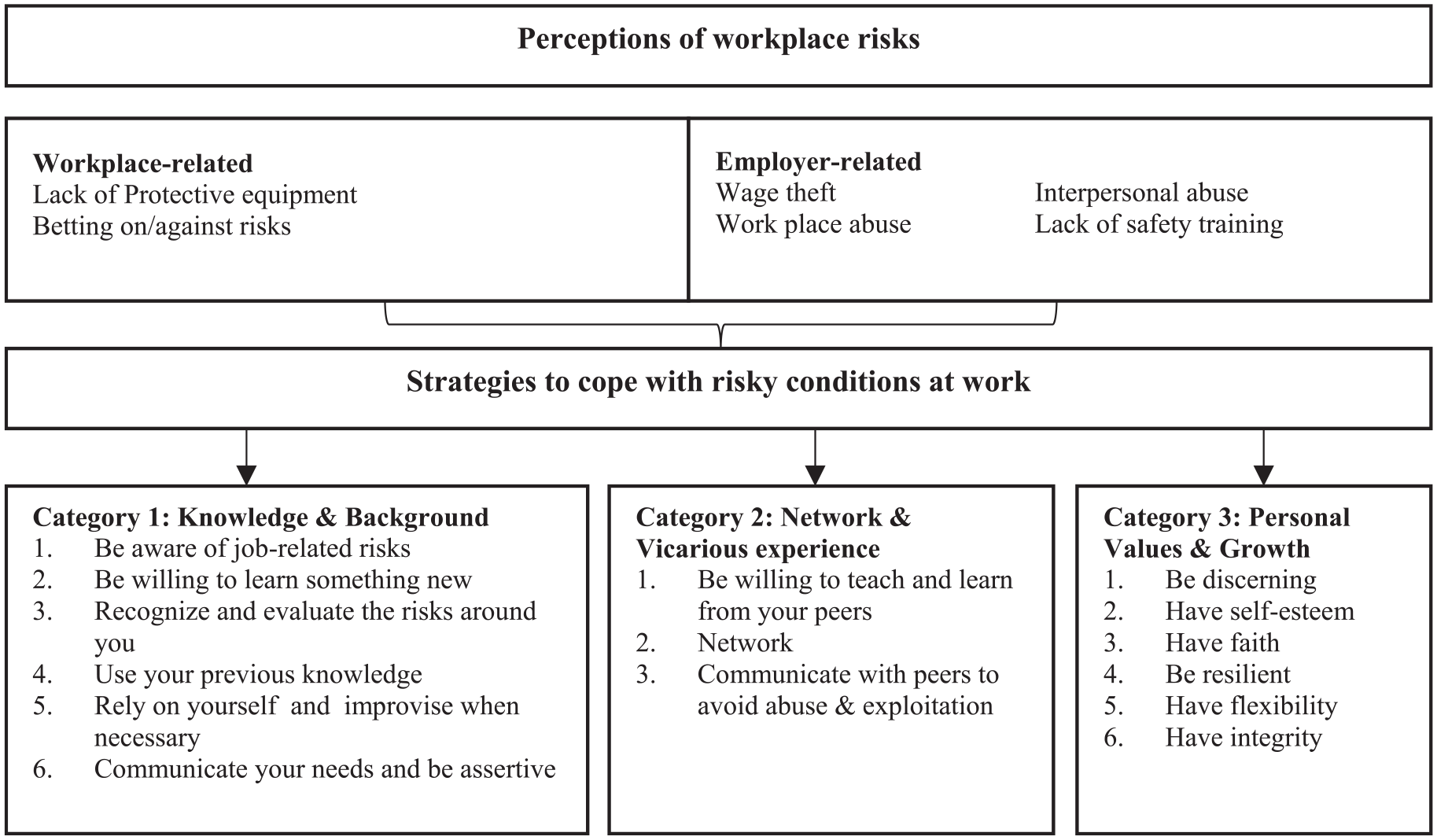
Schema Describing Findings Relating to Reported Risk Perceptions and Strategies to Cope
Results
Demographics
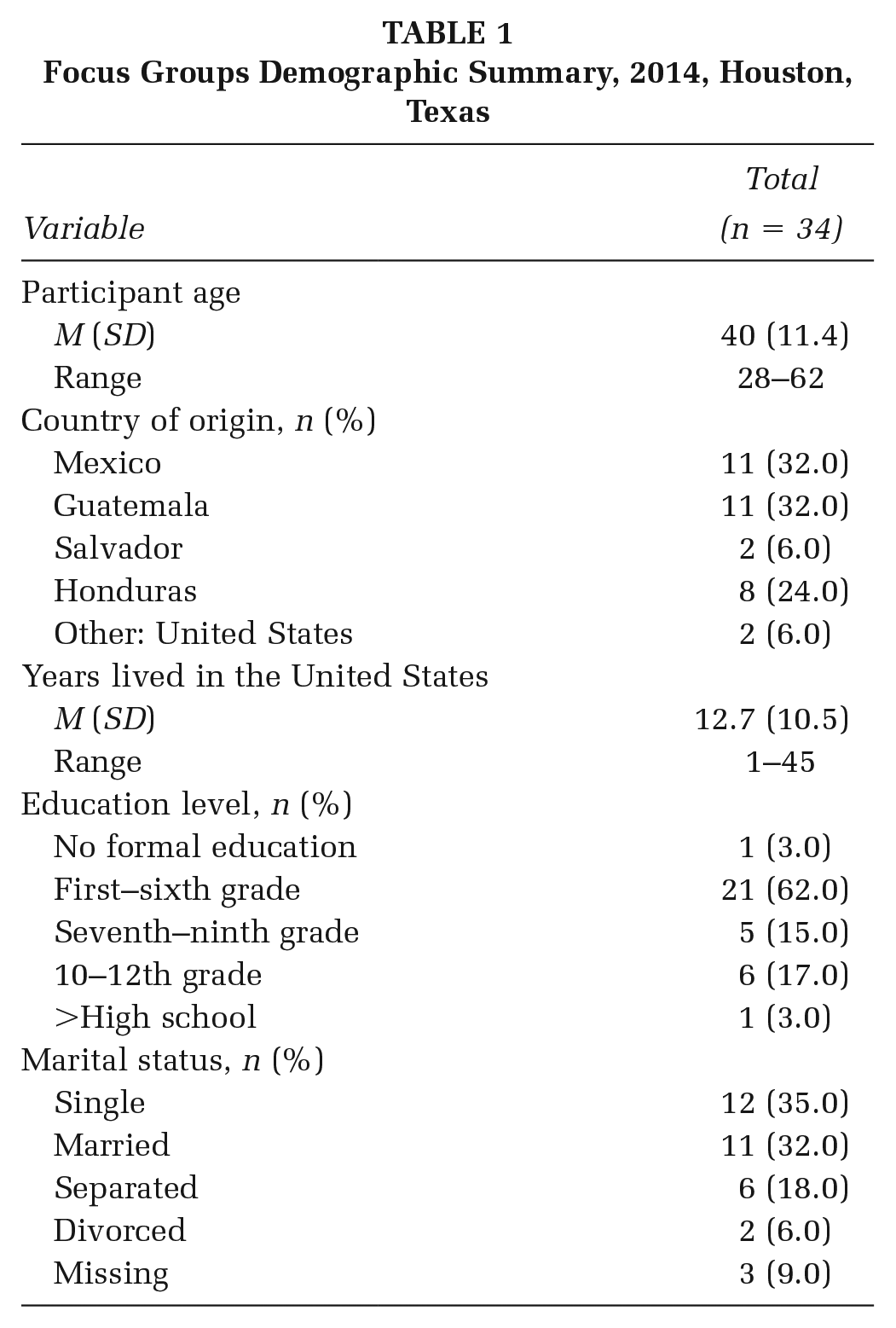
Table 1 shows a summary of participants’ demographics. A total of 34 LDLs participated in the focus groups. All participants were Latino males, aged 20 to 62 years (M = 40), originally from Mexico, Guatemala, and other Latin American countries. The participants’ mean years lived in the United States was 12.7 years. The majority of LDLs reported having completed sixth grade or less (64.2%).
Focus Groups Demographic Summary, 2014, Houston, Texas
To understand the risk-reduction strategies described by LDLs, we first coded salient perceptions of risks most frequently confronted at work. Figure 1 describes how results are presented.
Perceptions of Work- and Employer-Related Risks
LDLs reported workplace-related risks such as being hired to perform jobs outdoors, being exposed to the weather elements and heights; not being provided the appropriate tools or safety equipment to perform highly dangerous tasks and having to gauge risks depending on remuneration. LDLs also reported experiencing other challenges that increased their worksite risks such as interacting with employers that were demanding, unfair, abusive, and failed to provide safety training and/or equipment. LDLs also reported receiving low wages and experiencing wage theft.
Strategies to Cope With the Risky Conditions Confronted at Work
The risks and abuses described in the previous section provide the framework for understanding the strategies LDLs generated to deal with dangerous situations at work. For purposes of this article, “strategy” is loosely defined as any personal, interpersonal, or practice-related attempt to reduce a workplace risk or increase personal safety. In the next section, we describe strategies spontaneously generated by focus group participants as part of their description of the challenges they faced at work. We classified coping strategies in three categories: (a) practical knowledge and job experience, (b) interpersonal strategies, and (c) personal strategies.
Category 1. Practical Knowledge and Job Experience
Strategy 1: Application of lay worker strategies
This theme covers behaviors that indicate that LDLs are keenly aware of the risks they must take at work. Most participants saw the need to pay attention to the task at hand and focus on the work they are performing. One participant shared the importance of paying attention while performing work, he said “If you get injured, you won’t be paid. This is a drawback here at the corner. That’s why you always need to pay attention to what you are doing (focus group number, participant number, 4.1).”
Strategy 2: Willingness and ability to learn
This theme covers strategies indicating eagerness and willingness to learn something new, to better themselves through job training, or learning new skills that will help them find better work. Most participants saw the need to continuously improve themselves to increase the chance of getting hired for work and avoid safety risks. Learning then is not just tied to the job and to their current personal circumstances but it is also related to their need to secure a better future for their families. A participant said, “I’m trying to learn English because I know that the future of my children depends on it (3.3).” Learning new skills is something that participants seemed to enjoy, thus becoming a motivation to overcome the challenges they encountered at work.
Strategy 3: Recognizing and evaluating risk
As work-related risk is a danger found in many of the jobs that LDLs do, they acknowledged the importance of recognizing the ability to walk away from jobs when necessary. As economic need can override the need for safety, some workers may take all jobs offered to them, while others refuse a job deemed too dangerous. One participant said: “If they ask me to weld something, but (they) do not provide me with a hat and a mask . . . I will not lose an eye just to make $100. It’s not worth it (2.6).”
Strategy 4: Applying previous knowledge
Some participants had previous experience in construction or were farmers who learned to protect themselves from the sun and intense heat, as their work required being in the open air. When not provided with personal protective equipment or gear, they wear loose clothing with long sleeves and place handkerchiefs under their baseball caps to protect the back of their necks from the sun. One participant said, I use (dark) glasses. When the temperature gets very hot, it (sun) can ruin your eyes and when I work in construction, I use long sleeves so that when I sweat it stays there (that way) you don’t dehydrate (2.5).
Strategy 5: Self-reliance
The need for self-reliance to survive is a core strategy among LDLs. In the face of lack of resources, particularly money, LDLs develop the ability to solve their own problems and improvise solutions which become a matter of survival. With no health care or money to pay for a doctor’s visit, some use their knowledge of folk healing, while others resort to over the counter medications. In some extreme cases, some perform personal surgery using thread and needle to stitch an open wound.
Strategy 6: Interpersonal Skills at Work
Beyond language barriers, LDLs rely on their interpersonal skills on what and how to deal with the employers. They often look for the best way to ask how to perform tasks that are not clear, negotiate their salary, and claim their rights. They communicate their needs and are assertive. One participant mentioned a situation when the employer did not provide him the appropriate tool to cut cement, he said, “well, if you give me the right tool to cut, I would have finish it, but you leave me here cutting cement with this knife, how do you want me to be productive? (1.1).”
Category 2. Social Network and Vicarious Experience
Strategy 1: Sharing knowledge & skills
Each worker has a different set of previous knowledge and experience in a variety of jobs and is willing to share it with others. One participant said, I took a course in asbestos removal several years ago and last week an American brought us to a house to remove the asbestos and I knew how to do it (a special procedure and equipment is needed) so I told my coworker how he was supposed to remove it and discard it (4.8).
Some participants in the focus groups had low levels of literacy, so they rely on their peers when they need to deal with paperwork: “My problem is that I never attended school, I never studied. But thanks to my colleague that helped me to fill the form, because I can do it but I’m so slow (2.7).”
Strategy 2: Networking
Networking allows LDLs to form working crews with peers that they already know and trust. This improves their chances to get a job and work in tasks that best fit their knowledge and abilities. Many participants described how they were guided to the corner by a friend or a relative when they first arrived in this country. Finally, networking is an opportunity to socialize and share with peers un-related work issues when there is no job available (i.e., while they stand on corners waiting for their next job).
Strategy 3: Peer communication to avoid abuse & exploitation
The corner is a meeting point where workers communicate about possible dangers, abuse, and exploitation situations. It also allows them to develop criteria and take better decisions to avoid abuse. While sharing experiences with peers at the corners, LDLs learn about bad or fake employers, human trafficking, racial profiling, and work-related accidents that occurred to other workers. One participant said, “you don’t know with which kind of people you go (to work with), some persons are employers, and some are not, they just pretend to be so that they can rob you (1.10).”
Category 3. Personal Values and Growth
Strategy 1: Perspicaz/discerning
Some LDLs have the good judgment, experience, or intuition to detect red flags in the workplace. This ability helps them anticipate employers’ intentions based on their body language or the language they use during job negotiations. Even if imperfect, they use this strategy to further protect themselves from employer abuse. Some LDLs ask strategic questions to determine if they should trust the employer before accepting the job. One participant shared an incident where an employer showed up and did not clearly explain the job nor the pay, he said, . . .then, I’m doubtful, he (the employer) does not know what are we going to do or how much will he pay and when I see that they don’t know or they doubt, then I don’t take the job (1.6).
Strategy 2: Autoestima/self-esteem
LDLs may experience various stressors that may place them at risk of loss of self-esteem. However, some participants try to maintain their self-esteem and value their own work even when they are mistreated repeatedly by their employers: We want to be treated as humans because we are . . . And we are at the corner because it is our need, right? We have no other option, but we need them to respect us . . . (3.1).
Strategy 3: Fé/faith
Some participants mentioned the use of faith as a coping mechanism to deal with everyday stressors. They report that they pray and trust themselves to God in times of anguish and despair. One participant said, “. . . thank God, I am a Christian, and I do not despair . . . I haven’t suffered any depression because I trust in God (4,2).” They also find hope in God when they are alone and hopeless: “. . . here we are in God’s sake because he is the only one who is with us (3.1).”
Strategy 4: Resiliencia 1 /resilience
Some LDLs demonstrate the ability to be resilient and withstand adversity. This strategy allows them to always find a way to cope and overcome the many obstacles that they might face as laborers and immigrants. For LDLs, resilience often means to bear extreme conditions and poor treatment. A participant explained, “When we get hurt, but we have to put up with it because we need the money, we have to finish the job (4.8).”
Strategy 5: Flexibilidad/flexibility
The need for flexibility to perform different kinds of jobs is a strategy that helps them find various jobs and get hired more often. One participant said, “if they tell us to pour concrete, we will pour concrete . . . If they ask us for construction or remodeling too, we will do all types of work (4.7).” This flexibility also helps them find more stable offers by allowing them to move around from job to job, and sometimes to deploy to other parts of the country.
Strategy 6: Integridad personal/personal integrity
Some participants mentioned the importance of honesty, especially integrity at work. They mentioned that it is important not to misrepresent their abilities and be honest with the employers about their job capabilities and skills. This strategy may lead them to get rehired.
Discussion
Our findings about the risks and struggles of LDLs in Houston, TX, are similar to previous findings reported in studies with LDLs and in other U.S. cities (Fernández-Esquer et al., 2017; Negi, 2013; Walter et al., 2002, 2004). Findings of this study confirm that LDLs not only face risks to their health and wellbeing at the workplace but also in the different domains that constitute their daily life. According to Quesada’s Structural Vulnerability perspective, all these different contexts create the vulnerability internalized by LDLs, who on a daily basis perform high-risk tasks under a burden of accumulated anxiety and physical and socioeconomic insecurity (Quesada et al., 2011). Interventionists should consider the burden of LDLs’ increased structural vulnerability when developing interventions to reduce LDLs’ injuries by acknowledging the fact that LDLs face uncertainty and do not have total control over their everyday actions to avoid any kind of blaming or moral judgment.
This qualitative study was part of our pilot phase (2013–2014) that lead to the process of developing, implementing, and evaluating our randomized trial, the “Vales Más Tú” (You are Worth More) injury prevention program. The findings of this study led to the development of a booklet to systematically document severe workplace injuries (Fernández-Esquer et al., 2020) and an injury prevention program tested in a pilot trial and more recently in a larger and more rigorous cluster randomized trial. The study findings have also been disseminated to our CAB which include community leaders, academic researchers, community advocates, and representatives of local government that work closely with LDLs.
Limitations
Although our study provides information on important and useful findings, there are several limitations to consider. First, our qualitative study was limited to a small sample size of 34 LDL participants. Although, the sample may be small, the findings provide firsthand evidence of strategies that LDLs may use to cope with everyday struggles and help them prevent workplace injuries. Another limitation was that the study was conducted in a specific geographic area, Houston, TX. Although the reported strategies may well represent what LDLs across the United States may do in similar conditions, our findings would have to be validated in other U.S. locations. Finally, an important limitation to consider is that the results presented in this paper are based on focus group data collected 8 years ago. Although the reported patterns were obtained long before the current COVID-19 pandemic, we assume that the risks confronted by LDLs and the strategies to cope with them have not fundamentally changed. Instead, we assume that while rates of injury may have changed and preference for adopted strategies may have shifted, the hazardous work exposures and nature of coping responses has not changed.
The ongoing COVID-19 pandemic has disproportionately affected Latinos, especially the undocumented immigrants (Hasan Bhuiyan et al., 2021; Macias Gil et al., 2020; Page et al., 2020). Although the coping strategies obtained in our focus group were documented 8 years ago, we believe that their fundamental nature has not changed and may be important to understand how LDLs may have coped with the recent COVID-19 pandemic. Latinos, particularly those who are immigrants, have suffered from increased risk of infection, hospitalization, and death compared with Whites (Rodriguez-Diaz et al., 2020; Romano et al., 2021) and have been especially impacted by the pandemic due to their existing lack of access to health care, immigration status, language barriers, unstable financial instability, systemic racism, and poor living conditions (Blackburn & Sierra, 2021; Galletly et al., 2021; Lechuga et al., 2022; Salinas & Salinas, 2022). The COVID-19 pandemic has exacerbated the work-related stressors they experience every day and may have challenged them to use the coping strategies described in this article. Although the information we collected about coping strategies was obtained in the context of injury, it is possible that similar strategies may have been adopted for the current COVID-19 pandemic. Although we speculate that similar creative, adaptive, and proactive strategies may have been adapted to deal with the current pandemic, the COVID-19-specific responses remain to be explored in a separate publication.
Implications for Research, Practice, and Policy
In this qualitative paper, we described strategies to reduce risk for workplace injury generated by local LDLs in the context of a focus group. Strategies to overcome workplace risks and injuries were spontaneously reported sometimes overtly, sometimes more subtly, in our conversations with LDLs. The initial focus of these conversations was to describe their perceived risks for injury to develop a pilot intervention to assist LDLs in reducing workplace injuries (Fernández-Esquer et al., 2022). However, in reviewing the transcripts of these conversations, we realized that every story of experienced risk was linked to a description of how they coped with a variety of abusive and dangerous situations. We believe that these strategies should be chronicled and analyzed to assist in planning risk-reduction programs, presented in the voice and language of “inside experts” with firsthand experience. Due to COVID-19’s impact on LDLs, more research is also needed to better understand how the LDLs used these coping strategies in the context of a pandemic to prevent injuries and COVID-19.
Based on our findings regarding strategies adopted by LDLs to overcome job-related risks, implications for practice include developing interventions that teach LDLs to identify different levels of risks, enhance communication and negotiation skills, reinforce beliefs about safety self-efficacy, strengthen self-perceptions and values, and provide resources to help them with skill training and immigration services. This can aid in developing risk-reduction programs that are contextualized in the realities of LDLs. In addition, our findings suggest that the risks that LDLs face on a daily basis are ultimately rooted in economic and political determinants and the meaning and consequences of being undocumented and excluded from the official workforce (Walter et al., 2002). The most impactful risk-reduction strategies must address these underlying and driving determinants.
In conclusion, there are many social, psychological, and structural factors that contribute to increase the chances of workplace accidents for LDLs besides the most immediate work-related causes. Challenges posed by workplace dangers call for the adoption of coping strategies that represent the resourcefulness, creativity, and adaptability of vulnerable workers, as well as the limitations imposed by their lack of resources. Changes in worker safety made at a policy level could have an impact in improving LDLs’ work conditions and overall quality of life. Our results suggest that risk-reduction interventions for vulnerable workers should go beyond the immediate workplace context and consider the overall living context and daily struggles of LDLs.
Footnotes
Acknowledgements
We would like to specially thank the Latino day laborers in Houston who participated in the focus groups. We would also like to thank Fe y Justicia and the project’s community advisory board for their valuable advice throughout the study. We express our deep appreciation to the late Maria Jimenez for her dedicated work in the community and on this project.
This work was supported by the National Institute of Minority Health and Health Disparities (Grant no. 5R24MD007975-02).
The funding source did not have a role in any aspect of the preparation or publication of this manuscript. This content is solely the responsibility of the authors and does not necessarily represent the official views of the National Institute of Minority Health and Health Disparities or the National Institutes of Health. One author (MA) received support from a Susan G. Komen Traineeship in Breast Cancer Disparities research grant (No. GTDR14300827).

Notes
References
Supplementary Material
Please find the following supplemental material available below.
For Open Access articles published under a Creative Commons License, all supplemental material carries the same license as the article it is associated with.
For non-Open Access articles published, all supplemental material carries a non-exclusive license, and permission requests for re-use of supplemental material or any part of supplemental material shall be sent directly to the copyright owner as specified in the copyright notice associated with the article.
