



Abstract
The use of Critical Race Theory, Photovoice, and Community-Based Participatory Research has helped uncover the root causes of issues such as systemic racism in the fields of public health and health promotion. Often, we see studies using traditional research methods to investigate potential causal factors of disparities in minoritized communities report only quantitative data. While these data are imperative for understanding the severity of disparities, quantitative-only approaches cannot address nor can they improve the critical root causes of these disparities. As a team of BIPOC graduate students in public health, we conducted a community-based participatory research project using Photovoice methodology to explore inequities in Black and Brown communities exacerbated during the COVID-19 pandemic. The participatory nature of this research revealed cumulative challenges across the social determinants of health in New Haven and Bridgeport, Connecticut. It allowed us to engage in local-level advocacy to promote health equity as our findings illuminated the need for community-led and community-engaged action. Health and racial inequities cannot be effectively addressed if public health research and programming do not collaborate with the community to build community capacity, empowerment, and trust. We describe our experiences doing community-based participatory research to investigate inequities and provide reflections on their value for public health students. As responses to health inequities and disparities become more politically polarized in the United States, it is critical for public health and health education students to use research methodologies that elevate communities that have been historically marginalized and neglected. Together, we can catalyze equitable change.
Keywords
As public health students, we learn about achieving health equity. We promise to uphold the 10 essential services of public health, improve the social determinants of health, and dismantle racist systems of power. Despite the collective promises of the field, health inequities and disparities persist. As Black and Brown students and advocates, we have seen our communities over-researched and reduced to statistics. The effects of long-standing racism, including disparities and inequities, were amplified by COVID-19. The devastation of the pandemic within Black and Brown communities has widened the platform for progressive social and racial justice-based change (Ayanian & Buntin, 2020; Evans, 2020; Gibson et al., 2020). Public health students must learn firsthand about conducting research in collaboration with communities, expanding community capacity, listening, igniting grassroots movements, and using methodologies that value and elevate community voices.
To address this need, we conducted Photovoice research projects in New Haven and Bridgeport, Connecticut. Our projects were grounded in Critical Race Theory (CRT) and focused on investigating and acknowledging the impact of institutionalized racism on health during the COVID-19 pandemic. The community collaborators in each project decided which determinants of health were most important to their community and should be investigated. With our community collaborators, we are translating our findings into actionable advocacy steps and an authentic, sustainable, and non-exploitive community-university partnership.
We chose to employ Photovoice, a community-based participatory research (CBPR) method, because it uncovers the root causes of issues such as systemic racism through photographs and words of communities (Breny & McMorrow, 2021). Through Photovoice methodology, we collaborate with the community, value their expertise and lived experiences, create critical consciousness through a critical dialogue process, and empower our communities to act at the policy and social change levels for issues that are important to them. Through this theory and methodology, we investigated root or fundamental issues of health inequities and disparities in our community and elevated the people behind the statistics.
The personal reflections below are from each student on our research team. We have reflected on why and how Photovoice research helped us to see the importance of CBPR and how tools like policy advocacy can help make changes to eliminate systemic racism. In Table 1, we present quotes relating to common themes across all four student reflections.
Common Student Reflections on Career Development
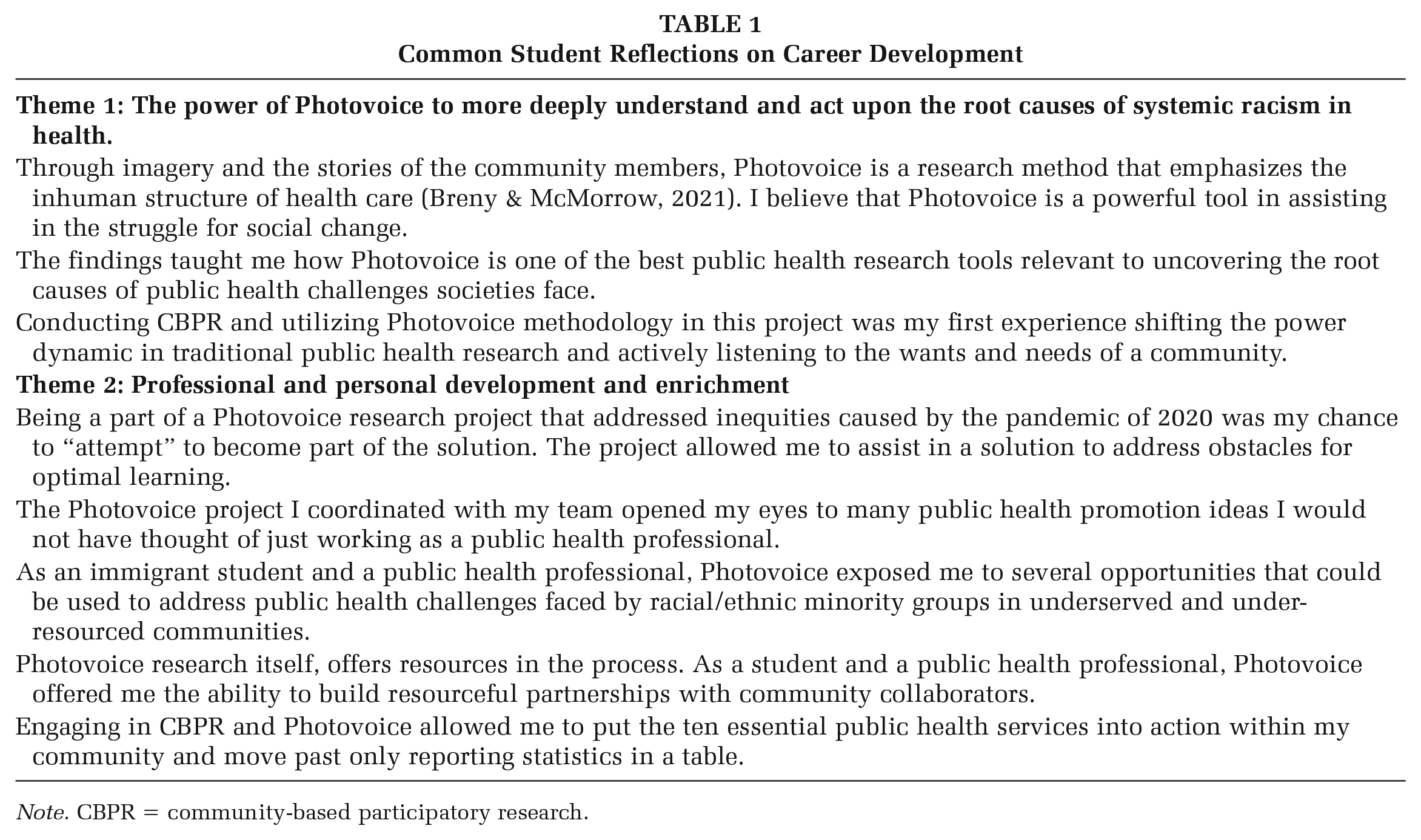
Note. CBPR = community-based participatory research.
Student Reflections
Cheryl
In the 1970s, I began my education at Maplewood Elementary School in the city’s Westside. Looking back, I enjoyed the commitment, compassion, and support of the educators and administrators. I loved knowing that the community within the school had my best interest. It truly was a village.
The year before we began this project, I was an advocate for the students and parents of the Bridgeport Public School System. During meetings I attended, I learned about many community members’ perceptions of and experiences at the School District. These highlighted a critical need for improvement. There were challenges with attendance, academia, special education, and nutrition. For some students, school meals may have been the only source of food and nourishment for the day.
Through our community work, we learned that there was a lack of involvement and commitment from the parents, which was likely due to not knowing how to get involved or not having time to get involved. Many students with special needs had not had their Individualized Education Plans (IEPs) adjusted to accommodate the changes from an academic setting to a home setting. School meals lacked the nourishment that was essential to the student’s holistic well-being, including the ability to learn. School computers were not available in quantities to meet the needs of families with multiple children in the household. Some households did not have cable or Wi-Fi needed to access the internet. Out of the entire school district, there were 4 participants in Photovoice, and 2 of the 4 were caregivers. My experience showed me the power of listening to community voices, the need to speak up about stagnant and broken systems, and the need to advocate because my community deserves better.
Ashley
Before pursuing my MPH (Master of Public Health), I had minimal experience with qualitative research. As a biology student, I spent my undergraduate years conducting quantitative research. I was well versed in quantitative research methods and analyzing health outcomes. I believed numerical data were essential to compare groups and ultimately drive health promotion. I have since learned that mixed-methods research is crucial. In health promotion, qualitative research elevates the stories of individuals who are directly affected by inequities. Through CBPR, individuals are an essential part of the change sought to protect and promote their health.
In this CBPR project, Photovoice methods allowed community collaborators from the New Haven area to visualize the effects of racism in their community. The community captured images of social inequities constructed by their officials through overt and covert racism. These images echoed how racism negatively impacts the health of the community. By using Photovoice, community collaborators brought to light the health issues that affect marginalized people and their communities, a view I believe should not be ignored just because it cannot be quantified. In my experience, Photovoice captures emotions, validifies life stories, and makes clear how social and health inequities create disadvantages for marginalized individuals. These stories are vital in communicating the inequities that exist at the intersection of racism and health.
Using Photovoice to document the lived experience of the New Haven community during the COVID-19 pandemic was impactful. The community picturized that the pandemic intensified inequities, contradicting some of the early theories that framed the pandemic as being “the great equalizer” (Asfaw et al., 2020). In their photos, the New Haven community collaborators documented the desperate need for health promotion.
One early challenge I faced was adapting to the way that the community collaborators chose to answer questions. Some would capture an image that I thought did not quite answer the agreed-upon question, which meant that during the focus group sessions I had to adjust the conversations to fit each participant. I looked forward to these “deviations” because the participants were always able to convey new themes that documented how racism negatively impacts the New Haven community. From these “deviations” came more effective ways to intervene in the social problems endured by the community.
Fatawu
During the project, I had the opportunity to meet different people with diverse educational and social characteristics. These interactions taught me new perspectives of public health and brought with them a broad array of health promotion knowledge for my public health role. The observations and discussions the group had allowed for many discoveries of what people of color had to face during the COVID-19 pandemic that otherwise would be hidden from policymakers. The photos shared by community collaborators revealed how people of color and their school-going children had to rely on insufficient resources to make sure their children had enough to eat and could receive the needed educational lessons. Photovoice as a public health tool highlighted the roles of various players like schoolteachers, babysitters, and daycare owners as necessary partners in protecting and promoting health in communities of color.
It was evident during the Photovoice project meetings that community collaborators experienced some level of self-perception and confidence to share more of their observations and personal experiences. This occurrence was possible because community collaborators were treated as facilitators of their own stories, rather than the cause of their challenges. This opportunity derived from Photovoice research broadened the community’s willingness to express themselves concerning the public health challenges they see and experience in their communities. As a racial/ethnic minority student in the field of public health, this observation is particularly important considering the mistrust and widening health disparities affecting minoritized communities. Photovoice offers a safe and open space for community members to share their stories. Our Photovoice project used this space to understand the public health issues discussed and designed a plan to engage the group to develop lasting solutions.
As a community health worker (CHW) in an underserved and under-resourced community, the bond I have established with the community collaborators of this project will go a long way to benefit the community I serve. The community collaborators in the project shared and have demonstrated a wealth of resources that could support families I work with. Building this social network with community collaborators with different social backgrounds, education, and culture would not have been possible had it not been for this Photovoice project.
Breanna
Substantial research has clearly identified inequities, injustice, and racism as root issues impacting the health of Black and Brown communities, yet the conditions in my community persist. Before working on this project, textbooks taught me to recommend white and Western evidence-based examples of healthy eating and healthy living. I did not know how to engage communities as collaborators in research. And, I did not understand why much of the public health research I studied seemed to be focused only on highlighting the symptoms of inequities, and not the root causes.
Through Photovoice, our team was able to generate hope and empowerment in ourselves and our community. In preparation for our projects I worked as a graduate research assistant and trained extensively in qualitative research methods. During the actual research, I managed the Photovoice projects and was largely responsible for the operations, logistics, and professional development aspects. One of my largest tasks was training the research facilitators about community engagement, how to conduct group discussions, and how to teach the power of utilizing photos to capture the reality of inequities and disparities in each community. In addition, I supported the research facilitators with their community engagement during each group discussion with data collection. At the end of the project, I worked closely with our research advisor to transcribe, thematically code, and analyze our group discussions.
As a public health student, it was humbling to take a step back and understand that my education does not mean that I know better than a community. It was critical to learn that textbook solutions do not work for every single community, and to truly create equitable spaces in research and in public health one must be willing to adapt research plans and goals. Investigating root issues of health inequities and disparities has motivated me to do better as a public health student, researcher, and advocate in terms of collaboration, considering unintended consequences of “evidence-based solutions,” and valuing the knowledge and expertise of communities. Photovoice methodology specifically has shown me the power of the people and how we can come together to create social change within our community and the nation.
Conclusion and Call to Action
There is a dire need to acknowledge the impact of systemic racism on health. Declaring racism as a public health crisis is only the first small step in achieving health equity and committing to anti-racist public health work (Breny, 2020; Jones, 2018). As public health students and professionals, it is necessary to commit to this work wholeheartedly (Breny & McMorrow, 2021). Through our project we have sought to elevate community voices, engage the community as collaborators, and go beyond simply documenting health disparities. Through these investigative Photovoice projects, we named institutionalized and structural racism’s role in the identified inequities. We used our public health education and research skills to provide guidance and resources as the community saw fit. We established a trusted and authentic collaborative community–university partnership in communities that have been historically exploited in research and we are holding ourselves accountable to promote health equity and anti-racism in our public health education and future projects. We implore current and future public health student researchers to push past the statistics; we already know that these inequities and disparities are an issue. As a field, we need to advocate for change, push ourselves to do the work that is actually needed and wanted by the community, and use research methods that value the community. We encourage public health student researchers to use CBPR and Photovoice to inspire grassroots advocacy and identify actionable and sustainable solutions to long-standing health inequities and disparities. These methods are critical in achieving health equity.
