



Abstract
Climate change is increasingly recognized as a public health issue that exacerbates existing social and structural inequities. While growing attention has been paid to gendered impacts of climate-related hazards, transgender populations remain largely absent from climate research, policy, and practice, especially in low- and middle-income country contexts. This article introduces Invisible in the Storm: Climate Change and the Lived Realities of Transmasculine People in India, a community-led and produced health promotion resource developed by Transmen Collective, India’s first national organization dedicated to transmasculine rights and well-being. Based on a mixed-method, survey-based study conducted with transmasculine participants across multiple regions of India, the report documents how climate events such as heatwaves, floods, and water scarcity intersect with gender identity, health care and resource access, and mental and emotional well-being. Quantitative findings highlighted exposure to climate stressors and disruptions to essential resources, while qualitative narratives illuminated how climate stress is embodied through constraints on gender expression and experiences of discrimination. Together, these findings reveal how climate change amplifies existing inequities and how the needs of the transgender community are rendered invisible in climate planning and responses. Positioned as a community-led health promotion resource, Invisible in the Storm offers insights for practitioners, organizations, and policymakers across climate, disaster, and public health sectors, highlighting the urgent need to integrate gender-diverse perspectives into climate responses. The report also underscores the importance of integrating lived experience into climate responses and demonstrates the value of gender-inclusive approaches to advance climate justice and health equity.
Keywords
Introduction
Climate change is an intensifying public health emergency that shapes ecosystems, economies, and lives worldwide. Beyond rising temperatures and extreme weather events, climate change operates through social and structural pathways, amplifying existing inequalities and placing disproportionate burdens on marginalized populations (Versey, 2021). Importantly, public health and health promotion scholars have emphasized that climate change must be understood not only as an environmental phenomenon but as a social justice issue that intersects with gender, health, and access to resources (Logie et al., 2024; Versey, 2021).
India is one of the countries most acutely affected by climate-related hazards, including heatwaves, floods, intense rainfall, cyclones, and water insecurity (Roxy et al., 2017). National and international assessments consistently rank India as highly vulnerable to climate impacts, particularly due to the monsoon system, large informal workforce, and social inequities (Intergovernmental Panel on Climate Change, 2023; Yenneti et al., 2016). While climate policies and disaster response frameworks in India recognize women, children, and older adults as vulnerable populations, transgender (trans) and other gender-diverse communities remain largely absent from climate vulnerability assessment and emergency response strategies (Simmonds et al., 2022).
Lesbian, gay, bisexual, transgender, and queer (LGBTQ+) populations face unique climate-related risks, including exclusion from disaster shelters, discrimination in relief distribution, and disruptions to essential health services (Dominey-Howes et al., 2022). However, within this growing body of research, transmasculine people—those assigned female at birth who identify as masculine, male, or along the transmasculine spectrum—remain particularly underrepresented in both climate and public health research, especially in low- and middle-income country contexts (Scheim et al., 2020).
Community advocates describe the abovementioned gap as “structural invisibility”: the systematic absence of transmasculine lives, needs, and expertise from climate research, policy, and practice. Without data grounded in lived experience, climate responses risk reproducing exclusion, leaving transmasculine individuals to rely solely on informal networks and personal copings strategies during climate-related emergencies. Community-generated data can inform policy changes to ensure that community needs are better met during climate crises.
Community-Led Research Report
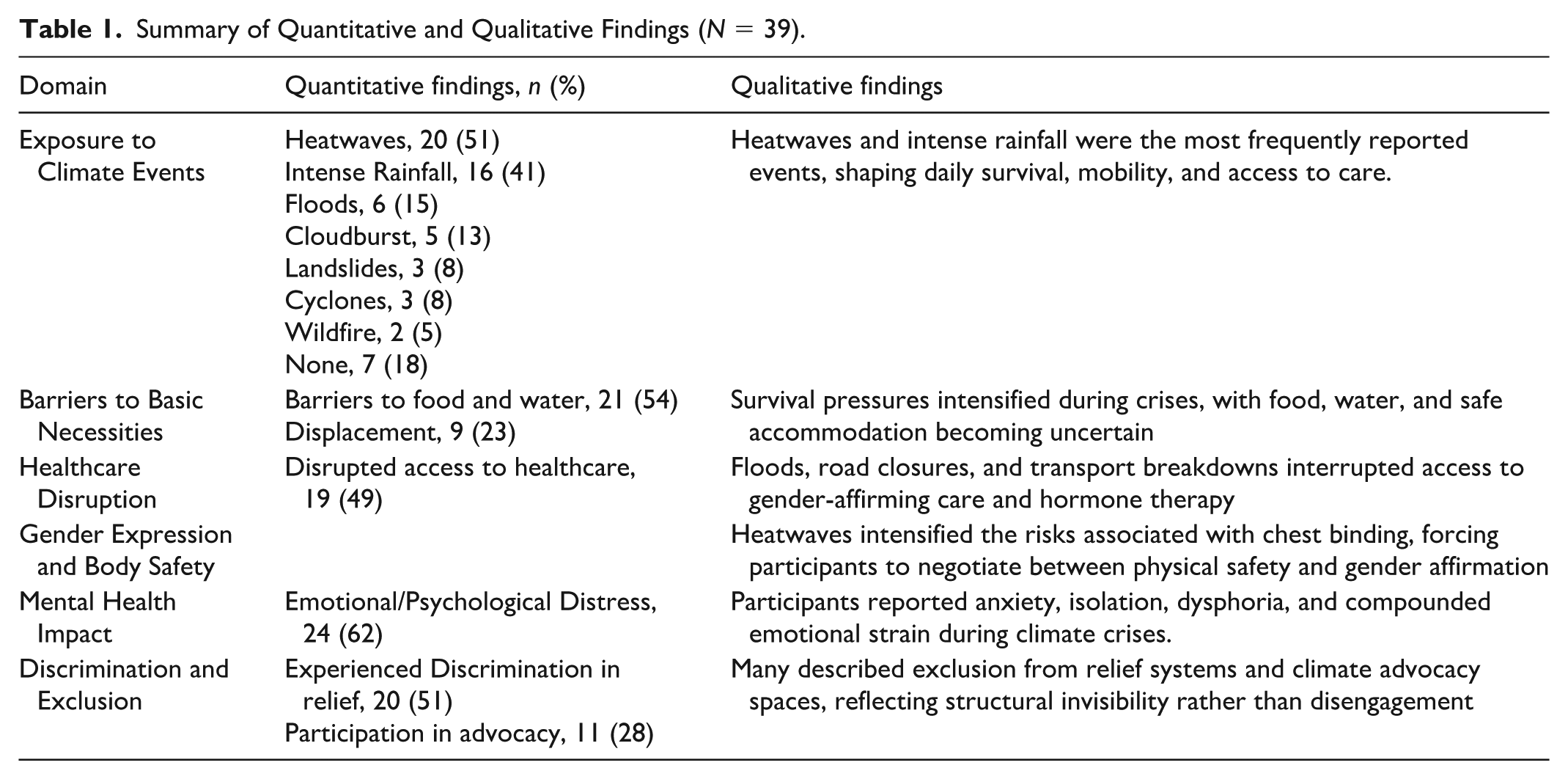
To address this gap, Transmen Collective—India’s first national organization dedicated to transmasculine rights and well-being—developed a report based on a community-led mixed methods study titled, Invisible in the Storm: Climate Change and the Lived Realities of Transmasculine People in India (see Supplemental Material). The study employed a survey-based approach with 39 transmasculine participants across the North-East, North, South, and Central zones of India to document how climate events such as heatwaves, floods, and water scarcity intersect with health care access, economic insecurity, and mental health. Findings are illustrated in Table 1. The quantitative results document high levels of exposure to heatwaves and extreme rainfall, alongside substantial disruptions to food, water, shelter, and health care access, as well as widespread emotional and psychological distress. The qualitative narratives further illustrate how climate-related stress affected gender expression, economic security and daily survival, and emotional well-being. Taken together, the findings highlight how climate events increased reliance on public systems that were already structured by cisnormativity and transphobia, thereby (a) constraining participants’ ability to express gender autonomously; (b) exacerbating barriers to general and gender-affirming health care access; and (c) rendering transmasculine voices and needs invisible in climate planning and disaster response efforts.
Summary of Quantitative and Qualitative Findings (N = 39).
Making Sense of Invisible in the Storm as a Health Promotion Resource
Invisible in the Storm (see Supplemental Material) was created as a community-led health promotion resource designed to inform practice, advocacy, and policy. Developed by Transmen Collective, this report centers the lived experiences and expertise of transmasculine individuals and forefronts knowledge that is actionable, contextually grounded, and responsive to needs identified by transmasculine people themselves. For health promotion practitioners and organizations, the report offers concrete indicators of need—such as disruptions to housing, water access, livelihoods, and health care—that can be used to guide program design, advocacy priorities, and resource allocation in climate-affected contexts.
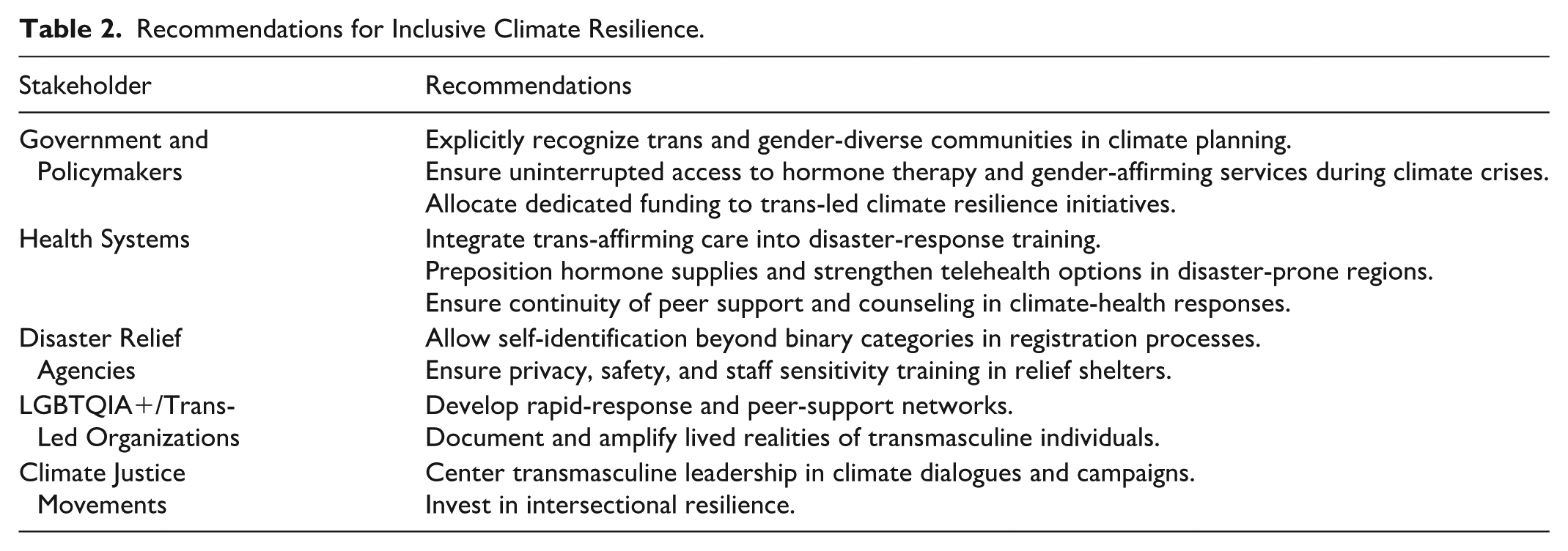
Importantly, the report positions transmasculine participants as more than just passive recipients of harm; it documents their coping strategies and recommendations for more inclusive climate responses (see Table 2). As such, this report can be read as a knowledge mobilization tool that bridges community experiences and institutional responses, offering insights that are directly relevant to health promotion practitioners, community organizations, and policymakers working in climate adaptation and gender-affirming service provision. This way, this report positions itself as recognizing marginalized knowledge and voices in climate response efforts. It demonstrates how marginalized voices can reveal structural gaps in existing frameworks while also identifying pathways for more equitable, inclusive, and responsive climate and health interventions.
Recommendations for Inclusive Climate Resilience.
The report can be accessed here: https://journals-sagepub-com-s.web.bisu.edu.cn/home/hpp.
Implications for Practice
The findings from Invisible in the Storm offer practice-relevant insights for organizations and practitioners working with transmasculine communities in India and other low- and middle-income country contexts. First, the high prevalence of mental and emotional distress (62%) indicates that psychosocial impacts are a central yet inadequately addressed component of climate vulnerability for transmasculine people. Community organizations and practitioners should integrate mental health and psychosocial support into climate-related programs, including peer support, crisis counseling, and trauma-informed care to address the compounded stress of climate exposure and gender-based discrimination.
Next, 28% of respondents reported participation in climate action or advocacy. Given the high climate-related harms and systemic barriers documented in this report, this level of engagement suggests meaningful interest and capacity for involvement in climate justice efforts. Practitioners and community organizations can build on this existing engagement by intentionally creating accessible and affirming entry points into climate programs, consultations, and leadership opportunities, ensuring that transmasculine perspectives shape climate responses rather than remain peripheral to them.
Importantly, Invisible in the Storm addresses the persistent underrepresentation of transmasculine people within climate and health research and practice. Given the limited scholarship focused specifically on transmasculine experiences—particularly in low- and middle-income countries—practitioners and researchers may unintentionally conflate transmasculine needs with those of cisgender women or transfeminine populations. By making transmasculine experiences visible as a distinct site of inquiry, the report encourages practitioners and researchers to critically reflect on whose needs are recognized within climate-related programming and evidence generation. It acts as a prompt to avoid reproducing historical gaps in recognition and to intentionally include transmasculine perspectives in future climate, disaster, and health initiatives.
Implications for Policy
The figures presented in Table 1 indicate that existing climate, disaster, and health policies in India are insufficient to address the lived realities of transmasculine people during climate-related events. These gaps are not solely due to the absence of legal or institutional frameworks, but to the limited ways in which current policies conceptualize gender and vulnerability, often excluding trans populations from risk mapping and adaptation planning.
First, there is high exposure to climate stressors, particularly heatwaves (51%) and intense rainfall (41%), combined with widespread disruption to daily life. Despite this documented vulnerability, national and state climate policy frameworks like National Action Plan on Climate Change (NAPCC) and State Action Plans on Climate Change (SAPCC) continue to frame gender primarily through a cisgender women–centric lens, excluding trans people from vulnerability assessments and adaptation planning. Thus, we argue that policies need to explicitly recognize gender diversity within climate risk mapping and adaptation strategies. This may include further evaluation of how trans communities are affected by climate stressors, due to their intersectional vulnerability and health-related needs that are affected by high exposure to heatwaves and rainfall.
Second, more than half of the respondents faced barriers to food, water, or shelter, alongside reports of discrimination in accessing relief, highlighting persistent implementation gaps within India’s disaster response systems (Hanspal & Behera, 2024). These findings suggest the need for clear, enforceable operational standards that prohibit discrimination based on gender identity and ensure equitable access to shelters and relief services. Disaster management protocols must include gender-inclusive intake processes, staff training, and accountability mechanisms to prevent exclusion during emergencies.
Third, disruptions to health care access for nearly half of the respondents—including to gender-affirming care—points to a critical gap between health policy and disaster preparedness. Although the Transgender Persons (Protection of Rights) Act, 2019 guarantees access to health care and non-discrimination, evidence suggests that these protections are often not substantively implemented within health care systems (Chakrapani et al., 2024). Our study shows that these protections are also not consistently upheld during climate-related emergencies. These patterns underscore that health and disaster policies must be better integrated to ensure the continuity of general and gender-affirming health care before, during, and after emergencies.
Conclusion
Invisible in the Storm responds to a critical gap in climate and health scholarship by centering transmasculine experiences that have been largely invisibilized within climate research, practice, and policy. By documenting how climate-related events intersect with gender affirmation, health care access, and everyday survival within a developing country context, this report illustrates how existing climate, disaster, and health systems insufficiently account for transmasculine experiences, even where legal frameworks formally exist. As a community-led health promotion resource, Invisible in the Storm demonstrates the value of lived experience as evidence and offers insights for practitioners and policymakers to advance more inclusive and equitable climate responses. This report underscores that climate resilience cannot be achieved without intentionally acknowledging and addressing the needs of trans communities.
Supplemental Material
sj-pdf-1-hpp-10.1177_15248399261458707 – Supplemental material for Invisible in the Storm: Climate Change and the Lived Realities of Transmasculine People in India
Supplemental material, sj-pdf-1-hpp-10.1177_15248399261458707 for Invisible in the Storm: Climate Change and the Lived Realities of Transmasculine People in India by Arnav Singh Rana, Sahil Jamal Siddiqui, Chitraksh Ashray, David Puvaneyshwaran, Carmen H. Logie and Ayden I. Scheim in Health Promotion Practice
Footnotes

Ethical Considerations
Ethical approval was not sought because the study was conducted as a community-led research initiative by Transmen Collective and was not affiliated with an academic institution.
Consent to Participate
Participants provided informed consent, and procedures were implemented to protect confidentiality and voluntary participation.
Author Contributions
Study design: AS, SJS, and CA. Methodological design: AS, SJS, and CA. Funding acquisition: AS and SJS. Methods/tool management/analysis: AS, SJS, and CA. Manuscript writing: DP. Manuscript editing and critical review: DP, CHL, AS, SJS, and AIS.
Funding
The authors disclosed receipt of the following financial support for the research, authorship, and/or publication of this article: This study was funded by Haiyya under their Youth Climate Research Network Project
Declaration of Conflicting Interests
The authors declared no potential conflicts of interest with respect to the research, authorship, and/or publication of this article.
Supplemental Material
Supplemental material for this article is available online.
References
Supplementary Material
Please find the following supplemental material available below.
For Open Access articles published under a Creative Commons License, all supplemental material carries the same license as the article it is associated with.
For non-Open Access articles published, all supplemental material carries a non-exclusive license, and permission requests for re-use of supplemental material or any part of supplemental material shall be sent directly to the copyright owner as specified in the copyright notice associated with the article.
