



Abstract
This study investigated the effects of a scaffolded-language intervention using cloze procedures, semantically contingent expansions, contrastive word pairs, and direct models on speech abilities in two preschoolers with speech and language impairment speaking African American English. Effects of the lexical and phonological characteristics (i.e., word frequency, neighborhood density, and phonotactic probability) of contrastive word pairs and direct models on speech production accuracy were examined. Speech outcomes support the application of a scaffolded-language intervention with children with speech and language impairment. Results lend support to the assertion that fundamental intervention principles are applicable regardless of native dialect. Effects of word frequency, neighborhood density, and phonotactic probability clarified their role within the scaffolded-language intervention.
Preschool children with language impairment often present with deficits in speech concurrently (Haskill & Tyler, 2007; Shriberg, Kwiatkowski, Best, Hengst, & Terselic-Weber, 1986; Shriberg, Tomblin, & McSweeny, 1999). Some treatments train speech and language in discrete domains using isolated target structures. Others suggest an integrated approach addressing language and speech simultaneously using broad language targets. This study examined the effects of an integrated, scaffolded-language intervention on speech abilities in two preschoolers with speech and language impairment speaking African American English (AAE). Clinical strategies included cloze procedures, expansions, contrastive word pairs, and direct models. An effect on speech was expected based on models of language in which aspects of speech and language are viewed as dynamic, and change or ability in one may trigger change or ability in the other (Bybee, 2001; Hoffman, 1992). Lexical and phonological characteristics (i.e., word frequency, neighborhood density, and phonotactic probability) of contrastive word pairs and direct models on speech production accuracy were examined to clarify their role in the scaffolded-language intervention.
Intervention Context and Clinical Strategies
Repeated storybook reading (RSR) established the intervention context. RSR serves as a redundant, meaningful experience for learning (Kaderavek & Justice, 2005; Snow, 1983; Van Kleeck, Vander Woude, & Hammett, 2006). Scaffolding strategies can be used during RSR to facilitate speech and language abilities (Bornstein & Bruner, 1989; Bruner, 1978; Kirchner, 1991; Norris & Hoffman, 1990). Scaffolding strategies allow redundant presentation of linguistic elements (e.g., semantic and phonologic) within various linguistic units (i.e., words, phrases, and sentences) during RSR. Each strategy is provided as a consequence of a child’s spontaneous initiations and responses, rather than a predetermined target. As such, a priori development of stimuli items with specific lexical or phonological structure does not occur.
A cloze procedure provides a linguistic context that requires a child to fill in specific information, which is signaled by an adult pause (Bradshaw, Hoffman, & Norris, 1998; Hughes & Till, 1982; Snow, Midkiff-Borunda, Small, & Proctor, 1984). Semantically contingent expansion refers to an adult repetition of a child’s semantic intention using more complex linguistic formulation and maintaining the child’s topic (Yoder, Spruytenburg, Edwards, & Davies, 1995). Direct models occur when a child is instructed to say a word. Contrastive word pairs compare the child’s error production with the correct production (e.g., Is it a/p^/or a/p^g/?; Bellon-Harn, Hoffman, & Harn, 2004). Contrastive word pairs and direct models directly prompt correct speech production following a child’s initiation.
Intervention Outcomes
Several studies support language interventions using interactive RSR to improve speech abilities in children (Bellon-Harn et al., 2004; Hart & Gonzalez, 2010; Hoffman, Norris, & Monjure, 1990). Results of these studies strengthen the assertion that language-based approaches have the potential to be efficient with children with speech and language impairment (Kamhi, 2006; Tyler, 2002). Hoffman et al. (1990) compared a narrative approach using feedback strategies (i.e., requests for clarification, requests for increases in narrative or syntactic language) and a phonological intervention using minimal pair contrasts. Twin brothers, aged 4 years 1 month, with low average language abilities and moderate phonological impairments were treated. The narrative intervention targeted broad language goals, and the phonological intervention targeted specific speech structures (i.e., production of clusters). Similar improvements on phonology were noted with both children.
Bellon-Harn et al. (2004) examined outcomes of cloze procedures, expansions, and contrastive word pairs during RSR on speech and language in three children ranging in age from 5 years 8 months to 5 years 10 months. One child exhibited a more severe speech and language impairment than the other two children. Pretreatment and posttreatment language samples, together with treatment data, provided indices of the semantic and phonological complexity of the children’s utterances. As a collective application, scaffolding strategies during RSR was associated with positive change in each child’s semantic complexity, percent consonants correct, and phonological error patterns.
Hart and Gonzalez (2010) investigated a combined approach of focused stimulation of key words during joint storybook reading and interactive practice of key words using communicative feedback on three children ranging in age from 3 years 7 months to 4 years 11 months. One child exhibited a moderate speech impairment, and two were characterized with severe speech impairments. All had language abilities within normal limits. The pattern of stopping was targeted during treatment. Feedback strategies included use of contrast questions following incorrect production of the targeted pattern (e.g., Do you mean tad or sad?). One child with severe impairment showed no treatment effect. The child with moderate impairment demonstrated the strongest treatment effects.
The application of clinical strategies varied among the studies. Taken together, positive speech outcomes have been attributed to the use of interactive storybook reading and application of key clinical strategies. Effects were noted on varying profiles of children, including those with language abilities in normal limits and moderate speech impairment (Hart & Gonzalez, 2010; Hoffman et al., 1990) as well as those with moderate-to-severe speech and language impairment (Bellon-Harn et al., 2004). This study contributes to previous studies by (a) examining effects on children with moderate speech and language impairments speaking AAE and (b) clarifying the role of two scaffolding strategies (i.e., direct model, contrastive word pair).
Nonmainstream Dialect Speakers
Seymour (1986) and Stockman (2010) reasoned that there is no need to design different types of treatments for children based on their native dialect. Although fundamental intervention principles are applicable regardless of dialect, evaluation of intervention outcomes must address dialectal patterns. Percent consonant correct–revised (PCC-R) provided a broad measure of speech sound change (Shriberg, Austin, Lewis, McSweeny, & Wilson, 1997). Its use is documented as an appropriate measure of speech with AAE speaking children (Stockman, 2008). Percent occurrence of phonological error patterns provided a measure to examine intervention effects on specific error patterns, even though no pattern was explicitly targeted. Occurrence of cluster reduction (CR) and final consonant deletion (FCD) was selected for analysis because it was clinically significant in both children. Furthermore, increased accuracy in clusters represents development of a complex phonological task (Gierut & Champion, 2001).
Production of word final singletons and clusters is variable in typically developing children speaking AAE (Craig, Thompson, Washington, & Potter, 2003; Craig & Washington, 2004). Stockman (2006) and Wolfram (1989) observed that absence of a final consonant is likely when the final consonant is an alveolar nasal consonant or an alveolar voiceless stop consonant. When an element of a cluster is deleted in final position, children speaking AAE are more likely to maintain the more sonorous element. Although it is difficult to separate dialectal influences from linguistic developmental factors in young children, dialectal influences on phonology discernable from age 4 include production of singleton consonants in final position (Pearson, Velleman, Bryant, & Charko, 2009). To observe use of final consonants in children speaking AAE, two analyses were completed (a) frequency of omission of all final consonants and (b) frequency of omission of alveolar nasals and alveolar voiceless stops in word-final position. Reduction of these sounds in word-final position can occur in casual conversation of mainstream or other nonmainstream dialect speakers. In this study, analysis of alveolar nasals and alveolar voiceless stops provides a measure of a documented dialectal variation.
Contrastive Word Pairs and Direct Models
Relationships between lexical and phonological characteristics of words on expressive phonology exist (Morrisette & Gierut, 2002). Once a lexical representation is activated, so will its phonological representation (Storkel & Morrisette, 2002). Conversely, phonological information about a word affects its lexical retrieval (Tyler, Lewis, Haskill, & Tolbert, 2002). Examining the impact of lexical and phonological characteristics of contrastive word pairs and direct models on speech production accuracy will clarify their roles within the scaffolded-language intervention.
Word frequency, neighborhood density, and phonotactic probability define lexical and phonological characteristics. Neighborhood density refers to the degree to which words are more or less phonologically similar (Storkel & Morrisette, 2002; Vitevitch & Luce, 1999). A similarity neighborhood includes all of the words differing from a given word by one phonemic substitution, deletion, or addition (Luce & Pisoni, 1998). A dense neighborhood includes words that sound like many other words; a sparse neighborhood includes words that have few similar sounding words. For example, neighbors of sit include words such as sip, sat, hit, it, and spot, and neighbors of these include words such as those, tease, and ease. The word sit resides in a dense neighborhood because it has many similar sounds (i.e., 36 neighbors), whereas these resides in a sparse neighborhood because it has relatively few similar sounds (i.e., 9 neighbors; Pisoni, Nusbaum, Luce, & Slowiaczek, 1985; Storkel & Morrisette, 2002).
Phonotactic probability refers to the likelihood of sound or sound sequences in a given language (Barlow, 2002). Some segments and segment sequences are more commonly occurring (e.g., /m/), whereas others are considered rare (e.g., /∂/). A common sound sequence, such as sit, contains individual sounds and sound sequences occurring in many other words in the same position. In contrast, a rare sound sequence, such as these, contains sounds and sound sequences that infrequently occur in other words in the same position (Storkel, 2001). Word frequency refers to the number of times a word occurs in a language (Morrisette & Gierut, 2002).
Neighborhood density, phonotactic probability, and word frequency influence word learning and speech production. Although the nature of these relationships in children with phonological impairments continues to be under investigation, some patterns are emerging. Rare sound sequences may be more beneficial because they are more distinctive than common sound sequences (Storkel, 2004a; Storkel, Maekawa, & Hoover, 2010). Children with phonological impairment may have difficulty with words from sparse neighborhoods due to impoverished lexical representations (Storkel & Hoover, 2010a). Frequent words should facilitate recognition and/or production of targets better than less frequent words (Gierut, Morrisette, & Champion, 1999; Storkel & Morrisette, 2002).
Summary
This study examined effects of a scaffolded-language intervention on speech sound production in two preschool children speaking AAE. Outcome measures addressed dialectal variations. A second purpose was to compare effects of lexical and phonological characteristics of contrastive word pairs and direct models on speech production accuracy.
Method
Participants
Two children identified with language and speech impairments were recruited via a speech-language pathologist at a local public school. Casey was a 4-year 8-month-old African American male and Delbert was a 4-year 2-month-old African American male. Both were enrolled in a Head Start program and spoke with dialects characterized as AAE, which was confirmed using blind listener judgments (Oetting & McDonald, 2002).
Children were included based on scores at least 1 standard deviation below the mean on word, consonant, and phonological process inventories of the Bankson–Bernthal Test of Phonology (Bankson & Bernthal, 1990), at least 1 standard deviation below the mean on the Structured Photographic Expressive Language Test–3 (Dawson & Stout, 2003), at least 1 standard deviation below the mean on the Diagnostic Evaluation of Language Variation: Norm-referenced Test (Seymour, Roeper, & de Villiers, 2005), and within normal limits on the Columbia Mental Maturity Scale (CMMS; Burgemeister, Blum, & Lorge, 1972). Table 1 includes participant characteristics. Phonetic inventories were completed from a 100-utterance spontaneous speech samples. Any sound that occurred more than once in the speech sample was considered as occurring in the child’s phonetic inventory (Stoel-Gammon, 1985). A sound was included independent of its phonemic status (see Table 2). Neither child presented with gross oral-motor, hearing, emotional, or neurological impairments based on school documentation and screenings. Both children presented with moderate speech and language impairments. Casey exhibited higher scores on the CMMS than Delbert.
Standardized Scores in Language Cognitive, and Speech Assessments

Note: DELV-NR = Diagnostic Evaluation of Language Variation–Norm-Referenced Test; SPELT-3 = Structured Photographic Expressive Language Test–3; CMMS = Columbia Mental Maturity Scale; W.I. = Bankson–Bernthal Test of Phonology word inventory, C.I. = Bankson–Bernthal Test of Phonology consonant inventory, P.I. = Bankson–Bernthal Test of Phonology phonological process inventory.
Phonological Characteristics of Participants

Study Phases
A single-subject, staggered multiple baseline, across participants design exposed children to a period of no treatment followed by treatment and posttreatment (McReynolds & Thompson, 1986). Prior to treatment, baseline measures were obtained. A clinician presented a storybook, asked broad wh-questions, and used general prompts without scaffolding. Casey participated in six baseline sessions and Delbert participated in nine. Following treatment, five posttreatment measures were obtained.
A total of 10 treatment sessions, 20 min in length, were completed. Books included narrative structures characterized as reactive or abbreviated sequences and were 15 pages (Applebee, 1978). At the first session, the initial 5 pages were introduced. During each subsequent session, the previous set was reviewed, and the next set was introduced. Each book was completed in three sessions.
Presentation of the book initiated the session (see Appendix). If the child did not spontaneously produce an utterance relative to the book, the clinician asked a wh-question. After the child’s conversational turn, the clinician judged the child’s utterance as phonologically, semantically, or syntactically appropriate or inappropriate. If judged appropriate, the clinician made an “online” decision to provide more information at higher levels of semantic, syntactic, or phonological complexity using cloze procedures and expansions. If judged inappropriate, the clinician made an “online” decision to provide a contrast word, direct model, or more information at a lower level of semantic or syntactic complexity. The interaction continued, and strategies were applied as a result of the child’s initiations and responses.
Treatment Fidelity
One 2nd-year graduate student clinician was trained to conduct all phases. The first author reviewed each session to ensure uniform application across sessions. Within each treatment session, adult scaffolds were coded according to scaffold type using the FREQUENCY (FREQ) program from Child Language Analysis (CLAN; MacWhinney, 2010b). FREQ is a program for frequency analysis that provides a frequency count. Percentage of occurrence for (a) contrastive word pairs and direct models and (b) cloze procedures and expansions was calculated for each child’s treatment sessions (see Figure 1). Scaffold use was comparable with the exception of wh-questions. For Casey, the clinician asked fewer wh-question than for Delbert. Casey produced more spontaneous initiations from which to use a cloze/expansion or contrast word/direct model. Delbert’s interactions were less spontaneous, so the clinician used more wh-questions to elicit a response. The overall number of scaffolds per minute was calculated for each child. Across all sessions and both children, scaffolds occurred between 7 to 9 times per minute. Percent use of contrastive word pairs and direct models was calculated. The clinician used direct models at 47% occurrence during the intervention for Casey and 41% occurrence for Delbert. The clinician used contrastive word pairs at 53% and 59% occurrence for Casey and Delbert, respectively.

Percent occurrence of scaffold types and wh-questions
Data Collection and Transcription
Baseline, treatment, and posttreatment sessions were recorded with a digital audio recorder (Tascam, Model DR-07). A total of 50 to 60 utterances per session were transcribed and analyzed. Two graduate students in a program of speech-language pathology transcribed and analyzed adult and child utterances. Each was trained in phonetic transcription and speech analysis. Samples were transcribed using the Codes for Human Analysis of Transcripts from the Child Language Data Exchange System (MacWhinney, 2010a). Samples were compared, and agreement was reached on all utterances. If agreement could not be reached, a third judge listened to the utterance for a final decision.
Speech Outcome Measures
PCC-R was calculated for each speech sample. In this study, major dialectal patterns not calculated as incorrect included reduction of vocalic and postvocalic/r/, substitution of f/θ, and stopping of word-initial interdentals. Proportion of errors (POE) was calculated with the formula: (no. of errors / no. of total productions) × 100. Percent occurrence of CR and FCD was calculated. All clusters in syllable initial and syllable final position excluding those that marked morphological relationships were counted. Occurrence of deletion of voiceless alveolar stops and alveolar nasals in final word position was calculated and divided by the number of obligatory contexts for production of/t/and/n/. Number of occurrences was calculated using the FREQ program from CLAN.
Reliability for Transcription and Coding
Adult and child utterances were transcribed and analyzed on 20% of the samples by trained graduate students. Transcriptions were compared using verbatim agreement and calculated using the following formula: (agreements / agreements + disagreements) × 100. Transcript reliability ranged from 90% to 94%. Agreement was calculated for PCC-R (94%–96%) and POE (93%–95%). Agreement for identification of FCD and CR was 89% to 91%. Identification of deletion of voiceless alveolar stop and alveolar nasal was 96% to 98%.
Neighborhood Density, Phonotactic Probability, and Word Frequency Measures
Words used in direct models and contrastive word pairs from all treatment sessions comprised a data set for analysis. Correlation between word length with phonotactic probability and neighborhood density measures exists (Storkel, 2004b). Consequently, words were categorized into three word lists (i.e., CVC, CCVC/CVCC, bisyllabic). An online calculator provided a measure of the number of neighbors (i.e., neighborhood density measure) as well as positional segment and biphone segment sum (i.e., phonotactic probability measures) for each word in the data sets (Storkel & Hoover, 2010b). The Hoosier Mental Lexicon (HML) database within the online calculator was used because it contains a large number of words, and the values are highly correlated with child values (Maekawa & Storkel, 2006).
Number of neighbor computation is the number of words in the HML that differ from a given word by a one-phoneme substitution, addition, or deletion (Storkel, 2004b; Storkel & Hoover, 2010b). Positional segment frequency is the likelihood of occurrence of a given sound in a given word position (e.g., the likelihood that/s/in the word/s^t/occurs in the initial position). Biphone frequency is the likelihood of occurrence of two adjacent sounds (e.g., the likelihood that the sequence/s^/in the word/s^t/occurs in the initial position). The MRC psycholinguistic database, Version 2, (Coltheart, 1981) supplied the word frequency calculations. It includes 150,837 words.
Following calculation, each word list (i.e., CVC, CVCC/CCVC, bisyllabic) was categorized as high or low using a median split (see Table 3). Word frequency measures for the full set of CVC, CCVC/CVCC, and bisyllabic words are found in Table 3. PCC-R was calculated for each child response to a contrastive word pair and direct model. These measures provided continuous variables from which to compare high versus low neighborhood density, phonotactic probability, and word frequency on speech production accuracy.
Ms and SDs of Neighborhood Density, Positional Segment Sum, Biphone Segment Sum, and Word Frequency Measures of CVC, CCVC/CVCC, and Bisyllabic Words

Note: C = consonant; V = vowel.
Data Analysis
Speech dependent variables were plotted across sessions. Presence of trends across baseline, treatment, and posttreatment was identified. A standardized effect size measurement, Busk and Serlin’s (1992) d1 statistic, provided a means to compare performance across phases (Beeson & Robey, 2006). Although effect size measurements in single-subject studies do not test the null hypothesis, they do yield a measure of the magnitude of change (Kromrey & Foster-Johnson, 1996; Meline, 2010). Effect size values of small, medium, and large are given as 0.2, 0.5, and 0.8, respectively (Cohen, 1988). Means and standard deviations of outcome measures for each phase of the study are found in Table 4.
Effect Size Measurements for Dependent Variables
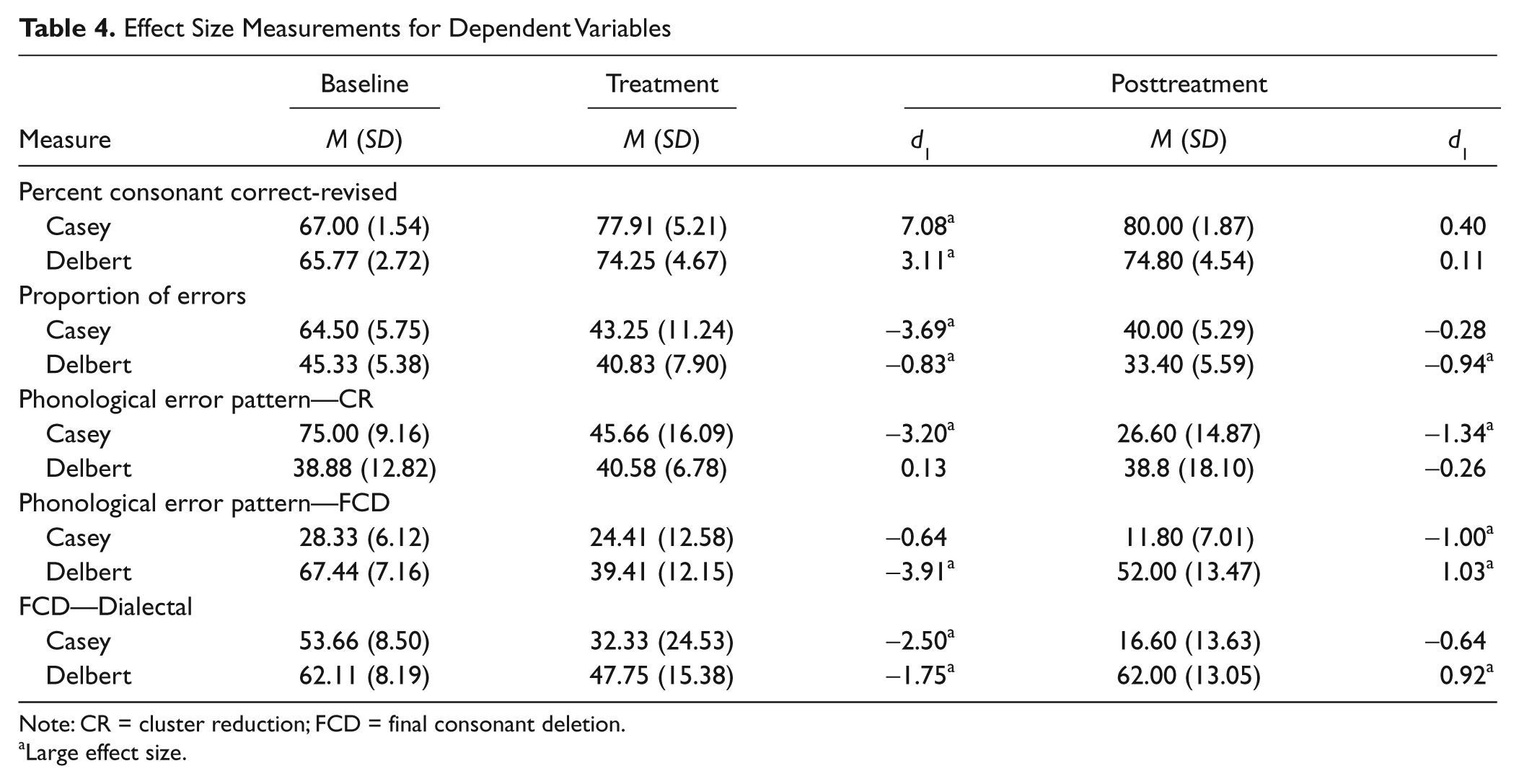
Note: CR = cluster reduction; FCD = final consonant deletion.
Large effect size.
Univariate ANOVA tests were conducted to compare high and low density, positional segment sum, biphone segment sum, and word frequency on PCC-R. Means and standard deviations of PCC-R of child responses following contrastive word pairs and direct models at high and low values of neighborhood density, positional segment sum, biphone sum, and word frequency are found in Table 5. Univariate ANOVA tests were used to compare differences of the full set of CVC, CCVC/CVCC, and bisyllabic words on PCC-R. Means and standard deviations of PCC-R for the full set of CVC, CCVC/CVCC, and bisyllabic word lists are found in Table 5. Univariate ANOVA tests were used to compare differences of the full set of CVC, CCVC/CVCC, and bisyllabic words on word frequency (see Table 3).
Ms and SDs of PCC-R of Single Word Responses to CVC, CCVC/CVCC, and Bisyllabic Words

Note: C = consonant; V = vowel.
Results
Outcomes of Treatment
Speech production change following a stable baseline and a divergence in data points for PCC-R and POE after initiation of treatment is evident for Casey and Delbert (see Figure 2). Effect sizes between baseline and treatment are large (see Table 4). Small effect sizes on PCC-R are noted between treatment and posttreatment for both children, suggesting that gains were maintained. Decreases in POE were maintained for Casey as noted by the small effect size comparing treatment with posttreatment. For Delbert, decreases continued in posttreatment as indicated by a large effect size.
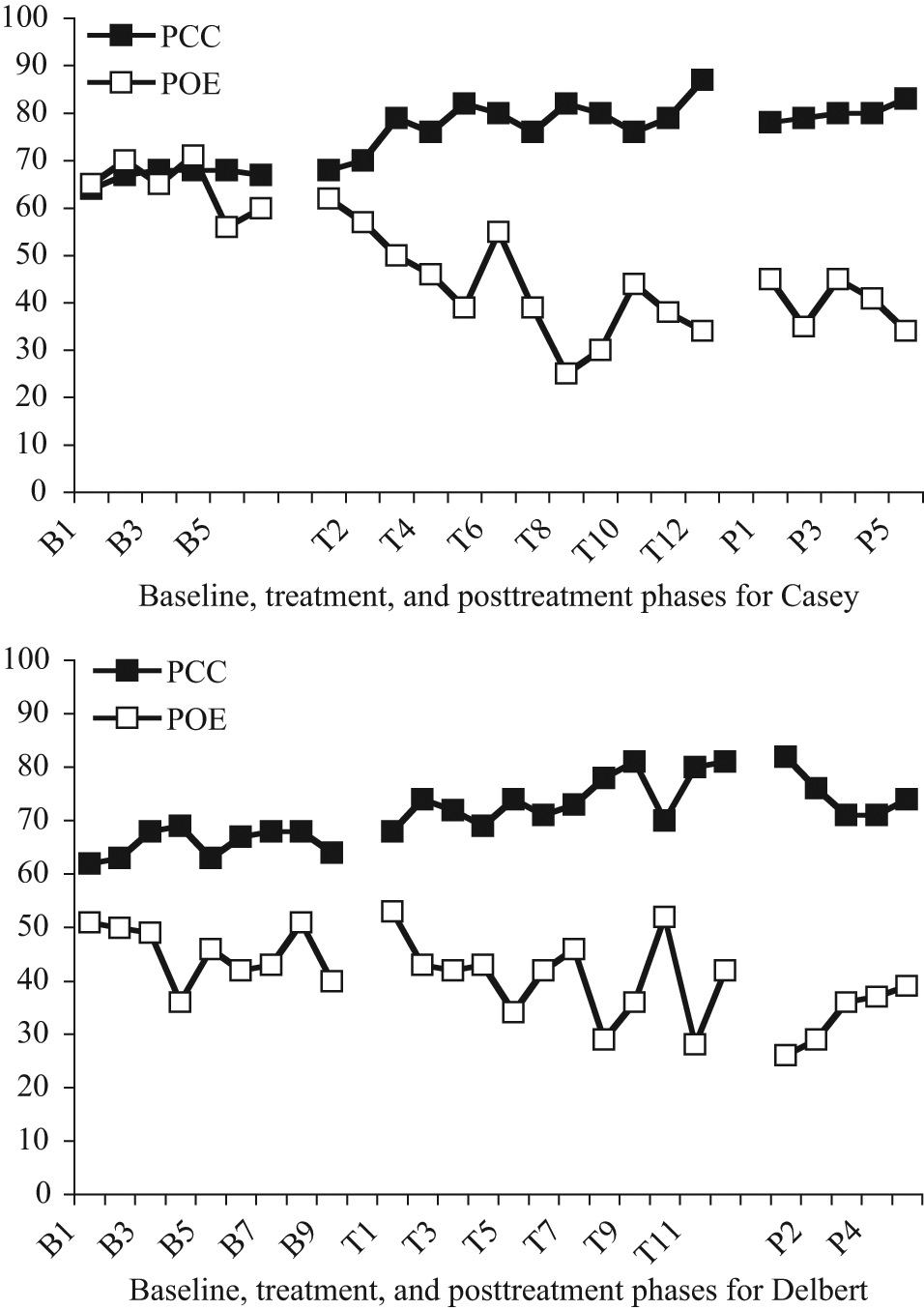
Results of PCC-revised and POE
Visual analysis of error patterns for Casey indicates decreases in CR between baseline and treatment with large effect sizes (see Figure 3). Treatment and posttreatment comparison revealed large effect sizes, suggesting that Casey continued to decrease occurrence of CR. Analysis of baseline and treatment indicated medium effect size for decreases in FCD. This pattern continued as noted by a large effect size when comparing treatment with posttreatment.
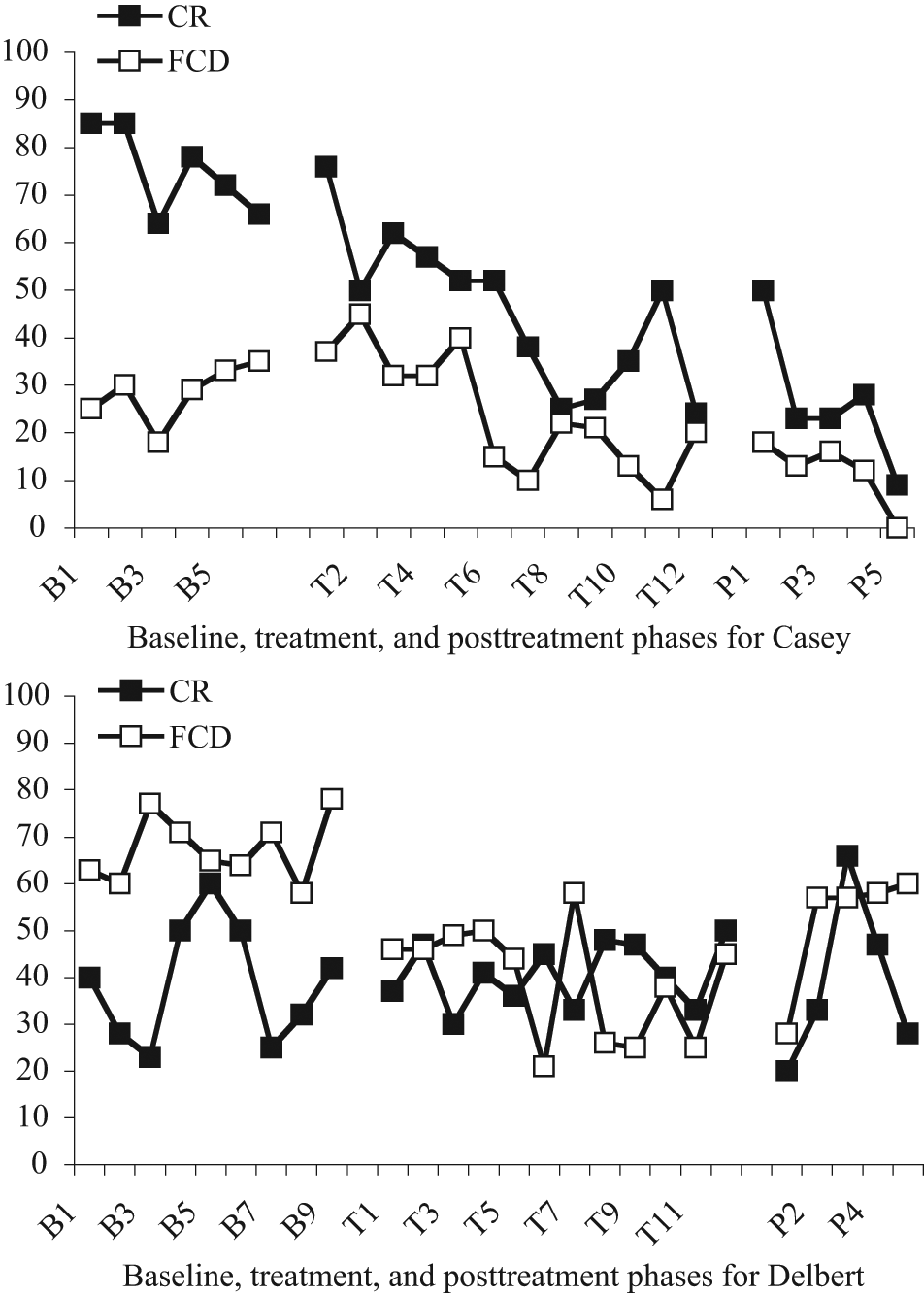
Results of percent occurrence of cluster reduction and final consonant deletion.
Visual inspection of FCD for Delbert indicates decreases with a large effect size when comparing baseline and treatment. This change was not maintained as indicated in treatment and posttreatment comparison. In fact, occurrence of FCD increased with a large effect size. Examination of CR suggests variability across phases with limited treatment effect.
Deletion of final consonants considered dialectal for Casey decreased following baseline with a large effect size (see Figure 4). Decreases continued into posttreatment with a moderate effect size. For Delbert, baseline and treatment comparisons indicate decreases with a large effect size and an increase from treatment to posttreatment with a large effect size.
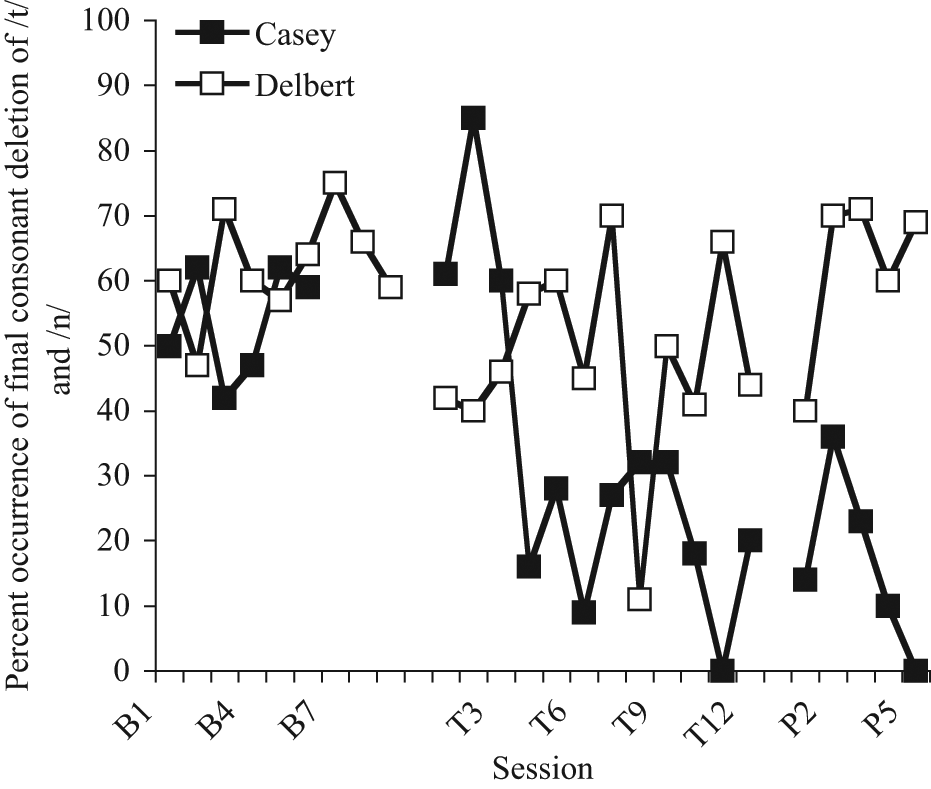
Results of percent occurrence of final consonant deletion of /t/ and /n/
Effects of Contrastive Word Pairs and Direct Models
For bisyllabic words, there was a significant difference in PCC-R for values (i.e., high/low) of number of neighbors, F(1, 65) = 10.12, p = .002; positional segment sum, F(1, 65) = 11.00, p = .003; and biphone segment sum, F(1, 65) = 14.42, p = .002. There was no significant difference in PCC-R for word frequency values of bisyllabic words, F(1, 65) = .01, p = .91. There was no significant difference in PCC-R for the CVCC/CCVC word list for values of number of neighbors, F(1, 167) = .54, p = .40; positional segment sum, F(1, 167) = .04, p = .83; biphone segment sum, F(1, 167) = 2.5, p = .11; or word frequency F(1, 167) = 1.84, p = .17. No significant difference in PCC-R was indicated for the CVC word list values for number of neighbors, F(1, 143) = .09, p = .76; positional segment sum, F(1, 143) = .24, p = .62; biphone segment sum, F(1, 143) = .66, p = .42; or word frequency, F(1, 143) = .38, p = .53.
Comparison of word frequency measures for CVC, CVCC/CVCC, and bisyllabic words was significant, F(1, 375) = 6.60, p = .002. Post hoc Bonferroni pairwise comparisons revealed that CVC and CVCC/CCVC were significantly different (p = .002) and CVC and bisyllabic words were significantly different (p = .05). CVCC/CCVC and bisyllabic words did not differ.
Comparison of PCC-R for the full set of CVC, CVCC/CVCC, and bisyllabic words was significant, F(1, 375) = 24.29, p = .00. Post hoc Bonferroni pairwise comparisons revealed that CVC and CVCC/CCVC were significantly different (p = .00) and CVC and bisyllabic words were significantly different (p = .003). CVCC/CCVC and bisyllabic words did not differ. See Table 6 for mean differences of word frequency and PCC-R.
M Differences of Word Frequency and PCC-R for CVC, CCVC/CVCC, and Bisyllabic Words
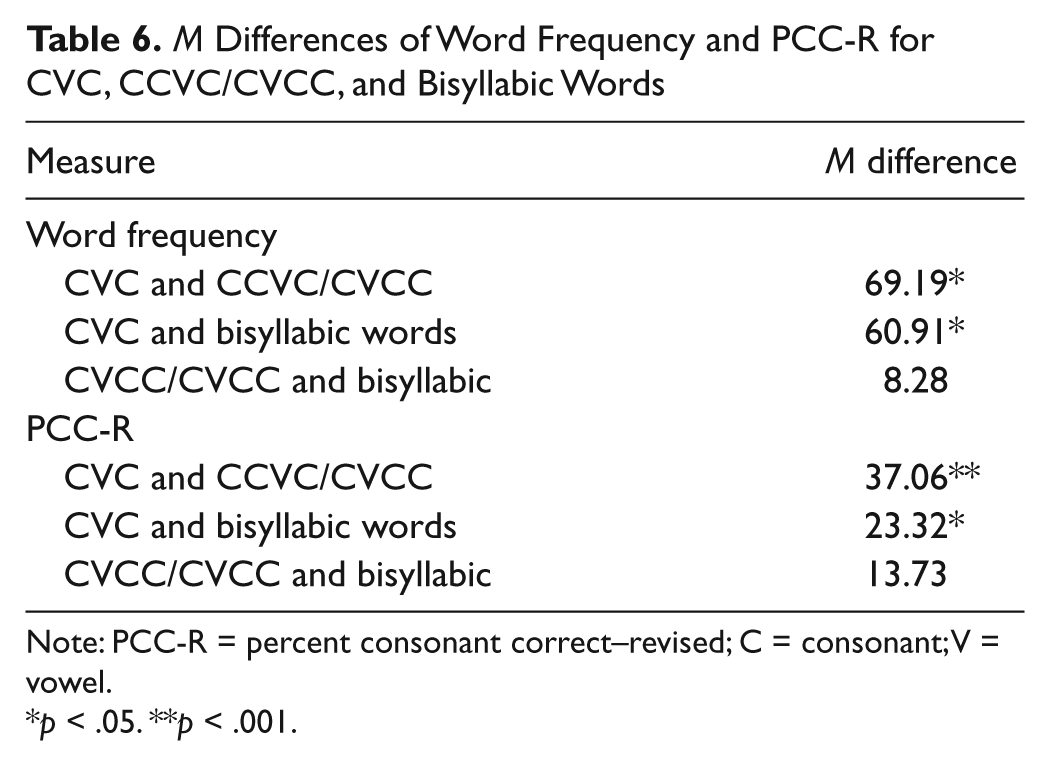
Note: PCC-R = percent consonant correct–revised; C = consonant; V = vowel.
p < .05. **p < .001.
Discussion
Similarities and differences in treatment outcomes are evident. Positive changes occurred in measures of PCC-R and POE following a stable baseline. Maintained gains in posttreatment probes suggest generalization of speech abilities. Casey and Delbert clearly increased the percent of consonants correct while decreasing the POE. Both children decreased error patterns; however, treatment effects differed.
Intervention Outcomes: Changes in CR and FCD
Visual inspection of CR for Casey reveals a downward trend across baseline, suggesting he was emerging in his abilities to use clusters. This may have contributed to the effect of treatment. This trend continued through posttreatment. It may be the combined effect of his emergent use and treatment application that resulted in the large effect size. The same pattern is evident for use of final consonants, albeit to a lesser degree because Casey did not delete final consonants with the same frequency as CR.
However, limited treatment effect was noted for Delbert on the measure of CR, though large effects were noted on FCD. When treatment was withdrawn, Delbert did not continue to use final consonants at the same rate as during treatment. He may not have generalized the use of final consonants in the absence of scaffolding. Delbert’s change on error patterns may be a consequence of developmental progression because CR spans a longer developmental stage than FCD. A longer treatment period would have provided stronger conclusions. Furthermore, production of clusters is a complex phonological task, which may have required more direct intervention.
Direction of change in FCD related to dialect for Casey and Delbert was concurrent with overall changes in FCD. Overall, positive changes in PCC-R, POE, and error patterns, including increased production of word-final/t/and/n/for both children lend support to the assertion that fundamental intervention principles are applicable regardless of native dialect.
Intervention Outcomes: Comparison With Previous Studies
The present findings corroborate an earlier study in which positive outcomes in speech production occurred during RSR with scaffolding (Bellon-Harn et al., 2004). Scaffolding strategies redundantly present linguistic elements in meaningful context. The child hears and produces the same word in several different contexts to become a more effective communicator. As in Bellon-Harn et al. (2004) and Hoffman et al. (1990), positive change in speech occurred in the absence of explicit speech targets. Instead speech was addressed within the context of a language approach using clinical feedback based on the child’s initiation or response. Collectively, results lend support to use of language-based treatments for children with speech and language impairment.
Contrastive word pairs and direct models provided direct feedback and prompting for speech production accuracy. Composition of contrastive word pairs (e.g., error patterns, later acquired sounds, new sounds) and treatment structure can influence speech outcomes (Gierut, 2001, 2005). Hart and Gonzalez (2010) emphasized the role of a contrastive word strategy targeting the error pattern stopping in a scripted intervention. Although the current study used contrastive word pairs without predetermined targets as a part of an integrated, scaffolded approach, it strengthens the conclusion that using contrastive word-pairs in a communication-based intervention is promising.
Results support the viability of this approach with children with moderate speech and language impairments. This substantiates previous studies. Of note with these participants is the difference in cognitive test scores. Delbert performed within normal limits, and Casey performed above normal limits on the CMMS. It may be that Casey managed various levels of semantic and phonological complexity within the scaffolded interaction better than Delbert. No conclusions can be drawn regarding this difference in this study.
Effects of Contrastive Word Pairs and Direct Models
A scaffolded-language intervention cannot predetermine targets for stimuli selection because the strategies are applied as a consequence of the child’s initiation or response. As a result, there were many words used in contrastive word pairs and direct models with various lexical and phonological characteristics. Several preliminary patterns are revealed. First, presentation of bisyllabic words from rare sound sequences resulted in greater PPC-R than bisyllabic words with common sound sequences. It may be that the rare sound sequence in a bisyllabic word stood out as being novel, leading to the triggering of learning. A core principle of the scaffolded-language treatment is redundant presentation of linguistic elements. As such, repetition may have facilitated processing words with rare sound sequences.
However, the children may not have been able to take advantage of the distinctiveness of bisyllabic words from sparse neighborhoods. Storkel and Hoover (2010a) suggested that children with phonological impairment recognize words from sparse neighborhoods as new, but a breakdown occurs as the child attempts to create the new lexical-semantic representation. Both children exhibited moderate speech and language impairment. The children’s impoverished lexicon may have contributed to poorer performance on words from sparse neighborhoods than words from dense neighborhoods.
Mean PCC-R was higher following CVC words as compared with CCVC/CVCC and bisyllabic words. This is likely due to the relative complexity of CVC words compared with other word forms. CVC words had significantly greater word frequency values than the other word types. One contributing factor to better performance following CVC words may be related to word frequency, which is consistent with literature identifying word frequency levels as a strong link to phonological accuracy. Other factors may be related to overall frequency of repetition of word types, which was not controlled in this study.
Some word types within contrastive word pairs and direct models differentially contributed to speech production. As a collective application, scaffolding strategies had an effect on speech production accuracy. Analysis of cloze procedures, expansions, and wh-questions should be examined for their relative impact on speech production. For example, wh-questions may contribute to responsivity while providing linguistic input. Furthermore, modeling is implicit within cloze procedures and expansions, which may augment speech production (Ellis-Weismer, Murray-Branch, & Miller, 1993; Fey et al., 1994).
Limitations and Future Research
This study presents with limitations and motivates future research. Interpretation of results and generalization to other children is limited because only two children were included. The speech profiles presented in this study can inform inclusion criteria for larger scale studies comparing this treatment approach with a control group. For example, factors such as cognitive abilities should be examined. In addition, the children’s age difference was 6 months. This may have contributed to the differences in rate of change. In a larger efficacy study, age is a variable to consider.
Future research should include a larger cohort of children speaking AAE with speech and language impairment to examine the relationship between speech acquisition, dialectal patterns, and dialect density. Many influences may have contributed to production and deletion of final consonants in this study. Further investigation into the patterns of change and contexts for variable use of final consonants with young children speaking nonmainstream English dialects participating in speech intervention is needed.
The study was short in duration. Future research should examine a treatment with controls for intrasession intensity and long-term effects. The treatment effects could be clarified in a study with greater experimental control of words and frequency of words in scaffolds within each session. One-month follow-up probes would provide greater information regarding maintenance of gains than in the current study.
Analysis of contrastive word pairs and direct model characteristics provides some initial information regarding their role in the scaffolded-language intervention. Number of words within each set and frequency of delivery of word types was not controlled, so the influences of repetition in scaffolding strategies could not be evaluated. Words were not balanced for common/rare, sparse/dense, or frequent/infrequent. Patterns should be interpreted with caution.
Footnotes
Appendix
Acknowledgements
The authors would like to thank Dr. Timothy Meline for his assistance in data analysis, Mrs. Deirdre Delcambre-Thigpen for her clinical contribution, and Lamar University for support through a Research Enhancement Grant.
Declaration of Conflicting Interests
The author(s) declared no potential conflicts of interest with respect to the authorship and/or publication of this article.
Funding
The author(s) disclosed receipt of the following financial support for the research, authorship, and/or publication of this article: The author(s) received funding thought the Lamar University Research Enhancement Grant Program.