




Abstract
Speech-language pathologists (SLPs) are experiencing the exciting challenge of serving increasing numbers of English Language Learners (ELLs) in U.S. schools. When ELLs struggle in school, they may be overreferred for speech-language services. SLPs are routinely expected to differentiate a language difference based on cultural, linguistic, and environmental characteristics from an underlying primary language impairment (PLI). This tutorial is designed to guide researchers and practicing professionals in the selection of research-based best practices for assessment and intervention for ELLs with potential PLI.
Keywords
The increasing numbers of English Language Learners (ELLs) in U.S. schools is a well-documented phenomenon that provides an exciting challenge for school-based speech-language pathologists (SLPs). The U.S. Census Bureau report in 2010 identified persons in our country who represent more than 207 different ancestral groups. More than 55 million people, or 20% of the population above 5 years of age, speak a language other than English at home (U.S. Bureau of the Census, 2011). From the 1997–1998 school year to the 2008–2009 school year, the number of ELLs in U.S. schools increased by 51%, going from 3.5 million to 5.3 million nationwide (National Clearinghouse for English Language Acquisition, 2011). By the year 2025, it is predicted that one in every four school-aged children will be an ELL (Silverman & Doyle, 2013).
Children from linguistically and culturally diverse backgrounds who are ELLs sometimes perform quite well in school. Being a proficient bilingual has many cognitive, linguistic, and social advantages (Grech & McLeod, 2012; Hammer & Rodriguez, 2012; Kohnert, 2013). However, some ELLs experience difficulty in school (Hernandez, Denton, & Blanchard, 2011; Kayser, 2012; Paradis, Genesee, & Crago, 2011). For example, results of nationwide eighth-grade math testing demonstrated that only 5% of ELLs scored at the proficient level or above compared with 35% of non-ELLs. On a national reading test, only 3% of ELLs scored at or above proficiency compared with 34% of non-ELLs (Education Week, 2012). Clearly, English language proficiency is correlated with academic success across the curriculum. It does not simply impact performance in the language arts.
Because of these difficulties, ELLs are frequently overreferred for special education, including speech and language services (Pieretti, 2011; Riquelme & Rosas, 2014; Wyatt, 2012). SLPs are regularly faced with the formidable task of differentiating between a language difference based on cultural, linguistic, and environmental characteristics and an underlying language impairment (Bedore & Pena, 2008; Guiberson, Rodriguez, & Dale, 2011; Roseberry-McKibbin, 2014). The lack of appropriate assessment instruments and methodology in this process presents significant challenges to SLPs nationwide (Kimble, 2013; Kraemer et al., 2013), and intervention for ELLs with language impairment is often not optimal (Simon-Cerejido, 2013). This article was designed to guide researchers and practicing professionals by synthesizing current research describing best practices in the assessment and treatment of ELLs with language impairments.
Background and Mismatch
One major reason that many ELLs struggle in mainstream American schools is that they begin kindergarten speaking little or no English and are frequently enrolled in schools that do not successfully support or accommodate their access to the general education curriculum (Davison & Brea-Spahn, 2012). Mainstream educational placements for bilingual students are becoming the norm in many states. The reasons for this may be related to state interpretations and initiatives (e.g., Proposition 227 of 1998 in California), the feasibility of providing instruction in the myriad of languages spoken by students in our schools, or both. As a result, there are few bilingual classrooms, and most classes in American public schools are taught in English only, with few if any supports or provisions for ELLs. In addition, many, but not all, ELLs come from cultural and environmental backgrounds that do not match that of the typical White, middle-class public school. The lack of familiarity with English coupled with environmental mismatch issues creates a great deal of vulnerability to school failure, even if students have typical underlying language-learning ability (Iglesias & Rojas, 2012; Pieretti, 2011; Rosa-Lugo, Mihai, & Nutta, 2012). According to Terry, Connor, Thomas-Tate, and Love (2010), the most salient child characteristics that predict academic success are race and socioeconomic status. Unfortunately, many ELLs tend to be from groups that disproportionately experience poverty (Hammer, 2012). In 2011, the poverty rate was lowest for Asian children (12%), followed by White children (13%). According to the National Center for Children in Poverty (2012), 63% of Hispanic children live in low-income families as opposed to 31% of White non-Hispanic children. The National Center for Education Statistics (2013) reports that 39% of Black children are poor, followed by 36% of American Indians/Alaska Natives, 34% of Hispanic children, and 30% of Native Hawaiian/Pacific Islander children (National Center for Education Statistics, 2013). Another variable that has an impact upon the performance of some ELLs is lack of preschool experience (Lopez, 2012). Research shows that ELLs from some cultural–linguistic backgrounds do not attend preschool at the same rate as children from other groups (Maxwell, 2012; Takanishi, 2006). When children come to kindergarten not speaking English, not having preschool experience, and experiencing poverty, the task of succeeding in school is daunting indeed.
When ELL students who appear to be struggling in school are referred to SLPs, the first question that SLPs usually ask is, “Does this student have a language difference or an underlying language impairment?” Language differences are behaviors that are commonly observed among second-language learners. Differences in sentence structure, speech sound production, vocabulary, and the pragmatic uses of language are to be expected when a child learns a new language. Unfortunately, children with language differences that result from limited experience in using a language are often misidentified as “language impaired.” The “language-impaired” diagnosis is appropriate only for students with disabilities affecting their underlying ability to learn any language. The challenge in assessment, then, lies in distinguishing between language and academic difficulties due to a mismatch between the child’s background and the school’s expectations and an underlying primary language impairment (PLI). It is important to recognize that although reduced language skill is the primary factor that defines PLI, there are, also, by definition, accompanying weaknesses in three areas of cognitive processing: speed of information processing, working memory, and selective/sustained attention (Jacobson & Walden, 2013; Kohnert, 2013; Singleton & Shulman, 2014). When attempting to ascertain whether or not an ELL may have a PLI, it is important to begin with a pre-evaluation process.
Pre-Evaluation Process
Before conducting a formal evaluation, there are several preliminary steps or components that should be completed as part of the pre-evaluation process. They are as follows:
A comprehensive teacher evaluation of the student’s classroom performance
The collection of a case history from parents
A review of the results of language proficiency testing
It is important that the student’s classroom teacher describe concerns regarding the student’s classroom performance. The SLP must also gather a complete case history. Research over the years has firmly established the fact that the parent report is a valid tool that helps distinguish a language difference from PLI (Goldstein, Bunta, Lange, Rodriguez, & Burrows, 2010; Grech & McLeod, 2012; Hammer et al., 2012; Kuder, 2013; Riquelme & Rosas, 2014; Simon-Cerejido, 2013). Furthermore, Dollaghan and Horner (2011), in a meta-analysis of the diagnostic accuracy of bilingual assessment measures, concluded that studies have shown that perceptions of parents, teachers, and other adults in children’s lives can provide crucial and accurate information to help professionals distinguish language differences from PLI in ELL students.
A recent study (Paradis, Schneider, & Duncan, 2013) conducted in Canada highlights the importance of parent perception in the assessment of ELLs. The children in the study were all sequential bilinguals, exposed exclusively to their primary languages before 2 to 3 years of age, and still in the process of acquiring English. There were 178 total participants in this study, including both typically developing and PLI children from a variety of socioeconomic backgrounds. The researchers used the Alberta Language Development Questionnaire (ALDeQ; Paradis, Emmerzael, & Duncan, 2010) as a parent questionnaire to gather information about early language milestones in the primary language (e.g., first words, putting words together, comparisons with other children of the same age). They then administered the nonword repetition subtest of the Comprehensive Test of Phonological Processing (CTOPP; Wagner, Torgeson, & Rashotte, 1999) and the screening form of the Test of Early Grammatical Impairment (TEGI; Rice & Wexler, 2001). The TEGI screener consists of two subtests that measure children’s accuracy in producing the third-person singular—s, regular past tense—ed, and past tense irregular verb inflection forms. The Story Grammar/Edmonton Narrative Norms Instrument (ENNI; Schneider, Dube, & Hayward, 2005) was used to assess narrative skills. The Peabody Picture Vocabulary Test-III (PPVT-III; Dunn & Dunn, 1997) was given as well. While the results of the study demonstrated that typically developing children scored significantly higher than PLI children on every language measure except the PPVT, the study concluded that the strongest indication of PLI was the results of the ALDeQ.
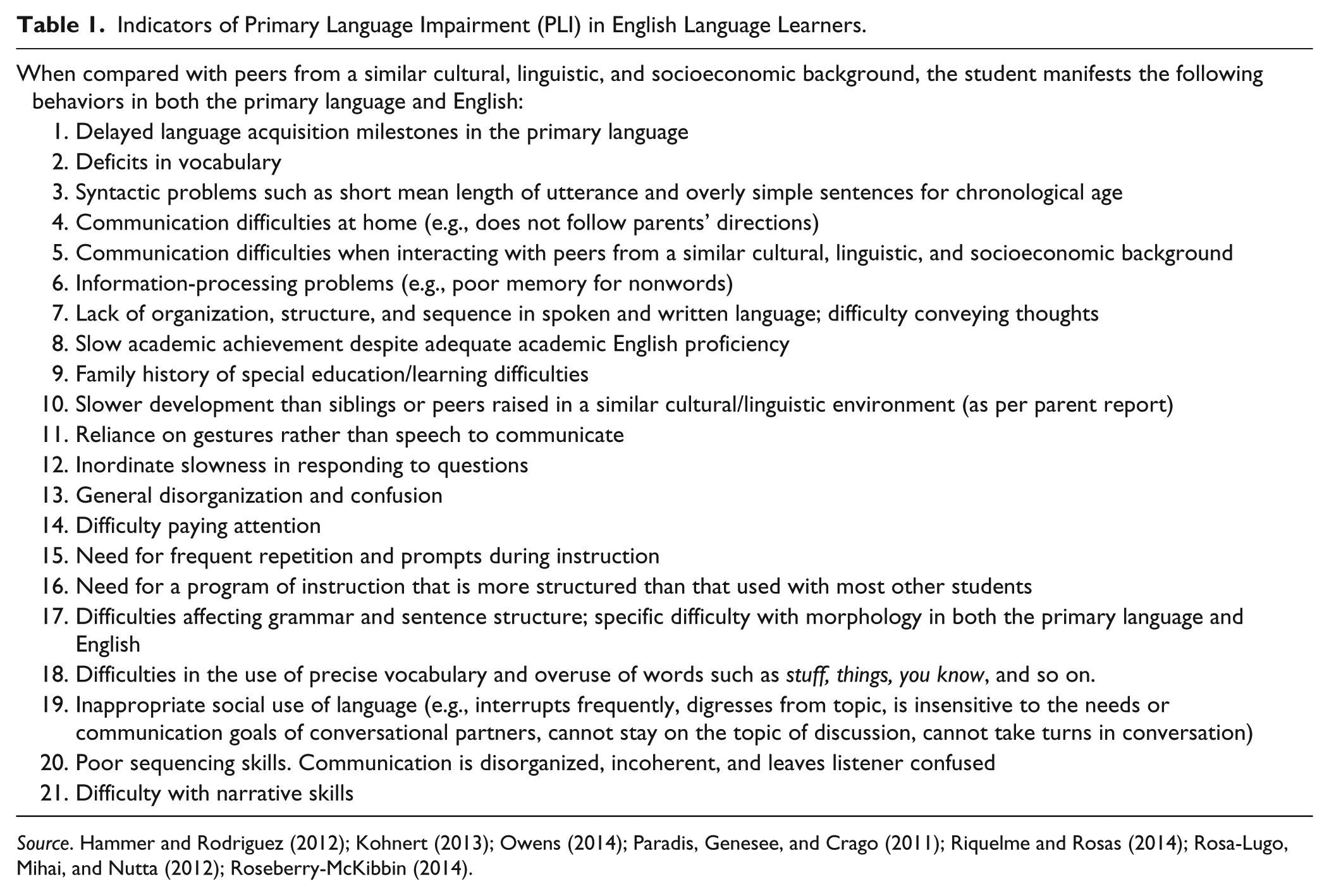
When the pre-evaluation process is carried out by a team of professionals, the information gathered facilitates decision making regarding the student’s need for both assessment and targeted intervention. As Riquelme and Rosas (2014) stated, “The most powerful weapon that SLPs have in their diagnostic repertoire is information. The more data one collects from colleagues, the community, family, and the child, the more likely one is to diagnose the child correctly” (p. 242). Therefore, when parents and teachers are interviewed during the collection of the case history, they should be asked whether they are observing any of the behaviors listed in Table 1. If parent and teacher report converge upon the fact that the ELL student in question is demonstrating a number of these behaviors or characteristics, even in the primary language, the SLP can confidently suspect that there is a definite possibility that the student has PLI.
Indicators of Primary Language Impairment (PLI) in English Language Learners.
Before considering a language assessment, it is also important to determine the ELL student’s primary language, proficiency levels in English and the primary language, and language dominance, which will vary depending upon each student’s individual background and experience. The primary language is the language the student learned first and used most frequently in the early stages of language development. Information regarding language use in the home is best established through carefully conducted parent interviews and home language surveys. The dominant language is the language spoken most proficiently by the student. The dominant language may change if there are changes in language usage patterns in the child’s environment. Moreover, language dominance can vary depending on what aspect of language is assessed (e.g., syntax vs. vocabulary). Language proficiency refers to the child’s level of skill in the use of a particular language. Information about language proficiency can be obtained through interviewing parents and teachers. Most states have language proficiency measures that assess students’ skills in both the primary language and English, and scores from these tests can also be used. A lack of progress, over time, on measures of English language acquisition also indicates that the student is not learning English within expected time frames. Such information, when available, is also indicative of the presence of PLI.
Preparing to Assess
When the information collected during the pre-evaluation process suggests the presence of PLI, further assessment is warranted to confirm the diagnosis. The information obtained about language proficiency in both languages can help determine which language is best to use in assessment. For children with very limited English and primary language dominance, testing in the primary language will provide the most accurate profile of their linguistic skills. For children who have more equivalent levels of proficiency in the primary language and English, testing in both languages is best. It is ideal to use combined scores from both the primary language and English when making clinical decisions, because some students may have experienced language loss in the primary language and are still in the process of developing English skills (Brice, Brice, & Kester, 2010; Hammer & Rodriguez, 2012; Patterson & Pearson, 2012; Pena, Kester, & Sheng, 2012).
SLPs must also consider the most valid, reliable assessment methods and materials for ELLs. According to the Individuals With Disabilities Education Act (IDEA, 2004), there must be procedures to ensure that testing and evaluation materials and methods are provided and administered in the child’s native language or best mode of communication, unless it is clearly not feasible to do so. Those who assess students must use a variety of data-gathering strategies and tools and may not rely upon any single procedure. Assessment materials must be reliable and valid, and must rule out environmental, linguistic, and cultural variables that may be affecting the student’s performance. Although informal assessment is ideal for achieving these ends, it is very common practice for SLPs to turn to standardized tests in their efforts to distinguish a language difference from PLI in ELLs (Kimble, 2013; Wyatt, 2012).
Drawbacks of Standardized Testing
Research has demonstrated that many SLPs rely almost entirely on the use of standardized tests to evaluate the language abilities of ELL students and to plan intervention/service delivery. In fact, when language evaluations are conducted, standardized tests are often the primary measure used in determining whether or not students qualify for special education intervention. In a survey of 1,736 SLPs across the United States, the Number 1 problem cited by these clinicians was the lack of appropriate, nonbiased assessment instruments with which to evaluate the ELL children who were referred for testing for PLI (Roseberry-McKibbin, Brice, & O’Hanlon, 2005). Many respondents in this survey used formal, standardized English tests. Kritikos (2003) surveyed SLPs in five different states and found similar results. Recent research indicates that lack of appropriate, nonbiased assessment instruments continues to present a substantial challenge for SLPs nationwide (Kimble, 2013; Kraemer et al., 2013; Roseberry-McKibbin, 2014).
Ecologically Valid Informal Assessment Measures
Many experts recommend the use of informal methods of evaluation, either alone or in conjunction with the use of standardized, formal tests in evaluating language skills (Grech & McLeod, 2012; Riquelme & Rosas, 2014; Wyatt, 2012). Using informal measures permits ecologically valid assessment, which considers the environment, home, and culture of the child and family; the child is assessed relative to performance in real-life contexts (Haynes & Pindzola, 2012). Federal law (IDEA, 2004) does not require the use of formal, standardized measures in the special education assessment and placement of students. Thus, SLPs can be assured that federal law allows the use of subjective, qualitative measures in the assessment of ELL students—as long as a team approach is used and the measures are equitable, valid, and nondiscriminatory. It is important that these measures possess ecological validity. Today, research has been conducted to support the validity of several informal assessment methods that reliably distinguish language differences from PLI in ELLs. These methods include dynamic assessment, response to intervention (RtI), assessment of information-processing skills, and language sampling.
Dynamic Assessment of Language-Learning Ability
Diagnoses of PLI are often made based on static assessment procedures in which formal, quantitative test scores are obtained during one or two testing sessions. This is a less than optimal approach to testing. A major difficulty with static assessment is that the information obtained represents the child’s performance at one point in time. In addition, static measures usually measure language knowledge, which can be affected by environmental variables such as poverty and lack of preschool experience as well as linguistic variables such as lack of familiarity with English. Dynamic, ongoing assessment of students’ ability to learn with instruction holds much greater promise for obtaining accurate measures of the language-learning ability of ELL students (Bedore & Pena, 2008; Kraemer et al., 2013; Paul & Norbury, 2012). Dynamic assessment determines the child’s capacity to learn when provided with instruction rather than just assessing the child’s knowledge at one point in time. Dynamic assessment also allows the examiner to observe how the student learns (Patterson, Rodriguez, & Dale, 2013). There are several types of dynamic assessments (Haynes & Pindzola, 2012; Kuder, 2013; Long, 2012). The most common one is test–teach–retest.
In the test–teach–retest method, initial testing is used to determine what the child does and does not know. Intervention focuses on teaching unknown items. The child is retested to ascertain whether he or she has acquired the newly taught information. The child is evaluated for the level of support needed to acquire the new information. In other words, the child’s modifiability is evaluated. If the child requires a substantial amount of support, more than required by peers from a similar cultural, linguistic, and socioeconomic background (similar peers), then the child may have underlying PLI. Many researchers believe that the test–teach–retest format has the best potential for fair and accurate assessment of ELLs suspected of having PLI (Grech & McLeod, 2012; Gutierrez-Clellen & Pena, 2008; Paradis et al., 2011; Wyatt, 2012). The child can be evaluated for the ability to acquire any type of new linguistic information (e.g., individual words, grammatical morphemes, social pragmatic conventions, etc.). It is helpful if several typically developing similar peers are evaluated as well; the performance and overall modifiability of the child in question can be compared with that of these similar peers.
Researchers have empirically addressed the dynamic assessment of language-learning ability in ELL student populations. For example, Ukrainetz, Harpell, Walsh, and Coyle (2000) demonstrated that dynamic assessment can be considered as one potentially reliable and valid way to assess the language-learning ability of Native American children. Kapantzoglou, Restrepo, and Thompson (2012) examined whether dynamic assessment of word learning skills is an effective method for identifying bilingual children with PLI. In this study, fifteen 4- and 5-year-old predominantly Spanish-speaking children with typical language development and 13 children with PLI participated in a 30- to 40-min session of dynamic assessment of word learning skills. A pretest–teach–posttest design was used. Results of the study indicated that typically developing children were faster than children with PLI in making associations between the semantic and phonological representations of the new words. Petersen and Gillam (2015) investigated the predictive validity of a dynamic assessment designed to evaluate later risk of reading difficulty in bilingual Hispanic children who were at risk for PLI. During their kindergarten year, 63 Hispanic bilingual children completed a dynamic assessment nonsense-word recoding task that yielded pretest–posttest scores in several areas. At the end of first grade, the same participants completed criterion reading measures of reading fluency, decoding, and word identification. The study demonstrated that use of this dynamic assessment measure in kindergarten, which was simple to administer and took less than 5 min to complete, was highly accurate in predicting later difficulties with reading.
When attempting to evaluate students’ ability to learn when provided with instruction, professionals can ask (relative to peers from similar cultural, linguistic, and socioeconomic backgrounds) the following:
How much structure and individual attention is needed for the student to acquire new language skills? Students with PLI usually need more prompts, modeling, and repetition than their peers.
During instructional activities, to what extent does the student exhibit off-task behaviors or inappropriate responses? Students with PLI may give responses that are off-topic or inappropriate. Because their problems make learning difficult, they also may show off-task behaviors such as fidgeting, annoying other students, and generally not attending to task.
To what extent does the student require instructional strategies that differ from those that have been used effectively with peers? Strategies that have worked effectively with typically developing ELL students may not be effective with students who have PLI and, therefore, these students require a more “customized” approach to instruction.
Response to Intervention
RtI may be used as a form of dynamic assessment of a student’s ability to learn when provided with instruction. RtI was mandated in the IDEA (2004) as a way of minimizing misidentification and overreferral of certain groups of students to special education. Today, researchers from many disciplines have recommended the use of RtI with ELL students suspected of having special education needs as an excellent “first step” toward assessing ability to learn when provided with instruction (Long, 2012; Rosa-Lugo et al., 2012). RtI is an assessment and intervention approach, carried out in the child’s general education classroom, that provides students with intense, high-quality, scientifically valid instruction through a three-level process that becomes progressively more individualized and intense (Long, 2012; Roth, Dixon, Paul, & Bellini, 2013). Put differently, RtI is a multitiered approach to providing services and interventions to struggling students at increasing levels of intensity. In the classroom, students are provided with small-group instruction and side-by-side teaching (McGill-Franzen & Smith, 2013).
RtI is a dynamic method for evaluating students’ ability to learn over time when provided with instruction. Before assessing ELL students for possible PLI, professionals need to ensure that these students are provided with RtI in the classroom. If students are given these extra supportive learning opportunities and continue to exhibit problems that exceed those of similar peers, the need for language intervention should be seriously considered.
Assessment of Information-Processing Skills
Over the years, research has consistently documented that children with PLI have difficulty with information processing (Chiat & Roy, 2007; Conti-Ramsden, 2003; Haynes & Pindzola, 2012; Kohnert, 2013; Leonard et al., 2007; Munson, Kurtz, & Windsor, 2005; Owens, 2014; Rispens & Baker, 2012; Roy & Chiat, 2004). Although reduced language skill is the primary factor that defines the construct of PLI, there are, specifically, often accompanying weaknesses in three areas of cognitive or information processing: speed of information processing, working memory, and selective/sustained attention (Kohnert, 2013; Singleton & Shulman, 2014). Therefore, it is assumed that students with PLI have difficulties with the mental operations required to manipulate linguistic material (Owens, 2014). While children from ELL and low-income backgrounds often have difficulty with assessment measures due to lack of background knowledge assumed by standardized tests, the assessment of information-processing skills provides ways to circumvent this pervasive problem (Kohnert, 2013; Paradis et al., 2011; Wyatt, 2012). A review of the literature supporting the validity of assessment of information-processing skills with ELLs suspected of PLI provides further insight into measures that may further help differentiate linguistic difference from PLI during the diagnostic process.
Children with PLI have difficulty recalling lists of words and do poorly on tests of auditory digit span (e.g., repeating a number sequence such as “6-3-5-1”). Difficulty repeating a series of nonsense words, or “non-words,” also appears to be a measure that is particularly sensitive to memory problems in children with PLI (Chiat & Roy, 2007; Hoffman & Gillam, 2004; Laws & Bishop, 2003). Kan and Windsor (2010) retrieved 846 published studies on the topic of word learning in children with PLI. For their meta-analysis, they analyzed 28 of the 846 studies. A strong and striking finding across studies was that children with PLI performed significantly below age-matched typically developing peers on nonword repetition tasks. The difference between typically developing and PLI participants increased as the complexity of the nonwords increased, with PLI participants demonstrating substantial difficulty remembering long nonword strings. Boudreau and Costanza-Smith (2011) reviewed research addressing the relationship of working memory to language development and academic functioning, and found that research converged upon the fact that children with PLI frequently have poor word memory skills. Campbell, Dollaghan, Needleman, and Janosky (1997) concluded that knowledge-based measures (e.g., knowledge of vocabulary) may be biased against diverse students and also suggested that professionals avoid this bias by using processing-dependent measures, such as nonword repetition, that do not tap prior knowledge and experience.
While there is a substantial body of research supporting the validity of processing-based measures with Spanish-speaking bilinguals suspected of having PLI (Guiberson & Rodriguez, 2013; Restrepo & Gutiérrez-Clellen, 2012), other research has also demonstrated the relevance of processing-based measures when used with children from other cultural and linguistic backgrounds. For example, Hwa-Froelich and Matsuo (2005) showed that processing-dependent measures were potentially useful for children who speak Vietnamese. Thordardottir et al. (2011) studied French-speaking children in Quebec, Canada. These children, with identified PLI, were evaluated in many areas, including nonword repetition, sentence imitation, following directions, digit span, and rapid automatized naming. The researchers concluded that measures of language processing provided accurate identification of PLI in French-speaking children. Thordardottir and Brandeker (2013) conducted a study of the use of nonword repetition and sentence imitation for diagnosis of PLI in French–English bilingual children. Vocabulary measures were also used. The study found that vocabulary scores were affected and influenced by previous language exposure; however, nonword repetition was not. This finding is important because it showed that typically developing bilingual children performed well on sentence repetition and nonword repetition tasks; previous language exposure did not matter. Children with PLI had difficulty with nonword repetition and sentence imitation regardless of previous language exposure (or lack thereof). Fortunato-Tavares and colleagues (2012) assessed two groups of Brazilian Portuguese-speaking children. In one group, the children were developing typically; the other group had identified PLI. Among other results, it was found that children with PLI were significantly less accurate than typically developing children on all test tasks, including those involving working memory. Engel de Abreu, Baldassi, Puglisi, and Befi-Lopes (2013) studied Portuguese-speaking immigrant children living in Luxembourg. They found that in comparison with multilingual language-majority children from Luxembourg and monolingual Portuguese-speaking children in Brazil, the results of verbal working memory measures involving numbers (e.g., digit repetition) were relatively independent of cultural status and language of testing. Vocabulary, however, was strongly influenced by linguistic and cultural backgrounds.
When information-processing measures are administered to ELLs with suspected PLI, their performance can easily and effectively be compared with that of siblings and typically developing peers from similar cultural, linguistic, and socioeconomic backgrounds. Nevertheless, there are several cautions that must be taken when using information-processing measures, such as nonword repetition tasks, with ELL students. Professionals must be careful to select only stimuli that are phonologically familiar to the children being tested and that are consistent with their articulatory abilities. For example, the use of nonwords with consonant clusters might be biased against Asian students whose languages do not contain these clusters. Young children might also have difficulty producing consonant clusters, even if those clusters exist in the primary language. Finally, nonwords should not represent real words (e.g., ganana for banana) because then children can access their lexical knowledge and thus the validity of the task as a measure of information processing is contaminated (Wagner, Francis, & Morris, 2005).
Language Sampling
In assessing oral communication of ELLs with suspected PLI, many experts recommend gathering a spontaneous language sample in English and in the child’s primary language (Jacobson & Walden, 2013; Paul & Norbury, 2012; Rosa-Lugo et al., 2012; Wyatt, 2012). When gathering a language sample from an ELL, it is important to collect the sample in a familiar context with conversational partners with whom the student is comfortable (Pena et al., 2012). Professionals must evaluate the student’s communicative competence in various settings. A bilingual SLP can be asked to collect and evaluate a sample in the primary language; if such an individual is not available, an interpreter can be utilized. It is important to examine the student’s morphosyntactic (grammatical) usage in both English and the primary language. SLPs must remember that grammatical errors in English are sometimes a result of transfer from the student’s primary language. One should not label a student as having PLI based only on grammatical errors in English. Grammatical errors are to be expected among second-language learners who have had limited exposure to the “rules” of English. Recent research has indicated that students with true PLI will usually have difficulty with verb tense morphology in the primary language. Difficulties in primary language verb tense morphology will need to be evaluated by a fluent primary language speaker. Once again, this individual would, optimally, be a bilingual SLP, but an interpreter may also be utilized.
Blom and Paradis (2013) investigated whether past tense use could accurately differentiate typically developing children from their peers with PLI when the children spoke English as a second language. All participants in this study were called “L2” learners because they were all learning English as a second language. A group of children with PLI and a matched group of typically developing peers were administered the past tense probe from the TEGI (Rice & Wexler, 2001) and the PPVT-III (Dunn & Dunn, 1997). A major finding was that the PLI group used fewer tense-marked verbs in English than the typically developing group. Blom and Paradis concluded that English past tense use could potentially differentiate between typically developing and PLI children who spoke English as a second language. More research is needed to further explore this finding with other groups of ELL children.
Grinstead et al. (2013) evaluated whether or not low performance on tense-related measures could distinguish Spanish-speaking children with PLI from those who were typically developing. Results of the study showed that in terms of tense production in Spanish, on 6 of 7 spontaneous speech measures, the PLI group had lower scores than typically developing children. Christensen and Hansson (2012) investigated the potential of past tense inflection as a clinical marker of PLI in Danish-speaking children. Using sentence repetition and completion tasks, they found that participants with PLI were less likely to produce past tense than typically developing peers. Only children with PLI had difficulties accurately producing past tense verbs in Danish during the sentence repetition task.
Southwood and van Hout (2010) evaluated whether production of tense morphology would differentiate typically developing children from PLI children who spoke Afrikaans. They found that PLI children performed worse than typically developing children in terms of tense production in sentence completion and sentence repetition tasks. Southwood and van Hout concluded that tense marking has the potential to be a clinical marker of PLI in children who speak Afrikaans. Jacobson and Walden (2013) explored the utility of language sample analysis for evaluating language ability in Spanish–English sequential bilingual school-aged children. Narrative samples were elicited from 48 bilingual children in both English and Spanish, and these samples were analyzed. The results demonstrated that word morpheme omission errors in both languages were the best predictors of bilingual PLI, and the authors concluded that these omission errors are significant as a clinical sign of PLI.
Taken together, these recent studies reveal an important diagnostic “red flag” that SLPs can look for when evaluating language samples: difficulty with tense morphology in both the primary language and English.
Intervention: Basic Principles
Determining the Language of Intervention
When planning intervention for ELLs with diagnosed PLI, it is important to support home and school languages to help these children achieve lifelong goals of vocational and academic achievement along with communicative, social, and emotional well-being (Kohnert, 2013; Roseberry-McKibbin, 2014). Much current research has emphasized the necessity of bilingual intervention to affect positive changes in PLI students’ ability to communicate in both the primary language and English (Goodrich, Lonigan, & Farver, 2013; Gorman, 2012; Lugo-Neris, Jackson, & Goldstein, 2010; Paradis et al., 2011; Pham, Kohnert, & Mann, 2011; Restrepo, Morgan, & Thompson, 2013; Riquelme & Rosas, 2014; Rosa-Lugo et al., 2012). Thus, it is optimal for intervention to occur in both English and the primary language. While this is not always feasible for a variety of reasons, including lack of materials and insufficient knowledge of the student’s primary language, efforts should be made to connect elements of the primary language to English whenever possible. For example, the SLP can easily learn vocabulary from students and their family members and incorporate these terms into vocabulary instruction. In addition, short, simple homework assignments that encourage parents, grandparents, or older siblings to talk in the primary language, English, or both about pictures or short stories used in therapy can also be beneficial. This promotes both language growth and maintenance of the primary language, which is ideal, due to the documented cognitive, linguistic, and social advantages enjoyed by fluent bilingual students (Grech & McLeod, 2012; Hammer & Rodriguez, 2012; Kohnert, 2013).
One example of a scientifically based intervention program that supports both Spanish and English in young children with PLI is Improving the Vocabulary and Oral Language Skills of Bilingual Latino Preschoolers: An Intervention for Speech-Language Pathologists (Gutierrez-Clellen, Simon-Cerejido, & Restrepo, 2014). The program can be used by both bilingual and monolingual SLPs working in collaboration with bilingual teachers or assistants. The manual contains lessons that correspond to preschool-level books that are commercially available in both Spanish and English and the lessons are presented in both languages, which also provides opportunities for language and literacy homework. Although no equivalent programs are available in other languages, SLPs can use principles of supporting both the primary language and English that are exemplified in this program.
Connecting With the Common Core State Standards
In planning intervention for ELLs with PLI, SLPs must focus on improving both social and academic language. In fact, the six instructional practices in reading that are recommended by Gersten and Geva (2003; explicit teaching, promotion of English language learning, phonemic awareness and decoding, vocabulary development, interactive teaching that maximizes student engagement, and instruction that produces accurate responses with feedback for struggling learners) are inherent in the individual and small-group instruction provided by the SLP. They are also evident throughout the Common Core Standards (National Governors Association Center for Best Practices, 2010), which were enacted in 2010 and have been adopted by 43 of 50 states (Common Core State Standards Initiative, 2014). The overarching goal of the standards is to create students who are ready to succeed in the 21st century, globally competitive society. SLPs who serve ELLs with PLI must work to align intervention goals with the Common Core State Standards. This underscores the relevance of the SLP’s job in school settings, and supports ELLs with PLI in attaining goals of the general education curriculum (Justice, 2013; Roth et al., 2013). The standards emphasize the critical relationship between oral language development, specifically listening and speaking, and the successful acquisition of reading and writing. They also stress the importance of developing students’ ability to work with informational text at all grade levels and with increasing levels of complexity as they progress through school. Because of this, there has been renewed focus on teaching expository text structures to promote successful reading comprehension. The results of a recent study (Pieretti, 2011) reaffirm the critical role of the SLP in ELL student success. The researchers examined three levels of literacy intervention for Hmong–English bilingual first-grade students in California who were exhibiting difficulties reading in English. The researchers concluded that the SLPs expertise in scaffolded oral narrative development particularly benefited struggling students whose primary language is Hmong. Phonological awareness, phonics, vocabulary, and language development were all targeted. While overall trends suggested that, on average, all students participating in this intense, short-term RtI curriculum modification were reading more words and understanding more of what they read than controls, the participants in the group that included direct instruction in oral narrative demonstrated improvement in six of the nine measures of prerequisite language and literacy skills that were measured. Furthermore, results indicating increased classroom participation and engagement were particularly compelling. The findings coincide with a similar study completed with Spanish-speaking ELLs (Vaughn et al., 2006), which suggests that contextualized, language-rich oral narratives may be an essential element in “building bridges” to academic English, including expository text structures, resulting in increased classroom curriculum participation and engagement and improved reading abilities. Such findings lead to important considerations not only for SLPs participating in multidisciplinary RtI and pre-intervention strategy development but also for those working in direct intervention, push-in, and consultative and collaborative settings.
Conclusion
New research has demonstrated that a thorough pre-evaluation process, combined with dynamic assessment, RtI, assessment of information-processing skills, and language sampling, holds great promise for appropriate language assessment of ELLs from a variety of language backgrounds with suspected PLI. These measures specifically help the SLP rule out the variable of background knowledge, which can be heavily influenced by conditions such as poverty, lack of preschool experience, and lack of knowledge of English (Roseberry-McKibbin, 2014). Accurate assessment of linguistic ability is also essential to the multidisciplinary assessment team as they explore the student’s ability to access the general education curriculum. To this end, language intervention for ELLs with PLI should ideally support both the primary language and English and should articulate with the Common Core State Standards to support ELLs in both social and academic language development.
Footnotes
Authors’ Note
Dr. Pieretti has co-authored books on language-based literacy intervention. Dr. Roseberry-McKibbin is the author of several books related to multicultural issues and English Language Learners. The authors are both frequent speakers on topics related to language and literacy in monolingual and bilingual student populations. They receive occasional speaker honoraria for these talks.
Declaration of Conflicting Interests
The author(s) declared no potential conflicts of interest with respect to the research, authorship, and/or publication of this article.
Funding
The author(s) disclosed receipt of the following financial support for the research, authorship, and/or publication of this article: Dr. Pieretti and Dr. Roseberry-McKibbin both receive financial compensation from the sale of their books in the form of royalties.