



Abstract
The purpose of this study was to evaluate the effects of phonetic transcription training on the explicit phonemic awareness of adults. Fifty undergraduate students enrolled in a phonetic transcription course and 107 control undergraduate students completed a paper-and-pencil measure of explicit phonemic awareness on the first and last days of class. Performance was analyzed for overall accuracy, as well as accuracy on easy-to-segment and hard-to-segment words. A MANCOVA revealed a main effect of group on each dependent variable. In addition, intervention-group pretest and posttest scores were not related. Thus, phonetic transcription training appears to be an effective method of increasing explicit phonemic awareness in adults, and initial skill level is not related to gains as a result of phonetic transcription training.
Keywords
Reading failure in the United States is epidemic. The most recent National Assessment of Educational Progress (NAEP) report revealed that only 36% of fourth graders, 34% of eighth graders, and 37% of 12th graders read at a proficient or higher level (U.S. Department of Education, Institute of Education Sciences, National Center for Education Statistics, & NAEP, 2015). Almost one third of students read at below basic levels. Research that explores underlying explanations of students’ low literacy acquisition and leads to effective remediation of these difficulties is vital.
Phonemic awareness, the ability to analyze the sound structure of words at the level of individual speech sounds, has emerged over the past several decades as an important, but not the only, linguistic predictor of children’s reading and spelling skills (e.g., Catts, Compton, Tomblin, & Bridges, 2012; Liberman, 1971; Mattingly, 1972; Nation & Hulme, 1997). Reading and spelling research has shown clearly that children who have higher levels of phonemic awareness are better readers and spellers than children who have lower levels of phonemic awareness (e.g., Catts, Adlof, Hogan, & Ellis Weismer, 2005). Likewise, children who are nonresponders to reading interventions exhibit persistent deficits in phonemic awareness (al Otaiba & Fuchs, 2002). Kindergarten phonemic awareness skills are positively correlated to word decoding and reading comprehension across grade levels, from elementary school to high school (Catts et al., 2012). This body of research has made it clear that phonemic awareness is critical for literacy acquisition.
The work of Read (1971), Treiman (1993), and Werfel and Schuele (2012) has revealed that during pre- and early literacy acquisition, children primarily analyze the phonological structure of words and demonstrate such analysis in their early spellings. For example, it is quite common for young children to spell r-blends with affricates (e.g., JRES for “dress,” CHRAN for “train”), representing the affrication feature of speech (Werfel & Schuele, 2012). After some level of literacy is achieved, however, children shift from analyzing words by phonemic features to analyzing words by orthographic features (Ehri & Wilce, 1980). Moats (1994) reported that teachers responsible for literacy instruction conceptualize words in terms of their orthographic form rather than their phonological form. A shift of educators from orthographic analysis to phonological analysis of words is needed to interpret and respond to student errors, select appropriate target words for teaching and testing, and sequence instruction developmentally (Moats, 1994). Therefore, Moats proposed that one need for teacher education is training that enables those who are responsible for literacy instruction to “think beyond print” (p. 94) to provide high-quality literacy instruction for pre- and beginning readers.
Explicit Phonemic Awareness
Thinking beyond print requires explicit phonemic awareness skills. A higher level skill than phonemic awareness, explicit phonemic awareness is the ability of a literate individual to analyze the sounds of words separate from print. After breaking the code of letter–sound correspondence, individuals are influenced heavily by print in their analysis of words, even when instructed to analyze the sounds of words (Ehri & Wilce, 1980). Explicit phonemic awareness requires individuals to ignore their knowledge of word spellings and analyze words based on sound alone. Individuals with lower levels of explicit phonemic awareness are highly influenced by print and likely would report that “witch,” for example, has more sounds than “rich.” However, individuals with higher levels of explicit phonemic awareness are better able to analyze the sound structure of words while ignoring the influence of print and, thus, likely would report correctly that “witch” and “rich” contain the same number of sounds.
The National Reading Panel recommended that phonemic awareness be included as a key component of early literacy instruction (National Institute of Child Health and Human Development [NICHD], 2000). A growing body of research, however, questions educators’ ability to provide high-quality instruction in this area because of limited explicit phonemic awareness skills (Cunningham, Perry, Stanovich, & Stanovich, 2004; Moats, 1994; Spencer, Schuele, Guillot, & Lee, 2008). Research in reading, as well as other academic areas such as mathematics, demonstrates that teacher content knowledge is an important predictor of their students’ outcomes (Cunningham, Etter, Platas, Wheeler, & Campbell, 2015; Hill, Rowan, & Ball, 2005).
Educators, as well as adults in general, are likely to have poor explicit phonemic awareness skills (Werfel, Lund, & Schuele, 2013; Cunningham et al., 2004; Moats, 1994). Speech–language pathologists (SLPs), however, consistently outperform other groups of educators on tasks of explicit phonemic awareness (Spencer et al., 2008). Spencer et al. (2008) reported that SLPs were 76% accurate at counting the number of sounds in words overall. In contrast, kindergarten and first-grade teachers were 53% and 56% accurate, respectively, and reading teachers and special education teachers were 56% and 50% accurate, respectively. When considering performance only on hard-to-segment words (i.e., words for which thinking beyond print is most required because the sound-to-letter correspondence is not transparent), SLPs performed with 48% accuracy; other educators achieved accuracy levels of only 21%. This finding indicates that when teachers provide phonemic awareness instruction with target words that do not have transparent sound-to-letter correspondence, they would incorrectly segment the word almost 80% of the time.
Of particular interest to the current study is the underlying source of SLPs’ higher levels of explicit phonemic awareness compared with other educator groups. SLPs’ preprofessional education includes specific training about the sounds of speech (i.e., phonetic transcription training); whereas teachers’ preprofessional education includes a specific focus on letters and phonics rather than speech sounds. The working hypothesis that drives the current study is that phonetic transcription training is the active ingredient in preservice education that results in SLPs’ higher levels of explicit phonemic awareness, but this hypothesis has not been empirically evaluated to date. Moran and Fitch (2001) measured undergraduate SLP students’ explicit phonemic awareness and phonetic transcription skills and found that higher performance on some explicit phonemic awareness tasks at the beginning of the course was positively correlated with performance on some tasks of phonetic transcription ability administered throughout the course. An important limitation of Moran and Fitch (2001), however, was that explicit phonemic awareness was not reevaluated following the phonetic transcription training. Thus, the literature currently contains no evidence of the effects of phonetic transcription training on explicit phonemic awareness.
The study reported here is the first to empirically evaluate the hypothesis that phonetic transcription training results in the higher levels of explicit phonemic awareness observed in SLPs than other groups of adults. If this hypothesis is accurate, phonetic transcription training may be an effective method of increasing explicit phonemic awareness skills in other educator groups as well. Typically, SLPs first are exposed to phonetic transcription training during their undergraduate program or as a prerequisite leveling course before beginning their graduate studies. Therefore, the purpose of this study was to evaluate the effects of phonetic transcription training on explicit phonemic awareness skills of undergraduate students in an SLP program.
Method
All study procedures were approved by the [University] Institutional Review Board.
Participants
Participants in the intervention group were 50 undergraduate students enrolled in a phonetic transcription course at the University of South Carolina. All intervention-group participants were undergraduate students pursuing a minor in communication sciences and disorders or were completing prerequisite coursework before beginning a master’s program in speech–language pathology. Participants in the control group were 107 students enrolled in an introduction to communication disorders course at the [University]. This course provides a general overview of the fields of speech–language pathology and audiology but does not contain specific instruction in phonetic transcription training. No participant had previously completed any training in phonetic transcription, per self-report.
Procedures
Phonetic transcription training
The phonetic transcription training consisted of a three-credit semester-long course. During the phonetics course, students learned manner, place, and voicing properties of each English phoneme, as well as how to transcribe each English phoneme in words and phrases. The first two course meetings introduced phonetics as the study of speech sounds and described the differences between graphemes and phonemes, as well as the reasons for using phonetic transcription in clinical practice. The third-course meeting discussed the anatomy and physiology of the speech mechanism. Each subsequent course meeting focused on a particular class of sounds: front vowels, central vowels, back vowels, diphthongs and r-colored vowels, plosives, fricatives, affricates, nasals, glides, and liquids. Instruction for each phoneme within a course meeting began with a short lecture describing its properties, the International Phonetic Alphabet symbol that represents it, features of the phoneme (e.g., syllable positions in which it can and cannot occur, common English spelling patterns of the sound, distinctive features), and allophonic variations of the phoneme. In the course meeting following each lecture on a class of sounds, students had the opportunity to practice transcribing the phonemes; sometimes transcription occurred at the board and sometimes at the students’ desk. In all cases, students transcribed every word presented (i.e., at their desk), whether it was their turn at the board or not. The final two course meetings discussed dialectal variation in speech sound production and connected speech. Students completed transcription quizzes after learning each new class of phonemes, as well as a midterm and final examination.
Measure
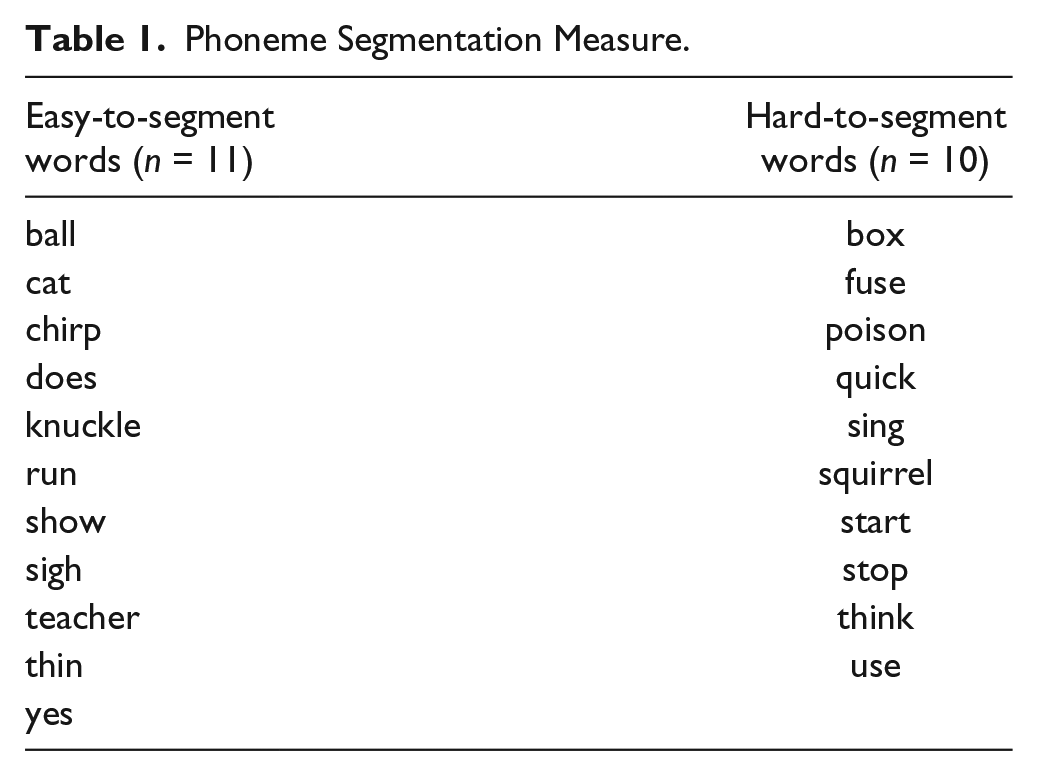
Participants completed a paper and pencil measure that assessed phoneme segmentation (Spencer et al., 2008). Because participants were presented written forms of words, this phoneme segmentation measure tapped explicit phonemic awareness skills that required participants to overcome orthographic information to analyze the sounds in words. The phoneme segmentation measure required participants to count the number of sounds in 21 words. Words ranged from two to six sounds. For each item, participants could select a response from one to 10 sounds. The phoneme segmentation measure contained words that had transparent (easy-to-segment; for example, cat) or nontransparent (hard-to-segment; for example, box) sound-to-letter correspondences (see Table 1). Designation as easy-to-segment or hard-to-segment was derived empirically from educators’ performance reported in Spencer et al. Easy-to-segment words were correctly segmented by more than 75% of participants in the Spencer et al. study; hard-to-segment words were correctly segmented by fewer than 65% of participants (no word’s accuracy in Spencer et al. fell in between the two cut-points). Correct responses received a score of 1, and incorrect responses received a score of 0. The maximum overall score was 21. The maximum scores for easy-to-segment and hard-to-segment words were 11 and 10, respectively.
Phoneme Segmentation Measure.
Participants completed the phoneme segmentation measure at two time points: the first day of class and the last day of class in the semester. Administration of the measure was not timed. Participants did not receive a course grade for the measure, and identifiable information was not collected. All students present for each testing point chose to participate in the assessment.
Scoring and reliability
For each participant, two overall scores were calculated: number correct on the phoneme segmentation measure at pretest and number correct on the phoneme segmentation measure at posttest. In addition, scores for easy-to-segment and hard-to-segment words were calculated for each participant at each time point. The author or a research assistant scored responses, and a second research assistant double-checked all scoring. Scorers were blind to participants’ group. There were fewer than 10 disagreements in data entry; each was resolved by discussion, resulting in 100% agreement of final scoring.
Results
Table 2 displays descriptive data and group comparisons for all study variables. Group differences between all variables were significant. Cohen’s d effect sizes indicated larger magnitudes of difference between groups at posttest than pretest for each variable (Cohen, 1988). Figure 1 displays pretest and posttest data for each group on easy-to-segment and hard-to-segment words. Because group differences were observed at pretest, total pretest score was used as a covariate in the primary analysis.
Descriptive Statistics of Study Variables.

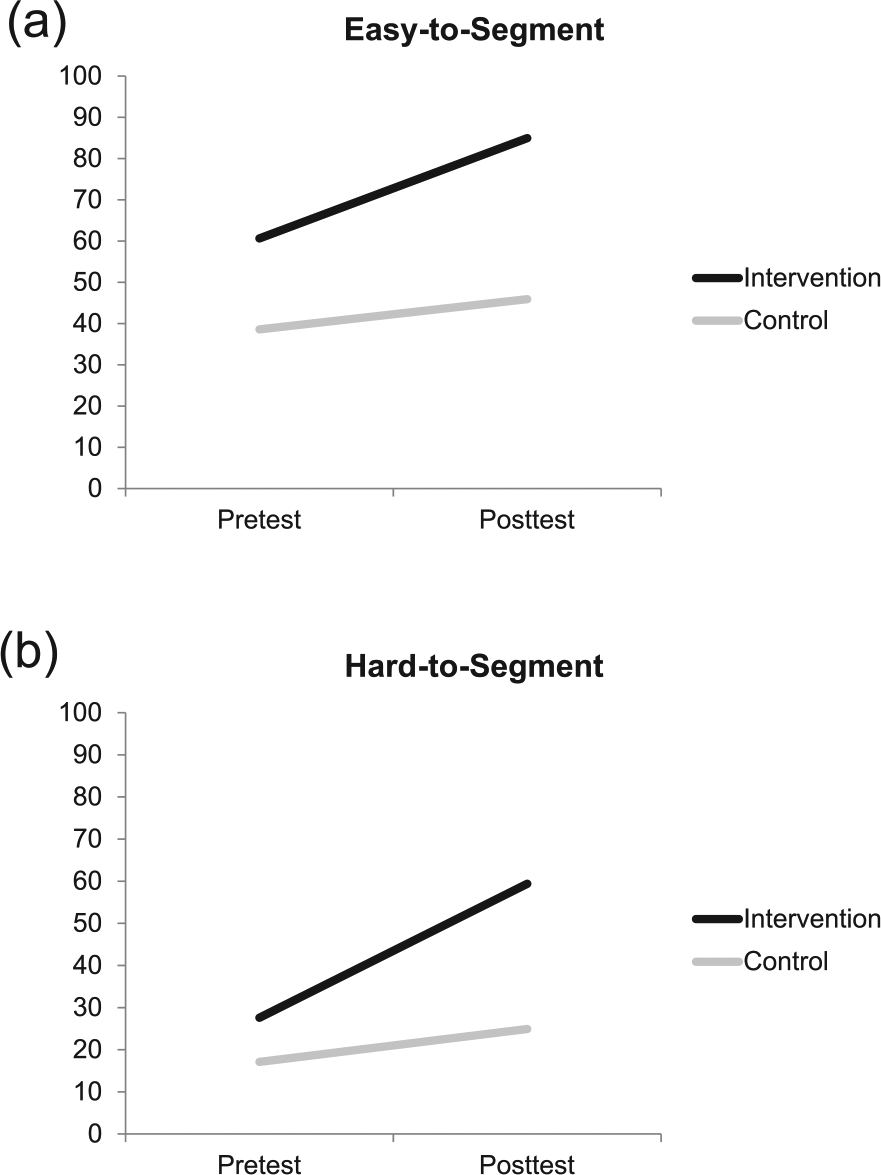
Growth in phoneme segmentation performance from pretest to posttest by each group: (a) displays growth on easy-to-segment words and (b) displays growth on hard-to-segment words.
A MANCOVA with posttest total percent correct, posttest easy percent correct, and posttest hard percent correct as the dependent variables, group as the between-subjects factor, and total pretest score as the covariate was conducted. The overall MANCOVA indicated main effects of group for each dependent variable, F(2, 154) = 109.52, p = .000, d = 2.08, 95% confidence interval (CI) = [1.44, 2.48]; F(2, 154) = 107.79, p = .000, d = 2.01, 95% CI = [1.52, 2.16]; F(2, 154) = 61.26, p = .000, d = 1.64, 95% CI = [1.25, 2.06], respectively. Cohen’s d effect sizes indicated large group differences at posttest for each dependent variable (Cohen, 1988).
Time
Follow-up t tests indicated significant growth from pretest to posttest for both groups on easy-to-segment words, intervention: p = .001; control: p = .001; and hard-to-segment words, intervention: p = .000; control: p = .000. Cohen’s d effect sizes for the control group indicated small to medium change over time, d = 0.33 and 0.42, 95% CIs = [0.06, 0.60] and [0.15, 0.69] for easy-to-segment and hard-to-segment, respectively. In contrast, effect sizes for the intervention group indicated large change over time, d = 1.34, and 1.47, 95% CIs = [0.79, 1.73] and [0.91, 1.86] for easy-to-segment and hard-to-segment, respectively.
Word Difficulty
Follow-up t tests indicated that participants in both groups were more likely to respond correctly on easy-to-segment words than hard-to-segment words at posttest, intervention: p = .000; control: p = .000. Cohen’s d effect size indicated large effects of word difficulty for the intervention and control groups, d = 1.29 and 1.02, 95% CIs = [0.78, 1.72] and [0.73, 1.30], respectively.
Relation of Study Variables
Table 3 displays correlations of study variables. For the control group, all correlations were significant. Performance on each variable at each time point was related. In contrast, for the intervention group, performance on each variable at pretest was related, and performance of each variable at posttest was related. Intervention-group performance at pretest, however, was not related to performance at posttest.
Correlations of Study Measures.

Note. Control group is displayed above the diagonal; intervention group is displayed below the diagonal. Bolded correlation coefficients are significant at p < .004 (corrected for multiple correlation coefficients).
Discussion
The aim of this study was to evaluate the effects of phonetic transcription training on explicit phonemic awareness skills of adults. The hypothesis that phonetic transcription training would result in growth in explicit phonemic awareness was confirmed. Undergraduate students in the intervention group exhibited substantial gains in explicit phonemic awareness skills compared with the control group. The novel findings from this study suggest that phonetic transcription training results in the increased levels of explicit phonemic awareness that have been observed in SLPs (e.g., Spencer et al., 2008).
Before participating in phonetic transcription training, the undergraduate students’ ability to count the phonemes in written words was generally poor. Both groups on average scored below 50% overall accuracy at pretest. At posttest, only the intervention group scored above 50% overall accuracy; the control group’s performance remained below 50% overall accuracy. The same pattern of performance was observed on hard-to-segment words: both groups scored below 50% accuracy at pretest, and only the intervention group exceeded 50% accuracy at posttest. These findings support the hypothesis that the mechanism behind the higher explicit phonemic awareness skills of SLPs is phonetic transcription training during undergraduate speech–language pathology education programs.
Although the control group exhibited some growth in explicit phonemic awareness skills across the semester, the group means of all posttest scores remained below the pretest levels of the intervention group. In addition, effect sizes suggested that the growth in the intervention group was approximately 3.5 to 4 times that of the control group. Figure 1 in particular illustrates the different slopes of growth between groups. This finding indicates that exposure to a general overview of speech and language concepts such as in an undergraduate introduction course results in small changes in explicit phonemic awareness skills. The elevated skills similar to those observed in practicing SLPs (Spencer et al., 2008), however, were not observed until after students learned how to phonetically transcribe words. The intervention-group undergraduate students in the current study exhibited strikingly similar levels of overall accuracy to the practicing SLPs in Spencer et al., 72% and 76%, respectively. This similarity lends further support to the hypothesis that phonetic transcription training, and not professional experience, leads to higher levels of explicit phonemic awareness in SLPs.
Growth in performance on hard words was greater than growth on easy words for the intervention group. This finding lends further support to the claim that phonetic transcription training is indeed an effective method of shifting the focus from letters to sounds when analyzing words in literate adults. For easy words, the phoneme-to-grapheme correspondence is transparent, and an analysis of letters can often lead to the same response as would an analysis of sounds. For example, easy words included cat, run, and stop. For each of these words, basic orthographic knowledge of letter–sound relationships results in an accurate count of the sounds. In contrast, hard words included sing, quick, box, and fuse. For each of these words, orthographic conventions do not match individual sounds. In sing, the letter pair “ng” represents one sound: /ŋ/, which is not commonly taught in schools as a single sound but rather as a consonant blend (Moats, 1994). “Qu” and “x” represent consonant blends (/kw/ and /ks/, respectively) but commonly are taught as single sounds. Fuse contains the /j/ sound, which is not separately represented in its spelling. For such hard words, a reliance on their orthographic patterns will not lead to accurate performance. Instead, accurate performance on hard words requires individuals to ignore the print to analyze the sounds of a given word.
Interestingly, correlations of study variables indicated that performance at pretest was not related to performance at posttest on any variable for the intervention group. Thus, baseline levels of performance may not be a contributing factor to the effectiveness of phonetic transcription training for improving explicit phonemic awareness. That is, prior levels of explicit phonemic awareness skills did not affect the final outcomes; instead the phonetic transcription training resulted in gains in explicit phonemic awareness regardless of prior skills. Interpreting this finding in light of Moran and Fitch (2001), it appears that the relation of explicit phonemic awareness and phonetic transcription ability may be unidirectional, such that baseline explicit phonemic awareness affects phonetic transcription ability (Moran & Fitch, 2001), but baseline explicit phonemic awareness does not affect the effectiveness of phonetic transcription training on subsequent explicit phonemic awareness skills (present study).
Clinical Implications
Many research groups have reported the need for increased explicit phonemic awareness skills of educators (e.g., Cunningham et al., 2004; Moats, 1994; Spencer et al., 2008). The present findings reveal that a semester-long course in phonetic transcription training resulted in greater explicit phonemic awareness skills in almost all students, regardless of their initial explicit phonemic awareness performance. When considered alongside previous research in this area, the findings of this study have important implications for practice. Explicit phonemic awareness is malleable in adults. It is reasonable to hypothesize that the increased skill as a result of phonetic transcription training is not limited to SLPs. Training programs in education and special education should consider incorporating phonetic transcription training, and future work should identify efficacious methods of doing so.
Limitations and Future Directions
As with any study, there are limitations of the current investigation. This study was the first to empirically evaluate the effects of phonetic transcription training on explicit phonemic awareness. Future work is needed to confirm the preliminary findings reported here. Because the study evaluated the effects of an undergraduate course in phonetic transcription, random assignment to groups was not possible. Future work should confirm the present findings with studies that employ random assignment to group. This study did not include follow-up beyond the posttest. Future work should employ a long-term follow-up design to measure the lasting effects of phonetic transcription training on explicit phonemic awareness skills. Only one measure of explicit phonemic awareness (phoneme counting) was measured. Future studies should measure additional skills. A semester-long course is time-intensive training and probably not feasible for other types of educators, particularly practicing educators. Future research should explore the effects of shorter periods of phonetic transcription training on explicit phonemic awareness of educators. In addition, future research should evaluate the relation of phonetic transcription ability after training and explicit phonemic awareness and explore moderators of the effectiveness of phonetic transcription training on improving explicit phonemic awareness.
Conclusion
Learning to transcribe necessarily requires adults to shift the way they analyze words. Indeed, phonetic transcription training results in increased explicit phonemic awareness skills for undergraduate students. The findings of this study suggest that phonetic transcription training may be the key to shifting the way educators analyze words for phonemic awareness and early literacy instruction.
Footnotes
Declaration of Conflicting Interests
The author(s) declared no potential conflicts of interest with respect to the research, authorship, and/or publication of this article.
Funding
The author(s) received no financial support for the research, authorship, and/or publication of this article.