



Abstract
Telepractice offers speech-language pathologists (SLPs) increased flexibility to support language development, including emergent literacy in clients with complex communication needs. However, clinicians may feel uncertain how to pair books with augmentative and alternative communication (AAC) over telepractice. Following an overview of telepractice, book sharing, and e-helpers, we describe four practical ways to combine storybooks with AAC online. These include: (a) using accessible books, (b) screen sharing e-books and communication aid, (c) adapting slide shows, and (d) creating asynchronous videos. Finally, we offer suggestions for modeling AAC, prioritizing emotions in storybooks, and tips for clinical supervisors. This topic can direct future researchers and is relevant to practicing clinicians who want to support language development for clients using aided communication systems.
Keywords
This tutorial describes four ways speech-language pathologists (SLPs) can pair books with communication aids, including high-tech and low-tech AAC, over telepractice. Book sharing promotes literacy and language development; this tutorial extends that knowledge by explaining how to use known procedures over telepractice. Despite the increased use of telepractice, clinicians may feel hesitant about how to coordinate components (i.e., books, AAC, interaction, and language support) online. This under-researched area of speech-language pathology is relevant to researchers and clinical practitioners.
Book Sharing Over Telepractice Promotes Language
Researchers support telepractice as an effective and flexible service delivery model for SLPs (Hines et al., 2019). Telepractice is a “a service that is provided at a distance to a patient or client” (Stredler-Brown, 2014, p. 21), usually online. This format allows SLPs to increase services to rural regions and culturally and linguistically diverse clients (Curtis, 2014; Grogan-Johnson, 2012; Hines et al., 2019). Barriers to telepractice include failure to collaborate, interstate license restrictions, technical difficulties, and reimbursement challenges (Curtis, 2014; Grogan-Johnson, 2012). Despite these barriers, telepractice continues to gain momentum and provide effective therapy options.
Book sharing and storybook reading promote language for all children (Kaderavek & Justice, 2002; Teale & Sulzby, 1986). The context of book sharing, including picture books, was identified as one in which toddlers acquire new vocabulary (Snow & Goldfield, 1983). Thus, storybook reading creates an important foundation in the home for developing oral language, comprehension, and vocabulary (Beauchat et al., 2009; Kaderavek & Justice, 2002). Book sharing also allows the adult and child to co-construct meaning, so the child can use that new knowledge to communicate with others.
Book sharing, when paired with AAC, facilitates overall communication for children with complex communication needs (CCNs). Students who use communication aids increase responses when interacting over a storybook compared to other conversation formats (Jackson et al., 2011; Koppenhaver et al., 2001). Book sharing with AAC should include repeated readings, interactive discussions, prosody models, classic literature, and use of thematic units (Beukelman & Mirenda, 2010; Madel & Bugaj, 2018). Language intervention with communication aids also requires partner training and collaboration (Kent-Walsh et al., 2010; Starble et al., 2005). Challenges include the basic logistics of coordinating a client, a book, a communication aid, and e-helpers within the social context (Coleman-Pierce, 1991). Executing this multilayered task within telepractice can be done.
E-Helpers are Essential
All the strategies listed in this tutorial depend on the participation of e-helpers (e.g., parents, caregivers, teachers, or paraprofessionals) to support the child with CCN. E-helpers are adults who can assist clients in real time at their location (Sippl & Ciccia, 2014). Ideally, an e-helper is dedicated to participating in the telepractice session and has received preservice training related to technical set up (Fissel et al., 2015). This training includes spending time during the first session addressing technical issues and ongoing collaboration (Curtis, 2014; Starble et al., 2005). E-helpers can read Figure 1: E-Helper Getting Started Checklist for additional tips.
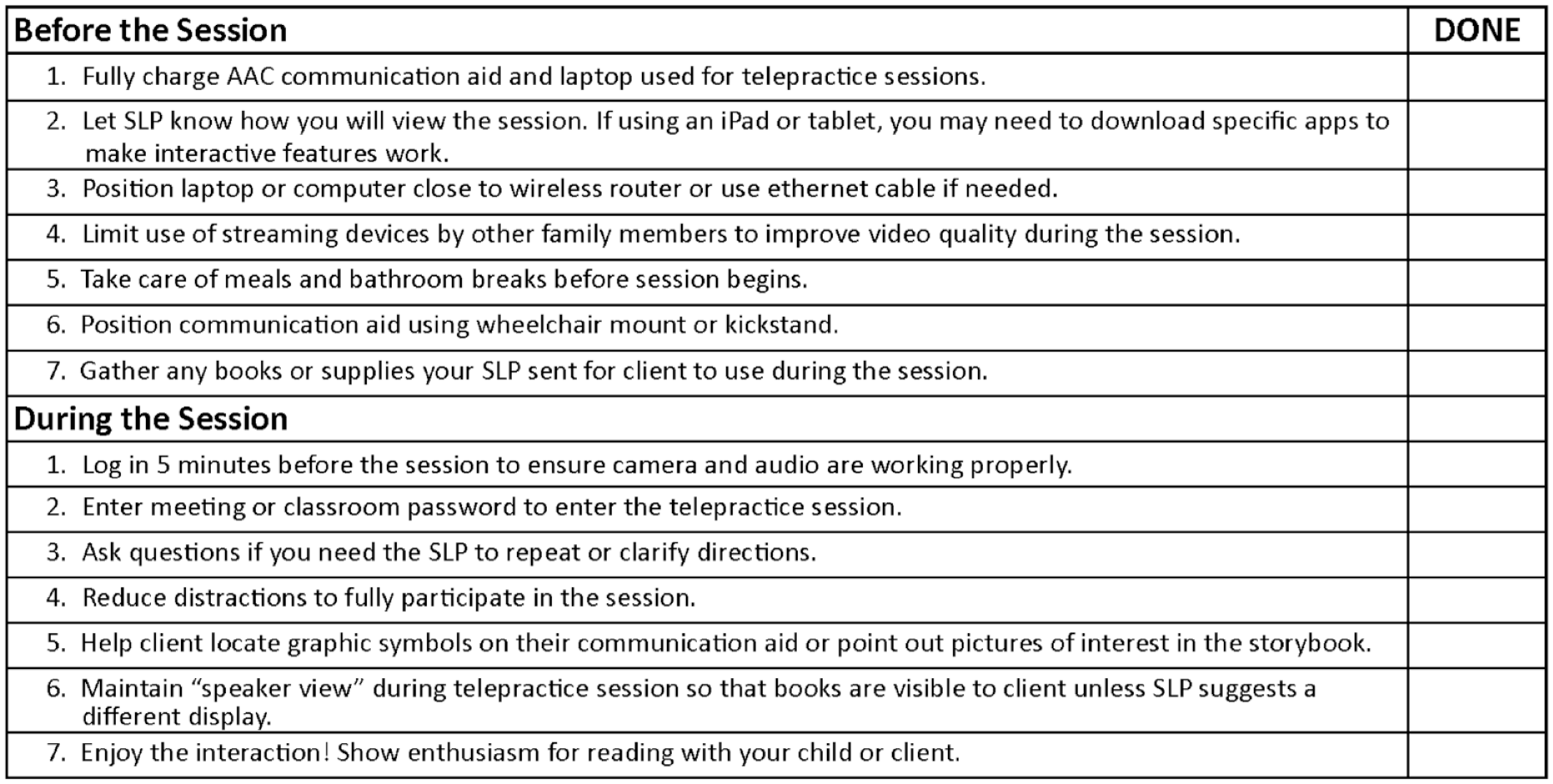
E-Helper Getting Started Checklist to Support Reading
Four Ways to Pair Storybooks With AAC Over Telepractice
What is the best way to pair storybook reading with AAC over telepractice? While a common approach is simply positioning materials—a storybook and communication aid—in the camera view over telepractice, this approach is not effective owing to poor visibility. SLPs should consider client needs, planning time, and technology access when considering options. This tutorial describes four flexible strategies, but SLPs should select approaches that meet the individualized needs of each client.
Strategy 1: Use accessible books online
The first strategy is to use accessible books that you create or obtain online. Tarheelreader is a database of stories that are accessible using touchscreens, switches, or adapted keyboards (tarheelreader.org). This site offers age-appropriate, motivating stories for older readers, but can be used with emergent readers. To use accessible books over telepractice, identify the best access method for your client and show the e-helper how to connect the switch or keyboard if needed. If your client accesses a touchscreen manually or with a stylus, there is no additional set up required. Within your telepractice platform, screenshare to display the book onto the screen and conduct your session. Support language skills by discussing vocabulary, identifying pictures, and helping the client connect stories to their own background knowledge.
This approach takes minimal planning time, and storybooks are already adapted for clients with CCN. Clinicians can create a favorites page, and a rating system exists to help identify appropriate content for clients. SLPs who have limited planning time or want clients to create their own stories may prefer this strategy. These stories are readily available and are ideal for use with low tech communication aids. However, SLPs should screen books for suitability and ensure the books integrate with the client’s aided communication system.
Strategy 2: Screen share book while holding communication aid
Another technique for pairing storybooks with AAC over telepractice is using screen share to display an e-book while holding the communication aid in the speaker window. The following steps outline this strategy using Zoom Pro features, but readers can adapt the format if using different telepractice software. First, retrieve an e-book from your preferred platform (e.g., YouTube, Epic, Tumblebooks, Kindle, or Vooks). Next, click “Share Screen” at the bottom of the speaker window, selecting storybook in the main view. Position the communication aid in the speaker window to point out words or graphic symbols as you engage in conversation about the story. E-helpers can expand the speaker window by dragging it to increase visibility. During the session, keep the book at the center of therapy, supporting language development by reading aloud, discussing vocabulary, and connecting concepts.
SLPs can use this strategy with dynamic or static AAC displays, it requires little planning time, and e-books can be changed if the client requests a different story. However, it may be difficult for clients to see the speaker window clearly (e.g., if client is using a phone to view the session). Take care to keep your face in view, together with the materials to preserve the essential interactive human component that drives purposeful, social communication. Young children take their cue from your facial expressions and how you communicate the story to them.
Strategy 3: Create an adapted slideshow
A third strategy for storybook reading with AAC over telepractice is to create an adapted book using slideshow software (e.g., Powerpoint or Google Slides). The following steps will help you get started. First, screenshot pictures of each page of the storybook and the communication aid (or graphic symbols) you want to highlight. Then select and paste each storybook page and graphic symbol to individual slides. Play slideshow in presentation mode, reading the book and connecting concepts while encouraging the e-helper and client to use their aided communication system. See Figure 2 for an example of this strategy.
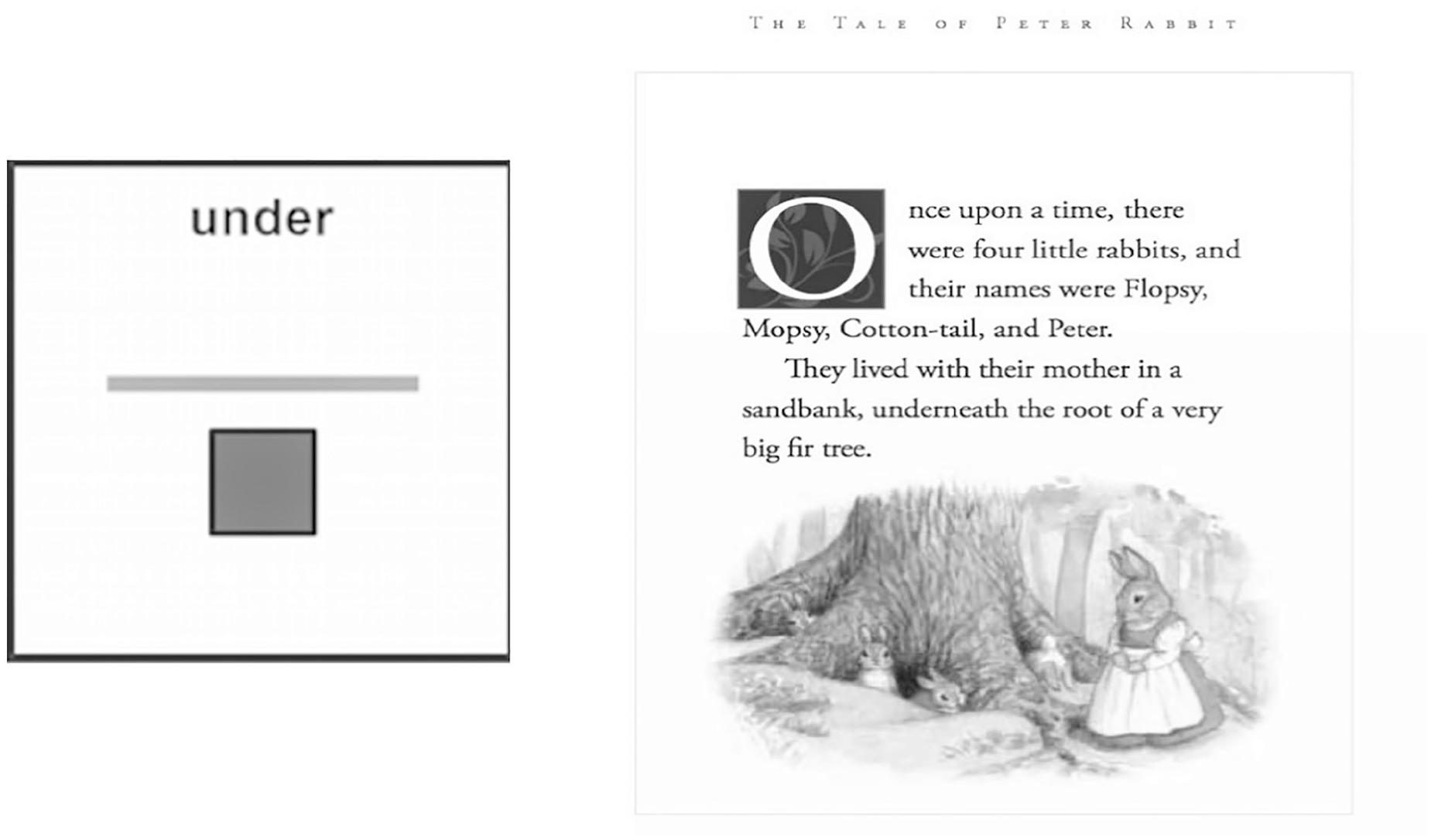
Example of strategy 3: Create an adapted slideshow.
Slideshows can also be interactive. To learn about more interactive features using slides, or for step-by-step instructions, watch the video link “Interactive Google slides for SLP & AAC teletherapy” at www.youtube.com/watch?v=L878Q_bQPrc&t (Gregory, 2020a) or visit https://www.pathstoliteracy.org/power-point-e-books. If using a tablet, clients may need to download the Google Slides app to use interactive features.
Creating slideshows allows the client to focus on the text and graphic symbols simultaneously. SLPs should ensure that slides afford participation opportunities for social interaction. Slideshows offer permanence and can include interactive features. To avoid any issues regarding copyrights, use materials that are in the public domain or seek permission from the copyright holder. An adaptive book using slideshow software takes more planning time, presenting a barrier for some SLPs. Since clinicians create the slideshow ahead of time, it cannot be switched out easily upon client request.
Strategy 4: Asynchronous video
SLPs can also create asynchronous, prerecorded videos using a dynamic display while book sharing. To get started, select and download a screen recorder to record and share videos (e.g., Screencastify) or create a recording using Zoom. Next, select the view—webcam or desktop—that you want and position open windows on your desktop. Hit “record” and share book while modeling use of the client’s own communication aid, then click “stop recording.” To see a detailed guide, watch “Recording videos to model AAC,” at www.youtube.com/watch?v=YbVSndMvlMg&t (Gregory, 2020b).
Asynchronous videos are permanent, and they are easy for an e-helper to use outside of sessions. This option is ideal for SLPs who want to share the same book across clients or who want to send clients home with a reusable activity, making sure the graphic symbol set used in the video is consistent with the client’s AAC system. However, this strategy takes the most planning time and clinicians must make efforts during sessions to pause the video and make the storybook reading interactive.
Discussion
Regardless of which strategy you choose, the following considerations will increase success when pairing books with AAC over telepractice.
Model the Use of the Client’s Communication Aid
Children have little or no experience seeing other people communicating via a communication aid (von Tetzchner et al., 2018). When working with graduate students in our university clinic, one of the most common coaching tips we provide is to model the communication system while sharing books. Within turns at talk, clinicians should use the communication aid themselves (along with speech) to ask questions, offer opinions, and label items. Modeling does not require one graphic symbol for every word but can include phrases or core vocabulary. Everyone participating in the session, including e-helpers, should use the communication aid.
Prioritize Identifying Emotions
Storybooks help children understand emotions, leading to affective theory of mind (ToM) skills and empathy (Baron-Cohen, 2011; Nelson, 1996; Westby, 2020). Although book sharing lays the foundation for emergent literacy skills, it also provides a social context to learn about interaction and emotions. Within book sharing contexts, clients learn to label a character’s feelings about an event, identify when two characters have different emotions about the same event, and eventually how a character can have mixed emotions about a singular event. Use of graphic symbols to reference emotions requires the ability to discern subtle differences in the symbols themselves (see https://mulberrysymbols.org for examples of symbols used to depict emotions). Targeting emotions supports language development; it extends affective ToM skills to better predict the emotions of others and ultimately develop empathy.
Suggestions for Clinical Faculty or Supervisors
SLPs who are in a supervisory role have additional considerations during telepractice sessions. Despite being tech-savvy, graduate students may find AAC intimidating if this is a new experience. The following strategies can boost a supervisor’s confidence. Before sessions: Require graduate students to practice using AAC and storybook materials on the telepractice platform prior to meeting with clients. Vendor representatives can help graduate students program and personalize systems for clients. During sessions: Supervisors should be present and actively participate in telepractice sessions to provide modeling and feedback. Use the chat box during telepractice sessions to encourage and guide graduate students. Outside of sessions: Engage in problem-solving by debriefings after sessions. Discuss ways to maximize participation and how to make book sharing a social interaction. Graduate students can also accompany supervisors to an assistive technology center to expand their understanding of accessibility options. AAC is a hands-on learning experience; supervisors can provide graduate students diverse opportunities for gaining competence in this domain.
Conclusion
Telepractice offers SLPs increased flexibility to support the language and literacy skills of children with CCN. Online formats help overcome logistical challenges like promoting interaction while manipulating a storybook and a communication aid in person (Bhana et al., 2020). Telepractice offers greater access to storybooks for clients with physical impairments who have difficulty holding or turning pages of a storybook (Bedrosian, 1999). As early and frequent exposure to storybooks is critical to develop the language skills of children with CCN, recorded telepractice formats discussed here provide ways for clients to review storybooks repeatedly outside of sessions. Strategies involving telepractice evolve rapidly, and SLPs are encouraged to think creatively about how to meet the needs of their own clients. Clinicians can support clients by exploring the wide variety of options for pairing books with AAC online as telepractice continues to expand.
Footnotes
Acknowledgements
The authors thank Sarah Gregory, SLP for sharing her YouTube video links referenced in this article. The authors have no direct or indirect affiliation with any links, websites, or channels cited.
Declaration of Conflicting Interests
The author(s) declared no potential conflicts of interest with respect to the research, authorship, and/or publication of this article.
Funding
The author(s) received no financial support for the research, authorship, and/or publication of this article.
