




Abstract
We used data from two telephone-administered health surveys to explore African Americans’ preferences for interviewer race. The first survey utilized African American interviewers to assess ethnic identity and aspects of healthy eating among 617 African American adults. In the second survey, interviewers of varying races queried 534 African American adults about their motivations to eat healthier. The motivation survey contained almost no racial content, whereas 40% of the ethnic identity survey assessed racial content. Using only ethnic identity survey data, we found that respondents with Afrocentric or Black American identity components were more likely to prefer African American interviewers than respondents with solely assimilated, bicultural, or multicultural identity components. Ethnic identity survey respondents were also more likely to prefer racially/ethnically matched interviewers than motivation survey respondents. Ethnic identity respondents with a college or graduate degree reported lower hypothetical comfort with a white interviewer than respondents with a high school education.
Introduction
This study explores the influences of ethnic identity, questionnaire content, and interviewer race on African Americans’ preferences for interviewer race in telephone-administered surveys.
Social science researchers frequently assign African American interviewers to African American survey respondents. This practice is prevalent in face-to-face surveys, but it is also often used when querying race-related topics in telephone-administered surveys. Such matching is typically motivated by three factors: (1) evidence of race of interviewer effects in surveys with African American respondents (Davis, Couper, et al. 2010); (2) widespread emphasis on enhancing cultural sensitivity; and (3) potentially stronger mistrust of research among African Americans (e.g., Corbie-Smith et al. 1999; Gamble 1997). Researchers may assume that race matching will reduce mistrust, put respondents at ease, and yield more valid data; however, there is little empirical evidence to support the validity of such assumptions, and several researchers have questioned the appropriateness of race matching (e.g., Anderson et al. 1988; Aspinall 2001; Groves 2004).
When deciding whether or not to use race-matching, researchers may want to consider African Americans’ preferences for interviewer race. There is extensive theoretical and empirical social science literature that supports preferences for within-group interactions (Simmel 1971 [1908]; Stryker and Burke 2000; Tajfel and Turner 1979) and positive identification with people of African descent among African Americans (Bennett 2007; Chavous et al. 2008). For example, social identity theory by Tajfel and Turner (1979) suggests that individuals derive a sense of self based on the social categories to which they belong. Particular social identities (e.g., race, nationality, gender) assume greater salience in guiding how individuals think, feel, and behave such that an individual’s conceptualization of others interacts with his or her response to others to determine in-group and out-group preferences and experiences. Beliefs about the quality of cross-race interactions or between in-groups and out-groups have implications for interviewer race preferences within the context of research involving African Americans with different racial identity orientations in a race-conscious society.
We could not find published studies that directly examine African American respondents’ preferences for interviewer race. However, in a Chicago study, Warnecke et al. (1997) found that over 90% of white respondents reported that other Whites would be comfortable with non-white interviewers, whereas only 60% of African American respondents reported that other African Americans would be comfortable with non-African American interviewers. These findings may indicate that white respondents are less likely to express hypothetical discomfort with non-white interviewers, possibly due to fears of conveying socially undesirable, racist attitudes. However, African Americans may also have stronger preferences for racially concordant interviewers than Whites.
African Americans’ interviewer race preferences may also correlate with their ethnic orientations. Ethnic identity is defined by Cokley (2007) as “the subjective sense of ethnic group membership that involves self-labeling, sense of belonging, preference for the group, positive evaluation of the ethnic group, ethnic knowledge, and involvement in ethnic group activities” (p. 225). African Americans’ feelings about ethnicity are heterogeneous (Cross and Vandiver 2001; Sellers et al. 1998). Findings from research in counseling indicate that African Americans with stronger ties to African American people and culture are more likely to prefer same-race counselors (Atkinson et al. 1986; Morten and Atkinson 1983; Parham and Helms 1981). African Americans with Afrocentric or black American identity orientations may similarly prefer African American interviewers. In contrast, African Americans with bicultural or multicultural identity orientations may have less preference for African American interviewers, as persons with these orientations are assumed to be more comfortable interacting with non–African Americans. Matching interviewers and respondents by race may even be contraindicated for respondents with low racial salience who may be offended by the concept of race matching.
We explored African Americans’ preferences for interviewer race using data from two telephone-administered health surveys. All respondents to both surveys were African American. One survey, which assessed participants’ ethnic identity, contained a substantial amount of racial content. The other survey focused on measuring motivations for healthy eating and had almost no racial content.
We predicted that ethnic identity survey respondents with Afrocentric, black American, or cultural mistrust identity components would be more likely to prefer an African American interviewer than respondents without these components and, conversely, that respondents with assimilated, bicultural, or multicultural components would not express a preference (Hypothesis 1).
We similarly hypothesized that ethnic identity respondents with Afrocentric, black American, or cultural mistrust identity components would report lower hypothetical comfort with a white interviewer than respondents without these components, but that no differences would emerge between African Americans with or without assimilated, bicultural, or multicultural components (Hypothesis 2).
We also compared responses on the two surveys to explore the influence of racial content. Among respondents interviewed by African American interviewers, we expected ethnic identity survey respondents to express stronger preferences for an African American interviewer than motivation survey respondents, regardless of respondent racial salience (Hypothesis 3).
We expected ethnic identity survey respondents to be less likely to say that they would have been comfortable if their interviewer had been white than motivation survey respondents (Hypothesis 4).
Finally, we compared preferences for a racially matched interviewer between motivation survey respondents interviewed by African American versus white interviewers. We predicted that motivation survey respondents would be more likely to prefer an African American interviewer when interviewed by an African American interviewer (Hypothesis 5).
Method
Participants
Data for this study were obtained from two health intervention trials that tested the efficacy of personalized health materials to increase fruit and vegetable consumption among African American adults: (1) an ethnic identity study, which tested materials personalized on ethnic identity (Resnicow et al. 2009); and (2) a motivation study, which tested materials personalized on motivational predisposition (Resnicow et al. 2008).
We recruited participants from the memberships of two health care systems in Detroit and Atlanta. At that time, African Americans comprised approximately 35% and 33% of the Detroit and Atlanta health system memberships, respectively, and over 90% of African American members were estimated to have a high school education or more. Recruitment letters containing $2 preincentives were mailed to potential participants, followed by recruitment calls during which interviewers administered baseline telephone surveys. Calls were conducted between May 2006 and July 2007. Eligible participants were between the ages of 21 and 70, self-identified as black or African American, were not Hispanic or multiracial, ate fewer than 10 servings of fruit and vegetables per day, were not living in skilled care facilities, had lived in the United States more than half of their lives, and had no health conditions that would preclude their participation in a nutrition intervention. A total of 625 eligible ethnic identity participants completed the baseline telephone survey (American Association of Public Opinion Research [AAPOR] Response Rate 1 = 34.6%; American Association for Public Opinion Research [AAPOR] 2003), of whom 617 had sufficiently complete data to be included in the present analyses. Eligible motivation study participants yielded 534 completed baseline surveys (AAPOR Response Rate 1 = 36.6%; AAPOR 2003). These response rates are conservatively calculated and are comparable to those obtained in other health behavior intervention trials. This research was approved by human subjects review committees at the University of Michigan and participating health care systems.
For both surveys, we randomly assigned interviewers to respondents using a computerized scheduler that created a queue of cases to be called. Each time an interviewer became available, he or she was assigned the next name on the call queue. Eight interviewers administered both surveys. Four additional interviewers administered the ethnic identity survey for a total of 12 interviewers, while an additional 7 interviewers administered the motivation survey for a total of 15 interviewers. The interviewers all worked in a professional survey call center and had an average of 2 years of experience conducting health surveys.
All 12 ethnic identity survey interviewers self-identified as black or African American. Of the 15 motivation survey interviewers, 8 were African American, 6 were white, and 1 was of an unknown race. Totals of 301 and 208 motivation survey respondents were interviewed by African American and white interviewers, respectively. The remaining 25 motivation surveys were administered by the interviewer of unknown race.
Due to customer relationship concerns expressed by the health care systems, all ethnic identity survey respondents were cued that their interviewer was African American. Only those motivation survey respondents who had an African American interviewer were cued about their interviewer’s race. We cued respondents about their interviewer’s race via the following language in the recruitment script: “I am calling as part of a team of African American interviewers.” Respondents were further cued to their interviewer’s race by scripted usage of the phrase “our community” in the recruitment script. Ethnic identity study respondents were warned that their survey included potentially sensitive racial attitude questions, and, as part of this scripting, heard two more references to “our community” near the end of their survey before ethnic identity was assessed.
Measures
Interviewer preferences
At the end of the ethnic identity survey, we asked all respondents two questions about interviewer preferences. The first item queried the importance of having an interviewer with a similar racial and ethnic background: “How important is it to you to be interviewed by an interviewer of your same race and ethnicity for a survey like this?” Response options ranged from 1 (not at all important) to 10 (very important). The second item explored predicted comfort if the interviewer had been white: “How comfortable would you have felt if this interview had been done by a white interviewer?” Response options ranged from 1 (not at all comfortable) to 10 (very comfortable). We administered the same two questions at the end of the motivation survey. However, we only asked the question about comfort with a white interviewer if the interviewer was not white. Each of the two preference items was treated as a continuous variable.
Racial salience
We included a single racial salience item in both the ethnic identity and motivation questionnaires: “How important is being black to your overall identity?” Responses ranged from 0 (not at all important) to 10 (very important). Racial salience was modeled as a continuous variable.
Ethnic identity
Ethnic identity survey respondents completed 34 items querying aspects of African American ethnic identity as part of the black identity classification scale (BICS) (Davis, Alexander, et al. 2010). We did not assess ethnic identity in the motivation survey. The BICS classified each respondent into 1 of the 16 identity types. As part of the classification process, the BICS algorithm yielded six core ethnic identity components: assimilated, black American, Afrocentric, bicultural, multicultural, and cultural mistrust.
According to the BICS, a person with an assimilated identity component has low racial salience and places little importance on being a member of a racial or ethnic group. In contrast, being African American is viewed as a valued aspect of personal identity for respondents with the other five identity components. A person with a black American component feels a strong connection to black American people and culture, while an Afrocentric person endorses connections to Africa. A bicultural person is defined as one who perceives the world as a black/white dichotomy, whereas a multicultural person values many cultures. Respondents with black American or Afrocentric identity components could have an additional cultural mistrust component, which was defined as a generalized mistrust of Whites and white society (Terrell and Terrell 1981). Item wording, a list of ethnic identity types, and information about psychometric properties of the BICS are available elsewhere (Davis, Alexander, et al. 2010).
Because small cell sizes prohibited separate analyses comparing the 16 BICS identity types, we used six variables to indicate whether or not a respondent had each of the core identity components: assimilated, Afrocentric, black American, bicultural, multicultural, or cultural mistrust. We coded a respondent as a “1” for each identity component that he or she had and “0” for each component that was not included in his or her BICS classification. Each respondent could have up to three 1s. The regression models used to test Hypotheses 1 and 2 tested the presence or absence of each individual identity component while controlling for the other five identity components (e.g., respondents with versus without a black American component while controlling for whether a respondent had any of the five additional components).
A degree of collinearity existed among the ethnic identity variables examined in Hypotheses 1 and 2. These variables were binary; thus, we examined collinearity by measuring bivariate correlations between respondents’ scores on the BICS subscales for the Afrocentric, black American, bicultural, multicultural, and cultural mistrust identity type components. The BICS did not contain an assimilated subscale; however, since the assimilated type was the only low racial salience identity type, we used the racial salience subscale score as a proxy for assimilated in computing these correlations. Correlations for the following pairings were considered weak associations: Afrocentric/bicultural (.07), Afrocentric/cultural mistrust (.14), black American/bicultural (.10), black American/multicultural (.27), black American/cultural mistrust (.27), bicultural/multicultural (.23), bicultural/racial salience (.08), bicultural/cultural mistrust (−.06), multicultural/cultural mistrust (.05), multicultural/racial salience (.32), and racial salience/cultural mistrust (.24). The other four pairings had moderate correlations: Afrocentric/black American (.52), Afrocentric/multicultural (.47), Afrocentric/racial salience (.57), and black American/racial salience (.65).
Racial survey content
The questionnaires from the two surveys contained different proportions of racial content. Excluding eligibility items and the two interviewer preference questions, the ethnic identity questionnaire contained 40 out of a total of 101 items that explicitly queried racial attitudes, preferences for an ethnically oriented health program, or preferred terminology to describe one’s racial and ethnic affiliation (e.g., black American, black, African American, etc.). The motivation questionnaire, which had 109 items, contained only one racial attitude item.
Other measures
Control variables included respondents’ age (How old are you?), gender (Are you male or female?), education (What is the highest grade or degree you have completed?), and income (Approximately what was the total income of your household last year before taxes?). Age was treated as a continuous variable. The education question had eight response categories, which we collapsed to four levels of academic completion: less than high school; high school or General Educational Development (GED) certification; post–high school vocational training or some college; and 4-year college degree or graduate school. Income was assessed using seven response categories, which we collapsed to four categories of annual household income: $20,000 or less; $20,001–$40,000; $40,001–$60,000; and over $60,000. Education and income were modeled as categorical variables, with the highest categories used as reference groups.
Analysis Plan
Mean scores on the interviewer preference items were calculated separately for respondents with each of the six core identity components.
To control for the clustering of data by interviewers and avoid potential Type I error (Dijkstra 1983; Fendrich et al. 1999), we used the linear mixed modeling approached outlined by West et al. (2007). This approach permits the estimation of fixed effects associated with data obtained from respondents and random effects resulting from the assignment of respondents to interviewers in a single model. All analyses were conducted using SAS 9.2 for Windows (SAS 2002–2008).
We estimated four linear mixed models using the SAS PROC MIXED procedure. The first two models were tested using data from participants in the ethnic identity survey (n = 617). The first model explored which of the six core identity components were associated with respondents’ ratings on the importance of having an African American interviewer (Hypothesis 1). The second model tested associations between the ethnic identity components and respondents’ hypothetical comfort levels if their interviewer had been white (Hypothesis 2). The third and fourth models used data from both surveys, but only from respondents surveyed by African American interviewers (n = 918). The third model tested whether ethnic identity survey respondents reported a stronger preference for a same-race interviewer than motivation survey respondents while controlling for racial salience (Hypothesis 3). The fourth model evaluated whether ethnic identity survey respondents predicted lower hypothetical comfort with a white interviewer than motivation survey respondents while controlling for racial salience (Hypothesis 4). All models controlled for respondent gender, age, education, and income.
We tested a fifth model using the SAS PROC GLM procedure, as a PROC MIXED model could not be estimated. This model assessed whether interviewer race (African American vs. white) was associated with motivation survey respondents’ preferences for a same-race interviewer (Hypothesis 5). This model controlled for respondent racial salience, gender, age, education, and income.
Results
Sample Characteristics
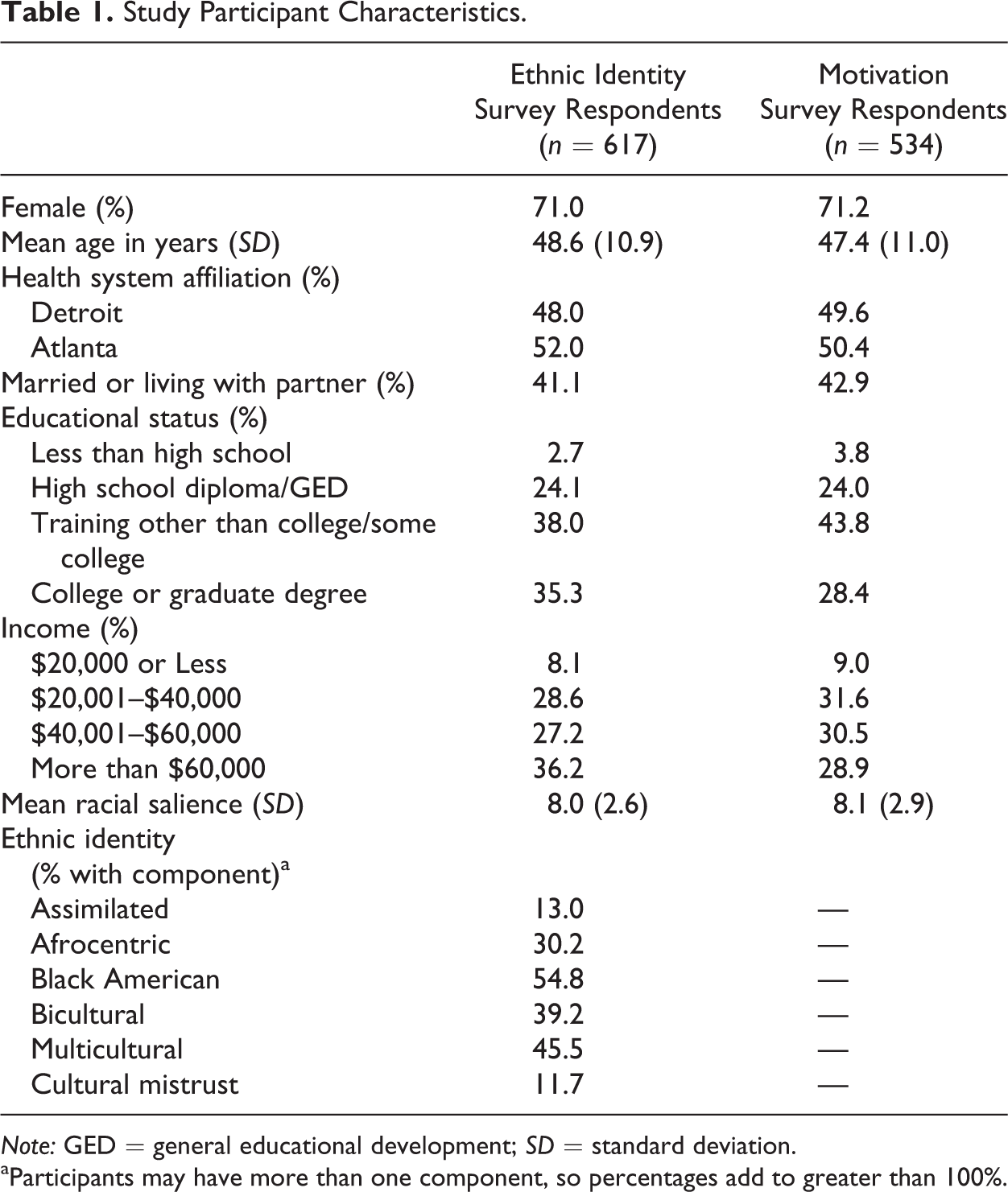
The ethnic identity and motivation survey samples were both predominantly female, with a mean age in the upper 40s and an almost even split between the Detroit and Atlanta health care systems (Table 1). Respondents from both surveys represented a range of income levels and educational attainment, with most respondents reporting a high school-level education or higher. Means on the single racial salience item were relatively high for both ethnic identity and motivation survey respondents. No differences were found between surveys for any of the variables listed in Table 1.
Study Participant Characteristics.
Note: GED = general educational development; SD = standard deviation.
aParticipants may have more than one component, so percentages add to greater than 100%.
Ethnic identity type was only measured in the ethnic identity survey. Among ethnic identity survey respondents, the most prevalent identity component was black American (54.8%), followed by multicultural (45.5%), bicultural (39.2%), Afrocentric (30.2%), assimilated (13.0%), and cultural mistrust (11.7%).
Mean Scores for Interviewer Race Preference Items by Ethnic Identity Component
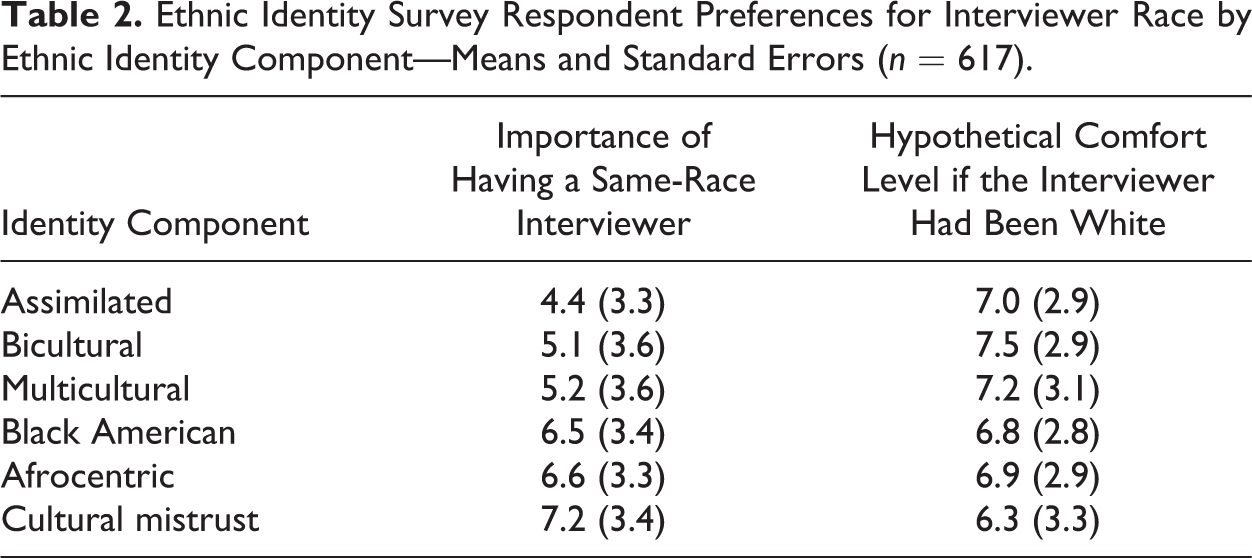
Among ethnic identity survey respondents, mean scores for the importance of having a same-race interviewer by ethnic identity component ranged as follows on a scale from 1 (not at all important) to 10 (very important): assimilated, 4.4; bicultural, 5.1; multicultural, 5.2; black American, 6.5; Afrocentric, 6.6; and cultural mistrust, 7.2 (Table 2). Means for the item querying predicted comfort level if the interviewer had been white were: cultural mistrust, 6.3; black American, 6.8; Afrocentric, 6.9; assimilated, 7.0; multicultural, 7.2; and bicultural, 7.5 (1 = not at all comfortable; 10 = very comfortable).
Ethnic Identity Survey Respondent Preferences for Interviewer Race by Ethnic Identity Component—Means and Standard Errors (n = 617).
Ethnic Identity and Racial Salience as Correlates of Interviewer Preferences
Ethnic identity survey respondents were more likely to prefer a same-race interviewer if they had an Afrocentric (p = .02) or black American (p = .0002) identity component than respondents without these components (Hypothesis 1, Table 3). Respondents with a cultural mistrust (p = .07) component were marginally more likely to prefer a same-race interviewer than respondents without a cultural mistrust component. Conversely, respondents with solely assimilated, bicultural, or multicultural identity components were no more likely to express a preference for a same-race interviewer than respondents without these components. Respondent gender, age, education, and income were not significantly associated with interviewer preferences.
Ethnic Identity Survey Respondent Preferences for Interviewer Race by Ethnic Identity Component (n = 617).

*p < .05. **p < .10.
aReference: college or graduate degree.
bReference: more than $60,000.
Ethnic identity type appeared to have no bearing on respondents’ hypothetical comfort levels if their interviewer had been white (Hypothesis 2). Respondent gender, age, and income were also not significant. Respondents with a college or graduate degree, however, reported lower hypothetical comfort with a white interviewer than respondents with a high school diploma or GED (p = .02).
We used likelihood ratio tests to compare models with and without accounting for interviewer variability for Hypotheses 1 and 2, respectively. These tests indicated that the model with clustering was a better fit for Hypothesis 1 (p = .01) but that a model with clustering was not necessary for testing Hypothesis 2 (p = .20). However, for consistency in the presentation of results, the model with clustering was retained for Hypothesis 2. Models not controlling for clustering (not shown) yielded identical patterns of estimated effects for Hypotheses 1 and 2.
Questionnaire Content as a Correlate of Interviewer Preferences
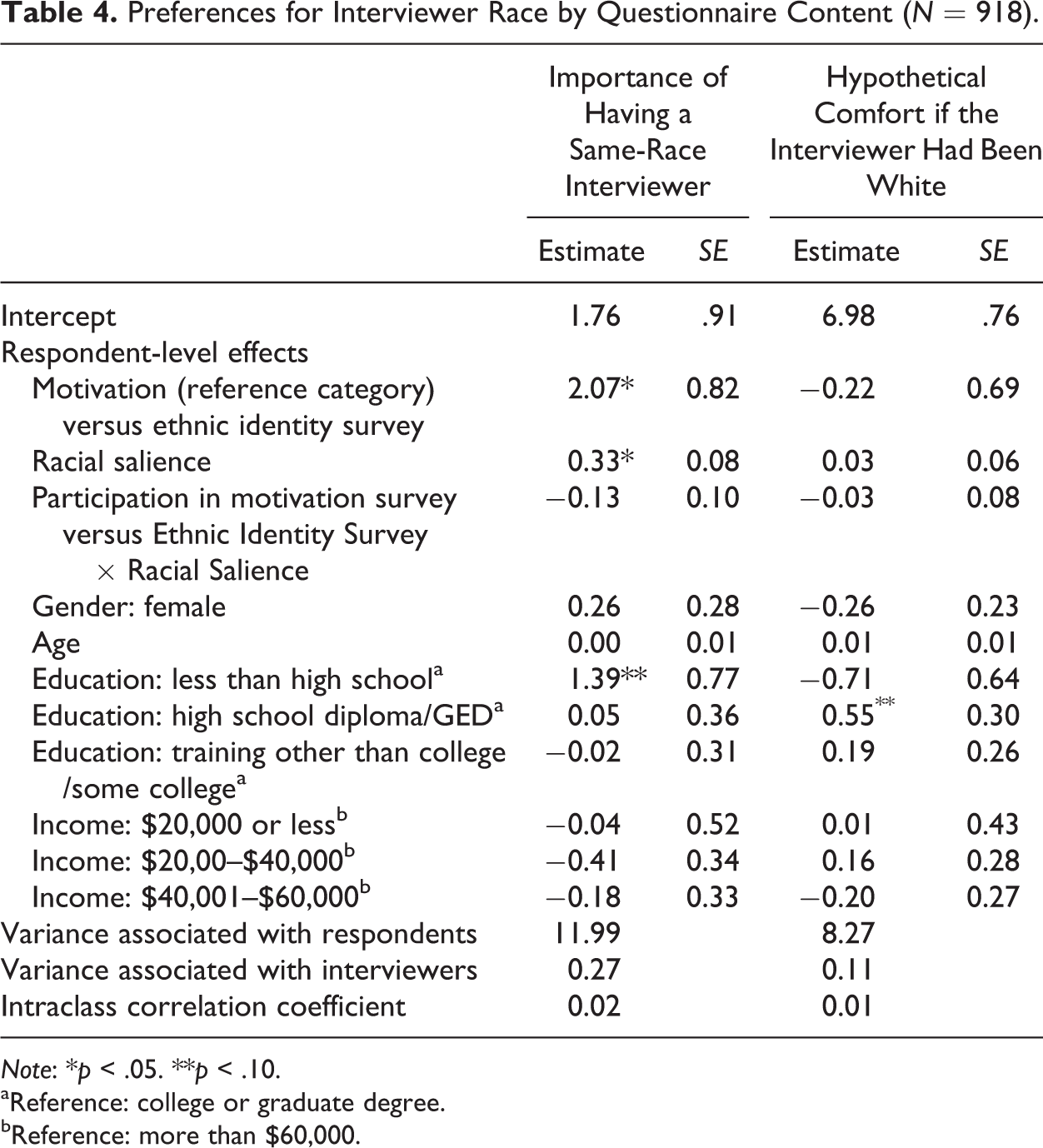
As shown in Table 4, results from the model testing Hypothesis 3 support the premise that ethnic identity survey respondents were significantly more likely to state a preference for a same-race interviewer than motivation survey respondents (p = .01), even after controlling for respondent racial salience. Respondents with higher racial salience were also more likely to prefer a same-race interviewer (p < .0001). The interaction between survey type and racial salience was not significant. Respondent gender, age, education, and income were also not significant.
Preferences for Interviewer Race by Questionnaire Content (N = 918).
Note: *p < .05. **p < .10.
aReference: college or graduate degree.
bReference: more than $60,000.
Motivation survey respondents were no more likely than ethnic identity survey respondents to say that they would have been comfortable if their interviewer had been white (Hypothesis 4). Respondent racial salience, gender, age, education, and income were not significant.
Likelihood ratio tests indicated a need to adjust for interviewer variability for Hypothesis 3 (p = .01) and for Hypothesis 4 (p = .05). Thus, the models with clustering were retained for both sets of analysis. Models not controlling for clustering (not shown) yielded identical patterns of estimated effects as those presented above for Hypotheses 3 and 4.
Interviewer Race as a Correlate of Interviewer Preferences
Among motivation survey respondents only, respondents who were interviewed by African American interviewers were more likely than respondents interviewed by white interviewers to prefer a same-race interviewer while controlling for racial salience, gender, age, education, and income (Hypothesis 5; β = 2.49, standard error = .32, p < .0001, R 2 = .19; results not shown). As assessed in the same model, respondents with higher racial salience were also more likely to report a preference for a same-race interviewer (β = .27, standard error = .05, p < .0001). There was no significant interaction between interviewer race and racial salience, and none of the control variables was significant.
Discussion
Findings from this study indicate that the ethnic identity orientations of African American telephone survey respondents are associated with their preferences for an African American interviewer. Respondents with Afrocentric or black American identity components were more likely to say they preferred a same-race interviewer than respondents without these components. In contrast, we found no differences in preferences between respondents with or without assimilated, bicultural, or multicultural components. These findings were largely consistent with our hypothesis as well as with prior research on counselor race preferences (e.g., Atkinson et al. 1986; Morten and Atkinson 1983; Parham and Helms 1981).
Our findings also support our hypothesis that the degree of explicitly racial survey content influences African American telephone survey respondents’ preferences for interviewer race. Among respondents surveyed by African American interviewers, we found that respondents to a survey with substantial racial content were more likely than those responding to a survey with almost no racial content to say that they preferred a same-race interviewer.
Data from this study also suggest that a single racial salience item could be used to predict respondents’ interviewer race preferences. Across two surveys, respondents with higher racial salience scores reported stronger preferences for an interviewer of their same race. Although the multidimensional ethnic identity measure used in this study may provide richer information, the single racial salience item may have more practical applicability. If preferences are deemed important and a longer ethnic identity measure is infeasible, one could ask respondents a single question to determine whether to match interviewers and respondents by race for a future survey interaction.
Contrary to our hypotheses, neither ethnic identity nor questionnaire content was associated with respondents’ predicted comfort levels if their interviewer had been white. This lack of main effects may be attributable to social desirability. In the ethnic identity survey, respondents with a college or graduate degree reported lower predicted comfort with white interviewers than respondents with a high school-level education. Since these respondents interacted with African American interviewers, their responses to this question were based on a hypothetical case of interacting with a white interviewer, which may have yielded less valid data. However, it is also possible that asking respondents to predict their comfort with a white interviewer was a more sensitive question than asking them about their preference for a same-race interviewer. Whereas the latter question provided respondents with an opportunity to voice affinity for their racial group, respondents may have felt that reporting discomfort with white interviewers would be perceived as racist.
Thus, some respondents may have adjusted their answers to provide socially desirable responses. Partial evidence for this notion may be derived from qualitative data collected from participants at the end of the surveys. Two respondents said that they were disturbed by the question about comfort with a white interviewer, and a third respondent commented: “I don’t want to sound like a racist.” In a meta-analysis, Narayan and Krosnick (1996) found that respondents with lower education were more likely to acquiesce than respondents with higher education. If the survey item querying predicted comfort with a white interviewer was a particularly sensitive item, it is possible that respondents with more education may have been less prone to acquiesce to this item and more comfortable expressing a less favorable opinion about white interviewers.
The question remains, however: Do respondents’ preferences about interviewer race matter? This question can be considered from two perspectives. From a total survey error perspective (Groves 2004), it is important to know whether obliging respondents’ interviewer preferences decreases interviewer error. In other words, would a respondent who prefers an African American interviewer provide substantively different responses to survey questions to an African American versus a white interviewer? We do not have the data required to explore this question; however, this line of inquiry merits further exploration. The second perspective considers respondent satisfaction with the survey experience. Catania et al. (1996) conducted a telephone survey of sexual behavior in which respondents were allocated to three conditions: (1) a gender-matched interviewer; (2) a gender-discordant interviewer; or (3) a choice situation, in which respondents selected their interviewer’s gender. Respondents in the choice condition were significantly less likely to break off the interview than respondents in the preassigned gender conditions.
These results suggest that permitting respondents to choose interviewer characteristics may increase survey response and engagement. Respondents may have more positive survey experiences if interviewers match their preferences, which, in turn, is likely to increase the chances that they will participate in a future survey. If preferences are deemed important, one could query respondents’ interviewer preferences to determine whether to match interviewers and respondents on selected characteristics for an imminent or future survey interaction. Matching respondents to their interviewer preferences may be of particular use in longitudinal studies, for customer service interactions that are tracked over time, for surveys querying sensitive topics, with populations known to have a higher mistrust of research, and in surveys where respondents are recruited via a self-administered mode but surveyed via an interviewer-administered mode.
This study has several limitations. For one, participants may include only those respondents above a threshold comfort level with African American or white interviewers, and floor effects are possible. This study was also constrained by the designs of the parent studies, which cued respondents with African American interviewers about their interviewer’s race. This cueing may have influenced respondents’ reporting of interviewer race preferences as well as differences in reporting between the two surveys. This possibility is further underscored by the finding that motivation survey respondents were more likely to report a preference for a same-race interviewer to African American interviewers. As discussed, we were not able to assess whether interviewer error increases if respondents’ interviewer race and ethnicity preferences are not fulfilled.
Research is needed to compare the validity of data from respondents whose interviewer preferences are fulfilled versus not fulfilled. Respondents were only asked about their preferences for interviewer race and ethnicity; the relative importance of other interviewer characteristics such as gender, age, social status, voice qualities, and so on, were not assessed. Further, the BICS is a relatively new measure of ethnic identity and, as such, requires further development and refinement. Participants in this study were members of health care systems responding to telephone surveys; thus, the results presented here may not be generalizable to other African American populations—particularly those with low socioeconomic status—or to surveys conducted or via other modes of administration. As noted, survey participants’ responses to the interviewer preference items may have been further influenced by socially desirable responding. Data in this study were also based on self-report, which may or may not have yielded valid data.
Social and behavioral scientists often target populations by race and ethnicity, and it is not atypical for researchers to match interviewers to the anticipated race or ethnicity of a survey population. Our findings caution against assuming that all African American survey respondents prefer African American interviewers. However, our findings also suggest that many African American survey respondents prefer African American interviewers for telephone surveys with racial content. It is possible that these preferences would be even stronger in face-to-face surveys. Many African Americans may be more comfortable with African American interviewers, and this greater comfort may lead to reduced measurement error and a more positive survey experience. Conversely, race matching may also increase interviewer error, as it may encourage respondents to report more “pro-black” racial attitudes with the assumption that such responses will be viewed as more socially desirable by an African American interviewer. If matching does increase interviewer error, then our knowledge of social issues is biased to the degree to which such knowledge is based on surveys with matched designs, and such matching will inherently demarcate differences among racial groups. Research is needed to determine whether fulfilling respondents’ preferences for interviewer race and ethnicity leads to the induction or reduction of measurement error.
It is clear from this study and others that attitudes about race and ethnicity vary greatly among African Americans. These attitudes are also likely to vary among other racial and ethnic groups. Until these dynamics are better understood, researchers would be wise to measure, monitor, and control for interviewer effects in their collection and interpretation of survey data.
Footnotes
Acknowledgments
The authors are grateful to the entire study team of Eat for Life for their support of this research. Thanks are also due to Brady West at the University of Michigan, Program in Survey Methodology.
Declaration of Conflicting Interests
The author(s) declared no potential conflicts of interest with respect to the research, authorship, and/or publication of this article.
Funding
The author(s) disclosed receipt of the following financial support for the research, authorship, and/or publication of this article: This work was supported by the National Cancer Institute [P50 CA101451].