



Abstract
Purpose:
To evaluate the midterm outcomes of the Endurant limb fenestration with internal iliac artery repair and enhanced preservation (ELFIRE) procedure, a physician-modified endograft technique developed to preserve internal iliac artery (IIA) perfusion during endovascular aneurysm repair (EVAR) for complex iliac artery aneurysms.
Materials and Methods:
This single-center observational study retrospectively analyzed a prospectively maintained cohort of 95 patients with common or IIA aneurysms with or without abdominal aortic aneurysm, who underwent EVAR using the ELFIRE procedure between August 2019 and May 2023. The technique utilized a physician-modified fenestrated Endurant contralateral limb incorporating a preloaded wire system to facilitate reliable internal iliac branch cannulation, representing the “enhanced preservation” concept of the ELFIRE procedure, combined with Viabahn VBX bridging stent grafts for IIA preservation. The primary outcome was the incidence of pelvic ischemic complications, including buttock claudication and rectal ischemia. Secondary outcomes included technical success, bridging stent graft occlusion, endoleak occurrence, reintervention, aneurysm sac morphology changes during follow-up, and other postoperative complications. Midterm outcomes were analyzed using the Kaplan-Meier method.
Results:
The mean age was 78 ± 6 years, and 83 patients (87.4%) were men. A total of 126 branches were preserved, including bilateral preservation in 31 patients. Technical success was achieved in 98.9%. The median follow-up duration was 36 months (interquartile range, 26-48 months). Kaplan-Meier-estimated freedom from bridging stent graft occlusion was 97.6% at 5 years (95% CI: 91.5-99.4), and freedom from reintervention was 96.6% at 5 years (95% CI: 90.2-98.9). Pelvic ischemic events consisted solely of buttock claudication (4.2%), and no cases of rectal ischemia were observed. The ELFIRE procedure was successfully applied in anatomically challenging cases, including 68 patients (72.6%) outside the instructions for use (IFU) of commercially available iliac branch devices.
Conclusion:
The ELFIRE procedure demonstrated favorable technical success, durable branch patency, and low complication rates at midterm follow-up. This simple and reproducible technique expands treatment options for patients with complex iliac aneurysms. Continued long-term follow-up is warranted to confirm durability and safety.
Clinical Impact
This study provides the first midterm outcomes of the ELFIRE procedure, previously introduced as a physician-modified endograft technique for internal iliac artery preservation. The results confirm durable branch patency and the absence of complications related to device modification, demonstrating the safety and reliability of this approach. ELFIRE expands the treatment options for patients with anatomies unsuitable for commercial iliac branch devices and offers a practical, reproducible alternative for maintaining pelvic perfusion in complex aortoiliac aneurysms.
This is a visual representation of the abstract.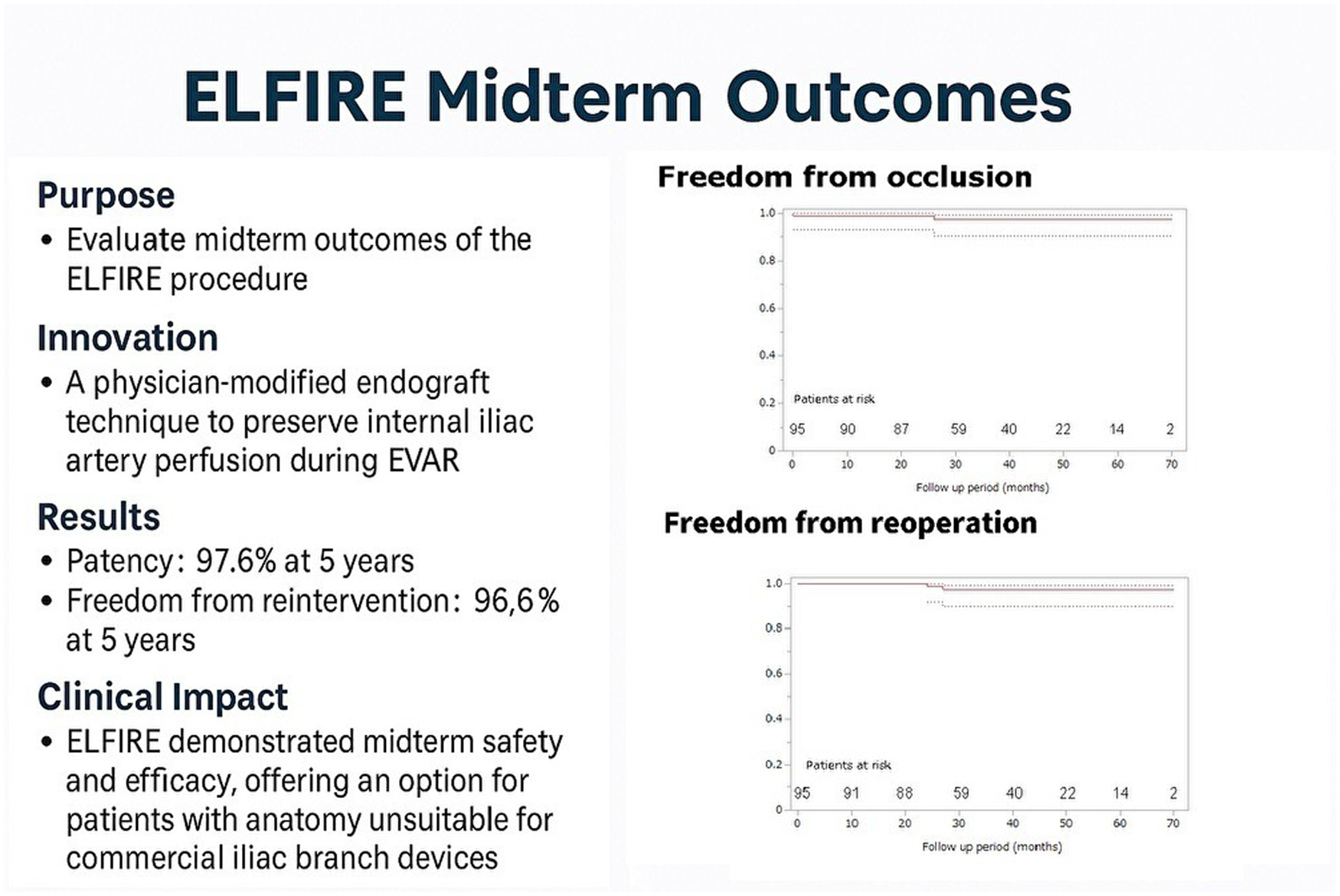
Keywords
Get full access to this article
View all access options for this article.
References
Supplementary Material
Please find the following supplemental material available below.
For Open Access articles published under a Creative Commons License, all supplemental material carries the same license as the article it is associated with.
For non-Open Access articles published, all supplemental material carries a non-exclusive license, and permission requests for re-use of supplemental material or any part of supplemental material shall be sent directly to the copyright owner as specified in the copyright notice associated with the article.
