



Abstract
This article models the role of a referee in a contest, in which players can invest into both productive and sabotage effort. The model shows that (1) a referee significantly influences the equilibrium strategies of the contestants, (2) whether or not the referee improves the quality of a contest depends on his refereeing performance and the marginal penalty awardable subject to the rules of the game, (3) the value of the referee is independent of asymmetries between players, as long as the asymmetric attribute does not affect the referee’s errors, (4) corrupt referees pose a serious economic threat to the sports industry, and (5) a referee reduces the competitive imbalance between the contestants in an asymmetric contest.
Keywords
With the increasing commercialization of professional sports and the rising public enthusiasm about various national and international sports events, professional sports referees are increasingly becoming the target of public scrutiny and criticism. Given the immense commerce involved in some types of sports, a single refereeing decision can not only have enormous financial consequences for the competing participants but in fact influences the event itself. In soccer, for example, a multitude of matches vividly exemplifies that referees are undeniably a critical part of the game and that it is not unusual for their judgments to determine the outcome of a game. Not long ago, during the round of 16 match of the 2010 FIFA World Cup, England versus Germany, the Uruguayan referee Jorge Larrionda disgruntled many English soccer fans by disallowing an irrefutable goal for England. At the same time, many German soccer fans celebrated the referee’s mistake as the revenge for the legendary “Wembley Goal” during the World Cup Final in 1966 (for more information, see Gödecke, 2010; Reschke and Knaack, 2010; and Volkery, 2010). Following this and other refereeing errors, the goal-line technology was introduced in 2012 to determine whether a goal has been scored or not. In addition, during an international friendly between Italy and France in September 2016, the video assistant referee (VAR) system was first used for testing to help referees reviewing their decisions made on the pitch: Using video reviews, goals and whether there was a violation during the buildup, penalty and red card decisions, and mistaken identity in awarding a yellow or red card can be overturned if there has been a “clear error” in the referee’s original decision.
What are the implictions of these new technologies on the outcome of a game? How do they influence the quality of a game and the competitive balance between teams? Do they favor stronger or weaker teams? And, more generally, how does the presence of a referee change the nature of the game, as the competitors will incorporate the referee’s performance in their strategic choices?
The aim of the following analysis is to explicitly model the decisions of referees and their impact on sporting contests from an economic perspective. Until fairly recently, the study of referees has not received much attention in the economic literature. Merely with the increasing exploitation of the commercial potential in professional sports, scholars started increasing their awareness of the economic importance of referees. The main topic among the few existing studies on referees has been the question of whether referees tend to be one-sidedly influenced by external social pressures. Several researchers conducted experimental and empirical studies to examine the incidence of a natural referee home bias in professional sports leagues. Nevill, Balmer, and Williams (2002), for instance, conducted an experiment to test the impact of crowd noise on the referee’s decisions. Two groups of referees were asked to watch the same game, where one group watched the game with and the other without volume. Interestingly, the group that watched the game with volume sanctioned fewer fouls of the home team. Sutter and Kocher (2004) empirically investigated the referees’ propensity of awarding extra time in the professional German Soccer League. They concluded that referees tend to add more extra time when the home team is behind. Dohmen (2008) also empirically confirmed the existence of a referee bias in the German Soccer League, where the composition and the size of the crowd seem to determine the direction and the extent of the bias. 1
Undoubtfully, all of the existing experimental and empirical studies provide useful insights regarding the existence and the determinants of referee biases in professional sporting contests. Yet the previous research on referees has little to contribute to the understanding of the actual role of referees in sporting contests. Especially, theoretical approaches explaining the role of referees are still absent in the economic literature.
However, a large amount of related research in the contest literature is available. 2 The origin of contest theory traces back to the pioneering contributions to the rent-seeking theory by Tullock (1967, 1980), Krüger (1974), and Posner (1975). In particular, Tullock’s (1980) formulation of an imperfectly discriminating contest success function, which gained its eminent popularity among researchers due to its analytical tractability, laid down the groundwork for further insightful research on rent-seeking contests. Skaperdas (1996), Kooreman and Shoonbeek (1997), and Clark and Riis (1998) axiomatized Tullock’s contest success function and suggested some constructive variations.
Aside from the Tullock contest, researchers such as Hillman and Riley (1989) and Baye, Kovenock, and deVries (1996) modeled rent-seeking contests in the form of perfectly discriminating tournaments. Contrary to the Tullock contest, perfectly discriminating all-pay auctions guarantee the contestant exerting the highest effort level to win the tournament. However, as Lazear and Rosen’s (1981) work shows, random factors can additively be accounted for in perfectly discriminating tournaments, so that the contestant with the highest effort is no longer guaranteed to win. This way, an auction tournament with noise becomes, similar to a Tullock contest, imperfectly discriminating. The assumption of an imperfectly discriminating contest success function, allowing for random external factors to affect the outcome of the contest, is in most sporting contests the more realistic approach. For this reason, we will also take this approach in the model developed in this article.
Scholars have studied perfectly and imperfectly discriminating contests along various dimensions in areas such as internal labor market tournaments (e.g., Lazear & Rosen, 1981; Rosen, 1986), R&D races (e.g., Dasgupta & Stiglitz, 1980; Fudenberg, Gilbert, & Tirole, 1983; Harris & Vickers, 1985; Leininger, 1991; Loury, 1979), political campaigning and lobbying (e.g., Arbatskaya & Mialon, 2008; Epstein & Hefeker, 2003; Skaperdas & Grofman, 1995), litigation (e.g., Baye, Kovenock, & deVries, 2005; Farmer & Pecorino, 1999; Katz, 1988), and sporting contests (Ehrenberg & Bognanno, 1990; Frick, 2003; Szymanski, 2003a, 2003b). Most of this research focused on the incentive effects of the prize structure of the contest, of information asymmetries between players, of the number of players, and of asymmetries in abilities and prize valuations between contestants. 3
Most studies, however, focus on contests where only positive rent-seeking activities are feasible. The possibility for contestants to also invest into negative rent-seeking effort, that is, sabotage effort, which will be of essence in the economic model developed in this article, has only relatively recently gained more attention. Therefore, only a few scholars have addressed this problem so far, see, for example, Lazear (1989), Konrad (2000), Chen (2003), Harbring and Irlenbusch (2008), Harbring and Irlenbusch (2011), Kräkel (2005), and Gürtler, Münster, and Nieken (2013) for theoretitical studies and Garicano and Palacios-Huerta (2005), Del Corral, Prieto-Rodriguez, and Simmons (2010), and Deutscher, Frick, Gürtler, and Prinz (2013) for empirical studies. 4
Our article is also related to the studies that propose policies to restrict sabotage. Garicano and Palacios-Huerta (2005) and Del Corral et al. (2010) examined empirically the effects of increasing the number of points awarded for a win in Spanish football. They find that teams invest more in sabatoge effort measured by the number of yellow cards and that teams in a winning position are more likely to have a player sent off the pitch (red cards). This response to change in incentive structure was also confirmed by experimental studies, see Harbring and Irlenbusch (2005), Harbring, Irlenbusch, Kräkel, and Selten (2007), and Harbring and Irlenbusch (2011). Another policy to reduce sabtoge in contest was analyzed by Konrad (2000). He shows that an increase in the number of contestants leads to higher productive effort compared to sabotage activities.
Yet none of the existing studies consider the impact of a referee on the strategic choices of contestants. Instead, in imperfectly discriminating contests, the referee is implicitly handled as an external random factor. A referee can, however, as the model presented in this article will demonstrate, play a crucial role in determining the contestants’ probabilities of success and thereby in affecting their strategic choices in sporting contests.
This article is structured as follows. The Model section of this article will introduce the economic model by defining the necessary parameters and by outlining the basic assumptions of the model. In Symmetric Games section, the model is solved for the contestants’ equilibrium strategies in a symmetric contest with and without a referee. In Asymmetric Games section, the effect of asymmetries between players on the quality of a contest and the value of a referee is examined. The Threat of a Biased Referee section then considers the possibility of corrupt referees and how it affects the quality of a contest. The Impact of a Referee on Competitive Balance section considers the impact of a referee on the competitive balance between the contestants. The Conclusion section will offer some concluding remarks.
The Model
As Neale (1964) pointed out in his discussion on the peculiarity of the professional sports industry, the market structure of the sports industry is anything but usual. While the structural details of sports leagues certainly differ across regions, it is fair to generalize that a joint firm (i.e., the sports association) made up by several members (i.e., the sports clubs) sells a joint product (i.e., the game) produced by its competing members. In essence, the quality of the product is determined by the quality of the interaction between the contestants, namely, the displayed skills and performance.
Now, supposing that the demand (i.e., the fan interest) increases with the game quality, the sports association is interested in optimally designing its sporting contests in order to maximize the quality of the product. 5 Thus, via the contest design, including the prescription of the rules subject to which the game is to be played, the sports association tries to provide the contestants with incentives to expend their best playing efforts.
One way for the sports association to control and hopefully to improve the quality of the game is to hire a referee who is responsible for enforcing the rules of the game. This, as illustrated in Figure 1, will be the basic structure underlying the economic model developed in the following sections.
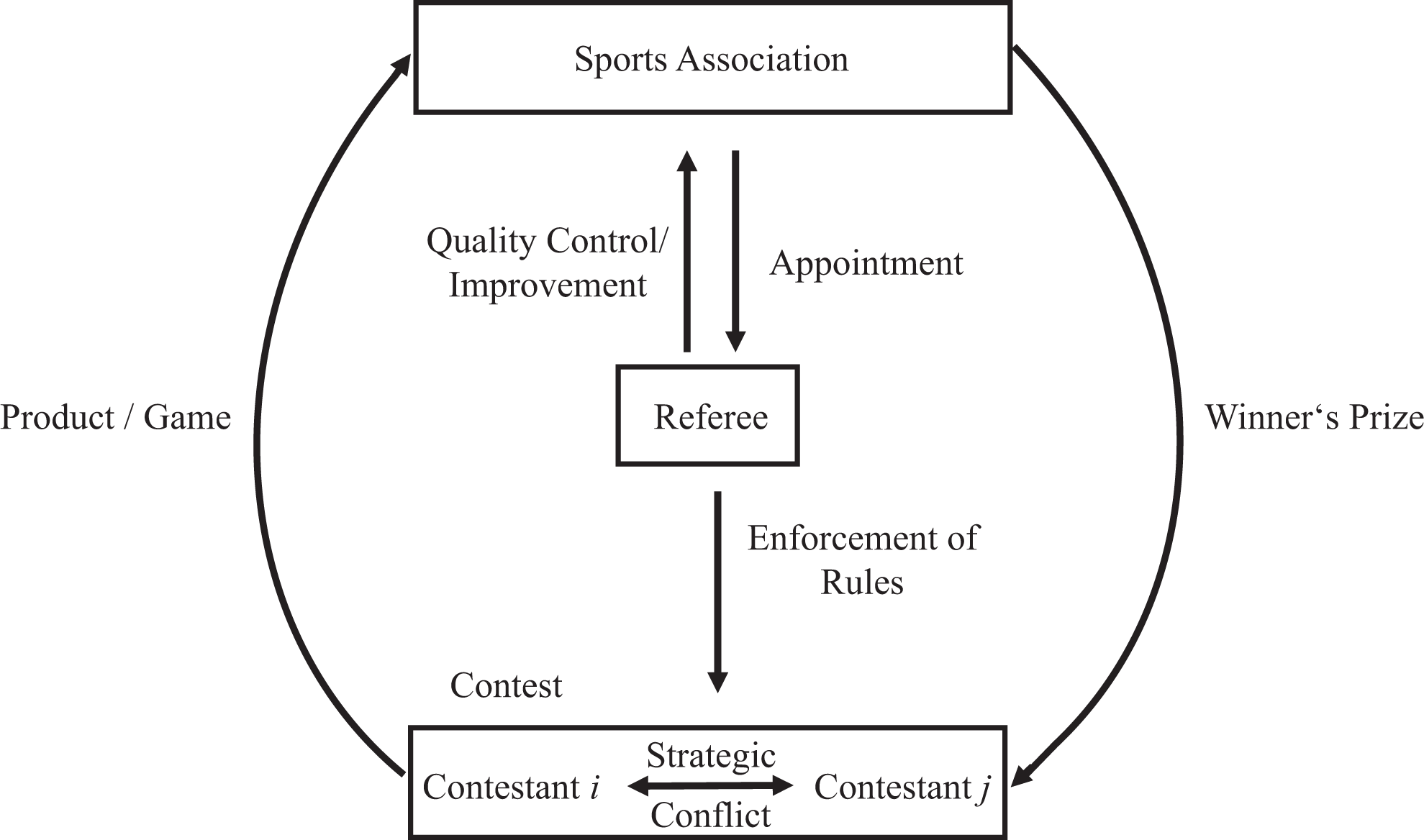
Underlying structure of the model.
In order to keep the model simple, the game will be played between two risk-neutral contestants i and j, that is,
Furthermore, each contestant can choose between two types of effort as instruments in order to increase his probability of success: (1) productive playing effort (

where
With regard to the game quality, it will be assumed that the average quality of a game is increasing in the contestants’ productive efforts

The idea behind the average quality function 2 comes from the observation that when the contestants already extensively choose to sabotage the opponent, while exerting low productive effort, an additional unit of sabotage lowers the already poor quality of the game by less than an additional unit of productive effort could raise the quality. Similarly, when contestants exert a high level of productive effort and a low level of sabotage effort, an additional unit of sabotage lowers the game quality by more than an extra unit of productive effort would raise the quality of the already high-quality game. 7
As mentioned earlier, the sports association can appoint a referee, ideally, in order to improve the game quality. The referee’s task will then be to correctly identify and penalize sabotage according to the rules of the game. However, a referee occasionally makes mistakes. Two types of mistakes can be differentiated: Type I error: The referee mistakenly calls a legitimate productive performance of a contestant as illegitimate with probability Type II error: The referee fails to convict a sabotage performance of a contestant with probability
where it will be assumed that
Note that we implicitly assume here that the referee is honest in the sense that he is not biased in favor of one of the two contestants. That is, the probability that the referee unconsciously makes a mistake to the detriment of contestant i is equal to the probability that he unconsciously makes a mistake to the detriment of contestant j. 9 Thus, supposing that the referee is honest, the performance function of contestant i transforms to

where
Expression 3 exhibits that contestant i's performance increases with his own productive effort as long as the referee does not mistakenly penalize it. If, however, the referee convicts contestant i's productive effort as a sabotage effort, contestant i not only loses his productive effort but in addition is penalized for it with the imposed penalty F. Conversely, contestant i's performance decreases with every sabotage activity exerted by contestant j, no matter whether the referee calls it or not. If he does sanction it, however, contestant i at least benefits from the penalty imposed by the referee on contestant j. In other words, all sabotage activities by contestant j will reduce contestant i's performance. But if the referee correctly penalizes contestant j's sabotage effort, contestant i is at least compensated for it with F.
Two remarks are worth mentioning: First, the referee executes his task to detect and punish sabotage according to the contestants’ performances in the contest. If, for example, the referee correctly penalizes contestant i's behavior, he does so with respect to i's sabotage performance
Furthermore, in order to ensure that the contestants produce positive productive effort in this model, the condition

that is

must be assumed to be satisfied throughout the whole discussion. 11 Hence, condition 4 requires a referee’s Type I error to be low enough for the contestants to be willing to exert productive effort so that a contest can take place.
As pointed out earlier, both contestants expend effort in order to improve their winning chances in such contest. Accordingly, the probability that contestant i wins the game will be given by

where
It will further be assumed that investing into effort is increasingly costly. Thus, let contestant i's cost function for legitimate effort be
Aside from incurring the costs of effort, the contestants also benefit from participating in a contest. Each contestant attaches a certain value to the winning prize, where for now let us assume that both contestants value the prize equally as V. Thus, the expected payoff of contestant i is given by

Finally, throughout the whole analysis, we will assume for simplicity that the participation constraint, namely, that the expected benefit from participating in the contest is at least as great as the expected cost, is always satisfied for both contestants.
Symmetric Games
A Symmetric Game Without a Referee
Today, given the immense commercialization surrounding modern sports events, a professional sports game without a referee, no matter whether in soccer, American football, basketball, or in any other established type of sport, is hard to imagine. Yet most sports were originally invented without incorporating a referee as a vital part of the game. 13 Hence, before introducing a referee into the game, consider first the players’ equilibrium incentives in a game without a referee. The results established in this section will then serve as a benchmark for studying the effect of a referee on the players’ incentives and on the quality of the game in the following sections.
In the case of a game without referee, each contestant will choose his effort levels so as to maximize his expected payoff, that is,

Recall from Equation 1 that


where we defined


As we would intuitively approve, Equations 9 and 10 show that the optimal effort choices increase with the valuation of the winner’s prize, the playing talent, and the marginal winning probability. Conversely, the equilibrium effort levels decrease with the marginal cost of effort.
Referring to Equation 2, the average game quality can now directly be derived as follows:

Thus, the average quality of a game with no referee between two symmetric contestants only depends on the playing talents as well as the marginal costs for productive and sabotage effort. The average quality increases with the amount of productive playing talent in the game as well as the contestants’ marginal cost of sabotage effort, while it decreases with the amount of sabotage talent as well as the contestants’ marginal cost of productive effort. Note, in particular, that the quality of a game here is independent of the contestants’ valuations of the winner’s prize and the marginal winning probability.
A Symmetric Game With an Honest Referee
Having examined the contestants’ incentives in a game without a referee, assume now that an honest referee is introduced into the game. The unconscious errors

Now, recall from Equation 3 that in a game with an honest referee


Thus, as in the game without a referee, the equilibrium playing efforts increase in the valuation of the winner’s prize, the playing talent, and the marginal probability of winning, while they decrease with the marginal cost of effort.
However, in the game with referee, the equilibrium strategies for productive playing effort and sabotage effort additionally depend on the marginal awardable penalty as well as the referee’s Type I and Type II errors, respectively. We observe, on the one hand, that the higher the Type I error,
Now, making use of Equation 2 again, the average quality of a game with a referee then becomes

Expression 14 illustrates that the average quality of the game increases with the quality of the referee, that is,

Comparing Equation 11 with Equation 14, it becomes apparent that the referee can actually increase the average quality of a game compared to the game quality without referee if


In this way, a referee is an important instrument for sports federations in the optimal design of sporting contests.
The Value of a Referee: Now, a sports association might be interested in a referee’s value, as it may be useful in determining a performance-based pay for referees. In fact, the value of a referee can be readily depicted from expression 16. Only if

Note that the value of the referee only depends on his Type I and Type II errors and the marginal penalty he is allowed to impose on wrongdoing contestants according to the rules of the game. It is independent of the marginal cost parameters c and k and independent of the contestants’ talents for productive effort and sabotage effort
Asymmetric Games
Having examined contests between symmetric contestants, we can now go on to study how asymmetries in prize valuations and playing talents/marginal costs of effort between players affect the results established above. Again, we will first study a game without a referee in order to examine whether and, if so, how asymmetries between contestants affect the quality and the competitive balance of the game in general. Afterward, an honest referee will be introduced into the game in order to compute the value of a referee in an asymmetric game. The effect of asymmetries between players on the value of the referee is then determined via comparison of the value of the referee in an asymmetric game with that in a symmetric game.
An Asymmetric Game Without a Referee
In order to assess the effect of asymmetries on the quality of a game, the various specific asymmetry parameters will be considered individually, using the case of the symmetric contest, that is, Equations 9 and 10, as the benchmark.
Asymmetric Prize Valuations: Consider first the possibility that the two competitors value the contest prize differently. Let the variable


for contestant i's and


for competitor j's effort choices. Note that, contrary to the contests studied so far,
The direct effect is that competitor j values the prize more than contestant i. This means that ex ante contestant j has a higher expected benefit from winning the contest than contestant i. Therefore, contestant j will exert more of both types of effort in equilibrium than contestant i in order to win the contest. This results in an increase in contestant j's equilibrium probability of success and an equivalent decrease in contestant i's probability of success. 18
In turn, the indirect effect is initiated by the reduction in the marginal probability of winning for both contestants, as a result of the shift in the contestants’ equilibrium probabilities of success. Being aware of this asymmetry and because effort is costly, contestant i maximizes his utility by indirectly lowering his effort choices. However, anticipating contestant i's behavior, contestant j's optimal response is to also indirectly lower his effort levels. Because of the symmetry of
It follows that the direct and indirect effects work in opposite directions on contestant j's incentives, while they work in the same (negative) direction on contestant i. This means that there must be a certain asymmetry threshold below which competitor j will increase his effort levels and above which contestant j will decrease his effort levels in equilibrium (compared to the symmetric game). This threshold is given by 19

Now, the asymmetry level at which the direct effect outweighs the indirect effect the most, that is, at which contestant j's equilibrium effort levels are maximized, is then given by

where
Regarding the average game quality, however, we notice that, due to the symmetry of the density function

The superscript a in Equation 25 signifies that this is the quality of an asymmetric game. Note that for
Interestingly, expression 25 demonstrates that the asymmetry in prize valuations in fact increases the quality of a game compared to a symmetric game for all values of
Asymmetric Productive Playing Talents: Consider now another likely asymmetry between competitors, namely, an asymmetry in productive playing talent. Similar to the analysis above, suppose that


for the effort choices of competitor i and


for competitor j's effort levels. The optimal strategies 26–29 again illustrate a direct and an indirect effect.
On the one hand, the increased effectiveness of contestant j's playing effort directly increases contestant j's productive effort incentives, while the lower effectiveness of contestant i's productive effort lowers contestant i's productive effort incentives. This leads to a higher equilibrium probability of success for contestant j and an equivalently lower probability of success for contestant i. Note that the sabotage activities by both contestants remain unaffected by the direct effect.
On the other hand, due to the indirect effect resulting from the contestants’ lower marginal probability of success, the asymmetry in productive playing talent at the same time reduces the incentives of both competitors to exert productive and sabotage effort.
Thus, as long as the direct effect outweighs the indirect effect, that is, as long as
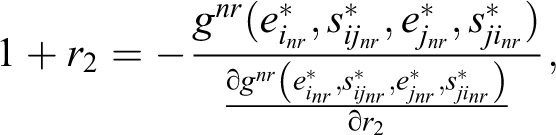
where
Now, consider the average game quality with an asymmetry in productive playing talent:

Comparing expression 30 with 11, we observe that the quality of the game remains unaffected by an asymmetry in productive playing abilities. Not only the indirect but also the direct effect cancels out in the computation of the game quality. 21
As expression 11 already showed, a game with overall greater productive playing talent has a higher quality than a game with overall lower productive playing talent. Interestingly, however, expression 30 now in addition demonstrates that the mere fact that contestants have unequal playing abilities has no effect on the quality of the contest. In other words, the quality of a game, as it is defined in this model, between a strong and a weak contestant will be equal to the quality of a game between two competitors of medium strength, as long as the absolute amount of ability in both games is identical.
Asymmetric Sabotage Talents: Let us now examine what happens if the contestants are asymmetric in sabotage talents. One could think of sabotage talent as the talent of hiding sabotage activities from the referee or as the ability of misleading the referee through blatant diving, for instance. Similar to the asymmetry analyses above, assume that


for contestant i and to


for contestant j. Thus, we obtain similar results for the contestants’ incentives as in the case of asymmetric productive playing talents, except that now the direct effect appears in the sabotage effort levels and not in the productive effort levels.
This leads to the important difference between an asymmetry in sabotage talent versus an asymmetry in productive playing talent: their effects on the game quality. Remember that, in the case of an asymmetry in productive playing talent, the positive direct effect on contestant j's productive effort canceled out with the negative direct effect on contestant i's productive effort because productive playing effort increases the average quality of a game linearly.
This, however, is not the case with an asymmetry in sabotage talent. Even though the direct effect increases the sabotage activity of competitor j by the same amount as it decreases the sabotage activity of competitor i, the two direct effects affect the average game quality unequally. In fact, because sabotage effort lowers the quality of a contest at a decreasing rate, the direct effect lowering contestant i's sabotage has a greater positive effect on the quality of a match than the direct effect increasing contestant j's sabotage. This means that the direct effect on contestant i's sabotage effort marginally increases the quality of the game by more than the direct effect on contestant j's sabotage activity marginally decreases the quality of a match. This is shown in expression 35,

where
Asymmetric Marginal Costs of Effort: Allowing for asymmetries in marginal costs of effort will effectively lead to the same results as shown in the study of asymmetric talents. This is because one could also interpret a more talented competitor as a competitor with a lower marginal cost of effort, that is,
An Asymmetric Game With an Honest Referee
So far, we have only looked at asymmetries in a game without referee. Now, we will study asymmetries in a game with an honest referee in order to examine the effect of asymmetries on the value of a referee. Consider first the asymmetry in prize valuations again, that is,


for competitor i and


for competitor j. 22 The quality of a game with asymmetric prize valuations and an honest referee therefore yields:

Hence, using expression 25, the value of a referee is given by

Comparing Equation 41 with Equation 18, we discover quickly that the value of a referee remains unchanged. In other words, an asymmetry in prize valuations does not affect the value of the referee.
This might seem surprising at first remembering that in expression 25, we observed that the asymmetry in prize valuations increased the quality of a game. Because the asymmetry in prize valuations in itself already led to a higher game quality, one might imply that the value of a referee would be reduced with the extent of the prize valuation asymmetry, as the game quality is already high even without the referee.
But, this mistaken conclusion presumes that the value added by the referee decreases with the quality of a game without referee. However, this is not the case. Recall from expression 18 that a referee’s value is merely determined by his own performance. Therefore, it does not matter whether the quality of a game without a referee is already high or low. As long as an asymmetry between contestants does not affect the referee’s errors, the value of the referee will remain unchanged.
Note that similar to an asymmetry in prize valuations, there is no obvious reason to suppose that an asymmetry in the competitors’ productive playing talents would affect the errors of an honest referee. Consequently, an asymmetry in productive playing talents will have no effect on the value of the referee either. 23
Conversely, if we want to study the effect of an asymmetry in sabotage talents on the value of the referee, it would be unrealistic to assume that the referee’s Type I and Type II errors are independent of the contestants’ abilities to sabotage. Therefore, we obtain a different result when contestants are asymmetric in talent. The Type I errors will increase with the contestants’ abilities of misleading the referee (e.g., through blatant diving), while the Type II errors will increase with their abilities of hiding sabotage activities.
Thus, assume now for the sake of the argument that


and


for contestant i and contestant j, respectively. Since
Surely, this result depends heavily on the assumption that the referee’s errors increase at a decreasing rate with the competitors’ abilities to sabotage. If we would assume instead that the errors increase at a constant rate, that is,
The Threat of a Biased Referee
As several corruption scandals involving referees have shown in the past, 25 it is not unusual for referees to be biased in favor of one of the competing contestants. All ethical and moral arguments taken aside, as soon as the referee’s expected benefit exceeds the expected cost from corruption, 26 it is only rational for the referee to use his powerful position to collect illicit rents in the form of bribes.
Therefore, suppose now that the referee is biased in favor of contestant i. Thus, assume only contestant i was willing to bribe the referee because contestant i has a lower productive playing ability than contestant j, that is, because
Now, let




Even though we know that, due to the normal distribution of the composed variable
Expressions 46–49 therefore clarify that the referee bias, on the one hand, leads to an unambiguous direct effect and, on the other hand, to an ambiguous indirect effect. 29 The bias directly reduces contestant j's productive effort because the referee more often falsely convicts contestant j's productive effort now leading to more penalties against competitor j. At the same time, the referee also convicts contestant i's sabotage less often, leading to fewer penalties against contestant i and therefore to a higher sabotage effort by competitor i on competitor j.
Because the direct effect increases contestant i's and equivalently decreases contestant j's equilibrium probability of success, the bias indirectly affects the effort choices via the consequential change in the marginal probability of success. Because of the symmetry of
From this it follows that if
If, however,
In this context, it is worth mentioning that the referee bias will unambiguously lower contestant j's overall performance, that is,
Contestant i's overall performance, however, is only affected by the indirect marginal probability effect. Because
From this discussion, one can already take a firm guess on what impact the fact that the referee is biased has on the quality of the game. According to expression 2, the average game quality with a biased referee is now given by

With expression 50, it can easily be shown that the quality of a game with a biased referee is lower than the game quality with an honest referee, that is,
This points directly at the potential threat that corruption poses to the competitive sports industry. Due to the lower quality of the contest, the demand for a sports event contaminated by corrupt referees will be determinedly lower.
The Impact of a Referee on Competitive Balance
In the following, we finally assess the effect of a referee on the competitive balance between the contestants. As it is common in the economic literature on sports, we measure competitive balance by the uncertainty of the outcome of the contest. We follow Hoehn and Szymanski (1999) and Vrooman (2007, 2009) and assume without loss of generality that competitive balance is given by the ratio of contestant’s

where
Of course, in a game with two symmetric contestants, the equilibrium probability of winning is

In an asymmetric game, consider first the possibility of asymmetric prize valuations and suppose as before that competitor j values the prize more than competitor i,

To analyze the impact of a referee on the degree of imbalance, we interpret a game without a referee as a game with an honest referee who never falsely sanctions productive effort and never correctly penalizes sabotage effort,

Consider first how a change in the Type I error affects the winning probability of contestant i. Expression 54 shows that an increase in
The same reasoning applies for the impact of a change in the Type II error on the winning probability of contestant j. If
The intuition behind this result is clear: A referee introduces an additional uncertainty into the game. This uncertainty increases the winning changes of the weaker team and equivalently lowers the winning changes of the stronger team. In sum, the outcome of the game becomes more uncertain and the degree of competitive balance increases.
Two remarks remain: First, the proposition above not only covers the case of asymmetric prize valuations but also asymmetries in productive and sabotage talent. This is simply due to the observation that for asymmetric productive playing talent with

and for asymmetric sabotage talent with

The reasoning then is as above. Second, if the referee is biased in favor of the weaker contestant i, the degree of competitive balance also increases. This directly follows from Proposition 7, since the overall difference in the productive and sabotage efforts between the unfavored and favored contestant is reduced. Of course, this increases the winning probability of the favored contestant to the disadvantage of the unfavored one.
Conclusion
With the model developed in this article, we make an attempt to explicitly explain the role of sports referees from an economic perspective. In previous studies applying a contest theory framework, referees were simply handled as an implicit part of a random factor affecting the outcome of an imperfectly discriminating contest. However, the model presented here evidently demonstrates that the referee must be viewed as an integral part of contests, as he can significantly influence the equilibrium strategies of the contestants. This inference not only applies to sports contests but also to any other type of contest involving a third-party supervisor enforcing a prespecified set of rules.
In our model, the referee is responsible for penalizing sabotage effort in order to uphold a certain standard for the quality of the contest. But, as the model shows, whether or not the referee can really improve the quality of a contest heavily depends on his own performance since the contestants will integrate the referee’s performance in their strategy choices. Given the specified penalties awardable subject to the rules of the game, the use of a referee becomes valuable only if the referee’s Type I and Type II errors are sufficiently low. As it turns out, as long as the disparity between the contestants does not affect the referee’s errors, the extent of a referee’s value creation is independent of whether contestants are of equal or unequal strength. If the asymmetry between players does affect the referee’s performance, as was exemplified here with the asymmetry in sabotage talent, the value of the referee depends on how the asymmetric attribute affects the referee’s errors.
In any case, highlighting the power of discretion of referees, the model also demonstrates how the problem of corruption can pose a serious threat to the sports industry. The biased referee evidently reduces the quality of the game causing the fan interest in a particular sport to decrease as well. Thus, it is of eminent importance for the continuing demand for sports events that the sports leagues actively engage in the deterrence of sports corruption. As a result, a sports association has to establish mechanisms aimed specifically at corruption prevention in order to at least maintain the present level of demand for future sports events.
Our model also sheds light on the controversy over the goal-line technology and the VAR system. Using the terminology of our model, the goal-line technology reduces a referee’s Type I error whereas the VAR system reduces mainly a referee’s Type II error. In both cases, the new technologies reduce the possibility of referees’ mistakes and thereby increase the competitive imbalance given by the initial strength of teams. Given our analysis, stronger teams then favor the introduction of these technologies whereas weaker teams refuse them.
Footnotes
Appendix
Appendix A. Stochastic foundation of the standard Tullock contest
Suppose that instead of the additive specification
where supercript
Then, for a given performance
Hence, the unconditional probability for contestant i to win is Appendix B. Asymmetry level maximizing contestant j's effort levels.
Contestant j's effort levels in an asymmetric game without referee are maximized when
where
Appendix C. Asymmetry in productive playing talents and its effect on the value of the referee.
for contestant i and
for contestant j. This leads to the following game quality.
Thus, the value of a referee in a game with asymmetric productive playing talents is given by
Hence, again the value of a referee is unaffected by an asymmetry in productive playing talents.
Appendix D. Reduction in the game quality resulting from a biased referee.
From Appendix C, we know that the game quality of a game with an honest referee and where contestants are asymmetric in productive playing abilities is given by
From expression 50, we know that the game quality of a game with a biased referee and where contestants are asymmetric in productive playing abilities is given by
Thus, in order to show that
Rearranging yields:
This always holds because
Declaration of Conflicting Interests
The author(s) declared no potential conflicts of interest with respect to the research, authorship, and/or publication of this article.
Funding
The author(s) received no financial support for the research, authorship, and/or publication of this article.
