



Abstract
We analyze habit formation in sports attendance utilizing rainfall as an unexpected, transitory shock to attendance costs. Using attendance data from Major League Baseball (MLB) and National Oceanic and Atmospheric Administration weather data, we analyze the impact of variation in game day weather conditions on current and future MLB attendance. The empirical strategy permits identification of both the formation and persistence of habit from exogenous weather shocks. Past adverse weather shocks increase future attendance by about 200 fans per game. This contributes to the literature developing empirical evidence of habit formation in the field and provides policy implications for optimal ticket-pricing strategies.
Introduction
Researchers have long been interested in attendance demand at live sports events and have investigated the role of ticket prices, outcome uncertainty, game importance, local income levels, competitiveness of the home team and opponents, facility quality, broadcast availability, game day weather conditions, and other factors on attendance. Borland and Macdonald (2003), García and Rodríguez (2009), and Martins and Cró (2018) contain comprehensive reviews of this literature. Behavioral aspects of fan attendance decisions recently attracted attention. For instance, Coates, Humphreys, and Zhou (2014) formulated a game attendance model based on a reference-dependent preferences framework.
Habit formation represents another well-studied area in the behavioral attendance literature. Fans are said to form a habit of attending live sports events if past attendance increases the probability of future attendance, holding other factors affecting the attendance decision constant. Previous studies (Ahn & Lee, 2007; Lee & Smith, 2008; Martins & Cró, 2018; Pawlowski & Anders, 2012) tested whether past season-level attendance explains current aggregate attendance with mixed results. While empirical attendance models may capture fans’ habit formation, they could also capture the effects of persistence in attendance generated by serial correlation in other factors affecting fans’ attendance decisions unrelated to habit. Also, much of the research on habit formation and attendance relies on data aggregated at the team level or season level to identify the effect of habit on attendance. The extent to which this manifests at a more granular game-level remains an open question.
In addition, previous research likely suffers from an econometric identification issue that limits researcher’s ability to distinguish the formation of an attendance habit from persistence in fan attendance. Correlation clearly exists between past and current attendance decisions and fans’ time invariant unobservable personal preferences and traits, as well as serially correlated economic factors affecting attendance. Empirically distinguishing habit formation from persistence to provide microlevel evidence of habit formation on attendance requires an exogenous shock to game attendance decisions that is orthogonal to fans’ personal traits and other economic factors affecting attendance decisions.
This article utilizes data from Major League Baseball (MLB) and explores the impact of habit on attendance by exploiting game day rainfall as an unexpected, transitory shock to the cost of game attendance. The impact of exogenous current adverse weather shocks on fans’ attendance decisions represents a source of variation in attendance demand uncorrelated with past attendance and unobserved fan characteristics. This allows us to disentangle habit formation from persistence and estimate the importance of habit. In addition, we utilize game-level attendance data rather than the more aggregated data employed in prior studies in order to provide improved microlevel evidence of habit formation.
We find robust evidence that past transitory weather shocks increase current attendance at MLB games. Specifically, a one standard deviation increase in cumulative rainfall on the previous game day boosts current game attendance by as much as 0.68% or approximately 210 fans on average. The results are robust to the inclusion of lagged attendance in the empirical models, suggesting that previous research using only lagged attendance to estimate the impact of habit underestimated the strength of habit in attendance decisions. In addition, the “dual self” model of impulse control developed by Fudenberg and Levine (2006) can explain the positive relationship between past weather shocks and current attendance, in the case where the long-run attendance habituated self overcomes the short-run self’s acquisition of the habit of not attending games because of weather shocks.
Our article also contributes to the broader literature developing empirical evidence of habit formation in the field. In addition to a number of laboratory studies (see Duhigg, 2012, for a review), recent growth in empirical research on habit formation focuses on consumer decisions made in the field and seeks to address key questions such as whether consumers form habits over time based on past decisions, the persistence of such habits, and under what conditions they will be altered. This article addresses these questions by analyzing the impact of exogenous weather shocks; our findings regarding live game attendance decisions represent additional evidence in a line of research that includes migrants’ preferences toward consumer-packaged goods (Bronnenberg, Dubé, & Gentzkow, 2012), diet variety of migrants (Atkin, 2013), adoption of preventative health behavior (Hussam, Rigol, Reggiani, & Rabbani, 2016), voting turnout (Fujiwara, Meng, & Vogl, 2016), exercise decisions (Humphreys, Ruseski, & Zhou, 2015; Royer, Stehr, & Sydnor, 2015), charitable donation responses to sports-related shocks (Meer, 2013), gasoline demand (Scott, 2012), and home energy consumption (Allcott & Rogers, 2014; Ge & Ho, 2019).
Conceptual Framework
The standard model of rational addiction (Becker & Murphy, 1988) includes time-consistent consumers making spending decisions on a good characterized by reinforcement—more consumption of the good in the past increases the marginal utility of consumption today—and tolerance—more consumption in the past decreases the absolute utility from consuming today. In other words, given utility defined over a time path of consumption of an addictive good
Much of the prior behavioral attendance demand literature follows Becker and Murphy’s rational addiction model and assumes a positive association between past and future attendance decisions due to the presence of habit. Ahn and Lee (2007) develop a two-period model of life cycle attendance at sporting events that includes habitual attendance. In this model,
In many empirical settings, researchers only observe persistence of attendance, presenting an empirical challenge for identifying the presence of habit. Measures of persistence in sports attendance have been limited to the inclusion of lagged attendance in most previous research, a practice with well-known problems (Dawson & Downward, 2000). Fujiwara, Meng, and Vogl (2016) point out that econometric identification of habit cannot be identified using data on attendance (in their case attendance at a voting station) alone because of serial correlation in factors not related to habit that affect attendance. In our case, such factors may include consumer preferences for attending games, income, and ticket prices.
Like Fujiwara et al. (2016), we avoid this problem by using weather shocks to identify habit. Weather shocks introduce cues that may exogenously trigger the formation of (a possibly different) habit like not attending games or, in other words, eliminate the habit of attending games. Intuitively, game day precipitation increases the cost of attending a game through logistical inconveniences (travel takes longer because rain slows traffic and walking from the parking lot to the stadium in the rain is unpleasant) and a less pleasant game-viewing experience. This is especially true for open-air stadiums. Twenty-three of the 30 MLB teams play in open-air home stadiums. MLB games are typically not affected by light to moderate rain. In case of a postponed or canceled game due to heavy rain or other adverse weather conditions, teams have “rainout” policies that allow fans to exchange tickets to the canceled game for a future game. We analyze only completed games and drop all rainouts from the sample.
Fujiwara et al. (2016) document that rainfall reduces both current voter turnout and future voter turnout in a regression model that includes both current rainfall and rainfall on the last election day. The econometric identification of habit formation in Fujiwara et al. (2016), in terms of attendance, points out that the presence of habit in baseball attendance cannot be identified from attendance data alone because changes in attendance reflect both persistence in factors affecting the decision to attend games and habit. Instead, identification requires a variable affecting current attendance decisions and uncorrelated with other factors like prices, preferences, and income. Weather shocks, in the form of rainfall, represent one possible variable affecting current attendance decisions and uncorrelated with other variables that influence the decision to attend a game. This approach assumes that past rainfall affected past attendance, but past rainfall has no impact on current attendance decisions. The effect of past rainfall on current attendance works entirely through the effect of past rainfall on past attendance and the effect of past attendance on current attendance, which reflects habit.
Many studies empirically document a negative impact of rainfall on current attendance. For example, Kalist (2010) shows that rain on game day reduces current MLB attendance, and Agha and Rhoads (2018) show that game day rain reduces current minor league baseball attendance. The relationship between past rainfall and current attendance represents the key empirical issue in this setting.
Baseball teams sell season tickets (a ticket to all 81 home games), partial season ticket plans (a ticket to a smaller number of home games, typically 10–30), advance sale single-game tickets, and single-game tickets on game day. A recent MLB case study reports that about 30% of tickets were sold on game day (Xu, Fader, & Veeraraghavan, 2016).
Full season ticket holders generate persistence in baseball attendance and clearly have the habit of attending games. Full season ticket holders generate no variation in day-to-day attendance. Partial season ticket holders likely have the habit of attending games and also generate variation in attendance. Weather shocks will not affect tickets sold to full season ticket holders. They purchased tickets to all games. Weather shocks could affect attendance by partial season ticket holders, if they attend additional games that are not part of their partial season ticket plan
The 30% of tickets sold on game day represent decisions by the marginal baseball fan. These marginal fans could represent local residents who randomly decide to attend a baseball game one day instead of some other entertainment activity. If all marginal fans make attendance decisions like this, and the city contains a large number of residents who attend one baseball game a season, then observed variation in game attendance will reflect variation in the number of these fans who decide to attend a baseball game on a given day. In this case, past rainfall should be unrelated to current attendance, since rain on the previous game day will not affect the marginal fan’s current decision.
Alternatively, the marginal fan could be a nonseason ticket holder with the habit of attending baseball games. Game day rainfall will deter this fan from attending today’s game and also possibly activate the habit of not attending games. Current rainfall may hinder the marginal fan with a habit of attending games from attending future games. In this case, past rainfall will lead to decreases in current attendance.
Nelson and Meyvis (2008) document how interruptions during a hedonic experience help restore the intensity of the experience and increase enjoyment. In the same vein, a transitory weather shock like rainfall may temporarily interrupt the habit of attending games, in turn resulting in an urge to attend future games. As the stock of such urges accumulate, a marginal fan may become more likely to make an active decision to satiate the urge by attending the next game. In other words, it is possible that past rainfall may lead to increases in current attendance.
In addition, nonseason ticket holders with the habit of attending games may have a strong enough habit to interfere with the formation of the habit of not attending games. The stronger the habit of attending games, the more likely a marginal fan who planned to attend a game on Tuesday but did not attend that game because of a negative weather shock would instead attend the game on Wednesday. These decisions can be motivated by the “dual self” model of impulse control developed by Fudenberg and Levine (2006). The presence of marginal fans with a strong habit of attending games leads to a positive relationship between past rainfall and current attendance.
Data and Empirical Strategy
Data
The data come from multiple sources. Our primary source is the MLB game attendance data available from MLB’s official website (www.mlb.com). We analyze game day attendance data for MLB games at approximately 29,000 regular season games from the 2005 through 2016 MLB season. The official game attendance defined by MLB reflects the number of tickets sold for a particular game rather than the actual number of people who attended the game. The actual turnout rate is not publicly available. Following the practice in the literature, we assume that MLB-reported “attendance” reflects the number of people attending each game.
In addition, we incorporate MLB money line betting odds data from www.covers.com to control for pregame expectations of game outcomes. We convert the money line odds to the probability that the home team will win each game using the standard formula.
The game day weather data come from the National Oceanic and Atmospheric Administration and contain hourly accounts of outdoor temperature and precipitation from the weather station closet to each MLB stadium in the sample matched by GPS coordinates. Data on hourly local precipitation intensity, in inches per hour, are collected for each game day in our data set. We mainly focus on rainfall as the weather shock of interest given that the MLB regular season typically runs from April through September, and it is less common to observe other adverse weather conditions such as snow, ice, or sleet during this period. Besides historical local weather data, we also collect the one-day forecast of average temperature and total precipitation from each weather station for each game day. 1
Each game in the data set can be uniquely identified by the home team, the visiting team, and the date of the game. Because our data contain a total of 275 doubleheaders, where the same pair of teams play two games on the same day, knowing the date and the teams involved may not uniquely identify a game. In addition, many doubleheaders tend to be split-gate doubleheaders, where the first game often involves a makeup game rather than a regularly scheduled game. Given that our identification strategy is based on game day weather conditions, we restrict our sample to those game days when a single game was played. In a robustness check, we reestimate our models by also including the second game of the doubleheader. Previous rainfall is the amount of rainfall recorded on the day of the previous home game played.
Table 1 provides summary statistics for the main variables of interest. Average attendance at MLB games in the sample is approximately 31,000 fans per game with substantial variation across time and cities. We also observe a sizable variation in the game day average outdoor temperatures and recent performance of both the home and visiting teams. The game day average cumulative rainfall is approximately 0.07 in., and the probability of raining on a given game day is about 8% with understandably large geographical and time variations. On the other hand, heavy rain (≥0.05 in./hr) is relatively rare on game days, possibly because of the team’s rainout policy. The MLB follows a compact game schedule with an average of approximately 2 days between any two home games. The high frequency of games combined with large variations in rainfall will facilitate our identification strategy. Weather forecast data on average match well with the actual historical weather data with respective correlations of approximately .50 and .88 for precipitation and outdoor temperature.
Summary Statistics.
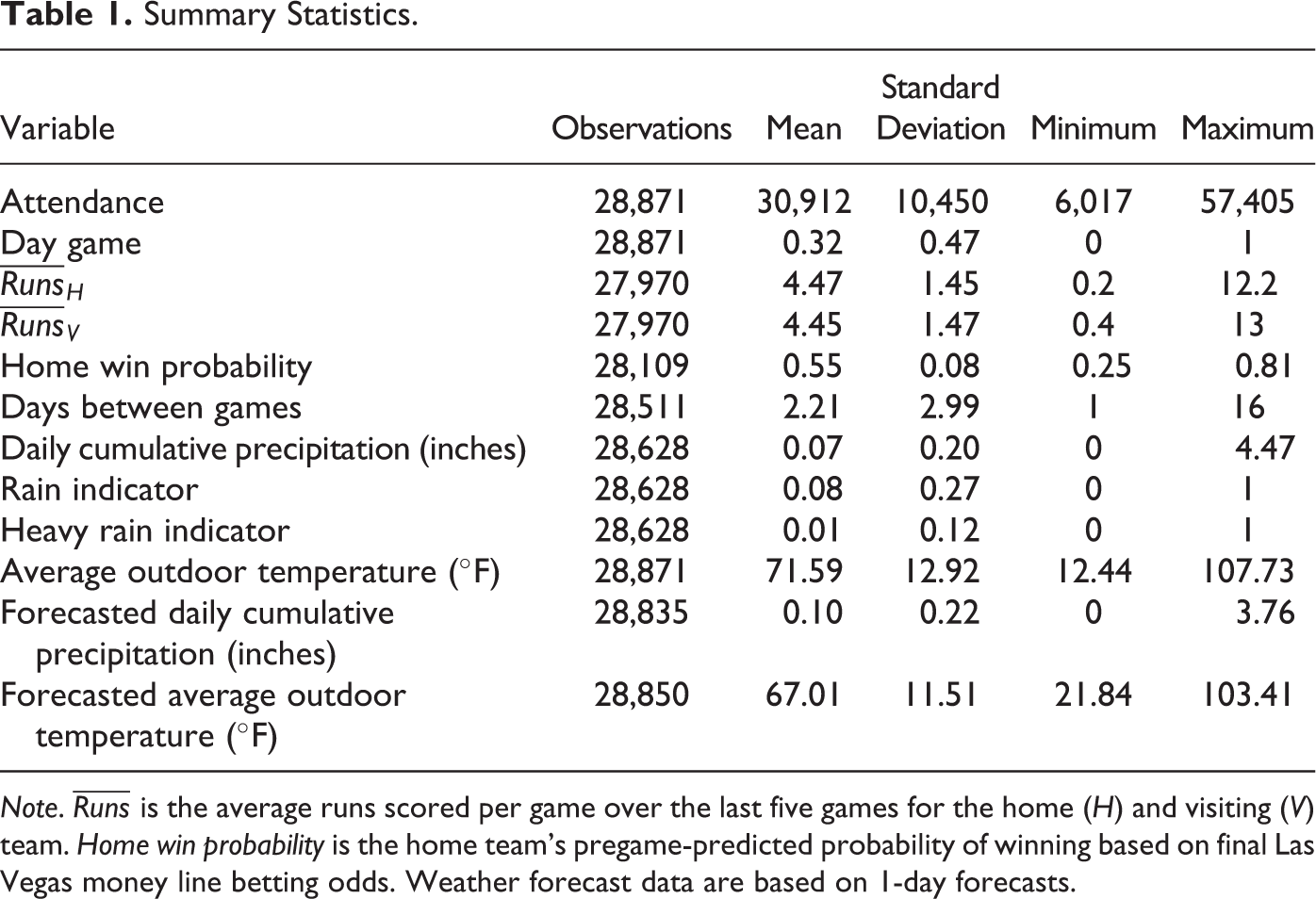
Note.
Empirical Strategy
Our empirical strategy follows Fujiwara et al. (2016). We exploit local variation in game day weather conditions and track the attendance at home games over time, controlling for a set of well-studied determinants of attendance demand used in previous empirical research. To motivate our approach, first consider the following empirical model that captures the contemporaneous impact of rainfall on attendance

In addition, we control for the number of days since the last home game and the average game day outdoor temperature. 2 To capture possible nonlinearity in the relationship between temperature and attendance, we also include a quadratic term for the average game day outdoor temperature—day games with extreme temperatures may not offer a pleasant experience to fans. Finally, estimated standard errors are cluster-corrected at home–team–city level.
To capture the impact of past rainfall on current attendance, we augment Equation 1 by including a lagged rainfall term:

This model permits estimation of the average effect of rainfall on attendance along with the effects of past rainfall on attendance, captured by the lagged rainfall variable. The lagged rainfall variable reflects the cumulative amount of rain recorded on the last day a home game was played in the stadium. Rainfall is plausibly exogenous to unobservable fan characteristics and unobservable factors affecting demand for attendance at specific MLB games. This specification represents a reduced form model of the impact of rain on attendance. As discussed above, the parameter on the lagged rainfall variable,
The impact of past rainfall on current attendance decisions may extend beyond the previous game. We investigate this possibility in a separate model by introducing additional lags of the rainfall variable, for example, the cumulative rainfall from two and three home games ago. Previous studies on habit formation in live game attendance often rely on directly regressing current attendance on past attendance. This empirical strategy may suffer from an endogeneity problem. Since game day rainfall is clearly correlated with game day attendance decisions and arguably exogenous to other factors like preferences, prices, and income affecting current and attendance decisions, an alternative empirical framework consistent with prior research would involve using past rainfall shocks as instruments for past attendance. As a robustness check, we estimate a Panel IV specification. Equation 2 is our preferred specification as it represents a reduced form model explaining variation in attendance that reflects the impact of past weather shocks.
In order to make our results comparable to previous results in the literature, we also estimate models containing lagged attendance, despite the potential econometric problems this generates. Finally, to account for possible spurious correlation, we also perform a falsification test similar to Miguel, Satyanath, and Sergenti (2004), where future rainfall is included as an independent variable in the regression model. We posit that the estimated coefficient on the future rainfall variable should be zero in a correctly specified model since a forecast of rainfall tomorrow should not influence today’s attendance decisions.
Results and Discussion
Main Findings
Table 2 contains our main empirical findings. Column 1 presents the results for a basic regression model specification that only includes game day and lagged precipitation and home team fixed effects. Contemporaneous (game day) rainfall reduces attendance, and past rainfall increases current attendance. Column 2 introduces time fixed effects (year, month, and day of week); lagged rainfall still has a positive impact on current attendance, and the impact of contemporaneous weather shocks on current attendance remains, with a smaller parameter estimate. Including visiting team fixed effects had no impact on the estimated parameters on the rainfall variables.
Column 3 includes a set of variables known to influence attendance decisions as documented in prior research, including past performance of the home and visiting teams, pregame expectations of game outcome as proxied by betting odds, and game day temperature (and its quadratic). 3 We also control for the number of innings for both home and visitor teams in each game as well as the number of days since last home game.
The attendance demand literature also typically controls for the total cost of attendance. Total cost of attendance data can be found in the Fan Cost Index (FCI), collected and published in Team Marking Report. Our main models exclude the FCI since these data are at the season level and our identification is at the game level. However, when we add the natural log of FCI as a control variable to the existing model specifications, we obtain identical results to those in Table 2. The sign and magnitude of the estimated parameter on the lagged rainfall variables are similar to those in Columns 1 and 2. The parameter estimate on contemporaneous rainfall becomes statistically insignificant.
Impact of Weather Shocks: Main Model Specifications.

Note. The dependent variable for all specifications is
***p < .01. **p < .05. *p < 0.1.
The results from our preferred model specification, Column 3, indicate that a one standard deviation increase in lagged game day rainfall will lead to a 0.42% increase in attendance or an average of approximately 130 additional fans at the next home game. In terms of the other control variables, we find that recent home team performance, in terms of runs scored, and home team pregame-predicted probability of winning both help boost attendance, which is expected and in line with previous results. In addition, game day outdoor temperature is positively correlated with attendance. Although there seems to be evidence for a nonlinear impact of outdoor temperature, its magnitude is small across all model specifications.
The positive parameter estimates on lagged rainfall reflect the impact of habit and not simply fans with tickets to a rained out game on the previous day attending a game the next day. We omit data from rainouts from the sample, so rainfall at the previous game reflects rain at a completed game. Tickets for rained out games are not automatically exchanged for tickets to the next home game. Fans must exchange them for some future game of their choice.
Some rained out games are rescheduled the next day as part of a doubleheader (playing two games on the same day), which could lead to an increase in attendance, as fans would get to watch two games for the price of one. As discussed in Data section, we drop all doubleheaders from the sample to avoid this complication. 4 The models contain team fixed effects and variables reflecting home and visiting team offensive performance over the last five games to control for any tendency of fans to attend the game following a day with rain because of the quality of the opposing team.
Column 4 contains results for a model including lagged home attendance as a right-hand side variable, reflecting the practice in previous literature. The parameter estimate on the lagged dependent variable is positive, statistically different from zero, and large. We estimate this model to make our results comparable to previous research. The sign and significance of the estimated parameters on current and lagged rainfall remains the same. The parameter estimate on the lagged rainfall variable increases. The coefficient on the lagged rainfall variable is 0.034, implying that a one standard deviation increase in lagged cumulative game day rainfall increases current attendance 0.68% or approximately 210 fans.
Finally, in Column 5, we introduce a future rainfall variable that presumably should not affect current attendance decisions if our model is correctly specified. The estimated coefficient on the future rainfall variable is not statistically different from zero.
We further investigate the extent to which past rainfall shocks affect future attendance decisions using the same model specifications as in Table 2 and introducing two additional lags of game day rainfall to the model. This captures the impact of weather shocks from two and three home games ago. Table 3 reports parameter estimates for rainfall variables only. Rainfall on the three most recent game days all have positive and significant impacts on current game attendance
Impact of Weather Shocks: Multiple Weather Lags.
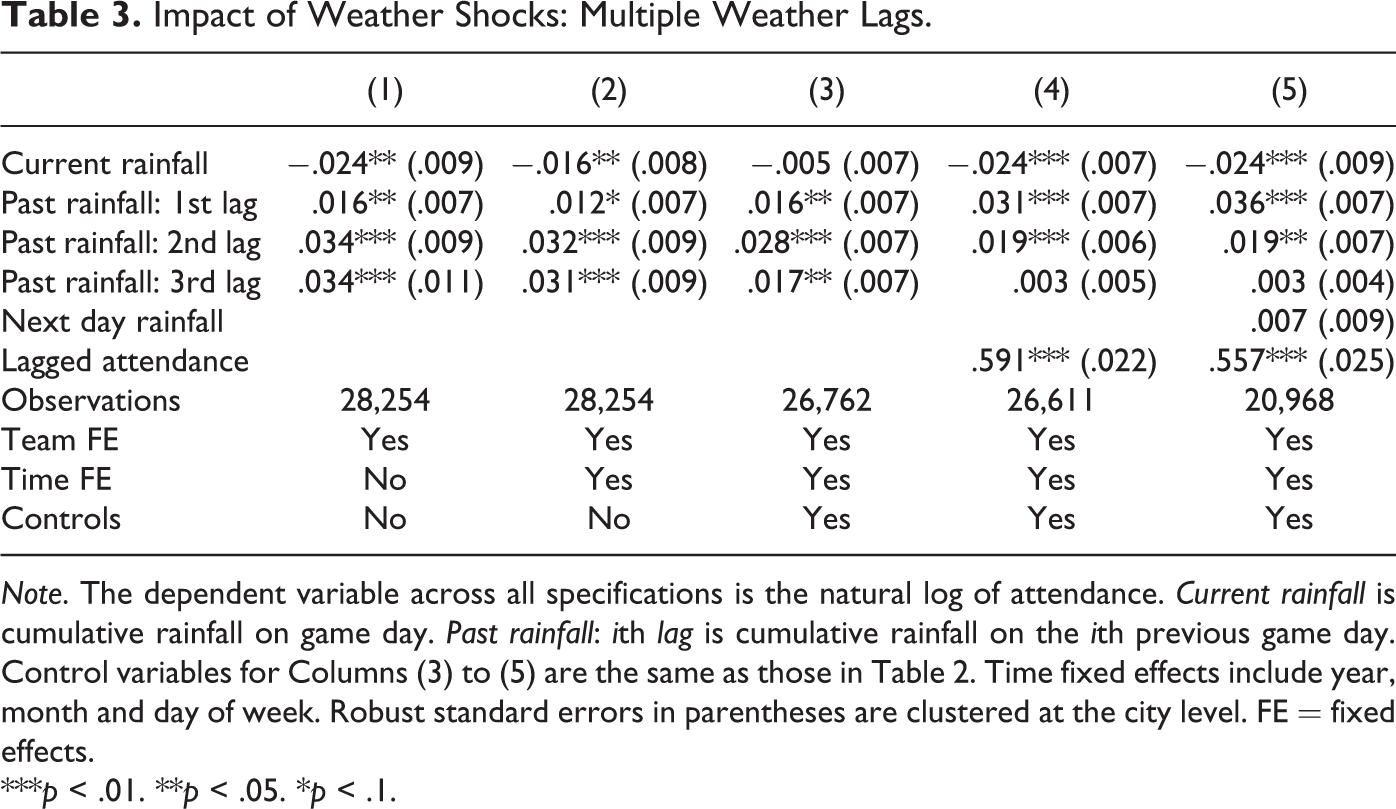
Note. The dependent variable across all specifications is the natural log of attendance. Current rainfall is cumulative rainfall on game day. Past rainfall: ith lag is cumulative rainfall on the ith previous game day. Control variables for Columns (3) to (5) are the same as those in Table 2. Time fixed effects include year, month and day of week. Robust standard errors in parentheses are clustered at the city level. FE = fixed effects.
***p < .01. **p < .05. *p < .1.
From Column 5, this specification continues to pass the falsification test. Overall, the results in Table 3 lend strong support to the conclusion that the impact of past rainfall extends beyond just the most recent game day. 5
Robustness Checks
We perform a series of robustness checks on our main model specifications. Results in this section come from empirical models based on Equation 2 with only one lag of the rainfall variable. We also perform the same set of robustness checks using models with multiple lags of game day rainfall as well as specifications involving visiting team fixed effects and quadratic current and lagged rainfall terms. The results remain similar and demonstrate that there is a nonlinear relationship between (past) cumulative rainfall and attendance. Full estimates are available upon request.
First, in line with prior literature on live game attendance, we reestimate our main model specifications using a panel tobit model to take into account right-censored games (sold out games). These estimates yield similar results to those on Tables 2 and 3. The panel tobit results are available upon request. Previous research (Meehan, Nelson, & Richardson, 2007) shows that baseball games are not usually subject to strong right censoring, and in our data, the mean and median attendance constitute approximately 70% of stadium capacity with only 11.56% of the games being completely sold out.
Second, we estimate the models separately using data from home stadiums with and without domes since the live game-viewing experience in open-air stadiums is presumably more affected by weather shocks than in domed stadiums. These estimates are shown in Table 4. Overall, the results for open-air stadiums are very similar to those in Table 2, with lagged rainfall displaying a larger magnitude when including a lagged dependent variable in the model in Columns 4 and 5. We also conduct the same analysis for home stadiums with domes and do not find statistically significant coefficient estimates on the lagged precipitation variable.
Robustness Check: Open-Air Versus Domed Stadiums.
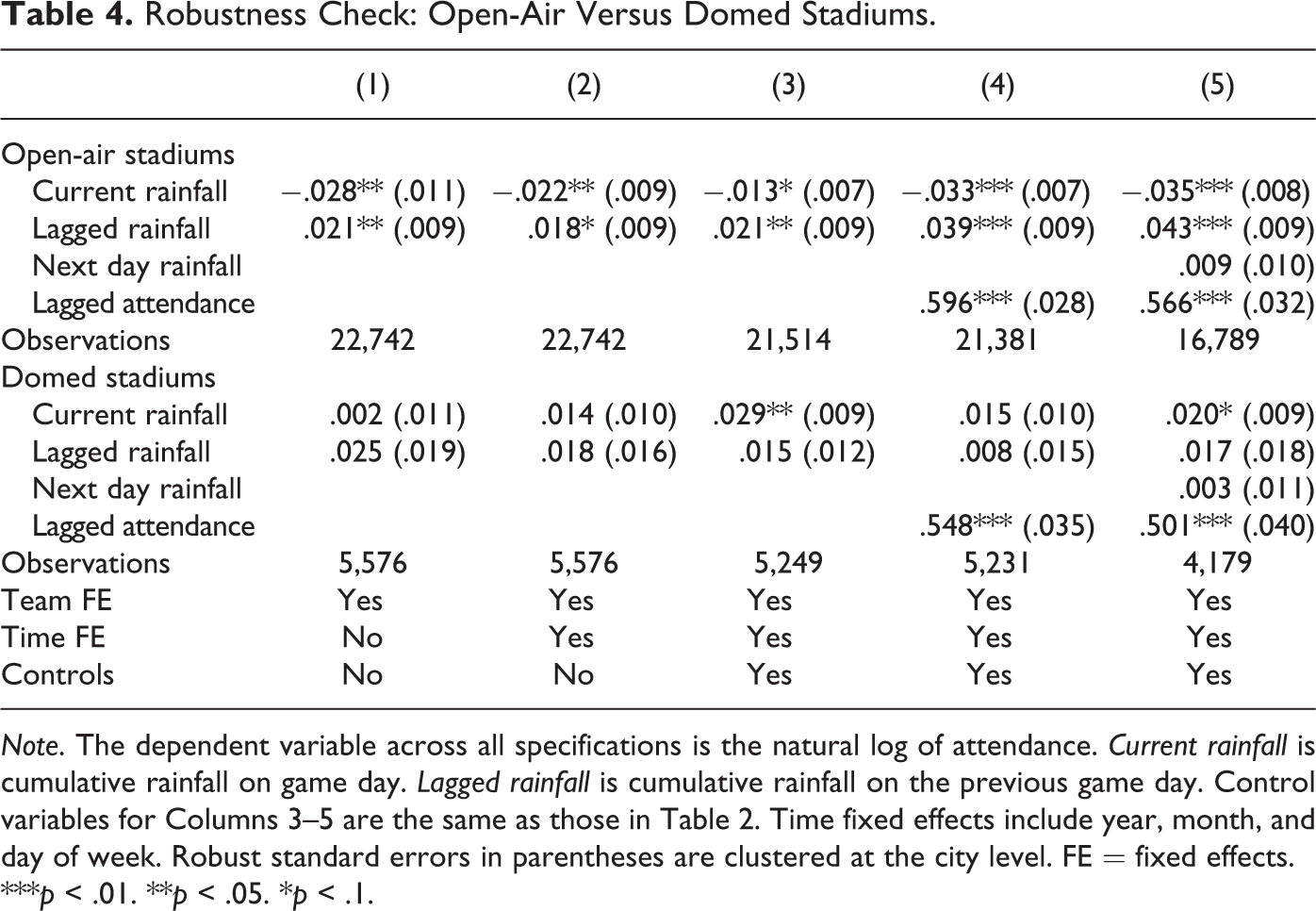
Note. The dependent variable across all specifications is the natural log of attendance. Current rainfall is cumulative rainfall on game day. Lagged rainfall is cumulative rainfall on the previous game day. Control variables for Columns 3–5 are the same as those in Table 2. Time fixed effects include year, month, and day of week. Robust standard errors in parentheses are clustered at the city level. FE = fixed effects.
***p < .01. **p < .05. *p < .1.
In fact, there is weak evidence that rainfall may boost contemporaneous attendance at domed stadiums as exhibited in Columns 3 and 5. This result could reflect the idea that attending a baseball game indoors on a rainy day is a substitute for other outdoor recreational activities that become unattractive on rainy days, like going to a park or amusement park or going for a walk. These results confirm that while rainy weather may inconvenience fans traveling to and from the stadium, the live game-viewing experience seems to be a more important channel through which weather shocks affect attendance decisions.
Finally, we consider different measures of rainfall in our empirical models, which is broadly related to the temporal dimension of fans’ game attendance decisions. Some fans, especially casual and fair-weather ones, may make game attendance decisions conditional on weather conditions just a few hours prior to the game. Alternatively, their attendance decisions may be based on weather forecasts. To address this concern, we use the same empirical model specifications as in Table 2 but consider different proxies for game day precipitation. Specifically, we include variables reflecting cumulative rainfall up to 2 hr before the game, 4 hr before the game, and the forecasted daily cumulative rainfall from the day before the game. The results are presented in Table 5. 6 There is no evidence that fans’ attendance decisions are based on weather conditions just hours before the game. Rather, they seem to pay attention to weather forecasts and make attendance decisions accordingly. In fact, the magnitudes of the impact of forecasted rainfall in Columns 5 and 6 are decisively larger than the comparable estimates of the contemporaneous rainfall variable in Table 2. This suggests that even casual fans may be forward-looking, which is consistent with the basic setup in a Becker–Murphy style rational addiction model.
Robustness Check: Alternate Rainfall Measures.
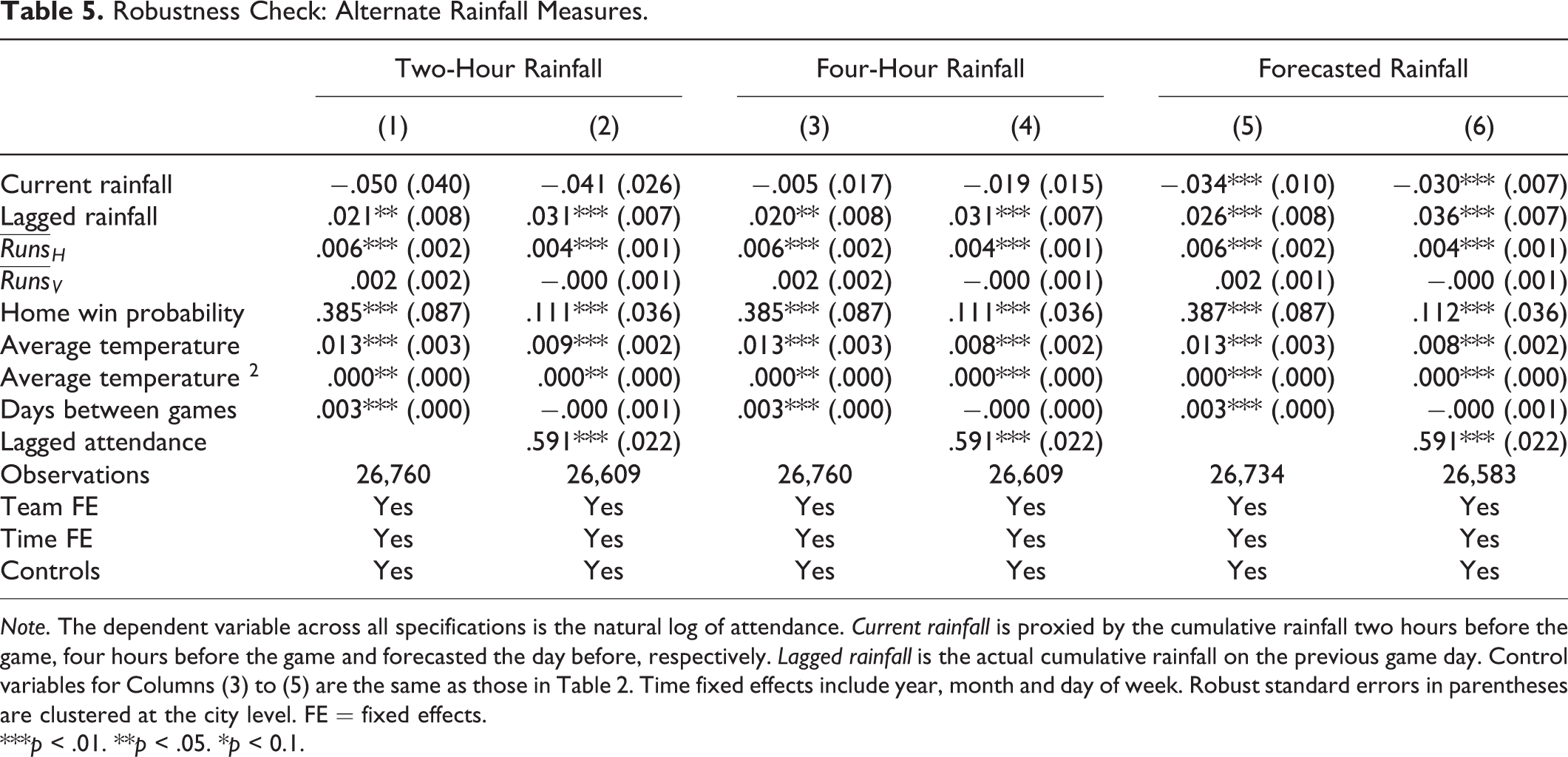
Note. The dependent variable across all specifications is the natural log of attendance. Current rainfall is proxied by the cumulative rainfall two hours before the game, four hours before the game and forecasted the day before, respectively. Lagged rainfall is the actual cumulative rainfall on the previous game day. Control variables for Columns (3) to (5) are the same as those in Table 2. Time fixed effects include year, month and day of week. Robust standard errors in parentheses are clustered at the city level. FE = fixed effects.
***p < .01. **p < .05. *p < 0.1.
Discussion
Our findings provide evidence that negative weather shocks affect future attendance decisions, likely through their impact on habit. Intriguingly, while contemporaneous rainfall reduces current attendance, past rainfall shocks increase future attendance, and the effect is robust to different model specifications and controls. In other words, rainfall and the resulting perceived unpleasant game-viewing experience may introduce a temporary break in the persistence of attendance. This is in contrast to the findings in Fujiwara et al. (2016), where voters form a lasting habit of not voting as a result of transitory weather shocks.
Our results reflect two possible underlying mechanisms. First, the empirical evidence may imply that fans with strong attendance habits experience no adverse effects of weather shocks. The strength of their attendance habit dominates. In this case, the evidence suggests strong effects of habit in game attendance decisions.
Alternatively, consistent with the notion that interruptions during a hedonic experience may help restore the intensity of the experience and increase enjoyment (Nelson & Meyvis, 2008), it is possible that the weather shock activates a stock of urge to attend future games, leading to increased future attendance. Based on the results from model specifications that control for the persistence of attendance, we believe that this mechanism could be more likely. Results from Table 3 shed further light on the urge explanation as negative past weather shocks beyond the previous game day continue to generate additional positive impacts on future game attendance.
Conclusions
In this article, we utilize exogenous weather shocks to identify fans’ habit formation separately from its persistence. We find evidence that rainfall temporarily introduces a break in attendance persistence. However, fans do not necessarily form a habit of not attending games in response to this shock. Instead, we find that past rainfall in fact promotes future game attendance. The habit of attending MLB games appears to be highly persistent at the game level.
Our results indicate that habit-based persistence exists in attendance at MLB games and that the strength of this persistence can overcome negative weather shocks that increase the current cost of attendance. This represents stronger evidence of habit persistence than developed in previous research using only lagged attendance to capture the effects of habit-based persistence and aggregate team- and season-level data.
If correctly identified and economically significant, the presence of habit formation in attendance has important economic and policy implications for optimal ticket-pricing strategies. For example, past research (Lee, 2006) suggests that ticket prices are lower than those predicted by the standard neoclassical profit-maximizing model. One possibility is that the total financial cost of attending games is more than just the ticket price due to the cost of transportation, lodging, and meals, and so on (Krautmann & Berri, 2007). On the other hand, our results imply that the high cost of attending a particular game may not always deter fans from attending future games due to the persistence of habit. It is thus important to take into account behavioral factors such as fans’ attendance habits when constructing optimal ticket-pricing strategies.
The results also have important implications for dynamic ticket pricing, a recent innovation in MLB ticket pricing where teams charge different prices for different games based on current conditions, including recent team success, opponent quality, and current weather conditions. Evidence suggests that dynamic pricing can increase ticket revenues, but current dynamic pricing models do not account for habit formation in attendance, or past weather shocks affecting current attendance (Xu et al., 2016). Including persistent attendance habituation and past weather conditions to dynamic pricing models can further enhance team revenues from ticket sales.
Footnotes
Authors’ Note
The remaining errors are ours.
Acknowledgments
The authors would like to thank the associate editor, J. C. Bradbury, and two anonymous referees for their insightful comments and suggestions. The authors thank Pamela Wicker and session participants at the 92nd WEAI Annual Conference for their helpful feedback.
Declaration of Conflicting Interests
The author(s) declared no potential conflicts of interest with respect to the research, authorship, and/or publication of this article.
Funding
The author(s) received no financial support for the research, authorship, and/or publication of this article.
