




Abstract
The paper investigates home advantages in skeleton. Our study broadens home advantage literature by providing models and estimation strategy applicable to other individual sports with tracks or courses such as biathlon, cross country skiing, etc. We identified two sources of advantages: support from the crowd; familiarity with the track. In the Olympics and the World Championships, home advantage leads to about a 0.510% improvement in performance on average, of which 0.110%-points are due to crowd support and 0.401%-points due to familiarity. Out-contribution of familiarity effect is common in all six major skeleton series.
Introduction
The traditional definition of home advantage is “the consistent finding that home teams in sport competitions win over 50% of the games played under a balanced home and away schedule” (Courneya & Carron, 1992). Thus, significant attention has been paid to home advantage in team sports, where seasons typically consist of an equal number of home and away games. On the other hand, home advantage in individual sports is less certain due to the typically unbalanced home and away schedule and the fact that many individual sports involve races, where results are determined by ranking not by one-on-one match ups.
Soccer is one of the most studied sports in terms of home advantage. Dowie (1982), Pollard (1986), and Clarke and Norman (1995) reported the existence of home advantage in English football leagues, while Pollard and Gómez (2014) conducted extensive research to reveal significant home advantage in most of the 157 national soccer leagues. Home advantage in professional leagues has also been reported for baseball (Pollard & Pollard, 2005; Schwartz & Barsky, 1977), basketball (Boudreaux et al., 2017; Pollard & Pollard, 2005; Schwartz & Barsky, 1977), ice hockey (Leard & Doyle, 2011; Pollard & Pollard, 2005; Schwartz & Barsky, 1977), American football (Pollard & Pollard, 2005), rugby (Morton, 2006), Australian football (Clarke, 2005), and Gaelic football (Rooney & Kennedy, 2018) though the size of this advantage varies by sport.
To the best of our knowledge, McCutcheon (1984) was the first paper to investigate home advantage in individual sports, reporting no significant advantage for home teams in high school cross-country. Alpine skiing (Bray & Carron, 1993), speed skating (Koning, 2005), skeleton (Bullock et al., 2009) and events in the Olympics (Balmer et al., 2001, 2003) are also individual sports for which home advantage has been investigated. For the individual sports with one-on-one match ups, Koning (2011) identified home advantage for male professional tennis athletes, while Balmer et al. (2005) reported a higher frequency of home wins in European championship boxing. In addition, Krumer (2017) and Ferreira Julio et al. (2013) documented home advantage in judo.
Our study aims to investigate home advantage for the individual winter sport of skeleton. Skeleton is a sledding sport in which an athlete rides a sled down an ice track headfirst while lying down. Balmer et al. (2001) investigated home advantage in Winter Olympics events between 1908 and 1998 based on the medals won by country. They found limited home advantage for the sledding sports bobsleigh and luge over other events; skeleton was not included in their research because it was held only twice during their study period. Our research differs from Balmer et al. (2001) in that we use a wide variety of skeleton competitions and not just the Olympics. Similarly, Koning (2005) identified a significant home advantage 0.2% for speed skating times and found evidence for crowd and familiarity effects among four known home advantage effects (crowd, travel, familiarity, and rule effects). We exploit two stages of skeleton heats, the pushing and sliding stages to separate out the effects of the crowd support from familiarity with the track. Lastly, Bullock et al. (2009) reported significant home advantage for women skeleton athletes in World Cup races between 2002 and 2006. We also analyze the results of the World Cup races but with more than four competition seasons. In addition, other skeleton series are used to determine whether the strength of home advantage varies with the type of competition. Our approach also differs from Bullock et al. (2009) in terms of the identification strategy and the isolation of two different factors.
The results show that familiarity has a significant impact on an athlete’s performance, which is a novel insight rarely dealt with in previous studies. The magnitude of the familiarity effect is large enough to determine the results of competitions with more skilled athletes. We also find that the crowd effect is still significant in skeleton as in other sports due to the proximity of crowds to athletes.
The structure of this article is as follows. Section 2 discusses home advantage in skeleton. In the third section, data and descriptive statistics are presented. Section 4 then introduces the model used in this article. We present the results in Section 5. The last section concludes the paper.
Home Advantage in Skeleton
In skeleton, a single ride is a heat, or known as a run. At the beginning of each heat, the athlete propels the sled by running in a crouching position holding onto the sled for the first 50 meters, i.e. the pushing stage. The speed obtained at the end of this stage is crucial for success in skeleton competitions (Zanoletti et al., 2006). After this stage, the athlete jumps onto the sled head first and steers the sled down the hill until the finish line, i.e. the sliding stage. Steering during the sliding stage is another important skill in a skeleton race. Too much steering control can lead to skidding, increasing the run time, while too little can lead to uncontrollable speed and a crash. Because sledding tracks vary in length, the number of curves, and gradient, it is important for athletes to plan an appropriate steering strategy for each course.
During a run, times are recorded at several points on the track. The time an athlete takes to reach the first 50 meters is called the start time and the time it takes to reach the finish line is called the run time or the final time. After the athletes have all finished their heats (two, three, or four heats depending on the competition), the combined run times for all heats determine the rankings. In this sense, home advantage in skeleton can be defined in terms of the run times. Because tracks differ in various aspects, including their lengths, we normalize the run times by converting them to average track speeds, which is the run time divided by the length of track, in order to take into account differences in track length. Thus, home advantage in skeleton in our paper means the consistent finding that a home athlete in a skeleton competition improves average speed of a race compared to that in away competitions with similar conditions.
The mechanisms behind home advantage have drawn the interest of sports scholars. In a seminal paper in the field, Courneya and Carron (1992) suggested four potential factors related to home advantage: crowd, travel, familiarity, and rules. Support from the home crowd can motivate the home team, demoralize the away team, and influence referee decisions. Dowie (1982) and Pollard (1986) reported that home advantage in English football leagues did not depend on crowd sizes, whereas Schwartz and Barsky (1977) found that home advantage in Major League Baseball increased with crowd size. Recently, Boudreax et al. (2017) and Ponzo and Scoppa (2018) isolated crowd support from the other factors by analyzing same-stadium derbies. In the study by Boudreax et al. (2017), two National Basketball Association teams sharing the same stadium in LA offered a natural experiment to quantify the crowd effect. It was found that support from the home crowd increased the likelihood of a win by nearly 22 percentage points. Ponzo and Scoppa (2018) analyzed the Italian soccer league Serie A in which several teams use the same stadiums, and reported a notable crowd effect. Several studies have indicated that one of the possible reasons for the crowd effect is referee bias arising from referees experiencing crowd noise as a form of social pressure (Balmer et al., 2005; Boyko et al., 2007; Dawson & Dobson, 2010; Dawson et al., 2007; Dohmen, 2008; Picazo-Tadeo et al., 2017; Sutter & Kocher, 2004).
The travel factor, or the fatigue effect, appears when an away team performs poorly due to increased fatigue after a long journey to an away game. Goumas (2014) reported that home teams in the Australian soccer league A-League won more competition points when the away team had to cross several time zones and thus suffered jet lag. Nichols (2014) also reported that the probability of home team wins in the National Football League increased when a visiting team crossed at least one time zone, while Oberhofer et al. (2010) identified non-monotonic effects of distance on team performance in the German professional soccer league. In contrast, Nutting (2010) and Scoppa (2015) found no travel or fatigue effect in the NBA and international soccer tournaments, respectively.
The effects of familiarity and rules have received less attention in terms of home advantage. Familiarity with the playing venue increases home advantage in the sense that home teams can take advantage of their familiar local environment. However, most research has found no familiarity effects in several sports. Dowie (1982) found that the home advantage of English soccer teams did not vary with the size of the playing area, while Moore and Brylinsky (1995) showed that home advantage for Western Michigan University basketball teams did not decrease when using temporary home courts while a new home court was under construction. Interestingly, Pollard (2002) and Loughead et al. (2003) reached the opposite conclusion on the effect of familiarity in several team sports, even though they used similar samples. Finally, rule advantages may be available for home teams. For example, Courneya and Carron (1990) found no home advantage from batting last in softball, whereas Leard and Doyle (2011) suggested that home advantage in the National Hockey League could be explained to some degree by its face-off rule.
Of the four possible factors affecting home advantage, skeleton is most likely to be affected by the crowds and familiarity. However, the effect of crowds may be more limited for skeleton races than for other sports for a number of reasons. First, the spectator capacity of a track is very limited. For example, the Alpensia Sliding Centre in Pyeongchang, South Korea, which held the 2018 Winter Olympics, can accommodate only 7000 spectators. Second, seats are not evenly distributed next to the track. Most of the seats are located at the start or finish, with the rest spread sparsely alongside the track. Third, it is difficult for the crowd noise to reach the athletes during a ride, during which they can reach speeds of up to 130 km/h. Finally, referee bias caused by the noise of the home crowd is not likely to be a factor in skeleton because the rankings are not determined by referees. Therefore, it is safe to assume that the crowd noise can only affect athletes in the starting area, where they sprint to gather sled speed. If a crowd effect exists, then the speed of home athletes at the pushing stage should be higher.
Familiarity, on the other hand, is likely to be the main driver behind home advantage in skeleton, assuming it exists. As noted above, good steering skills are a must for athletes. If an athlete can adapt to a track through a considerable number of practice rides, it is highly likely that they can develop and practice an optimal steering strategy and appropriate skills for the track. Thus, athletes can benefit from their familiarity with their home track because they have frequent access to the tracks for practice rides. Familiarity, again if it exists, will be most important in the sliding stage because the first 50 meters are too short for familiarity to affect the speed of the athlete to a meaningful degree and, more importantly, the starting area of most tracks are the same. The familiarity effect is also expected to be greater in top competitions, such as the Olympics, where host countries, in their pursuit of medals, will give their athletes unlimited access to the facilities.
On the other hand, the effects of travel fatigue and home-ground rules are expected to be negligible in skeleton. Each competition includes at least three official training days prior to a race day. These training days, in addition to additional rest periods, would give athletes sufficient time for recovery. In addition, the limited number of official tracks for competitions would allow athletes to handle time differences or jet lag. Finally, there is no rule advantage for home athletes. Obviously, the result of skeleton is determined by race times, leaving no room for officials to intervene. In addition, race order is determined by IBSF rankings or the results of the prior heat, which means nationality is not an issue.
In summary, we conclude that, of the four potential factors that affect home advantage, only crowd support (the increase in speed due to crowd support) and familiarity with the course (the increase in speed due to track familiarity) will play crucial roles in skeleton. This paper explicitly isolates the effect of these factors by using the race times at different points and using a unique identification strategy made possible by the nature of skeleton.
Data and Descriptive Statistics
Based on our understanding of home advantage in skeleton, we seek to identify the effect of crowd support by analyzing the pushing stage and the effect of track familiarity by analyzing the sliding stage. The outcome variable for the pushing stage is the average speed for the first 50 meters, which is the start time, i.e. the pushing stage time, divided by the interval length (50 meters) converted to km/h. We refer to this as the pushing stage speed (

The sliding stage speed is also converted to km/h.
We used the official results from 13 seasons between the 2006/2007 and the 2018/2019 seasons. The data were obtained from the official website of the International Bobsleigh & Skeleton Federation (IBSF, 2019a,b,c). Six major skeleton series—tiers of competitions—were chosen for our analysis: the Olympics, the World Championships, the World Cup, the Intercontinental Cup, the North American Cup, and the Europe Cup. The race times from the 2006 Turin Winter Olympics, taken from an official document from the LA84 Foundation Digital Library website (2019), were added for the analysis of the Olympic games. We removed competitions that were canceled due to weather conditions or for which the pushing stage time was not available on the website. In addition, the times of athletes who were disqualified (DSQ), did not start (DNS), or did not finish (DNF) were removed from the analysis. As a result, the total number of the observations used in the analysis is 33,902 rides by 853 athletes over 792 competitions. We also had access to information on 17 competition tracks from the IBSF website. Table 1 shows the details of these tracks. The tracks differ in competition length, average gradient, vertical drop, the number of curves, and start altitude, thus requiring different steering strategies to be employed according to each track’s characteristics. The 17 tracks are located in 12 countries, while athletes in our data set come from 53 countries.
Characteristics of the Sledding Tracks Analyzed in the Present Study.

Notes. aIndefinitely closed in 2019. bClosed in the 11/12 season. cData source for the Cesana track is the Wikipedia. Official information is not available. (https://en.wikipedia.org/wiki/List_of_bobsleigh,_luge,_and_skeleton_tracks). dSome are calculated by the authors with https://www.daftlogic.com/sandbox-google-maps-find-altitude.htm.
Table 2 provides a summary of the observations used in the analysis. Nearly 14% of the total observations are from home athletes (athletes from the host countries). Note that sliding stage speed is about 2.7 times faster than the pushing stage speed in terms of the mean and the maximum speed. This shows that gravity plays a critical role in a sledder’s speed. The lower tail of the speed distributions is partly due to athletes who fell in the pushing stage or who crashed during the sliding stage. The Track_possess variable, a dummy variable that takes a value 1 if an athlete’s country has a sledding track at the time of a competition, was included in order to isolate track familiarity from the effect of skeleton infrastructure. Some sledders from three countries (Italy, South Korea, and Russia) experienced changes in the infrastructure between the 06/07 season and the 18/19 season. The Cesana track in Italy closed during the 11/12 season, while the Pyeongchang (South Korea) and Sochi (Russia) tracks were built before the respective Olympic events. The Age of each athlete was converted to the difference between the birth date and the competition date in days in the actual analysis.
Descriptive Statistics.
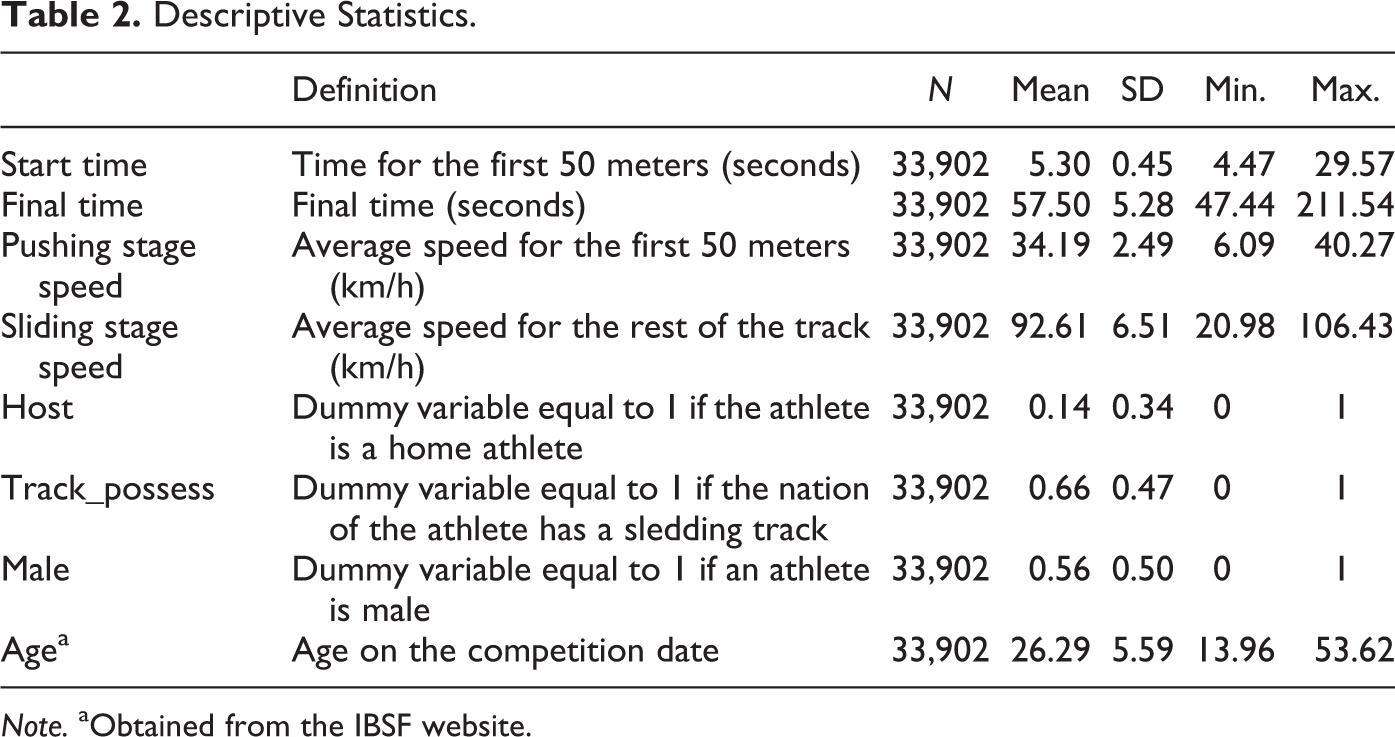
Note. aObtained from the IBSF website.
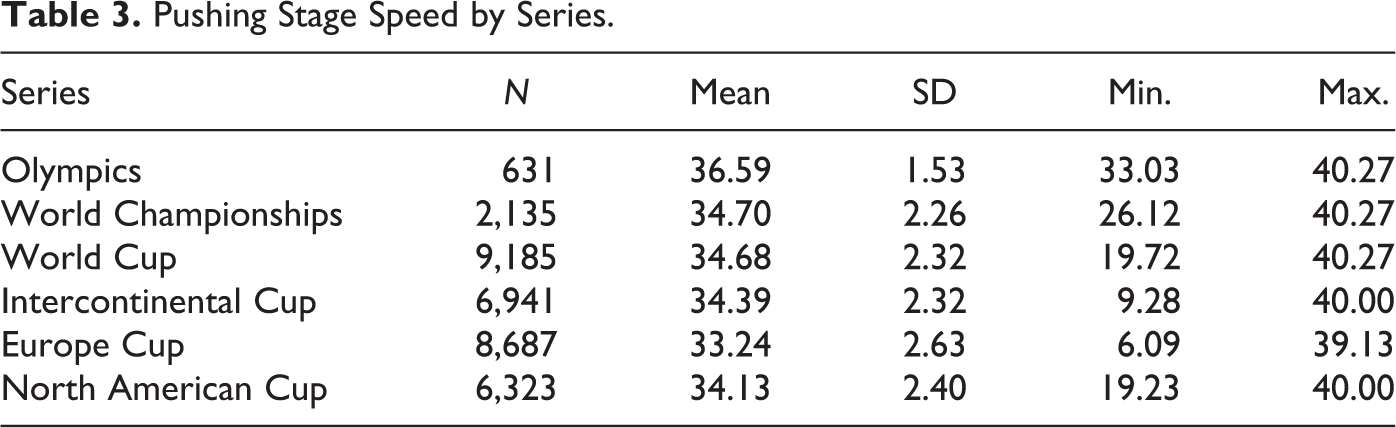
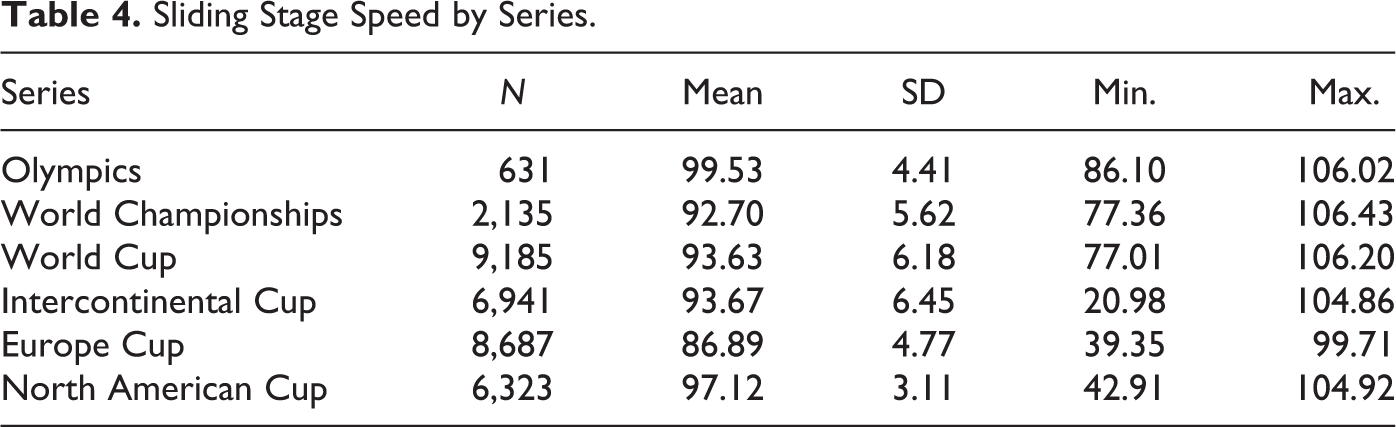
The data also reveals some interesting features regarding skeleton speeds. Tables 3 and 4 present descriptive statistics for pushing and sliding stage speeds by series. Firstly, average speeds at the Olympics are the fastest of the series. There are two possible reasons for this: being in the Olympics is a motivation for an athlete to exert more effort. Most of the participants in the Olympics are top ranked athletes according to the IBSF rankings, which may explain the small standard deviation for the speeds at the Olympics. Secondly, the average sliding speed at the Europe Cup is noticeably lower than average speeds of other series, while that of the North American Cup is close to that of the Olympics. This might be due to the fact that the two continental cups are held in their respective continents, so the differences in track characteristics of two continents might contribute to the difference in the average sliding speed.
Pushing Stage Speed by Series.
Sliding Stage Speed by Series.
The six series are of different prestige and importance, and even their frequencies are different. The Olympic events, the most prestigious, are held once every four seasons. The WCH, which is held once at the end of every season except in an Olympics season, is regarded as the top series in skeleton together with the Olympics. Because the Olympics are held once every four years, we have very limited data for Olympic athletes, so we are going to combine the Olympics and the WCH as one series in our estimations. The two series combined cover every season and both feature a format that involves four runs. The other series are held at least 4 times a season. The WC competitions are as important as the WCHs in the sense that the same ranking points are available to the participants in both series. The other three cups, the ICC, NAC, and EC, are often referred to as the development circuits in that they give newcomers an opportunity to gain experience and qualify for the WC and WCH. The ICC falls between the WC and the two continental cups. The ranking points available in the ICC are lower than in the WC, but higher than in the two continental cups. To summarize, we are going to estimate our models by five series: the Olympics and WCH combined, WC, ICC, NAC, and EC.
Econometric Models
It is reasonable to assume that the size of the home advantage is proportional to the athletes’ speeds, so we use
The regression model for

Since

The
Inspired by Koning (2005) who identified improvement in speed skating over time (i.e. from season to season), we include three types of temporal variables. Firstly,
While the season dummies capture year to year variations in athletes’ records that may have taken place due to factors such as year to year weather changes, gradual developments in sports gear technologies, and so on, there may be systematic changes in athletes’ records between competitions. Figure 1 shows the possibilities, indeed. The left panel shows averages of male athletes’

Average male records in World Cups in Innsbruck. (a) Average of ln(y 1). (b) Average of ln(y 2).
Unlike textbook setting panel data models where there are individual and time indices only, our data are indexed by i, h, and c. Since we would like to keep heat-specific effects in our FE estimation, we use what we dub “heat-fixed within-transformation.” For a variable

Notice that the “heat-fixed within-transformed” variable is different from a textbook style within-transformed variable

where the textbook style within-transformation ignores the fact that there are multiple heats in a competition.
Finally, our FE estimation estimates the following transformed models. Inclusion of constant terms is innocuous.


Results
We also did OLS estimation of models (2) and (3) without individual dummy variables for comparison purpose. In this section, OLS estimation results of models (2) and (3) without
Results for the Familiarity Effect
We first discuss home advantage arising from familiarity with the track, i.e. Model (3) and (7) the dependent variable of which is log-transformed sliding stage speed. Let us begin with the results for the Olympics and WCHs presented in Table 5. First note that we have different estimates in HFE and OLS, which implies that
Familiarity Effect in the Olympics and WCH.

Notes. Standard errors in parenthesis are robust standard errors, standard errors in curly braces are clustered by player, competition and heat.
*
The coefficient estimate for
A 1% increase in the pushing stage speed results in about a 0.08% increase in the sliding stage speed, thus confirming that the momentum gathered by the sprint in the starting area is vital to the final performance. The estimate for the Olympics variable is 0.0861, which means times in the Olympics are 8.61% faster on average than those in the WCH. We believe that this reflects the increase in motivation due to the prestige and importance of the Olympics. The effect of skeleton infrastructure is insignificant, meaning that having a track does not affect an athlete’s performance in the sliding stage to a notable degree. The coefficient estimate for
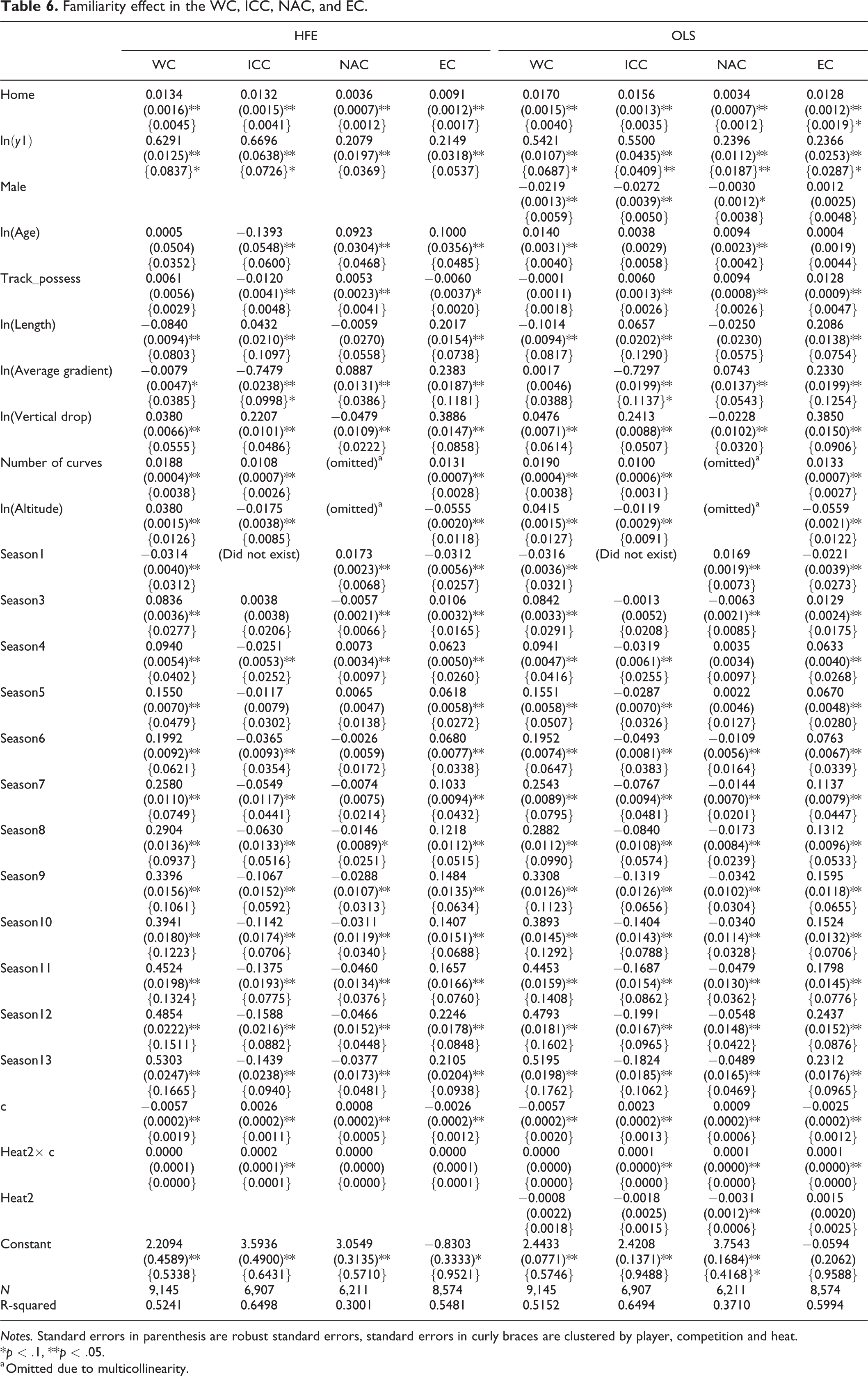
The results for the WC, ICC, NAC, and EC are presented in Table 6. The coefficient estimates for
Familiarity effect in the WC, ICC, NAC, and EC.
Notes. Standard errors in parenthesis are robust standard errors, standard errors in curly braces are clustered by player, competition and heat.
*
a Omitted due to multicollinearity.
The signs of the coefficients for
In the WC and EC,
Results for the Crowd Effect
The estimation results of Model (2) and (6) for the Olympics and WCH are presented in Table 7. The crowd effect in relation to the home advantage for the Olympics and WCH combined is estimated to be 0.68%-points. The estimate for the Olympics dummy is positive and significant under the robust standard errors, which suggests that the Olympics leads to faster sprints than the WCH. The effect of an athlete’s nation having a track on
Crowd Effect in the Olympics and WCH.
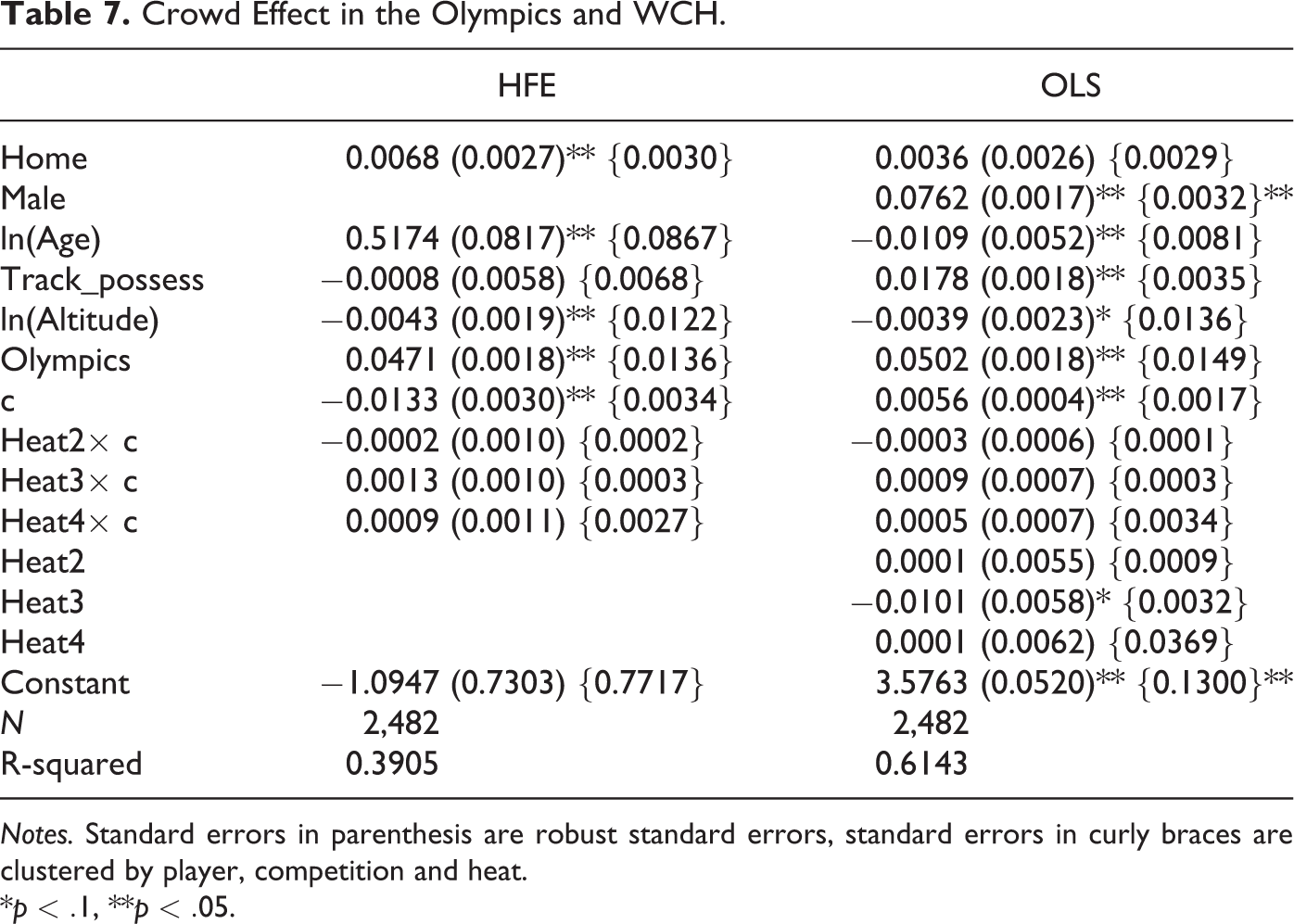
Notes. Standard errors in parenthesis are robust standard errors, standard errors in curly braces are clustered by player, competition and heat.
*
Table 8 presents the results for the estimation of Model (2) and (6) for the WC, ICC, NAC, and EC. The estimates of
Crowd Effect in the WC, ICC, NAC, and EC.
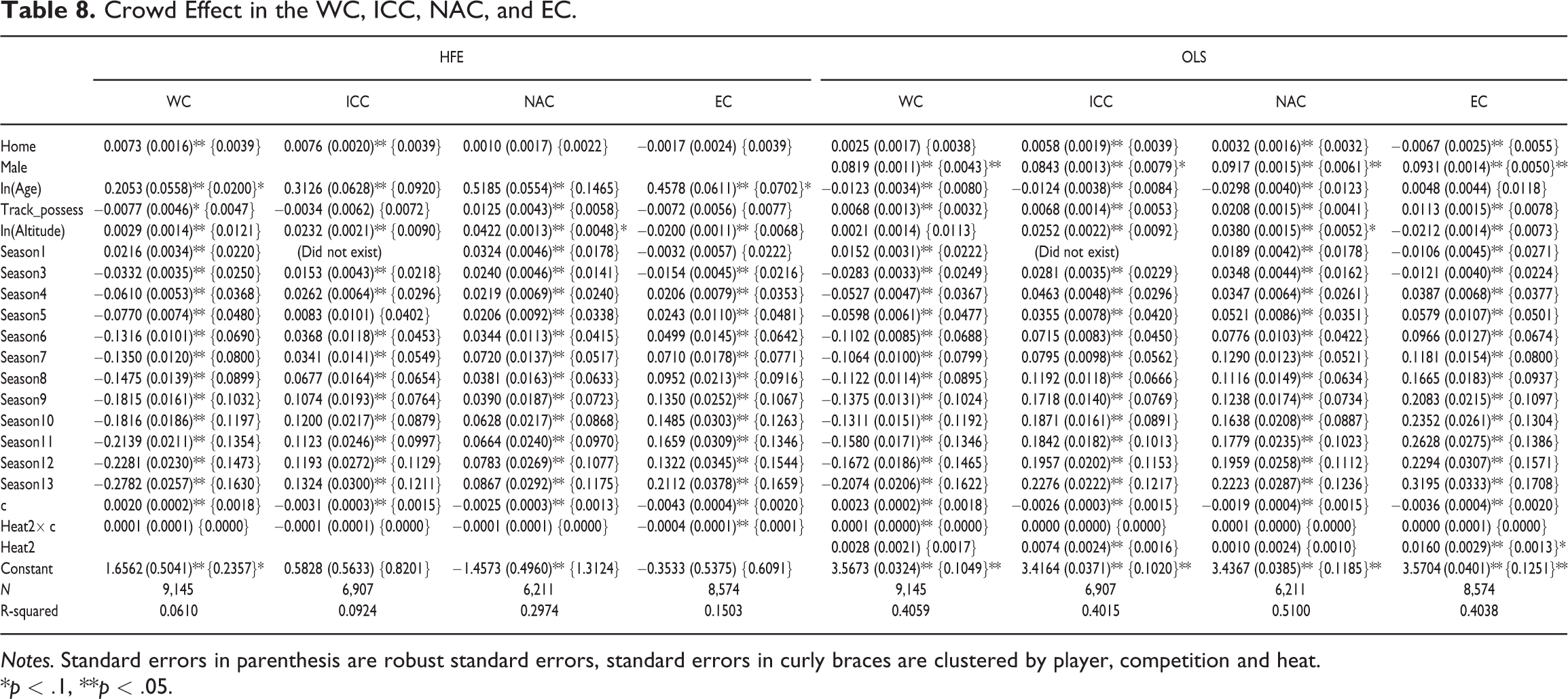
Notes. Standard errors in parenthesis are robust standard errors, standard errors in curly braces are clustered by player, competition and heat.
*
The coefficient estimates for the other control variables are difficult to explain, except for the coefficients for
Overall Home Advantage
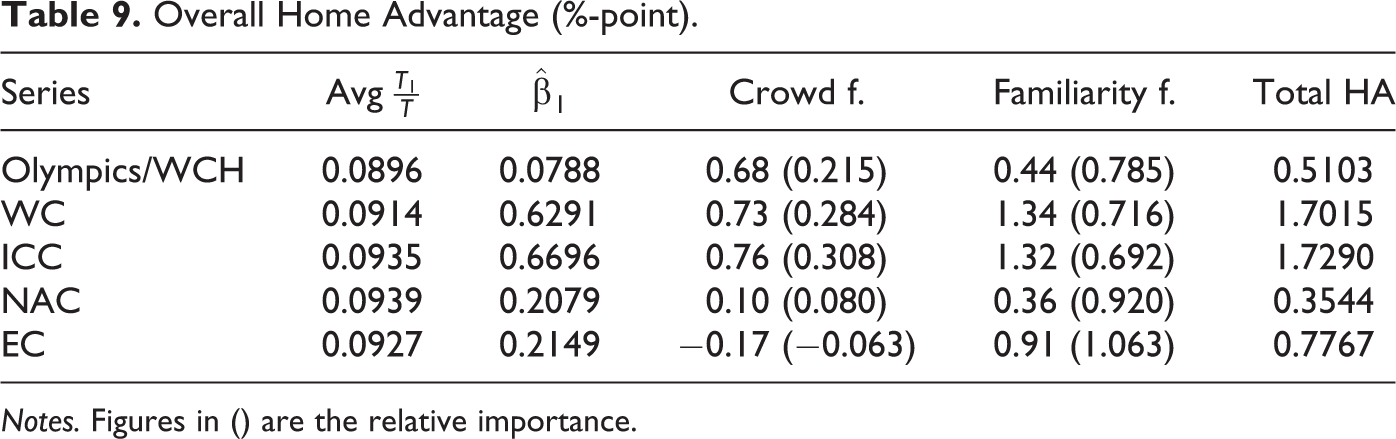
We can combine the familiarity and crowd effects to compute the size of the overall home advantage. Let T be the final time and T
1 be the start time and define

where

The relative importance of the crowd and familiarity effects for overall home advantage may be defined as
Overall Home Advantage (%-point).
Notes. Figures in () are the relative importance.
In the Olympics and WCH, athletes seem to benefit by about 0.510%-points on average from home advantage, of which 0.110%-points are due to the crowd effect and 0.401%-points are due to the familiarity effect. Thus, the relative importance of familiarity with the track is greater in the Olympics and WCH. This trends also can be seen in the other series and notably, the familiarity factor is strictly dominant in the NAC and EC. The size of the overall home advantage is the lowest in the NAC. The relative importance of the crowd support is in the order of ICC
Conclusion and Discussion
Of the four known factors that affect home advantage, we selected the two that are most influential in skeleton and estimated the size of their effects: crowd support and familiarity with the track. Due to the limited crowd capacity at sledding tracks and the fast speed of a sled, crowd support affects an athlete’s performance only in the first 50 meters where the athlete sprints to gather speed. The familiarity effect, on the other hand, is the main driver of home advantage for the rest of the track because steering skill determines performance after the sprint. The other two factors, travel and home-ground rules, are not likely to occur in skeleton.
In order to separate out the two factors, we used IBSF times for the first 50 meters and the entire race from athletes who competed in at least two competitions in a given series so that, by employing FE estimation models, we were able to eliminate individual-specific heterogeneities that may obscure the effects of home advantage. The size of home advantage differed by series. Athletes in the Olympics and World Championships benefit from about a 0.510% reduction in their final time on average thanks to home advantage, of which 0.110%-points are due to the crowd effect and the remaining 0.401%-points are due to the familiarity effect. Athletes in the World Cup have about a 1.702% reduction in their final time on average, of which 0.483%-points are due to the crowd effect and 1.218%-points are due to the familiarity effect. The Intercontinental Cup, North American Cup, and European Cup differed in the extent of home advantage. Overall, track familiarity out-contributes the crowd support for average athletes. We also found that athletes are faster on average in the Olympics than in the World Championships, which represents the motivational effect of the Olympics.
Our results have some implications for home advantage in sports in general. Firstly, this paper showed that familiarity has a significant impact on an individual’s performance, which had rarely been dealt with in previous studies. This finding can apply not only to the other sledding sports, bobsleigh and luge, but also to some other individual sports which have tracks or courses with variations in several characteristics. Biathlon, cross country skiing, slalom skiing, and canoe/kayak slalom are some of the examples. When it comes to team sports, familiarity might not be that influential, as Dowie (1982) and Moore and Brylinsky (1995) found, for the following two reasons. One is that pitches of team sports have lower variation than tracks of individual sports. In football, the variations in the length of the pitch or the lawn seem relatively small compared to those in the track characteristics in skeleton. It should also be noted that home advantage in team sports is often measured in team records such as winning percentage and the number of goals, which aggregate out each player’s performance.
Secondly, familiarity may have a noticeable influence particularly on competitions with high-skilled athletes. In Section 5.1, we showed that the familiarity effect in the Olympics and World Championships could have been decisive in determining medalists. Thus, one can expect that familiarity can be crucial in competitions where the gaps in records are narrow. This insight also explains the results of Dowie (1982) and Moore and Brylinsky (1995) since they included competitions of low tiers. The variations in team quality might have been large in those competitions, which provides not enough room for familiarity to determine the match results.
Lastly, we also found that the crowd effect is still significant in skeleton as in other sports. This is interesting because crowd support in skeleton can affect athletes only during the pushing stage which lasts a small fraction of the total race, and because the size of spectators in skeleton tends to be very small compared to other sports. We attribute this to the proximity of the stand to the track. As an athlete sprints right next to crowds, we expect that an athlete is deeply affected by crowd support in a psychological sense. We thus conclude that the distance between athletes and crowds might determine the magnitude of the crowd effect. This is somewhat in line with Dohmen (2008) who suggested that referees make more biased decisions when the match is played in a stadium without a running track separating the pitch and crowd.
Footnotes
Declaration of Conflicting Interests
The author(s) declared no potential conflicts of interest with respect to the research, authorship, and/or publication of this article.
Funding
The author(s) received no financial support for the research, authorship, and/or publication of this article.
