




Abstract
In professional boxing, a higher-ranked boxer chooses his opponent among challengers varying in popularity and strength. We build a three-stage model of a professional boxing fight between the chooser and a challenger to examine the strategic incentives of a chooser in sharing the purse and exerting a proper level of effort. More importantly, we endogenize the choice of the opponent and the purse to be generated. We found that an older chooser who is ready to cash in his reputation tends to choose a stronger opponent with little effort, while a young rising “star” prefers a match against weaker opponents.
Introduction
Boxing is one of the most popular sports 1 and the toughest sport in the world that demands the most from its athletes. 2 However, professional boxing industry is one of the most secretive ones in the world when it comes to the inaccurate records of money revenue inflows in it. There are several reasons for it. First of all, there is no uniform salary for all individuals involved in the organization of the bout. Especially boxers, acting as independent contractors (Chaplin et al., 2018), don’t earn a regular salary and their earnings are not subject to minimum wage law. Second, the amount of the purse to be collected is mainly determined by the marketability of the fighters in the ring (Chaplin, 2012). Taxation, naturally, can be another reason. Last but not least, there is no specific calendar for the bout to organize. Usually, the top boxing “stars” don’t fight in the ring more than twice a year and earn millions of dollars per fight, while those in the earlier careers may come to the ring 4–5 times a year and may not earn more than $1000 per fight. 3 Thus, the revenue from professional boxing varies greatly depending on experience, reputation or popularity, location etc. For example, Mayweather-Pacqiuao 2015 so-called “Fight of the Century” generated a total of $678 million revenue, from which Mayweather and Pacqiuao earned $223.5 million and $122 million, respectively, not counting the pay-per-view (PPV) and other cash sources. 4 In addition, HBO/Showtime PPVs broadcast between 2017 and 2018 generated approximately $700 million in the US market alone (Butler et al. 2020). Despite the popularity of pro-boxing sports along with the economy it generates, the literature in the sports economics using microeconomic tools to model it is surprisingly very limited.
In the sport of professional boxing one should be curious about the market value of the forthcoming bout between two fighters and its split between them. Put it differently, why do some bouts generate huge revenue and some less? Also, why does one fighter receive a larger share of the revenue than the other? Consider the purse history of Floyd Mayweather. 5 He faced De La Hoya, Canelo, and Pacquiao in 2007, 2013, and 2015, respectively. The respective total revenues from these fights are $187 mln, $214.7 mln and $678 mln. Excluding the cash from PPV and Gate entry, the purse splits (Mayweather vs opponent) were $20 mln vs $42 mln, $65 mln vs $9.7 mln, and $223.5 mln vs $122 mln, respectively. As noted earlier, there’s no fixed revenue and fixed split though the rules for all fights are the same. The numbers clearly indicate how the revenue and purse split of Mayweather change for each opponent. Notice, the Mayweather-Pacquiao revenue in 2015 is more than three times that of Mayweather-De La Hoya in 2007 where the purse of Mayweather was twice less than that of his opponent. That is because De La Hoya seemed to be a bigger name than Mayweather at that time. On the one hand, upon announcing such big numbers in the cashier, one would expect that the boxers would put huge efforts in the fight in order to win (or earn or retain the title, say championship belt). On the other hand, once boxers’ money shares from the fight is guaranteed, there are likely disincentives for extra effort in preparing for the fight, which create a moral hazard problem(Amegashie & Kutsoati, 2005; Tenorio, 2000). Professional boxing matches such as these create interesting, possibly unexpected, scenarios that pose challenges to theoretical analysis.
Our paper is an attempt to understand the strategic incentives of boxers in sharing the money in Nash Bargaining framework and exerting proper level of effort within a contest theory model. More importantly, we take into consideration the decision to pick the optimal opponent among several alternatives challenging him. The existing literature is surprisingly silent about optimal opponent choice in spite of the fact that it is a very, if not the most, crucial decision of stakeholders in professional boxing.
Unlike other sports such as football, basketball, or tennis, there is neither a centralized governing body nor a structured and periodic tournament, league or match in professional boxing. 6 The existing problematic structure and ambiguous rules inevitably lead to strategic opponent choice not only at the top level but at all levels. Thus, in our paper we study the strategic opponent choice of a professional boxer and the relevant incentives shaping this choice. In professional boxing, usually the boxer who is higher in the rankings is challenged by the ones who are lower in the rankings. Then, the higher-ranked boxer chooses one of the challengers or refuses them all. Since the amount of money revenue is determined by reputation or popularity of both boxers, we argue that the higher-ranked boxer (we will call him 7 “chooser” or “champion” if he is at the top) decides whom to fight in the ring. Moreover, we intuitively assume that the fight with a more popular opponent will likely generate more money revenue than that with no-names. In supporting this argument, Butler et al. (2020) points out that fans prefer to watch more dominant boxers. In addition, Chaplin et al. (2017) finds that being a “superstar” is essential for live attendance in professional boxing. Thus, the main result of this paper highlights the importance of an opponent choice in money revenue, and shows that with the right names in the ring, the boxers (and promoters) are given the incentives to meaningfully negotiate on purse split and prepare for the upcoming bout accordingly.
We build a three-stage model of a professional boxing fight/bout between the chooser and one of his challengers from the opponent choice to the start of the bout. In the first stage, the chooser selects one of his challengers. Choosing a more popular challenger generates higher revenue, but it is also more costly in the sense that the likelihood of a loss is higher (Issabayev & Oskenbayev, 2019) since more popular opponents are usually stronger. 8 At the start of the second stage, the names of the fighters are known. The shares of each fighter from the money revenue that will be generated from the fight is endogenously determined by the asymmetric Nash bargaining game (unlike Issabayev & Oskenbayev, 2019). We treat the popularity parameter as a proxy for bargaining power of each fighter, which are assumed to be asymmetric.
In the final stage, the fighters choose their efforts for the upcoming fight. We solve optimal efforts for each player. Given the names of the fighters in the first stage and the bargaining outcomes from the second stage, we consider the incentives of each fighter using a generalized Tullock contest (Tullock, 1980). We further assume the chooser has an edge over the opponent in transforming his efforts into a win probability as in Jia et al. (2013). It is also worth noting that the efforts can be considered as an investment with no return in the short term. In other words, the fighters are not paid for the efforts put in preparation for the forthcoming fight. However, the effort of a fighter is an investment with return in the long term. More precisely, the current efforts increase the probability of winning, which in turn would have a positive impact on future earnings.
Existing economics literature on boxing is very scarce and there are only two theoretical papers. Tenorio (2000) examines the boxer’s incentives in choosing an effort level in a dynamic way. The reputation of the boxers determines the purse size and the payments to the boxers. However, due to the nature of the reward system in professional boxing, a boxer who is promised a fixed (especially high) payment has an incentive to shirk if his accumulated wealth is high enough. The boxers with many years ahead to fight are more likely to exert high effort, since the future payments will depend on past performances. Unlike ours, the focus of Tenorio (2000) is not to explain how the boxers are matched. Our paper, on the other hand, models the strategic opponent choice process that in turn determines the purse size and characterizes the optimal sharing rule of this purse via Nash bargaining and optimal efforts.
The other paper studying the incentives in boxing is Amegashie & Kutsoati (2005)that points out the importance of the rematch clause. The authors show that if the winner is obliged to offer a rematch to the loser, i.e. a mandatory rematch clause, the aggregate effort level will be higher compared to the contracts that condition the rematch on the effort level. They consider neither opponent choice, nor purse size determination, nor optimal purse sharing. Although we are not considering the possibility of a rematch, as a future research, it would be interesting to see how the rematch possibilities (mandatory challenger or mandatory defence clauses that are common especially among high-ranked boxers) can change the strategic opponent choice and the optimal purse sharing rule.
Our paper has sought to add to the existing literature by focusing on the following research questions that are relevant in professional boxing: which factors affect the opponent choice in professional boxing and how? How does the opponent choice impact the purse split decision between the fighters? For given fighters and purse split, how do fighters choose their optimal efforts to prepare for the match? Our model incorporates both strategic opponent choice and cooperative bargaining theory to explain the purse split, which lacks in the existing literature. Moreover, it is important to note that other than negotiating on purse split and deciding on how much effort to put, the opponent choice by a higher-ranked boxer is one of the most important decisions in professional boxing. The amount of purse, before it is split between the fighters, strongly depends on the popularity of the opponent. The steps of the model are dictated by the real-world anecdotes. To the best of our knowledge, our paper is the first in the existing literature that attempts to fill this missing gap.
While searching for answers to the above questions we came across with a number of interesting results, which obviously depend on the equilibrium concepts we use. Under reasonable assumptions, we find that a higher minimum purse or outside option to the chooser implies a choice of relatively stronger opponent. But an additional victory premium (difference in the expected discounted future gains of a win and a loss) to both fighters or larger outside options to the opponent discourages the chooser to fight against a stronger opponent. We also document that as long as the money purse of the chooser increases for picking a relatively stronger opponent, he is willing to sacrifice some share from the overall purse in favor of his opponent in order to make the fight happen. Furthermore, for a given opponent, the chooser is willing to put less effort for an additional victory premium of his opponent. However, the additional victory premium to the chooser tends to decrease the efforts of a given opponent. we also show that for a stronger opponent, the chooser will be trying his best to win the bout. Finally, an older chooser in order to benefit from the purse tends to accept the challenge by a stronger opponent, but exerts lower effort -abstracting from the age related physical deterioration. A young rising “star” in order to benefit more from a “winning record” in the long term is not ready to challenge a stronger opponent in the short term.
The rest of the paper is organized as follows. Section 2 introduces the model and characterization of the equilibrium. Section 3 describes the comparative statics and implications of the model. Finally, section 4 concludes with a discussion of the results.
The Model and its Analysis
We model the problem of a boxer as a three-stage game. Since the bout with the right opponent could generate big money revenue, the first and most important element of the professional boxing fight is the opponent. 9 Hence, in the first stage of the game, the higher-ranked boxer (the chooser) picks the right lower-ranked opponent among many challengers. Accordingly, the chooser has a greater bargaining power in money share than the challenger. 10 Rankings are common knowledge. In the second stage, the boxers bargain over the total money amount to be shared. Finally, in the last stage, given the current purse, boxers choose their effort.
We now provide required definitions for the variables used in the model. Let us suppose that
We also define
In the second stage, boxers play the cooperative Nash bargaining game. Total money amount to be shared is a function of

We denote the share of the money revenue to the chooser as
The last stage is modelled as a contest game. We use one of the commonly used contest success functions in the literature. Probability of winning the contest depends on the efforts of both boxers and the relative strength of the opponent

We now characterize how the chooser selects his opponent optimally, how the shares are determined, and how the boxers choose their optimal effort levels. We assume the utility of the boxers is linear in money purse (Amegashie & Kutsoati, 2005) and there is no incomplete information. We will write down each stage separately and then solve them by working backwards.
In the first stage, the chooser maximizes his expected utility by selecting an opponent, that is, by selecting an


In the second stage, the boxers play the cooperative Nash bargaining game to decide how to share the total purse. We assume that the bargaining powers are not symmetric and are proportional to the relative popularity,











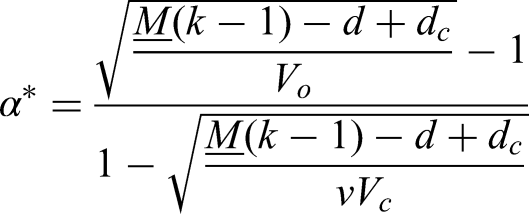

We now continue our analysis with comparative statics assuming interior solution.
Comparative Statics and Implications
In this section, we derive some comparative statics from the explicitly found optimal level of efforts, bargaining share, and opponent choice in the previous section. These help us understand the motives of each boxer before coming to the ring. That is, whom to fight in the ring, how to come to negotiate regarding the money share and whether it is worth putting huge efforts in the upcoming fight. We will present our results in the inverse chronological (backward induction) order and start with the optimal efforts.
Optimal Efforts
Optimal efforts of the players in stage 3 depend on the choice of an opponent by the chooser and the expected victory premium of both players. The following propositions summarize the results we obtained from the comparative statics.
The chooser is willing to put higher effort into the fight against a stronger opponent (
The chooser (opponent) is willing to put more (less) effort into the fight as the expected victory premium of the opponent (chooser) increases (
Proposition 1 states that the stronger the opponent, the higher effort the chooser puts. On the other hand, proposition 2 shows that for a given opponent
17
, as the victory premium to the opponent increases, the chooser is willing to put more effort into the fight (
To give a concrete example of this, consider the current champ Saul Canelo Alvarez, who is in the peak of his professional boxing career and the opponent like Jaime Munguia. Just Canelo’s “name” along with his past successful records until he became the champ (against big names such as Floyd Mayweather, Miguel Cotto, Gennady Gennadyevich Golovkin/GGG, Sergey Kovalev) already seem to generate huge money revenue in the boxing industry. On the other hand, as noted before, the higher victory premium to the opponent like Munguia may also imply another possible forthcoming star in the market. If this is so, then Canelo, who wants to remain a champion for a longer period, should be willing to put a huge effort into the fight. Hence, for an additional premium for his stronger opponent, the current chooser will do his best to remain as the “star”, while Munguia, considering the dominance of the Canelo now and in the near future, may not be willing to work harder as he could for the additional expected premium to the Canelo.
One may intuitively expect that an increase in a player’s own expected victory premium can motivate him to put more effort to earn this extra premium (

Finally, the aggregate effort in a given match can be expected to positively influence the future prospects of fighters (Amegashie & Kutsoati, 2005). The promoters will be able to generate a higher purse for the coming matches of a fighter who earned a reputation of being a tough nut to crack. Thus, it is always desirable for the promoters to extract as high effort as possible from the fighters to increase the purse. Our analysis showed that
Optimal Bargaining Shares
From the second stage of the game, we found that the optimal bargaining share from the money purse for each fighter depends on the choice of an opponent by the chooser and their disagreement payoffs.

As the chooser picks a more popular opponent, although his share decreases (
This proposition states that a match with a stronger opponent always generates a greater purse but his optimal share goes down. Since the total money revenue, not the share, is usually the priority for the chooser, and as long as the overall money to the chooser increases from the upcoming fight, the chooser is willing to sacrifice some share of the purse in favor of his challenger. A higher money revenue represents the benefit of choosing a stronger opponent when the boxer makes his optimal opponent choice.
Regarding the effect of outside options on the share, intuitively, a higher outside option of the chooser (opponent) should lead to a larger (lower) share of money revenue from bargaining,

Finally, it is easy to see that
Optimal Opponent Choice
The closed form solution for the optimal opponent choice is given as follows:

We can start the comparative statics analysis with respect to outside options of the fighters.
The greater outside option of the chooser (opponents) leads him to choose a relatively stronger (weaker) opponent
Proposition 4 implies that as the chooser’s outside option gets higher, his marginal benefit today becomes larger. Hence, he may like to take advantage of this higher marginal gain by choosing a stronger opponent (
Moreover, as the opponents’ outside options get higher, the chooser’s marginal gain today gets lower and he chooses a weaker opponent to be able to increase his chance of winning the imminent fight to keep his future prospects high (
The opponent choice essentially depends on the expected victory premium of win over loss for the players. The next result specifies these relationships.
The additional expected premium of the chooser and the opponent encourages the chooser to pick a relatively weaker opponent
Remember that
Since
If the victory premium for the opponent,
An increase in
The minimum purse that can be obtained from a match,
Our model sheds light on the moral hazard problem too, which arises when the chooser prepares for retirement and tries to milk his reputation before he quits, through the changes in the victory premium from winning over losing. In 1990, the world heavyweight boxing champion James Douglas met Evander Holyfield to defend his title, but since Douglas knew before the match that he guaranteed $20 million even in case of a loss, he was obviously unprepared and lost the match as a knockout in Round 3. Under “large” guaranteed purses (how large this is depends on each boxer’s aspired wealth level), the victory premium for the boxer can be assumed to be very close to zero because he does not care much about the result and tries to milk this last opportunity to make as much money as possible. A very small
Discussion and Conclusion
Although professional boxing is a very popular sport and its generated economy is huge, there is a very limited literature on it. In this paper, we have developed a three-stage game-theoretic model to explain the incentives and strategic behavior of professional boxers. Our paper highlights the importance of the opponent choice by a higher-ranked boxer, which is missing in the existing literature. We model the fact that the amount of the purse should be determined endogenously by the popularity of the fighters. We then demonstrated how the optimal money share between the fighters and their respective efforts are strongly dependent on the popularity of the fighters. We also characterised the equilibrium in each stage to better understand the incentives of the boxers. It should be noted that since our paper is the first trying to understand the big picture in the professional boxing sport, we have substantially simplified the model. Therefore, we propose how the current work could be extended in a number of ways in the future.
Firstly, the expected discounted values of fighters’ future gains can be a function of their spent efforts. As Tenorio (2000) and Amegashie & Kutsoati (2005) show, the expected victory premium to the fighters depends on their efforts, which we didn’t consider for mainly tractability purposes. That is, if one is a tough nut to crack and puts a high effort then this most likely increases his future prospects. However, it is clear that this would complicate the calculations and lead to no closed form solution for the optimal efforts.
Secondly, one may argue that there is no formal connection between the second and the third stage in the model. Namely, the money guaranteed as a result of the bargaining game in the second stage does not affect the optimal effort levels of the players determined in the third stage. There is no direct link between guaranteed money and optimal effort in our model but the guaranteed share of the purse indirectly affects the expected discounted value of the future gains through the accumulated wealth. If this guaranteed money is large enough, it may lower this expected gain (and this, in turn, leads to less effort) because the boxer might have accumulated a high enough wealth with this large guaranteed purse so that winning or losing may not make too much of a difference for the boxer. This explains the naturally arising moral hazard problem that leads to low effort once the gains are fully insured. Besides, one may also consider the well-known prospect theory in this case that emphasizes how the losses can loom much larger than similar sized gains. This would be another interesting avenue for future research.
Third, we assume that the expected victory premium to the current higher-ranked fighter is independent of the chosen opponent. However, dependency of these two can easily be argued. For example, the WBO champ may be challenged by the IBF champ in order to unite the championship belts to qualify to announce his absolute championship. If the WBO champ accepts a challenge by the IBF champ, the future expected gain of the WBO champ will obviously be much higher than that with a lower-ranked contender in the WBO rank. Our model can be extended by relaxing this assumption.
We mostly provide anecdotal evidence and commonly known facts to support our results instead of empirical evidence or generalized statistics. This is mainly due to nonavailability of data. Since most of the parameters and valuations we use (e.g., outside option, additional expected premiums, efforts etc.) are private or not publicly shared information, we could not provide the associated statistics. Nevertheless, collecting the available data, if any, and analyzing its compatibility with our results would be a great empirical extension as a future research.
In the paper, we focus on the interior solution. Namely, we consider the case where the boxer does not choose the weakest or the strongest opponent. These boundary choices may rarely happen in some real life cases that we have already touched upon. For example, if the outside options of opponents are high enough (
Finally, our analysis can be applied to not only boxing but also other sports that have no specific tournament format. For example, some combat sports have similar incentive and institutional structures such as MMA (mixed martial arts) that is the fastest growing sport in the world over the past 30 years, mainly due to the growth of the UFC (Ultimate Fighting Championship). 25 Our paper can be considered as one of the first steps to better understand complex incentives and opponent choice in boxing and other sports having similar institutional structures.
Footnotes
Acknowledgements
We are grateful to two anonymous referees and the editor for very valuable feedback. We are grateful to Ilhan Sezer, Ismail Saglam, Piruz Saboury, Robert Butler, and Selcuk Ozyurt for their insightful comments. Rafael Tenorio has given considerable comments on the manuscript, we especially thank him for helpful suggestions. Any errors are our own.
