



Abstract
In 2004 Showtime launched The L Word with a site that encouraged fans to login and chat about the show. Over time, they updated the site with all of the emergent bells-and-whistles: blogs, social networking, and Second Life portal. These new spaces simultaneously provided lesbians an expanded and easy-access online community and created a corporate-controlled space that spoke to Showtime’s own economic agenda. To partake in these new toys, fans were encouraged to define themselves in ways most conducive to the network’s sexual, economic, and gendered vision. Through an examination of the sites’ strict reins on identity construction as produced by its texts, interfaces, inclusions, and striking omissions, this article seeks to shed light on the subtle means by which corporate participation in and design of fan spaces can lead to fans (perhaps unwittingly) bending to corporate designs and playing on a field skewed to corporate rather than personal advantage.
The expansion of net access, computer literacy, and media convergence continues to provide new means and spaces for individuals who may have once felt isolated by identity or fannish fixation. Where once fans of Doctor Who or Farrah Fawcett were left to enjoy their obsessions in solitary or pursue each other through conventions or hard-to-find fan clubs, they now need only log on to find a stream of others similarly passionate about their objects of desire. Scholars such as Henry Jenkins (2008) and Sharon Ross (2008) have focused heavily on the dynamics and politics of both this new-found access to like-minded people and media creators’/producers’ drive to make the most of escalating convergence. 1 As the internet has provided fans easy access to each other, it also continues to allow members of once-isolated groups convenient ways to find and chat with each other. Members of the gay, lesbian, bi, trans (GLBT) community, for example, once relegated to finding like individuals through community outreach or bars (if even available) need only jump online to find thriving communities that self-identify as queer. In addition to an array of GLBT dating and sex sites, websites such as Gay.com and AfterElton.com provide varying forms of queer entertainment information, political commentary, and social networking.
Along with this popularity, visibility, and access comes the corporate recognition that this audience is a lucrative one. Acknowledging in the nineties that gay dollars were just as worthy as straight ones, companies started overtly targeting the “good” GLBTs through subtle advertisements and an increased presence of GLBTs in mainstream television and film (Becker 1998; Fejes 2002; Oakenfull et al. 2008; Seidman 2002). This desire to sell did not coincide with a sudden change of heart toward the entire GLBT community; rather the value of upwardly mobile purchasers (who happened to be GLBT) merely trumped what may have still been seen as problematic identity politics. Shows such as The L Word and Queer as Folk provide stellar evidence of who “good gays” are (or who they should want to be)—good-looking, flashy, upwardly mobile purchasers—and the online spaces discussed in this article further illustrate the media industry’s investment in those desirable characteristics through their choices in interface, staffing, and overall design. 2
The power of the purse strings not only determines which audience is valuable enough to target, but through the corporate control of television-related fansites, it also allows those with creative and economic control to tweak fanbase identities and define who is worthy to engage in seemingly independent conversations about who she or he is and what she or he desires. (After all, companies are not using their resources simply to build an online play land for visitors, but to further hawk their wares.) As media companies take control of and fill fansites with all of the latest bells and whistles, an increased level of policing of fan products and interactions works to curtail fan activity. Not always strong-arming fans into submission, a more subtle control emerges as fans trade increased visibility for complicity in a vision conducive to the industries’ own economic or ideological goals.
A Butlerian (1990) notion of personal performance suggests that only through repetition do gender and gender norms become socially legible; as interactive websites recurrently promote specific images of queerness (and marginalize others), they consequently render legitimate or readable a similarly limited “lesbian” or “gay male.” Through website/game construction the creators/sponsors choose which identities are easily accessible as they feature specific bloggers’ voices, choose predetermined subject headings for conversations, and make specific gendered visages more visibly present or easily available than others during site design or avatar construction. In order to partake in the newest and sexiest online toys, fans are encouraged to conform—wittingly or no—and define themselves in ways most conducive to the corporation’s predetermined vision. While not all overt calls toward legitimizing “the lesbian” or “the gay male” image most attractive to the moneymakers will succeed, such choices in style and message favor—while not guaranteeing—a reading/fan performance that privileges the “good gays.”
This article explores this concept of corporate control and its resultant homogenization of the conceived audience through a look at the evolution of the Showtime-sponsored L Word (2004-2009) websites. More than a study of fan activities, this is a study of the construction of spaces. I am ultimately interested in how Showtime, The L Word’s cast and creative team, and The Electric Sheep Company (the Showtime-hired Second Life portal design company) created sites that would textually and formally project a relatively stable notion of the “good gay.” The online activities and spaces provided to further advertise the show projected a welcoming space of lesbian freedom, but one far from equally hospitable to everyone.
Why study the Showtime L Word sites over fan-created sites or other lesbian blogs or social networking sites? At the heart of my answer to this question lies the intertwined economic and ideological stakes of media convergence discussed by scholars such as Jenkins (2008) and Ross (2008). Both explore the current state of media convergence, as well as the implications of such convergence for media (money) makers. In his canonical work Convergence Culture, Jenkins frames the concurrent economic, technical, and artistic stakes of convergence (e.g., transmedia storytelling and the cross-platform selling of The Matrix) and then focuses on “the people’s” role in the media phenomenon. Ross, in no way denying the personal agency of the professional and para-professional media (e.g., online press or Television Without Pity recappers), viewers, or fans, spends a significant portion of Beyond the Box focusing on the ways in which today’s media-makers merge television and online spaces to sell beyond the screen. Just as Fox’s American Idol uses its site to further its brand and entice its fans by selling clothes, showing extras, and advertising Coke and Ford, Showtime used The L Word’s online presence to further promote the show’s brand, story, and lesbian image.
I fully admit that these sites with overt links to Showtime were not the only or likely even the most frequently visited lesbian-targeted sites on the web. AfterEllen.com and gay365.com have surely found traction, perhaps in part to MTV Networks’ acquisition of both in 2005. Unofficial fan sites of The L Word such as thelwordonline.com and l-word.com, as well as sites tailored to specific characters or fan fiction aficionados, surely provide more comprehensive and fan-centered looks at the Sapphic melodrama; however, the textual, mechanical, and aesthetic choices and interactions on Showtime’s sites speak more directly to the possible economic and ideological underpinnings at the heart of media corporations’ drive to capitalize on convergence. As a corporate-controlled extension of the brand and a (perhaps flimsy) occurrence of transmedia storytelling, the Showtime sites provoke a more robust examination of the interplay between the economic/artistic stakes discussed by Ross and Jenkins and the associated cultural or ideological implications of such an interplay when convergence encroaches on seemingly safe spaces of marginalized groups.
I also make no claims that these sites are wholly peopled by lesbian fans, users, or gamers, only that the users and creators assume a lesbian presence. The anonymity of online life always provides the user a bit of secrecy and the scholar the burden of ambiguity (Nakamura 2002; Hussain and Griffiths 2008). However, the sites’ advertisements (some to be discussed later), visual and textual positioning of and on the websites, and conversations occurring in the blogs and on the boards themselves render evident the assumed lesbian viewer, reader, and gamer. As the OurChart founders publicize their new L Word–inspired social networking site, they overtly invite lesbians to use it as a gathering place. The early L Word board posters shout out to the other lesbians they believe are listening—thereby implicating both their own and others’ sexualities. The Showtime-aired advertisement for The L Word’s foray into the 3D virtual world of Second Life (SL) directly implicates the lesbian viewer/gamer in its invitation to the site. So, while a site will never be wholly peopled by actual lesbians, I can glean who the dominant targeted audience was for these sites and therefore will discuss how the various layouts, interfaces, and featured blogs speak to a targeted definition of that audience. In the end, this is a study of privileged discourse more than of actual fan activity. Only restricted by the bounds of a given interface, fans have the agency to choose to use a site however they want; however, Showtime and their creative and technical partners guide the discourse as they work to define to whom they would like to speak or in what way they would like the user/gamer/viewer to see herself.
Showtime’s foray into Sapphic cyberspace began in 2004 when they launched their dyke drama with a less-than-stellar website that allowed fans to login and talk about the show (or whatever). Over time, Showtime augmented The L Word’s online presence with all of the trendy accessories: blogs, social networking, SL portal, wiki, online-only video materials, and message boards. Along with these changes came an increasingly rigid sense of how the network and The L Word defined “lesbian” and to whom they hoped to speak (or how they hoped fans might come to see themselves). In a promo, cast member Jennifer Beals (Bette) describes the social networking site—OurChart—as “for gay women, [and] a safe place for them to go and be themselves and meet new people, people who they probably wouldn’t meet otherwise.” 3 Kate Moennig (Shane) then says “I’m just really looking forward to being part of something so exciting that can create community.” This fan–star interaction positioned online fans as possessing a heightened sense of “access” or “democratic agency” (Moore 2009b). Although their closeness to and (assumed) two-way communication with the stars provided a sense of access to and control over both the show’s diegetic community and a burgeoning star-studded online one, the site as designed fell short of such utopic promises of empowerment.
Advertisements cloak the design-driven limitations of the site. Both the SL portal and OurChart—by content, design, staffing, and interface—privilege narrow images of lesbianism (usually white, often American, upwardly mobile, educated, urban, non-butch, seldom bi). Restricting and tailoring representation and participation, the sites and corporations used their sizable power to produce and solidify an utterly predictable and restrictive vision of the lesbian target market, while simultaneously usurping the supposed freedom associated with the increase in online fan activity. For this study I focus heavily on the structure of the websites themselves. How were they constructed? How easy were they to use? What kinds of exchanges did the layout favor or encourage?
For the later L Word cyber-spaces—OurChart, SL portal, blogs, and boards—I created my own profile and avatar and over a period of a couple of months in 2008 routinely visited the sites to check up on discussions and homepage visuals and drop in on the SL portal. I made occasional visits thereafter until the sites were rendered defunct. I admit that my visiting times at the SL portal were often at times that seemed underattended. 4 I am unsure whether that was a natural state of the site or coincidence. Regardless, at the heart of my study of these sites lies an examination of their strict reins on identity construction as produced by their texts, interfaces, inclusions, and striking omissions. Ultimately, I hope to shed some light on the more subtle means by which corporate participation in and design of fan spaces can lead to fans (perhaps unwittingly) bending to corporate designs and playing on a field skewed to corporate rather than personal advantage.
The L Word, “L” Is for Less Than Realistic
The tweaking of The L Word’s fanbase identity does not come as a complete surprise. Critics, scholars, and viewers complained since the show’s 2004 premiere about its unrealistic or narrow projection of the lesbian community (Chambers 2006; Jonet and Williams 2008; Moore and Schilt 2006). The show centers on the lives of a handful of (mostly) feminine, (almost entirely) white, and (unrealistically) economically flush lesbians living in Los Angeles. Always at the center of the action stand Bette, a sassy bi-racial art curator/academic dean; Tina, Bette’s on again/off again movie executive longtime companion and coparent; Jenny, a hypersexual and emotionally imbalanced writer; Shane, the show’s token butch street-smart hairdresser—who only seems butch in the context of her highly feminine cast mates; and Alice, the group’s token bisexual, wacky radio/blogging pioneer. 5 Not so removed from straight-targeted lesbian pornography or the show’s soap opera foundation, traditionally hot/heteronormative women cavort, swim, and have liaisons (occasionally with men) in sexy LA (Allen 1985; Beirne 2007; Moore 2009a; Williams 1989).
On the fansite boards and elsewhere, viewers scorned the show’s creators for their reinforcement of dominant norms and the continued invisibility of nonwhite, butch, and middle- and working-class lesbians. Jumping to her own defense, creator Ilene Chaiken described the show as a representation of her own specific Los Angeles lesbian community. Sure, butches, lesbians of color, lesbians of different body types, trans folks, as well as pretty much anyone identified as middle class or nonurban are largely absent from the narrative, but as director Rose Troche is quoted as rationalizing in a 2004 The Advocate article, “These characters are not every woman. They are not every lesbian. They are a very real depiction of a group of L.A. lesbians based on Ilene’s own experiences” (Hensley 2004, 46).
Showtime’s role in the development of the show is less frequently considered. Their transtextual participation and the economic stakes thereof, however, are of ultimate importance in this examination of the ideological ramifications of OurChart and The L Word’s SL portal. Although the network has prided itself on the production and airing of GLBT-friendly television—Queer as Folk, Tales of the City mini-series installments, The L Word, The United States of Tara—it nevertheless exists as a premium cable channel, part of a major media conglomerate, and within a capitalist television model. When the show launched, Showtime was part of Viacom. On the CBS/Viacom split of 2006, the network fell to CBS. Regardless of parent, it overall exists as part of a major media corporation whose primary goal is drawing eyeballs. Despite Showtime’s gay-friendly programming, it still played it safe by relying heavily on heteronormative or hypersexualized images, constructing shows around traditional generic norms, and programming its lineup to include only one gay show at a time. 6
Marnie Pratt examines the interplay of Chaiken’s creative control and Showtime executives’ requests and overall perceptions regarding the show. She argues that although Showtime has made very few specific demands, the network’s feelings about desirable content and aesthetics emerge through executive commentary. She quotes then President of Entertainment Robert Greenblatt as somewhat patronizingly stating:
It must be liberating for Ilene to do a series about her own experiences, but ultimately, we want people everywhere to buy it. So yes, the women are all attractive and we make no apologies about that. It’s television. Who wants to watch unattractive people, gay, straight, or whatever? (Pratt 2008, 142)
As Greenblatt implies and Alexandra Chasin (2000) argues in her analysis of the gay market and marketing, wide appeal and salability will always trump calls for greater diversity. Corporations—and Showtime has been no exception—have repeatedly courted the GLBT dollar through nonthreatening and hetero-friendly images that reinforce traditional gender norms, visages of conspicuous consumption, and established definitions of attractiveness.
“L” Is for Let Me Tell You Who I Am
The drive for marketability and a tendency toward the femme-imperative (or at least the “good gay”) emerged quickly as Showtime and the show’s creative team committed fully to branching out from The L Word’s early rudimentary online presence and its original sho.com site. In early 2004, the interactive element of the show’s fan site mirrored boards common to those on television-related sites at the time: low-tech, user friendly, and user driven. Generalized in its setup and not really directing viewers toward any specific kind of commentary—other than being about the show—the boards appeared as just that: message boards on which to discuss Showtime’s new hopefully hit show. What emerged out of these early message boards was a vibrant community who used this assumed lesbian space to discuss their mutual object of mediatized affection, chat about ways in which the show’s plotlines related to and deviated from their own lives, and ask for, offer, and receive advice as posters used this space to come out, discuss problems, and ask others for help.
The nameless moderator would start a new generic forum each week for discussion of the given week’s episode, and from that point, users would create individual threads that addressed the show or their more pressing concerns. This largely hands-off policy by Viacom/Showtime created few roadblocks for community discussion. Like critics, visitors to the boards pondered the exclusion of women of color, butches, and less-than-affluent lesbians. After the first episode, softtouch noted, “There are many, many older lesbian couples that need to be shown also. The show has a good story line though. We really like watching the show. My friends say . . . more sex!!!!!!!!!!!!” Like many fans, her enjoyment in viewing lesbian couples onscreen comes through. Simultaneously, however, she longs for more complex representations. Others appear more pragmatic, recognizing the possibility for character development, as well as the economic imperatives that drove the show. Mandarose states, “What is real…is that they have to sell the show. Sexy women in their twenties will sell to men and women alike, and that is why they are the main characters. I think you need to let the show progress before you say they aren’t showing any other type of lesbian though.” Simultaneously, confrontation arose on the boards over the dearth of women of color. Onesexychick started the “I’m black and I don’t know if I’m coming back” thread, while a few months later, misfitalways88 started the “I’m A Black Non-Confrontational Woman…It’s a Show, So Get Real” thread.
The largely undirected nature of the original boards encouraged show support and critique equally, and appeared to project an assumed safe lesbian space. Perhaps by accident, Showtime created a forum where lesbians could meet, discuss feelings, and engage in a virtual lesbian community. Early threads often wholly deviated from the show itself. Members instead inquired/shared, “What City and State are You Watching From?,” “MY LIST OF LESBIAN FILMS,” “Married bi women.….need to know,” “Can’t enjoy sex (minus love) with a woman, but can enjoy it with a man..What’s up with that??,” or “Any single Lesbians out there who would like to become pen pals and share thoughts of the show as well as anything else??” Via the vagaries of the early boards, participants in The L Word’s online community were encouraged to engage on levels of the mundane and personal. Not guided by site-designed topics, users appeared free to broach conversations not limited by subject or specific sexual identity (e.g., the repeated appearance of bi-related threads). Just as Shelley Correll (1995) argued nearly a decade earlier in her study of a virtual text-based lesbian café, the very form of these boards promoted virtual camaraderie, mentoring, and personal construction of the discursive space.
The seemingly libratory function of these early boards—allowing for personal agency and equality in topic development with minimal monitoring—reflects the possibilities of virtual (at times queer) spaces as discussed by Jenkins (2007), Kristina Busse (2006), and Alexis Lothian, Busse, and Robin Reid (2007). Whether addressing SL or slash fiction—a genre of fan fiction where writers create queer sexual relationships not native to the original source material—such scholars position these safe online spaces as low-pressure/low-threat locales for players/writers to transcend rigid notions of sexuality, propriety, and appropriate personal behavior/performance. Each argues that writers’/gamers’ “real” selves can benefit from these liminal spaces where their identities expand through virtual production. They can in Sherry Turkle’s (1995) words “self-fashion and self-create.”
Turkle’s work on the internet describes even early and somewhat rudimentary virtual communication as “a significant social laboratory for experimenting with the constructions and reconstructions of the self that characterize postmodern life” (1995, 180). The liminal space provided in the early boards—little outside monitoring, user-friendly interface, equality among users—appeared to reflect a similar safe space, as user talk transcended chit-chat and show speak to offer opportunities for personal disclosure and growth. Like SL users and slashers, these board visitors were able to question or transcend their real lives (free of consequences) and troubleshoot their future paths. Members posted about current relationships, questions about coming out, and quandaries about being stuck in heterosexual relationships. More than simply serving as a site to stir one’s love for the dyke drama, the early boards functioned as a safe (assumed) lesbian gathering space. With all posts falling under a general forum slated for responses to the episodes, the site’s construction aided in the creation of a community where everyone had the potential for equal—spatial and discursive—footing.
“L” Is for Lack of Cargo Shorts and Pool Tables
While the early boards welcomed all minimally computer literate participants with their simple interface and user-created threads, later network sponsored forays into cyberspace would fail to do so. In early 2007, The L Word’s Emmy-winning virtual reality SL portal would overtly disinvite those who possessed questionable technical savvy, lacked economic means, and/or deviated from a predetermined vision of gender performance. Like the rest of SL, the L Word portal functioned as a virtual world where residents could join (for free), create their own self-designed or self-modeled characters (or avatars), use real money to purchase property, clothes, et al., or even make real money by creating sellable objects or performing a service. Developed by the (ironically named) Electric Sheep Company, Showtime’s virtual incarnation of the dyke drama allowed fans to step into the lush surroundings of The L Word to live, chat, dance, and hangout. Per the network’s SL advertisement, this experience would only increase fans’ opportunities to “be whoever you want to be.” Instead of welcoming such promised inclusiveness, however, its complex and limited interface and money-reliant culture ultimately reinforced qualities critiqued about the show and embraced the characteristics of the “good gay”—attractiveness, youth, wealth, leisure, and education.
Far from Correll’s (1996) online text-driven lesbian bar of yesteryear where the cyber-visitors created their own space, identities, and rituals, SL welcomed players into a world where the skins of their virtual incarnations—or avatars—came from a limited number of easily accessible options. Gals could purchase bustiers and sassy tattoos to flaunt their stuff to the local hotties, but cargo shorts or butch haircuts were hard to come by. The L Word portal allowed participants to choose from a limited number of options (or forced them to diligently seek out other options and pay through the nose). If fans signed up with SL and transported themselves to the virtual L Word reality—rife with rental properties, a dance club, an amphitheatre, a virtual version of the show’s meeting place The Planet, and a large park in which to dance, chat, or chill—they were immediately directed to create their SL visual personae. These newbies were taken through a step-by-step process of choosing their body types, hair styles, eye colors, skin colors, makeup choices, clothing lengths, etc.
To look at the Showtime-produced advertisement for The L Word in SL or images posted on various websites, one would think dyke-friendly visages were readily available. 7 To the contrary, Electric Sheep Company and the folks at Showtime appeared to have had little concern about tweaking the interface such that visitors could easily assume the appearances flaunted in the ad. Instead, the default female avatar came big busted, big haired, Caucasian, and sporting funky sandals, a bare midriff top, and low-rise jeans (Figure 1).
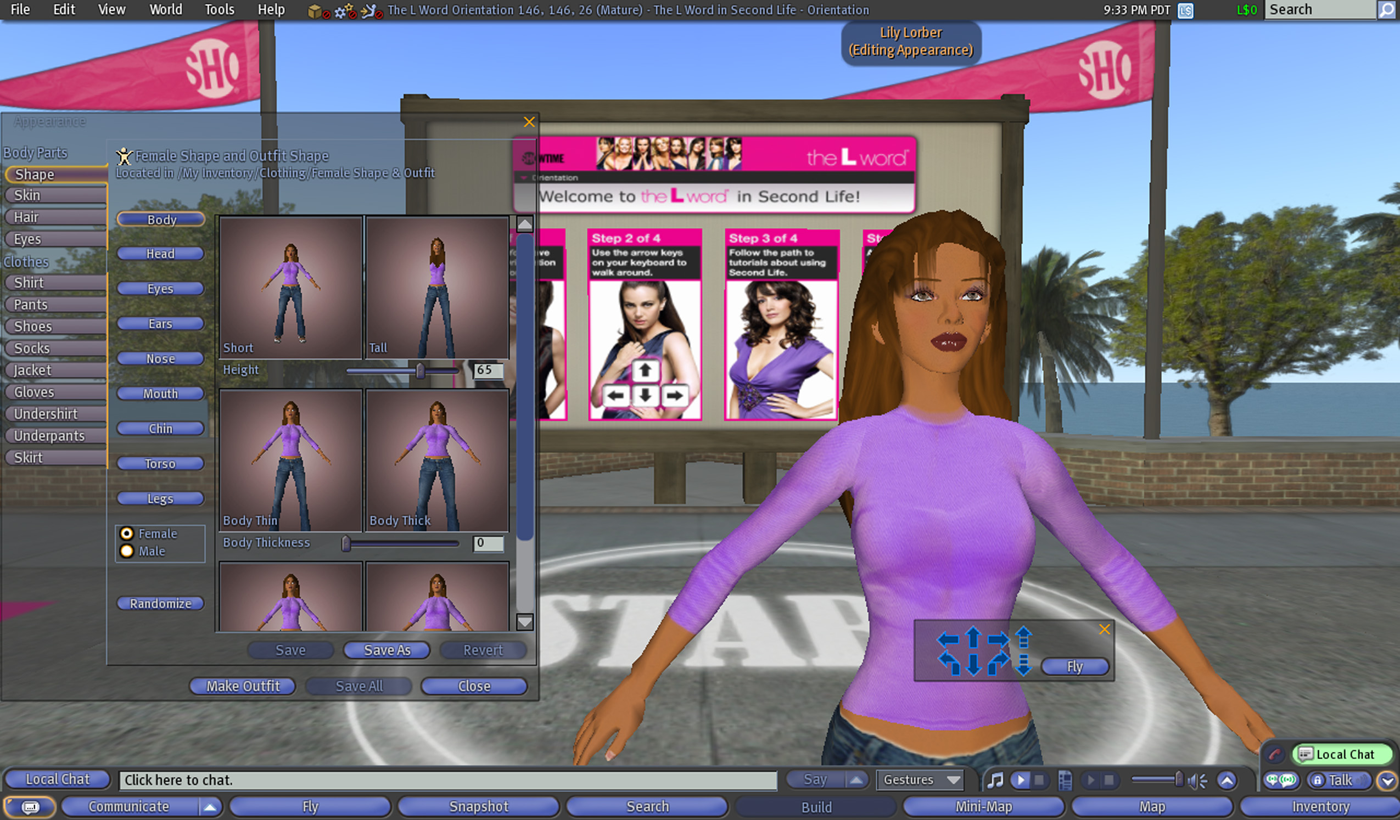
The default avatar at the entry point of the L Word portal in SL dons a sassy, girly outfit and all the markers of traditional femininity as she reflects the styles of The L Word characters pictured behind her. (Notably, the more generic SL homepage offers new users an array of default avatars—various races, various prefabricated hairstyles, and all with differing vibes.)
On my arrival, I fussed with the avatar options attempting to settle on a cyber-me that remotely represented the (relatively computer literate) soft-butch I am. After much struggle I settled for a crazy looking, short hair sporting, and almost-belly shirt wearing figure totally unrepresentative of me. The most difficult part of this process was manufacturing short hair when the program tended to equate short hair with baldness. As I tried to escape the default flowing locks, I repeatedly created unattractive bald spots on my avatar, Agnes. After a bit of travel through the welcome area, I discovered a few outfits that newbies could choose to wear: six women’s and two men’s. Although these women’s outfits provided some options—jeans, dresses, capri pants, strappy heels, tank tops, spaghetti strap tops, etc.—they all screamed “I enjoy being a girl.” I was eventually able to find an outfit less awkward for my avatar to wear by donning clothes they identified as men’s.
Assumedly, once the gamer created her avatar, she could go on to the good part of the program: becoming part of a community. Instead, what Agnes/I found was a rather standoffish group of people with little patience for newbies and which was suspect of Agnes’s butch appearance. More than once she was defensively asked if she was a man. Upon revealing she was a woman, she was met with hostile dialogue regarding men and their less-than-welcome presence in this SL portal. In a community known for its diversity and in a fan community vocally disturbed by the absence of narrative butches, this aggression came as a shock. Perhaps I should have been less shocked in a portal where developing a newbie butch avatar was such a challenge. (After all, the only way to produce a “butch” avatar early on was to disavow one’s female-ness and choose to be a man.) Regardless, it quickly became clear that to some degree gamers had internalized (or at least settled on visually projecting) the traditionally feminine image, one encouraged by the show and the interface equally.
Surely, not all women who visited the site would want to build a butch avatar—a thought just as essentialist as the one guiding the actual interface—but where was the option? The actual interface ultimately made difficult the kinds of virtual experimentation Jenkins (2007) and Mary Bryson (2004) argue sites such as SL encourage. Byron states:
Participation in, and construction of, online spaces, identities and relations by QLBT women seems to be motivated less by the desire to “Go anywhere and be anybody,” than strategic engagement fueled by the urgent need to gain access to live performances of queer culture, including queer women’s communities, in order to be afforded the hard-won and often unavailable space to play, in relative safety, with non-normative identities, and of critical importance, to take up an improvisational role on a stage populated with other variant characters who also serve the function of an audience (Bryson 2004, 152).
Like Jenkins, Bryson sees these spaces as opportunities for safe play or experimentation. The interface as created, however, makes difficult the creation of “variant characters” or a diverse queer culture in which to play. Instead the same heteronormative images projected through the show’s narrative visually guide the possibilities for performance.
SL gamers possess the personal agency necessary to choose alternate visages, but to do so they must have emotional security, user knowhow, and perhaps cash. Scholars such as Max Burns (2009), Rustem Altinay (2008), and Melissa Gregg (2008) refute the utopic vision of online play projected by Jenkins and Bryson. While not always acknowledging the powerful link between design, interface, and behavior, they argue the social pressure to conform, seek bonds, or please stands solidly in the way of honest self-construction. Users feel pressure to “broadcast” themselves in manners most apt to gain approval in the given online community (Gregg 2008, 11). The L Word SL interface—by complexity and chosen defaults—encourages gamers to embrace what appear to be (both real life [RL] and SL) dominant social norms: femme conspicuous consumption.
Upon arriving, dressing, and being chastised, Agnes set out to see what this L Word world was all about. What she found was a small group of rather femme women—although one person had located some camouflage—standing around talking about Snickers and Fleetwood Mac. They seemed to have little interest in Agnes (and she was too late for the afternoon aerobics session which occurred every day . . . seriously), so she went for a walk. (This was initially a chore, as I had a difficult time figuring out the interface, not running into things, not flying, etc.) Along with freebie activities at The Planet, a dance club (where visitors could pole dance or choose one of various pre-programmed dance moves, but should not count on finding a pool table or dart board), an empty amphitheatre (that occasionally showed L Word specials), and a swanky bar (empty), SL’s L Word community also included opportunities for shopping. 8 Agnes thought maybe she could find other folks and make her new home more of a home. Instead she was smacked with an awareness of her own economic disenfranchisement.
SL—L Word portal and the broader universe—functions on its own economic system. Edward Castronova (2006) likens such virtual economies to RL ones. Fostering both wage and wealth inequality, such virtual worlds reflect the social divide in RL relationships and therefore favor those with economic or technological advantages. 9 Citizens exchange “lindens,” named for SL creator Linden Labs, for products. At the time of Agnes’s arrival, the local trade rate was 1,000 lindens to approximately $4. A highly skilled player—a programmer or performer—can earn money by performing, creating new products for others to purchase, etc. An average visitor, however, must use his or her own RL money to participate in the SL economy. Small houses—almost wholly rented out at the time of my arrival—ran the renter 810L per week (about $2). Prices skyrocketed when one bought a large fenced-in house, Rolls Royce, pinball machine, etc.
Agnes did finally discover the clothing store located in SL’s L Word reality. Again, what the creators of the space had developed as the only shopping opportunity was one that further reinforced a highly sexualized femme version of women and lesbians. Various products were available (at a hefty price), but the store conveniently forgot to stock or sell clothes that an average person would wear, let alone a butch. This was no GAP, Old Navy, or JC Penny. Rather, what The L Word folks found most necessary to provide citizens arriving into the L Word portal was their overpriced fill of belly sweaters, thigh-high neon stockings, hot pants, thongs, feathered vests, Fredrick’s of Hollywood-inspired bustier/hat outfits, rainbow jewelry, and “clit rings” (Figure 2).

“Agnes found herself frustrated by the lack of cargo shorts and Western shirts, but if she had needed hyper-sexual, hyper-femme lingerie or intimate piercings, the L Word portal was the place to shop.”
Belly sweaters ran 1799L (approximately $4.50) if one wanted to share her midriff and a (perhaps too) groovy short hairstyle 2250L (approximately $5.50). Tellingly, it cost more to construct one’s visual image than it did to rent a house. (Well, who was going to come into one’s virtual house if one couldn’t draw them in with her virtual hotness?) Even if Agnes had the cash, she would have been out of luck if she had been in search of some jeans, tennis shoes, or a T-shirt. It is no surprise the most prominent image of lesbianism in this cyber L World was one reflective of the show (and some strip clubs), when both the privileged avatar form and available commercial products constructed that image and omitted (or made quite complicated) divergent forms.
The privileging of the economically and educationally enfranchised emerged not only through the linden-based monetary exchange and the types of products one was able to purchase, but also in the lack of user-friendly interface. I have always considered myself a rather computer-literate individual. Even if I am an average user, then those who would have entered The L Word’s virtual community with a weaker grasp on the workings of such a program would have found themselves at a terrible disadvantage.
In Agnes’s experience in the L Word portal, seasoned users—hostile and put-out by her newbie sensibilities—provided little help to her or others struggling to understand the rules of the community or the means by which one controls or alters one’s avatar. The keyboard-driven interface—although not unique to the L Word portal—was quite difficult to intuitively master. Upon her initial and subsequent visits to SL, Agnes spent much time under water, flying into electrified fences, walking into people, and making out with no one in the middle of the dance floor (which was rather embarrassing). My RL partner, concerned that my shunned avatar looked like a stalker, developed her own avatar to help Agnes blend into the community. Also a rather computer-literate individual, she could not manage to remove a martini glass—destined for her mouth—from her rear end; we could, however, figure out how to dance with the crowd and pole dance—the most important tasks in developing meaningful relationships with strangers.
Missing from this program was an easily accessed cheat sheet or visual tutorial about how to get around, use the resources in the L Word space, and find the freebies (which were in other non-L Word portals and where Agnes ultimately found her jeans, groovy eyewear, “Don’t Hassle the Hoff” T-shirt, and Sketcher-like sneakers). Instead, one was forced to use an embarrassing process of trial and error, struggle to find a more established citizen who would help out, or read the tome provided at the SL main site. I repeatedly attempted to gain help through the L Word boards, but the only SL posts prior to or following mine were similar newbies looking for help (to no avail).
Robert Boostrom’s (2008) ethnographic study of the SL newbie highlights the necessity of a quick recovery from newbie status. He positions the newbie as somewhat of a social pariah who irritates the established user with his or her lack of social knowledge and functionality and disturbs seasoned users by interfering with their willing suspensions of disbelief. Only the social assimilation and visual reinvention of the avatar can save the newbie. However, he also places the burden of such a social reinvention on three accomplishments: finding helpful users to augment one’s knowledge base, procuring available cash to purchase clothes and accessories beyond the SL entry site, and quickly mastering the site’s interface. On all three counts, Agnes failed.
Without an incoming base knowledge, loads of leisure time during which she could figure out the process, or the aid of the seemingly absent knowing helper, the newbie was left relatively helpless. Furthermore, the acts and images most easily accessible complicate the potential freedom of virtual play and encourage a preferred site-specific heteronormative aesthetic and set of sexualized (e.g., free pole dancing, free making out) behaviors. While encouraging an adherence to such in-site social norms, the portal’s overall design and the gamer’s resultant technical, social, and physical awkwardness may further promote the same social inhibitions she would exhibit in RL (Hoyt et al. 2003), the same ones the Showtime ads suggest the site will combat. Those without the computer knowledge to teach themselves and overcome the initial learning curve—again, those possibly most in need of a virtual lesbian community—may simply ignore the increased potential for online community and abandon the SL journey.
“L” Is for Let Me Tell You Who You Are
All outfits, dance floors, and standoffishness aside, the proposed virtual lesbian utopia of SL reinforced the classist vision established by the L Word narrative, and ultimately that which the ancillary voices chosen to define the OurChart political/social agenda would similarly reinscribe. In the same year (2007) that Showtime rolled out its high-tech, dyke-friendly SL portal, they marginalized their largely fan-driven message boards. Where once the Showtime show site had included mainly show information, low-tech boards, a few show extras, and links to L Word merchandise, the new highly designed and interactive OurChart site presented fans with more L Word extras, dyke-friendly (but show divergent) webisodes like GirlTrash! (2007), games, the show-based Sapphic social networking site, and new and fancier blogs and boards.
Early responses to and reviews of the site touted its focus on user-generated content, with founder Hilary Rosen predicting the day that the “community takes over” (Jensen 2006). The Hollywood Reporter’s pre-launch article about the site claimed, “About 75% of the content will be user-generated, and the rest will be ‘L Word’-related material” (Schiller 2006). Not addressed in such articles was the specific form and slant of “user-generated materials.” OurChart’s choices in layout and staffing resembled choices made in the design of the SL portal, foregrounded economic and social upward mobility, and underscored the economic drives that linked Showtime and the site.
By privileging certain voices, the site simultaneously positioned itself as a portal for the “good gay” consumer and reinforced the very characteristics of the show critiqued by fans (Russo 2009). In the end it appeared that Chaiken, who claims in the site’s promo to have had a hand in many of these elements, squandered her opportunity to overcome the looming critiques of the show’s narrow depiction of lesbians as white, femme, upper class, and traditionally hot. While the site’s creators textually marginalized the same voices missing (or seldom heard) on the show, designers made the site more complex to use. Much like SL, the layout made it unruly for those perhaps most disenfranchised and in need of an online GLBT community.
The social networking site—founded by Chaiken, cast members Leisha Hailey (Alice), Beals, Moennig, and political commentator Rosen—took its name and inspiration from the show itself. Season one had introduced Alice’s “The Chart,” a wall-sized dry erase board with an undirected labeled graph connecting people’s names—including all main characters—through their multiple sexual relationships. During season four—the year OurChart would debut online—Alice launched a diegetic online version of “The Chart.” With all the earmarks indicative of television’s strengthened engagement with the web, the newly launched OurChart served as a transmedia-light Facebook or MySpace for the L Word–watching lesbian set. Along with the social networking aspect, the site included blogs, forums on various topics (sex, food, travel, etc.), L Word outtakes, interviews, and original non–L Word materials. The website described itself in the following terms:
OurChart is the new site where women can connect, share and hang out with friends of all shapes, stripes, genders and orientations. Launched from an idea in the Showtime hit “The L Word,” OurChart provides unreleased gems from the show, along with exclusive original editorial and multimedia content from some of the most excellent creative folks out there. OurChart will also let folks create their own chart of friends, lovers, and everyone else in their own L worlds. OurChart was founded by several of the people behind the innovative TV show, along with a few professional homosexuals and a crack team of queer-at-heart geeks, designers and writers. Rumor has it the site was created in order to fulfill item 197 on the Homosexual Agenda, but we’re not gay enough to see the document, so we have no idea if it’s true or not. Most of the staff is based in Los Angeles and San Francisco, but like the gays, we’re everywhere. Snap. (OurChart 2007)
Tongue in cheek, OurChart’s mission mocks the Right’s paranoia regarding the homosexual agenda, while merely setting the site up as a queer-friendly place to meet and gather. The mission statement itself articulates the hopes that Chaiken and cast members highlight on the aforementioned season four/OurChart promo. Chaiken states, “The central motif of the show has always been that interconnectivity in all of us. It makes so much sense to us to now make that on the internet.” Moennig then evokes a utopic vision of “a safe place” for women “to go and be themselves” (The L Word - OurChart promo 2007). Between the promo and the site’s listed mission, the founders position OurChart as transcending the narrow view of lesbian life the show so often had been critiqued for espousing. The mission statement evokes the popular mantra “we are everywhere” as it jokingly positions its founders as edgy folks looking out for the lesbian community (although it simply says “for women”). Chaiken and Moennig bring to mind the transcendent quality of the site and its ability to bring fans in to join in good clean fun, especially those otherwise lacking a lesbian community.
Contrary to the founders’ publicized aspirations, the site suffered from the same weaknesses as the series. The chart itself functioned much like other social networking sites where members develop profiles, seek out connections, and make visible their own likes, dislikes, and social networks. 10 As would be expected, OurChart members developed profiles and sought out friends (through connections or blog entries). After its initial launch, designers added a “friends plus” component to mirror Alice’s sexual encounter-driven “Chart.” Little set OurChart’s social networking interface apart from its nonqueer or queer competitors. The accompanying boards, blogs, and media perhaps stood as the more innovative or sexier aspects of the new site, providing new video content, more highly designed spaces to replace the traditional boards, and celebrity, pseudo-celebrity, and individually helmed blogs targeted at a (hopefully) captive audience. The latter two elements most strongly embody the ideological shortcomings of the new site, and therefore garner the most attention here. Although the original sho.com L Word site had surely lacked pizzazz, its free-flowing, largely fan-driven quality had provided a space that encouraged the kind of open community the founders of OurChart professed a desire to create. The updated site’s design and choices in staffing would instead help to replicate the narrow world of the show fans so often criticized.
When a viewer entered the OurChart site, she could choose to enter the profiles or visit the blogs, forums, or video areas. Upon traveling to the blogs, she could choose to read the latest featured blogs or enter one of the general topic areas: “Hook Up” (messages from the editors), “Feel Up” (culture and entertainment), “Touch Up” (health and beauty), “Wake Up” (politics), “Sex Up,” or “The Chart Report” (gay news stories). Featured blogs visually dominated the space, with links to the most read blogs by everyday users identified by small profile pictures off to the right. The featured blogs dwarfed those of everywoman bloggers both in size and overall prominence within the site’s visual design, as they consistently appeared on the homepage as a hello for visitors. Individuals hired/appointed by the OurChart powers that be—ranging from creator Ilene Chaiken and author/radio personality Diana Cage to urban designer Mitch McEwan and OurChart editor Lisa Bang—authored these more prominent blogs. 11 (Notably, many of the celebrities and pseudo-celebrities would only be recognized by those “in the know,” placing those visitors not hip to dyke culture at a disadvantage.) Unlike the “we’re all equal in the board’s eyes” feel of the old site, the new format framed these bloggers as the chosen ones (both literally and figuratively).
By mid-2008, OurChart’s thirteen featured bloggers included two writers, two radio hosts, a performance artist, urban designer, magazine founder, comic, music industry insider, personal trainer, and the OurChart site editor. Pictured on the page—larger than the everywoman bloggers—they headlined the main editorial content of the sexual, political, and cultural themed headings. Of the thirteen, all but one resided in New York, Boston, or California. Although OurChart was launched for lesbians “everywhere,” the voices who constructed the face of OurChart excluded many of the same individuals excluded from the series. Despite including African Americans more fully than the series, the bloggers remained largely American and white. Living in Canada, Leah Beckingham provided OurChart with its only blogger living outside of the United States. Lenelle Moise and Parisa Parnian, Haitian and Iranian respectively, served as the only non-Americans (although North American coastal residents). These thirteen women’s prominent voices and social profiles define the site’s image of the “good lesbian” or she who is worthy of address. Despite some diversity, the overall range of valid lesbian voices wholly excluded those who might identify as rural, suburban, Southern, Midwestern, conservative, or working-class to name a few.
Like the show, whose main characters are filmmakers, hair designers to the stars, and star athletes, the bloggers/anointed opinion leaders brought glamour and cultural capital to the table. Simultaneously, visible bi, butch, and transgendered voices failed to emerge through the design of the featured community. Only African American blogger and self-identified dyke Mitch McEwan (sporting short cropped hair, sport coat, and sweater) would have been visibly identified as butch; none of the bloggers self-identified as trans or bi. 12 Whether out of snobbery or a dual-market-driven path to homogeneity, the show’s and the site’s lesbians—as Showtime executive Greenblatt said—emerged as those most easily sold to both gay and straight audiences and reflective of dominant norms.
Despite the mission statement’s and cast members’ claim that the site was for everyone, these visually and therefore rhetorically favored blogs solidly reinforced a legitimate and homogenous image of lesbianism perhaps even narrower than the show’s storylines. Such homogeneity has been a critique of the blogging phenomenon. Julie Rak (2005) argues:
As a genre, blogs create a specific type of social space, and are constructed to attract specific types of community based on similarity rather than differences. For example, key words to describe a blog are used so that other readers can find blogs that are closest to their interests (Rak 2005, 177).
The show’s white, femme, upwardly mobile, coastal lesbians broaden only slightly on OurChart, as the featured bloggers comprised an image of largely femme (or at least nonbutch) East or West Coast artists and academics. Rak further argues, “That act of classification is a social act in the blogger community that works to create recognizable subjects which do not shift” (2005, 178). Consequently, so-called queer blogs, because of the nature of blogging, often lack the fluidity often implicit in the very term queer. While in no way curtailing who can read the OurChat blogs, the choices in featured bloggers surely refine the who that the site hails: one who fits the definition of a specific lesbian, rather than particularly queer.
Users could surely find other (assumed) lesbians to talk to aside from the featured bloggers, but those who reflected their own political, economic, and regional backgrounds (if divergent from the in-site established norms) were perhaps hard to find. True, members could create their own blogs, as well as reply to those of nonfeatured bloggers, but while pictures of and links to the featured bloggers graced the blog homepage the site’s design marginalized member-driven blogs and replies. Only by searching a secondary link under “profiles” or a small “browse member blogs” link in the bottom corner of the homepage could visitors explore the musings of the larger spatially closeted community—and that beyond the urban intelligentsia. Reflecting a common design-oriented “pseudo-closeting gesture” discussed in Jonathan Alexander’s (2002, 92) exploration of “homo-pages,” OurChart forced visitors to seek out divergent voices, rather than—as in the early boards—featuring them equally.
Such weaknesses and site-created biases appeared in the forums as well. Simply a more site-designed version of the early sho.com boards, the OurChart forums defined the major topics of conversation by breaking them down into various headers: OurChart, The L Word, OurLives, Popular Culture, and Miscellaneous. Within these links, major subheadings such as feature requests, help, fan fiction, family, sex, support, and news and politics drew members to proper places to start their individual threads. The subheadings highlighted many of the topics popularized on both the blogs and the early sho.com boards. Through this design, however, the narrow definition of what lesbians were worthy of being spoken to entrenched further. Throughout the site, biological women who identified as lesbian garnered visibility, while bisexual women (extremely present on the sho.com boards) and Male-to-Female (MtF) or Female-to-Male (FtM) transgendered individuals who did or had identified as lesbian were forced to carve out their own secondary spaces by creating new threads under headings such as sex or help . This freedom—or necessity—to create one’s own space mirrored the show’s gestures toward diversity regarding inclusion of bisexual, racial, or transgender issues. As could have been claimed with the show, OurChart members had the ability to create psychic spaces for themselves, but these folks most often omitted from the real-life lesbian community failed to find a welcome mat laid out by either the show or its supposedly more inclusive social networking site.
“L” Is for Better Luck Next Time or Lookin’ Out for the Man
Through each of these fan-directed and somewhat fan-driven activities/meeting grounds tied to Showtime’s and The L Word’s (2004-2009) investment in media convergence, the same issues of minority marginalization or assimilation emerged that had been critiqued for decades regarding film, television, and the internet. The issue of ultimate importance in this and other cases relating to user participation in corporate-created interactive spaces—specifically those targeting marginalized, minority, or isolated groups—is the fact that the fans themselves are so highly complicit in their own invisibility. In short, while these sites were (like the show) totally sexy, the images and voices presented as natural options were narrow depictions of a diverse community.
Unsurprisingly, the network-sponsored sites erased the butch, the bi, the trans, the working class, the Midwestern, and the rural, all in favor of creating a largely idealized and marketable (to both men and women) image of lesbianism. This corporate creation of the lesbian community basically legitimized a new closet, one in which lesbianism was accepted, but only a narrow vision thereof. This type of site, behavior, and fan-creation goes beyond the television industry’s historically problematic production of limited images of non-whites and non-upwardly mobile characters. This type of user-driven activity, instead provides a façade of visibility, ownership, equality, and agency though its interactivity, rending less visible the individuals omitted from its virtual guest list or kept just behind the velvet ropes.
Although these same users can storm the dance club by trampling through the ropes, they may lack the self-assuredness (that scholars argue an inclusive site would help foster) or the technical knowhow to do so. I hope that work such as this and further interrogations of the economic, racial, gendered, and sexual ramifications of television/film-linked media convergence continue to examine such “liberation” and that both scholars and users develop a keener eye toward the limited options being presented by the big corporations in the guise of community development and harmless branding. As for The L Word in SL and OurChart, between 2008 and 2009 both came to a screeching halt with little explanation from Chaiken or Showtime. Perhaps the monetary payout was too insignificant or perhaps the participant-fans grew tired of their complicitous objectification and simply abandoned ship.
Footnotes
Acknowledgements
I would like to thank Sharon Ross, Paul Booth, and the anonymous reviewers for their insight and for helping me work through various incarnations of this article.
Declaration of Conflicting Interests
The author declared no potential conflicts of interest with respect to the research, authorship, and/or publication of this article.
Funding
The author received no financial support for the research, authorship, and/or publication of this article.