



Abstract
This article presents the results of a study of social media uses and standards from the perspectives of online newspaper managers in Argentina, Colombia, Peru, Mexico, Venezuela, Spain, and Portugal.1 Interviews with online news managers and a content analysis of journalists’ use of Facebook and Twitter accounts show that cultural, economic, and organizational factors handicap news outlets’ adoption of social media. At the same time, evidence shows that these professionals’ drive and enthusiasm for transitioning to online and using social media have made meaningful changes in the ways news is produced in the Ibero-American region.
Despite the extraordinary growth of social media in Iberian countries and Latin America, news outlets in those regions have lagged behind the general public. Facebook alone is the most visited website in Latin America (Alexa 2012). Yet, studies show few newspapers in Latin America have embraced web 2.0 technologies as part of their content production strategies (Rodríguez 2011). Mexican newspapers, for example, have even reduced the interactive options for their readers in recent years, though this trend may be reversing (Caballero 2000; Lerma 2009; López 2009; Navarro 2004; Rodríguez 2011). Less than 40 percent of Latin American online news outlets use social networking such as Twitter and Facebook or online forums (Tejedor 2010). Newspapers in Portugal and Spain fare somewhat better. Still, less than 20 percent of twenty-seven Portuguese digital outlets permitted readers to post opinions on their websites (Zamith 2008). In Spain, studies show that few online newspapers can compete with the array of web 2.0 technologies offered in other European countries, and most newspapers did not even adopt interactive technologies until 2006 (Armentia et al. 2000; Cabrera 2001; García de Torres and Pou 2003; García de Torres and Rodríguez 2007; Salaverria 2005).
At the same time, streams of postings and blogs have generated an environment that Hermida (2010) describes as “ambient journalism” in which journalists are hailed to integrate the bits and pieces of public inputs. Some commentators have claimed that newspapers can better integrate social media and microblogging into journalistic routines to better contextualize stories to fit personal experiences (Rodríguez-Martínez et al. 2010). This would make news coverage less formal, and more conversational in speaking to readers who are also social media users. To understand the degree to which this has been a goal of Latin American and Iberian journalists and the handicaps to achieving this goal, this article presents two sets of data about professional aspirations and the realities of news production in these regions. Following Salzman and Albarran (2011), the article demonstrates the need to understand the dynamics associated with online content production and the professional contexts for using social media in news production.
This article begins with a review of the literature on online news and journalism in Latin America, Spain, and Portugal, before presenting the results of a survey and interview-based study of online news managers across seven countries. From the evidence, we find that despite the cultural, economic, and organizational obstacles, news media professionals are enthusiastic about the ways they can use social media in their everyday practices.
Web 2.0 in Latin American, Spanish, and Portuguese News Outlets
Despite the variations among different newspapers in Latin America and the Iberian countries, studies reveal that news organizations in both regions were late adopters with web 2.0 technologies and have failed to develop in step with the innovations. Most online outlets simply depend on the print edition for content and lack viable means either for gathering audience feedback or even allowing readers to make contact with the pressroom (García 2007; Llano 2005; Rojano 2006; Said-Hung and Arcila-Calderón 2011; Zuñiga and Duque Soto 2009). Online readers, however, often repost stories and their own feedback on outside social media, making for an unintended resource sharing network between the newspapers and social media sites (García-De-Torres et al. 2011; Yezers’ka 2008). Igarza (2008) argues that eventually publishers will have to recognize the economic value of social media spaces and will put journalists and readers into a “market conversation.” Yet to date, a study by the New Latin American Journalism Foundation (TICbeat 2011) found that most entrepreneurial digital information projects were unsustainable due to the lack of viable business plans, social media strategies, and the low quality of the content published on web 2.0 platforms.
The dichotomy between the low availability of web 2.0 technologies on news sites and the high availability of social media among general readers has resonated with many news professionals and scholars of journalism. A study of journalists’ perspectives at fifty-six news organizations has shown that they see the potential benefits of more interactive technologies on their online outlets, such as contributing to the content of their news coverage and developing better relationships with readers (Martínez 2011). Meanwhile, observers have also questioned the impacts of these technologies on journalists’ professional identities and organizational newsroom cultures. Domingo (2008) and Steensen (2009), for example, argue that any innovation in online newspapers must be considered in relation to occupational autonomy, work culture, the roles of managers, and journalists’ professional identities.
Some of this hesitancy could be a matter of professional training. As journalists have become Twitter users themselves, they face specific challenges as to how to publish opinions, to re-tweet users’ messages, and to increase the transparency of information spread through their networks. According to a report submitted by Recuero et al. (Marketing Directo 2011) at the first Latin American Social Networks Congress, U.S. journalists increasingly use both Facebook and Twitter to spread news and transmit information. They blamed the lower indices of interactivity between Latin American journalists and readers on the absence of a community manager in the newsroom, the lack of style standards, and the lack of guidelines for the use of social networks in the media. The report recommends the need for journalists and media executives to work together to establish social media norms that would increase users’ participation without restricting the freedom of expression.
Taking these factors into consideration, this study focuses on online news managers as key figures in bridging the disconnect between social media users and news organizations in the age of Facebook and Twitter. 2 Online managers may ease the adoption of social media strategies at newspapers and help contribute to a workplace in which journalists have the proper training and guidance for using social media to develop news stories and reach out to readers. They mediate between the publisher and journalists in development viable business plans to create a new vision for news production.
Study Method
This study explores how Ibero-American news outlets from Argentina, Colombia, Peru, Mexico, Venezuela, Spain, and Portugal manage social media in their operations. 3 The study combines these countries as a region because they not only share historical linkages in terms of languages and cultures but also because the countries in this region increasingly comparable indices of information technology users as shown in a recent business school study that combined Internet, mobile phone, and other national statistics for smart technology uses. The study found that the economic crisis in Spain and Portugal together with the economic boom in parts of Latin America has leveled the playing field between countries that used to be considered, respectively, technologically more or less advanced (Everis 2011). We focused on Twitter and Facebook as interactive technologies that are already highly used in the region and already known to stimulate potential conversations between journalists and readers (Jerónimo and Duarte 2010). 4 From there, we wanted to understand the technological, cultural, or organizational factors that would foster or impede social media in news production.
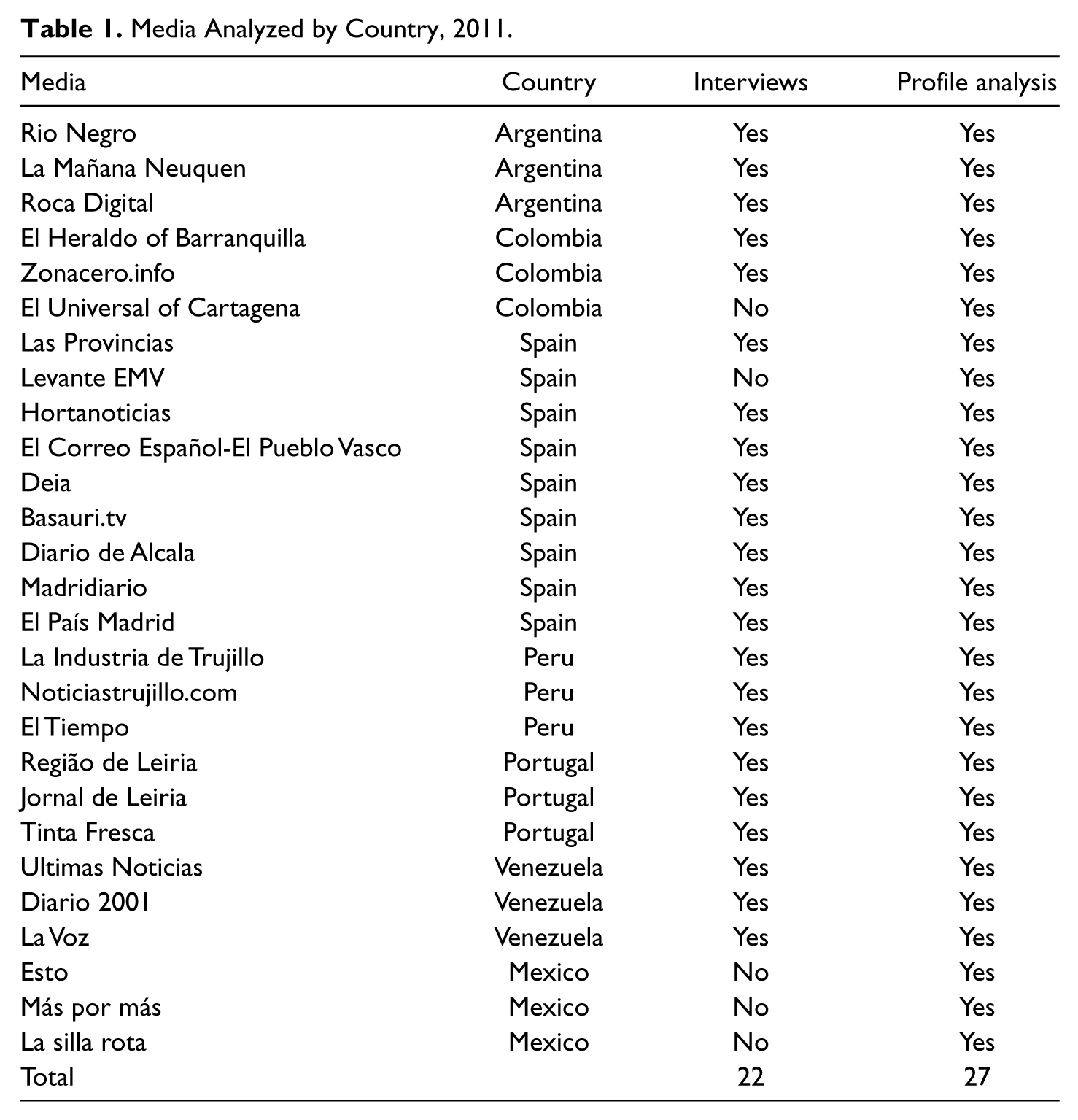
Our sample comprised a total of twenty-two news organizations with online editions. The sample included both local and nationally circulated papers with the aim of including the news outlets with the largest circulations in a given country. We interviewed the news editors in charge of online production in each of these organizations using a script of twenty-five semistructured questions that would give in-depth answers about social media uses and workplace issues in the newsroom.
In addition, we analyzed the Twitter and Facebook profiles of each of the chosen media in the sample. To this analysis, we added five local media outlets (three of them from Mexico, one in Colombia, and one in Peru) for a content analysis of the types of posts and interactivity in social media related to the twenty-seven outlets.
We classified these contents according to whether journalists were adding information to stories or whether readers were responding to stories. A total of 5,010 messages of twenty-seven profiles were analyzed, of which 1,634 were posted on Facebook (32.7%) and 3,376 on Twitter (67.3%). Both the interviews and the analysis of the profiles were carried out between February 18, 2011 and March 11, 2011.
This is an exploratory study to provide insight on some trends in Latin American countries and their Iberian counterparts in Europe (table 1). The interview data allowed us to observe some differences in the development of digital media across countries, but what was more striking were the similarities in taking the countries as a whole. In distinguishing between the countries in the future, one would account for the economic booms in some Latin American countries like Colombia, Argentina, and Mexico versus the recessions in Spain and Portugal. In the cases of Peru and Venezuela, in particular, the continuing increase in the number of Internet users has boosted the media’s attention to social media. Other variables, such as control of new media by the state or the economic model of the media, could also contribute to a better understanding of these phenomena.
Media Analyzed by Country, 2011.
Results
Not surprisingly, newspaper editors with online editions felt it was the local media’s responsibility to open alternative information channels and that social media was important to achieving this goal. The majority expressed the usefulness of Facebook (nineteen) and Twitter (seventeen) in circulating, compiling, and, in the case of Twitter, even receiving news. Yet, the main finding of the study was that there were no standard norms or processes by which news outlets in the region developed social media.
Online managers said social media became part of their organizations through various means. Most (fifteen) said the publisher started initiatives. According to a Venezuelan manager, the publisher opened social media accounts in part to prevent other Latin American news outlets with similar names from taking the Facebook page or Twitter account names. Only five of the respondents said that journalists and technical directors worked together in initiating social media uses in the organization. An Argentinean manager said, “On Facebook, [social media networking] was done by our technical department . . . We began to upload notes about events three years ago.”
Of the twenty-two online managers, only seven of them had hired a community manager to oversee social media in a kind of role that would put someone in charge of news posts and in closer contact with the reading public. Community managers produce a sense of proximity, closeness, and participation between journalists and users (Dans 2009). Instead, most of the work is done by the journalists themselves, with a few cases in which the editor or the editorial board also post contents. Said one Spanish manager, “There is no single person assigned to [social media posting], or rather; all of us do it in some way.” The responses overall showed a genuine disinterest in having someone mediate between the public and the editorial staff in a social media setting. One manager said the person who was initially assigned to the job of community manager had no specific function, so this person only kept track of whether the news was published online, not the contents. Similarly, another online manager framed the community manager as a delegate of the editor, not an author in his own right.
From the decision to enter social media, online managers said that there were few internal guidelines as to how to proceed in using the channels. A Portuguese manager said he simply followed the same rules used in writing print stories. The responses revealed a near universal lack of standards regarding how to use Facebook and Twitter at work and more than 80 percent of the sample group wanted some guidelines for time management in using social media for journalistic purposes. Two-thirds of the interviewees said they wished they had internal guidelines for posting information, and only three said they knew of internal guidelines for deciding who to “friend” through their workplace Facebook site. The overall reactions to the lack of guidelines could be ambivalent as in one interviewee who said, “I have publishing autonomy; in other words, it is very easy. Everything that is published in the provinces can be published on Facebook and Twitter. What I receive are directions to enhance certain content.”
Meanwhile, the news organizations themselves were divided evenly about where journalists should post. More than half of the online managers said they had policies barring journalists from posting news on Facebook walls not aligned with the company, while almost one-third of them worked for organization that habitually posted on walls not aligned with the company. In the latter group, a Spanish manager commented that the strategy was meant to draw different social groups to the newspaper’s official site: “We try to create groups and respond to their interests because what we can offer is professional information. We try to get our information posted on the pages of those who are interested.” One Portuguese outlet tried a similar strategy by tagging the names of people in stories to draw interest from Facebook friends of those people. In other words, these online managers saw the role of the media as intervenors in social groups so as to provide professional information about an event, and they reported the lack of internal policies restricting this type of practice. Those in the former group of online managers saw themselves as simply sharing information already produced by the media outlet. Said an Argentinean manager, “Our Facebook wall is basically a replica of the notes published by the [media outlet’s site] . . . There is virtually no interaction with the social networks.” Those who did not post anything on Facebook said they lacked personnel to do so. Despite the lack of clarity around how or where to post, the majority of the interviewees (fifteen of the twenty-two) said they looked to hire journalists with social media skills. “Now when new hires are contracted, they are instructed to use Twitter. This is something that I can attest was not the same a year and a half ago,” stated one online manager in Spain.
The different ways in which the two editors talked about Twitter and Facebook in the previous example spoke to a bigger generalization about the differences that all of the editors shared between these social media. Whereas all of the interviewees framed Facebook as a mere repository for reposting stories, they saw Twitter as having a function in terms of news production. Said a Peruvian interviewee, The local news posted on Facebook is useful to readers no longer living in the area who want to know more about what is happening here . . . On the other hand, Twitter permits us to maintain a network of contacts.
Another Colombian manager confirmed, “Facebook is the place . . . to put out your brand so your readers know you are there, but if anyone has information to give, it would be on Twitter and not Facebook.” In other words, all of the interviewees saw Twitter as more in line with the cultural norms for producing professional news stories, a fact that one Venezuelan manager attributed to the fact that the platform was more easily accessed on mobile phones. Most of the interviewees (sixteen) stated that Twitter activities on their news outlet pages increased the number of story sources and developed new information for news stories. In other words, social media settings became “additional sources” for the media outlet. A few respondents also valued these new platforms for providing information that helped edit or guide story selection. Said one Spanish manager, “We ask, above all, for inputs [into social networks] that give us clues [to breaking a story]. That information is handled like any other source.”
To encourage these user inputs, most of the social media managed by news outlets did not tell users how or what to post, but rather reviewed and, at times, controlled user participation through “cleaning up” posts. Nine of the twenty-two editors said they review participation on the websites, though only a couple had a dedicated staff person in this role. One manager in Argentina said that the publisher ordered managers to observe what social networks were posting in the wake of President Nestor Kirchner’s death. “There were one or two times when we were asked to post on social networks,” he added. In general, we noted that at least sixteen of the twenty-five news organizations had a policy for deleting user comments for such violations as inappropriate language, data protection laws, the disrespectful use of public communication spaces, or irrelevance to a particular story. In addition, five of the respondents noted that there were no defined criteria for deleting user comments. “If they are personal attacks, we should delete them,” stated a Peruvian manager. Most of the news outlets assumed the responsibility for deleting their own messages, while only one interviewee mentioned using formal complaint process on Twitter or Facebook to exclude comments. These opinions indicate that editors still believed that the information users provide on social media is less valuable than the news content they provide.
Indeed most of the postings on Facebook and Twitter presented few interactive opportunities. The content analysis showed that news organizations generally use social media to direct traffic to traditional stories through reposts of headlines or links to their own online content. Seven out of every ten posts on Facebook were headlines. Six out of every ten tweets were links to traditional stories in the newspaper. Less than 10 percent of the postings request user feedback. In turn, few postings received readers’ comments; less than 1 percent of posts received either a comment or a “like” on Facebook. Some postings explicitly sought conversation and input from the audience, however, and demonstrated the perceived utility of Twitter for news production. For example, editors said they reached out to Twitter users about accidents so as to solicit more information from witnesses. One Colombian manager explained, When roads are blocked, or there are murders, or there is an accident, Twitter users are the first to sound the alarm. They tell us they just saw a fire, or something bad is happening on such and such street.
Most of these posts received over four comments, suggesting the readers will engage with journalists when presented opportunities. 5
According to data collected in this study, management personnel recognized that using social media was inevitable but they could not predict the paths they would forge in social networks, such as Twitter and Facebook, nor how to exploit these networks’ profitability. Editors said they were exploring ways to make the added work generate income, mostly to create better synergies with the print editions, a process that a Peruvian manager called “retro-feeding” the paper. At best, one Portuguese interviewee said the newspaper was attracting new readers.
Given the cultural norms of news organizations and their structures, editors considered the capacity of social media to assist in news production of secondary importance to the economics of the platforms. As a result, social media was often delegated or entrusted to online managers who are responsible for monitoring those channels. The responsibility for using social media was outsourced or shared among journalists who only reviewed these alternative sources of information on request. Although news organizations respected Twitter users more than Facebook users, they nevertheless did not intend to incorporate the voices of those found through social media in a more permanent relationship. With the exception of a few professional bloggers or vloggers who are considered to be reliable sources, the organizations in the future will likely still keep social media users on the margins of news production.
Summary
Although it may be inappropriate to say that the local media in Latin America, Spain, and Portugal are making full use of social media, this study indicates newspapers are slowly progressing toward a model of global networked communication (Cardoso 2011) that would enable the masses to communicate while following certain standards or norms issued by web 2.0 technologies. The news outlets in this study recognize the ways in which social media can promote conversation between journalists and readers in the Ibero-American region and thus promote more information sharing in the production of news. At the same time, the lack of norms and standards for communication signifies that newspaper editors are just beginning to realize the potential of these media. The lack of procedures and personnel dedicated to social media among the news outlets in this study has been both a cultural and economic handicap in being able to leverage the technology in the professional context of news organizations. The management of readers’ comments and potential exclusion of user inputs shows the difficult decisions editors make implicitly around norms for dialogue and professional hierarchies. Procedures regarding how news organizations shall connect with their audience and generate high-quality participation among users will depend on efforts among editors not only to enhance community members’ contributions but also to establish more regular spaces in the local media where these discussions can take place. In this case, the economics of downsizing newsrooms may ultimately promote the cultural sea change in social media use as the “audience” becomes more important as the generators of news stories and their circulation.
Footnotes
Declaration of Conflicting Interests
The authors declared no potential conflicts of interest with respect to the research, authorship, and/or publication of this article.
Funding
The authors received no financial support for the research, authorship, and/or publication of this article.