



Abstract
Since the 1990s, conversations about the dearth of women working in the video game industry have centered on three topics: (1) ways to draw more women into the field, (2) the experiences of women working in the industry, and (3) the experiences of those who once worked in the industry but left. Although there has been considerable research on the conditions and occupational identities of video game developers, less scholarly attention has been devoted to women in gameswork, the barriers/obstacles and challenges/opportunities they face, and how they talk about their experiences. This article offers a feminist approach that demonstrates how discourse focused on affect can be reread as intimately related to silences about power and how the rhetorical constraints that public speech imposes upon what can be said about “women in games” aid us in understanding what might remain unspoken, and why.
Keywords
Background
Since the 1990s, there has been increasing alarm expressed about the dearth of women working in the video games industry, increasing interest in ways to attract more women to the field and increasing concern about the experiences of women employed in the industry, if less often about the motivation of those who have left it. Our study focuses on what women working in the games industry can tell us about these questions and concerns. Its methodological aspiration is feminist, and this means, at minimum, that the ways we collect and analyze our data should be ethical and respectful and enhance rather than exploit women’s resources. Generally, time is our most important resource. This is particularly true for women as their time is often devalued when compared with that of men (Freysinger et al. 2013, 13–14). Moreover, women typically do not have as much control over how their time is spent. So, in laying the foundations for this study, instead of surveying and interviewing prospective informants, we wanted to see who among this group of women has already invested her time and energy to tell a public story, whether in a blog post, a book chapter, a televised talk, a radio interview, or other public medium—and to build the foundations of our study by focusing on that subgroup of women in games.
We found that their public speech predominantly advances positive accounts of women’s involvement in the games industry, and this “insider” perspective stands in contrast to research-based accounts that have foregrounded masculinized and often hostile working conditions across the industry (Consalvo 2008; Harvey and Fisher 2013, 2015). There is indeed a tension here: because efforts to repudiate the burden of gender and to claim an equal right to speak about their work, and not about their sex, compel women in games to perform the additional affective labor of justifying their role and influence as workers who “fit in,” a rhetorical stance which simultaneously prohibits them from critiquing misogynistic working conditions endemic to the industry. Integral to that paradoxical discursive work is a peculiar burden of compulsory speech.
“The Questions”
The women whose viewpoints we seek have persistently and emphatically conveyed their frustration about having to speak repeatedly about and for their gender (Alexander 2011). Many women in the industry have prepared answers that can be delivered on demand to answer what Robin Hunicke (2014) calls “THE QUESTIONS.” “The Questions” are along the lines of “What is it like being a woman in games?” “What should we do to include more women?” and “Why haven’t we figured out how to end sexism in our workplaces, at our conferences and industry events?” Amy Hennig says that she has declined many speaking engagements specifically because she does not want to be asked these questions: she wants to be asked about her work, not about her work as a female (GDC Vault 2015). Brenda Romero characterizes this as a “female tax,” the extra time and effort women who make games must expend in discussing gender as well as their work whenever they engage in public speaking. Conversely, Romero says men have the privilege of discussing only their work. Men are rarely asked about gender, or how their personal identity influences their work. Several women in our sample articulated their frustration and fatigue in relation to the topic of “gender and the games industry,” at the same time acknowledging the importance of women’s voices and perspectives being heard within the industry.
Some, indeed, have made it a personal mission to take on the struggle to increase women’s representation in the games industry. Although acknowledging that many women do not want to, or cannot, discuss being a “woman in games,” Elizabeth Sampat (n.d.) says, I will be loud, I will always answer THE QUESTIONS—and depending on how often I’ve answered them recently and how much I am dying inside, I will do my best to answer them with a smile . . . I will never turn down an opportunity to talk about Women in Games if it is within my power. I will be patient, or angry, or vengeful, or conciliatory, whatever is necessary to get the job done.
What these perspectives on how and why women should or should not need to discuss “women in games” make obvious is that women have already spoken about it—a lot. Taking their public voice seriously, listening to what women in games have already said on this issue, requires using their interviews and discussions of gender and/in the games industry as our primary data, so this is where we began.
In using “public speech” as primary data, it is important to consider what informs and constrains decisions about what to say and how to speak “in public.” In game culture, for instance, the misogynistic onslaught of “Gamergate” has had direct and serious impacts on the lives and careers of female players, developers, and game scholars alike (Chess and Shaw 2015; Straumsheim 2014; Stuart 2014). And long before the dramatic disclosures of #MeToo, women’s subordination and precarity across many other spheres of professional life were well understood. Whatever the facts about workplace policies, wages, job descriptions, or working conditions and whatever the varied ways these may be experienced, it is a further question whether and how to speak publicly about them. This is a study of that further question: it is a study of the politics of speech, and specifically, the politics of public speech by women. It is not only in game cultures that women have been condemned and punished for assuming a public voice (Beard 2014; Jenson and de Castell 2017). Only recall the punitive consequences of a woman with vastly superior education, ethics, experience, and intelligence daring to run for president against a racist, misogynist, lying grifter in the 2016 Presidential election. It is, in this regard, worth bearing in mind the differences between the kind of critical public discourse that is building in the entertainment and tech industries more generally and the comparatively muted voices from within the games industry.
What We Did: Recruitment, Virtually Speaking
Methodologically, this study aspires to Verta Taylor’s (1998, 360) “five features of feminist methodology: a gender perspective, accentuation of women’s experiences, reflexivity, participatory methods, and social action.” Looking exclusively at North America, we gathered material by women in games about their experiences that we located through text and media sources: previously published interviews, corporate employee profiles, social media posts, and other public forums.
We focused on the working conditions of women gainfully employed in games development work, whether in design, production, management, or distribution of games, in both commercial and independent sectors. To develop our initial sample of “women in games,” we began with Jennifer Hepler’s book Women in Game Development, identifying contributing chapter authors and others named in those chapters. We added names using the International Game Developers Association (IGDA) website, particularly through the IGDA special interest group “Women in Games,” and the Game Developers Conference website and media library. Our search began by identifying “vocal” women: those who had published chapters in books, had delivered public talks, or posted to blogs and forums. This approach yielded significantly greater numbers of women working in the United States than in Canada. To expand that initial list, we used the Canadian and U.S. Entertainment Software Association websites and the GameDevMap website (https://www.gamedevmap.com/) to compile a list of game development companies, which included 244 Canadian and 1,221 U.S. companies. To bring our sample closer to parity, we directed our attention to Canadian companies, scouring their websites for information. Many of the smaller companies had employee profiles listed, or promotional videos that included names and job titles. Overall, this resulted in identifying eighty-nine women who work or have worked in the U.S. games industry and 101 women who work or have worked in the Canadian games industry. As we used different sampling methods to enlarge our Canadian database, we cannot directly compare the experiences of women in the Canadian and U.S. samples, though we do report these separately.
Using our list of 190 names, we began a search for anything these women had said “in public” about their work. We completed a series of Internet searches, first using each woman’s name, then their name and “video games,” and finally their name and “diversity.” Using the resulting texts as “virtual interview” material, we looked for answers to the following questions: Where are they currently employed? How long have they worked in the industry? What role/job(s) do they fill? What education/experience do they have? What drew them to the industry? Do they talk about gender/race/sexuality, and, if so, how? Have they had to leave a job, and, if so, why? Do they describe positive or negative experiences in industry? What do they say about diversity?
Coding
Excerpting both factual information and narrative passages from these texts, we compiled a spreadsheet of our research data and did an initial coding pass. From this inductive round of coding, we identified prominent themes relevant to our questions and reorganized the data into three broad categories, conceptualized as points at either end of an “affectivity continuum,” from affirmative and “positive” accounts through “neutral,” “how-things-are” descriptions, to negative and “critical” accounts. Our reason for paying particular attention to the affective dimensions of women’s accounts of working in the games industry—and for looking with particular interest at “critical accounts”—is simply because the industry is a notoriously hostile space for women (DeWinter and Kocurek 2013; Harvey and Fisher 2013, 363; Hepler 2016, 1; Kafai et al. 2017). Next, we selectively transcribed women’s public statements and organized them into categories on the basis of women’s uses of keywords, such as “bias,” “harassment,” and “misogyny” for critical accounts (see Table 1) and “love,” “passion,” and cognates for positive accounts (see Table 2).
“Critical” Perspectives on Working in Games.
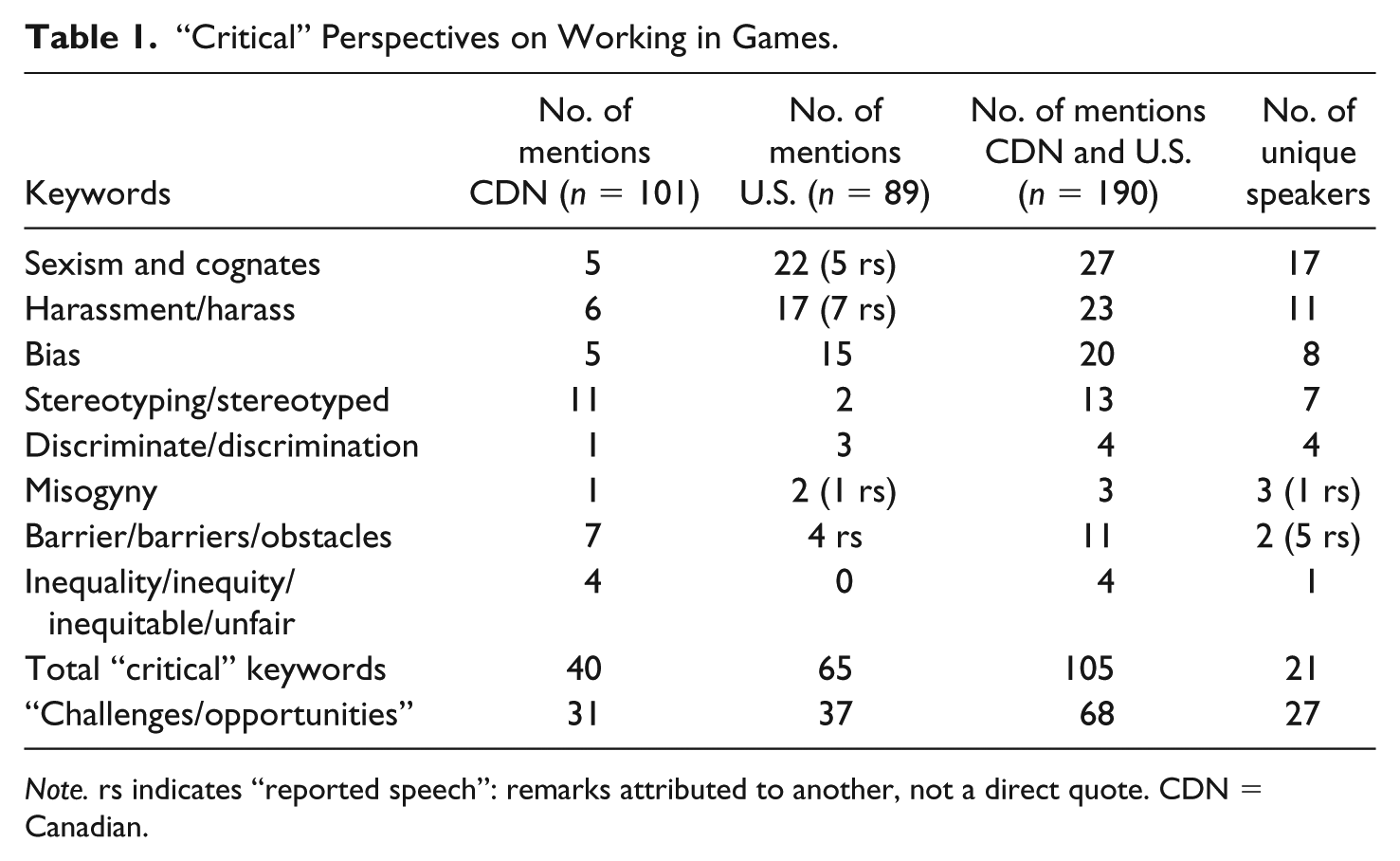
Note. rs indicates “reported speech”: remarks attributed to another, not a direct quote. CDN = Canadian.
Mentions of Love and/or Passion.

Note. rs indicates “reported speech”: remarks attributed to another, not a direct quote. CDN = Canadian.
The “other” category includes love/passion for math, sciences, software development, arts, computer science, reading, escaping into other worlds, cosplay, dancing, clubs, celebratory environments, others’ work, science fiction, story-telling, managing teams, helping others grow, people, giving interviews, equity, black girl nerds, black women in technology, diversity and representation in gameplay, engagement with culture, biology, how games are experienced as a medium, data and innovative campaigns, and programming.
Accounting Patterns
Counting the incidence of a set of terms is not in and of itself especially meaningful—if it were, we could readily conclude that women working in games today have few concerns or criticisms and that their optimism, enthusiasm, and enjoyment of the work they do far outweighs those dissatisfactions they might have. Raw data become findings only as data are interpretively analyzed and empirically supported—and ours is an admittedly “catch-as-catch-can” sample. The texts we are working from reside in the public domain, accounts women have given in full knowledge that they will or can be made public, including to their colleagues and employers. When we use keywords to search for patterns in those texts regarding who speaks, and in what ways, about their experiences working in the industry, it is therefore particularly important to ask who does not speak and what is not said, and why. This allows us to consider women’s discursive decisions as strategic ones about what and how to speak publicly of their workplace experiences.
Of the 190 women in games in our initial sample, we were able to find at least some public comment, however brief, on their experience working in the industry for ninety-four of them. In total, we had thirty-three such accounts from women working in Canada, and sixty-one from women working in the United States. The analysis that follows is based on this sample, which, while relatively small, is larger than any we could have mustered through more orthodox methods, and it will grow over time as we continue to search and add virtual informants to our database in this ongoing project.
Critical Accounts
Table 1 shows the set of keywords we used to identify accounts likely to be on the “critical” end of the continuum, and their frequency of use in the Canadian, US, and combined samples. After compiling all incidences of each keyword, we extracted the passages in which it appeared for semantic context and created analytical summaries of women’s uses of each of those eight terms. Examples are summarized and contextualized next.
Inequality/Inequity/Inequitable/Unfair
There were just four mentions of “inequality” in the Canadian sample, and the only woman in our sample speaking explicitly about inequality in talks, interviews, and blogs (2011–2012) did so in arguing that women in games initiatives are inspired by inequality but only address its symptoms and not inequality’s systemic basis, that perceived differences are irrelevant to abilities yet account for much of the industry’s inequality, and that women in games initiatives work as “pressure release valves” or “band aids” but do not address the problem.
In our U.S. sample, we did not find the terms “inequality/inequity/inequitable/unfair” used by anyone. Given the frequency of these terms’ occurrence in academic research concerned with women in games (Harvey and Fisher 2013; Jenson and de Castell 2017; Kafai et al. 2017), their negligible use in women’s public speech speaks to the distances and differences between discourses within academy and industry, raising questions about how we might bridge them, so as to support one another to better effect.
Bias
In the Canadian sample, of five mentions of “bias” (by two unique speakers), three out of five referenced “unconscious bias.” Of fifteen mentions (by six unique speakers) of “bias” in the U.S. sample, seven out of fifteen characterize bias as “unconscious”; five out of fifteen speak about “cognitive bias”; and of the remaining three, one spoke of bias as a judgment placed on talk about diversity, as never being conspicuous or conclusive enough to mention, and as “based on silly things like colour or gender.” Largely, then, for both groups, “bias” was not used to refer to a form of unjustified discrimination, but to a mistake, an oversight, or an unwitting habit that was based on “silly” things; this was the nature of its use in seventeen out of twenty instances. In functional terms, this use of the term “bias” renders its operation in discourse that of “raising in order to dismiss,” something we have elsewhere observed as characteristic of references to gender in games and much other research (Jenson and de Castell 2010).
Barriers? or “Challenges”?
Alongside more aversively toned “critical” comments were almost as many “positively” toned invocations of “challenges” and “opportunities.” In fact, women’s uses of all eight “negative” keywords combined totaled 105, by twenty-one unique speakers. By contrast, just two “positive” terms—“challenges” and “opportunities”—were used sixty-eight times by twenty-seven unique speakers, with “opportunity” (the more positive of the two terms) used twice as often as “challenges.” Compared with their semantic counterparts, very few (eleven) references are made to “barriers” and “obstacles,” of which five are reported speech, talking about someone else, and not about oneself. A recent example is Kotaku’s third-person coverage of women’s experiences, which is strikingly different in tone and content from what women themselves say about their own experiences (D’Anastasio 2018). Of only four mentions in the U.S. sample, all were reported speech, and three of the four were, rhetorically speaking, raised to dismiss the issue: “inevitable” (in the film industry), “felt no barriers,” and “don’t talk obstacles, talk opportunities.” In just one case was this term’s use followed by substantive examples of obstacles women in tech fields face: “lack of exposure, lack of support and lack of understanding.” In sum, there is a lot more talking about talking critically, than there is critical talk.
Positive Accounts
I can say, I have experienced the absolute worst harassment a person can experience, and I’m still here. I love my job, and I love the game industry . . . (Wu 2016)
Detailed analytical work identified specific ways uses of “negative” terminology were systematically mitigated and strategically diverted, or “translated,” into positive terms. We found it similarly remarkable how often the words “love” and “passion” were used, all things considered. These “positive” terms were differently inflected, and we further analyzed affectional declarations by reference to their specific objects; Table 2 identifies and enumerates those uses. Analyzing uses of the words “love” and “passion” as rhetorical devices, we ask what kind of work invocations of love and passion do in women’s public speech about working in games. If critical terms are less frequent, and raised primarily to dismiss critique, what functions are affectively positive terms like love and passion performing in public speech? Although, on the surface, the “other” category might not seem to have much significance, it is quite telling of the ways women frame their public speech. Expressions of love work to build alignment between the speaker and the hearer. Many of the “other” loves are of things/activities stereotypically associated with masculinity (e.g., math, programming, science fiction, etc.). This kind of talk greases the wheels of opposition for women whose presence in game culture writ large is often under question. The recurrent use of love and passion also highlights how women are encouraged to frame their experiences in terms of feelings (Tokumitso 2014).
When Love Is Not Enough
The most frequent invocation was of “loving” games, which, while it might well be true, functions no less as a rhetorical means of claiming authority and rationalizing one’s rightful presence in game-making spaces. That makes sense given how hard it is for women to feel they have a “place” in the games industry—understandable enough when only about one-in-ten colleagues are women. Not only do women frequently point out that they love games, but several point out that games have been important to them far longer than their job(s) making them.
Sometimes, though, love is not enough: Kari Toyama (2017, 149) says, “. . . even with the great mentorship and guidance I had from my team, and my passion for the projects, I was still never even considered for a permanent position [at Microsoft].” Karisma Williams (2017, 52) speaks even more directly about an unintended outcome of her passion: “One thing I have learned is people will often misinterpret my passion for delivering high quality for being negative.”
Although making games because you love them makes for a logical career choice, there is also a problematic undertone to many of the ways love/passion is talked about. The eagerness of those looking to break into games, coupled with a discourse that lauds love/passion for your work, enables exploitative relationships that can result from a passion-based job—particularly as industry moves toward temporary and flexible employment. Speaking from a hypothetical employers’ perspective, Ann Lemay says, “we don’t have to pay them as much, they’ll work for the passion” (cited in Serrels 2015). Thirteen women talked about loving their work despite serious obstacles, speaking to the tension between pursuing a career in making games because you love them and the costs of doing so. Anna Megill says, “Yes, there’s harassment and ugliness, but the industry is also full of creative, brilliant, passionate people. We all share a love of games. Don’t let bullies stop you from being part of that” (cited in Fissenden 2014). So, while love and passion for games is in one sense a lure for people to pursue game-making, it can simultaneously be the means through which women are exploited and subjected to hostile work conditions.
Results and Next Steps?
Coming to terms with what we see from this initial and exploratory study of what women in games have said “in public” about their working conditions and experiences, conclusions must be correspondingly tentative and provisional. Even so, at a time when self-presentation, self-expression, self-branding, and self-marketing are the order of the day, what is striking is who speaks in public and how, and who does not speak, and why. The short answer is, it is painful and dangerous. Of the 190 women whose “public voices” we sought out, for ninety-six (51%), we could find no such public statements. Looking for a relationship between seniority/precarity and voice/silence, we found fifteen years average games industry experience for women who commented versus twelve years for those who did not. A preliminary analysis of job type and experience suggests that this is a sample of the most accomplished and successful women in games, who have mastered a specialized discourse, a “professional language” with its own distinguishing idioms and rhetorics. Making meaning of this specialist discourse means listening for what is not said, seeing how silences are structured through, to borrow from Habermas (1970), the “systematic distortions” of communication identifiable in these samples of public speech. Identifying key lexical terms and discursive tactics, distinguishing “negative” from “positive” utterances and excavating from linguistic literalness a deeper sense of its strategic deployment, it becomes clear that women in games are far from feeling any “permission to speak freely,” both uses and meanings of their linguistic utterances being indirect, suggestive, and very, very careful. When women are one-tenth of a workforce, and that workforce has a long tradition of exclusion, marginalization, and hostility toward women, it is little wonder. As Rosalind Gill (2014, 511) has remarked, it is through such discourses and practices of power that “gender inequality has become if not unspeakable, then extremely difficult to voice.”
#MeToo
People keep asking when games is going to have its MeToo moment—why more men in the game industry aren’t getting outed as harassers. It’s because women in games generally have even less power and security than actresses. For the most part, we can’t afford to name abusive men. (Jessica Price @Delafina777 Jan 18, 2018, fired by ArenaNet, July 2018)
Recent years have seen a tremendous groundswell of support for the women (and, as we are learning, at times also men) who have been coerced and silenced, sexually exploited, economically discriminated against, professionally sanctioned, punished, and excluded by powerful men in Hollywood and other entertainment institutions. Whether this recent public hunger for gender equality will extend beyond the constellation of the beautiful, rich, and famous fetishized for mass consumption remains to be seen, but it is certainly true that the games industry (no less than the academy, one might add) remains very far indeed from realizing its #MeToo moment.
Meanwhile, the exploitation and silencing keenly denounced via #MeToo carries on relatively unscathed in the games industry, where what women have to say about it must be decoded before it can be heard and understood. This article offers an initial foray into that project of deciphering. And although there is much more yet to be done, this is the only compilation we know of publicly expressed perspectives of women involved in game development. We hope it offers a small new “tool to think with,” in the form of a dynamic database for querying specific patterns: the relationships between who speaks, especially who speaks critically, and relative professional security/seniority versus precarity of employment; the impact that events like #GamerGate have had on what and how women have spoken about working in games; entry points for women, whether through formal educational programs or informal routes, that can inform educational policy and program reform; and the specific discursive deformations that constrain and regulate women’s ability to speak about their experiences. Understanding what public speech by women in games tells us about work in that industry means calling out its material conditions and consequences, its props and prohibitions, its politics of speech. 1 Identifying persistent “silences,” the recurrent structures and rhetorical strategies that control, divert, mute, and suppress critical accounts by women of their experiences is a small first step toward creating interventions, policies, and practices that support women in games for whom, by now, enough really is enough.
Footnotes
Declaration of Conflicting Interests
The authors declared no potential conflicts of interest with respect to the research, authorship, and/or publication of this article.
Funding
The authors disclosed receipt of the following financial support for the research, authorship, and/or publication of this article: This study was supported by REFIG (Refiguring Innovation in Games), a feminist research network funded by the Social Sciences and Humanities Research Council of Canada project.
