



Abstract
In the context of Netflix’s rapid expansion in European markets and its growing investments in original content, this article conducts a comparative case study analysis of Netflix offerings and investment strategies in four European Union countries: Belgium, Romania, Spain, and Sweden. A first aim of the article is to establish the extent to which offerings in these markets confirm or reshape the findings of transnational flow studies on the imbalance of content supply. A second aim is to analyze how these offerings reflect the platform’s investment strategies in the different markets. Although findings point to increased diversity in catalog composition, as well as growing investments in European works, Netflix also reconfirms and contributes to existing power imbalances between markets. US content dominates the four European catalogs, while investments in European original content considerably favor strong media markets over weaker ones.
Introduction
The last decade has seen media delivery significantly shift toward linear-delayed and subscription-based viewing, particularly on over-the-top platforms (Lotz 2019). Among these platforms, Netflix has become the “world’s leading curated video entertainment service” (Lotz 2020, 1, emphasis in original). Not only has the company expanded into a global player, but it has also been heavily investing in original content, developing into a “tech-media hybrid” (Fagerjord and Kueng 2019) that has proven challenging to regulate, as well as thoroughly research. This has been particularly important in the context of the escalating “streaming wars” between powerful platforms, as high-quality, exclusive offerings are used both to attract new subscribers around the globe, but also to keep existing users on the platform (Evens and Donders 2018).
The high market shares that companies such as Netflix and Amazon hold in Europe (EAO 2020b) have been a constant reminder of the decades-old US dominance in the audio-visual industries (Chalaby 2006). Netflix’s presence on the European market has increased financing fragmentation, redefined the territorial pre-sale model, shifted release windows, and contested the content exclusivity of broadcasters (Doyle 2016). Moreover, European broadcasters are faced with financial difficulties brought on by cutbacks and decreasing ad-revenues due to competition from global platforms (EAO 2020b).
Although recent years have seen a surge in media and communication research focused on the platform, Netflix still raises numerous questions. Relevant to this article is Netflix’s ambiguous position between a dominating US platform, and its role in increasing content diversity through its transnational offerings. As the analysis focuses on Netflix’s presence in Europe, the article builds on discussions about the rise of platforms and the market challenges associated with them (Evens and Donders 2018), as well as power imbalances in the transnational flow of audio-visual content (Guback 1969; Sinclair et al. 2002).
By taking a closer look at Netflix’s presence in four different European markets, the article aims to establish the extent to which Netflix offerings in European Union (EU) markets confirm or reshape the findings of previous flow studies on the imbalance of content supply; and to analyze how these offerings reflect the platform’s investment strategies in the different markets. The article takes the form of a comparative case study analysis (Esser 2019) of Netflix catalogs in four EU countries: Belgium, Romania, Spain, and Sweden, framed by theories on transnational flows of audio-visual content and platform power. The analysis follows a number of key parameters for the catalog offerings: number of records, country of origin, language, and genre, consolidated by the type and volume of investments made in each of the four markets.
Of Flows and Platforms
Transnational Flows
The case of Netflix will first be framed by the decades-old critical political economy of communication discussions on media imperialism, which focus on elements of power and economic domination that extend into the cultural domain (Guback 1969; Hamelink 1983; Sinclair et al. 2002). Although export power has not been proven to translate directly into cultural domination (Lobato 2019), the imperialistic character of the media remains relevant in researching shifts in global capitalism (Fuchs 2010). In this context, power imbalances, the fight for market dominance, ownership concentration, and the established tensions between protectionism and cultural diversity have all been brought back into focus by global tech-media giants (Cunningham and Silver 2013; Flew et al. 2016; Lobato 2018). Discussions framed by television studies contribute to our analysis, both in identifying elements of continuation with legacy media (see Dhoest and Simons 2016; Jenner 2018; Wolff 2017) and weighing the potential influence Netflix’s investment strategies may have on European media markets (see Lotz 2019; Petruska and Woods 2019).
Over-the-top providers do not entirely break away from certain traits of legacy media distribution channels but rather bring incremental changes, as digital television has been said to follow the same developmental path and effects as satellite television had during the debates on media imperialism. Lobato applies Williams’ (1975) predictions about satellite television to over-the-top distribution, particularly in its reinforcement of existing forms of industrial and geopolitical power, fear of cultural penetration, the weakening of the nation-state, the lack of domestic content, and the ongoing privatization of public institutions (Lobato 2019, 48-50). Subscription video-on-demand (SVOD) platforms such as Netflix reinforce the theme of continuity with television studies, as their offer promotes the same type of passive viewing and narrative entertainment (Wolff 2017). Moreover, large global platforms are expected to promote similar Hollywood productions as previous popular television channels (Smits and Nikdel 2019), while local public and pay-TV channels continue to offer domestic content (Lobato 2019).
Companies such as Netflix continue to facilitate the distribution of US content to the European continent and are believed to offer little to no financial support to local markets, and limited attention to cultural diversity. This is particularly relevant as it has been pointed out in previous literature that distribution was always at the core of reinforcing US dominance in the media industries (Hesmondhalgh 2013). This is enhanced by fierce competition for exports with big budget productions, as well as limited intra-European circulation, due to fragmentation determined by borders, market size, export capacity, cultural specificities, and language diversity (Bondebjerg et al. 2017), as well as territory-by-territory licensing, overproduction, and weak marketing campaigns (Szczepanik 2020, 161).
Platform Power
Alongside theories that underline the continuation with the past, studies on digital television have focused on the novel elements. The transition to new ways of distributing and consuming audio-visual content has provided viewers with a wider array of audio-visual content, and has “supposedly created more choice, control and convenience in the process” (Evens and Donders 2018, 51). Alongside the distinctive viewing experience, Netflix distinguished itself through a business model built on subscriber-funding and global reach (Lotz 2019), as well as algorithms and data analytics (Jenner 2018). Platform power also comes from the expansion of economies of scale and scope, supported by the lack of certain physical limitations (Ranaivoson 2019), as well as a financially profitable position in the value chain, as returns in distribution and services are significantly higher than in production and aggregation (Evens and Donders 2018, 117).
Netflix entered the European market in 2012 and expanded rapidly throughout the continent. As research has shown, various forms of localization have historically been a key element in achieving and sustaining success in foreign markets (Chalaby 2006). The importance of local content and geo-linguistic markets (Straubhaar 2007) has not been underestimated by Netflix, which has been heavily investing in original content produced outside of the US. A significant element of change with past distribution channels is Netflix’s investment model, which is based on user preferences and big data analytics, with a focus on market specificities (Shattuc 2020).
Original European content has also received growing investments from the platform, with more and more titles announced for the coming year (Thomson 2020). Defining the Netflix Original has not been an easy task, as the company has been continuously diversifying its strategies (Afilipoaie et al. In press; Petruska and Woods 2019). Four types of investments have been identified in the European markets: (1) licensed originals, (2) continuation deals, (3) co-production/co-financing deals, and (4) “full Netflix Originals,” which are produced and financed entirely by the platform for exclusive rights (Afilipoaie et al. In press). A notable trend is the move from acquiring content or co-producing with European broadcasters, to investing in its own exclusive original content, which has not only led to independence from other content producers, but also to a large and more diverse offering.
Methodology
The core aim of the paper is to examine Netflix’s transnational process across different contexts (Livingstone 2003, 479), through conducting a small-N comparative case study analysis (Esser 2019) of the Netflix offerings and investment strategies in four EU markets. Comparative research “attempts to reach conclusions beyond single systems or cultures and explains differences and similarities between objects of analysis against the backdrop of their contextual conditions” (Esser and Hanitzsch 2012, 5). First of all, the study aims to discuss to what extent Netflix offerings in EU markets confirm or reshape the findings of previous flow studies on the imbalance of content supply. Secondly, the study researches how these findings reflect Netflix’s investment strategies in the different markets.
The design takes the form of Most Similar Systems–Different Outcome (Przeworski and Teune 1982), with the Netflix catalog as unit of comparison. The case study will be framed by four national contexts: Belgium, Romania, Spain, and Sweden. The comparison builds, firstly, on the catalog offerings and the differences between them; and secondly, the different investment strategies in terms of market specificities. The first line of enquiry follows a series of parameters that have been previously used in landmark flow studies (see Iordache et al. 2018): number of records, country of origin, language, and genre. The second will focus on the available Netflix original productions in each of the markets analyzed. The national context is instrumental in framing and explaining these differences, by focusing on the characteristics of the market, elements of media regulation, SVOD and Netflix user penetration, and Netflix investments in the market.
Due to challenges in data collection, such as restrictions in systematizing and accessing the Netflix catalog, data were collected on 7 April 2020 by using a web scraping program on third-party sources. The Unofficial Netflix Online Global Search (UNOGS.com) provided the list of titles in each country catalog, while the Internet Movie Database (IMDb.com) was used for information on year of release, country of origin, language, type (film/series), and genre. Additional sources were used for information on “Netflix Originals” and market strategies, including: the Netflix website and media center, webpages of the film/series or production company, policy documents, industry reports, and media articles.
National Contexts
Netflix provides catalogs that are specifically curated and made available within nation-state boundaries, restricted by territorial licensing, geo-blocking regulations, and cultural preferences, confirming the more accurate description of “multinational television” (Lobato 2019), rather than the “global TV network” it brands itself as. The four countries were chosen in order to contextualize and explain some of the variances between Netflix offerings in the EU. As differentiating between population sizes was insufficient (Hallin 2009), based on previous research (Brüggemann et al. 2014; Hallin and Mancini 2012; Herrero et al. 2017), other factors were considered, such as historical and political characteristics, the strength of the media market and that of the public service broadcaster, the level of SVOD and Netflix user penetration, and the platform’s collaborations with existing market players (Figure 1).
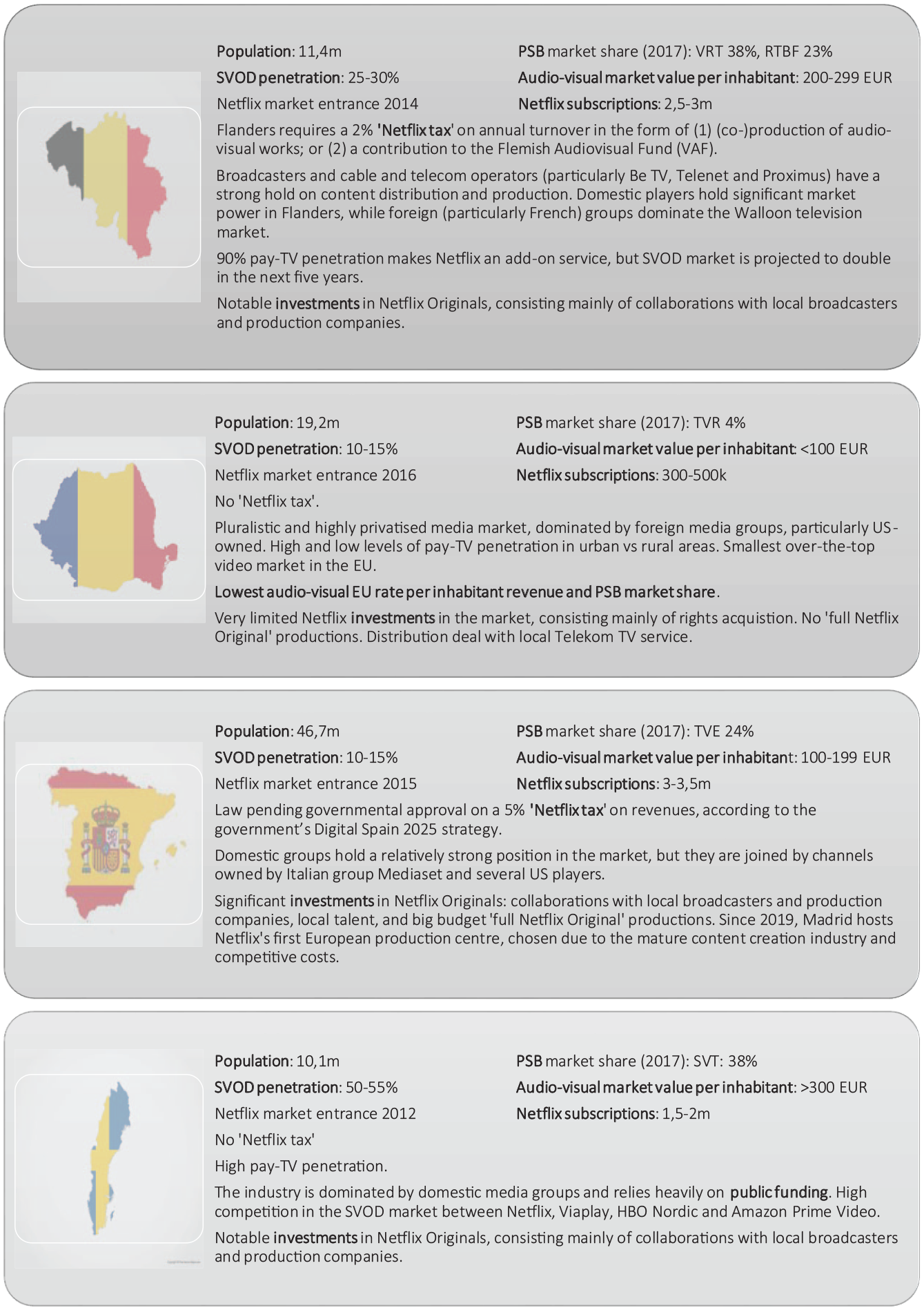
Author’s development, based on: Netflix, Eurostat, EBU, European Audiovisual Observatory, PwC, Comparitech, Mediavision, Statbel, Global Internet TV Consortium, imec.digimeter, Initiative Media, the Romanian National Authority for Management and Regulation in Communications.
Spain represents one of the largest European media markets, with high levels of production and exports, particularly for series (EAO 2020b). Local content continues to hold high market shares, and Netflix has joined this trend by investing heavily in Spanish originals (Castro and Cascajosa 2020).
Belgium is a small market in terms of population, but a well-developed one in the audio-visual sector. The country’s complex political structure creates distinct media industries with linguistic and market specificities. Locally produced content holds a high market share in the country, particularly in the Dutch-speaking region of Flanders, as does the Flemish public service broadcaster VRT. The predominantly French-speaking communities of Wallonia and Brussels are more impacted by large culturally proximate neighbor France, whose channels hold a significant audience share (Schneeberger 2019, 37).
The strong Swedish market is characterized by democratic-corporatist co-regulation and a relatively high degree of program diversity, as well as a strong and well-funded public service broadcaster (Lund and Berg 2009). The region has also experienced fast-growing SVOD revenues, and increasing cord cutting (EAO 2020b, 56), a situation that Netflix has played a significant part in, having entered the Nordic markets early and consistently invested in original productions since.
Romania is the obvious outlier in the group. The industry does not benefit from strong production houses and distribution networks, and is characterized, as other post-socialist media systems, by lags in the professionalization and internationalization of independent producers. Known for award-winning arthouse films, Romanian cinema is highly auteurist in making and marketing, primarily festival-oriented, with very little appeal to local audiences and an incoherent media support toolkit (Parvulescu and Hanzlík 2020). Series are produced primarily by private broadcasters exclusively for their own channels. Before Netflix’s arrival, HBO had already been collaborating with production houses and distributors in the region for several years (Szczepanik 2020, 174).
Four Markets. . . Four Platforms?
Number of Records
A first interesting finding is that the four catalogs are of different sizes, the Romanian catalog consisting of significantly more titles (5,126) than the ones of Belgium (4,409), Spain (3,899), and Sweden (3,829) (Figure 2). When looking at the titles themselves, the majority of them overlap, as 2,851 titles are present in all four catalogs (Figure 3), while 2,602 titles are unique to only one catalog, almost half of them in the Romanian catalog (1,294). This points to different strategies that Netflix applies in different markets. First, Netflix does not always aim to secure global distribution rights for all of the content it acquires, and territory-based licensing can prove beneficial for the platform, particularly when it comes to back-catalog content that secures high volumes for low prices (Aguiar and Waldfogel 2018). Licensing has also become more problematic due to increasing competition from local broadcasters setting up their own VOD platforms, as well as Netflix’s streaming rivals who are striving for content exclusivity (Ene 2020). Due to this, Netflix may reduce its content to more appealing or relevant content acquisitions in stronger, more competitive markets. Furthermore, the choice of content is also based on local cultural preferences. These factors account for the additional titles in the Romanian catalog, as discussed further in the Country of origin and Genre sections.

Type of production in number of records by country catalog: film or series (left) and single or multiple production countries (right).
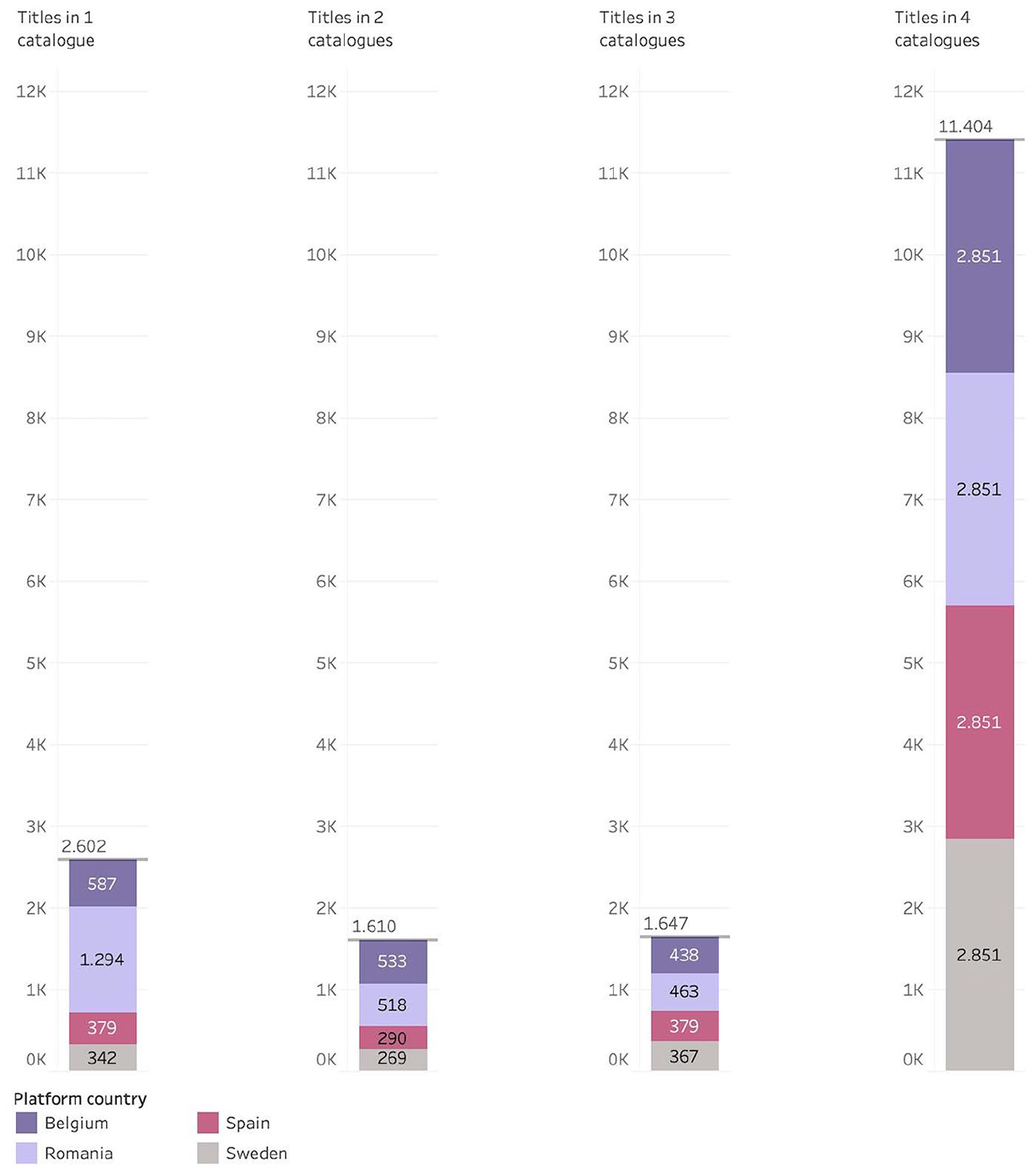
Number of titles that are present in one or more catalogs, from left to right: number of unique titles in each catalog, number of titles present in two of the four catalogs, number of titles present in three of the four catalogs, and number of titles present in all catalogs.
All catalogs primarily consist of single productions, rather than co-productions (Figure 2). This can already limit the available European content, as television studies have shown that co-production and co-financing deals have been preferred by broadcasters and Pay-TV players as a way to overcome the structural constraints of small markets, which represent a majority in the EU (Hammett-Jamart et al. 2018) and reach higher budgets and top quality (EAO 2020b, 7, 12).
Country of Origin
The four catalogs contain titles from seventy-eight different countries of origin, the Romanian catalog being slightly more diverse, with titles from seventy-four majority production countries, also due to the larger number of records, compared to Belgium and Spain (seventy-one), and Sweden (sixty-eight). However, regardless of this seemingly diverse pool, there is a clear dominance of US content, which represents over a third of each catalog as first country of origin. Not only is the representation of US content overwhelming, but it is complemented by additional strong presences from the English-speaking “global North,” such as UK, Canada, and Australia.
Interesting differences occur when comparing the volume of a country of origin as first production country—or majority production country—and as minority co-producing/co-financing partner. Figure 4 shows a significant increase in representation through the addition of minority productions for countries such as Belgium (69%), Germany (56%), Canada (50%), Sweden (44%), and France (38%). This confirms established patterns, as they are countries known for transnational collaborations and involvement in co-productions (Bondebjerg et al. 2017; EAO 2017; Hammett-Jamart et al. 2018). Although the US sees an increase of “only” 12%, this is still significant when considering the absolute numbers, consisting of 1,060 additional titles as co-producer. At the other end of the spectrum, we also find a limited involvement in co-production projects, namely only 6% more titles for South Korea, and 5% for India. Romania also contributes with only an additional 8% of minority titles, but this is insignificant, considering the very small total number of productions, both as majority and minority producer.
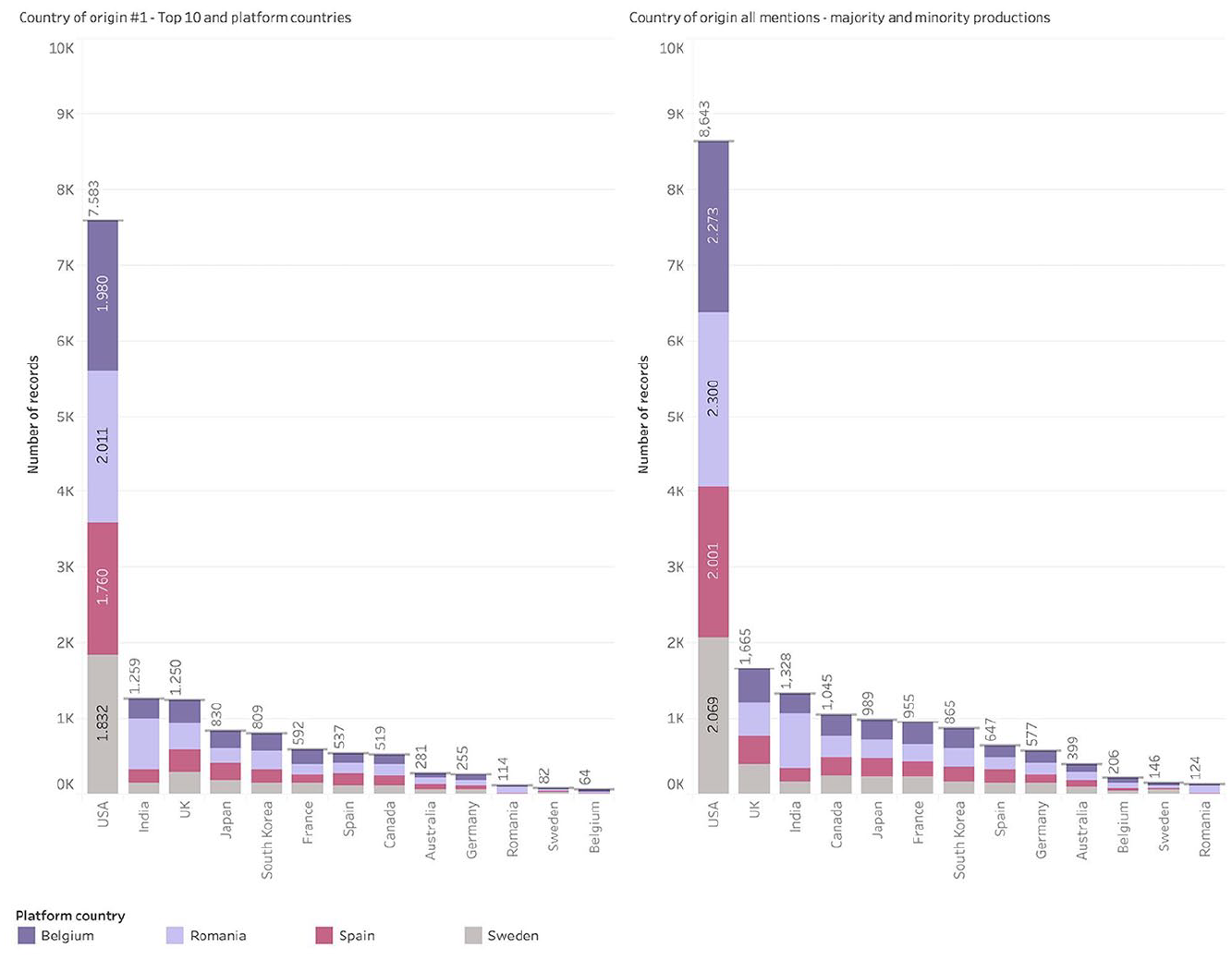
Country of origin representation in top ten country of origin and catalog countries: majority productions (left), all mentions of country of origin—majority and minority productions (right).
Large European markets, UK, France, Spain, Germany are rather well represented in all catalogs. This is to be expected in Europe, as they are established content producers and exporters that manage to achieve economies of scale both due to the size and strength of their home-market, as well as produce in languages that are also spoken abroad (Berg 2011). Among the “Big European Five,” Italy has a limited presence in the catalogs; nevertheless, it is a market in which Netflix has also invested in original content (Fumagalli and Braga 2019).
What is striking is the very low representation of national productions, even in the national catalogs, even though Spain, Sweden, and Belgium are among the top production countries in Europe (EAO 2020b, 12). This goes against the importance awarded to the presence of local content in order to reach a foreign market (Chalaby 2006), as well as the way Netflix markets itself as a promoter of local stories (Holland 2019). However, it has been stated that audiences may not even be looking for local stories on Netflix, but rather for Hollywood stories that may not be as easily provided by existing domestic broadcast and pay-TV channels (Lobato 2019, 156).
There is also a limited presence of non-national European productions, which also reconfirms older distribution patterns. Media scholars have previously pointed this out when discussing the effects of satellite television, which instead of enhancing intra-European circulation, led to the strengthening of national and regional markets, both through economic measures of commercialization and competition (Sinclair et al. 2002), and culturally specific elements (Straubhaar 2007; Thussu 2007). Due to this, a series of EU media policies such as encouraging rights acquisition and investing in European content, were particularly focused on strengthening intra-European circulation. However, the high fragmentation determined by borders, market size, export capacity, and cultural specificities continued to create hurdles to the circulation of European works (Bondebjerg et al. 2017; Raats et al. 2018).
The data also show patterns established through the representation of global production “hot spots,” some featured in discussions of global contra-flows (Thussu 2007), such as India, Japan, or South Korea (Dudrah 2012; Iwabuchi 2007; Ju 2020). The Romanian catalog contains a particularly high number of Indian titles, especially when considering the 1,294 titles that are unique to the Romanian catalog, and the large number of them (439) that have India as first production country (Figure 5). This can be explained through historical political reasons, as the former Eastern bloc was closed off to Western imports, including audio-visual products, but welcomed content originating in the East. This included both political content with strong propaganda character, but also what was considered to be “harmless,” non-political content, such as Bollywood films, which were popular with former Soviet audiences (Rajagopalan 2008; Roy 2012). Japan and South Korea also continue to be strong exporters of content, particularly in certain genres, such as animation (Iwabuchi 1998) and romance series (Ju 2020), respectively.
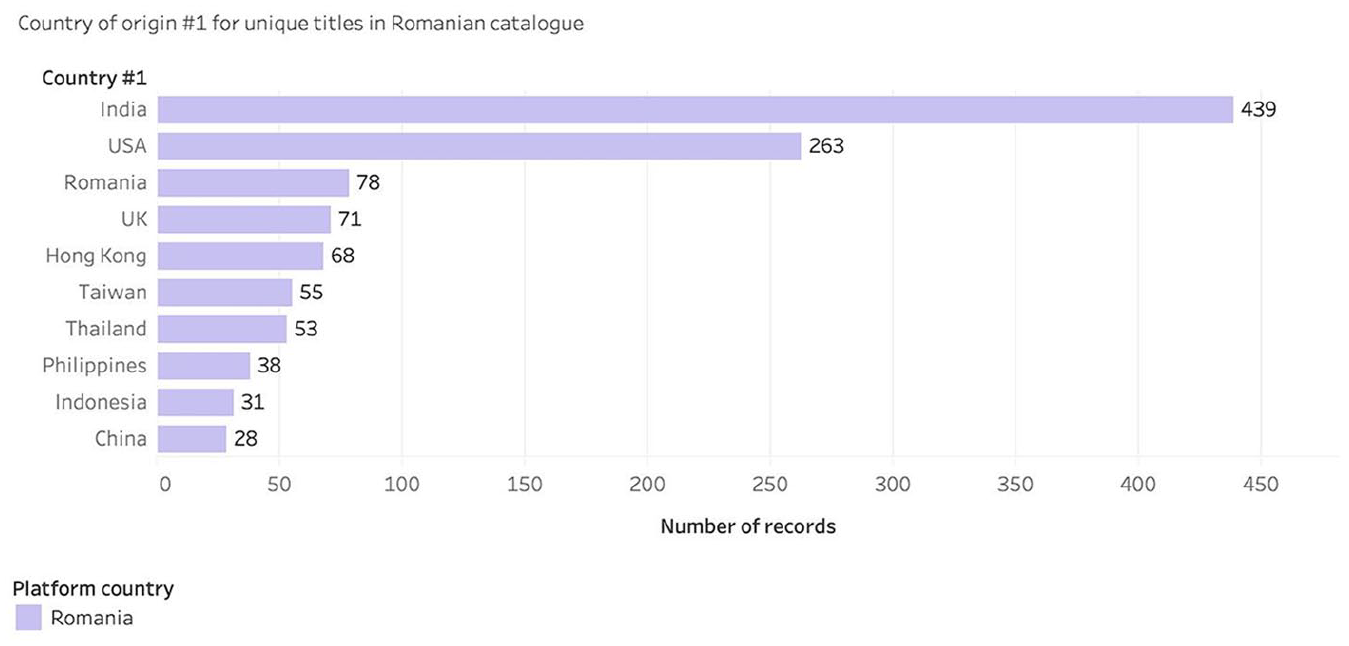
First country of origin for unique titles in the Romanian catalog.
Language
The four catalogs consist of titles in eighty-two languages, labeled as first language of production. Although some of these may somewhat overlap (e.g., Dutch and Flemish), the diversity per catalog follows the same pattern as that of first country of origin, with the Romanian catalog consisting of the widest diversity, with seventy-six different languages, followed by Belgium and Sweden with sixty-five, and Spain with sixty-three.
English remains the “language of advantage” (Collins 1989) in all catalogs (Figure 6), supported both by the volume of English-speaking production countries, the US, UK, Canada, and Australia, but also by the higher potential for export for productions in English, even when they are produced by non-English speaking countries which choose to “delocalize” their content in order to make it more appealing for foreign audiences (see Straubhaar 2007).
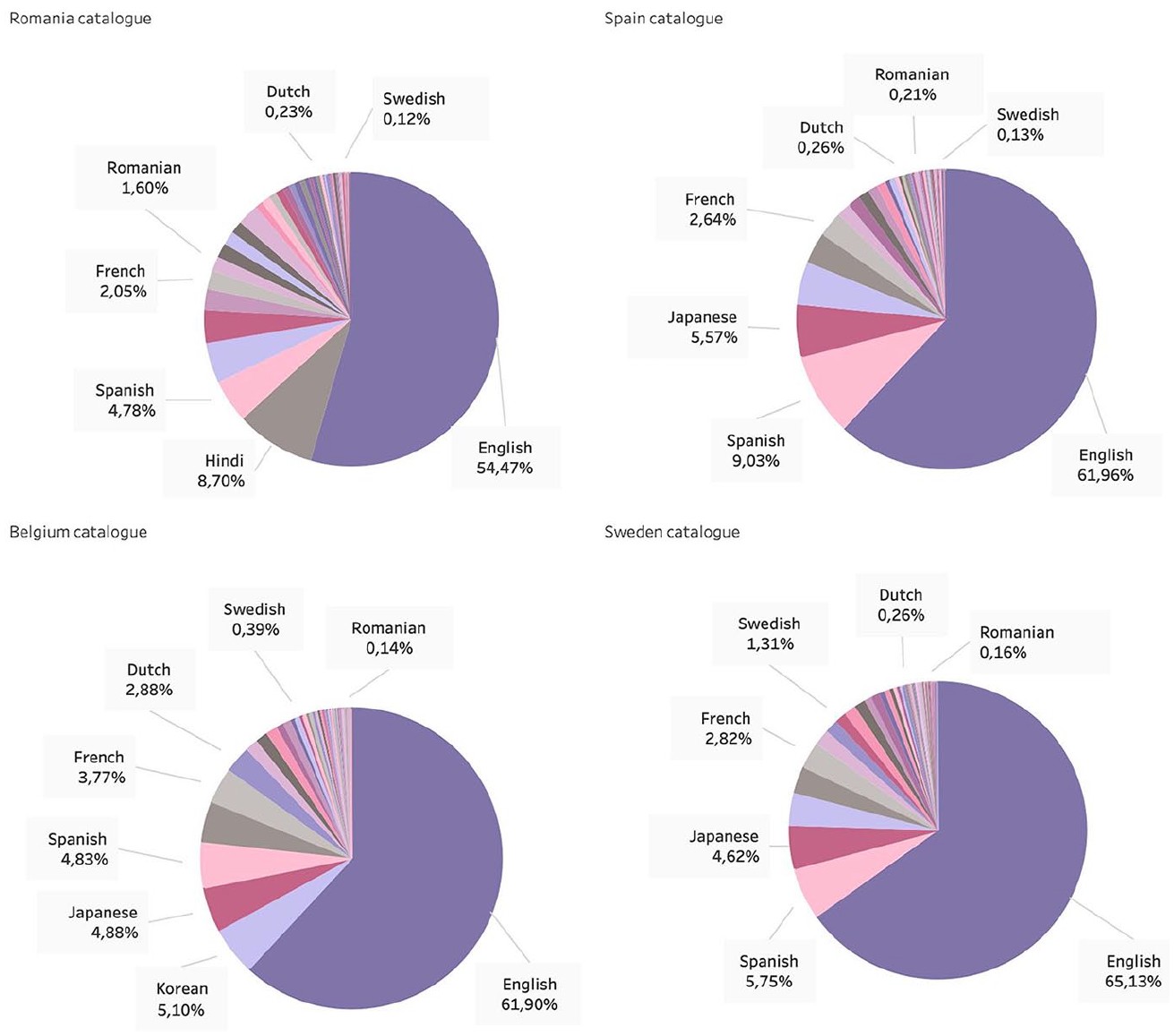
First language of production: top three languages and the local catalog languages.
The low representation of national languages in each catalog reconfirms the findings in the previous section. Although Spanish is the second most encountered language in the Spanish catalog, it only represents 9% of productions, compared to almost 62% of English-language content. Hindi is the second most present language in the Romanian catalog, which is not surprising considering the high volume of Indian content in the catalog. Korean takes up second place in the Belgian catalog, however that is only with 5.1%, while the local French and Dutch/Flemish amount to under 7%, which is minimal, especially considering the general output of French-language content.
Genre
The exact volume of different genres is more difficult to assess than other parameters, as most overlap and each title generally falls into more than one genre category. Nevertheless, based on the available data, twenty-one categories were created to include all available titles, and each production was placed within at least one category (Figure 7).
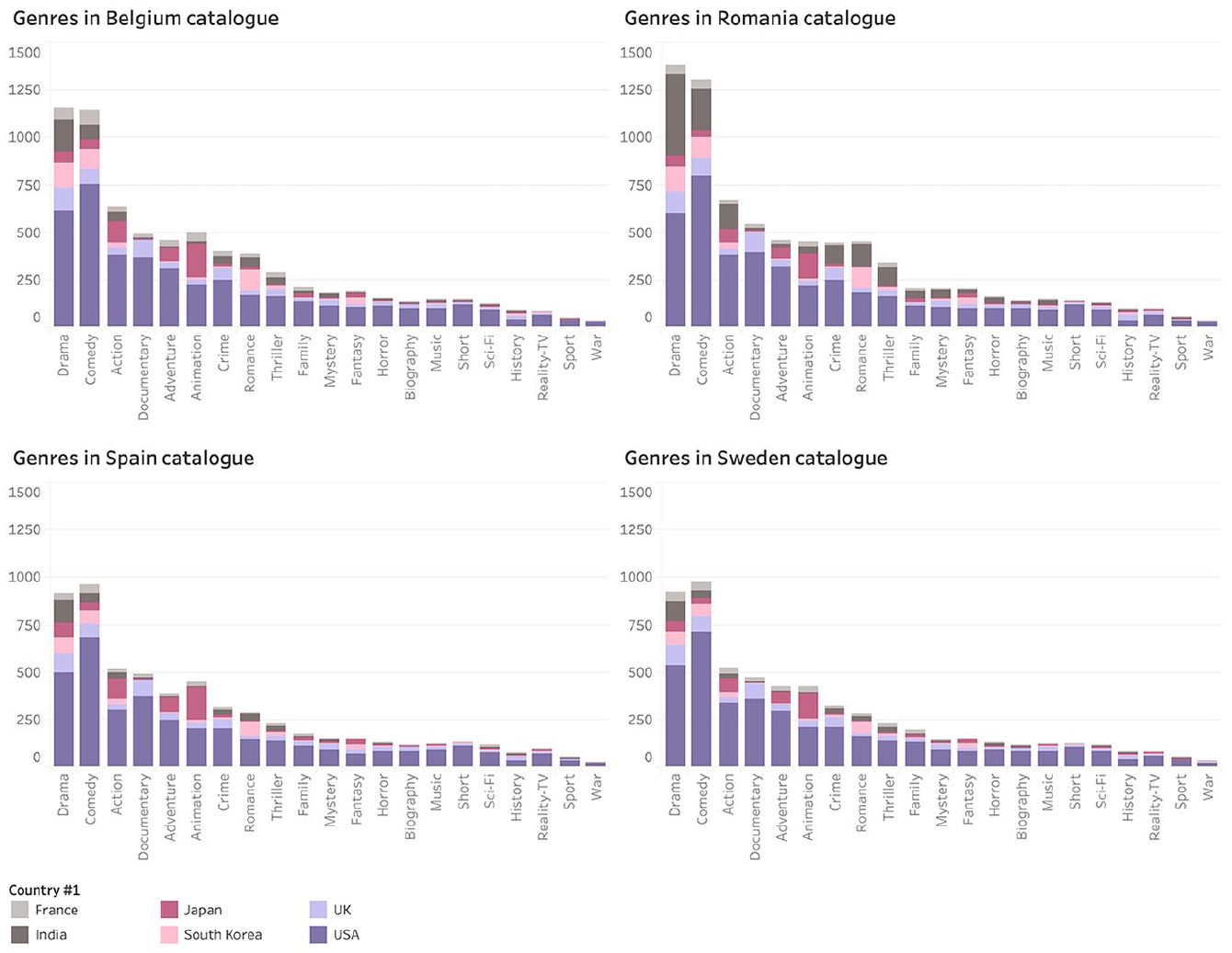
Genre representation per catalog, by first country of origin.
Drama is one of the most popular genres, particularly in the Belgian and Romanian catalogs, and is often linked to the genres of crime and history. In Europe, the UK remains a strong producer and exporter of drama series (EAO 2020b). The genre has been extensively discussed in European television studies (Bondebjerg et al. 2017; McElroy and Noonan 2019; Raats and Iordache 2020; Redvall 2013), as it is a popular, but also risky and expensive genre to produce. Drama has also been popular with online platforms, as the genre’s episodic nature keeps audiences on the platform, while enhancing the value proposition of subscription services through distinctive content (McElroy and Noonan 2019, 29-30. Nevertheless, this analysis primarily applies to European “high-end” television drama (Nelson 2013), and possibly less so to content that is cheaper for Netflix to acquire, such as Indian (romance-)drama, which is also well represented, particularly in the Romanian catalog.
The findings also point to a high number of comedy titles. This is somewhat surprising considering previous discussions in television studies pointing to comedy as a genre that does not travel easily, due to its strong cultural specificity (Raats et al. 2018). However, 2,958 of the total comedy titles—which also represents most titles in one genre—are US productions; so, this may be explained through the label of the US as the world’s “second culture” (Gitlin 2003), which does not point to comedy in general traveling well, but to US comedy in particular. Many of the comedy productions are also hybrid genres, such as comedy-romance and comedy-drama.
According to the data, some of the popular genres also have non-Western/European origins; however, these also follow existing transnational distribution patterns. Japan continues to have a strong presence in animation, which it has established decades ago both in series and film (Iwabuchi 1998, 2007), while South Korea exports notable volumes of romance and comedy-romance series (Ju 2020).
The volume of documentaries is also quite high. Netflix has promoted the genre on its platform, in order to demonstrate its dedication to quality cinema and to distinguish its catalog from the usual television programming (Sharma 2016, 143). The service has also been investing in original documentary productions which seems to be a strategic financial decision, as documentary is cheaper to produce than scripted television, following the economic disparity in linear television between Reality-TV and series (see several contributions in Murray and Ouellette 2004). Although these investments have become audience favorites, they have also contributed to the commercialization of the genre by focusing mainly on global topics that are easy to market and already known (Sharma 2016), and on the increasingly popular sub-genre of true crime (Bruzzi 2016).
Netflix Investments
Out of the total number of records in the database, 4,483 are labeled as Netflix Original, 2,632 of which are series. The large majority of these original titles are present in all four catalogs (Figure 8), while only fifty-seven are unique to one catalog, most of them (twenty-two) in the Romanian catalog, fourteen in Spain and Belgium, and seven in Sweden. Half of all the originals in the database are US majority productions, while the rest originate in fifty-one other countries. The second most represented first production country in Netflix Originals is the UK, however at the much lower rate of 8.6%, while Spain is fourth, at 4.4%. Non-Western originals are primarily from Japan (5%), South Korea (4.1%), and Mexico (1.9%), mostly consisting of series, and India (2%), mostly film. Compared to the overall catalog composition, this does support Netflix’s discourse regarding a surge in foreign investments. The complexity of defining the Netflix Original leaves a gap in analysis, as the weight of the platform’s financial contribution, the nature of its collaborations with local players, and the potential lack of creative involvement would provide a deeper evaluation of the findings. Moreover, this strengthens Jenner’s (2018) notion of the fluidity of transnational television, as the difficulties in defining the “nationality” of a production, already signaled in media research and policy (EAO 2020a), become even more cumbersome through the platform’s diversification of investment strategies.
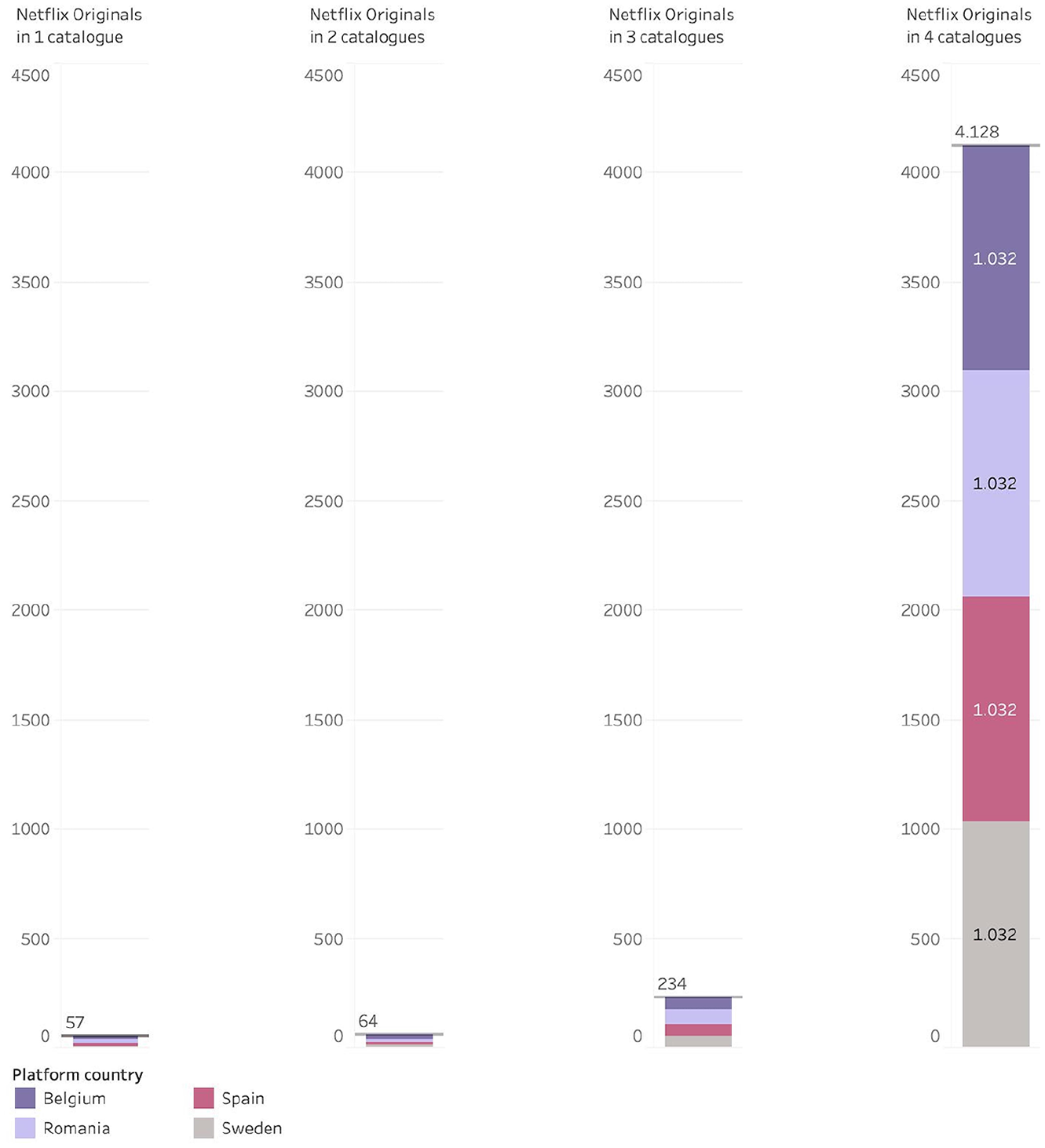
Number of Netflix Originals that are present in one or more catalogs, from left to right: number of unique titles in each catalog, number of titles present in two catalogs, number of titles present in three catalogs, and number of titles present in all four catalogs.
When focusing on the unique original titles produced by the four countries, Spain is the strongest Netflix Original producer, with twenty-six series and twenty-six films as majority producer, to which three series and three films are added as minority producer. It is followed by Belgium with six series and one film as majority producer, plus one more series and sixteen films as minority producer. Sweden has two series and three films as majority producer, plus two series and two films as minority producer. Romania is lagging behind, with only one film as majority producer, and one as minority producer. The differences reflect the development and “attractiveness” of the market for Netflix investments, with a wide discrepancy between large and small media markets (see Berg 2011; Puppis 2009). Spain is not only a large market and strong content producer and exporter—to the rest of Europe and to its geo-linguistic market—but, since 2019, it also hosts the first Netflix European production hub. Spain is one of the first European markets in which Netflix invested in a big budget, flagship production, with Cable Girls (2017–), reported to have had the highest budget allocated to a domestic Spanish production at the time of release (Newbould 2017). In the same year, Netflix picked up the canceled series Money Heist (2017–), which went on to become one of its biggest global hits (Jones 2020).
The first Netflix Original in Sweden was the 2016 co-production The 101-Year Old Man Who Skipped Out on the Bill and Disappeared, followed by a continuation deal for The Bonus Family (2017–), which was originally produced by Swedish broadcaster SVT, and acquired by Netflix in 2017. Sweden only saw its first full Netflix Original in 2019, with the crime teen drama Quicksand (2017–) (Netflix 2018a). On the Belgian market, Netflix acquired license deals for Tabula Rasa (2017–) and Hotel Beau Séjour (2016–), which were streamed as Netflix Originals outside of Belgium. It continued with the co-financing/co-production deal for Undercover (2019–), and in 2019 invested in its first full Netflix Original, Into the Night (2020–) (Netflix 2019). Moreover, the significant number of minority Belgian productions reconfirms the pattern established in television production, where Belgium is one of the top minority producing countries in Europe (Bondebjerg et al. 2017; EAO 2017). Romania is clearly one of the neglected Eastern markets for Netflix, even though the platform has been investing in more developed markets in the region, such as Poland and Russia (Netflix 2018b). And, although the only original Romanian majority production Oh, Ramona! (2019) is available in all four catalogs, the production is not even in Romanian, but in English.
Discussion
Elements of domination have always been at the core of the media imperialism debate, asserting both economic and cultural power. Recent developments in the industry have shifted the focus from notions of cultural domination toward media trade, as US platforms continue to expand into European markets. Our findings reconfirm previous research through the striking domination of English-language content, originating from the “global North,” and specifically from the US. Netflix not only favors US content, but it also pushes its original productions, the majority of which also skew heavily North American. The imbalance is further reinforced when comparing this to the minimal representation of national content, even in developed European markets. On the other hand, the platform continues to diversify its offerings, as well as enhance collaborations with European players. To this end, it is worth signaling the increasing presence of more internationally diverse, as well as local and non-national European content in the Netflix catalogs discussed. There is evidence to suggest that Netflix contributes to the circulation of European content, which should not be understated, in the fragmented EU audio-visual ecosystem (Raats et al. 2018). Moreover, scholars warn against making use of the same binary discussion between indigenous media and US-led media imperialism, due to the fluid nature of transnational television, whose content is made to appeal to both local and global audiences (Jenner 2018, 206). Nevertheless, although a nuancing of previous debates is warranted, the platform’s strong position in Europe continues to pressure the sustainability of smaller markets, and raise concerns of power imbalances, market domination, and ownership concentration.
Through its investments, Netflix also contributes to changes in audio-visual production, as it reinforces imbalances between strong and weak audio-visual markets within the EU. As European broadcasters continue to drive television production, the majority of high-end content originates from public service broadcasters (Fontaines and Pumares 2019). In this context, a weak market such as Romania is of limited interest to Netflix, both in terms of investments in original content and collaboration with local players, which remains difficult and unprofitable for the latter (Szczepanik 2020, 173). Meanwhile, the potential of strong producing markets, particularly Spain and Sweden, has been harnessed by Netflix from the outset, reinforcing intra-European power dynamics. Netflix also donated generously to support the audio-visual industry in Spain, which was severely hit by Covid-19 (Netflix 2020), helping creative workers, but also painting itself as a savior, rather than a threat. At the same time, these markets are better equipped to mitigate Netflix’s presence through local/regional collaborations, such as the Nordic Entertainment Group (NENT) and Nordvision in Sweden, Streamz in Belgium, and Movistar+ and LOVEStv in Spain.
In order to enlarge its market exposure and quickly reach local audiences, Netflix collaborates with local players, mainly by co-producing with local broadcasters and making distribution deals with major telecommunication and pay-TV providers (EAO 2020b). Due to generous production budgets and creative freedom, Netflix also became a tempting partner for local talent and independent producers, bringing financial security to new projects or struggling productions (Castro and Cascajosa 2020). The implications of these collaborations are difficult to assess. On the one hand, independent producers welcome the financial stability and international exposure (Perquy 2019), even though Netflix often gains exclusive rights over these productions, perpetually growing its catalog while denying creators the residual benefits they once received. This can also lead to increased concentration in the market (Ranaivoson 2019), as local players, and particularly smaller ones, are likely to see their audiences diminish. The SVOD segment has already seen a notable transfer of revenues from legacy players to SVOD services (EAO 2020b). To this end, both sides are in search of sustainability: local players are setting up more collaborations, as well as their own streaming platforms with exclusive content; meanwhile, Netflix shifts toward “full Netflix Originals” and is setting up its own production houses on the continent.
In its attempt to level the playing field between powerful US streaming platforms active in European markets, and local or regional players, the 2018 revision of the Audiovisual Media Services Directive imposed a 30% European quota on on-demand audio-visual players, enhanced prominence demands, and allowed Member States to extend investment obligations to on-demand service providers, also when targeting a foreign market. Although there is evidence to suggest that Netflix was already investing in European content before the provisions were implemented (Afilipoaie, In press), they may be relevant in the European expansion of other “Streaming Wars” protagonists.
The method used in the study confirmed certain limitations signaled in literature with regard to compiling and analyzing comprehensive and accurate data from online sources (Lobato 2018; Szczepanik 2020). Although the study attempted to minimize gaps and inaccuracies, the lack of transparent and publicly available data provided by the platform itself continue to be problematic for conducting research on streaming services. The platform’s lack of transparency strengthens its power and market position, as it not only conceals the complexities of the content licensing and investment strategies employed, but it also closely guards the workings of its algorithm-based recommender system, the data it collects on subscribers, and the way these data are used.
Footnotes
Declaration of Conflicting Interests
The author(s) declared no potential conflicts of interest with respect to the research, authorship, and/or publication of this article.
Funding
The author(s) received no financial support for the research, authorship, and/or publication of this article.
