




Abstract
This paper analyses YouTube comments on the viral short “Do NOT Interrupt Our Mukbang!” from the Netflix phenomenon K-pop demon hunters to explore how participatory culture and parasocial interaction intersect in digital fandom. Drawing on 1,798 comments, we show how fans collaboratively construct meaning through humour, insider knowledge, and affective identification with animated idols and the K-pop industry beyond them. Commenters blend discourses of food, fitness, body ideals, and K-Pop industry realities, collapsing boundaries between fiction and reality. These practices illustrate a dual parasociality in which intimacy is projected onto both fictional characters and real-world idols. Through such playful and emotionally charged exchanges, fans transform online commentary into a participatory, interdiscursive space that negotiates identity, belonging, and critique. The analysis highlights how affective engagement and cultural production converge to sustain collective intimacy within transnational K-pop fandoms.
Introduction
In June 2025, the animated film KPop Demon Hunters (KPDH) was released on Netflix and was quick to achieve international commercial and critical success. The two fictional bands in the film (Saja boys and HUNTR/X) surged in popularity with the soundtrack even achieving platinum status. As Elphick (2025) observed, “if you’ve heard anyone mumbling the lyrics ‘my little soda pop’ under their breath, congratulations, you’ve accidentally encountered KPop Demon Hunters.” The film’s reach has expanded across social media through memes and other forms of pop cultural media remixes. One notable meme to emerge from the film is a GIF from a scene in which the character Rumi dramatically sniffs a kimbap (Figure 1) – a Korean dish of seaweed rice rolls filled with meat and vegetables. The meme repository Know Your Meme traced the popularity of this GIF on TikTok and Twitter/X, noting its use in “a series of suggestive jokes” and even going so far as speculating that the creators of the film may have engaged in deliberate “meme-farming” (a digital practice where memes are deliberately produced, recycled or exploited in order to generate engagement).
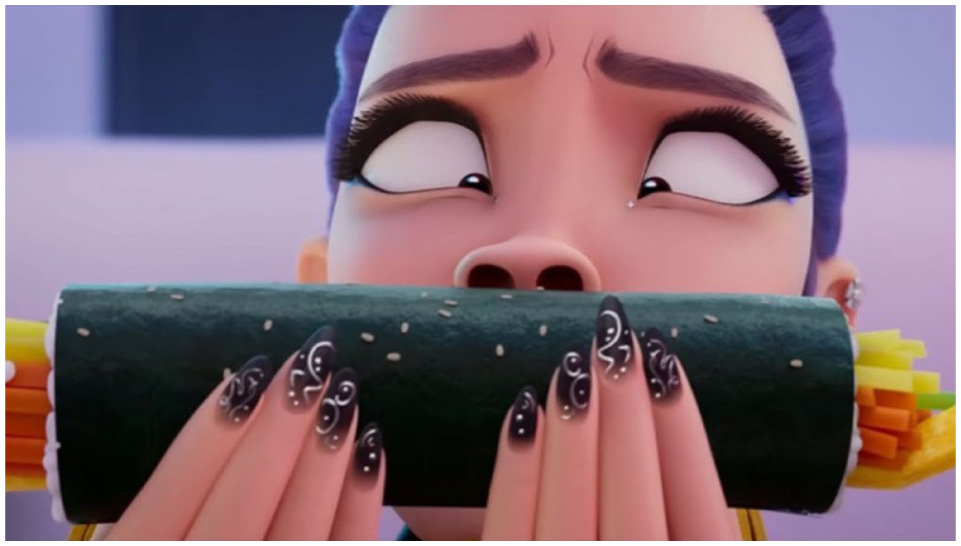
Rumi sniffing kimbap.
This image originated from a scene in which the members of the HUNTR/X girl group (Rumi, Mira, and Zoey) share in a selection of Korean dishes before their show. Their exaggerated enjoyment, playful banter, and over-the-top reactions recall the performance aspect of mukbang, a Korean livestreaming practice revolving around the performance of eating that has itself become something of an online phenomenon (Choe 2019). This scene has received extended attention on YouTube where it was captured in the short video titled “Do NOT Interrupt Our Mukbang!” At the time of writing, this video had been viewed over 19 million times and attracted more than 2,000 comments. It is the comments that form the focus of this paper. They reveal humour, admiration, critique, and personal identification as fans engage with media texts. Such engagement provides insight into how audiences interpret, extend, and reframe popular media within the broader sphere of digital fandom.
Our analysis is grounded in two key theoretical concepts. The first is participatory culture (Jenkins 2006), which highlights how fans contribute to meaning making by sharing knowledge, creating humour, and generating “insider” discourse. The second is parasocial interaction (Horton and Richard Wohl 1956), which offers a lens for understanding the one-sided intimacy fans express towards these fictional, animated characters and, by extension, towards the broader K-Pop industry and real-life K-Pop idols. Importantly, we explore the practices that fans employ in these comments and see that they are underpinned by “interdiscursivity” (Fairclough 1992) as they draw simultaneously on discourses of food, music, celebrity, and digital media to negotiate meaning and identity.
Against this interconnected theoretical backdrop, we argue that the hybrid text of KPDH and the microcosm captured in the comments exemplify how such hybrid texts inspire equally hybrid forms of engagement. They provide a particularly rich case for examining how the KPDH and K-Pop fandoms discursively construct intimacy, humour, critique, and cultural capital. Ultimately, this study demonstrates how digital fandom operates as a site of negotiation where identity, affect, and culture intersect.
We would also point out that beyond merely showing the presence of parasocial interaction, our study addresses the important question around why such interaction matters in contemporary digital fandom. Specifically, we posit that in the context we explore, parasociality is not just a by-product of media consumption. Indeed, it is a socially consequential discursive practice through which fans collectively negotiate body ideals, industry ideals, industry knowledge, and authenticity norms. Through our analysis of parasocial interaction and participatory culture as phenomena produced in comment threads rather than as an individual psychological attachment, we contribute to a reframing of parasociality as an interactional and participatory phenomenon. In this case, KPDH is particularly relevant because it involves animated, fictional characters explicitly modelled on real K-Pop idols, thus enabling parasociality to operate simultaneously across fictional and real-world industry domains. This allows fans to rehearse, critique, and normalise expectations surrounding eating, training, and body discipline that circulate more broadly in K-Pop culture. As such, we show how seemingly playful fan commentary functions as a site where cultural values about bodies, labour, and celebrity are reproduced and contested. In turn, this extends the relevance of parasocial interaction beyond merely fan-text relations to wider debates in media, fandom and digital discourse studies.
Literature Review
Situating (K-Pop) Fandoms
Fandoms have grown to be identified and recognised as a significant and powerful force in late modern contexts. Previously, fandoms were often viewed as a marginal phenomenon; however, Jenkins (2006) indicates that this perspective has evolved so that fandoms are now part of a significant arena of sociocultural production that shapes mainstream media practices (Hills 2002). Duffett (2013, 18) helps us understand the concept of the fan and the link with fandom in the following definition emerging from fandom studies where a fan is: . . . a person with a relatively deep, positive emotional conviction about someone or something famous, usually expressed through recognition of style or creativity. He/she is also a person driven to explore and participate in fannish practices. Fans find their identities wrapped up with the pleasures connected to popular culture. They inhabit social roles marked up as fandom.
However, it is important to note that in the online context, discourse is often fleeting and ephemeral (e.g., liking, commenting), or “light” (Blommaert and Varis 2015), which lends itself to shifting and temporary fan identities. Such an understanding should be integrated into any current definition of fans and fandom. This understanding aligns with broader fandom scholarship which conceptualises fan identity as reflexive, socially produced and spanning multiple texts as opposed to being anchored to a single object of fandom (Sandvoss 2005). Within this conceptualisation, fans routinely move across cultural texts, genres, and media forms, drawing on multiple affiliations to articulate belonging and expertise. As noted by Gray (2010), these kinds of blended fandom identities are especially visible in digital contexts where artefacts such as memes, remixes and other communicative phenomena enable fans to connect disparate fan worlds into shared interpretive frameworks.
Beyond participatory culture alone, it must be said that scholarship of fandom has developed into a strong, well-established and theoretically diverse field that gives significant attention to affect, intimacy, identity, and power relations as central concepts in the broader context of fan engagement (Duffett 2013; Hills 2002). Importantly, rather than fandom being viewed solely as a set of participatory practices, it is increasingly conceptualised as a kind of affective orientation where emotional investment in and imagined proximity to media figures play a vital role (Hills 2016). Grounded in this perspective, fandom is enacted discursively through humour, evaluation and insider knowledge, and this is especially true in digitally mediated environments.
Fandoms, then, can be characterised as comprising individuals who hold deep and emotional investments in cultural figures, groups or texts and with identities that find themselves intertwined in the pleasures and practices of popular culture. In the case of KPDH, there is a difference in that the fandom revolves not only around the film as the cultural text, but around the K-Pop industry as a popular culture phenomenon. The ways that these individuals engage with the short video and the various discourses that emerge show how fandom moves beyond being merely a leisure activity but is more complex and meaningful.
Moving beyond fandom more broadly, K-Pop fandom, specifically, exemplifies this dynamic. The various fandoms in the K-Pop sphere are critical to its massive growth in popularity internationally as they sustain and amplify groups within the industry. Fans of K-Pop are active participants in its construction as a global phenomenon beyond mere consumption. Jung (2011) also points out the role of fandoms in helping fans bridge any geographical distance between them as well as providing avenues to non-Korean fans interpreting and using K-Pop in ways meaningful to them in their local contexts. Such work provides valuable insight into how K-Pop fandoms are both globally connected and locally situated.
The evolution of fandoms has become more rapid through digital platforms and social media. K-Pop fans are mostly young and digitally fluent and thus possess the capabilities to create and nurture fan spaces online in ways that encourage collaborative interaction and organisation (Otmazgin and Lyan 2014). Through such interactions, K-Pop fandom illustrates how digital fandoms grow alongside social media affordances that support practices such as viewing, liking, commenting, and posting (Lee and Park 2025).
It is also important to acknowledge the linguistic and discursive dimensions of K-Pop fandoms and their vital role in overall cohesion. For example, Lee et al. (2019) argue that it is through language use that online fandom communities generate shared identities and belonging. They suggest that identity in fandom should be seen not as a pre-existing essence but as an emergent product of communicative practice. Furthermore, fan practices are not confined to a single discourse but instead demonstrate interdiscursivity as fans draw on awareness and understanding of a variety of discourses that impact the expression of affiliation and the negotiation of meaning. This interdiscursive nature of fandom discourse is particularly relevant to the present study, as YouTube comments operate as sites where affective alignment, expertise, humour, and self-positioning are jointly produced through interaction.
Given the above, research to date has positioned K-Pop fandoms as a paradigmatic case of contemporary fandom. They are simultaneously cultural consumers and producers, situated at the intersection of global media flows and local cultural practice. These fandoms establish social, affective and productive participatory communities through digital affordances and online discourse. In situating K-Pop fandoms within the broader field of fandom studies, these communities can be viewed as emblematic of contemporary transformations in media consumption, identity work, and cultural participation.
Participatory Culture and Digital Discourse
The concept of participatory culture emerged from the work of Jenkins 2006; Jenkins et al. 2006), who attempted to discern between active engagement in media and passive consumption. Specifically, Jenkins argued that participatory cultures are characterised by low barriers to creative expression, strong support for creating and sharing, informal mentorship structures, and a sense of social connexion and shared investment in collective projects. Within this framework, participatory culture can be positioned as relational, varying in degrees of openness and intensity, rather than a fixed category of cultural practice.
This conceptualisation has been widely adopted and adapted by scholars to examine online cultural practices across domains. These domains and sites include YouTube (Burgess and Green 2009), fan fiction (Pole 2010), and activism (Rotman et al. 2011). A common theme across such studies is that participatory culture thrives in fluid, digitally mediated contexts where content circulates easily and is reworked, reframed, and re-embedded into everyday practices. As noted by Bury (2025), this creativity is often motivated by a desire for connexion, with fan practices forming part of what Booth (2010) described as a “gift economy of fandom,” where cultural products are generated to be shared, exchanged, and appreciated by fellow participants. Within fandom studies, participatory culture has been closely aligned with the affective and creative commitments of fans, situating fans as users who not only elaborate upon media texts but also adopt and amplify new technologies in ways that shape broader cultural circulation.
Research focussing on digital fandom further emphasises that participation is fundamentally relational, with fan identity emerging through interaction with other fans rather than solely through attachment to media texts (Booth 2010). From this perspective, participatory culture is organised through social navigation across interconnected fandom spaces where shared humour, knowledge, and affect function as key resources for community-building. Similarly, Baym (2018) argues that intimacy in mediated culture is not simply parasocial but collaboratively produced through ongoing interaction, shared norms, and affective labour within fan communities.
Importantly, participatory culture in fandom contexts is bound together with affective and relational dynamics. Participation is not only about content production or circulation, but about sustaining shared emotional investments and social bonds, often through playful and intimate discursive practices. This affective dimension becomes especially salient when participatory practices overlap with parasocial forms of engagement as fans collectively negotiate proximity and identification with pop cultural figures.
K-Pop fandoms offer one of the most illustrative contemporary examples of participatory culture in action. Research shows that global K-Pop fans organise themselves collaboratively and identify with an “imagined transnational fandom sphere” (Jin 2021, 34). K-Pop idol groups’ fandoms such as BTS’s ARMY mobilise collectively to support, protect, and promote their idols (Hong 2020). This kind of participation extends beyond promotional activities and into broader civic and creative domains. This ranges from coordinating fan-led social and political campaigns, such as the use of K-pop light sticks during South Korea’s presidential impeachment protests (Yim et al. 2024), to producing fanfiction and other transformative works that reimagine idols and their narratives (Kim and Wu 2026). This solidarity is reinforced by the affective affinities and sense of belonging central to fan identities. Yet, as Yoon (2022) observes, these forms of participation are not free from tension as fans continually negotiate the meaning of K-Pop as a global cultural genre in relation to their own positionalities.
K-Pop participatory culture is also bound up with the dynamics of digital media convergence. James (2025) argues that fans occupy an “in-between” role that is both contradictory and affective, navigating responsibilities as consumers and creators. K-Pop fans are empowered to produce and circulate content globally. However, their activities remain subject to algorithmic bias and the structural power of entertainment corporations and platforms. K-Pop’s global success has been made possible by this ecosystem, which thrives on digital connectivity and fan participatory labour (Kim 2021). In this sense, participatory culture in K-Pop illustrates both the generative potential of global digital discourse and the ways it is unevenly entangled with corporate and technological structures.
Overall, participatory culture provides a productive lens for analysing K-Pop fandoms as digitally networked and affectively charged communities. Practices ranging from fan activism and creative remixing to algorithm-driven promotion show how digital discourse reconfigures the relationship between cultural industries and their audiences. However, it should also be acknowledged that the intensities of K-Pop participatory culture cannot be fully understood without considering the affective and relational dimensions of fandom. While participatory practices highlight creativity and solidarity, they are also linked to how fans imagine and experience their connections to idols and the K-Pop industry as well as to characters representative of this (as in KPDH). This leads us into the next section, where we engage the concept of parasociality to explain how one-sided but emotionally resonant relationships help explain the intimate dynamics underpinning K-Pop and KPDH fandom discourse.
Parasociality in Online Fandom
The concept of parasocial interaction was coined by Horton and Richard Wohl (1956) and has since been employed to understand fan practices across a range of contexts. Yan and Yang (2021, 2595) state that “while ostensibly resembling normal face-to-face interactions, parasocial interaction hinges upon the fantasy and imaginations of media audiences, for the responses from the media personae with whom they are seemingly interacting are absent.” As Meyrowitz (1985) observed, viewers come to feel they “know” media figures as they know friends, despite the unavoidable one-way nature of the medium. Over time, this concept has been expanded into the study of parasocial relationships, which describe the longer-term bonds of intimacy and familiarity that audiences form with celebrities, performers, or fictional characters. As an example of what this might look like, in the K-pop industry, this affective proximity is further intensified through structured “fan service” practices such as paid one-on-one video call events, where fans can briefly interact with idols for one or two minutes via live video. However, Keith (2023, 38) points out that this is often “available on a paid subscription basis, charged by the number of artists the user wishes to interact with.” While these encounters simulate genuine interpersonal communication, they remain tightly scripted and monetised, amplifying the illusion of intimacy and reinforcing parasocial bonds. Such experiences blur the boundary between mediated and direct contact, sustaining the emotional investment that defines contemporary fan–idol relationships.
More recent scholarship has emphasised that parasociality much more than a psychological state. Indeed, it is a socially and discursively produced phenomenon, particularly in digital environments where fans collectively articulate concern, admiration or knowledge about media figures (e.g., Hills 2016; Yan and Yang 2021). From this perspective, parasocial interaction is enacted through language, stance, and affective alignment and not from individual attitudes and beliefs. In this sense, parasociality can be understood as a blurred relational fan experience that is collaboratively enacted and socially reinforced in discourse, while still remaining structurally one-sided in that the media figures at its centre cannot reciprocate these forms of intimacy.
Early research in this area emphasised the parasocial dynamics of television, but subsequent work has shown how these bonds adapt to new technological and cultural contexts, particularly social media. Clark (2015) notes how mediated personalities can often be perceived as friends even though parasociality is a form of mediated intimacy that remains fundamentally non-reciprocal (Andrejevic and Volcic 2025). Studies on parasociality have been particularly prominent in relation to music and fan relationships (Kurtin et al. 2019). Similarly, Auter et al. (2008) showed that increased media consumption strengthens parasocial attachments, with music videos perceived as especially authentic. These insights are important for understanding fandom where mediated personae are central to fans’ emotional investment and identity work.
In digital fandom contexts, parasocial interaction is increasingly operationalised through discursive indicators. Prior research identifies several recurring markers of parasociality in online commentary. These include (1) relational address, whereby fans speak to or about media figures as socially knowable individuals; (2) projections of private or embodied routines such as diet, training, health, or emotional states; (3) affective alignment, including expressions of care, envy, protectiveness, or concern; and (4) identity mirroring, where fans explicitly align their own experiences or bodies with those of the media figure (Auter et al. 2008; Flinchum et al. 2024; Yan and Yang 2021). These indicators function as collective discursive practices through which intimacy in parasocial interaction is negotiated and shared within fan communities, rather than as isolated psychological responses.
Social media has reconfigured the conditions of parasociality by affording more opportunities for apparent reciprocity as platforms allow fans to follow celebrities’ daily lives and sometimes even interact with them directly (e.g., Chen 2016). For Marwick and Boyd (2011, 148), social media represents a move beyond parasocial interaction through the facilitation of “direct engagement between the famous person and their follower,” which serves to blur the line between imagined intimacy and actual communication as fans can now receive likes, replies, or acknowledgements from media figures. Although the asymmetry remains, the digital turn complicates the notion of parasociality by layering mediated intimacy with occasional, tangible interaction.
In the K-Pop context, this reconfiguration of parasociality is further intensified through dedicated fandom platforms such as Weverse and LYSN bubble. These applications are designed to stimulate intimate communication between idols and fans by enabling features such as personalised messages, livestreams, and subscription-based updates that appear as direct exchanges between performer and follower. Scholars have argued that such platforms technologically structure fandom participation by domesticating fan communities within proprietary ecosystems while simultaneously amplifying the perception of interpersonal connexion (Bollmer and Tillerson 2025). From a user-experience perspective, their design intentionally foregrounds proximity and immediacy, encouraging fans to experience communication with idols in a conversational and ongoing way (Hong and Kim 2022). Research on fan usage of applications such as LYSN Bubble further demonstrates how these environments cultivate heightened forms of parasocial interaction by enabling fans to interpret platform-mediated messages as personalised engagement, even though communication remains largely uni-directional.
In the case of K-Pop fandoms, these dynamics take on distinctive characteristics. The K-Pop industry is built around practices of sustained visibility and accessibility, with idols participating in livestreams, variety shows and constant social media engagement (Jin 2021). This reinforces intimacy in parasocial interaction by encouraging fans to feel close to idols and to align their own experiences with those of performers. As Flinchum et al. (2024) argue, musicians play a central role in parasocial relationships, and in K-Pop this is amplified by the industry’s global reach. While fans remain aware of the managed and commercialised nature of idol-fan interaction, the feelings of intimacy remain powerful and consequential for fan identity and practice as these fandoms mobilise to promote their idols and the industry in general (Hong 2020).
In the present study, it is important to note that parasociality is not always oriented towards a single individual. Fans frequently invest in groups, rotating their attention among members, or even extend their parasocial projection to the industry more broadly. In the KPDH data we analyse here, parasocial interaction operates on two levels. First, it is directed towards animated fictional characters who can never reciprocate interactions. Second, it is directed towards real-world K-Pop idols who embody the broader industry. This dual parasociality complicates conventional understandings of parasocial interaction by combining attachments that cannot be reciprocated with commercially structured, partially interactive forms of intimacy.
In our study, we approach parasocial interaction as a discursive and interactional resource and not as an individual psychological disposition. We explore how parasociality is collaboratively performed within online comment threads. This aligns with recent approaches that treat parasociality as collectively achieved in online discourse, particularly within participatory fan communities where fictional characters, real performers, and industry knowledge intersect.
Data and Procedure
The data are taken from the online comments of a YouTube short titled “Do NOT interrupt out Mukbang!” in which the HUNTR/X members enthusiastically eat a range of Korean foods before their performance. The foods include kimbap, sundae (blood sausage), saewoo kkang (shrimp-flavoured chips), eomuk (fish cake), hotteok (sweet pancakes), naengmyeon (cold noodles), and cup ramyeon (instant noodles). As mentioned earlier, the video short has attracted over 19 million views and 1,912 comments at the time of writing, which was early August, 2025.
Although the content of the video triggered the variety of comments and interactional exchanges presented in the comments, the video itself is not analysed here. Our focus is specifically on the emergent comments and related discourse. The entirety of the comments were exported using YouTube Comment Downloader. This included indication of where a comment was standalone or was part of a longer exchange of two turns or more as well as any paralinguistic features (e.g., emoji). After export, the dataset was cleaned by removing comments that were ambiguous or unable to be interpreted; for example, there were instances of comments such a “Csbb” and “Pp” which carried no meaning for either author. This reduced the total number of comments to 1,798. It should be noted that the overwhelming majority of comments were in English, with a small number in Korean (20), Japanese (2), Mandarin Chinese (2), and Thai (1). As one author is a native speaker of Korean, the Korean language comments were able to be easily translated, while the others were translated using Google Translate. All these non-English comments were included in the final analysis. There were also many comments that were emoji only, and these tended to show only positive affect such as  or
or  . Although such comments were not able to be interpreted beyond this positive affect, they were also included in the final dataset.
Our analysis was qualitative and revolved around discourse analysis that combined inductive theme identification with interpretation underpinned by established theoretical frameworks. We opted not to apply a pre-determined coding scheme and instead engaged in iterative close reading of the entire dataset to identify patterns, stances, and interactional practices that were relevant to our overall theoretical interest in participatory culture and parasociality. Thus, our analysis is thematic in its orientation but is explicitly anchored in the conceptual framework outlined in our literature reviews, namely participatory culture (Jenkins 2006), parasocial interaction (Hills 2016; Horton and Richard Wohl 1956), and also interdiscursivity (Fairclough 1992).
Each author independently conducted an initial analysis of the data for patterns. The preliminary observations were then collaboratively discussed and compared, which allowed us to refine analytic categories and ensure interpretive coherence. Overall, there were four main themes agreed upon that recurrently organised the fan discourse in the dataset, and these revolved around genre hybridity, industry knowledge display, personal experiences, and body image. Although all four themes appeared in a recurring manner across our data, comments relating to body image – particularly the paradox of eating large quantities while remaining slim – were especially prominent. This prevalence likely reflects the centrality of body aesthetics within K-Pop culture, where strict diet regimes and highly regulated idol body standards are widely discussed within fandom discourse. As a result, the scene in the video appears to trigger a particularly strong interpretive response from commenters, who repeatedly attempt to reconcile the visual representation of enthusiastic eating with broader cultural expectations surrounding the idol body. It is important to note that these themes do not function as purely descriptive groupings but as analytically motivated lenses through which participatory culture and parasocial practices are enacted in the data. Specifically, the themes have been labelled in the following analysis as “Genre Blending in KPDH Discourse,” “K-Pop Industry Knowledge,” “Sharing Personal Experiences,” and “Being Skinny and Eating a Lot.”
Analysis and Discussion
This analysis examines these themes as discursive formations through which participatory culture and parasocial interaction are collaboratively enacted, drawing explicitly on the theoretical frameworks and concepts outlined previously. However, it is first useful to foreground a key analytic thread that runs through our data, and this pertains to the notion of blending. Across the comment corpus, fans continually merge discourses from different domains such as industry realities, K-Pop training regimes, anime and gaming logics, personal experiences, and body ideologies into hybrid articulations of engagement. This blending functions as a participatory strategy that allows fans to inhabit the border between fantasy and reality, bridging the fictional world of KPDH and the affective spaces of K-Pop fandom. Furthermore, these blended discourses play a significant role in both constructing and strengthening intimacy in online fandom contexts. Through humour, parody, and self-disclosure, commenters blur the distinction between parasocial projection and participatory creativity. In doing so, they transform media consumption into a form of discursive world-building that traverses both online and offline contexts. Thus, we feel that blending is not merely a thematic feature of the data but a key modality of fandom engagement, one that encapsulates the interdiscursive, affective, and imaginative labour through which fans sustain proximity to both idols and their animated counterparts.
Across the four themes we explore below, these discursive patterns also repeatedly realise key indicators of parasocial interaction as outlined earlier. Namely, there are relational address, projections of private routines and bodily states, affective alignment with idols, and identity mirroring between fans and idols. As the analysis will show, these indicators surface through fans’ explanations of idols’ eating practices, expressions or concern or admiration, and comparisons between idol bodies and their own experiences.
Genre Blending in KPDH Fandom Discourse
One of the richest clusters of discourse centred on genre hybridity, meaning the blending of stylistic logics, genres, and cultural references that would not typically be placed in juxtaposition. Such hybridity aligns with the notion of interdiscursivity (Fairclough 1992), whereby participants fluidly combine discourses from different domains to make sense of a text. This practice exemplifies Jenkins’ (2006) participatory culture by highlighting the HUNTR/X girls’ enthusiastic eating, prompting fans to rationalise, explain, and reframe this act through comments. In doing so, they construct meaning collaboratively, weaving together logics of fantasy, performance, and everyday nutrition. Representative examples include:
(1) Carbo loading. Hours and hours of very intense cardio needs a lot of energy.
(2) Killing demons is cardio.
(3) You can’t fight, or run from, demons and still be fat.
(4) Probably demon hunting uses a lot of energy.
(5) They can eat whatever and still be skinny because they fight demons as workout lmao.
(6) You know kpop star have to eat strictly and train hard before show, and they only allow to eat more when its close to the show to have more energy. I guess this is the case, plus they fight demon everyday, they need energy 
(7) A: On the contrary, actual k-idols eat very little before the concert. So, they don’t look bloated during the event. B: True but when you fight demons, you need the energy. I am sure they burn it all before they get to the stage.
(8) I thought it would be hard for a Kpop girl to eat like that. But they were also doing Idol + Hunter so I that they they were burning calories.
Two dominant forms of hybridity emerge here. First, users mobilise real-world discourses of nutrition and exercise – as seen in phrases and expressions such as “carbo loading” and “uses a lot of energy” – to explain and justify excessive eating. These explanations are interdiscursive as they draw on a perceived knowledge of nutrition and fitness to fill narrative gaps in the fantasy world. For instance, comments 2 and 3 naturalise demon hunting as strenuous cardio, thus justifying the mukbang scene. This lifts the scene out of the fictional as commenters compare it to reality. Similarly, the exchange in 7 and the reflection in 8 show how fans interweave imagined demon-slaying with perceived knowledge of K-Pop training regimens and calorie expenditure.
Other contributions take this logic further, blending technical terminology with fantastical imagery:
(9) They gotta build those glycogen stores for the big show somehow. They are gonna be dancing and singing for hours on top of needing to be ready to fight demons and potentially run one down on foot while carrying a sword. Also what they are eating doesn’t seem that bad considering it’s sugary snacks that cause the most weight gain cause sugar is something human bodies struggle to deal with in large amounts safely.
This commenter deploys biomedical vocabulary (“glycogen stores”) to establish epistemic authority, but immediately recontextualises this within the demon-hunting narrative. This discursive shift highlights not only a creative reworking of the text, but also the construction of parasocial forms of intimacy. In other words, we can see that fans treat characters as if they are real performers whose routines, diets, and energy demands can be plausibly debated. Such interactions illustrate how participatory culture enables audiences to collapse the boundary between fantasy and reality while reinforcing their own insider status. The technical terminology is then juxtaposed against the rationale that the girls may need to run down demons on foot while carrying a weapon. This is an example of audience participation and engagement with the text of both the YouTube short and the broader KPDH film as they establish what the scene means within this world and share this among the fandom community as they integrate the fantasy into their reality.
This blending also extends through intertextual references to other fan worlds:
(10) Anime logic: eat unlimited, stay skinny, fight demons.
(11) They’re like Goku but K-pop version – eat now, fight later.
(12) Superhuman strength and their powers can justify the calories. Basically same reason to out see the likes of Luffy and Goku
(13) The only known character I know who has that same metabolism is Yui Hirasawa.
Such comments highlight the circulation of cultural logics across fandoms. Comment 10 invokes “anime logic” as a shorthand for an apparently well-known trope of limitless consumption without weight gain. Comments 11 and 12 go further and specify Japanese manga characters (Goku from Dragonball and Luffy from One Piece) who, among the commenters, seem to have a reputation for prodigious eating, which is then positioned as mirroring the HUNTR/X girls’ performance. Comment 13 extends the analogy to Yui Hirasawa (cartoon character from Japanese manga, K-On!). These intertextual moves demonstrate how fans draw on multiple narrative repertoires to create coherence and community, using shared referents across fandoms to explain and normalise what they see in KPDH. Ultimately, such discursive practices underscore the dynamic ways in which online fandom operates. Genres are blended, reality and fantasy are collapsed, and intertextual world-building is enacted in a way that deepens both parasocial engagement and participatory meaning-making.
K-Pop Industry Knowledge
Another significant cluster of comments shows fans demonstrate and authenticate their real or perceived knowledge of the K-Pop industry. These discursive strategies are marked not only by a sense of insider authority, aligning with Bourdieu’s (1984) concept of cultural capital, but also practices emblematic of participatory culture. Within such communities, participants move beyond passive consumption to active contribution and a policing and sharing of knowledge in ways that establish and reinforce collective expertise. Simultaneously, this authority is often infused with a sense of intimacy embedded within parasocial interaction as commenters claim some kind of access or understanding of pop idols’ private lives and speak with a familiarity about their routines, restrictions and vulnerabilities. This convergence of knowledge display and parasocial proximity shows how fandom discourse operates interdiscursively, drawing on aspects of expertise, affect and shared participation to construct and legitimise fan identity.
Most of the epistemic work done in the comments revolves around the eating practices shown. Fans interpret these practices in relation to broader assumptions about the lived realities of K-Pop performance culture and related rules and constraints. A particularly poignant example can be seen in Comment 14:
(14) I hate the food jokes and gags just because it feels disingenuous, we know those girls don't eat that much. We know some of their diets are extreme, we hear so many stories of them sneaking food past their managers, we've seen the food portions new jeans members were given on set, we've heard stories like Momo not eating for a week because management said she'd be cut if she didn't. Like think about IUs diet, jeon Somi's diet. I think a lot of idols lie about how little they eat and those cute videos of them eating pasta or chips–thats probably all they ate that day or edited so they don't actually have to eat it all. Think about the videos of idols streaming their birthday celebration and how we've seen management taking food off the tables so the idols don't eat it. The majority of female idols, if their listed heights and weights are accurate, are medically underweight.
The length and density of this comment functions as a display of authority, aligning with observations about legitimisation through discourse of numerous scholars (e.g., Ross and Rivers 2017). The repetition of collective epistemic markers (e.g., “we know . . .,” “we’ve seen . . .,” “we’ve heard . . .”) reinforce a sense of credibility by situating the commenter within a knowledgeable community. This can also be viewed as another instance of interdiscursivity as industry-related anecdotes, medicalised framings of bodyweight, and media references are brought together to uphold this discourse of insider knowledge and authenticity. Simultaneously, the references to specific K-Pop groups and idols (New Jeans, Momo, IU, Jeon Somi) foreground a sense of intimacy, transforming mediated fragments into evidence of intimate familiarity. Other comments further demonstrate these kinds of dynamics:
(15) actually its unrealistic because in real life they stay skinny because they dont that much and they still have to practice alot so kpop companies are so cruel to their talents(the idols). its just sad that their close to starving 
(16) Kpop idols don’t eat until after they perform.
(17) It’s funny cos kpop idols irl would rather die than eat .
(18) Thats such a big missconception. Yes there are bad kpop agencies but its not the huge ones that everyone knows about. Its very rare and only happens with the very sketchy scam agencies that try to hire anyone super young off the streets. 99.9 Percent of kpop groups do get to eat and have a free life. The only restrictions are just relationships related to other idols and or fans. Typically theres a lotta rules around how to let the public and agents know. So they can plan out releases or announcements before media coverage. If it was such a big issue there would be human rights issues and actual legal perciedings. Stop beleiving everything yall see on twitter.
These comments show epistemic certainty occurring through declarative claims (e.g., “they stay skinny,” “idols don’t eat,” “there are bad agencies”) and information-giving stances as fans resist negotiation and therefore position themselves as arbiters of “truth” about the idols. This stance reflects the notion that expertise is not merely asserted but collectively enforced in such communities. For instance, comment 18 corrects what they refer to as a “missconception,” further reinforcing the policing of knowledge that directs the interpretive frames available to the community. There is significant interdiscursive layering being engaged in here as discourses of health, labour, legality, and social media intersect to produce competing truths about idols’ lives. Such overlaps highlight the hybrid character of fandom discourse, where multiple domains of knowledge converge in the negotiation of authority.
Affect also holds a central position. They are deeply reflective of the intimacy that can be involved in parasocial interaction as fans articulate concern for idols’ well-being (e.g., “its just sad that their close to starving”) while simultaneously joking about their eating habits (e.g., “would rather die than eat”). These contradictory discourses reflect an inherent paradox in relation to intimacy, shifting as they do between protective empathy and ironic detachment.
Overall, these comments reveal a discursive tension at the heart of participatory fandom. On one hand, fans express admiration for idols and their representations; on the other, they critique exploitative industry practices and position themselves as more knowledgeable than outsiders. Through a combination of participatory culture and parasocial interaction, commenters claim both authority and proximity, monitoring and policing the boundaries of legitimate knowledge while simultaneously cultivating the sense that idols’ lives are knowable and sharable within the fan community.
Sharing Personal Experiences
Building on the parasociality, another theme relates to the sharing of personal experiences. A key characteristic of parasociality is fans aligning the actions of their idols with their own everyday experiences. In this sense, Hills (2016, 466) suggests that this establishes a “felt connection between the fan and celebrity.” Importantly, these connections evoke a sense of shared life, even though they are enacted without expectation of reciprocity, something especially relevant in the context of anime, manga, and fictionalised idols. The social media setting further accentuates this dynamic as platforms can “nurture and foster interpersonal connections” (Flinchum et al. 2024, 84). Even if idols or characters cannot respond, commenters nonetheless experience interpersonal bonds through shared experiences and their ongoing familiarity with K-Pop discourse and fandoms.
This interweaving of parasociality and participatory culture reflects broader interdiscursive practices. As in genre-blending where different media logics intersect, here fans blend discourses of everyday life, celebrity intimacy, and fandom engagement into a single affiliative register. In this sense, the discursive space is not only parasocial but also a site of playful world-building and identity performance. The overlap with participatory culture is most visible in the social bonding that emerges between commenters and characters. Comments 19 to 22 exemplify this sense of shared life:
(19) Me and my sisters when food.
(20) Literally me and my friend at lunch time.
(21) They’re all like, literally, me with food IMAOO.
(22) Me and my three siblings eating at 3 am until mom pops out in our secret base where we always eat.
First, these comments position the idols’ eating behaviours as a fictional mirroring of the users’ own real-world behaviours. The use of intensifiers such as “literally” draws the idols’ actions more closely into alignment with users’ identities, reinforcing the shared parasocial space. Second, they provide personal anecdotes as contributions to the communal thread that represent acts of personal revelation, embedding intimacy through parasocial interaction in participatory culture as users connect with the text by inserting their lived experiences. Comment 22 highlights this as the recollection of siblings hiding and eating late at night parallels the actions of the characters.
Other comments expand the relational frame by comparing physical experiences of eating and body image with those of the idols:
(23) I have a fast digestion so I can eat a lot and still be slim.
(24) I’m impressed. How they eat like me but be skinnier than my arm.
(25) They eat 3x as much as me. . . and I eat three servings each meal. . . and they’re skinnier than me! A fishbone!
(26) What they eat 


 how they look:
What I eat 


 what I look like:


These comments extend the intimacy we have discussed as part of parasocial interaction into domains of embodiment, diet, and self-comparison. For example, Comment 23 suggests an affinity with idols through claims of metabolic similarity, whereas Comments 24 and 25 highlight amazement that idols remain “skinnier than my arm” or “a fishbone” despite overeating. These remarks, often humorous, foreground the paradox of comparing human bodies to fictionalised, animated characters who are exempt from such constraints. This recalls the earlier discussion of genre hybridity. Just as genre blending invites interdiscursivity between different cultural logics, here users negotiate discourses of fiction and reality, merging humour, disbelief, and admiration into the identity work they engage in in this online space.
The humorous and self-deprecative tone is particularly clear in Comment 26. The post is multimodal, using emoji to dramatise the contrast between idols and the commenter’s self-image. Such emoji use functions as social media paralanguage (Zappavigna and Logi 2024), intensifying affect and creating affiliative resonance. At the same time, the comment reveals a paradoxical logic whereby idols who eat unhealthy foods remain slim, while the commenter claims that eating healthy still leads to weight gain. The absurd and contradictory nature of this assertion highlights the tension between fantasy and reality, while the humour tempers the implicit critique of body ideals.
These examples illustrate how fan comments move between discourses of intimacy, humour, self-disclosure, and embodiment. Interdiscursively, they weave together parasociality, participatory culture, and genre hybridity. We see fans revealing personal anecdotes and bodily comparisons that signal a willingness to merge identity with fictional characters, yet they do so in ways that are humorous, affiliative, and socially connective, enabling bonding with fellow fans. Crucially, such comments demonstrate how users both project themselves into the world of the idols and bring the idols into their own worlds, producing a shared discursive space that is simultaneously personal, social, and interdiscursive.
Being Skinny and Eating a Lot
Although earlier sections have explored the paradox of being skinny while consuming large amounts of food, the sheer prominence of this discourse in the data warrants deeper analysis. This theme crystallises parasocial projection, normative body ideals, and participatory fan practices into a highly visible node of interdiscursive activity. Admiration, envy, and disbelief repeatedly surface, showing how fans naturalise the contradiction of “being skinny but eating a lot” as a desirable and even enviable state. As Mwaniki (2017, 56) argues in relation to sport and media, fandom often cultivates “a certain bodily aesthetics, an aesthetics based on how bodies should look when performing and also measure on quantifiable performance indicators.” In the K-pop context, this aestheticised and idealised idol body is projected as necessarily slim, even when staged narratives of appetite and indulgence are emphasised. This idolatry and its potential impacts has been highlighted in recent work such as that by Vivas (2025, 110), who explained that Female fans tend to pay more attention to their physical appearance and body image to resemble their favorite artist, which was found to put them at risk or engaging in pathological behaviors due to body image distortion and lower self-esteem caused by comparison with celebrities.
Similarly, Vera (2025, 9) suggests that the Huntr/x members share what can be considered a “normative idol body template,” indicating that this slim aesthetic has become ingrained in perceptions of what a K-Pop idol should look like. Moreover, gender and the body operate as key semiotic resources through which fans engage with idols in a parasocial manner, irrespective of real or fictional. Fanfiction is one manifestation of this dynamic (as mentioned earlier in this paper), where gender play, imagined intimacy, and same-sex coupling extend the affective investment in idol bodies into creative practices. In our dataset, body-focussed comments echo similar affective work where envy, admiration, and disbelief are mobilised to reproduce and circulate gendered fantasies of proximity and desire. These expressions can thus be seen as a discursive extension of gender play in fan creativity, where the idol body becomes a site of emotional and symbolic negotiation. Interdiscursively, these comments align K-pop’s body logics with broader cultural fantasies where virtual images displace material realities, allowing fans to sustain parasocial fantasies of consumption without consequence.
Pertinent comments in this theme include the following:
(27) Bro how are they eating so much and they are still skinny.
(28) That’s crazy cus they eat all the food but they’re still Soo skinny.
(29) Bro they eat so much but.. . .. Why the heck can they be so skinnyyyyyyyyyyy 
(30) I’m so jealous with their body. No matter how much food they ate, they still slim as supermodels.
(31) I think the most impressive thing about them is that they can eat like THAT and still be SKINNY.
(32) For those who don’t understand, Yui from K-On! has an inhumanly-fast metabolism, meaning she can eat all the junk food she wants and still maintain her figure, just like these three.
The paradox is foregrounded directly in comments 27 and 28, while comments 29 to 31 intensify the affective evaluation with emoji, jealousy, and positive appraisal of slimness. Comment 32 illustrates an explicitly interdiscursive turn, invoking Yui Hirasawa from K-On! as an explanatory analogy. Here, discourses of anime fandom, nutritional knowledge, and idol body logics intersect, enabling fans to rationalise the paradox by blending explanatory resources across cultural domains. Such layering exemplifies the interdiscursivity at play with the negotiation of body aesthetics, anime references, and health discourse within the same participatory space.
Overall, a pattern of parasocial admiration and envy emerges where fans implicitly compare themselves to idolised figures while reaffirming slimness as a central marker of desirability. In this theme, fans mobilise interdiscursive resources – body aesthetics, anime logics, nutritional discourse – to sustain fantasies of consequence-free indulgence and to align themselves affectively with the idol body. In doing so, they reinforce the parasocial bond while reproducing the wider cultural valorisation of slimness as both naturalised and celebrated within participatory culture.
Conclusion
In this article, we analysed the comments from this YouTube short to demonstrate how digital fandom operates as a site of cultural negotiation where intimacy, authority, humour, and identity intersect. Drawing on Jenkins’ (2006) participatory culture, we see how fans are not passive consumers but active co-creators of meaning. They police knowledge, share personal anecdotes, and rationalise implausible narratives, extending the media text in ways that reinforce collective belonging and branch into hybridity. Such practices exemplify the participatory nature of online fandoms. Importantly, these findings highlight that participatory practices are not only creative or affiliative, but also normative. In other words, through humour, explanation, and correction, fans collectively stabilise assumptions about bodies, discipline, and legitimacy within K-Pop culture.
Equally central to our analysis was the concept of parasociality. As Horton and Richard Wohl (1956) observed, mediated intimacy arises from the illusion of reciprocity, and in the K-Pop context this is amplified by the industry’s sustained emphasis on idol visibility. With the connexion to KPDH characters through the comments to this short, this parasociality is heightened and chance of reciprocity further reduced. This occurs as fans invest affectively in animated characters who can never respond while simultaneously projecting onto the broader K-Pop industry. This dual orientation highlights parasociality not only as an individual attachment but as a collective discursive resource that strengthens community bonds.
The broader significance of these findings lies in how parasocial interaction facilitates cultural sense-making rather and moves beyond being just a simple attachment. The comment threads analysed reveal how fans use parasocial projection to rationalise contradictions such as eating large quantities while remaining extremely thin by drawing on interdiscursive resources from anime, fitness culture, and industry lore. This shows how fans participate in the circulation and normalisation of idealised body logics that extend beyond the fictional world of K-Pop Demon Hunters and resonate with real-world K-Pop idol practices. In turn, this highlights how parasociality functions as a bridge between entertainment and everyday understandings of health, labour, and self-discipline, demonstrating its relevance for scholarship on media influence, body politics, and digital participation.
Finally, the data reveal the centrality of interdiscursivity in online fandom. Fans fluidly show a tendency to mobilise discourses of food, body aesthetics, anime, and industry expertise, collapsing boundaries between fantasy and reality. In doing so, they reinforce cultural ideals, particularly slimness in the face of indulgence while also embedding these in humorous, affiliative, and critical exchanges. Overall, we found that parasocial and participatory engagement in this discursive space are somewhat blurred, or blended. Here, fans engage with imagined intimacies in ways that align with conventional fandoms. However, a key feature is that they are performed collaboratively. The fact that this blending occurs on social media (YouTube) intensifies the blurring as it helps to amplify affective proximity, circulate shared discourses, and sustain the illusion of co-presence that binds fan communities that are separated by space and time. In terms of contribution to the field, this suggests that parasocial interaction should be understood less as an individual illusion of intimacy and more as a collectively organised discursive process through which fandoms negotiate cultural norms, affective investment, and social meaning in platformised environments.
In closing, however, it is also important to address limitations of this research. Firstly, our data are drawn from a single YouTube short – albeit with massive engagement – associated with one specific media text. While the volume of comments has provided rich insight into participatory and parasocial practices, the analysis reflects a particular moment, platform, and fandom context. Second, building on the first, the focus on one moment and platform means that this study does not account for broader, cross-platform fan practices that may further shape how participatory and parasocial practices are developed and sustained over time.
These limitations lead into potential future research directions. Comparative studies across other platforms would be beneficial in terms of identifying how affordances shape the discursive realisation of parasociality and participatory culture. Longitudinal research would also help to better understand how fan discourse evolves. Further, linked to the body ideals explored in our analysis, future work could place greater focus on the implications of such body-related parasocial discourse, particularly in relation to gender and health, by exploring how such talk traverses fictional, animated and real-world contexts.
Footnotes

Funding
The authors received no financial support for the research, authorship, and/or publication of this article.
Declaration of Conflicting Interests
The authors declared no potential conflicts of interest with respect to the research, authorship, and/or publication of this article.