




Abstract
Marine oil spills pose a persistent treat to aquatic ecosystem and coastal livelihoods, yet commercially dominant synthetic sorbents such as polypropylene are non-biodegradable and generate secondary pollution after use. This study reports the fabrication and performance optimization of fully biodegradable needlepunched nonwoven mats manufactured from banana and sisal fibers as low-cost, sustainable sorbents for diesel-oil removal. Single-fiber webs were produced by carding and parallel-lay formation, then mechanically consolidated by needlepunching to yield cohesive mats with well-defined structural parameters: areal densities of 198.8 g/m2 (sisal) and 183.5 g/m2 (banana) and thickness of 2.7 and 2.38 mm respectively. Diesel-oil sorption was evaluated under dynamic conditions using an orbital shaker and central composite design with RSM was applied to model and optimize the effect of contact time and agitation speed on uptake capacity. Both materials exhibited statistically robust, reproducible behavior (ANOVA: p < 0.0001; R2 > 0.96). RSM optimization identified maximum predicted diesel uptake of 16.34% for banana mats (10 min, 100 rpm) and 13.59% for sisal mats (5 mi, 100 rpm). The higher uptake of banana mats is attributed to their finer fiber diameter (6.2 tex vs. 7.697 tex) and greater capillary driving force, whereas sisal mats achieved peak sorption at shorter contact times, reflecting their more open pore architecture. These findings demonstrate that agro-waste-derived banana and sisal mats are technically feasible, cost-effective alternatives to synthetic sorbents.
Introduction
Textile materials now extend far beyond apparel and household uses to a broad range of technical applications, including filtration, medical textiles, geotextiles, agro-textiles and environmental protection.1,2 Natural-fiber nonwoven textiles are of particular interest because of their versatility, low cost and tunable properties such as porosity, thickness and high specific surface area, which can be controlled during web formation and bonding. 3 Because nonwovens can trap and retain liquids within their three-dimensional fiber networks, they are especially well suited for absorbent applications.3,4
By definition, nonwoven fabrics are sheet or web structures in which fibers or filaments are bonded together mechanically, thermally or chemically; their functional performance depends strongly on fiber selection, web-forming method and bonding technique.5,6 Nonwovens can be engineered for either short service life (single-use) or extended durability and are employed where properties such as absorbency, liquid repellency, resilience, softness, strength, flame retardancy, filtration efficiency, thermal and acoustic insulation, or bacterial barrier function are required.3,7
Needle punching is a widely used mechanical bonding method for manufacturing robust nonwoven mats. In this process, stacked carded or air-laid webs are repeatedly pierced by barbed needles, which entangle fibers and consolidate the mat into a cohesive three-dimensional structure without necessarily requiring chemical binders.3,6 Needlepunched nonwovens are attractive for absorbent and environmental applications because the process is scalable, cost-effective and compatible with a wide range of fiber types, allowing designers to balance mechanical integrity, porosity and bulk to optimize sorption performance.3,4
Oil discharged to land, rivers or the ocean poses a major threat to ecosystems and livelihoods; spilled oil can cause acute and chronic damage to coastal habitats, marine life and human communities. 8 A variety of response techniques are used to mitigate oil spills, including skimming, dispersants, in-situ burning and sorbents, and the chosen method depends on available resources, regulatory constraints and the physical and ecological context of the spill (shoreline versus open sea).9–11 Sorbents are a key tool in many cleanup scenarios because they selectively remove oil from water surfaces and shorelines, enabling physical recovery with minimal chemical side-effects.12–14
The ideal sorbent combines high oil-uptake capacity and rate, strong hydrophobicity/oleophilicity, mechanical strength and retention in aqueous environments, reusability where feasible, and minimal post-use environmental impact such as biodegradability.15–17 No single commercial sorbent currently satisfies every requirement, which explains the dominance of polymeric materials (e.g., polypropylene, polyester, polystyrene, polyacrylonitrile and polyurethane foams) in current practice despite their limited biodegradability and disposal challenges.18–22
Against this background, lignocellulosic agricultural fibers such as sisal and banana are promising feedstocks for low-cost, biodegradable oil sorbents because they are widely available, inherently porous, and amenable to web formation and mechanical bonding (needle punching) to produce cohesive mats. When necessary, surface modifications or post-processing can further enhance hydrophobicity and oil selectivity.5,6 Systematic development and optimization of such natural-fiber nonwovens is therefore needed to quantify trade-offs between uptake, sorption rate, mechanical durability and manufacturability under conditions representative of field use.
Accordingly, this study develops and characterizes needlepunched nonwoven mats manufactured from banana and sisal fibers, evaluates their diesel-oil sorption behavior under dynamic laboratory conditions, and applies response surface methodology (central composite design) to model and optimize key process and test variables. The work aims to demonstrate the feasibility of biodegradable banana–sisal nonwovens as practical marine oil sorbents and to provide statistical guidance for future scale-up and field evaluation.
Materials and methods
Materials
Physical and mechanical properties of banana and sisal fiber used for nonwoven fabrication.

Figure 1 representative photographs of the raw staple fibers used in this study: (a) banana fiber showing its characteristic ribbon-like, smooth surface texture; (b) sisal fiber showing its coarser, more irregular surface. Both fiber types were sourced from local markets in Dessie, Ethiopia, and processing into 100% single-fiber needlepunched nonwoven mats for diesel-oil sorption evaluation. The key properties: banana fineness = 6.2 tex, density = 1.350 g/cm3; sisal fineness = 7.697 tex, density =1.750 g/cm3 (see Table 1). Raw banana and sisal fibers used for fabrication of needlepunched nonwoven sorbents: (a) banana fiber and (b) sisal fiber.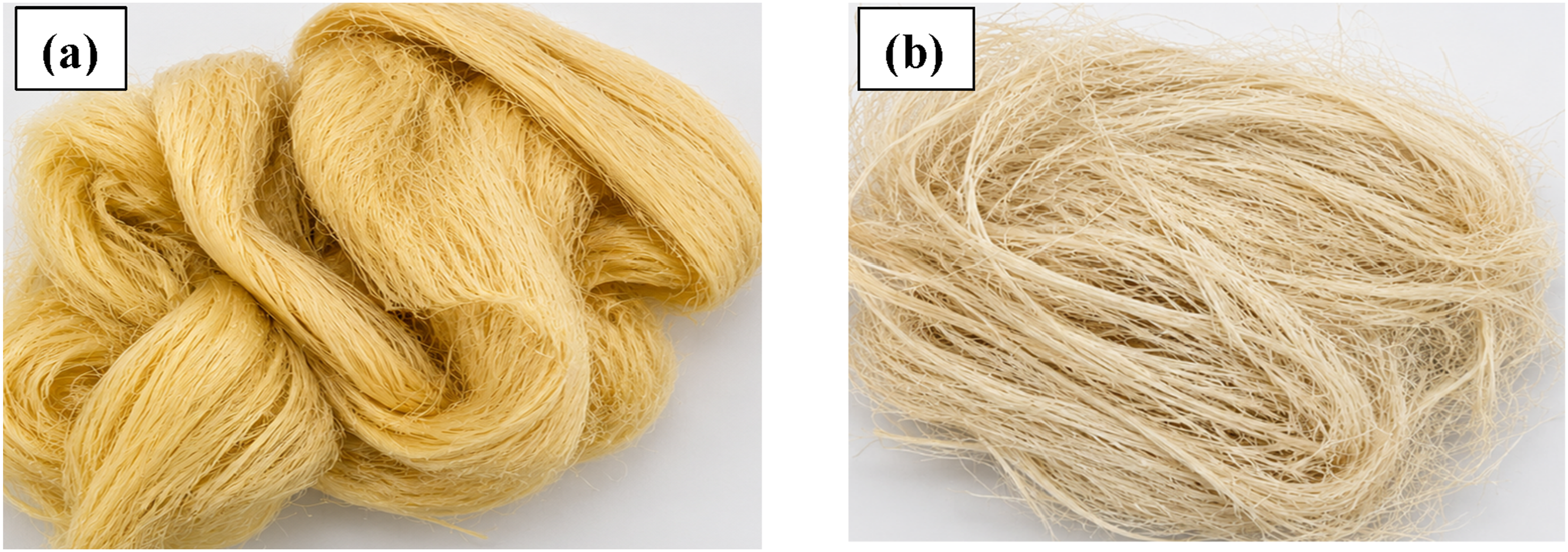
Sorbents and their properties
Diesel oil was used as the test liquid because of its frequent occurrence in spills and its environmental relevance. The physical properties of the diesel oil used in this study were: density = 817 817 kg/m3 measured using a gravimetric method; surface tension = 26 mN/m at 20 °C measured using a process tensiometer; and kinematic viscosity = 2.5 mm2/s at 20 °C.
Nonwoven web preparation and needle-punching
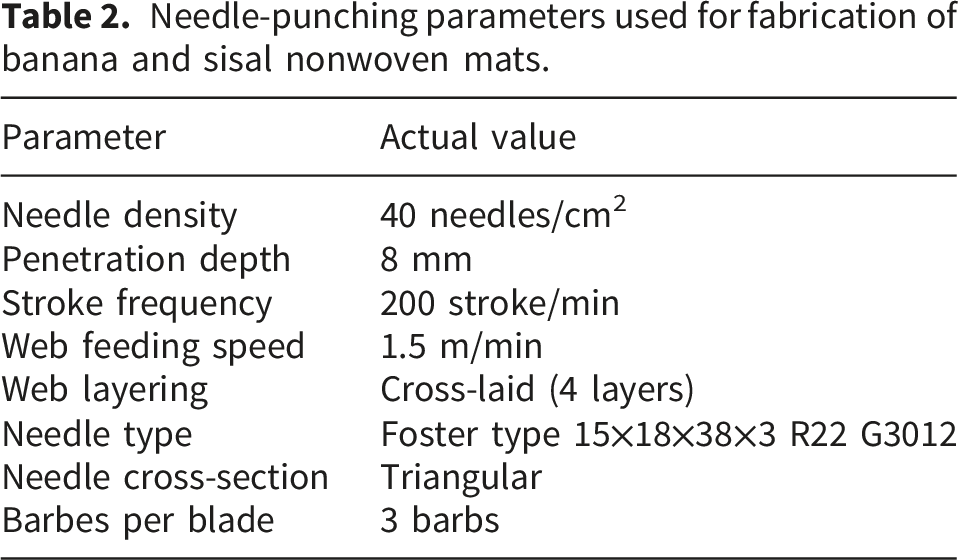
All fiber processing was carried out at standard laboratory conditioning as specified ISO 139 (temperature 20 ± 2 °C, relative humidity 65 ± 4%). Each fiber type (sisal and banana) was first manually opened to loosen the fiber bundles and then carded individually using a mini carding machine to obtain individualized staple fibers. In this study, only single-fiber nonwoven mats were fabricated and evaluated: a 100% sisal mat and a 100-banana mat. No inter-fiber blending was performed; each mat was produced from a single fiber type to allow a direct, unconfounded comparison of fiber specific sorption properties. This design choice was deliberate by isolating each fiber type, the study establishes the baseline sorption performance of each material individually, which is a necessary first step before investigate the blended composition. Parallel-laid webs were produced on the mini carding machine by layering the staple fibers to reach the target basis weight.
Web consolidation was achieved by needle-punching: stacked carded webs were passed under a laboratory scale swing type needle punching loom and repeatedly pierced by barbed steel felting needles to mechanically entangle the fibers and form a cohesive nonwoven mat. The needle had a triangular cross-section with 3 barbs per blade, which is suitable for effective entanglement of the course natural fibers while limiting fiber damage. The complete needle-punching process parameters are as follows.
Thes parameters were selected based on established protocols for coarse natural fiber nonwoven fabrication and were held constant across both fiber types to ensure direct comparability of sorption result.
Measurement of oil retention of nonwoven fabrics
The oil sorption test was carried out using diesel oil following the ASTM F726-12 standard for sorbent performance evaluation. A 2 g sample of nonwoven mat was placed in a glass beaker containing 200 ml of diesel oil. To simulate dynamic sea-surface conditions, the beaker was placed on orbital shakers. Tests were conducted at three shaker speeds (100, 150, and 200 rpm) and three exposure times (5, 10, and 15 min) to investigate the effect of agitation and contact time on sorption behavior. Immediately after each exposure period, the sorbent sample was removed from the shaker, allowed to drain on stainless-steel mesh for an initial gravimetric drip, and then weighed. Dripping and retention were further monitored gravimetrically at scheduled intervales (every 12 h ± 1 min) up to a cumulative period of 36 h to evaluate oil retention and dripping losses. After each test, fresh diesel oil was used to minimize the effect of volatile fuel components. Oil retention, expressed in g/g was calculated using the following equation.
Experimental design and optimization (RSM)
The response surface methodology (RSM) based central composite design (CCD) was employed to model the effect of two independent variables, namely shaker speed (rpm) and contact time (min) on oil sorption capacity. Design-Expert® v13 (Stat-Ease) was used to generate the experimental design matrix and to perform statistical analysis. The factor levels selected for the CCD were aligned with the dynamic sorption tests described earlier, with the shaker speed set at 100 rpm low, 150 rpm center and 200 rpm high and the contact time at 5 min low, 15 min center and 20 min high The CCD incorporated center points and axial runs to enable estimation of linear, quadratic terms and interactions effects. Model adequacy was assessed by ANOVA, coefficient of determination (R2), adjusted R2, lack-of-fit tests and residual diagnostics. While the model predictions were validated against experimental replicates at the predicted optimum conditions.
Microstructure characterization of fibers and nonwovens
The longitudinal surface morphology of individual banana and sisal fibers was examined using optical light microscopy. Fiber samples were mounted on glass slides and observed under a laboratory optical microscope (Leica DM50, Leica Microsystems, Germany) at ×100 magnification. The images were captured using the integrated digital camera and processed with the LAS EZ software (Version 3.4) to evaluate surface texture, cross-sectional uniformity and the presence of lumen channels or fiber-bundle remnants. At least five representative fields of view were recorded per fiber type to ensure adequate representation of the morphological features.
The three-dimensional fiber network structure of the needlepunched nonwoven mats was examined by scanning electron microscopy (SEM). The representative specimens of approximately 10 mm × 10 mm were cut from the central region of each mat, mounted on aluminum stubs using double-sided carbon adhesive tape and sputter-coated with a thin layer of gold (approximately 10 nm) under an argon atmosphere using a Quorum Q150R sputter coater (Quorum Technologies, UK) to render the specimens electrically conductive and prevent charge accumulation during imaging. The specimens were observed in a JEOL JSM-6390A scanning microscope (JEOL Ltd., Japan) at an accelerating voltage of 15 kv and working distance of 10 mm. All micrographs were acquired at ×250 magnification to reveal the inter-fiber pore structure, fiber entanglement, density and overall mat architecture. Image analysis was performed using ImageJ (Version 1.54, National Institutes of Health, USA) to qualitatively evaluate pore-channel dimensions and fiber orientation distribution.
Measurement of areal density, thickness, porosity Sorption’s of oil and water droplets
The areal density and thickness of needlepunched nonwoven fabrics were determined by following of ASTM D6242 and ASTM D5729-97 testing standards respectively. The fabric porosity was calculated using (Eq.2).
The thickness measurement was carried out both dry and oil saturated condition. Initially the dry thickness of each sample was recorded and subsequently oil was applied onto the fabric using the syringe while maintaining the sample position on the thinness tester until the full saturation was achieved. The thickness was measured after completed whetting of the experiment for all samples. For the evaluation of oil and water sorption behavior, small droplets of oil and water were carefully deposited onto the surface of the needlepunched nonwoven fabric using 4 ml syringes the interaction between the liquid droplets and the fabric surface was observed and recorded.
Results and discussion
Microstructural characterization of fibers and nonwoven mates
The optical micrographs in Figure 2 reveals the clear morphological differences between the two fiber types. Banana fiber (Figure 2(a)) displays a smooth, ribbon-like longitudinal surface with the fine longitudinal striations associated with their cellulosic microfibrillar architecture, whereas, sisal fiber (Figure 2(b)) exhibits a coarse, more irregular surface texture with visible lumen channels and occasional fiber-bundle remnants. These surface features are consistent with the reported fineness value (banana: 6.2 tex; sisal: 7.697 tex) and reflect the distinct botanical origins of the two lignocellulosic materials. Optical micrographs (×100) showing longitudinal morphology of (a) banana and (b) sisal fibers.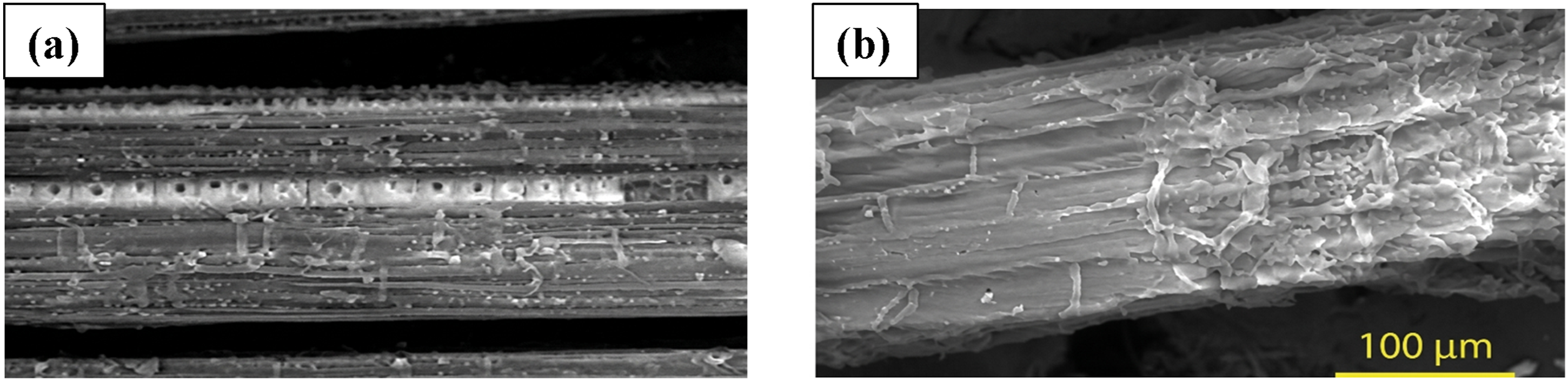
The SEM micrographs at ×250 magnification (Figure 3) provide the structural evidence of the three-dimensional fiber network formed after needle-punching. In the banana nonwoven mat (Figure 3(a)), the finer fibers are densely and uniformly entangled, forming a compact network of narrow inter-fiber pore channels. The needle-punching process has effectively reoriented and interlocked the individual fibers in the thickness direction, producing the cohesive mat with high fiber-to-fiber contact density. The pore spaces visible in the micrograph are predominantly small and interconnected, consistent with the calculated porosity of 95.4% and the high capillary pressure associated with the fine-fiber architecture. SEM images (×250) of needlepunched nonwoven mats made from (a) banana and (b)sisal fibers.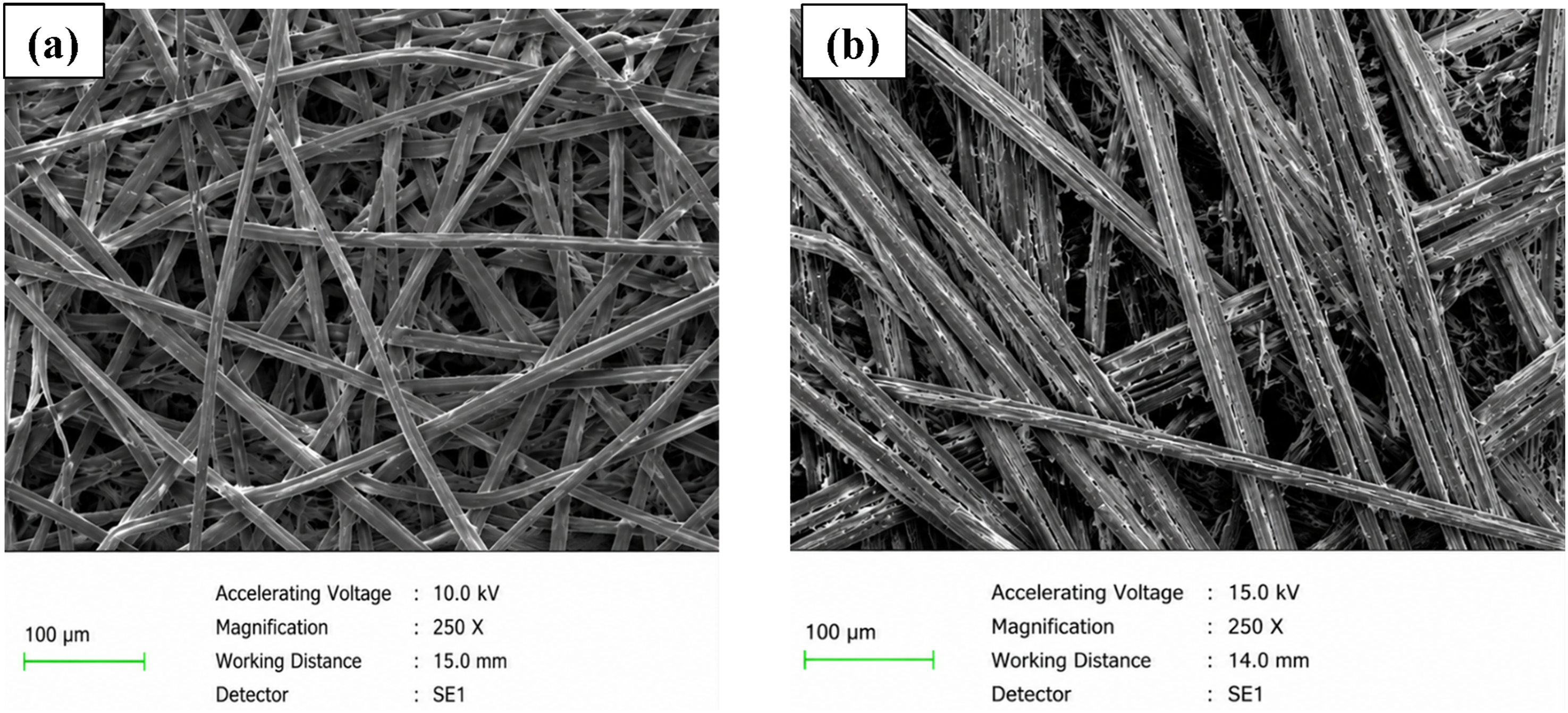
In contrast, the sisal nonwoven mat (Figure 3(b)) exhibits a more open heterogeneous pore structure. The coarse, stiffer sisal fibers produce a mat in which inter-fiber voids are visibly larger and less uniformly distributed. Although fiber entanglement is evident from the needle-punching treatment, the lower fiber count per cross-sectional area results in fewer capillary junctions and larger macropores compared to the banana mat. This structural difference is directly linked to the sorption behavior. The smaller and more numerous capillaries in the banana mat generate a stronger capillary driving force (ΔP = 4γcosθ/d) that promotes rapid oil uptake and resists drainage under agitation, whereas the larger pores in sisal mat allows oil to drain more readily, particularly at higher speeds. Together, the optical and SEM images corroborate the fiber property data in Table 1 and provide direct microstructural evidence for the performance differences quantified by the RSM models.
Model fitting and overall performance
The CCD–RSM analysis produced simple linear models that describe the dependence of diesel-oil uptake (%) on contact time (A, minutes) and shaker speed (B, rpm) for the two needlepunched nonwoven sorbents. The fitted models (expressed in actual terms) are:

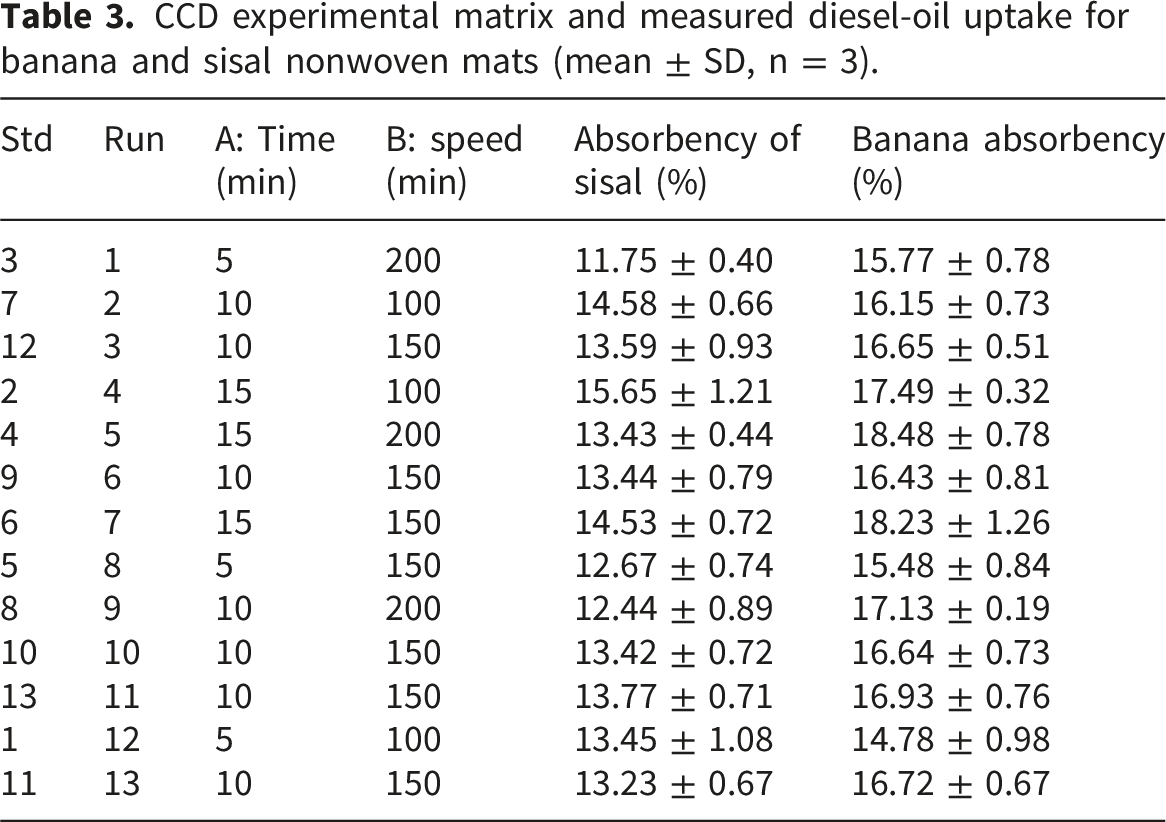
Predicted values from these linear equations 3 and 4 show excellent agreement with experimentally observed uptake across the CCD runs, and parity plots indicate a close 1:1 relationship between measured and predicted values. Although the oil uptake in porous sorbents can be exhibit nonlinear behaviour over wide operating ranges frequently described by nonlinear kinetic models such as pseudo-second-order kinetics that account for complex pore diffusion and surface site interaction, 23 within the restricted experimental domain investigated in this study the contact time (5-15 min) and the shaker speed (100-200 rpm), the response showed an approximately linear trend. The statistical analysis of the CCD results indicated that the quadratic and interaction terms were not statistically significant (p > 0.05); therefore, the linear models were sufficient to describe the uptake behaviour without loss of predictive accuracy.
Needle-punching parameters used for fabrication of banana and sisal nonwoven mats.
The parity plots in Figure 3 (a) and (b) show minimal scatter around the diagonal and corroborate the strong predictive performance of the linear models.
CCD experimental matrix and measured diesel-oil uptake for banana and sisal nonwoven mats (mean ± SD, n = 3).
ANOVA results for RSM model of diesel-oil uptake in sisal fiber nonwoven mats.
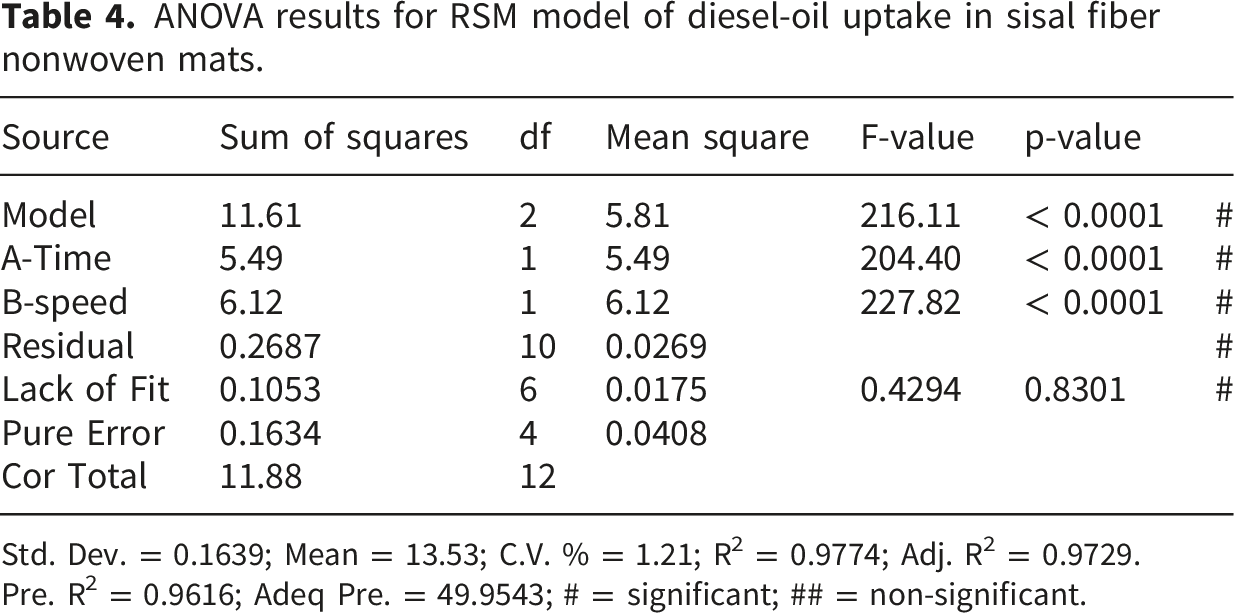
Std. Dev. = 0.1639; Mean = 13.53; C.V. % = 1.21; R2 = 0.9774; Adj. R2 = 0.9729.
Pre. R2 = 0.9616; Adeq Pre. = 49.9543; # = significant; ## = non-significant.
ANOVA results for RSM model of diesel-oil uptake in banana fiber nonwoven mats.
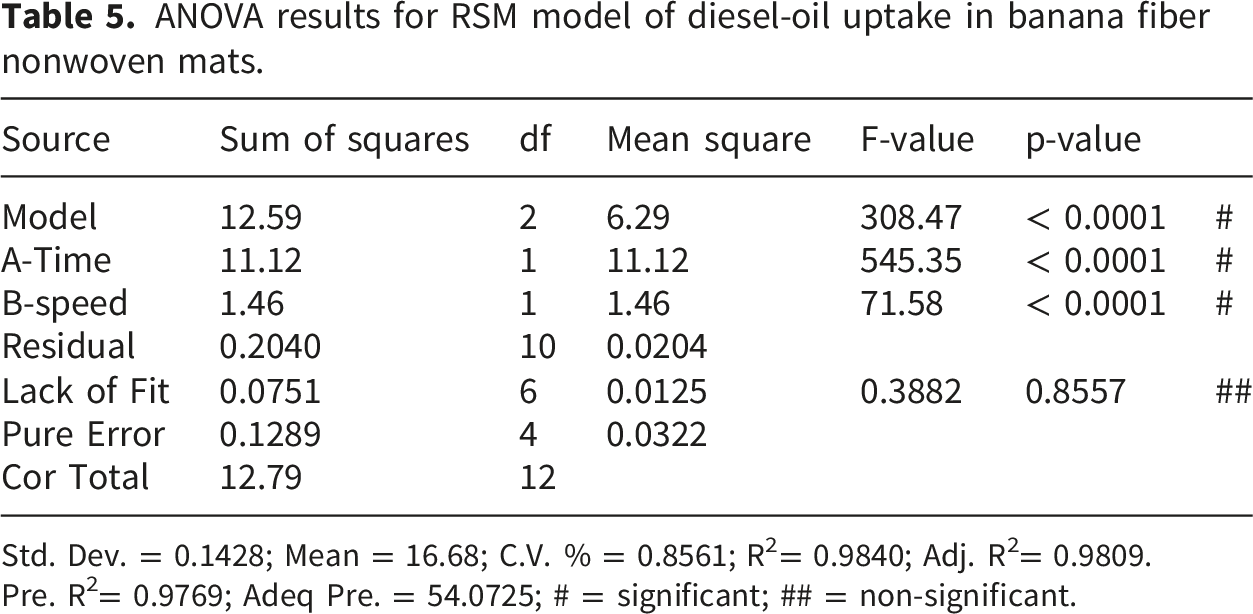
Std. Dev. = 0.1428; Mean = 16.68; C.V. % = 0.8561; R2= 0.9840; Adj. R2= 0.9809.
Pre. R2= 0.9769; Adeq Pre. = 54.0725; # = significant; ## = non-significant.
Main effects: Influence of contact time and speed
The structural basis for this divergent response lies in the difference in inter-fiber pore size between the two mats. In the sisal mat, the coarser fibers (7.697 tex) produce larger macropores with lower capillary retention pressure; at high orbital speeds, the hydrodynamic shear force exceeds the capillary pressure holding oil in these large pores, leading to net drainage. In the banana mat, the finer fiber (6.2 tex) generates substantially narrower capillaries with proportionally higher retention pressure (ΔP ∝ 1/d); these narrow channels resist hydrodynamic displacement even 200 rpm, so moderate agitation instead aids oil transport deeper int the mat interior without causing significant drainage loss. This pore-scale mechanism is directly visible in the SEM image (Figure 3) and is quantitatively consistent with the higher post-saturation dimensional stability of banana mat (thickness change 3.63% vs. 6.67% for sisal; Table 9).
The regression analysis shows that contact time (A) positively affects uptake for both fiber types, with coefficients +0.191333 and +0.27333 for sisal and banana nonwoven mats respectively, indicating that longer contact time increases the total uptake through diffusion limited filling of pore space and progressive imbibition into fiber interstices. Shaker speed (B) had divergent effects on the two fiber types. For sisal nonwovens, the negative coefficient 9-0.020200) indicates that higher agitation reduces retained oil, likely owing to accelerated drainage and impaired capillary entrapment under strong hydrodynamic shear. For banana nonwovens, the small positive coefficient (+0.009867) indicates that controlled agitation modestly promotes oil transport into accessible pores without causing excessive drainage loss (Figure 5a and 5(b)). Response surface plots showing effects of contact time and shaker speed on diesel-oil uptake for (a) sisal and (b) banana nonwovens.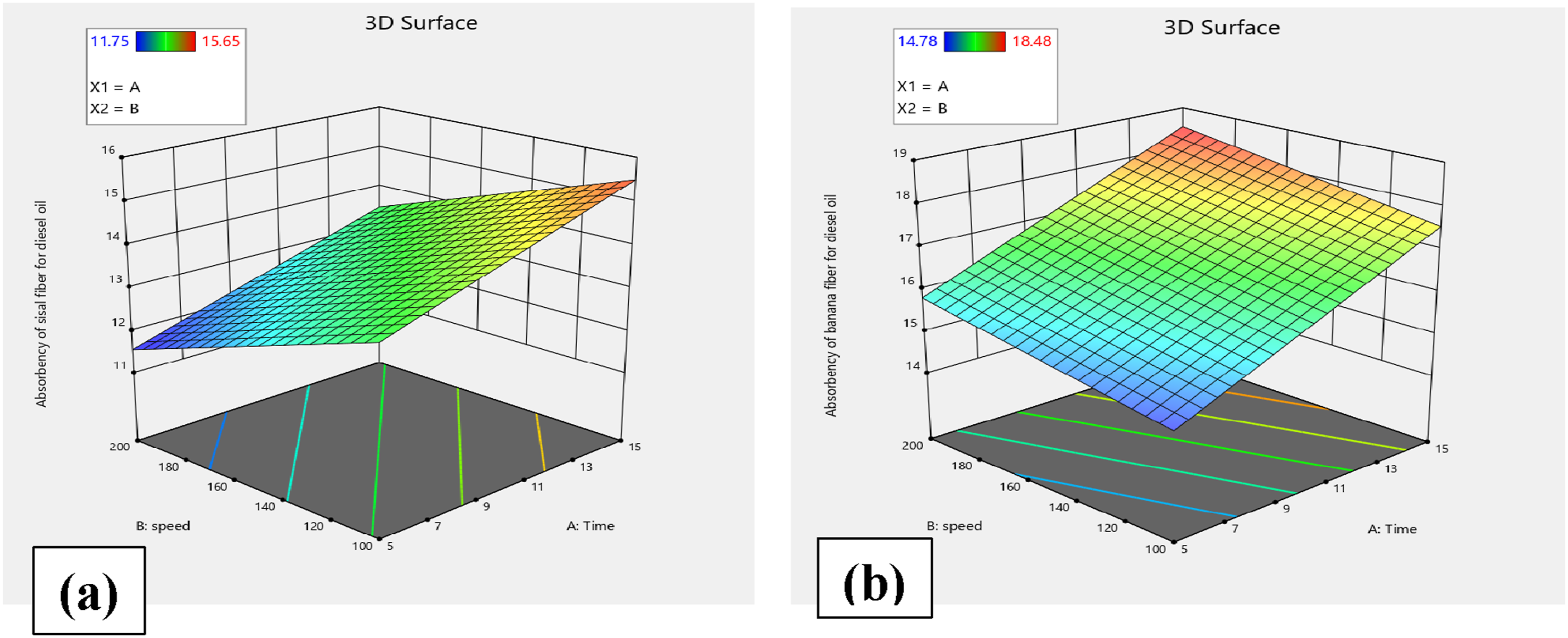
Optimization and practical operating points
Model fit summary statistics for sisal and banana fiber absorbents.
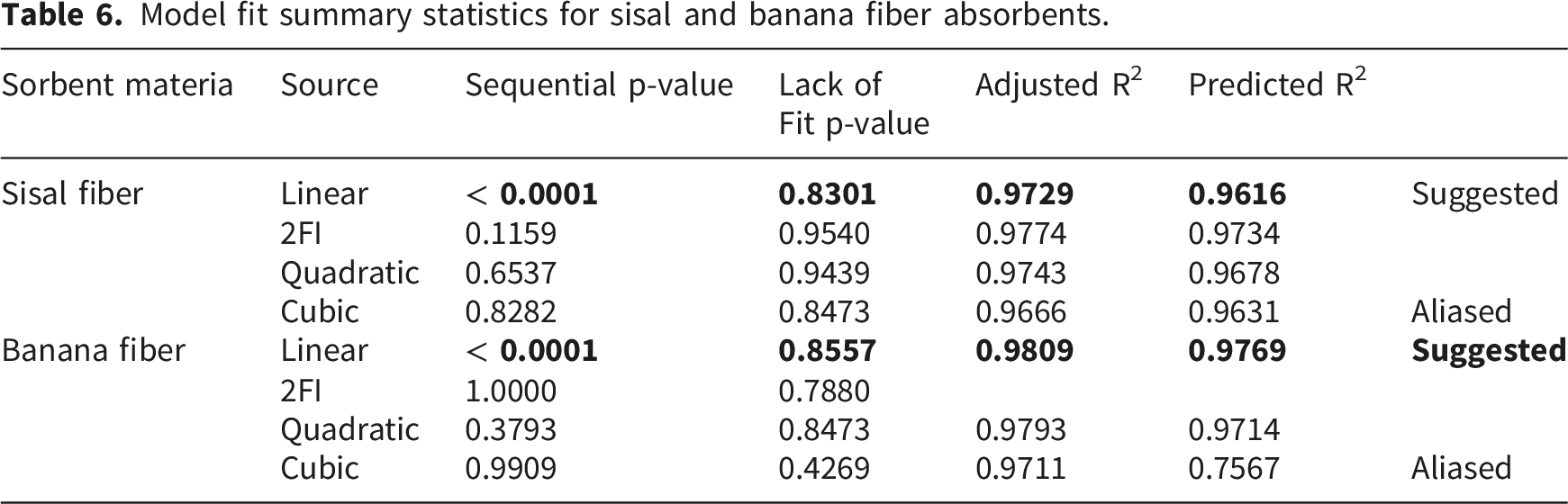
Optimization constraints for sisal and banana nonwoven fabrics.

Optimization results (selected solution) for sisal nonwoven.

While higher agitation or longer contact times could further increase the oil uptake, the desirability function penalized such conditions. Consequently, the model favors low-speed, short-contact operation that still attains acceptable uptake. These results provide practical guidance for rapid, low energy recovery scenarios such as emergency oil spill response, while to highlight the material specific performance differences, with banana nonwoven mats consistently outperforming sisal mats.
Across the experimental domain banana nonwovens provided consistently higher diesel uptake than sisal nonwovens. The reasons for the superior performance of banana fiber nonwovens are rooted in three interrelated structural factors such as fiber morphology, pore architecture and fabric consolidation. First, banana fiber is considerably finer (fineness = 6.2 tex) than sisal fiber (7.697 tex), as reported in Table 1. The finer fibers pack more tightly within the needlepunched mat and generate a larger number of inter-fiber capillary channels per unit cross-sectional area. Because capillary pressure scales inversely with effective pore radius (ΔP = 4γcosθ/d), the narrower capillaries in banana mats exert a stronger capillary driving force that actively wicks oil into the mat interior and resists drainage under agitation (25 ref). Second, despite banana mats having a slightly lower areal density (183.5 vs 198.8 g/m2) and thickness (2.48 vs. 2.70 mm), their calculated porosity (95.4%) is marginally higher than that of sisal (95.25), indicating that the banana mat accommodates more open void volume related to its fiber mass. This combination of fine fibers and high porosity creates a densely interconnected capillary network that maximizes both oil uptake capacity and retention. The third, the divergent response to shaker speed, sisal fiber mat uptake decreasing at higher rpm (negative coefficient -0.020200) while banana uptake increases modestly (positive coefficient +0.009867) reflects structure resilience: the finer mor flexible banana fiber network resists hydrodynamic displacement of trapped oil, whereas the coarser, stiffer sisal fiber produce larger macropores from which loosely held surface oil is more readily expelled by agitation. Together, these morphological and structural differences consistently favor banana fiber nonwovens across all experimental condition. 24
Characterizations of non-woven fabrics in terms of areal density, thickness and oil retention properties
Structural properties and diesel-oil retention performance of banana and sisal nonwoven mats.

The diesel oil retention result shows the clear difference between the two fiber types. The banana fiber nonwoven fabric indicates higher oil retention capacity (16.34 g/g) compared to the sisal fiber nonwoven mat (13.59 g/g) as shown in Table 9. This difference attributed to the finer morphology of banana fibers, which provides the larger effective surface area and more interconnected capillary networks within the fabric structure. A higher number of fibers per unit volume improves the capillary action, leading to the improved oil uptake and retention. This observation agrees with previous studies reporting that oil sorption in fibrous materials is strongly governed by capillary forces, fiber fineness, and pore structure. 25 By contrast, sisal fiber nonwoven mats demonstrated lower oil retention (13.59 g/g) despite having slightly higher areal density (198.8 g/m2) and thickness of (2.70 mm). The coarser and stiffer nature of sisal fiber (fineness = 7.697 tex; density = 1.750 g/cm3) produced a mat with larger inter-fiber pore channels and lower fiber count per unit area. The larger pore radii reduce the capillary suction pressure, diminishing the driving force for spontaneous oil imbibition and allowing oil to drain more freely under agitation. Additionally, the surface-area -to-volume ratio of coarser sisal fibers reduce the total interfacial contact area available for oil adhesion. The higher density of sisal fiber (1.750 vs. 1.350 g/cm3) for banana also means that for an equivalent mass of fabric, sisal presents fewer individual fibers and thus fewer capillary junctions where oil can be retained by meniscus force. Similar behavior has been reported for coarse natural fiber-based sorbents, where larger pore sizes and reduced surface area lead to lower oil retention efficiency. 26 The thickness variation after oil absorption further reflects the structural response of the fabric. Banana fiber nonwoven mat showed a smaller percentage change in thickness (3.63%) compared to the sisal fiber nonwoven mats (6.6%) as indicated in Table 9. This suggests that the denser, finer fiber network of banana mats maintain better dimensional stability upon oil uptake. The finer fibers interlock more tightly during needle punching, creating a more cohesive three-dimensional structure that resists swelling. By contrast, sisal mats undergo greater thickness expansion (6.67%) because the coarser, stiffer fiber are held in a less compact arrangement; when saturated, oil accumulation within larger inter-fiber voids causes fiber rearrangement and mat lofting. This greater swelling in sisal mats further implies that a portion of the oil is held in loosely structured surface voids rather than in tight capillary channels, consistent with the higher drainage losses observed for sisal observed for sisal under agitation.
Overall, the results showed in Table 4 demonstrate that fiber fineness and structural characteristics significantly influence diesel oil retention behavior in needlepunched nonwoven mats. The banana fiber nonwoven mat exhibits superior oil sorption performance and better structural stability compared to sisal fiber nonwoven mats, making it more suitable for biodegradable oil sorbent applications.
Dripping, retention and temporal stability
Dripping and retention were monitored gravimetrically during a 36-h post-test period (see Methods). Qualitatively, most immediate mass loss occurred during the first draining interval (i.e., the standardized free-drain period and the first 12 h), after which mass loss slowed and approached a plateau. These behaviors that rapid initial drainage followed by stabilized retention matches expectations for porous sorbents where loosely retained surface oil drains quickly while oil that impregnated inner pore space remains. For deployment, these retention characteristics imply that (i) short-term reloading or handling soon after recovery risks additional oil loss, and (ii) sorbent design should balance high initial uptake with structural features that minimize post-collection dripping if recovered mass is to be preserved.
Practical implications and comparison with conventional sorbents
The observed maximum uptakes (18.5% for banana and 15.7% for sisal under certain test conditions) are lower than typical uptake capacities reported for synthetic polymer sorbents on a mass basis; however, the value proposition of banana and sisal nonwovens lies in biodegradability, low cost and local availability. 21 For shoreline or localized spill scenarios where sorbent retrieval and disposal pose logistical and environmental challenges, biodegradable natural-fiber nonwovens represent a compelling sustainable alternative, particularly if uptake and retention can be enhanced through targeted post-treatments or structural optimization.
Among natural-fiber sorbents, kapok is the most extensively studied benchmark. Its hollow, waxy lumen structurer imparts intrinsic hydrophobicity and reported oil sorption capacities of 20-40 g/g for crude and refined oils in static tests.27,28 Although these values exceed those measured here for banana (up to 18.5%) and sisal (up to 15.75), kapok is specialty crops in sub-Sharan Africa and other tropical regions, making them far more accessible for in-country oil-spill response. Coir (coconut husk fiber), another frequently compared sorbent, exhibits oil uptakes in the range of 3-8 g/g in its raw form, which is attributable to its high lignin content and relatively low specific area.29,30 Banana and sisal nonwovens thus outperform raw coir by a substantial margin, and their needlepunched fabric from eliminates the loos-fiber handling challenges associated with coir deployment. Raw cotton fiber and cotton nonwovens show moderate uptake value (typically 5-12 g/g for mineral oil) and are highly hydrophilic, which limits their selectivity in oil-water scenarios without surface modification.31,32 The banana and sisal mats evaluated in this study operate in a comparable performance range on a mass basis while offering the additional advantages of being fabricated from zero-cost agricultural bioproducts. The commercial synthetic sorbents particularly melt-blown polypropylene (pp) nonwovens remain the industrial standard, with reported oil uptake capacities of 20-70 g/g depending on fiber diameter, mat thickness and test conditions.33,34 Ther superior performance derives from inherent oleophilicity, controlled microfiber diameters (1-5µm), and highly uniform pore size distributions achievable through industrial melt-blowing, none of which are readily replicated in the needlepunched coarse-fiber format used here. Nevertheless, the critical disadvantage of PP and related polyester, polyurethane, and polystyrene sorbents is their persistence in the marine environment: they are not biodegradable and their fragmentation into microplastics during deployment or disposal constitutes secondary pollution.35,36 By contrast, banana and sisal fibers degrade completely under ambient environmental conditions and their fabrication requires no petrochemical inputs. For applications in ecologically sensitive coastal zones, coral reef environments, or regions with constrained waste-management infrastructure, the sustainability profile of natural-fiber nonwovens is a decisive advantage that partially offsets their lower gravimetric uptake. Future performance improvement through alkaline or silane surface treatment which have been shown to reduce the hydrophilicity of cellulosic fiber by 30-50% while increasing oil selectivity could substantially close the gap with synthetic sorbents without sacrificing biodegradability.14,16
Conclusions
Needlepunched nonwoven mats produced from banana and sisal fibers exhibited measurable and reproducible diesel-oil sorption behavior that can be effectively model using a CCD–RSM linear framework within the investigated experimental domain. Banana nonwovens achieved a higher predicted optimum uptake (16.34%) than sisal (13.59%) under the selected multi-objective optimisation conditions (minimum contact time and shaker speed), while sisal uptake showed a marked sensitivity to agitation intensity. Both models are statistically robust (p < 0.0001; R2 > 0.97), and the microstructural evidence presented in Figures 3 and 4 corroborates the fiber-level mechanisms responsible for the observed performance differences. The results establish banana and sisal needlepunched nonwovens as viable, fully biodegradable candidate sorbents for marine diesel-oil spill mitigation, with a particularly compelling sustainability profile relative to conventional synthetic alternatives. Parity plots showing agreement between experimental measurements and RSM-predicted diesel-oil uptake (%) for (a) sisal and (b) banana needlepunched nonwoven mats.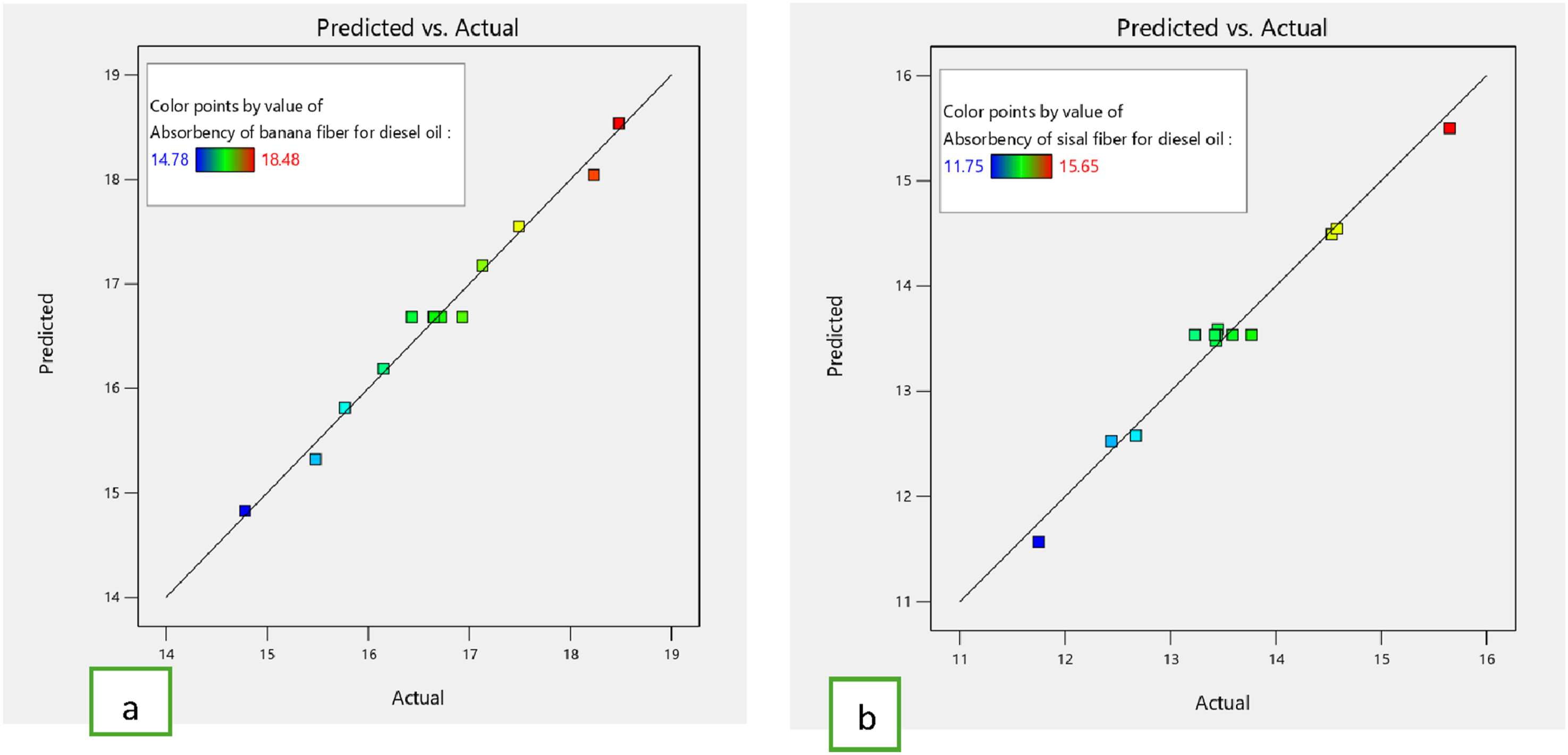
Several directions merit priority attention in follow-on research. First, reusability must be quantified: multiple sorption-expression cycles should be evaluated to determine the capacity retention, structural integrity and drainage efficiency of the mats after mechanical squeezing or centrifugal dewatering, since practical deployment almost universally requires at least partial sorbent recovery. Second, retention kinetics should be characterized more rigorously; the current gravimetric drip tests provide useful qualitative insight, but fitting the temporal drainage data to established models (e.g., pseudo-second-order intraparticle diffusion) would allow the rate constants and equilibrium retention values to be compared quantitatively with those of competing sorbents. Third, surface modifcation offers a clear route to performance enhancement: hydrophobic treatment such as silane functionalization, alkali-acid sequential treatment or low-cost wax or fatty acid coatings have been shown to reduce the surface energy of cellulosic fiber substantially, improving oil-water selectivity without compromising biodegradability. Fourth, the current laboratory test used static beaker conditions with diesel oil; field validation under realistic marine conditions including waves, saline water, weathered crude oil a variable temperature is an essential and necessary next step before any operational deployment can be recommended.
Footnotes

Funding
The authors received no financial support for the research, authorship, and/or publication of this article.
Declaration of conflicting interests
The authors declared no potential conflicts of interest with respect to the research, author ship, and/or publication of this article.