




Abstract
Bailey et al. (2016) have provided an excellent, state-of-the-art overview that is a major contribution to our understanding of sexual orientation. However, whereas Bailey and his coauthors have examined the physiological, behavioral, and self-report data of sexual orientation and see categories, I see a sexual and romantic continuum. After noting several objections concerning the limitations of the review and methodological shortcomings characteristic of sexual-orientation research in general, I present evidence from research investigating in-between sexualities to support an alternative, continuum-based perspective regarding the nature of sexual orientation for both women and men. A continuum conceptualization has potential implications for investigating the prevalence of nonheterosexuals, sexual-orientation differences in gender nonconformity, causes of sexual orientation, and political issues.
In “Sexual Orientation, Controversy, and Science,” J. Michael Bailey, one of the foremost sex researchers of our time, whose footprint is clearly evident throughout the manuscript, has assembled an impressively diverse and eminent array of scholars who tackle the complexities of sexual orientation. For the most part, they have accomplished this task with excellence and within a scientific framework.
However, I have one major objection to their overview: Whereas they approach the field of sexual orientation from a categorical perspective, I interpret the same data as being indicative of a sexual and romantic continuum. The empirical evidence convinces me that sexual orientation should not be reduced to two or three (gay, straight, bisexual) discrete categories. And, if discrete groups exist, there are more than three and they are likely not to be separate but to be overlapping—a continuum (Savin-Williams, 2014; Savin-Williams, Cash, McCormack, & Rieger, in press).
First, however, I address several secondary concerns.
Limited Scope of Overview
The purpose of the overview is “to provide a current summary of scientific findings regarding sexual orientation” (p. 45). Although its coverage is indeed wide-ranging, it is somewhat restricted in that an equally celebrated assemblage of scholars might have produced a different manuscript in terms of topics reviewed and conclusions reached (e.g., emphasizing negligible differences between the sexes in sexual orientation). This is not to say that the science would be equally robust but merely that scholars disagree as to the prominence and interpretation they give to particular findings.
For example, topics given short shrift by Bailey et al. (2016) include the impact of sexual orientation on mental and physical health; personality traits related to sexual and romantic expression; sexual and romantic developmental milestones; variations among ethnic, racial, social, and other minorities; and societal contributions to, well, everything. Nuances among findings are sometimes missing or downplayed. For example, men as well as women experience instability (sexual fluidity) across time and context (Diamond, in press; Savin-Williams, 2016; Savin-Williams, Joyner, & Rieger, 2012).
Methodological Limitations
Bailey et al. (2016) also did not emphasize several methodological shortcomings endemic in sexual-orientation research that have had profound effects on the research they cite. Although sexual orientation can be assessed using numerous methods, including self-reports, physiological responses (genital arousal, pupil dilation, neurological activity), and indirect behavioral protocols (reaction and viewing time; Costa, Braun, & Birbaumer, 2003; Ebsworth & Lalumière, 2012; Huberman & Chivers, 2015; Lippa, 2012; Rieger & Savin-Williams, 2012; Wright & Adams, 1994), the vast majority of research relies on a single method (self-report) and a single measure (one survey question inquiring about sexual-orientation identity based on sexual attraction). Researchers seldom include multiple methods and measures to assess the validity and reliability of findings. Whether this weakness is sufficient to cast doubt on the veracity of the science of sexual orientation remains unresolved (Korchmaros, Powell, & Stevens, 2013; Savin-Williams, 2005; Sell, 1997).
The frequent failure of research to incorporate romantic indicators that would enhance our understanding of sexual orientation is another methodological shortcoming unrecognized in this review. Whether romantic orientation is identical to, overlaps with, or exists separate from sexual orientation is a matter of ongoing debate. The inclusion of infatuation, romantic-attraction, and romantic-relationship measures in sexual-orientation research would likely reveal that these features overlap, to varying degrees, with sexual orientation and would help elucidate the degree to which and the consistency with which they are indicative of sexuality (Hatfield & Rapson, 2009; Savin-Williams, in press). 1
Although subject recruitment—that is, who is included and excluded in sex research—is only minimally addressed in the manuscript, it is arguably the single most critical and disregarded factor in scientific sexual inquiry (Bogaert, 1996; Kuyper, Fernee, & Keuzenkamp, 2016). The importance of recruiting a representative sample of nonheterosexuals, as well as the costs (i.e., skewed findings and lack of generalizability) of failing to do so, is usually conceded in individual studies. Thereafter, however, these limitations are minimized or summarily dismissed. Yet it greatly matters how sexual orientation is defined and where participants are obtained. For example, a common strategy for recruiting nonheterosexuals is to mine gay organizations, websites, conferences, resource centers, and pride marches, venues most sexual minorities do not frequent. In addition to these errors of omission, errors of inclusion also skew the data, such as the presence of straight prankster adolescents in The National Longitudinal Study of Adolescent to Adult Health (Add Health; Savin-Williams & Joyner, 2014). Both sampling issues confound the conceptualization and analysis of topics raised by Bailey et al. (2016). For example, they reported that sexual minorities are more gender nonconforming, yet this discrepancy between heterosexuals and nonheterosexuals might be overstated, a consequence of recruitment strategies that solicit sexual minorities who are more likely to be out to themselves and others precisely because they are gender nonconforming and thus unable to conceal their sexual orientation. Concurrently, research likely fails to include gender-conforming nonheterosexuals who eschew sex research or do not acknowledge their same-sex sexuality. Perhaps they are better able to conceal their sexuality, want to avoid being associated with feminine gays or masculine lesbians, or do not volunteer for sex research because they believe their sexual orientation should not, and does not, define them (Savin-Williams, 2005, 2016).
Sexual Orientation as a Continuum
These reservations aside, my primary concern with Bailey et al.’s (2016) report entails a fundamental disagreement with a premise of their overview—that there are only a few distinct sexual-orientation categories. Bailey et al. (2016) defined sexual orientation as “attraction to members of the same sex, both sexes, or the other sex” (p. 48). The critical modification I would make is to append the words “—to varying degrees,” thus designating a sexual continuum. Indeed, many sex researchers initially assessed sexual orientation as a continuum, ranging from exclusively opposite-sex to exclusively same-sex attraction with degrees of nonexclusivity in between—usually rated on a 5- or 7-point Kinsey-like scale (Kinsey, Pomeroy, & Martin, 1948; Klein, Sepekoff, & Wolf, 1985). Despite employing this methodology, many contemporary sex researchers have subsequently collapsed the continuous construct into discrete, mutually exclusive categories (Haslam, 1997) and “refer to sexual attraction patterns as ‘homosexual,’ ‘bisexual,’ or ‘heterosexual’” (Bailey et al., 2016, p. 48). Kinsey 0s and 1s become “heterosexual,” Kinsey 5s and 6s become “gay,” and all extraneous (nonexclusive) orientations (Kinsey 2s, 3s, 4s) become “bisexual.” Not uncommonly, the latter two groups are further combined and defined as amorphous nonheterosexuals or generic sexual minorities.
Regardless of which procedure is employed, the range of sexual and romantic characteristics of nonexclusive sexualities (i.e., bisexuality) is typically disregarded. Reasons for lumping sexual orientation into typologies are both practical, because an insufficient number of nonheterosexual participants are recruited or volunteer, and theoretical, based on a conceptualization of sexual orientation that is essentially categorical, especially for men (Bailey, 2009). Though Bailey et al. (2016) recognized the unique nature of bisexuals in the first third of their text, including a separate section, bisexuals are subsequently largely ignored in discussions of the causes of sexual orientation, gender nonconformity, the historic and cultural record, and policy debates. Relevant data exist, however, for all of these topics. For example, bisexual males vary from straight and gay males in gender nonconformity (Cohen, 2002; Dunne, Bailey, Kirk, & Martin, 2000). Dunne et al. (2000) found that straight-identified men and women with some degree of same-sex attraction and/or behavior (e.g., “mostly straight”; see below) varied from individuals who reported no same-sex attraction and/or behavior in gender nonconformity. Both these studies and others support the view that bisexual individuals are not merely closeted gays or misdirected straights.
Whether sexual orientation should be reductively conceptualized as a few discrete categories with little overlap or as a continuum with gradations of sexual and romantic features has long been a source of controversy (Gangestad, Bailey, & Martin, 2000; Haslam, 1997; McConaghy, 1987, 1999; Norris, Marcus, & Green, 2015; Savin-Williams, 2014). The categorical approach was challenged some 40 years ago when Hart and colleagues (1978) warned against subsuming all “homosexuals . . . under the same label” (p. 607) simply because they engage in similar behavior. To do so is to overlook complexities, including the extent to which similar behavior arises from discrepant “underlying biological, psychological, or sociocultural mechanisms” (p. 607). A recent review concluded that measuring sexual attractions along a continuum acknowledges sexual orientation as a continuous variable and that data from such measurements are “likely be more accurate than data from questions using distinct categories [identity, sexual behavior]” (Pega, Gray, Veale, Binson, & Sell, 2013, p. 3). Regardless, McConaghy’s (1987, 1999) early critique that identified the category-versus-continuum debate as one of the major unresolved issues in sex science remains prescient. And so it endures.
In support of a sexual-continuum perspective, I present below evidence for the uniqueness of in-between (i.e., between heterosexual and homosexual) sexualities that is sufficiently extensive to challenge attempts to remove them from sexual-orientation research. This issue has direct implications for several areas of research reviewed by Bailey et al. (2016), including the prevalence of nonheterosexuality, gender nonconformity, biological causes of sexual orientation, and political considerations.
In-Between Sexualities
Bisexual
Within the rubric of bisexuality is an exceptionally broad range of sexual and romantic characteristics, readily apparent when assessed across multiple measures and methods. The “bisexual” label itself is a catchall for a variety of sexual orientations, obscuring their many unique developmental pathways (Baldwin et al., 2015; Dodge & Sandfort, 2007; Fox, 2003; Rodríguez Rust, 2002; Rullo, 2010; Weinberg, Williams, & Pryor, 1994). For example, Taywaditep and Stokes (1998) assessed sexual-orientation self-identity, erotic fantasies during masturbation, numbers of male and female sexual partners, frequencies of sex with male and female partners, and numbers of steady relationships with males and females and found eight clusters of bisexual men. Using the Klein Sexual Orientation Grid, Weinrich and Klein (2002) reported three clusters of bisexual women and men: bi-straight, bi-bi, and bi-gay. The massive heterogeneity among bisexual individuals applies to not only their sexual orientation but also their gender expression and romantic orientation. Four less commonly described or studied points along the nonexclusive continuum are examined below.
Mostly straight
Over the past decade, considerable research has discovered mostly straights (Kinsey 1s), who have a unique sexual and romantic profile that differentiates them as a separate sexual-orientation group between heterosexuals (Kinsey 0s) and “substantial” bisexuals (Kinsey 2s; Savin-Williams, 2014, in press; Savin-Williams, Rieger, & Rosenthal, 2013; Savin-Williams & Vrangalova, 2013; Vrangalova & Savin-Williams, 2014). Although frequently grouped with heterosexuals, excluded from samples, or combined with nonheterosexuals, mostly straights are distinct from individuals with adjacent sexual orientations in five ways. First, they constitute a sizable presence in the population, greater than that of all other nonheterosexuals combined. Second, mostly straights have a physiological, behavioral, and self-report profile of sexual and romantic indicators that is suitably exceptional (straight with a “trace of gayness”) to warrant their classification as a separate group. Third, a mostly straight identification is relatively stable over time. Fourth, mostly straights differ from heterosexuals and bisexuals on a variety of risk behaviors, mental and physical health outcomes, and protective factors. Fifth, mostly straights report this sexuality to be subjectively meaningful to them.
Mostly gay/lesbian
At the gay end of the sexual spectrum are mostly gays/lesbians (Kinsey 5s), who parallel mostly straights in several respects, including a pattern of sexual attraction and sex partners distinct from those of bisexuals and gays/lesbians (Vrangalova & Savin-Williams, 2012). In a nationally representative study, there were nearly as many mostly gays/lesbians as either bisexual men or lesbians separately (Chandra, Mosher, & Copen, 2011). A recent multimethod, multimeasure study that assessed seven sexual and romantic indicators supported a sexual continuum at the gay end of the spectrum with a succession of distinct and overlapping points, from bisexual-leaning gay, to mostly gay, to gay (Savin-Williams et al., in press). Mostly gay men had strong physiological arousal to their preferred sex and weak but significant arousal to their nonpreferred sex.
Primarily straight and primarily gay/lesbian
Evidence for a sexual-orientation continuum is further supported when the 7-point Kinsey Scale is expanded to a 9-point scale with two additional response options: primarily straight (Kinsey 0.5), which falls between exclusively and mostly straight (“nearly always sexually attracted to the opposite sex; rarely attracted to the same sex”), and primarily gay/lesbian (Kinsey 5.5), which falls between exclusively and mostly gay (“nearly always sexually attracted to the same sex; rarely attracted to the opposite sex”). When participants in one study were able to use an expanded rating scale that included these two options, a significant number of individuals chose one, especially primarily straight (Savin-Williams, 2014, in press). Not unlike populations in previously documented samples across many cultures and historic periods, primarily straight and gay individuals identify as straight or gay, respectively, but report a small degree of sexual attraction, fantasy, and/or behavior involving their nonpreferred sex (Hoburg, Konik, Williams, & Crawford, 2004; Morales Knight, & Hope, 2012; Preciado, Johnson, & Peplau, 2013; Vrangalova & Savin-Williams, 2010).
Bailey et al. (2016) largely overlooked this research, though these findings parallel what is known about other complex human characteristics expressed in multiple neurological, emotional, cognitive, behavioral, and social domains. The classic differentiation of gay, bisexual, and straight as distinct classifications is too simplistic to capture varying gradations of sexual orientation.
Potential Consequences
How might considering sexual orientation as a continuum rather than classification into one of two or three discrete categories impact the findings reported in Bailey et al. (2016)? I suggest several possibilities based on topics they reviewed.
Prevalence of nonheterosexuals
Bailey et al. (2016) concluded, “Those with predominantly same-sex attractions comprise fewer than 5% of respondents” in surveys on sex orientation (p. 45). This low estimate does not, however, take into account the full spectrum of nonheterosexuality and thus severely undermines their “high degree of confidence” that “Kinsey’s famous survey likely overestimated the frequencies of nonheterosexual attractions and experiences” at 10% (p. 53). Either Kinsey got it right (see, ironically, the 10% average prevalence rate for “mostly heterosexual” orientation in Fig. 1 of Bailey et al., 2016) or underestimated (≥ 13% in Add Health for all nonheterosexual groups; Savin-Williams & Joyner, 2014; see also Copen, Chandra, & Febo-Vazquez, 2016) the prevalence of nonheterosexual individuals. For example, the percentage of nonheterosexuals doubles among women (from 10% to 20%) and men (from 5% to 10%) when sexual attractions are assessed using a 5-point scale rather than a three-category measure (Table 1). These data also illustrate cohort effects (Copen et al., 2016), and the proportion of participants identifying as nonheterosexuals depends on which aspects of sexual orientation are assessed (Bostwick, Boyd, Hughes, & McCabe, 2010). In addition, published rates are likely conservative estimates, given the persistent stigma associated with claiming “a drop of gayness,” which silences many individuals from identifying as nonheterosexual in typical sex-research designs.
Prevalence Rates of Indicators for Sexual-Identity Labels Among Young Adult Women and Men
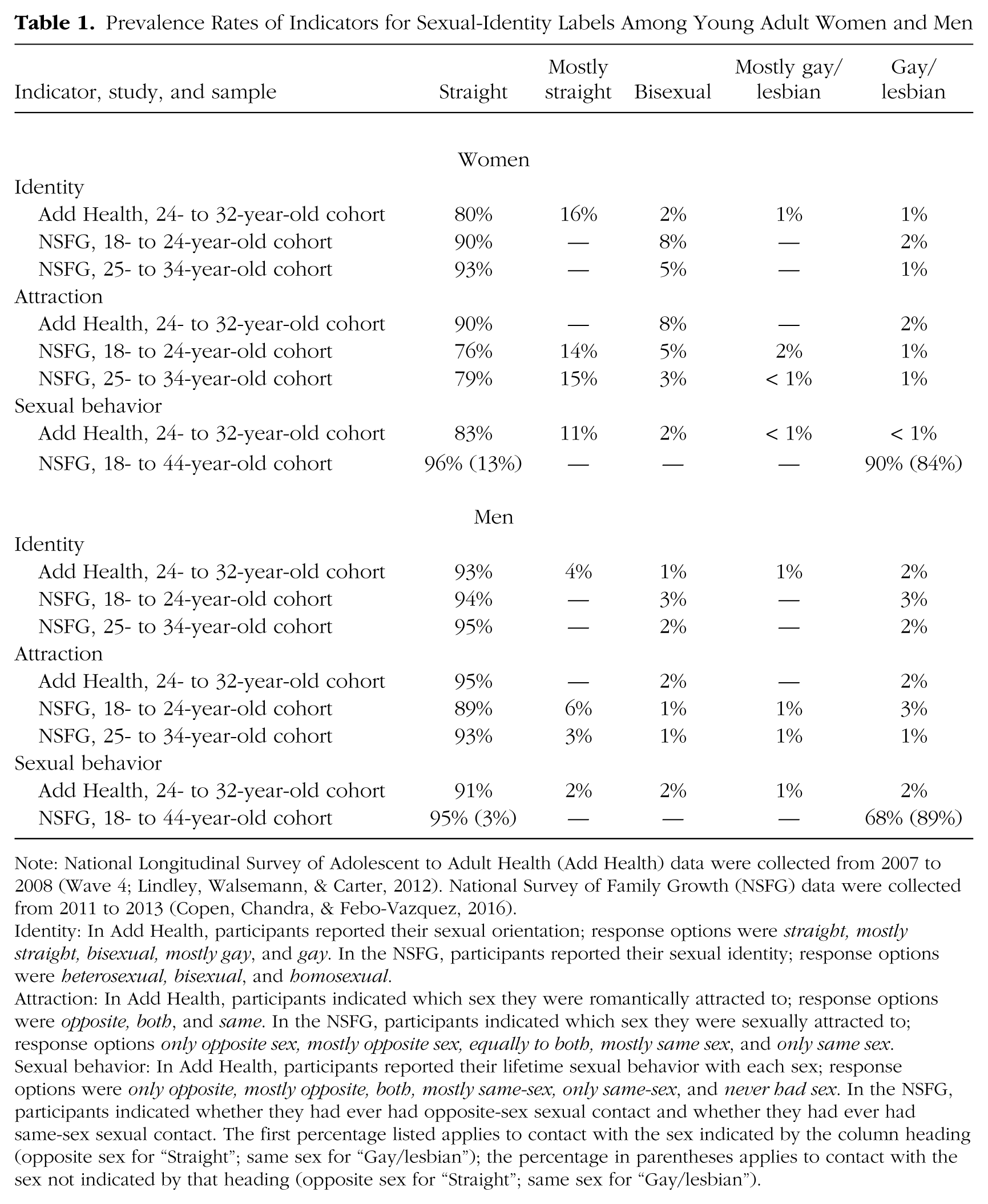
Note: National Longitudinal Survey of Adolescent to Adult Health (Add Health) data were collected from 2007 to 2008 (Wave 4; Lindley, Walsemann, & Carter, 2012). National Survey of Family Growth (NSFG) data were collected from 2011 to 2013 (Copen, Chandra, & Febo-Vazquez, 2016).
Identity: In Add Health, participants reported their sexual orientation; response options were straight, mostly straight, bisexual, mostly gay, and gay. In the NSFG, participants reported their sexual identity; response options were heterosexual, bisexual, and homosexual.
Attraction: In Add Health, participants indicated which sex they were romantically attracted to; response options were opposite, both, and same. In the NSFG, participants indicated which sex they were sexually attracted to; response options only opposite sex, mostly opposite sex, equally to both, mostly same sex, and only same sex.
Sexual behavior: In Add Health, participants reported their lifetime sexual behavior with each sex; response options were only opposite, mostly opposite, both, mostly same-sex, only same-sex, and never had sex. In the NSFG, participants indicated whether they had ever had opposite-sex sexual contact and whether they had ever had same-sex sexual contact. The first percentage listed applies to contact with the sex indicated by the column heading (opposite sex for “Straight”; same sex for “Gay/lesbian”); the percentage in parentheses applies to contact with the sex not indicated by that heading (opposite sex for “Straight”; same sex for “Gay/lesbian”).
Gender nonconformity
According to Bailey et al. (2016), childhood gender nonconformity is “a strong correlate of adult sexual orientation” and “not an either/or trait but, rather, a dimensional one” (p. 57). I agree on both accounts. Given these conclusions and the possibly shared biological underpinning of childhood gender nonconformity and sexual orientation, it follows that sexual orientation is likely to also be dimensional. That is, to borrow Bailey et al.’s (2016) language, I believe that both gender nonconformity and sexual orientation are “a matter of degree and not of kind” (p. 57). If this is true, then research into the origins of sexual orientation and gender nonconformity would both benefit from being assessed as a continuum.
Causes of sexual orientation
A continuum perspective suggests that homoeroticism and gender nonconformity are related to their degree of genetic loading or expression, in utero hormone environment, and maternal immune response to a male fetus. Perhaps variations in quantity, timing, and quality (e.g., number of genes, markers, or receptors; epigenetic factors; critical neurodevelopmental windows; individual vulnerability; environmental triggers and their interactions) account for observed variance in sexual orientation. For example, does the number of biological markers determine where one is along a sexual continuum—such that the more markers, the more likely one is to be exclusively gay, whereas fewer markers would result in one’s being, say, mostly straight?
A potential model for such investigations is research on the fraternal-birth-order effect (Blanchard, 2004) which exemplifies the complexities inherent in continuous mechanisms. It is likely not merely having an older brother that is critical but the genetic predisposition of the male fetus to respond to maternal antibodies and the robustness or timing of the maternal immunological response to male antigens that contribute or interact to produce a gay son. Whether successive male children increasingly deviate from both exclusive heterosexuality and gender conformity could be determined, for example, by assessing whether the first son in a given family is masculine and straight, the next son is slightly less masculine and mostly straight, the next is slightly feminine and bisexual-leaning straight, and so forth.
A political consideration
Another consequence of a continuum perspective is its potential to promote the well-being of sexual minorities. A fundamental objective of anti-gay organizations is to lowball the prevalence of nonheterosexuals. For example, the National Association for Research and Therapy of Homosexuality (http://www.narth.com/) claims that the number of individuals who are “homosexual or bisexual” is considerably lower than reported by “gay activists,” less than 2%. Armed with inaccurate data purporting a low prevalence, these organizations feel empowered to dismiss a sexuality they disparagingly refer to as a “lifestyle choice,” cast doubt on the biological roots of sexual orientation, make spurious assertions that homosexuals have histories of childhood abuse, and advocate for conversion therapies (for a history and critique of such therapies, see Beckstead, 2012). As long as nonheterosexuality is erroneously characterized as an uncommon anomaly, they are emboldened to cast aspersions and call for silence or reorientation treatment. Anti-gay organizations would not be pleased with a nonheterosexual prevalence rate of 10% or higher and evidence of a sexual continuum because those convey the normality of same-sex sexuality.
Although I agree with Bailey et al. (2016) that policy issues ought not to be contingent on the size of a minority group, in reality, size does matter. Debates concerning equal rights, health care, discrimination, and violence, among many other policy issues, might be considered more urgent and pertinent if the group facing deficits in these areas were considerably larger than imagined (i.e., a larger voting constituency), including not just the extremes on the sexual-orientation continuum (gays/lesbians) but all nonheterosexuals, including many who are invisible because they do not identify as belonging to a nonheterosexual category. Granting equal rights and protecting a sizable portion of the population that experiences any degree of homoeroticism ought to be a part of our agenda.
Thus, I stand in unison with all six authors of Bailey et al. (2016) in promoting equal rights for sexual minorities, independently of whether we believe in sexual-orientation categories or a sexual-orientation continuum.
Footnotes
Acknowledgements
Kenneth M. Cohen rearranged my words and sentences to add clarity.
Funding
The American Institute of Bisexuality has provided generous support throughout the past 4 years, including during the writing of this commentary.
Declaration of Conflicting Interests
The author declared no conflicts of interest with respect to the authorship or the publication of this article.