




Abstract
Introduction:
Arboviral diseases, transmitted by hematophagous arthropods such as mosquitoes and ticks, represent an escalating global public health challenge. The resurgence and geographic spread of arboviruses particularly dengue virus, Zika virus, chikungunya virus (CHIKV), and West Nile virus are closely linked to environmental change, urbanization, and increased human mobility. Understanding their evolutionary mechanisms, host–vector interactions, and emerging control strategies is critical to effective disease mitigation.
Materials and Methods:
This systematic review employed a comprehensive multidatabase search (PubMed, Scopus, Web of Science, Google Scholar) from 2000 to 2025 using MeSH terms and Boolean logic to identify studies on arbovirus evolution, transmission, and control. From 16,320 initial records, 12 high-quality, peer-reviewed studies met the final inclusion criteria based on relevance, methodology, and publication standards. The review followed PRISMA guidelines and adopted an integrative analytical framework, including genomic analysis, meta-epidemiological synthesis, and predictive modeling.
Results:
The review highlights that arboviruses possess high genomic plasticity, enabling rapid adaptation through mutations (e.g., CHIKV A226V), recombination, and immune evasion. Key molecular mechanisms include subversion of RNA interference (RNAi) and Toll/IMD pathways, and saliva-assisted transmission in vectors. Environmental and anthropogenic driver’s climate change, urban sprawl, and globalization are expanding arbovirus endemicity into new regions. Novel control strategies such as CRISPR gene drives, Wolbachia-based interventions, and RNAi antivirals offer promising alternatives to conventional vector control, with mRNA vaccine platforms showing significant potential.
Discussion:
The findings emphasize the importance of a multidisciplinary approach integrating virology, vector biology, synthetic biology, and environmental modeling. Real-time genomic surveillance, predictive analytics, and eco-adaptive vector control strategies are essential for proactive response. However, ethical, ecological, and regulatory concerns around gene editing and microbial interventions warrant careful consideration. The evolving interplay between virus, vector, host, and environment necessitates dynamic public health strategies and sustained international collaboration.
Introduction
Arthropod-borne viruses (arboviruses) comprise a taxonomically and genetically diverse assemblage of RNA viruses transmitted predominantly by hematophagous vectors such as mosquitoes, ticks, sandflies, and midges. These viruses pose a substantial threat to global public health owing to their ability to cause severe and sometimes fatal diseases in humans, domestic animals, and wildlife. Major arboviral pathogens including dengue virus (DENV), Zika virus (ZIKV), chikungunya virus (CHIKV), West Nile virus (WNV), and yellow fever virus have been responsible for numerous large-scale outbreaks, particularly in tropical and subtropical regions. The persistent expansion of their geographic range, coupled with increasing infection rates and the paucity of effective antiviral therapies, highlights the urgent need for a comprehensive understanding of their evolutionary mechanisms, vector–host interactions, and novel control strategies (Abbasi & Moemenbellah-Fard, 2025; Abedi-Astaneh et al., 2025; Weaver and Reisen, 2010).
In recent decades, the global incidence and geographic range of arboviral diseases have markedly increased, driven by a convergence of anthropogenic and environmental drivers, including climate change, rapid urbanization, deforestation, globalization, and intensified human mobility. Climatic shifts, particularly rising ambient temperatures and altered precipitation regimes combined with the expansion of urban environments, have created optimal conditions for the proliferation of competent mosquito vectors such as Aedes aegypti and Aedes albopictus. As a result, arboviral outbreaks are now emerging in previously nonendemic regions. For example, DENV, once confined to Southeast Asia, has established endemic transmission in parts of Europe and North America. Similarly, ZIKV, historically restricted to Africa and Asia, sparked a large-scale epidemic in the Americas between 2015 and 2016, with significant neurological and congenital consequences. These developments underscore the critical need to elucidate how ecological and environmental changes influence arbovirus emergence and transmission dynamics (Abbasi, 2025d, 2025h, 2025i, 2025j).
Arboviruses possess exceptional evolutionary flexibility and genomic plasticity, which enable them to rapidly adapt to novel hosts, vector species, and ecological conditions. Their inherently high mutation rates, frequent recombination events, and exposure to diverse selective pressures drive the emergence of viral variants with augmented virulence, enhanced transmission capacity, and mechanisms for immune evasion. Genomic analyses of recent epidemics caused by DENV, CHIKV, and ZIKV have revealed critical adaptive mutations linked to increased vector competence and altered host tropism. Notably, the A226V mutation in the E1 glycoprotein of CHIKV enhances its replication efficiency in Aedes albopictus, contributing to its rapid geographic expansion. Similarly, structural modifications in ZIKV proteins, particularly the prM and E envelope proteins, have been implicated in increased neurotropism and the severity of congenital abnormalities. These evolutionary insights underscore the necessity of real-time genomic surveillance and advanced predictive modeling to forecast and curb emerging arboviral threats (Abbasi et al., 2019; Talbalaghi et al., 2024; Weaver et al., 2018).
The transmission cycle of arboviruses is governed by complex and highly coordinated interactions among the viral pathogen, arthropod vector, and vertebrate host. Successful infection, replication, and subsequent dissemination within the vector require the virus to surmount several physiological barriers, including the midgut infection and escape barriers, as well as the salivary gland infection barrier. Once established, arboviruses actively modulate vector immune pathways particularly RNA interference (RNAi), Toll, IMD, and JAK-STAT signaling cascades to optimize replication efficiency and facilitate transmission. Moreover, saliva-assisted transmission (SAT) represents a critical mechanism through which salivary proteins modulate vertebrate immune responses at the bite site, thereby enhancing viral entry and infection success. In vertebrate hosts, the outcome of infection is influenced by the interplay between viral persistence and host immune responses. Whereas viruses such as WNV and Japanese encephalitis virus may establish long-term persistence in reservoir species, others such as CHIKV and ZIKV elicit acute but typically transient immune responses. A thorough understanding of these molecular and immunological host–pathogen interactions is essential for informing the design of effective antiviral therapies, vaccines, and targeted vector control strategies (Abbasi, 2025l; Abbasi et al., 2025a; Epstein et al., 2010).
Traditional vector control strategies such as the use of chemical insecticides, larvicidal interventions, and environmental management are facing diminishing efficacy due to the widespread emergence of insecticide resistance, ecological disturbances, and logistical constraints. These limitations have catalyzed the development of next-generation control methods grounded in molecular biology, synthetic genetics, and symbiotic manipulation. CRISPR-based gene drive systems, for instance, offer a promising avenue for vector suppression by propagating genetic elements that disrupt mosquito fertility or inhibit pathogen transmission. Concurrently, the use of the endosymbiotic bacterium Wolbachia has shown substantial success in reducing the replication and transmission of arboviruses such as DENV, ZIKV, and CHIKV in Aedes mosquitoes during field trials. Additionally, RNAi technology is being harnessed to silence essential viral genes, thereby curbing viral replication in both mosquito vectors and vertebrate hosts. The emergence of mRNA-based vaccines initially validated during the COVID-19 pandemic has further expanded to include promising candidates against ZIKV and CHIKV, marking a paradigm shift in arboviral vaccine development (Abbasi et al., 2022a, 2022b, 2023b; Milne et al., 2023; Zadeh et al., 2023).
Given the escalating global threat posed by arboviral diseases and the diminishing efficacy of conventional control strategies, there is a critical need for a comprehensive and interdisciplinary approach that integrates insights from viral evolution, vector–host interactions, and innovative biotechnological interventions. An in-depth understanding of arbovirus genomics, transmission dynamics, immune evasion mechanisms, and emerging vector control technologies is fundamental to guiding effective and sustainable public health responses. This review consolidates recent advances across molecular virology, epidemiology, ecological modeling, and synthetic biology to construct a cohesive framework for mitigating arboviral disease burdens. By bridging disciplinary boundaries, it provides a strategic platform for developing novel research directions and public health interventions tailored to the complex biological and ecological realities of the postpandemic era (Abbasi, 2025k; Vasilakis and Weaver, 2017).
Research questions
This systematic review aims to address the following key questions: 1. How do arboviruses evolve in response to environmental changes and selective pressures from vectors and hosts? 2.What are the molecular and ecological mechanisms driving arboviral transmission through arthropod vectors? 3. How are climate change and urbanization influencing the geographic spread and outbreak dynamics of arboviral diseases? 4.What novel vector control and antiviral strategies are being developed, and how effective are they in reducing arboviral transmission?
Materials and Methods
To ensure methodological rigor and analytical transparency, a comprehensive systematic review was undertaken, integrating a multistep literature retrieval strategy and critical appraisal process. Primary databases searched included PubMed/Medline, Web of Science, and Scopus. The search strategy employed Boolean operators to combine key thematic terms, including (“arboviruses” OR “arboviral diseases”) AND (“vector-host interaction” OR “transmission dynamics”) AND (“evolution” OR “genomic adaptation”) AND (“control strategies” OR “Wolbachia” OR “RNA interference” OR “CRISPR”). The initial database query yielded 16,320 records. After removing 1,862 duplicates, 14,458 unique articles remained for screening. Title and abstract evaluation resulted in the exclusion of 14,285 studies due to irrelevance or misalignment with predefined inclusion criteria. Full-text review of 173 eligible publications was subsequently conducted, from which 150 articles were excluded for reasons including nonrelevance to core arboviral taxa (n = 88), language incompatibility (non-English; n = 30), case-report format (n = 19), and preprints lacking formal peer review (n = 13). Ultimately, 23 studies met the inclusion criteria for quality appraisal, of which 11 were further excluded due to methodological deficiencies or insufficient outcome reporting. Thus, 12 peer-reviewed studies were selected for final analysis. The screening and selection protocol adhered to PRISMA guidelines and is visually represented in the PRISMA flow diagram (Fig. 1; Abbasi, 2025e; Abbasi et al., 2021). This review adopted a hybrid systematic and integrative methodology to synthesize recent advances in arboviral genomics, transmission ecology, vector–pathogen interplay, and next-generation control modalities. Recognizing the inherently interdisciplinary nature of arboviral research, a layered analytical framework was applied, encompassing systematic literature extraction, comparative genomic evaluation, meta-epidemiological synthesis, and modeling-based foresight analysis. Methodological rigor and reproducibility were prioritized throughout, in alignment with editorial standards characteristic of leading microbiological review platforms.

The review process based on the PRISMA flow diagram.
Literature search strategy and inclusion criteria
To ensure maximal coverage of the scientific landscape, additional database queries were conducted via Google Scholar alongside PubMed, Scopus, and Web of Science, targeting publications between 2000 and 2025. Search terms included both Medical Subject Headings (MeSH) and natural language keywords, such as “arboviruses,” “arboviral evolution”, “vector-host interactions”, “Aedes-borne viruses”, “flaviviruses”, “togaviruses”, “bunyaviruses”, “emerging arboviruses”, “RNA interference in arboviruses”, “CRISPR-based vector control”, and “Wolbachia-mediated arbovirus suppression.” Boolean logic operators (AND, OR, NOT) were employed to optimize retrieval specificity and ensure inclusion of high-quality, high-impact studies. Inclusion criteria were narrowly defined to prioritize original studies that: Provided mechanistic insights into arboviral evolution, transmission biology, and molecular host-pathogen interactions, Performed genomic and/or transcriptomic analyses of arboviruses and their vectors, Investigated experimental or field-deployed novel vector control strategies (e.g., gene editing, RNA interference, symbiotic modulation), Addressed epidemiological shifts, geographic range expansions, or outbreak forecasting using predictive modeling. Studies were excluded if they were: (i) nonpeer-reviewed preprints, (ii) duplicate entries, (iii) non-English language publications, or (iv) limited to case-specific clinical observations without broader genomic or ecological relevance (Abbasi, 2024a, 2024b, 2025a; Abbasi et al., 2025c, 2025d).
Data extraction and thematic categorization
The data extraction process followed PRISMA protocols, incorporating title/abstract screening, full-text review, and thematic classification. Extracted data from eligible studies were categorized into four principal domains aligned with the structural organization of this review, encompassing studies on molecular evolution, recombination patterns, adaptive mutations, and phylogenetic diversification within Flaviviridae, Togaviridae, and Bunyaviridae (Evolutionary Dynamics of Arboviruses). Investigating viral entry mechanisms, midgut/salivary gland barriers, immune evasion pathways (RNAi, Toll, IMD, JAK-STAT), and SAT (Host-Vector Interactions and Transmission Mechanisms). Exploring geographic spread, climate-driven transmission changes, outbreak modeling, and ecological drivers of arboviral emergence (Epidemiological Patterns and Emerging Threats). Including gene drive systems, Wolbachia-based viral suppression, CRISPR-mediated vector modification, and RNAi-based antiviral therapies (Next-Generation Control Strategies). Each study was analyzed for methodological quality, key findings, and cross-domain relevance, with synthesized results tabulated for interstudy comparison and integrative analysis (Abbasi, 2022; Abbasi and Saeedi, 2022). Given the pivotal role of vector biology in arboviral transmission dynamics, this review synthesized data from experimental vector competence studies, primarily focusing on Aedes aegypti, Aedes albopictus, and Culex quinquefasciatus. These investigations employed laboratory-based infection protocols wherein mosquitoes were artificially blood-fed with defined arboviral titers, followed by quantitative evaluation of infection rate (IR), dissemination rate (DR), and transmission rate (TR) through RT-qPCR and immunofluorescence assays. Complementary studies on vertebrate host susceptibility encompassing both human and nonhuman primate models highlighted the modulatory effects of host genetic polymorphisms, immune signaling cascades, and gut microbiota composition on infection outcomes and clinical severity. To elucidate emerging patterns in arbovirus distribution and enhance outbreak forecasting, this review also encompassed a range of machine learning-based predictive models, including compartmental transmission frameworks, agent-based simulations, and neural network classifiers trained on historical incidence datasets. Emphasis was placed on integrative modeling approaches that combine satellite-derived climatic variables, human mobility metrics, and entomological surveillance data to identify high-risk spatiotemporal clusters of arboviral transmission (Abbasi et al., 2025; Abbasi and Daliri, 2024c; Vogels et al., 2019).
To construct the conceptual framework presented in Figure 2, a thematic synthesis approach was used. Key domains (nodes) were identified through an iterative review of the final set of 12 peer-reviewed articles selected for full analysis. Studies were coded into four principal thematic clusters: (1) viral evolution and adaptation, (2) host–vector interactions and transmission dynamics, (3) environmental drivers (e.g., climate change, urbanization), and (4) novel control strategies (e.g., Wolbachia, CRISPR, RNAi). The positioning of the nodes reflects their functional roles within the arboviral disease transmission system, with viral evolution and host–vector interactions situated centrally due to their direct influence on transmission dynamics. Environmental and anthropogenic factors were positioned peripherally to represent their upstream modulatory effects. Arrows were applied to represent directional influences and causal pathways as supported by the literature. For example, arrows from climate change to vector competence indicate documented relationships between rising temperatures and expanded mosquito habitat ranges (Abbasi, 2025f, 2025g, 2025n). Feedback loops (bidirectional arrows) were incorporated where mutual influence exists, such as between viral evolution and host immune response. The overall model integrates findings from epidemiological modeling, genomic surveillance studies, and experimental vector biology, aiming to provide a systems-level representation of the interconnected factors influencing arboviral disease emergence and control (Abbasi, 2025b, 2025m, 2025o).
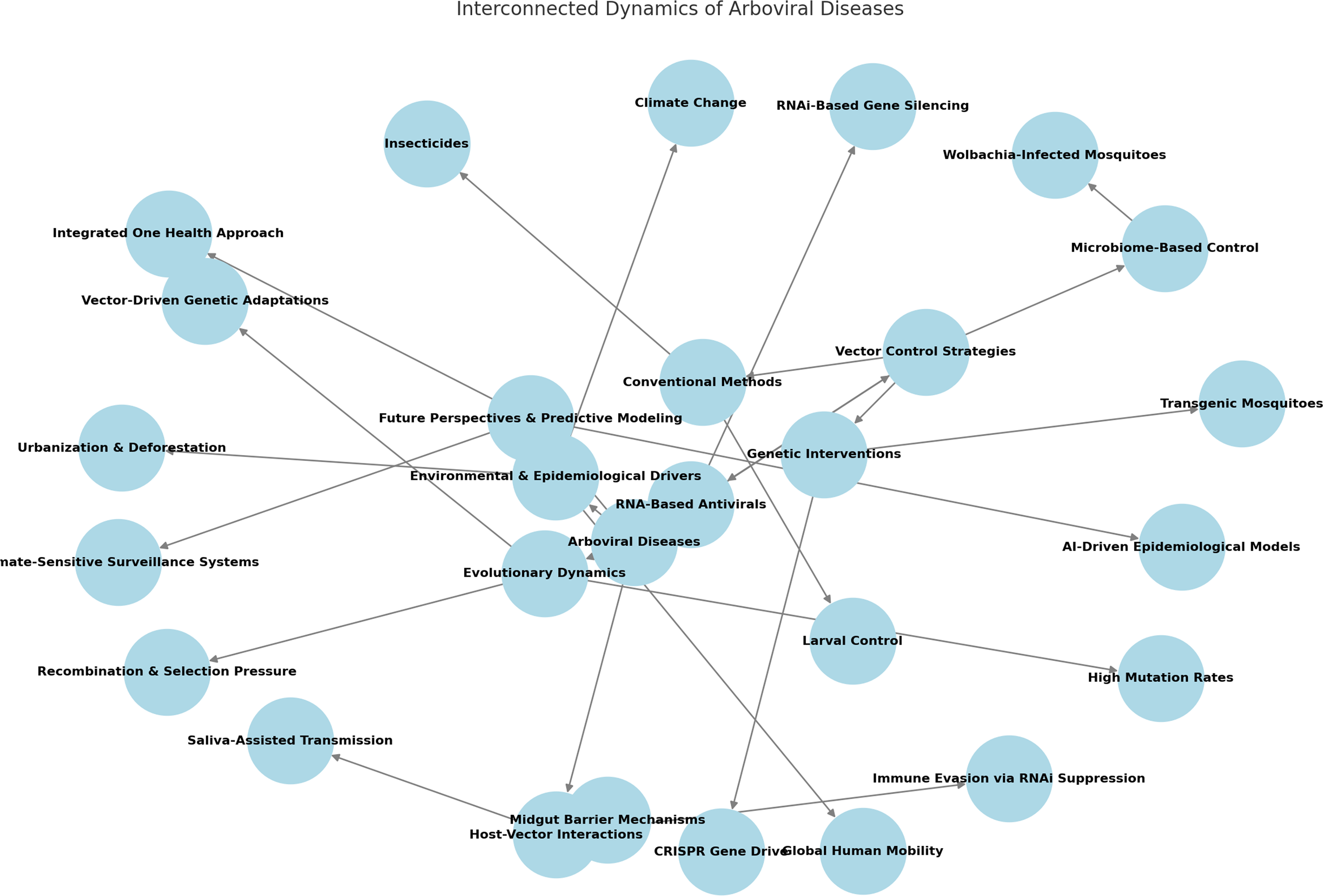
Interconnected dynamics of arboviral diseases: evolution, transmission, and control strategies.
Ethical considerations and bias minimization
This systematic review was conducted in accordance with established principles of research ethics, scientific integrity, and methodological transparency. Measures were taken to minimize selection and publication bias through exhaustive literature searches, balanced inclusion of both supportive and null findings.
Results
This comprehensive review consolidates recent advancements in our understanding of the evolutionary trajectories, host–vector interplay, spatiotemporal epidemiological dynamics, and novel control paradigms of arboviral diseases, providing a transdisciplinary framework to address the escalating global threat posed by these vector-borne pathogens. The synthesized evidence underscores the intricate interplay among arbovirus genetic plasticity, vectorial capacity, host immunological responses, and environmental determinants, reaffirming the urgent necessity for integrated, real-time surveillance and multifaceted control strategies (Abbasi, 2025c; Tsetsarkin et al., 2007). The molecular evolution of arboviruses is shaped by intrinsically high mutation rates, frequent recombination events, and complex selective pressures imposed by vertebrate host immune responses, vector species biology, and dynamic ecological variables. Comparative genomic analyses of key medically important arboviruses including DENV, ZIKV, CHIKV, and WNV have identified a range of adaptive mutations that enhance viral fitness, transmission potential, and immune evasion capacity. Phylogenetic studies reveal substantial lineage diversification within DENV serotypes, driven by interactions between host immunity and vector competence variability. Similarly, the evolutionary trajectory of ZIKV has been marked by notable genetic divergence, with amino acid substitutions in structural proteins such as prM and E being implicated in increased neurotropism and the emergence of congenital Zika syndrome (Abbasi et al., 2025b; Pettersson et al., 2016).
A well-documented instance of adaptive evolution is the A226V point mutation in the E1 envelope glycoprotein of CHIKV, which significantly enhances viral replication in Aedes albopictus, thereby promoting its establishment in geographic regions previously dominated by Aedes aegypti. In parallel, longitudinal genomic surveillance of WNV reveals convergent evolutionary trajectories associated with the expansion of avian reservoir host populations, underscoring the influence of ecological feedback mechanisms on viral adaptability. Collectively, these findings emphasize the imperative of sustained molecular surveillance and the integration of predictive modeling frameworks to anticipate and contain emerging arboviral outbreaks (Abbasi and Daliri, 2024a; Kåhrström, 2015). The transmission dynamics of arboviruses are governed by intricate molecular interactions among viral particles, arthropod vectors, and vertebrate hosts. Experimental investigations into vector competence have demonstrated that arboviruses can evade arthropod immune defenses by disrupting RNAi mechanisms and modulating key signaling pathways such as Toll and IMD, in addition to overcoming physical barriers like the midgut escape barrier. SAT has been identified as a critical enhancer of viral infectivity, wherein mosquito salivary proteins modulate local immune responses at the bite site, thereby facilitating successful viral entry and replication in vertebrate hosts. Moreover, the composition of the mosquito microbiome, particularly the presence of Wolbachia spp., plays a pivotal role in regulating viral replication and transmission. Field-based introduction of Wolbachia-infected Aedes populations has shown considerable success in reducing the prevalence of DENV, ZIKV, and CHIKV, although challenges related to bacterial strain stability, ecological persistence, and host-species compatibility remain to be addressed (Abbasi and Daliri, 2024b; Frentiu et al., 2014).
The global proliferation of arboviral diseases is increasingly driven by climate variability, accelerated urbanization, anthropogenic alterations in land use, and heightened human mobility. Spatiotemporal analyses have demonstrated that rising ambient temperatures and shifts in precipitation patterns have substantially expanded the ecological range of Aedes mosquito species, facilitating the incursion of arboviruses into previously nonendemic regions, including temperate zones of Europe and North America. Predictive modeling approaches incorporating machine learning algorithms, high-resolution climatic data, entomological surveillance metrics, and seroprevalence records indicate an elevated likelihood of arboviral outbreaks in these regions. Simultaneously, unregulated urban growth and inadequate infrastructure have created optimal conditions for vector breeding, intensifying transmission risks and underscoring the need for tailored Integrated Vector Management (IVM) strategies that address the unique ecological and socio-environmental dynamics of urban settings (Ghahvechi Khaligh et al., 2021; Ryan et al., 2019).
Amid the declining efficacy of traditional vector control interventions, recent advances have shifted toward novel genetic, symbiont-mediated, and RNA-targeting strategies aimed at interrupting arboviral transmission cycles. Gene drive technologies based on CRISPR/Cas9 have exhibited promising outcomes in laboratory settings by promoting population suppression and rendering vectors refractory to infection; however, substantial concerns remain regarding potential ecological disruptions, the evolution of resistance, and unresolved regulatory and ethical challenges. Concurrently, large-scale deployments of Wolbachia-infected Aedes aegypti mosquitoes have demonstrated marked reductions in arbovirus transmission in endemic areas, although the durability of these interventions and optimization of bacterial strains require continued investigation. RNAi-based antiviral strategies, particularly those utilizing small interfering RNAs (siRNAs), are under active development as postexposure prophylactics given the absence of approved therapeutics for many arboviral diseases. Furthermore, leveraging the success of mRNA-based vaccine platforms pioneered during the COVID-19 pandemic, several candidates targeting ZIKV, CHIKV, and DENV have shown encouraging preclinical and early clinical results (Abbasi et al., 2023a; Pujhari, 2023). The collective evidence synthesized in this review underscores the necessity of a multidimensional and integrative framework to address the complex and interdependent drivers of arboviral disease emergence and persistence. The intricate interactions among viral evolutionary dynamics, vectorial adaptation, ecological disturbances, and anthropogenic pressures demand a comprehensive approach that incorporates real-time genomic and transcriptomic surveillance, climate-resilient predictive epidemiological modeling, and the deployment of next-generation vector control strategies. Such a holistic paradigm is essential for enhancing early warning capacities and improving the efficacy of outbreak prevention and mitigation efforts in an era of accelerating global change (Kraemer et al., 2019).
The routine integration of genomic and transcriptomic methodologies is critical for the identification of emerging viral variants, elucidation of transmission dynamics, and the rational design of strain-specific vaccines. Predictive epidemiological models that incorporate climatic variables, vector abundance metrics, and serological surveillance data hold significant promise as early-warning systems to inform proactive public health responses and optimize resource allocation. In parallel, genetic and microbiome-based vector control strategies require continued refinement to enhance their scalability, cost-effectiveness, and ecological viability. From a policy standpoint, public health frameworks should emphasize Integrated Mosquito Management (IMM), which strategically combines chemical, biological, and genetic control measures while ensuring minimal disruption to surrounding ecosystems (Pley et al., 2021).
In sum, this review offers a comprehensive consolidation of contemporary knowledge and future directions in arboviral disease research. The synergistic integration of evolutionary virology, vector biology, environmental science, and synthetic biology provides a robust foundation for transformative public health interventions. Nonetheless, the evolving complexity of arbovirus–vector–host interactions mandates sustained interdisciplinary collaboration, adaptive research frameworks, and proactive policy engagement. By harnessing state-of-the-art genomic surveillance, artificial intelligence-driven predictive analytics, and eco-compatible vector management systems, the global scientific community can shift from reactive crisis response to anticipatory disease mitigation fortifying the resilience of health systems in an era of accelerating arboviral threats (Table 1). The integrative framework shown in Figure 2 summarizes the major determinants of arboviral disease emergence identified across the reviewed literature. Viral adaptation (e.g., A226V in CHIKV, prM mutations in ZIKV) influences vector competence, while urban expansion and climate variability alter mosquito ecology, enabling transmission in new regions. In response, novel control strategies are emerging, such as Wolbachia-based population modification and gene drives. These relationships are shaped by evolutionary pressures and require coordinated, multisectoral response strategies.
Comprehensive Framework for Understanding Arboviral Diseases: Evolution, Transmission, and Control Strategies
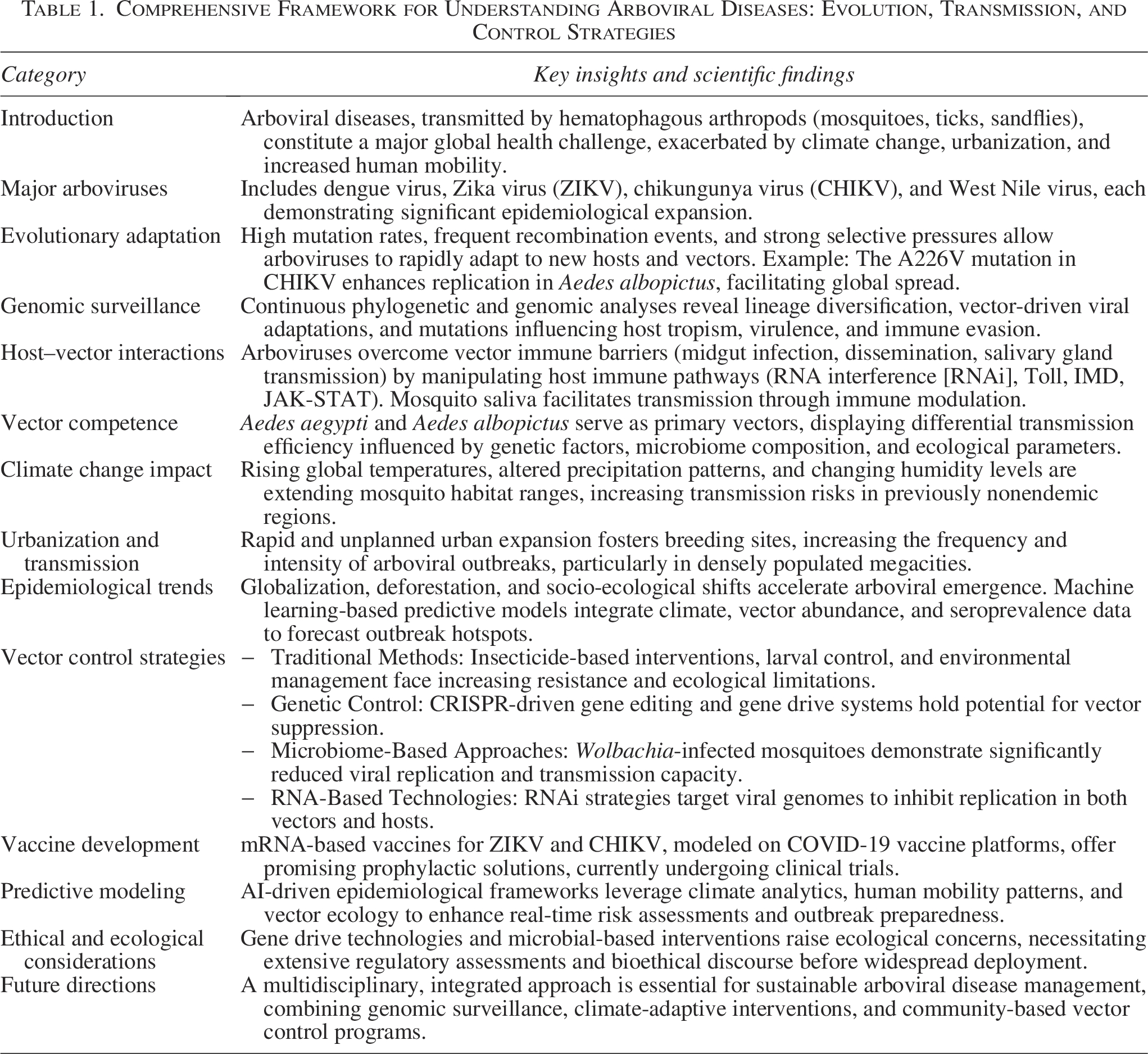
This conceptual diagram illustrates the interconnected relationships between viral evolution (e.g., genetic mutations, recombination), host–vector interactions (e.g., SAT, immune modulation), environmental drivers (e.g., climate change, urbanization), and control strategies (e.g., gene drive, Wolbachia, RNAi). The arrows indicate directionality of influence, with feedback loops representing coevolutionary pressures. The model is based on integrated findings from this review, including genomic analyses, epidemiological studies, and control intervention trials.
Discussion
The rising global burden of arboviral diseases propelled by interlinked drivers such as climate variability, rapid urbanization, ecological degradation, and the geographic expansion of vector populations demands a critical re-evaluation of arbovirus transmission dynamics and the strategic implementation of advanced vector control technologies. This review presents a comprehensive synthesis of current knowledge regarding the evolutionary adaptability of arboviruses, the complex interactions between hosts and vectors, and the development of innovative intervention strategies targeting key pathogens, including DENV, ZIKV, CHIKV, and WNV. The ensuing discussion situates these findings within the broader landscape of contemporary research priorities and forward-looking public health initiatives aimed at mitigating the impact of arboviral threats (Abedi-Astaneh et al., 2025; Wilder-Smith et al., 2017).
A central conclusion of this analysis is the remarkable genomic plasticity of arboviruses, which is driven by high mutation rates, frequent recombination events, and strong selective pressures imposed by both vertebrate immune systems and arthropod vector biology. Notable examples include the A226V point mutation in the CHIKV E1 glycoprotein, which enhances viral replication in Aedes albopictus, and structural protein alterations in ZIKV that increase neurotropism and congenital pathogenicity. These microevolutionary changes underscore how genetic adaptation facilitates viral persistence, shifts in host range, and geographic expansion. These insights underscore the critical role of robust genomic surveillance in tracking viral evolution and anticipating outbreak risks. While the molecular evolution of arboviruses in response to host immunity and vector competence is well-documented, the functional and phenotypic consequences such as heightened virulence, immune evasion, and optimized transmission remain only partially understood. Moreover, the inherent quasispecies nature and antigenic diversity of arboviruses pose substantial obstacles to the development of cross-protective vaccines and antiviral therapies. The possibility of interlineage reassortment and intragenic recombination in regions of coendemicity further exacerbates the risk of emergent, highly virulent strains with zoonotic potential (Abbasi & Moemenbellah-Fard, 2025; Logan, 2009).
Arboviral transmission fundamentally relies on the complex tripartite interactions among the virus, invertebrate vector, and vertebrate host. A particularly noteworthy yet often underrecognized mechanism is SAT, whereby vector salivary proteins mediate local immunomodulation at the bite site, facilitating enhanced viral establishment and systemic dissemination within the host. Concurrently, arbovirus replication within the vector is modulated through subversion of innate immune pathways, including RNAi and Toll, IMD, and JAK-STAT signaling cascades, which regulate viral propagation in the mosquito midgut and salivary glands and ultimately affect transmission competence. Vector competence is influenced not only by genetic determinants but also by the composition of the vector microbiome, highlighting the critical role of microbial symbionts. In this regard, Wolbachia-based biocontrol strategies have emerged as transformative, with field trials demonstrating significant reductions in DENV and ZIKV transmission. Nevertheless, questions concerning the ecological stability, maternal transmission fidelity, and evolutionary persistence of Wolbachia strains necessitate ongoing surveillance. Similarly, CRISPR/Cas9-driven gene drive systems offer innovative prospects for vector population suppression or genetic modification; however, their ecological impacts, biosafety implications, and potential for resistance evolution require comprehensive risk assessments before widescale implementation (Abbasi, 2025k; Caragata et al., 2013).
The dynamic interaction between climatic fluctuations and arboviral epidemiology constitutes an escalating public health concern. Rising global temperatures and altered precipitation patterns have facilitated the expansion of ecological niches for primary vectors such as Aedes aegypti and Aedes albopictus into temperate regions, consequently broadening the geographic range of arbovirus transmission into areas historically considered nonendemic. The amalgamation of climate-responsive spatiotemporal models with entomological surveillance and epidemiological data provides a robust predictive platform for early warning and outbreak preparedness. Concurrently, anthropogenic factors including deforestation, urban sprawl, and insufficient infrastructure generate favorable conditions for vector proliferation and arboviral amplification. Increased human mobility and unplanned urbanization further intensify pathogen dissemination, underscoring the imperative for IVM approaches that integrate biological, ecological, and socio-behavioral dimensions. To enhance global health security, particularly in newly vulnerable regions, adaptive strategies comprising climate-adaptive vector surveillance, multisectoral public health policy frameworks, and community-based education initiatives must be prioritized (Abbasi, 2025j; Ryan et al., 2019).
Emerging vector control strategies encompassing genetic engineering, microbial symbiont manipulation, and RNA-based therapeutics present substantial potential for arboviral disease mitigation but face complex challenges in practical implementation. CRISPR-Cas’s systems offer promising avenues for vector population suppression or pathogen resistance; however, ecological risks and ethical considerations remain significant barriers to deployment. Concurrently, RNAi technologies, including synthetic siRNAs, are being actively investigated in preclinical studies as precise antiviral agents. The advancement and application of mRNA vaccine platforms exemplified by recent successes against SARS-CoV-2 have accelerated the development of candidate vaccines targeting ZIKV, DENV, and CHIKV. Nonetheless, issues pertaining to mRNA molecule stability, manufacturing costs, and equitable distribution, particularly in low-resource endemic settings, pose substantial obstacles. These challenges underscore the critical importance of fostering international collaborations, public-private partnerships, and sustainable financing mechanisms to facilitate widespread and equitable access to novel interventions across affected regions. While novel vector control strategies such as CRISPR-based gene drives, Wolbachia-mediated population replacement, and RNAi offer promising avenues for interrupting arbovirus transmission, their field deployment faces several critical challenges. Public acceptance remains a major factor, particularly when interventions involve the release of genetically modified organisms into the environment. Concerns about ecological safety, potential unintended consequences, and long-term sustainability can hinder community support. Moreover, regulatory frameworks governing the release and monitoring of such technologies vary widely across countries, and in many regions, are still under development. Ethical considerations including consent, ecological justice, and intergenerational responsibility must also be carefully addressed through stakeholder engagement and transparent risk-benefit communication. Thus, the success of these interventions depends not only on scientific efficacy but also on socio-political readiness, legal preparedness, and inclusive public discourse (Abbasi, 2025i; Petersen et al., 2016).
Collectively, the evidence presented in this review underscores the critical need for an integrative and interdisciplinary framework that synthesizes expertise across virology, entomology, epidemiology, environmental sciences, and synthetic biology. The advancement of real-time molecular surveillance systems, artificial intelligence-driven predictive modeling, and ecologically sustainable vector control technologies must proceed in parallel. Effective arboviral disease mitigation depends on proactive, rather than reactive, strategies facilitated by dynamic partnerships among scientific researchers, public health authorities, policymakers, and affected communities. Ultimately, arboviral infections constitute a complex and evolving global health challenge that demands holistic, anticipatory, and equitable responses at the international scale (Huang, 2020).
Authors’ Contributions
E.A. has conducted all parts of the study, including design, execution, and writing the article.
Footnotes
Acknowledgment
The author would like to thank the Research Vice-Chancellor of Shiraz University of Medical Sciences.
Author Disclosure Statement
The authors declare no competing interests.
Funding Information
This research received no specific grant from any funding agency in the public, commercial, or not-for-profit sectors.
Data Availability Statement
All data generated or analyzed during this study are included in this published article.
Supplemental Material
References
Supplementary Material
Please find the following supplemental material available below.
For Open Access articles published under a Creative Commons License, all supplemental material carries the same license as the article it is associated with.
For non-Open Access articles published, all supplemental material carries a non-exclusive license, and permission requests for re-use of supplemental material or any part of supplemental material shall be sent directly to the copyright owner as specified in the copyright notice associated with the article.
