




Abstract
Background: Leishmania mexicana
was identified as the causal agent of localized as well as diffuse cutaneous leishmaniasis (DCL) in Mexico.
Methods:
To clarify the roles of the inoculum size and host sex, three different doses of the L. mexicana reference strain MNYC/BZ/62/M379 were inoculated into susceptible BALB/c mice.
Results:
A low dose (25 × 100) did not produce lesions, a medium dose (25 × 103) produced localized lesions, and a high dose (25 × 106) produced diffuse leishmaniasis. Male mice became infected with the reference strain M379 at a dose 1000 times lower than that required to produce the same type of infection in female mice. Male mice developed lesions 2 or 3 months earlier than female. The dose-dependent severity of lesions was confirmed in 22 previously frozen L. mexicana isolates obtained from patients with either localized or diffuse forms of the disease.
Conclusion:
We concluded that DCL caused by L. mexicana is a severe form of tegumentary leishmaniasis caused by a high parasite inoculum dose in susceptible hosts, with increased susceptibility in males.
Introduction
Leishmaniasis is one of the 17 neglected tropical diseases that are endemic to over 99 countries, with approximately 300,000 new cases reported each year from 55 of the 90 endemic countries (Jain et al., 2024). The disease has a broad spectrum of clinical manifestations, ranging from visceral leishmaniasis, which affects internal organs and can lead to death, to the more frequent cutaneous forms. Cutaneous leishmaniasis (CL) can manifest as a variety of unique lesions, such as ulcers, papules, and nodules, as well as more severe disseminated leishmaniasis (DL), which is characterized by the presence of multiple cutaneous lesions. In the latter form, tissue destruction can cause permanent disfigurement (Meireles et al., 2017).
A particularly severe form of CL is diffuse cutaneous leishmaniasis (DCL), which is considered the most severe form of tegumentary leishmaniasis and presents with multiple papules or nodules extending to the extremities, thorax, and face, often with mucosal involvement of the nose (Hashiguchi et al., 2016; Machado et al., 2024). DCL progresses slowly, is refractory to treatment, and is associated with specific T-cell anergy to Leishmania antigens. Parasite dissemination occurs through the peripheral lymphohematogenic route (Silveira, 2019). Owing to its anergic immune response, DCL is also known as anergic diffuse cutaneous leishmaniasis (ADCL). The Leishmania species associated with ADCL include Leishmania aethiopica in Ethiopia, Kenya, Namibia, and Tanzania and Leishmania mexicana and Leishmania amazonensis in Mexico, Brazil, Bolivia, Colombia, the Dominican Republic, Ecuador, Honduras, Nicaragua, Peru, the USA (Texas), and Venezuela (Volpedo et al., 2021).
The risk factors contributing to the development of the initial lesion in ADCL remain unclear. Implicated factors include parasite species (Oliveira et al., 2021) and considering the genetic variability of Leishmania (Cupolillo et al., 1997; Schönian et al., 2001), even the isolates could contribute, host genetic background (Colmenares et al., 2002), and components of the adaptive (Th2 cytokine pattern (Satoskar et al., 1998) and low interferon-gamma [IFN-γ] levels (Castellano et al., 2009)) and innate immune system (NK cells and neutrophil gene mutations) (Scorza et al., 2017), as well as low DHEA levels, due to aging (Galindo-Sevilla et al., 2007), malnutrition (Nweze et al., 2020), male sex (Lockard et al., 2019) and differential gene upregulation (Christensen et al., 2019). However, such factors are typically observed once the disease is already established, and their causal role in disease development remains uncertain.
Inoculum size has been proposed as a potential risk factor for severe manifestations of several infectious diseases, including coronavirus disease 2019 (Guallar et al., 2020; Van Damme et al., 2021), disseminated candidiasis (Xin et al., 2019), and hepatic alveolar echinococcosis (Zhang et al., 2017). However, in naturally acquired infections, inoculum size is difficult to assess at the time of infection. Even when the microbial load can be measured, sequestration in host tissues may prevent accurate quantification (Cunnington, 2015). Experimental animal models provide a controlled approach to investigating the role of inoculum size in disease severity. For example, in leishmaniasis, high-dose inocula of cutaneous species have been shown to induce a Th2 cytokine response in animal models; however, the role of high-dose inocula in severe disease development has not been fully established (Paiva et al., 2021).
Recognizing inoculum size as a determinant of severe leishmaniasis is crucial for developing targeted interventions. For example, COVID-19 vaccines do not prevent infection; rather, they reduce disease severity and mortality by generating immunological memory that rapidly curtails viral replication. In regions where Leishmania species associated with DCL are prevalent, vaccination could prevent DCL development.
To clarify the contribution of high inoculum size to severe disease progression in leishmaniasis, we conducted an experimental study in which we administered three doses of a reference L. mexicana strain (MNYC/BZ/62/M379) to male and female BALB/c mice, confirming results in several strains isolated from patients, whose clinical outcome is actually known.
Materials and Methods
Ethics statement
All experimental procedures were conducted in accordance with local and international bioethics and approved by the Institutional Animal Care Committee (approved protocol: 212250-22701).
Animal model
BALB/c mice were obtained from the animal facility at the Universidad Juárez Autónoma de Tabasco (UJAT). After weaning, the mice were separated by sex and housed in polycarbonate cages in groups of three males or three females. Each cage was labeled to identify the inoculum size and sex. The animals were maintained under controlled environmental conditions, with a temperature of 21°C and humidity of 40%. Food and water were provided ad libitum, and bedding was changed twice a week.
At 8 weeks of age, the right footpad of the mice was inoculated with 10 µL of parasites obtained from 7-day cultures and suspended in phosphate-buffered saline (PBS, pH 7.2). Lesion development was monitored weekly for 24 weeks postinoculation. At the end of the study, the mice were euthanized by halothane inhalation.
Testing thawed L. mexicana strain isolated from patients in 1991
Patients from Cunduacan, Tabasco, México, a municipality with a high prevalence of CL, provided informed consent, or in the case of a child, consent was obtained from their parents. From June to September 1991, lesion biopsies were obtained by aspiration prior to the initiation of treatment. Parasites were grown under axenic conditions and subsequently kept frozen, until 2020. Upon thawing, they were identified as L. mexicana based on the amplification pattern of minicircle kDNA using primers JW11 (forward, 5′-CCTATTTTACACCAACCCCCAGT-3′) and JW12 (reverse, 5′-GGGTAGGGGCGTTCTGCGAAA-3′). The thawed parasites were then inoculated at defined doses into the previously described model (Nicolas et al., 2002).
Results
Influence of inoculum size and host sex on the development of infection in BALB/c mice
An important role for both inoculum size and host sex was confirmed for the M379 reference strain. The lowest inoculum dose (25 × 100 parasites) did not induce footpad inflammation during the observation period (Fig. 1). However, with an inoculum dose of 25 × 103 parasites, male mice developed inflammation at the inoculation site at 12 weeks, whereas female mice did not. At the highest inoculum dose (25 × 106 parasites), male mice began to show footpad inflammation after 12 weeks, but female mice remained free of inflammation. By 17 weeks postinoculation, male mice presented inflammation of the back footpad and tail and mild swelling of the snout, leading to their sacrifice. In contrast, female mice developed only mild inflammation at the inoculation site and remained in that condition until 24 weeks after inoculation, when they were sacrificed. Spontaneous cure was never observed, and specific anti-Leishmania antibodies were detected only after the lesions had disseminated.
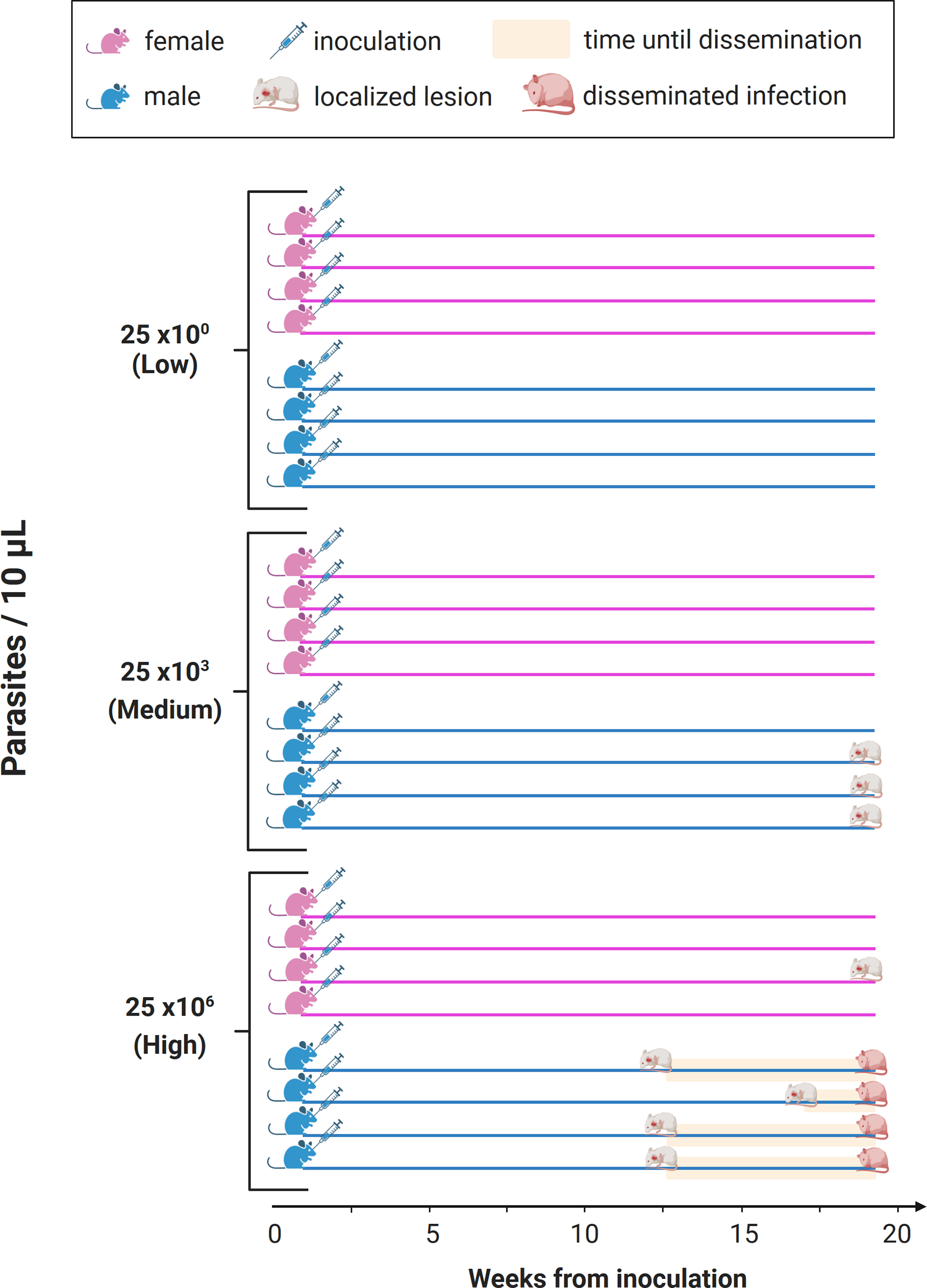
Comparison of L. mexicana inoculum size in male or female BALB/c, 8-week-old mice, infected i.d. in the footpad with reference strain MNYC/BZ/62/M379 at doses 25× (100, 103, and 106). Mice were observed once a week during 20 weeks for clinical signs of localized or diffuse leishmaniasis. The results are representative of four mice per inoculum per sex in three experiments with strains MHOM/MX/02/Tab2, MHOM/MX/01/Tab3.2, and reference strain. Survival times were statistically evaluated by the Kaplan–Meier statistic (Lumivero 2025. XLSTAT statistical and data analysis solution. New York, USA. https://www.xlstat.com/es), and p values <0.05 were considered statistically significant.
Reproducibility of dose effect of leishmania strains isolated from patients
Parasites were thawed from lesion samples collected from 45 patients, 42 with LL and 2 with DCL. Of these, only 22 strains were successfully recovered and intradermally (I.D.) injected into the footpad of mice using the previously described model. At the lower dose (10 × 104), all strains induced swelling at the site of inoculation within 40–90 days. At the higher dose (10 × 106), two-thirds (15/22) of the strains produced lesion diffusion. This group included two strains isolated in 1991 from male patients with DCL, no longer alive, and one strain from a female patient who presented with a localized lesion at the time of sampling but has since developed DCL (Table 1). The remaining patients are currently lesion-free. Although slight interstrain differences were observed in the dose required to induce diffusion, this capacity was presented even in strains isolated from patients whose localized lesions resolved shortly after treatment.
Influence of Inoculum Size on Leishmaniosis Development

Localized (L) or diffuse (D) lesion on male BALB/c mice infected with parasites isolated from patients. Bold values indicate isolates obtained from patients who developed diffuse cutaneous leishmaniasis (DCL) and were not cured with treatment.
Female patient sampled at 9 years of age while she had localized cutanous leishmaniasis, developed DCL at 19 years of age and died in 2024 due to cevical cancer.
Male patients with DCL at the time of sampling. Patient 6 died in 2017, and patient 23 in 2021, both from unknown causes.
Discussion
This work confirms the importance of inoculum size in the development of DCL, a severe form of leishmaniasis. Potential confounding variables, such as genetic background, age, sex, and environmental factors, were controlled for under experimental conditions. Further evidence supporting the relevance of inoculum size in naturally acquired infections was found in infected L. umbratilis specimens, which harbor L. guyanensis at densities ranging from 6 to 40 parasites per microscopic field (Freitas et al., 2002). Experimental infections of Phlebotomus papatasis with Leishmania major (Añez et al., 2003) and Lutzomia migonei, fed on vertebrate blood meals mixed with Leishmania braziliensis and L. amazonensis, revealed parasite loads of 6,500–18,000 parasites per gut for L. braziliensis and 11,500–140,000 for L. amazonensis (Nieves and Pimenta, 2002). Further investigation is required to determine whether the parasite load within vectors depends on parasite species or specific strains.
In this study, lesions appeared at noninoculated sites, including other extremities, as well as the tail and snout. Antibody production was high, and spontaneous resolution of lesions was never observed, indicating that this mouse infection more closely resembled human diffuse leishmaniasis than human DL. A limitation of this work is that the T-cell response was not tested. However, in a similar model in which a high inoculum dose was used, a Th2 immune response was induced, leading to the development of leishmaniasis (Doherty and Coffman, 1996; Lang et al., 2003; Menon and Bretscher, 1998).
The induction of peripheral tolerance by high doses of antigens harbored by infecting agents, such as Leishmania parasites, represents a promising venue of research to elucidate factors involved in severe cases of leishmaniasis. Several models have shown that a high dose of a pathogenic inoculum can modulate the initial immune response, leading to a state of exhaustion (Lira et al., 2000; Redeker et al., 2018; Baral et al., 2019) or peripheral tolerance that prevents the host from eliminating the pathogen. In contrast, a low dose of pathogen elicits an effective immune response, ultimately resolving the disease. The contribution of central tolerance, which refers to the elimination of reactive clones during the first trimester of pregnancy, to the development of DCL also remains to be explored. Moreover, functional exhaustion associated with CD8+ T cells has been reported in DCL patients from Tabasco, highlighting the need for further investigation into the immunological mechanisms underlying disease progression (Hernández-Ruiz et al., 2010).
For a long time, epidemiological reports have shown that, for each woman with localized lesions, two men are similarly affected (de Carvalho et al., 2022) and that at least three men are affected for every woman with diffuse leishmaniasis (Turetz et al., 2002; Velasco et al., 1989). Only recently has sex been recognized as an important factor in susceptibility to leishmaniasis. Experimentally, DBA/2 male mice presented greater susceptibility than female mice did when infected with L. mexicana. This increased susceptibility was associated with a Th2 immune response in males, and a Th1 response in relatively resistant females (Satoskar et al., 1998). Additionally, this sex effect was observed in a wild hamster colony infected with Leishmania (viannia) sp., where administering female hamsters with male sex hormone supplements increased their susceptibility to Leishmania, accompanied by elevated production of IL-4, IL-10 and TGF-β (Travi et al, 2002). Our data underscore the influence of sex susceptibility, in addition to the importance of inoculum size. Male susceptibility may depend on interactions involving the hypothalamic–pituitary–adrenal axis, which modulates the immune system (Heck and Handa, 2019). Notably, men seem to be more susceptible to infectious diseases than women are, whereas women are more susceptible to antibody-mediated autoimmune disorders than men are (Forsyth et al., 2024; Klein and Flanagan, 2016; Imrich, 2002; Merrill et al., 1996). Therefore, understanding how immune tolerance is differentially regulated in men and women has emerged as an intriguing area of research, and this model may offer valuable insights into that question.
In this study, we present evidence that both inoculum size and host sex are major determinants of disease severity in tegumentary leishmaniasis caused by L. mexicana.
Authors’ Contributions
J.O.A.: Article writing and mice experiments. J.M.R.: Analysis and conceptualization. J.L.A.P.: Patient selection and sampling. M.F.G.H.: Patient management. L.J.Q.D.: Parasite management and identification. A.R.B.: Data analysis. L.F.U.: Article writing, mice, and parasite experimentation. N.G.S.: Conceptualization, writing, and analysis.
Footnotes
Acknowledgments
The authors thank Javier Mancilla-Galindo (Institute for Risk Assessment Sciences, Utrecht University) for designing Figure 1 for our article (created in BioRender. Mancilla Galindo, J. (2025)  ). The payment of article processing charges was financed by Instituto Nacional de Perinatología.
Author Disclosure Statement
No conflicting financial interests exist.
Funding Information
This work was supported by Instituto Nacional de Perinatología (INPer): 212250-22701.