



Abstract
Objective:
This study aimed to explore the effects of demographics and social determinants of health (SDOH) on remote patient monitoring (RPM) utilization and blood pressure (BP) improvement.
Methods:
A secondary data analysis of an RPM program for hypertension in federally qualified health centers (FQHCs). This observational study, guided by the Digital Health Equity-focused Implementation Research framework (DH-EquIR), used linear mixed effect models to investigate the effects of demographics and mean area deprivation index (ADI) on utilization and BP change among patients with three months of home BP monitoring data. Utilization was measured as a count of missed days per week, indicating days without transmitted BP readings.
Results:
There were 105 participants, averaging 55.4 years old, with 64.8% Black or African American race, and 33.4% of Hispanic/Latino ethnicity. On a scale of 1–10, with 1 indicating the lowest level of deprivation, the mean ADI NY state rank was 3.3. As weeks on RPM progressed, participants experienced significant increases in missed days per week overall. For every point increase in ADI NY state rank, missed days per week increased by 0.24 (p < 0.05). Regardless of ADI, for every increasing week on RPM, the systolic BP value decreased by 0.55 mmHg (p < 0.0001).
Conclusion:
This DH-EquIR-guided RPM study, among the first in FQHCs, found minimal RPM usage differences by demographics and SDOH. Overall, participants in this sample effectively utilized RPM and showed improvement in BP, including in participants living in areas of high ADI NY state rank and inconsistent RPM utilization.
Keywords
Introduction
Nearly half of the adults in the United States have hypertension, and only one in four hypertensive adults has controlled hypertension (defined as systolic blood pressure (SBP) less than 130 mmHg or diastolic blood pressure (DBP) less than 80 mmHg). 1 Hypertension is a major risk factor for numerous conditions, including stroke, myocardial infarction, congestive heart failure, and cognitive impairment. 2 In a meta-analysis of medication therapies, lowering SBP by 10 mmHg or DBP by 5 mmHg reduced coronary heart disease events by 22% and stroke events by 41%. 3 Besides medication, nonpharmacologic interventions such as dietary modifications and physical exercise are effective in lowering blood pressure (BP). 4
Self-monitoring BP interventions range from instructing a patient to record home BPs on paper to remote patient monitoring (RPM) programs with integrated BP monitors and at-home clinician support. A typical RPM program includes a Bluetooth or cellular-enabled BP monitor capable of measuring and automatically transmitting home BP readings to an RPM application. More mature RPM programs can sync measurements directly to the electronic health record (EHR). Given the Centers for Disease Control and Prevention’s assessment that only 25% of adults have their hypertension under control, 5 there is a significant opportunity to improve control by using RPM modalities, including home monitoring. Numerous studies to date have indicated that RPM effectively assists patients in reducing BP, leading Medicare, Medicaid, and commercial insurances to reimburse for RPM in many cases.6,7
Federally qualified health centers (FQHCs) are community-based health care providers that receive funding from the federal government and are safety-net clinics for individuals who lack insurance. These clinics see high proportions of patients that face burdensome social determinants of health (SDOH), defined as the conditions in which people are born, grow, live, work, and age (e.g., housing, food access). 8 For those with financial limitations, purchasing necessary equipment and internet access can be a challenge. However, when studies provide RPM devices to economically marginalized patients, they exhibit improved BP control, 9 decreased clinic visits, and participants reported convenience of use. 10
Utilization studies of RPM are few but have been increasing steadily since 2013, with the majority of focus on evaluating usability, feasibility, and the improvement of disease-specific outcomes. 7 Existing RPM utilization studies have found that reductions of SBP vary by practice location in a medically underserved area, duration of time on RPM (e.g., 3 months on program versus 6 months), and frequency of remote transmission of BP data. 11 Despite this growing significance, there remains a gap in understanding the utilization patterns of RPM within health disparity populations. This study addresses this critical gap in literature by examining factors that affect RPM utilization and subsequent change in SBP in an exclusively health disparity population receiving care in an FQHC. This retrospective study uses the Digital Health Equity-focused Implementation Research Model (DH-EquIR), 12 a framework designed to lead implementation research with a focus on equity promotion. The framework aims to ensure digital health tools reach all populations, especially those facing social and health inequities, by incorporating equity principles throughout the research process.
OBJECTIVES
This retrospective study’s aims were twofold: (1) to investigate whether demographic and SDOH factors affect RPM utilization, and (2) to evaluate the relationship between RPM usage duration and frequency and SBP changes in a sample of minoritized patients with uncontrolled hypertension. Understanding these elements is important for improving RPM uptake within these populations and to help drive equitable health care solutions.
Methods
OVERVIEW AND STUDY DESIGN
This secondary data analysis, guided by DH-EquIR, 12 analyzes RPM home BP from a large FQHC network in NYU Langone Health (NYULH) that provides care to over 100,000 underserved patients. This retrospective study focuses on a subset of patients in an RPM program for uncontrolled hypertension. DH-EquIR-guided outcomes included utilization of metrics (e.g., average utilization) and change in home BP. Core outcomes were adoption and appropriateness. Adoption refers to the intention, utilization, or action of the new intervention, and appropriateness refers to the relevance, usefulness, or practicability of the program in the health disparity population. 13 Adoption was analyzed by reviewing utilization patterns of home BP data transmission by patients, while appropriateness was analyzed by reviewing how utilization impacted BP change. The study protocol was approved by the NYULH institutional review board (s21-01614). The STROBE checklist for observational studies was used for reporting guidelines. 14
STUDY SAMPLE
Patient home BP data included a convenience sample of FQHC patients who began submitting home readings after February 1, 2022, coinciding with the start of the Advancing Long-Term Improvements in Hypertension Outcomes Through a Team-Based Care Approach (ALTA) RPM program. Included patients had hypertension, were over 18 years of age, and used RPM for at least three months before March 31, 2023. Only the first three months of a participant’s usage were analyzed. As the research involved no more than minimal risk to subjects and used de-identified data, a waiver of authorization and consent was granted to analyze RPM utilization, demographic, and SDOH data.
DESCRIPTION OF THE ALTA RPM PROGRAM
This study is a secondary analysis of ALTA, an evidence-based intervention that utilizes RPM combined with Target:BP MAP [Measure Accurately, Act Rapidly, Partner with Patients]15,16 best practices. ALTA identified patients with uncontrolled hypertension and medication nonadherence. A clinic registered nurse (RN) provided a Bluetooth-enabled BP device and training. The BP device communicated with Epic MyChart, requiring internet access and a smartphone. A virtual team of RN and nurse practitioner (NP) monitored home BPs and provided health coaching using structured tools in the ALTA RPM hypertension program. The NP documented hypertension medication changes, and data were shared with primary care providers. A community health worker (CHW) assisted with any technology or other barriers to RPM use.
MEASUREMENTS
Home BP data were recorded in the NYULH Epic EHR via its RPM platform. All BPs during the study period were included in the analysis. Extracted EHR data included demographics, utilization data, and whether BP readings were manually input via the MyChart patient portal or automatically collected via Bluetooth. The New York state area deprivation index (ADI) score was calculated for each individual, measuring socioeconomic disadvantage as other studies have validated previously.17–19 The ADI allows neighborhoods to be ranked by socioeconomic disadvantage, accounting for income, education, employment, and housing quality. 20 ADI scores are reported in deciles from 1 to 10, with a higher number indicating greater disadvantage. 20
DERIVED STUDY VARIABLES FOR RPM UTILIZATION
Descriptive statistics related to RPM utilization were calculated. Average total utilization was the proportion of days patients took BP over the sample period. Participants followed Target BP guidelines 15 for the measurement schedule. The term “utilization” was selected to avoid implying adherence or compliance. Aggregated variables, summarizing lower-level observations, 21 included average proportion of manually collected BPs and missed days per week. Total missing weeks tracked weeks without BP transmission. Additional indicator variables captured BP collection times. Baseline SBP was the first home BP on the patient’s second day on RPM, excluding day one, due to device testing in the clinic. DBP was not the focus of this study, as SBP is the greater driver of cardiovascular events; 22 full BP analyses from this program are published elsewhere. 23 Studies relying on patient-collected home BP data24,25 can detect white-coat and masked hypertension, associated with increased cardiovascular risk. 26
STATISTICAL ANALYSIS
Data processing excluded SBP lower than 60 mmHg. 24 Linear mixed effects models, suitable for repeated measurements over time, were used to analyze the data. Linear mixed-effect models were identified as the best method for assessing the effect of RPM on BP control with home-collected BP data. 24 These models were validated using diagnostic checks, including QQ plots, showing no significant departures from linearity.
For the outcome variable change in SBP, a linear mixed-effect model was fitted with nested random effects for patient, week number, and day number to account for potential within-patient variability. Fixed effect variables included baseline SBP, total number of weeks with zero BP readings, missed days per week, ADI NY state rank, patient time after first RPM measurement, and demographics.
To analyze missed days per week, the model included a random effect for data grouped by patients. Fixed effect explanatory variables included baseline SBP, patient time after first RPM measurement, ADI NY state rank, demographics, smoker, and proportion of manually inputted total BPs (see Supplementary Tables S1 and S2 for details of mixed-effect models).
Sensitivity analysis was completed by excluding four cases with eight or more missing weeks of data. Nine patients were missing ADI due to a lack of address information; they were excluded from mixed effects models due to their centrality in the analysis. All analyses were performed using R Studio 2022.07.2 + 576 (R version 4.2.2).
Results
PATIENT DEMOGRAPHICS
One hundred and five (n = 105) patients who were part of the ALTA RPM program for home BP monitoring for 3 months comprised the sample (Table 1
Demographics
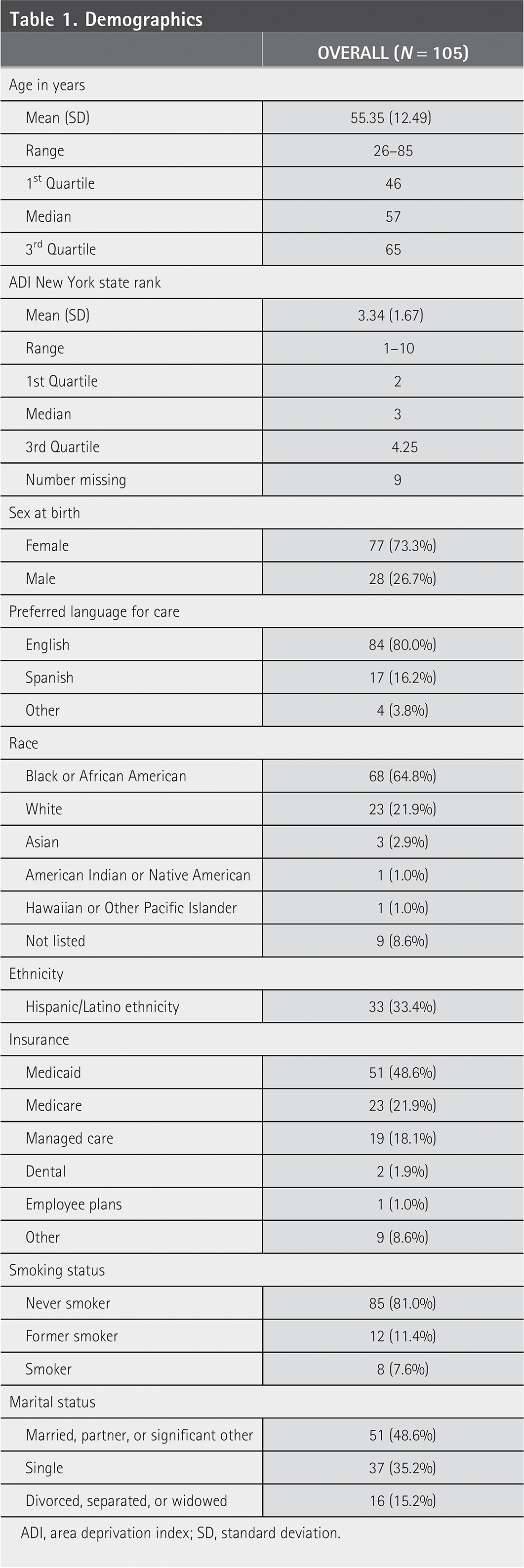
ADI, area deprivation index; SD, standard deviation.
DESCRIPTIVE STATISTICS FOR RPM UTILIZATION
In the overall sample (n = 105), the average total utilization score was 55.6%, indicating that, on average, participants took their BP readings on 55.6% of the days during the study period. The total missed BP check days ranged from 1 to 94 (Table 2), with an average number of 1.9 missing weeks per participant. In the overall sample, BPs were inputted manually 22.5% of the time, and 77.5% were sent via Bluetooth. Some participants submitted 100% of their readings via Bluetooth, while others submitted 100% of their readings via manual input. Within the sample, a mean of 43% of BP readings were submitted in the morning between 5:00 am and 11:00 am. This time block may represent the “upon waking up, before work” timing of routinely collected BP. A mean of 24% were sent between 11:00 am and 5:00 pm, 26% between 5:00 pm and 11:00 pm, and 9% between 11:00 pm and 5:00 am. Baseline SBP ranged from 94 to 194, with a mean of 142 ± 23.25. These descriptive statistics provide an overview of the RPM usage patterns among participants.
Study Variables/RPM Utilization per Patient
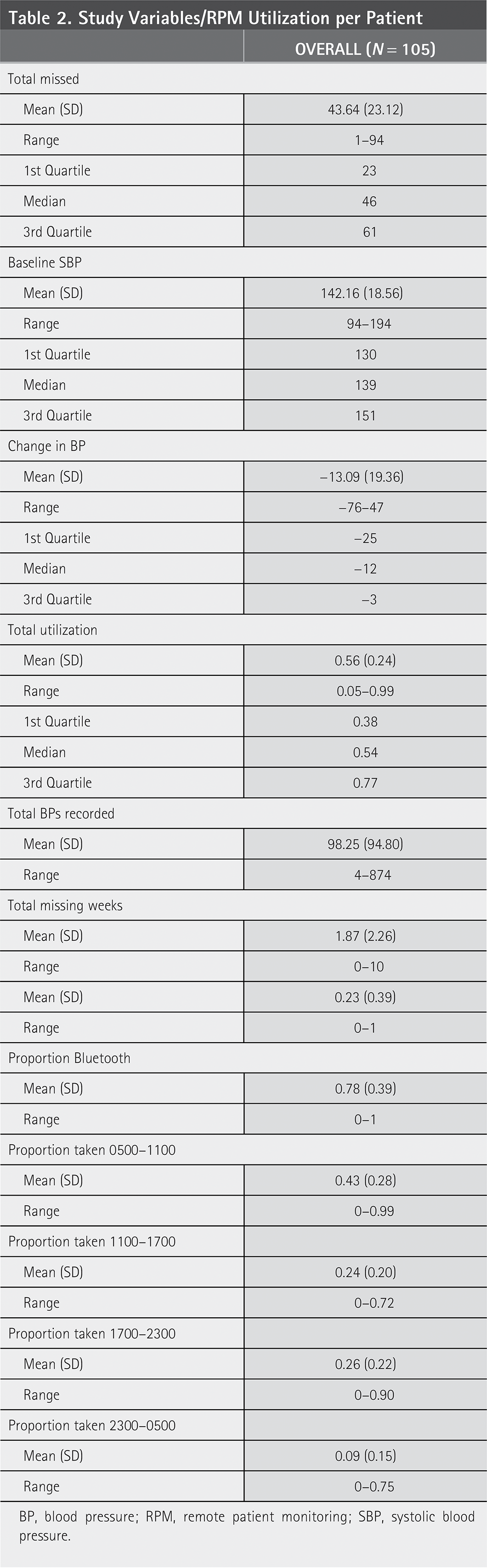
BP, blood pressure; RPM, remote patient monitoring; SBP, systolic blood pressure.
MIXED EFFECT MODELS
The linear mixed effect model analyzing the effect of fixed and random effects on missed days per week (Table 3) found that for every point increase in ADI NY state rank, missed days per week increased by 0.24 (p < 0.05) over the 3-month measurement period. For male patients, missed days per week increased by 0.84 (p < 0.05). Sensitivity analysis showed minimal changes, with male sex and ADI NY state rank increasing in significance. As the number of weeks on RPM progressed, participants had significant increases in missed days per week overall. Week 4 was associated with a 0.92 increase in missed days when compared to week 0 (p < 0.0001), peaking in week 9 with 1.92 more missed days (p < 0.0001). Coefficients from weeks 10 through 13 ranged from 1.17 to 1.66 (p < 0.0001). Participants on insurance other than Medicare or Medicaid had 1.67 more missed days per week over the 3-month measurement period.
Linear Mixed Effect Model: Change in Missed Days per Week Showing the Effect of Time, Utilization, Demographics, and SDOH

*p < 0.05; **p < 0.01; ***p < 0.001.
SDOH, social determinants of health.
The linear mixed effect model, looking at utilization, demographics, ADI, and change in SBP over time, found several significant results (Table 4
Linear Mixed Effect Model
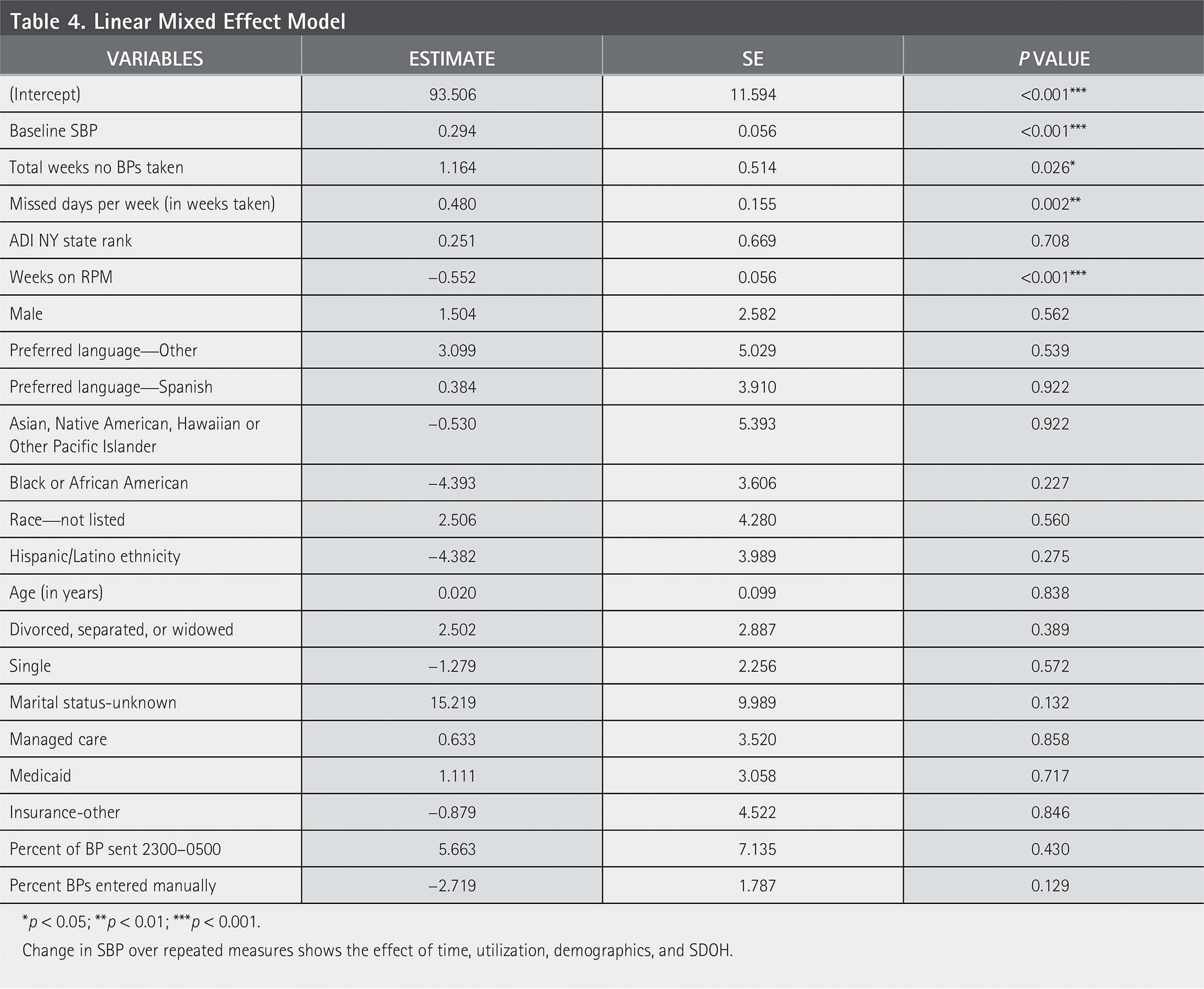
*p < 0.05; **p < 0.01; ***p < 0.001.
Change in SBP over repeated measures shows the effect of time, utilization, demographics, and SDOH.
In summary, the linear mixed effect model analyzing the effect of ADI on missed days per week found that higher ADI scores were associated with an increase in missed days per week (p < 0.05). However, the model analyzing the change in SBP over time indicated that ADI did not significantly impact the reduction in SBP, suggesting that while patients from areas of high deprivation missed more days, their overall BP reduction was not adversely affected.
Discussion
This study was among the first to analyze RPM utilization in a diverse FQHC population. Grounded in the DH-EquIR framework, this research explored relationships between demographics, SDOH, utilization metrics, and SBP changes. The DH-EquIR framework includes utilization as an implementation outcome, stressing the importance of ease of digital health integration into a patient’s daily routine. We examined RPM usage over 3 months, focusing on duration, frequency of RPM usage, and their relationship with demographics and ADI.
As participants continued using RPM over several weeks, the number of missed BP check days increased, especially in later weeks. Other studies found RPM utilization lessens over time, starting after the second month of program enrollment. 27 DH-EquIR suggests that a connected care team can reinforce utilization. Prior research has trialed clinician outreach, automated adherence calls, and automated text messaging.27–29 Patients received health coaching and outreach, which may have supported many participants in continuing to use RPM for three months despite fluctuations in missed days. Clinicians should consider regular follow-ups and providing reassurance through connected care teams to enhance utilization. Based on our experiences, we also recommend CHWs or nurses as care team members to perform weekly outreach by phone or portal message to increase utilization.
Our analysis focused on SDOH’s impact on RPM utilization, using the ADI NY state rank as a proxy. The DH-EquIR model recommends analyzing barriers to digital health tools utilization during the design phase; proposed reasons for this disparity include lower digital literacy and factors associated with the digital divide within low-income communities (e.g., poor internet access). Higher ADI (higher burden) significantly increased the number of missed days per week. Besides ADI, male sex and non-Medicare/Medicaid increased missed days. Lack of significance with other demographics suggests RPM’s success may stem from social support and effective device distribution.
We noted a reduction of SBP with longer RPM utilization, with a weekly reduction in SBP by 0.55 mmHg (p < 0.0001). The −0.55 coefficient for “weeks on RPM” represents the expected reduction in SBP for an average patient per week when other covariates and confounders are considered. This weekly reduction is a ‘by week’ outcome produced by the mixed effect model, and cumulatively, it would be a larger number over 13 weeks of RPM utilization. A separate analysis of BP reduction in the larger ALTA study showed a reduction of 13.5/8 mmHg SBP/DBP. 23 A similar study estimated a weekly −0.06 point decrease in SBP. 24 The reduction in BP due to RPM utilization is also noted in numerous other studies.25,30,31 Patients with a higher number of weeks in which they did not send BP data were predictive of higher SBP values over the 3-month measurement period. Higher RPM utilization led to improved cardiovascular-related outcomes in other research. 32 This finding reinforces the importance of clinical practices assisting patients in developing home BP monitoring routines. 26
Our exploratory analysis suggests that higher ADI participants missed more BP checks, but this did not significantly impact the reduction in SBP. This indicates that RPM can be effective in lowering BP even in populations facing significant socioeconomic challenges, although further research with a larger sample size is needed. DH-EquIR emphasizes the intersection between socioeconomic factors and digital health tool implementation, highlighting the need for targeted interventions to address digital determinants of health (e.g., digital literacy, access, and skills)—now regarded as a super SDOH.33,34 Super SDOH refers to the digital domain’s significant impact on various aspects of life and health, making it a critical determinant of health. Clinicians should consider screening for digital literacy and providing referrals for training in the local community. CHWs and RNs can also help provide hands-on training in digital skills to navigate RPM and other digital health tools. Using cellular BP devices that do not require Wi-Fi can help overcome connectivity issues. Additionally, digital determinants of health can be addressed with subsidies and reenactment of public policies to cover internet and device costs to ensure reliable internet access.
Limitations included the observational study design, which did not account for each patient’s BP monitoring protocol (e.g., twice a day, weekly) or clinic location differences. There are many challenges and potential biases in the analysis of home BP data. 24 This study was not powered to evaluate the overall effectiveness of RPM in this FQHC network. There is ongoing work in a larger sample to examine the effectiveness of this RPM program. The observation period required three months of continuous RPM usage, excluding participants with shorter usage thresholds.
Future research may explore how the time of day when participants collect their BP readings affects utilization frequency, such as considering barriers for night shift workers. Other studies have shown RPM feasibility for patients with chronic conditions to monitor vital signs every two days over extended periods. 35 Emerging research indicates that conversational agents, like chatbots, can enhance patient accountability, facilitate communication with care teams, and improve medication management. 36
Conclusions
In conclusion, results from this observational study of RPM for hypertension in a FQHC network offer support towards the provision of RPM in this setting. As participants stayed on RPM for longer amounts of time, missed days per week rose, particularly among those with higher ADI rankings. Despite high ADI NY state ranks and inconsistent RPM utilization, participants showed improvement in SBP. Total weeks with zero BPs sent and higher missed days per week were associated with higher SBP values over time. Participants were most likely to miss days in later weeks, peaking at week 9 of the program. The predictive nature of higher ADI state rank on increasing missed days per week warrants further attention to support populations experiencing burdensome SDOH. Future research is needed in more controlled studies to understand differences in RPM utilization in persons of high SDOH burden.
Authors’ Contributions
L.L.G.: Conceptualization, data curation, formal analysis, methodology, visualization, writing—original draft, and writing—review and editing. A.M.S.: Conceptualization, supervision, and writing—review and editing. R.B.: Validation and writing—review and editing. D.M.M.: Conceptualization, supervision, and writing—review and editing. A.A.B.: Conceptualization, supervision, validation, and writing—review and editing.
Footnotes
Author Disclosure Statement
The authors declare that they have no conflicts of interest in the research.
Funding Information
This research did not receive any specific grant from funding agencies in the public, commercial, or non-profit sectors.
Supplemental Material
Supplemental Material
References
Supplementary Material
Please find the following supplemental material available below.
For Open Access articles published under a Creative Commons License, all supplemental material carries the same license as the article it is associated with.
For non-Open Access articles published, all supplemental material carries a non-exclusive license, and permission requests for re-use of supplemental material or any part of supplemental material shall be sent directly to the copyright owner as specified in the copyright notice associated with the article.
