




Abstract
This review of martian organic geochemistry aims to contextualize recent findings of organic molecules in martian meteorites and from Mars missions within the broader study of origins of life on Earth. Analyzing martian organic inventories helps us understand the abiotic processes in planetary environments that are common wherever rocks interact with liquid brines and that likely contributed to the emergence of life on Earth. Mars is only the second planetary body studied for organic molecules; while carbonaceous meteorites, comet missions, and sample-return analyses of comets and asteroids have shown the diversity of organics across the solar system, studying Mars reveals what these molecules are on another planet. Although a definitive sign of extraterrestrial life has not yet been found, the findings provide insights into abiotic synthesis mechanisms that would have occurred on early Earth. At worst, these observations represent the oldest planetary record of organic and prebiotic chemical synthesis pathways that could have led to life, as inferred from the alteration of Earth’s oldest rocks. They may also point to potential habitats for past martian life. Currently, samples collected by the Perseverance rover represent a unique opportunity to verify which of the two questions, “Are we alone?” or “How did we get here?” will be true for Mars. Without doubt, these questions would be best addressed through the use of higher resolution analyses by more advanced and sensitive instrumentation after sample return to Earth. Even if no definitive signs of life are found in returned samples, they would give us the opportunity to study the missing link to life on Earth, that of the primordial abiotic organic chemical processes that could have led to life. Therefore, there are no wrong answers to exploring Mars for signs of life; its secrets will illuminate our understanding of ourselves and our place in the universe, whatever the answer.
Introduction
After decades of studying martian meteorites and deploying lander, orbiter, and rover missions to Mars, it is clear, based on our current data, that Mars is most probably a prebiotic planet. Evidence for martian organic compounds comes from robust, mutually confirming datasets derived from meteorite samples analyzed at the atomic scale in terrestrial laboratories and on Mars by some of the most analytically capable robotic missions our species has deployed (Eigenbrode et al., 2018; Freissinet et al., 2014,2016; Glavin et al., 2013; Grady et al., 2004; Grady and Wright, 2006; Hurowitz et al., 2025; Jaramillo et al., 2019; McKay et al., 1996; Millan et al., 2022; Scheller et al., 2022; Schmitt-Kopplin et al., 2023; Sharma et al., 2023; Steele et al., 2012a, 2018; 2019,2022; Wright et al., 1989). The irrefutable conclusion is that Mars contains organic compounds derived from known and unique organic synthesis mechanisms. This, in some respects, is unsurprising, given that Mars is the only other planet studied for organic geochemistry and the presence of life. Whether these observations constitute potential biosignatures—in martian meteorites and in ancient rocks on the planet itself—remains up for debate (Hurowitz et al., 2025). What is not debated is that Mars contains evidence of ancient abiotic organic synthesis mechanisms that have not been fully described or even considered in Earth’s origin-of-life studies (Steele et al., 2012a, 2012b; 2016, 2018, 2022). Namely, reactions such as serpentinization, carbonation, and the electrochemical reduction of CO2 have been active processes on Mars in the past and have produced a plethora of organic compounds abiotically (Steele et al., 2012, 2012b; 2016,2018, 2022). Serpentinization is often discussed in studies of the emergence of life on Earth, but there is no record of the rocks that could have participated in the reactions thought to have led to life’s origin (Westall et al., 2025). Indeed, the record of water-rock reactions early in the Hadean and Archean eons has, at best, been cooked to the point of providing little information on the state of the original organic inventory. At worst, it has been misleading about the presence or absence of Earth’s first organisms (see Brasier et al., 2002; Westall et al., 2025 and references therein). Since its formation, Earth has been a dynamic planet, slowly swallowing then squeezing and heating near-surface rocks and eventually reintroducing them to its surface, where they are further subjected to myriad forces for change, such as water, sunlight, and the influence of a continuous multi-billion-year-old biosphere separate to the original provenance of the rock itself (Ivarsson et al., 2018; Kadnikov et al., 2020). The most ancient of these rocks often serve as “evidence” of Earth’s early biosphere, despite the ubiquitous and extensive geologic and biologic forces of alteration that have operated on them over billions of years (Brasier et al., 2002, 2004a; 2004b, 2005). For example, there is evidence of several distinct and separate events contributing to the organic inventory of the Apex and Strelley cherts from Australia, where it has been argued that these rocks contain evidence of the oldest microfossils on Earth, a claim that has been disputed for several decades (Brasier et al., 2002, 2004; 2004, 2005).
On Mars, organic material is associated with relatively recent shergottite meteorites—the youngest documented so far was formed ∼170 Mya—as well as Nakhlite meteorites (∼1.2 Gya) and Allan Hills (ALH) 84001 (∼ 4 Gya), with the organic material having been synthesized ∼3.6 Gya (Mya and Gya are used for million and billion years, respectively) (Barnes et al., 2020; Herd et al., 2024; Symes et al., 2008; Udry et al., 2025; Udry and Day, 2018). During Mars missions, strikingly similar organic material to that found in meteorites has been identified and characterized at both Gale and Jezero craters. While the organic material in martian meteorites has been shown to be martian in origin (i.e., synthesized on Mars) rather than of meteoritic origin, this would also imply that organic synthesis occurred on Mars at a time when Earth had already developed life ∼3.6 billion years ago (Agee et al., 2013). The prevalence of organic synthesis reactions in rock samples from Mars over most of its history indicates that Mars has episodically initiated abiotic organic synthesis networks that have advanced to some extent though never resulted in an obviously global martian biosphere. In contrast, early Earth rocks, with far more extensive alteration and similar abiotic synthesis organic inventories, have been argued to provide evidence for an early emergence of life, presumably from a single pathway of events after the cooling of the magma ocean and the formation of surface oceans in the late Hadean.
Here, we review observations of Mars’ organic inventories, environments, and mechanisms of abiotic synthesis; the importance of understanding the planetary abiotic background; and the implications for identifying early life on Earth, Mars, and elsewhere. We also argue that Mars’ organic inventory, produced through abiotic, planetary processes, provides insight into Earth’s early prebiotic chemistry and should inform our interpretation of Earth’s earliest putative biosignatures used to constrain the timing of life’s emergence here.
The Nature of Martian Organic Material
Martian organic material is quite heterogeneous in its nature and composition. Initial studies showed that organic material released during pyrolysis mass spectrometry at temperatures above 600°C from martian meteorites had a very light carbon isotopic composition, similar to terrestrial biological systems, ranging from −11 to −24 ‰, with an average of approximately −19 ± 5 ‰ (Steele et al., 2016). Nitrogen released within the same temperature range, however, had a distinctly extraterrestrial signature between +15 and +300 ‰ (Aoudjehane et al., 2012; Eigenbrode et al., 2018; Fogel and Steele, 2013; Wong et al., 2013; Wright et al., 1989). This led to suggestions that the carbon that produced this signal was a reduced carbon phase of igneous origin (Grady et al., 2004; Grady and Wright, 2006; Steele et al., 2012; Wright et al., 1989). Note that the terrestrial biological and abiological ranges of carbon and nitrogen isotopes are discussed in detail in these excellent review articles: Horita (2005) and Thomazo et al. (2009). The Tissint meteorite provided an opportunity to analyze a martian sample collected just weeks after its witnessed fall, with minimal terrestrial contamination (Aoudjehane et al., 2012). Initial analysis of samples from this meteorite reported 14 Parts per million (ppm) of carbon released above 600°C, with a carbon isotope value of approximately −18 ‰ and a nitrogen isotope value varying between +40 and +80 ‰ (Aoudjehane et al., 2012; Steele et al., 2012a, 2016). High-resolution confocal Raman imaging spectroscopy of inclusions in primary minerals in 13 martian meteorites, including Tissint, revealed that this organic phase was associated with spinels, pyroxenes, apatite, and sulfides, and was found in both olivine and pyroxene minerals (Steele et al., 2012a).
At that time, the sample analysis at Mars (SAM) instrument aboard the Curiosity rover was analyzing the Cumberland site on Mars, and the resulting data were examined for signals of organic molecules based on molecular weight, released above 600°C (Eigenbrode et al., 2018). The Tissint meteorite was used to validate these analyses and, interestingly, showed almost complete agreement with both the mass distribution of organic molecules released (See Table 1) and the concentration of organic carbon in martian meteorites (i.e., 11.15 ± 6.9 ppm vs. an adjusted value of approximately 10.6 ± 8.9 ppm in the meteorites; Steele et al., 2016). The speciation of organic material released in the SAM experiments on Cumberland mudstones (above 500°C in this case) was highly diverse. Broadly speaking, the organic material was extremely similar to that released from Tissint and contained aromatic, aliphatic, carbonyl-, chlorinated-, and sulfur-functionalized organic compounds, such as thiophene (2014; Eigenbrode et al., 2018; Freissinet et al., 2016; Freissinet et al., 2014; Glavin et al., 2014; Grady et al., 2004; Grady and Wright, 2006; Hurowitz et al., 2025; Jaramillo et al., 2019; McKay et al., 1996; Millan et al., 2022; Scheller et al., 2022; Schmitt-Kopplin et al., 2023; Sharma et al., 2023; Steele et al., 2019; Steele et al., 2022; Steele et al., 2018; Steele et al., 2007; Steele et al., 2012a; Wright et al., 1989). Nitrogenous organic matter was identified in Tissint but not detected in the SAM datasets from Mars (See Table 1). However, measurements of the C:N ratio of carbon-bearing inclusions by Nano-SIMS in Tissint revealed a 16:1 carbon-to-nitrogen ratio, indicating that the organic nitrogen content (if present) was well below SAM’s detection limit (Steele et al., 2018). These data collectively exhibit uncanny similarity in the organic signatures between the Tissint meteorite and the organic inventories found within the mudstones of Gale crater. At the time, these represented mutually confirming datasets from state-of-the-art analyses on two planets (Eigenbrode et al., 2018; Steele et al., 2018) and have since been supplemented with additional, complementary, and higher-resolution instrumentation and analyses (Schmitt-Kopplin et al., 2023).
Similarities in Analysis of Instrumentation Measuring High-Temperature-Released Organic Material from the Tissint Meteorite, Using a Standard Gas Chromatography-Mass Spectrometry Instrument, versus within the SAM Testbed and Released on Mars during Analyses of the Cumberland Mudstones (Steele et al., 2012; Steele et al., 2018; Eigenbrode et al., 2018)
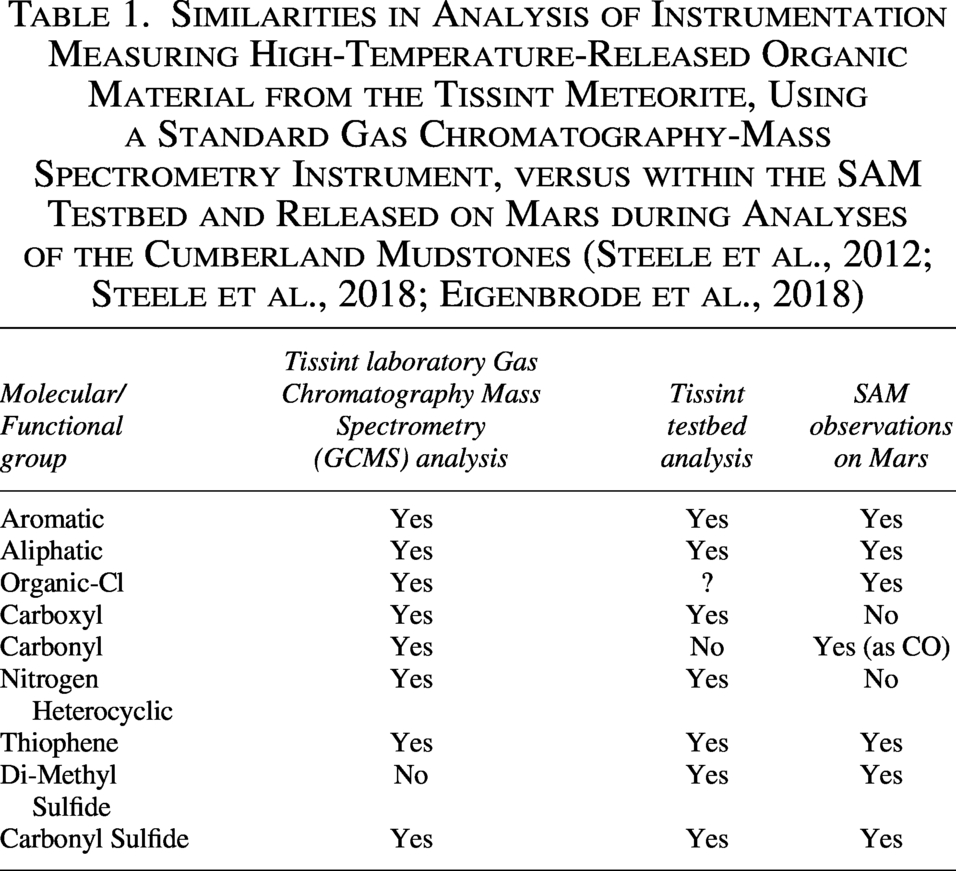
Similarities in Analysis of Instrumentation Measuring High-Temperature-Released Organic Material from the Tissint Meteorite, Using a Standard Gas Chromatography-Mass Spectrometry Instrument, versus within the SAM Testbed and Released on Mars during Analyses of the Cumberland Mudstones (Steele et al., 2012; Steele et al., 2018; Eigenbrode et al., 2018)
The Tissint meteorite fall represented a unique “sample return opportunity”—without the challenges of an in situ mission—to explore the nature of martian organic material with ever-advancing, state-of-the-art instruments on Earth that are not yet or, in some cases, not capable of being flight-ready. As an example, recently, ultra-high-resolution mass spectrometry analyses using a Fourier transform ion cyclotron resonance mass spectrometer (FT–ICR–MS) of Tissint have confirmed the organic carbon speciation inferred from meteorite analyses and SAM data and further revealed a more diverse organic inventory of remarkable complexity and novelty. The chemical fingerprint of the Tissint organic inventory was unique compared with the Murchison carbonaceous meteorite and biological or terrestrial geosystems (Fig. 1). Schmitt-Kopplin et al. (2023) used solvent extraction methods and showed that the Tissint meteorite contains thousands of individual polar organic masses with C, H, N, O, S, Cl, and, interestingly, Mg functional groups (Schmitt-Kopplin et al., 2023). The average distribution of organic matter composition was CHO > CHNO > CHOS > CHNOS, confirming both the N- and S-functionalities previously revealed in this meteorite (Eigenbrode et al., 2018; Jaramillo et al., 2019; Schmitt-Kopplin et al., 2023; Steele et al., 2018). Figure 1 shows Fourier transform ion cyclotron resonance mass spectrometer (FT–ICR–MS) analysis of biological (Fig. 1A), terrestrial organics (Fig. 1B), Murchison (Fig. 1C) and Tissint organic material (Fig. 1D), along with the signal chosen at an arbitrary mass of m/z 319, which was originally chosen during the analysis of the Murchison meteorite as an illustrative example of the resolution of the FT–ICR–MS technique and to be able to be transferable, for illustrative purposes, across matrices (Schmitt-Kopplin et al., 2010). Both Tissint and Murchison have much higher concentrations and distributions of CHNOS- and CHOS-associated masses than the terrestrial samples and show distinct differences between themselves, which indicates that martian organic material is distinct from that in carbonaceous chondrites. (Pieczonka et al., 2020; Schmitt-Kopplin et al., 2010,2014; 2023). Many nonbiological homologous series of related organic masses were identified in Tissint, such as those present in the Murchison meteorite, which suggests an abiotic source for the synthesis of this material (see Fig. 1C and D compared with Fig. 1A). For example, the mass accuracy and detail for the nominal mass of 319 are shown in Figure 1. At this mass, the biological sample clearly shows a mass signature in each nominal mass corresponding to individual concentrations of metabolites as a result of a selective metabolism (in this case a fruit fermentation product) that can be annotated to single molecules being carbohydrates, lipids, acids, nucleotides, or various polyphenols (Fig. 1A). These assignments are not possible in the other samples as the exact masses attributable to biological molecules are not prevalent in these samples. Both the Murchison meteorite (Fig. 1C) and Tissint (Fig. 1D) show mass distributions in each nominal mass (exemplified with mass [m/z] 319 in the middle of the figure) that reveal little to no concentrations of masses due to the presence of life, but are instead indicative of repeating homologous series associated with abiotic chemistry.

Van Krevelen diagrams (H/C to O/C), with associated m/z 319 peak distributions and the distribution and number of compounds in CHO, CHOS, CHNO, and CHNOS space, of high-resolution mass spectrometer (FT–ICRMS) data of a number of samples:
Although the distribution of particular functional groups in Tissint differs from that observed in carbonaceous chondrites such as Murchison (Fig. 1C), the similarity in the presence of abiotic homologous series is stark and also significantly distinct from that of terrestrial biological or geological samples (Fig. 1A and B). Furthermore, analyses of different lithologies within the meteorite showed that the organic composition is matrix-dependent, with concentrations of specific organic masses varying across the olivine, black glass, and matrix (see Schmitt-Kopplin et al., 2023; Fig. 2). Interestingly, the magnesium-functionalized organic material, which may or may not contain sulfur, represented by the general formulae RCO2Mg(OH)2 and RCO2Mg(OH)2SO2, was most prevalent in the olivine-only fraction of the analyses (Schmitt-Kopplin et al., 2023). This type of material had been observed previously only in meteorites and in asteroidal material associated with high-temperature and pressure processes (Schmitt-Kopplin et al., 2023). Their presence in Tissint, associated with the olivine megacrysts, indicates that the organic material is nonterrestrial and therefore martian in origin and either formed after a high-temperature episode or resulted from fluid reactions with olivine, probably by a sulfate-containing brine. The sheer complexity of the abiotic organic inventory necessitates the highest mass spectral resolution, as lower-resolution techniques cannot provide sufficient detail to distinguish extraterrestrial abiotic inventories from terrestrial biological materials and their derivatives.
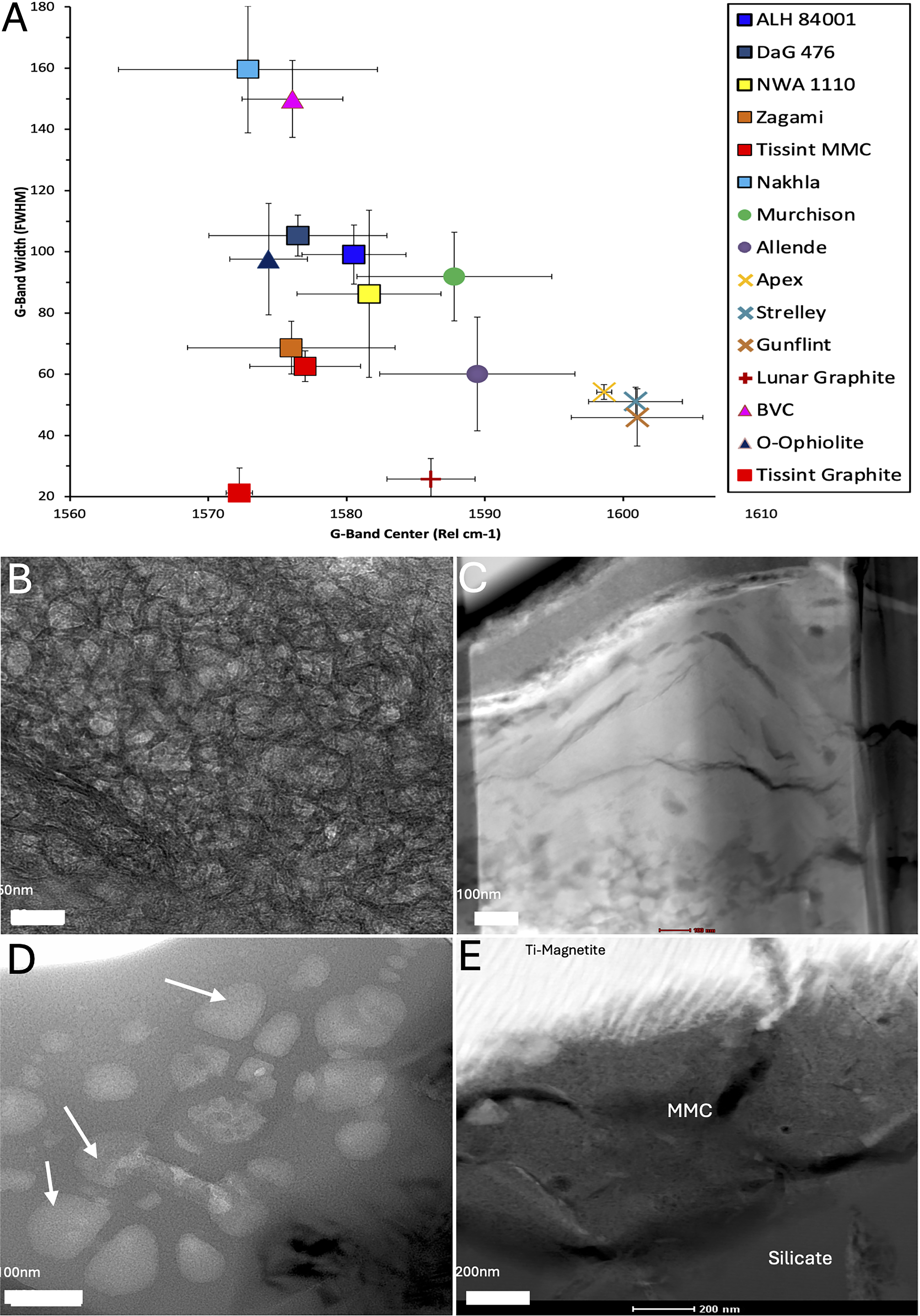
As discussed earlier, the Raman analysis of martian meteorites revealed a macromolecular carbon (MMC) phase similar to the insoluble organic material (IOM) in carbonaceous chondrites and to kerogen from terrestrial fossiliferous rocks (Bower et al., 2013; Sandford et al., 2006; Steele et al., 2016). Figure 2A shows the nature of this Raman signal and its distribution across a subset of martian meteorites, carbonaceous chondrites, interplanetary dust particles, and presumed terrestrial fossiliferous material (data taken from (Bower et al., 2013; Busemann et al., 2007; Sandford et al., 2006; Steele et al., 2016). Much has been written about the nature of this signal, particularly its significance for life detection in early Earth rocks (Brasier et al., 2002; Pasteris and Wopenka, 2003; Schopf et al., 2002). Reviewing this body of literature is outside the scope of this article; however, it is important to note that the correlations of this Raman MMC signal with putative compositional, structural, and/or diagenetic features of the organic material being analyzed—whether kerogen, IOM, or martian MMC—are complex and in many cases overinterpreted (Potiszil et al., 2021). Figures 2B–D are visual representations of MMC-rich areas within martian meteorites, as revealed by transmission electron microscopy, and show MMC in a range of contexts, almost always within amorphous silica-bearing phases. Interestingly, in NWA 1950, a meteorite was excavated from deep within the martian crust (∼5 km), and the MMC in this meteorite is riddled with bubbles, possibly pointing towards volatile release from depth during impact ejection but also indicating that organic material may be found at considerable depth on Mars (Stolper and McSween, 1979). Therefore, the Raman peak associations depicted in Figure 2 should be interpreted broadly, as they illustrate only similarities or differences that warrant further investigation and cannot be used to describe any definitive features of the organic material other than the level of ordering.
Observations by the SHERLOC instrument aboard the Perseverance rover have also identified MMC peak distributions on Mars, which are similar to those observed in martian meteorites (Hurowitz et al., 2025; Sharma et al., 2023). It is important to note that the deep UV (SHERLOC) and visible-light Raman spectra of MMC are not directly comparable, as the same material shows a peak shift between the two techniques (Quirico et al., 2020). Interestingly, this shift has been observed in martian meteorite SaU 008—this meteorite, which is known to have MMC associated with carbonate, is used as part of the SHERLOC calibration target suite and, ironically, is also the only meteorite to return to Mars (Bhartia et al., 2021). Thus, while comparisons of MMC from SHERLOC with the martian meteorite calibration standard are possible, comparisons of these spectra with other MMC samples obtained with visible-light Raman spectroscopy systems remain challenging, and studies are ongoing at the time of writing. One certainty, however, is that the presence of MMC on martian meteorites and on Mars itself has been confirmed by Perseverance by Raman (Hurowitz et al., 2025; Sharma et al., 2023), by Curiosity through SAM analyses (Eigenbrode et al., 2018), and by isotopic measurements of the hydrogen isotopes of organic material in martian meteorites (Steele et al., 2018,2022).
Broad characterizations can and have been made to understand the provenance and formation mechanisms of martian MMC. Foremost among these is that this material is notoriously difficult (but not impossible) to produce as contamination; therefore, its presence in the rocks warrants attention. Initial studies that mapped the distribution of this material discounted its occurrence in the cracks and fissures of martian meteorites as contamination (Steele et al., 2007, 2012a), given the known presence of terrestrial organisms contaminating meteorites (O’Brien et al., 2022; Steele et al., 2000; Toporski and Steele, 2007). Later studies revealed that some of this organic material is intimately associated with spinel, exhibits a hydrogen-isotopic signature consistent with Mars, and provides evidence for aqueous alteration of the primary mineralogy (Steele et al., 2018,2022). Indeed, atomic-level studies of Tissint, Nakhla, and ALH 84001 have shown that the martian MMC is synthesized in situ by several distinct reactions (Steele et al., 2007, 2012a, 2018,2022). By applying in situ nanoscale, high-resolution cross-correlation analyses to several martian meteorite samples, we have identified two distinct mechanisms for martian abiotic organic synthesis: serpentinization in combination with carbonation and the electrochemical reduction of CO2 (Steele et al., 2007, 2012a, 2018,2022). In these studies, the effects of terrestrial organic input on the observations have been mitigated by hydrogen-isotopic analyses of the observed carbon-rich material. Importantly, both of these mechanisms share a common feature: initiation of the organic synthesis pathway occurs when a brine reacts with an igneous rock—a process that is not only plausible but likely on other wet rocky bodies and therefore a critical consideration for Earth’s prebiotic chemistry and also for understanding the planetary abiotic background against which putative extraterrestrial biosignatures must be tested (Steele, 2016; Steele et al., 2022,2018; 2007, 2012a; Teece et al., 2025).
Functionalized organics
In previous studies of martian meteorites, Sephton et al., 2002 reported abundant benzonitrile in the Nakhla meteorite detected with pyrolysis gas chromatography–mass spectrometry. Although this study could not rule out contamination, the authors initially attributed the high-molecular-weight organic compounds to meteoritic infall onto Mars rather than to indigenous martian processes. The presence of carbon-nitrogen functional groups, including C–N = C moieties in a six-membered ring (pyridine) and pyrrolic functional groups, was confirmed by scanning organic-rich areas of Tissint across the N-K edge using soft-transmission X-ray microscopy. These observations are consistent with energy-dispersive X-ray spectroscopy analyses of MMC in Nakhla; confirm the co-occurrence of nitrogen and carbon in the corrosion features analyzed; and also extend the provenance of nitrogenous organic compounds to aromatic functional groups. This is also consistent with the nature of MMC and mass spectrometry observations of the aqueous phase. A time-of-flight secondary ion mass spectrometer (ToF–SIMS) study was performed on fresh fracture surfaces of the Tissint meteorite, and the negative ion analyses confirmed the presence of organic functional groups, including COOH−, CH2O−, CN−, C3N−, C2N3−, C5N−, C7N−, CNO− (Steele et al., 2018). Furthermore, the presence of CS−, C2S−, and C4H4S−species in the meteorite further supports the observations of these species in the SAM dataset. In particular, these species are co-located with areas of the sample that also contain C−, OH−, FeO2−, FeCl−, FeCl2−, S−, Cl−, SO3−, and, notably, ClO−, ClO2−, and ClO4−. The presence of ClO− > ClO2− > ClO4− in Cl− and organic-rich areas of the sample indicates perchlorates, which have been detected on Mars by the Phoenix, Curiosity, and Perseverance missions, and whose presence has also been confirmed in martian meteorites (Kounaves et al., 2014; Steele et al., 2018). These data indicate that organic carbon co-occurs with Cl−, S−, and FeO2− (note negative charge indicating ion fragment) in some regions of the sample; thus, they corroborate the association of the organic material with a Cl-rich fluid interacting with corroding Fe-rich mineral phases (see Steele et al., 2018, for discussion).
Interestingly, non-terrestrial C5 amino acids have been detected in the martian meteorite Roberts Massif (RBT) 04262 (Callahan et al., 2013). These amino acids are unusual in terrestrial samples and were present at levels well above those of any terrestrial contaminant proteinaceous amino acids, supporting hypotheses of their martian origin. Similar amino acids have been found in ureilites by similar methods (Burton et al., 2012). One possibility is that these amino acids were formed by impact processes, possibly from nitrogen-containing heterocycles broken down during the impact. Additional SAM investigations on Mars have revealed the presence of diverse organic species, including chlorohydrocarbons, C9 and C11 aliphatics, and sulfur-functionalized organics such as thiophene, dimethyl sulfide, and dithiopentane (Freissinet et al., 2025; Millan et al., 2022). In a recent article, the concentration of C9 and C11 aliphatic organic material in SAM data was modeled through geological time, indicating that concentrations of these molecules would have been much greater at the time of rock deposition. The authors hypothesized that currently understood abiotic synthesis mechanisms cannot account for the presence of these molecules at this concentration, and they advanced both abiotic and biotic explanations for this observation (Pavlov et al., 2026). Furthermore, recent observations of reduction spots at Neretva Vallis on Mars reveal intriguing mineralogical indicators of reduction processes associated with organic material in the form of MMC (Hurowitz et al., 2025). The authors argue that this intriguing observation, which couples the probable detection of vivianite, an Fe(II) phosphate, with iron sulfides and organic material, if present in terrestrial rocks, is usually indicative of microbial activity.
Other pools of martian carbon
There are two other indicators of processes in martian meteorites that warrant comment. In answer to whether polycyclic aromatic hydrocarbons (PAHs) were present in ALH 84001, it was posited by Treiman (2003) and substantiated by (McCollom, 2003) that the thermal breakdown of siderite (FeCO3) may have formed the PAHs during impact ejection of the meteorite from Mars (McCollom, 2003; Treiman, 2003). Interestingly, Steele et al. (2007) showed that MMC was present in a subset of “ghost” globules—seemingly once-intact carbonate globules that were reduced to just rings of magnetite with little to no carbonate present (Steele et al., 2006,2007). They postulated that these “ghost globules” were remnants of intact globules that had decomposed, forming PAHs, as speculated by Treiman and McCollom (McCollom, 2003; Treiman, 2003).
Finally, there is a discrete population of highly crystalline graphite in the Tissint meteorite. This meteorite has experienced some of the highest shock pressures known for ejection from Mars, forming a secondary black glass component during ejection (Baziotis et al., 2013). Highly ordered graphitic particles were detected in this black glass component; they likely represent organic carbon transformed during the impact. However, the transformation of siderite, as mentioned above, cannot be totally ruled out. The absence of magnetite in the organic association may indicate that it is more likely to have been originally organic in nature. Whether the graphite originated as organic carbon, from the impacted rock, or from the impactor is also unknown (Steele, 2016).
Combining in situ and bulk datasets
Each of the analytical techniques described above, when applied in terrestrial laboratories and aboard Mars rovers, provides insight into the progression of martian prebiotic chemical reactions. More importantly, the combination of these data indicates that Mars’ organic chemistry is active and driven by the composition of fluids interacting with martian mineral surfaces. Key observations from these datasets are as follows: The ToF-SIMS data reveal N-, O-, S-, and Cl-containing organic fragments associated with iron oxides. The nitrogen component was confirmed by nano-SIMS and elemental analyses. FT–ICR–MS reveals a pattern of martian organic inventories consistent with an abiotic distribution, and while similar to that seen in the Murchison meteorite, there are major differences that make martian organic geochemistry unique to Mars (Fig. 1, comparison of m/z 319). For example, martian organics contain a much higher proportion of S- and Cl-associated organic compounds than terrestrial or carbonaceous chondrite organic material, which makes the signal distinctly martian (Schmitt-Kopplin et al., 2023). Long-standing observations indicate that martian fluids are more S- and Cl-rich than terrestrial fluids, and these data suggest that the fluid composition is a critical determining factor to the abiotic synthesis mechanism involved (Gooding, 1992; Gooding et al., 1990,1991; 2009; Gooding and Muenow, 1986; Lee et al., 2013,2015; Needham et al., 2013; Schwenzer, 2014; Schwenzer et al., 2016; Tomkinson et al., 2013a, 2013b). Martian prebiotic chemistry may have included many steps toward the formation of life, but the higher concentrations of S and Cl in the foundational organic inventory may have prohibited further evolution toward a prebiotic/biotic transition. Nevertheless, functionalizing organic molecules with halides remains a crucial step in many industrially important organic chemical reactions and could be a critical component of prebiotic reaction networks. Brines are rarely incorporated in abiotic synthesis and prebiotic transformation experiments, and these results from Mars present an opportunity to apply lessons learned from martian prebiotic chemistry to Earth’s origin of life studies, as well as our understanding of the abiotic background.
Abiotic Organic Synthesis on Mars
Serpentinization and carbonation
Analyses of Nakhla and ALH 84001 both revealed the presence of serpentine-family minerals, and in each meteorite these have been linked to the presence of organic material (Steele et al., 2022; Thomas-Keprta et al., 2022). Examination of the carbonate globules in ALH 84001 and a terrestrial analog from Svalbard showed that organic carbon is typically associated with carbonate, though it is also intimately connected with spinel or sulfide phases within the carbonates (Steele et al., 2022). Transmission electron microscopy analysis of ALH 84001’s carbonate phases and the pyroxenite host rock has revealed significant alteration (Steele et al., 2022; Thomas-Keprta et al., 2022). The weathering of iron-rich pyroxene produces amorphous silica and magnetite, likely indicating hydrogen release in this system. Soft-transmission X-ray microscope (STXM) analysis of this material documented major peaks that correspond to various carbon species: 284.9 eV (aromatic olefinic-rich), 286.4 eV (vinyl-keto groups), 288.56 eV (carboxyl groups), and 290.4 eV (carbonate). Confocal Raman imaging spectroscopy indicated that the carbon-containing phase is a complex aromatic structure lacking graphitic domains (as no significant peak at 290.1 eV, indicative of graphite, is present) and containing a considerable amount of C = C, C = O as ketone and carboxy groups, C–O–H as enol and carboxy groups, and possibly aliphatic carbon. Therefore, the production of aromatic compounds adjacent to amorphous silica indicates that serpentinization reactions on early Mars drove abiotic organic and the production of a complex organic inventory. The studies of Nakhla also reveal that similar organic synthesis mechanisms were at work for a significant period after Mars lost its atmosphere, indicating the importance and episodic nature of martian organic synthesis over geological time scales (Steele et al., 2018,2022; Thomas-Keprta et al., 2022).
Electrochemical reduction of CO2
Analysis of spinels in the Nakhla meteorite reveals Ti-rich spinel laths that remain intact alongside adjacent Ti-poor lamellae, which have undergone preferential corrosion, leaving behind an iron-rich phase within the remaining grain structure. Elemental analysis indicates that this iron-rich, amorphous phase also contains Cl, O, N, C, and Si (7). Confocal Raman imaging spectroscopy mapping of the region further confirms the coexistence of titanomagnetite and MMC. These findings suggest an interaction between titanomagnetite grains and a Si- and Cl-rich aqueous fluid containing K, Mg, Al, Fe, and Mn. The variation in composition within individual spinel grains could have established micro-galvanic couples, with Ti-poor/Fe-rich domains acting as anodes and Ti-enriched phases as cathodes, while the fluid acts as the charge-balancing electrolyte. The preferential dissolution of Ti-poor regions leaves the Ti-rich domains relatively preserved. The spatial correlation between Fe and Cl supports the presence of a brine, enhancing ionic conductivity and promoting galvanic corrosion. The likely, but not yet confirmed, electrochemical reactions are as follows.


Reaction (1) represents the anodic oxidation of magnetite to hematite, likely proceeding via maghemite as an intermediate, while reaction (2) corresponds to the cathodic hydrogen evolution reaction (HER). Together, these reactions define a self-sustaining galvanic corrosion cell that generates reduced species without an externally applied voltage (Wang et al., 2026, In review). In subsequent reactions, also catalyzed by magnetite, the anodic half reaction of water electrolysis can also produce O2.
The hydrogen evolution reaction is pH-dependent and usually requires an externally applied voltage to operate in engineered systems. Associations between reduced phases and organic material in martian meteorites suggest that analogous natural processes proceeded spontaneously during mineral-fluid interactions. In this context, the oxidation of magnetite releases electrons that can be transferred across mineral-fluid interfaces. The question then becomes whether the galvanic potential and current associated with the dissolution of natural magnetite and titanomagnetite are sufficient to drive the production of H2 and/or the reduction of CO2. White et al. (1994) undertook dynamic polarization experiments on natural magnetite and ilmenite and reported that natural magnetite releases ∼0.65 mV during corrosion (White et al., 1994). While such values are small when considered as bulk potentials, localized interfacial potentials at mineral-fluid boundaries enhanced by surface states, compositional zoning, and semiconductor band bending in Fe- and Ti-bearing oxides could be sufficient to promote kinetically favorable electrochemical reactions. Under these conditions, magnetite and titanomagnetite could plausibly participate in the electrochemical reduction of aqueous CO2. At standard conditions and pH 7, the electrode potentials for the reduction of CO2 to CO, HCHO, HCOOH, CH3OH, and CH4 range from −0.24 to −0.61 eV. However, the effective in situ electrode potentials depend on temperature, pressure, pH, and the presence of additional ions, such as Si or Al, or halide ions (e.g., Cl−).
Electrochemical reduction of aqueous carbon dioxide is a highly active research area due to its potential to sequester CO2 from Earth’s atmosphere. Considering the mineral associations identified in martian meteorites, how plausible is it that an electrochemical reduction process could account for organic synthesis? Experiments have confirmed that several species are produced during the electrochemical reduction of aqueous KHCO3, including H2, CH4, HCOOH, CO, C2H4, C2H6, C2H5OH, and CH4O (Azuma et al., 1990). Examination of the soft transmission X-ray microscopy (STXM) spectra (confirmed by ToF-SIMS in Steele et al., 2018) shows that, although most spectra include the olefinic aromatic peak at ∼285 eV, there is a variety of carbo–-oxygen functional groups, such as C–O, C = O, and COOH. This combination is consistent with multi-step CO2 reduction followed by surface-mediated condensation or polymerization reactions on mineral surfaces, rather than a single-step reduction pathway. This aligns with the expected products of the electrochemical reduction of CO2, in which the primary factor influencing product composition is the electrode material (Azuma et al., 1990; Eck et al., 1966; Farooqi et al., 2023; Seh et al., 2017).
One notable aspect of electrochemical reduction is that it is relatively easy to produce both methane and oxygen, both of which are present in the atmosphere of modern Mars. Furthermore, electrochemical processes are linked to the formation of perchlorate, chloromethane, and potentially nitrate on Earth (Long et al., 2024; Tock et al., 2004; Wang et al., 2024). The presence of these molecules has been attributed to atmospheric processes on Mars; however, they may also indicate that subsurface electrochemical processes remain active and therefore that liquid brines persist in Mars’ subsurface.
In the 1970s, the data collected by the Viking missions were interpreted as indicating the absence of life (Anderson et al., 1972; Biemann et al., 1977). The disappointment that followed led to a hiatus in the search for life for several decades, until the announcement of possible relic biogenic activity in ALH 84001. That announcement reignited and fueled a robust discussion of life detection, the abiotic background, and how we might learn about the origin of life on Earth from our planetary neighbor. It also highlighted one critical twist to the search for life: the search for life elsewhere and the search for life’s beginning are both underpinned by understanding how planetary bodies abiotically synthesize organic compounds (e.g., the abiotic background) (Steele et al., 2007). The search for and detection of organic compounds in martian meteorites and on the surface of Mars was in pursuit of an answer to the question, “Are we alone?” What we have learned is that there is a plethora of organic chemistry happening not just in asteroids or comets but on any planetary bodies, that the resulting abiotic organic inventories vary from one rocky body to another, and that such organic inventories on a planet like Mars are different from those in carbonaceous chondrites and comets (because of the diversity of temperature and pressure conditions for water alteration of rocks). In other words, the necessary building blocks of life can be produced on anybody in the solar system that allows water-rock reactions, however fleeting. So, in our search for life elsewhere, we have (un?)wittingly addressed the question, “Where did we come from?” and we have accomplished this not by looking at our own planet, where a record of life’s abiotic chemistry has been erased by geology and overwritten by biological processes, but by looking for life elsewhere. As such, the search for life and the search for our own origins are in fact two sides of the same coin.
The emergence of life on Earth
Terran life must have emerged from Earth’s own abiotic organic inventories, resulting from the interactions of fluids, rocks, and volatiles in dynamic early Earth environments, and potentially augmented by infalling meteorites and comets. The evolution of the abiotic/prebiotic network on Earth that did give rise to life remains elusive, evolved/erased by billions of years of volcanism, plate tectonics, metasomatism, and the superseding biosphere—or it still may be present in deep Earth. Mars’ abiotic organic inventories and network of prebiotic chemistry are a useful analog from which Earth’s own prebiotic processes might be inferred. Serpentinization has long been implicated in abiotic CO2 reduction in Earth’s ultramafic deep-ocean and subsurface environments (Etiope et al., 2018; Holm et al., 2015; Kelemen and Hirth, 2012; Lollar et al., 1993,2002; McCollom, 2016; Schrenk et al., 2013; Steele et al., 2022; Szponar et al., 2013; Wang et al., 2014), though experimental organic products that represent terrestrial serpentinizing systems bear little resemblance to the organic compounds identified in martian meteorites (see Section 3.1). Not only are the compositions of martian mafic and ultramafic rocks different than Earth’s, but the planetary conditions vary widely between the two bodies (Grady and Wright, 2006; Humayun et al., 2013; Westall, 2008). Nonetheless, observations of primary and secondary mineralogy, as well as the resulting organic inventories observed in martian meteorites, can serve as guideposts for future experiments that seek to explore serpentinization as a plausible contributor to early Earth’s abiotic organic inventory (McCollom and Seewald, 2001,2007). In a similar vein, the documentation of abiotic organic synthesis in martian meteorites via electrochemical reduction of CO2 raises important questions about the role of electrochemical reactions of spinels and sulfides with brines in early Earth environments, and their potential to significantly contribute to the early Earth abiotic chemical inventory (Azuma et al., 1990; Chin et al., 2020; Steele et al., 2018; Yamaguchi et al., 2014; Yamamoto et al., 2013). In martian systems, spinels act as batteries; they release energy at the nanoscale as they corrode and accumulate a variety of solid-phase organic compounds at the mineral/electrode interfaces. The posited electrochemical reactions documented in martian meteorites have been reproduced in the laboratory, and the abiotic synthesis of formate, acetate, and aromatic compounds has been documented (Wang et al., 2026). Even more surprising and exciting is the fact that these reactions can occur at temperatures as low as 4°C and at any location where an igneous rock interacts with brine—environments so widespread on early Earth that resulting abiotic synthesis products should have been abundantly available for subsequent alteration and selection (Azuma et al., 1990).
Decades of work to delineate Mars’ abiotic organic inventories, its abiotic baseline, and the associated processes serve as a starting point for positing Earth’s abiotic organic inventories, likely formed by similar processes but with different organic distributions driven by variable planetary compositions. Using Mars’ abiotic organic inventory as an imperfect analog for early Earth, it can nonetheless be inferred that (i) the presence of brines during water/rock reactions can be a critical part of generating a galvanic cell but also subsequently functionalizing the organic compound products; (ii) nitrogen incorporation into the abiotic organic inventory is facile in the processes documented for Mars, seemingly without the need for the cyanide-based processes often implicated in Earth’s prebiotic chemistry (Borquez et al., 2005; Holm and Neubeck, 2009; Liebman et al., 1995; Villafañe-Barajas et al., 2020); and (iii) a wide variety of organic functional groups are produced by these processes, including pyridines, pyroles, other aromatics, benzonitriles, vinyl-keto groups, ketones, carboxyl groups, and a variety of C-N, C-S, and C-N-S compounds. Many of these organic compounds are found at mineral interfaces, form in low-water/rock systems, or are left behind after water-removal processes. In any case, observations of abiotic organic synthesis on martian meteorites provide a clear recipe book for Earth’s abiotic and prebiotic organic chemistry, and the convergence of the Mars life-detection community and literature with the origin of life on Earth community and literature may hold the key to both objectives.
Life detection and the abiotic baseline
In previous articles, we have laid out the case for why life detection should be undertaken against an understanding of the planetary abiotic background, and this concept has become firmly rooted in the astrobiology arsenal (Steele et al., 2006,2007, 2012a, 2012b, 2016,2018, 2022). These articles and this philosophy of life detection were rooted in the debate over life in the ALH 84001 meteorite, which laid bare our limited understanding of Mars’ abiotic organic inventory and the need for laboratory experiments that explore abiotic synthesis reactions under fluid and mineral conditions that mimic martian conditions. As we have seen, martian abiotic organic chemistry differs from that of carbonaceous chondrites in that fluid and mineral compositions affect the products of organic synthesis and, consequently, the inventory of organic material available for prebiotic-to-biotic transitions. Recent thinking on the detection of life in returned martian samples echoes this philosophy, as it provides a workable baseline and an adaptable hypothesis that is not biased toward Earth’s biochemistry (Teece et al., 2025).
Planetary abiotic synthesis processes produce diverse inventories of organic compounds, a huge alphabet that encompasses many thousands of compounds, moieties, and functional groups. From this alphabet, emergent life and the proximate planetary conditions co-evolve to select only a few to make the chemical language of life (Steele, 2012b; Steele et al., 2006, 2016). This philosophy assumes that life remains carbon-based but is otherwise agnostic about the specific biochemistry of Terran life. A simple example is the so-called LMNOP principle, that is, if Terran life uses A,C,T,G,U in its genetic code and martian life may use L,M,N,O,P, these parts of biochemistry must be interchangeable so that a biosphere can evolve into inter-dependent ecosystems (see Williams et al., 2026 in this issue) and have at least the same function, if not the same specific chemistry. More critically, the alphabet of emergent life will be distinguishable from the abiotic baseline for the specific extraterrestrial body in which signs of life are sought (See Fig. 1).
The more obscure life is, the more challenging it is to distinguish signs of emergent life from the abiotic background, and such differentiation will require a wealth of mutually confirming techniques applied to both bulk and in situ samples, as described here. In the field of life detection, the number, complexity, and resolution of measurements must increase as putative life becomes less distinguishable, or in the case of terrestrial samples, more altered. For example, if life on another world is composed of charismatic mega-fauna, say herds of wildebeest sweeping majestically across a martian plain, then all that is needed for its detection is a camera. As life decreases in size, concentration, and ability to influence its environment, and spreads across planetary environments, the number of techniques, resolution, and the complexity of analysis and sample preparation increase. Add to this the possibility that life is ancient and has undergone diagenesis to the point that only trace amounts of molecules remain for study. On Mars, we have undertaken decades of intensive study with the most sophisticated instrumentation our species has produced. In terrestrial laboratories, meteorites have been studied at the atomic level using synchrotrons, mass spectrometers, and imaging systems that will not be ready for mission deployment within any reasonable time or financial framework. That said, when combined with the most capable flight platforms, they have produced outstanding results, yielding what we argue are mutually confirming datasets of Mars’ organic inventory through analyses on two planets. Still, after decades of study and ever-more highly resolved analyses, any definitive traces of putative martian life remain stubbornly elusive. However, there are tantalizing glimpses that there may be signs of prebiotic or even biotic deviations from the currently defined martian abiotic baseline. However, this baseline remains only partially characterized, and Mars has shown many surprises in the past. However, our publications and the science community’s decadal reports establish that the threshold for life detection on Mars exceeds the analytical capabilities of flight instruments and requires the full capabilities of the best instrumentation available to the science community on Earth. Life detection on Mars will likely succeed only through sample return, either by robotic or human means. Whether on early Earth or Mars, successful life-detection results are not a single signature or measurement; they come from multiple, mutually confirming techniques across several laboratory or investigator groups, which the scientific community debates, acknowledges, and accepts as robust and definitive. In other words, life detection takes a community.
Life on Earth/Life on Mars
The emergence of life on Earth was not a singular event, defined by a specific chemical transition at a specific location or time. In fact, life on Earth likely had many origins that spanned environments, timescales, and chemistries (see Williams et al., 2026, in this issue) that grew out of an array of different organic inventories, on the abiotic–prebiotic–biotic spectrum. Most, if not all, of this evolution has been lost to Earth’s dynamic forces; therefore, our observations of martian organic geochemistry serve as a unique and precious window into Earth’s past prebiotic state. The extensive, almost exhaustive, application of analytical techniques applied to martian materials has found a variety of organic inventories, environments, and mechanisms of synthesis, and our understanding of Mars’ prebiotic chemistry is far more extensive than our understanding of the prebiotic chemistry of Earth. Thus, our search for life on Mars, currently without certain success, has advanced our understanding of Earth’s abiotic and prebiotic chemistry and offers a plethora of uncharted avenues for experimental exploration of the pre-life chemical milieu. Meanwhile, the rigorous evaluation of putative signs of life on Mars against this abiotic background also serves as a lesson for interpreting Earth’s oldest biosignatures.
Footnotes
Acknowledgments
A.S. would like to acknowledge A Schrieber, R Wirth, and L Benning of the GFZ in Potsdam for their expertise and assistance in acquiring the TEM images shown in  . A.S. and K.L.R. would like to acknowledge a grant from the NASA ICAR program 80NSSC19M0069. A.S. would also like to thank M. Walter (EPL) for internal support from Carnegie.
Author Disclosure Statement
No competing financial interests exist.
Funding Information
No funding was received for this article.
Associate Editor: Christopher P. McKay
Associate Editor: Christopher P. McKay