



Abstract
Home to a lake around 4 billion years ago, Jezero Crater is a unique location to study the interplay between igneous processes and aqueous alteration on ancient Mars. The Máaz formation, rich in basaltic rock, is the highest stratigraphic unit on the crater floor and hosts a diversity of alteration phases that indicate multiple aqueous episodes affected the crater floor rocks. Using data from the Planetary Instrument for X-ray Lithochemistry aboard the Perseverance rover, we investigated manganese enrichments across the crater floor. We report on multiple distinct types of Mn-rich materials. The first, in the Guillaumes abrasion low in the Máaz formation, has been tentatively identified as the rare mineral despujolsite (Ca3Mn4+(SO4)2(OH)6·3H2O), which forms on Earth in hydrothermal and lacustrine deposits. In the Alfalfa abrasion patch, high in the Máaz formation, we find Mn-enriched magnetite spatially associated with a Ca-dominant sulfate that may contain minor Mn, which suggests a history of serpentinization followed by exposure to oxidizing acidic fluids. These findings underscore the complexity of aqueous alteration over the course of Jezero history. Future sample return missions could refine mineralogical interpretations and provide more information to improve our understanding of aqueous conditions and habitability in the crater.
Introduction
Manganese oxides are strong oxidants and serve as favorable substrates for microbial respiration. Multiple oxidation states make manganese redox cycling central to biogeochemical processes. The ability to catalyze the oxidation of soluble Mn(II) to insoluble manganese oxides is widespread among prokaryotes and eukaryotes and occurs across diverse environments (Nealson, 2006). The resulting Mn oxides can endure for billions of years in high-radiation, near-surface environments and are found recorded in rocks as old as the Paleoproterozoic (Cloud, 1965; Barghoorn and Tyler, 1965; Knoll and Barghoorn, 1975; Walter et al., 1976; Lopuchin and Sambe Gowda, 1983; Amard and Bertrand-Sarfati, 1997).
Manganese is typically a minor element in igneous minerals, with concentrations rarely exceeding 1 wt% in either terrestrial or Martian igneous rocks. Terrestrial igneous rocks average ∼0.12 wt% MnO, with basaltic compositions averaging ∼0.18 wt% MnO (Turekian and Wedepohl, 1961). In comparison, Martian meteorites (mafic to ultramafic) contain 0.27–0.82 wt% MnO (Udry et al., 2020). The Martian crust is estimated to contain ∼0.36 wt % MnO, with soils containing 0.29–0.37 wt% MnO, sedimentary rocks around 0.30–0.47 wt% MnO, and volcanic and pyroclastic rocks containing 0.22–0.47 wt% MnO (Taylor and McLennan, 2009).
On Mars, the Curiosity rover in Gale crater and the Opportunity rover in Endeavor crater have discovered manganese enrichments, which indicate highly oxidizing conditions over Martian history (Lanza et al., 2014; Arvidson et al., 2016; Mitra et al., 2023; Wen et al., 2023; Treiman et al., 2023; Gasda et al., 2024). Furthermore, these enrichments indicate Mn mobilization in fluids and its potential availability as an energy source for life (Berger et al., 2022; VanBommel et al., 2023). Although Mn enrichments have been documented previously on Mars, Mn-bearing alteration minerals have not been widely studied. Identifying and characterizing these minerals is particularly relevant in the ongoing search for evidence of past microbial life due to the biological relevance of Mn oxides.
Here, we report newly discovered high Mn mineral grains found in two locations in Jezero crater by the Planetary Instrument for X-Ray Lithochemistry (PIXL) on the Perseverance rover, which enables micron-scale mapping of elemental abundances on Martian rock surfaces. These Mn mineral grains have Mn concentrations an order of magnitude greater than those typical of Martian igneous materials (Udry et al., 2020), indicating aqueous mobilization and oxidation. Because manganese has a broad range of oxidation states, from Mn2+ in reducing conditions to Mn³+ and Mn4+ in more oxidizing environments, including the effect of ultraviolet photooxidation (Guo et al., 2026), Mn-bearing alteration minerals are sensitive indicators of the redox state of the fluids and environment in which they formed (Boyle, 2001; Davison, 1993). We examine the mineralogy and geological context of these Mn enrichments to constrain the timing and style of aqueous alteration in Jezero crater. These constraints provide insight into the redox evolution of the crater and the biosignature potential of returned samples.
Geologic Context
Jezero crater formed during the Noachian period on Mars (∼4.1–3.7 Gy), when there was abundant evidence of liquid water and a denser CO2-rich atmosphere (Pollack et al., 1987; Ramirez and Craddock, 2018; Wordsworth, 2016; Kite, 2019). However, there is still much uncertainty about the history of aqueous alteration and fluviolacustrine activity in the crater. It is hypothesized that rivers filled the crater with water, depositing complex deltas in the process that were later eroded once the crater wall was breached and the lake drained (Goudge et al., 2017; Goudge et al., 2018; Mangold et al., 2021). Rocks on the crater floor are dominantly igneous, of basaltic parentage (Schmidt et al., 2025; Tice et al., 2022; Liu et al., 2022; Wiens et al., 2022). However, they also host a diverse assemblage of aqueous alteration minerals, which indicates that Jezero crater rocks experienced multiple stages of fluid chemistry interactions (Tice et al., 2022; Scheller et al., 2022; Siljeström et al., 2024) that reflect substantial environmental changes over time.
Rocks of the crater floor have been divided into two separate igneous formations, Máaz and Séítah (Fig. 1). Séítah, interpreted to be the oldest stratigraphic unit (Farley et al., 2022; Hamran et al., 2022; Sun and Stack, 2020; Sun et al., 2023), consists primarily of olivine-rich rocks. Séítah’s rocks were altered by aqueous processes to form secondary carbonates and phyllosilicates that provide evidence of long-term water–rock interactions (Liu et al., 2022; Farley et al., 2022). The Máaz unit is interpreted as lava flows that were emplaced on the Séítah formation (Schmidt et al., 2025; Udry et al., 2023).
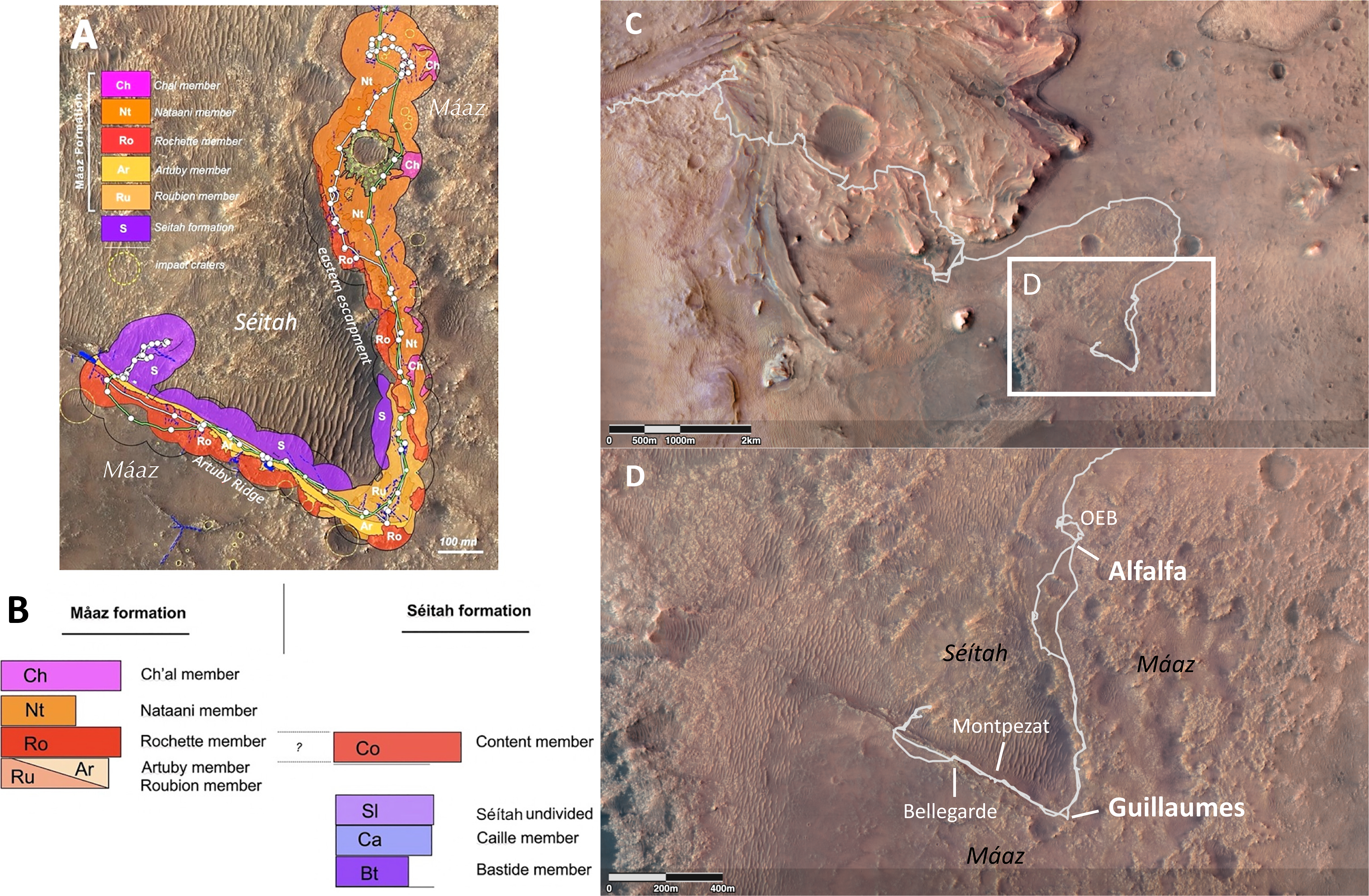
Máaz consists primarily of basaltic rocks, mostly pyroxenes and plagioclase feldspar, with alteration minerals that include hematite (Horgan et al., 2023). The Máaz formation is divided into five members (Fig. 1A,B). The Roubion member, a low-relief area of meter-scale polygonal pavers that lies directly over the Séítah formation, is one of the oldest layers. The Ch’al member, a group of massive boulders that sit on a mounded area in a high stratigraphic layer within Máaz, is the youngest (Farley et al., 2022; Schmidt et al., 2025; Crumpler et al., 2023).
PIXL is an X-ray fluorescence spectrometer mounted on the arm of the Perseverance rover that scans a focused X-ray beam with a full-width at half-max of ∼120 µm at ∼7 keV (Allwood et al., 2020; Das et al., 2024) over the Martian surface. The beam reaches its nominal spot size at a standoff distance of approximately 25.5 mm from the target surface (Allwood et al., 2020). Fluorescent X-rays emitted from the target are detected by two silicon-drift detectors positioned on either side of the X-ray optic in near-backscatter geometry (Allwood et al., 2020). The fraction of emitted photons recorded by the detectors is governed by the detector solid angle and varies with X-ray energy because of energy-dependent transmission through the polycapillary optic and detector windows (Allwood et al., 2020; Heirwegh et al., 2022).
Spectra are acquired at discrete PIXL Motor Control (PMC) positions spaced approximately 120 µm apart. Throughout this article, “PMC” refers to an individual PIXL measurement location (i.e., a single analyzed spot within a scan), while groups of adjacent “PMCs” represent contiguous measurement locations on the rock surface. The resulting fluorescence spectra at each PMC are quantified using PIQUANT software (Heirwegh et al., 2021; Heirwegh, 2023) with quantified elemental concentration maps produced in PIXLISE software (Barber and Davidoff, 2022) for further analysis. In addition, PIXL’s micro-context camera (MCC) takes images before and after each scan and shows the PMC analytical locations on the surface of the rock (Allwood et al., 2020). Elemental concentrations are used to identify mineral phases, either through ternary diagrams and stoichiometry or through the use of the MIST (Mineral Identification by Stoichiometry) algorithm. MIST automates stoichiometric mineral identification by comparing PIXL-derived compositions to mineral-specific stoichiometric constraints, enabling rapid identification of primary and secondary mineral phases across large PIXL datasets (Siebach et al., 2026; Moreland et al., 2025).
The Scanning Habitable Environments with Raman and Luminescence for Organics and Chemicals (SHERLOC) instrument is a deep ultraviolet Raman and fluorescence spectrometer, also mounted on the arm of the Perseverance rover. The Wide Angle Topographic Sensor for Operations and eNgineering (WATSON) imaging system is a high-resolution color imaging system that captures detailed (16–150 μm/pixel resolution) images of the target area. WATSON images aid in the precise localization of SHERLOC’s spectroscopic measurements (Bhartia et al., 2021) and support textural analysis, such as the size, shape, spatial relationships, and alteration characteristics of grains and other microscopic rock features. When PIXL and SHERLOC analyses are collocated, these textural observations can be directly compared with geochemical and spectroscopic measurements.
During Perseverance’s traverse of the Máaz formation, PIXL collected X-ray fluorescence maps from four abraded patches (Moeller et al., 2020) (Fig. 1D). PIXL detected high Mn (here defined as greater than 1 wt%) in discrete regions in scans at the Montpezat, Guillaumes, and Alfalfa abrasion patches (Table 1). The high Mn detected by PIXL at Montpezat is limited to several isolated PMCs. This makes mineral identification problematic due to beam-mixing effects (Tice et al., 2022); we therefore limit our analysis to data from PIXL scans at Guillaumes and Alfalfa (Fig. 2) where several contiguous PMCs of high Mn were observed.
Summary of Máaz Formation Scans
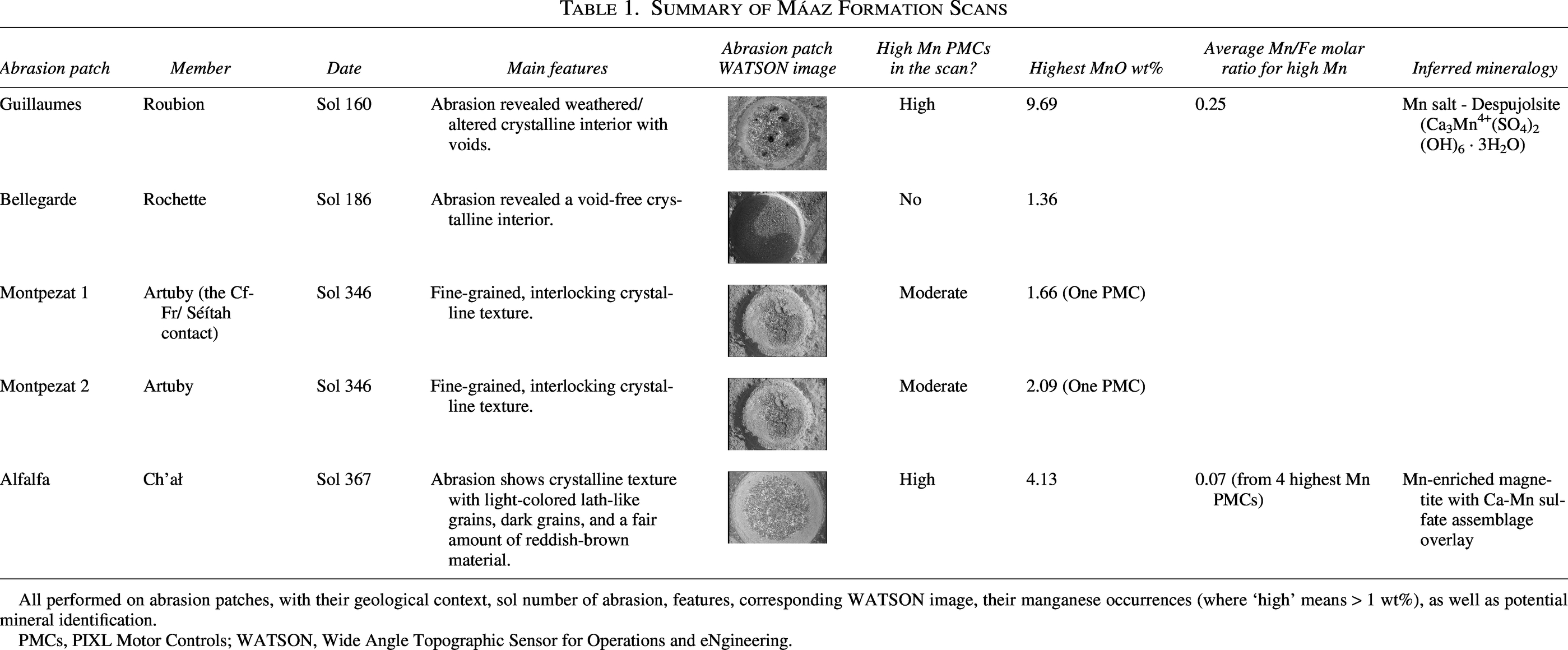
All performed on abrasion patches, with their geological context, sol number of abrasion, features, corresponding WATSON image, their manganese occurrences (where ‘high’ means > 1 wt%), as well as potential mineral identification.
PMCs, PIXL Motor Controls; WATSON, Wide Angle Topographic Sensor for Operations and eNgineering.
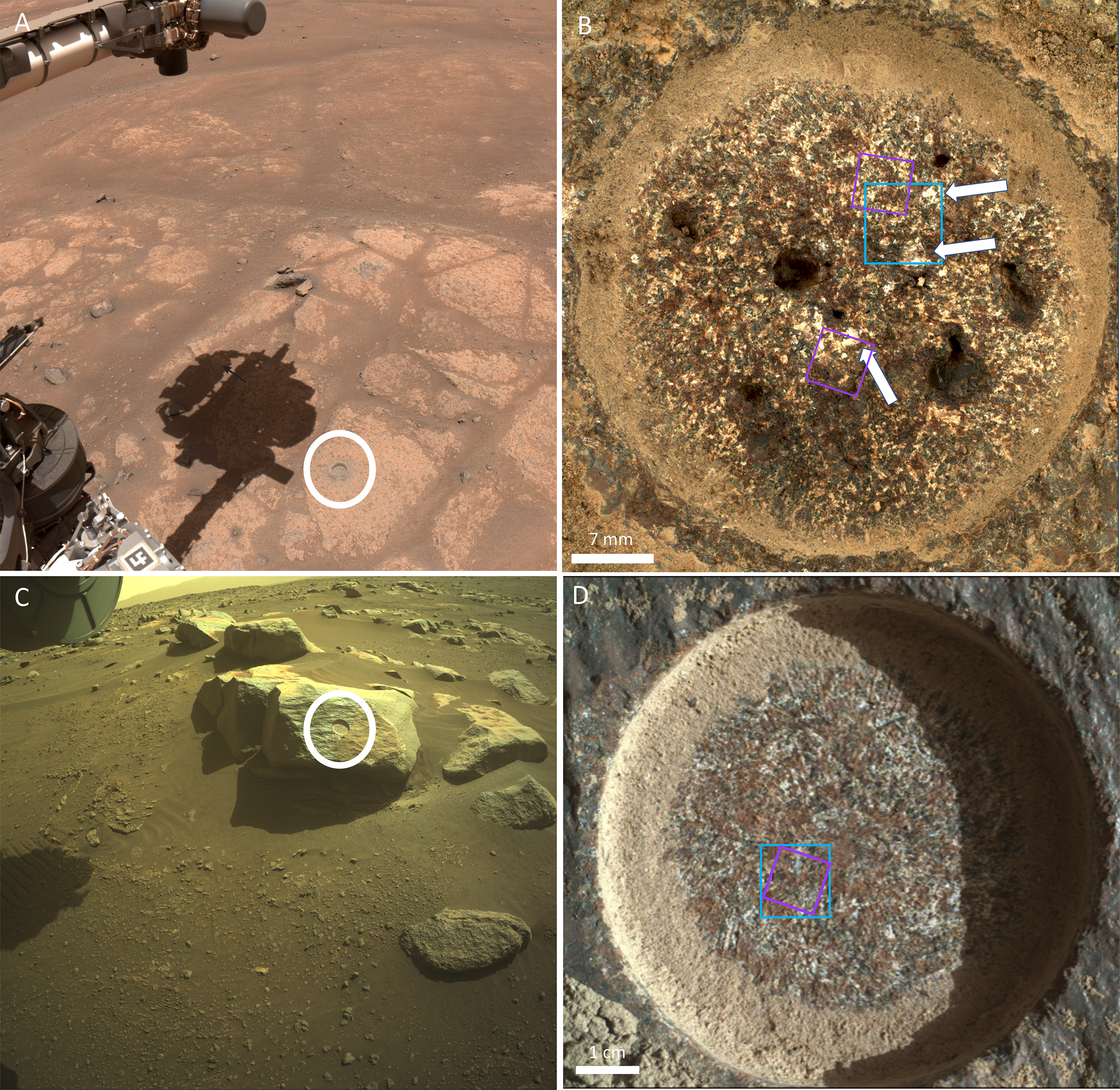
The Guillaumes target was abraded on Sol 160 in the Roubion member (Fig. 1), and a 6.5 × 6.5 mm PIXL map with 2811 PMCs was taken on Sol 166 (Fig. 2B, cyan box) with SHERLOC data collected on Sols 162–165 (Fig. 2B, purple boxes). The Guillaumes rock was drilled with the intention of acquiring a sample; however, the rock crumbled while being drilled, and no solid sample could be collected. This reinforces the importance of the analyses presented here, as this material is not currently available for future sample-return investigations. The Alfalfa target was abraded on Sol 367 in the Ch’al member (Fig. 1), and a 7 × 7 mm PIXL map with 3258 PMCs was taken on Sol 369 (Fig. 2D, cyan box) with collocated SHERLOC data collected on the same sol (Fig. 2D, purple box).
The Guillaumes abrasion patch (Fig. 2A,B) has white-to-brown submillimeter-sized grains distributed uniformly, with red staining intermixed, likely from Fe oxides (Wogsland et al., 2023). The texture of this rock resembles fine-grained gabbro or holocrystalline basalt, with plagioclase and pyroxene associated with the dark-toned grains; Ca sulfate, halite, perchlorate, and Ca phosphate associated with the white patches; and Fe oxides in the brown-toned patches (Schmidt et al., 2025). The bulk igneous composition of Guillaumes is of a trachybasalt (Schmidt et al., 2025). This diversity of alteration phases was the first in situ evidence that multiple aqueous episodes affected the crater floor rocks.
Mastcam-Z, a pair of mast-mounted stereo cameras with multispectral imaging across the visible/near-infrared (VNIR) (Bell et al., 2021), show absorption features in the Guillaumes abrasion patch consistent with either Mn oxides and sulfides or mixed-valence Fe-bearing phyllosilicates like greenalite (Horgan et al., 2023). The dark brown and red regions of the Guillaumes abrasion show absorption characteristics of hematite (Horgan et al., 2023). Visible-infrared (VISIR) spectra from SuperCam (Wiens et al., 2021; Maurice et al., 2021) show features consistent with oxyhydroxide, Fe-phyllosilicate, monohydrated sulfate or perchlorate, and gypsum or an Al-OH or hydrated silica (Wiens et al., 2022). This would imply a monohydrated Mg sulfate from VISIR observations, or a poorly crystalline mineral with water, such as oxyhydroxides and sulfates (Wiens et al., 2022). SuperCam also observed alteration materials such as carbonates, sulfates, perchlorates, hydrated silicates, and iron oxides in the VISIR (Wiens et al., 2022).
In contrast, the Alfalfa abrasion (Fig. 2C,D) showed the least amount of alteration among the analyzed crater floor rocks with a bulk composition consistent with trachyandesite (Schmidt et al., 2025). Grains of feldspar, pyroxene, and possibly olivine and quartz were identified, with alteration minerals such as carbonate, Fe oxides, and possibly phyllosilicates, chlorite, phosphate, and perchlorate (Horgan et al., 2023). SHERLOC detected some of the highest concentrations of organics in the Alfalfa abrasion (up to 400 pg, assuming the observed fluorescence was solely from organic molecules), with organic abundance correlated with water-driven alteration (Sharma et al., 2023).
Mastcam-Z VNIR spectra at the Alfalfa target showed the strongest hematite signatures in the Máaz formation, indicating the Ch’al member is the most oxidized member in the formation (Horgan et al., 2023). However, a millimeter-sized grain of magnetite was also identified in PIXL data due to its high abundance of Fe, moderate abundance of Mn, low abundances of other elements, and MCC images yielding distinctly low NIR/UV and green/blue ratios, consistent with magnetite being the dominant spinel endmember (Tosca et al., 2025).
Results
Guillaumes
Guillaumes has the highest Mn concentrations in all of the crater floor scans, up to 9.7 wt% MnO (Fig. 3A), which is an order of magnitude greater than MnO concentrations measured in Martian igneous meteorites (Udry et al., 2020). The six high-manganese PMCs form a single contiguous region (Fig. 3B), with clear correlations with respect to CaO and SO3 (Fig. 3C,D), which indicate a mineral rich in Mn, S, and Ca. There are eight known minerals that contain these elements (Supplementary Table S1). Three of these minerals are silicates (“Na-metaschoepite,” Roeblingite, and “M2006-18-SiO: CaClFFeHMnNaZr”), and one of them is an (Al,Fe)-sulfate that contains Mg (svyazhinite). For the PMCs of interest, Mn is anti-correlated with Si (Supplementary Fig. S1), which makes silicate minerals unlikely. Similarly, Mn is anti-correlated with Al and Fe with a slight positive correlation between Mg and Mn (Supplementary Fig. S1), which makes svyazhinite unlikely. The remaining four minerals are despujolsite (Ca3Mn4+(SO4)2(OH)6 · 3H2O), jouravskite (Ca3Mn4+(SO4)(CO3)(OH)6 · 12H2O), saccoite (Ca2Mn23+F(OH)8 · 0.5(SO4)), and an unnamed possible Mn(IV) analog of sturmanite (Ca6Mn24+(SO4)2[B(OH)4](OH)10O2 · nH2O).
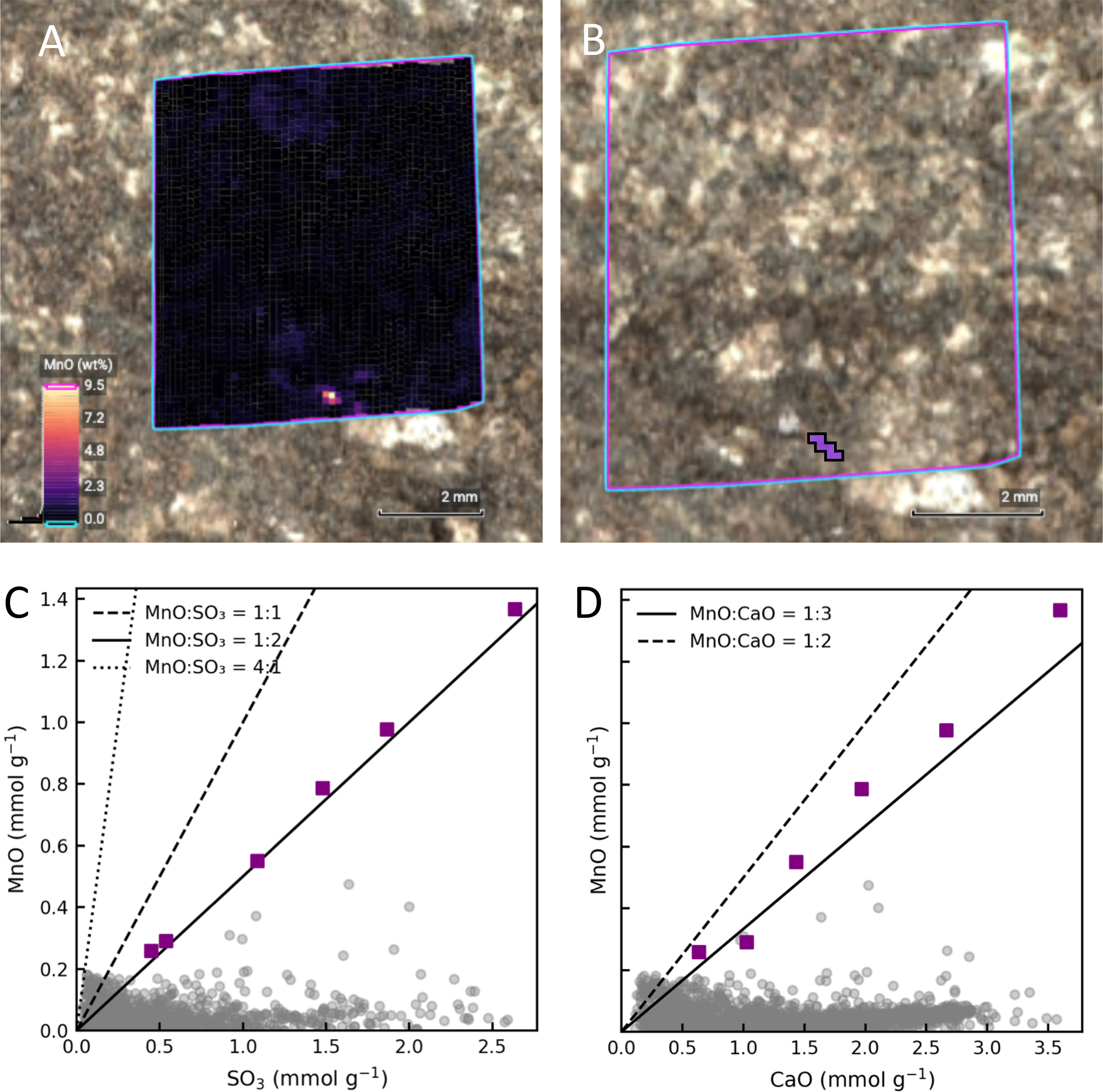
To determine the most likely candidate from these minerals, we investigate the molar ratios of MnO to SO3 and CaO (Tice et al., 2022; Jones et al., 2025; Liu et al., 2022; Hurowitz et al., 2021; Schmidt et al., 2025). The MnO to SO3 ratio for jouravskite and the sturmanite analog is 1:1, despujolsite is 1:2, and saccoite is 4:1. The high-Mn PMCs in Guillaumes have a clear MnO:SO3 ratio of 1:2 (Fig. 3C), which suggests that despujolsite is the most likely candidate. Similarly, the MnO:CaO ratio of saccoite is 1:2, while despujolsite, jouravskite, and the sturmanite analog have a 1:3 MnO:CaO ratio. The high-Mn PMCs in Guillaumes have a clear MnO:CaO ratio close to 1:3 (Fig. 3D). A linear regression through the high-Mn PMCs gives a molar MnO:SO3 ratio of 0.51 and a molar MnO:CaO ratio of 0.39, which are consistent with despujolsite’s stoichiometry (molar Mn:S ratio of 0.5 and molar Mn:Ca ratio of 0.33) (Fig. 3C,D). The near-zero intercepts of these regressions (−0.024 mmol g−1 for MnO:CaO; 0.017 mmol g−1 for MnO:SO3) indicate that all the MnO, CaO, and SO3 within these high-Mn PMCs are contained within the likely despujolsite [i.e., no mineral stripping (Tice et al., 2022) is required].
The concentration of MnO + CaO + SO3 in these PMCs averages 19.27 ± 0.22 wt%; this suggests that despujolsite constitutes approximately 20% of these PMCs if all the MnO, CaO, and SO3 are contained in despujolsite, which is likely given that the previous analysis indicates a lack of mixing with other minerals. As PIXL cannot measure elements lighter than Na (atomic number Z < 11), PIQUANT assumes that all measured elements are present as oxides for its quantification by default (Heirwegh et al., 2022). Therefore, if all the elements are present as oxides and there are no additional elements lighter than Na, PIQUANT returns an ideal total quantification of 100% (Heirwegh et al., 2021; Heirwegh, 2023). Because of this, PIQUANT does not enforce geo-chemical summing to 100% (Allwood et al., 2020; Heirwegh et al., 2022). The difference between the ideal total quantification and the measured total quantification is referred to as the “mass deficit” and can be due to low Z elements in hydroxyl groups, water molecules, or carbonates, for example (Heirwegh et al., 2021; Heirwegh, 2023). For the high-Mn PMCs, the total quantification averages 90.96 ± 0.73 wt%, giving a mass deficit of about 9 wt%. This mass deficit may be spread across other minerals in this region and not entirely be due to low Z elements in despujolsite. Assuming the despujolsite makes up 20% of the PMCs, as discussed previously, the expected mass deficit due to the low Z elements in despujolsite [(OH)6 and 3H2O] is approximately 5 wt%, which is within the 9 wt% mass deficit for these PMCs allowing for a 4 wt% mass deficit contained in other minerals (for example Tosca et al., 2025; Supplementary Table S1).
This potential despujolsite identification cannot be confirmed by SHERLOC because the Raman spectra were not collocated with the high-Mn grain (Fig. 2,3). However, the SHERLOC spectra of other regions in the Guillaumes abrasion reveal the presence of hydrated Mg sulfate and anhydrous Ca sulfate (Siljeström et al., 2024). Interestingly, SHERLOC was unable to identify a specific mineral species for the sulfate spectra in Guillaumes, since it has features from many standards such as gypsum, epsomite, natural kieserite, and synthetic magnesium sulfate, suggesting mixed calcium and magnesium cations. While not collocated with the potential despujolsite grain, the mix of sulfate phases observed by SHERLOC in the same abrasion, some of which are hydrated and show signs of mixed cations, suggests the likely presence of hydrated Ca–Mn sulfates.
The magnetite grain identified in this abrasion patch (Tosca et al., 2025; Fig. 4A) overlaps with a high MnO region, with MnO concentrations up to 4 wt% at the center that decrease outward (Fig. 4B). The highest MnO values are in four PMCs contiguous with the magnetite grain, coinciding with a small group of sulfate-rich PMCs (SO3 > 2 wt %; Fig. 4B,C). Although bulk Alfalfa contains < 1 wt % SO3, a few PMCs reach up to 17 wt % SO3. These points show a strong correlation between SO3 and both MnO and CaO (Fig. 4D,E). CaO rises linearly with SO3 (R2 = 0.96, slope = 0.69 ± 0.09, intercept = 0.1 ± 0.1; Fig. 4D), while MnO displays a weaker correlation (R2 = 0.3, slope = 0.02 ± 0.02, intercept = 0.54 ± 0.03; Fig. 4E). These trends indicate that the sulfur resides primarily in a Ca-dominant sulfate with very minor Mn, and that the rest of the Mn may be hosted by a sulfur-free Mn oxide (magnetite). FeO and MgO both negatively correlate with SO3 (Supplementary Fig. S4); this suggests the absence of Fe and Mg in the sulfate lattice. FeO also shows little variation between the bulk and the high MnO PMCs along the MnO/SO3 trend (Fig. 4E), consistent with Fe precipitation occurring independently of Mn-Ca formation. The data are consistent with a Ca-dominant sulfate phase such as gypsum (CaSO4·2H2O) or anhydrite (CaSO4), with minor Mn that could reflect limited Mn substitution into the sulfate structure or contributions from co-occurring Mn-bearing phases. The Ca:Mn ratio in the four highest MnO PMCs, 36:1, does not match the stoichiometry of any possible Ca-Mn sulfate phases (Supplementary Table S1). If the Mn in these PMCs is incorporated into the sulfate lattice, the composition would correspond to gypsum or anhydrite with ∼2.7 wt% Mn substitution for Ca. The PIXL elemental data alone do not uniquely distinguish between gypsum and anhydrite, and resolving their hydration state is beyond the scope of this study.
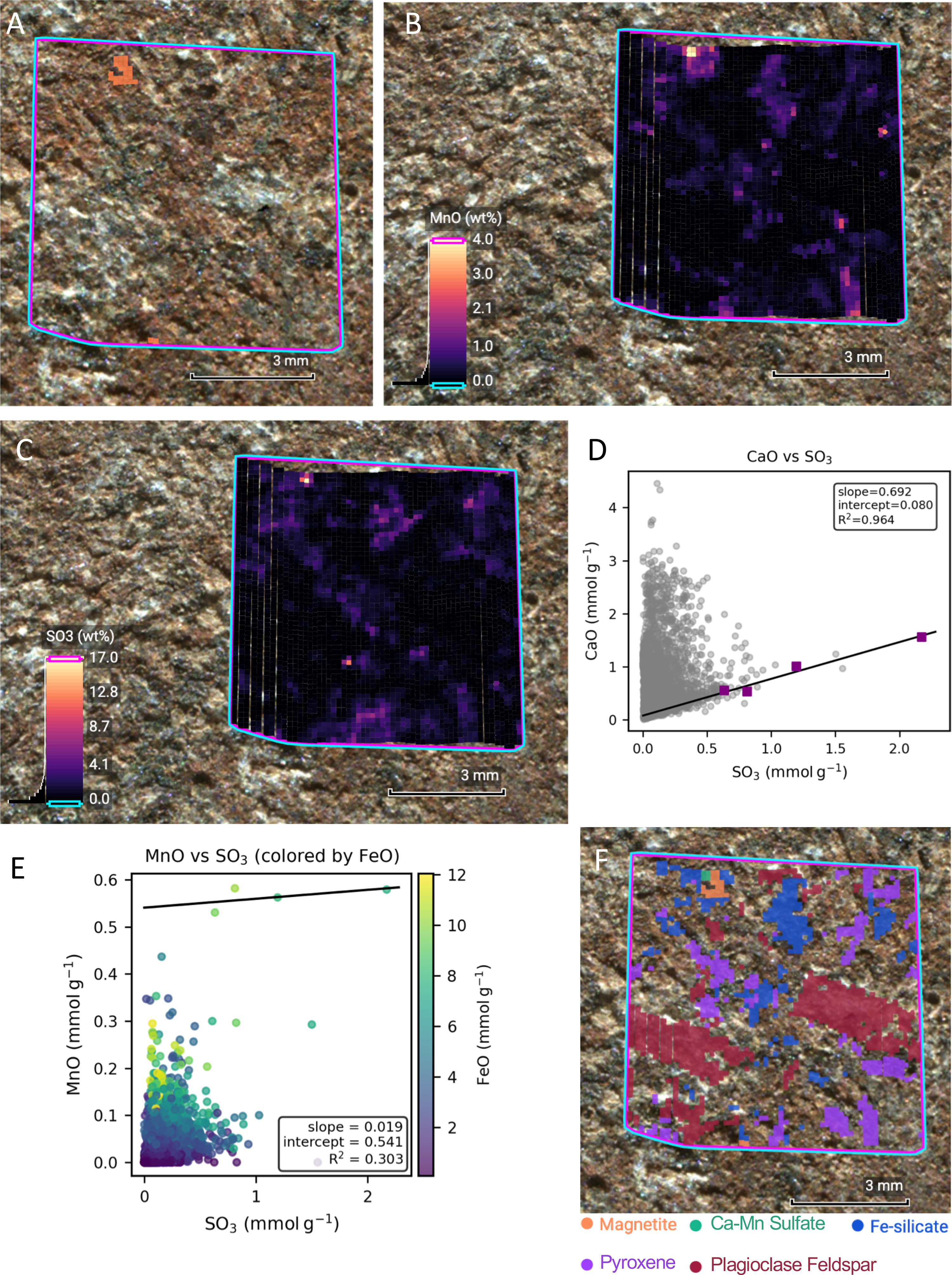
Additionally, two of the most sulfate-rich PMCs in this scan have much lower MnO content, even though one of these PMCs is contiguous with the Ca–Mn sulfate assemblage identified above. These points could represent a Mn-poor Ca sulfate or a late-stage gypsum that formed after Mn was removed from the alteration fluid. Mn heterogeneity is expected since Mn2+ solubility (and therefore its availability to enter gypsum) drops sharply as soon as pH rises above ∼6 or as soon as Mn is oxidized to Mn³+/Mn4+. A fluid wave that has already oxidized/lost Mn can still carry Ca2+ and SO42- and precipitate pure gypsum.
Many PMCs above 1.5 wt% MnO are scattered around the scan (Fig. 4B). These MnO-enriched PMCs are found in Fe silicate material at the top of the scan, which can be olivine or serpentine, as well as pyroxene at the bottom of the scan (Fig. 4F), in the form of augite. This is consistent with a Mn source from the host igneous rock that was later altered. The highest-MnO region is bordered by Fe silicate material (Fig. 4F), with the highest Mn concentration in the center of the sulfate/magnetite grain (Fig. 4B). The concentrations at the center of the magnetite/sulfate grain are ∼4 wt%, while concentrations fall to ∼2 wt% away from the sulfate grain, and then to ∼1 wt% at the border of the magnetite grain (Supplementary Fig. S5A). The uncertainty on the PMCs with > 2 wt% MnO has a 1 σ of 0.32–0.59 wt% (Supplementary Table S2). The measured gradient we discuss (from 4 wt% at the center to 1 wt% at the rim) spans 3 wt%, which is 5–9 σ above uncertainty. There is also a possibility of Mn leaching preferentially with respect to Fe from the host silicate into the sulfate (Supplementary Fig. S5B), which can happen under mildly acidic conditions where Mn2+ remains soluble and mobile over a wide pH–Eh range, enabling transport and local sequestration into secondary phases, while Fe is rapidly immobilized during oxidation (Khosravi et al., 2020). These observations are compatible with, but not diagnostic of, olivine alteration instigating secondary magnetite formation, and later alteration of the magnetite to form Mn sulfate.
Overview of alteration pathways in the crater floor
Previous analyses of crater floor rocks have identified multiple stages of aqueous alteration that affected both the olivine-rich Séítah formation and the overlying basaltic Máaz formation. Observations made with PIXL suggest a three-phase aqueous history corresponding to low-temperature olivine carbonation in the Séítah formation, followed by sulfate precipitation from vadose zone brines and perchlorate infiltration from oxidizing fluids under low water–rock ratios that extended through the crater floor (Tice et al., 2022). The SHERLOC instrument found similar evidence for distinct aqueous episodes in the crater, breaking up the sequence into an initial episode of carbonation in Séítah and a later briny episode during sulfate and perchlorate formation (Scheller et al., 2022). Because the SHERLOC detection of perchlorate accompanied the sulfate detection in the same scan, Scheller et al. concluded that they formed at the same time during a single briny episode, rather than as separate events as inferred from the PIXL-based sequence (Tice et al., 2022), which puts perchlorate infiltration as a later stage. The Mn-bearing minerals identified in the Máaz formation expand on this sequence; this indicates that fluid chemistry and redox state evolved substantially through time.
Formation of Mn sulfate phases in the Roubion member
Possible formation mechanisms of despujolsite
Terrestrially, despujolsite has been observed in active volcanic hydrothermal systems in Nicaragua (Hynek et al., 2013) and manganese vein deposits associated with a fossil hydrothermal system in Morocco (Gaudefroy et al., 1968). But despujolsite is also found in offshore subsurface sediments of evaporitic hypersaline sulfate lakes in Canada (Little Manitou Lake and North Ingebrigt Lake) (Sack and Last, 1994; Shang, 2000). This suggests that there are two main possibilities for the origin of despujolsite in the Roubion member: hydrothermal or lacustrine.
Hydrothermal analogs
In the hydrothermal acid-sulfate systems in Nicaragua, despujolsite was found in mudpots, with pH from 1.5 to 4, temperatures between 75°C and 100°C, and high fluid–rock ratios (Hynek et al., 2013). The despujolsite is associated mostly with gypsum and clays such as montmorillonite and kaolinite. Minor associated phases include khademite (Al(SO4)F·5(H2O)), fibroferrite (Fe3+(SO4)(OH) ·5(H2O)), pickeringite MgAl2(SO4)4 ·22(H2O), and alunogen (Al2(SO4)3·17H2O). The acidic hydrothermal systems in Nicaragua resemble Martian basalt in chemistry and contain all groups of clay minerals (except serpentine group minerals) identified on Mars (Hynek et al., 2013). The systems in Nicaragua have abundant hydrated sulfates and phyllosilicates arising from aqueous alteration of basalts.
Despujolsite also occurs at the Tachgagalt manganese deposit (Anti-Atlas mountains, Morocco). Here, meter-scale Mn oxide veins, interpreted as fossil fumaroles, cut late Neoproterozoic rhyolitic volcanic rocks (Bazini et al., 2012). Despujolsite fills cavities between bundles of gaudefroyite (Ca4Mn3+2–3(BO3)3(CO3)(O,OH)3) formed in CO2-poor, highly oxidizing conditions that favored Mn4+ precipitation (Gaudefroy et al., 1968).
Hypersaline lake analogs
Despujolsite is also reported in two of the sulfate-rich hypersaline lakes of southern Saskatchewan, Canada: Little Manitou Lake and North Ingebrigt Lake (Sack and Last, 1994). In these lakes, the clastic sediments are dominated by clay (illite), feldspar (plagioclase), carbonate (dolomite), quartz, and ferromagnesian minerals, while the salt minerals include mainly hydrated sodium and magnesium sulfates (bloedite, mirabilite, epsomite), the carbonates aragonite and dolomite, plus gypsum and halite (Sack and Last, 1994). The surrounding Cretaceous strata (Bearpaw, Belly River, and Lea Park Formations) consist mainly of sandstone, shale, and molluscs (Saskatchewan Energy and Mines, 1999). The lake waters are alkaline (pH > 8) and dominated by Na+, Cl-, and SO42- ions (Shang, 2000). The occurrence of despujolsite in these lakes implies relatively high dissolved Mn concentrations sufficient for Mn sulfate mineral precipitation, but the local bedrock (the Bearpaw, Belly River, and Lea Park Formations) contains ≤ 3004 ppm elemental Mn (∼0.39 wt% MnO) (Meek et al., 2023). If Mn in these lakes is locally derived, their waters must have concentrated the Mn through evaporation.
Evaluation of analog environments
The mineralogy of Guillaumes most closely aligns with the basaltic alteration seen in Nicaragua and Morocco, where hydrothermal fluids infiltrated mafic rocks and precipitated despujolsite under oxidizing, sulfur-rich conditions. The host rock composition of the Máaz formation, a gabbro or holocrystalline basalt, more closely aligns with the volcanic environments of Nicaragua and Morocco than the sandstone, chert, and shale of southern Saskatchewan. Additionally, the lakes of Saskatchewan possess much more carbonate, which is not as present in either Guillaumes or Alfalfa. However, the North Ingebrigt Lake analog setting has hydrated Ca-Mg sulfates, which is more in line with sulfate detections in Guillaumes made by SHERLOC (Farley et al., 2022; Corpolongo et al., 2023; Scheller et al., 2022), SuperCam (Wiens et al., 2022), Mastcam-Z (Horgan et al., 2023), and PIXL (Supplementary Fig. S2A) than the Al-Fe sulfates found in Nicaragua.
Guillaumes reveals predominantly Fe-bearing phyllosilicates (Tosca et al., 2025) such as greenalite (Horgan et al., 2023) (Supplementary Fig. S2B) and nontronite (Moreland et al., 2025), which is expected due to the high concentrations of Mg and Fe in the Martian basalt. Nontronite is found in the Nicaraguan analog, but so is kaolinite, an Al-phyllosilicate. Kaolinite forms in highly weathered, leached environments, while greenalite forms in reducing, low-temp, iron-rich environments. This leaves the comparison of paragenetic clay mineralogy between Guillaumes and Earth analogs inconclusive, due to the limited identification of clay phases with PIXL, and requires reliable mineralogical analysis of returned samples to conclusively identify the clay minerals in this scan to aid in differentiating which analog environment matches most closely.
Evidence for serpentinization and Mn mobility
The presence of serpentine group minerals in Roubion implies serpentinization as a possible alteration pathway for Mn leaching from primary olivine, followed by later aqueous alteration leaching Mn from Fe silicates to form Mn sulfate. This pathway is consistent with the presence of an altered grain of olivine, bordered by serpentine, within < 2 mm of the Mn sulfate (Supplementary Fig. S3). The Mn/Fe gradient in this olivine grain (Supplementary Fig. S3) shows surface depletion and core enrichment in Mn, consistent with Mn leaching and reprecipitation during successive alteration. Although Fe silicates do not directly rim the sulfate region (Supplementary Fig. S2C and D), Mn-bearing fluids could have precipitated sulfate nearby. Therefore, it is possible that the Mn sulfate could be a later alteration product of serpentine/olivine in Guillaumes. This is in contrast to the allocthonous origin story for Ca and Mg in the sulfate minerals in Guillaumes (Tice et al., 2022) but is consistent with the redistribution of Mn during serpentinization at the Alfalfa abrasion site as described by Tosca et al. (2025), who observed enrichment of Mn in Fe-rich secondary silicates and magnetite (their Figs. 2–5), implying Mn mobilization from primary olivine.
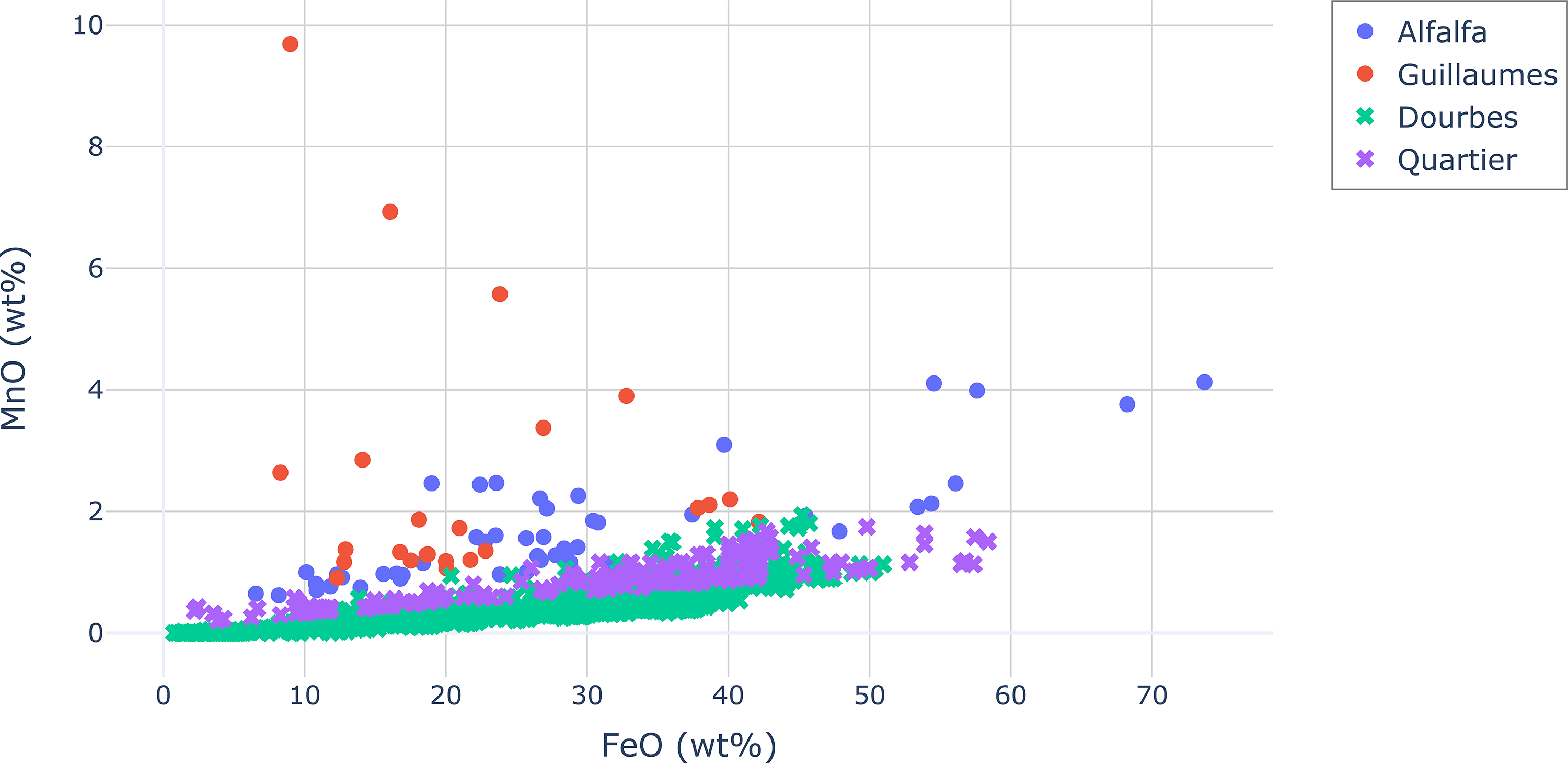
Plot of crater floor scans with high Mn occurrence, demonstrating the different Mn/Fe ratios between the Máaz (‘o’ marker) and Séítah (‘x’ marker) formations.
In the Moroccan analog, despujolsite would have formed in the absence of CO2, in an oxidizing medium that allowed the precipitation of Mn4+, while hydrothermal formation in Nicaragua reflects a high water-to-rock ratio, acidic, oxidizing, and elevated-temperature system, dominated by fumarolic and geothermal processes. Similarly, Little Manitou Lake also reflects an oxidizing environment but with alkaline, highly saline, moderate temperature conditions. Previously, it has been suggested that Jezero lake was neutral or alkaline (Goudge et al., 2015). However, we must consider a potential acidic episode where the lake chemistry was driven by sulfuric acid alteration instead of by carbonate alkalinity (Hurowitz et al., 2023).
Constraints on the alteration history in Jezero
Resolving which specific environment likely existed on Mars will require precise mineralogy of the whole assemblage, which could be accomplished with returned samples, to differentiate accompanying phases. Additionally, we would need to refine the emplacement history of the Máaz formation and the order of major events to limit the possible suite of environments. Lastly, laboratory measurements of isotopic geochemistry and fluid inclusion microthermometry would also help resolve formation conditions.
Serpentinization and Mn mobility in the Ch’al member
At the Alfalfa abrasion target in the Ch’al member, multiple alteration episodes appear recorded in the mineral textures. Manganese was likely transferred from primary olivine to secondary serpentine and magnetite during an early stage of serpentinization, followed by a later sulfate overprint from oxidizing near-surface fluids. These two alteration stages are further evaluated below based on mineral textures, compositional zoning and terrestrial analogs.
Evidence for serpentinization and Mn redistribution
The first stage of alteration, where ferroan olivine is selectively replaced by Fe-serpentine and magnetite, bears close resemblance to the Duluth Complex in Minnesota, USA (Tosca et al., 2025; Tutolo and Tosca, 2023; Evans et al., 2017; Tutolo et al., 2019). The potential Mn zoning in Alfalfa is consistent with the boundary-layer exchange seen in Duluth, where low-temperature (150°C–200°C) serpentinization drives Mn and Mg out of olivine into magnetite (Tutolo et al., 2019; Ripley et al., 1993) with the resulting serpentine minerals containing up to 0.26 wt% MnO (Ripley et al., 1993). Manganese-enriched magnetite has also been observed in serpentinized peridotites in the Oman and Bou-Azzer Ophiolite in the Anti-Atlas in Morocco, where MnO concentrations are as high as 1.9 and 0.13 wt%, respectively (Khedr and Arai, 2018; Gahlan et al., 2006). These examples show that high MnO values (≤2 wt%) are seen in serpentinizing environments on Earth. The ∼4 wt% MnO in 4 PMCs in Alfalfa, distributed between phases of Ca sulfate and Mn-substituted magnetite, is high but plausible with mixed-phase composition.
Manganese zoning in the sulfate/magnetite grain, where Mn is highest at the magnetite core, indicates early formation under Mn-rich conditions, followed by Mn-poor overgrowths as alteration progressed and Mn became depleted. This is a common pattern in secondary minerals formed during progressive alteration of primary silicate minerals (Knipping et al., 2015).
Minnesotaite and illite were identified in Alfalfa with the MIST algorithm (Moreland et al., 2025), and greenalite has been observed elsewhere in the Máaz formation (Horgan et al., 2023). Minnesotaite commonly forms through low-grade hydrothermal alteration of greenalite or fayalitic olivine (Rasmussen et al., 2017; Miyano and Beukes, 1984). The coexistence of greenalite, minnesotaite, and magnetite in Alfalfa indicates low-temperature (∼100°C–200°C), Fe-rich serpentinization in acidic, potentially sulfidic waters that became progressively more oxidizing, as seen in the Duluth Complex (Evans et al., 2017; Tutolo and Tosca, 2023; Tosca et al., 2025).
Formation of the Ca-Mn sulfate assemblage and implications for oxidation state
The Ca-Mn sulfate assemblage in Ch’al likely formed later from oxidizing, acidic fluids that weathered existing Mn-bearing phases. Natural Ca sulfates typically contain < 5 ppm Mn (Medlin, 1961), likely due to lattice strain caused by the mismatch in ionic radius between Mn2+ and Ca2+. However, synthetic precipitation methods can incorporate up to ∼380 ppm Mn. These levels are lower than the MnO concentrations overlapping the Ca sulfate phase observed in Alfalfa, but the limits of Mn doping in calcium sulfate remain unconstrained, and it is likely that the MnO in these PMCs is mixed with other Mn-bearing phases. Studies on gypsum solubility and kinetics have shown that acidic conditions can enhance Mn solubility provided that sufficient Mn is in the solution to substitute for Ca in gypsum, and that temperature has an effect on the Mn substitution (Farrah et al., 2007; Farrah et al., 2004). Most importantly, the precipitation of a Mn2+ sulfate requires an oxidizing, evaporitic environment.
Other sulfates, both in the kieserite and jarosite groups, exist on Mars. Kieserite (MgSO4·H2O) has been identified by CRISM and Opportunity and falls in the solid solution series with szomolnokite (FeSO4·H2O) (Arvidson et al., 2015; Bishop et al., 2009; Mangold et al., 2008; Noel et al., 2015). Laboratory studies confirm that Mn substitution in the kieserite/szmikite (MnSO4·H2O) solid solution series is plausible on Mars (Talla et al., 2023). SuperCam also identified kieserite with VISIR in the Máaz formation (Mandon et al., 2023).
Alteration sequence in the Ch’al member
It is likely that Alfalfa experienced serpentinization first, given that the Mn-bearing Ca sulfate grain is rimmed by the magnetite grain (Fig. 4F) and that serpentine-rich regions could have provided source material and pore space for late-stage alteration. Volatiles exsolved from the melt seem to have selectively replaced olivine, forming serpentine minerals and magnetite. Low-temperature (∼100°C–200°C) acidic alteration, similar to that of the Duluth complex, could form the Mn-enriched magnetite we observe in Alfalfa. A later supergene alteration may have remobilized Mn from the Mn-enriched Fe silicates and magnetite in acidic, oxidizing waters percolating through fractures in the rock, producing or overprinting nearby Ca sulfate-rich material with minor Mn.
Late-stage oxidizing alteration
SHERLOC identified Na-perchlorate in the bright-white void-filling material in Guillaumes, commonly associated with hydrated Ca and Mg sulfate (Farley et al., 2022; Corpolongo et al., 2023; Scheller et al., 2022). These white grains, seen by the SHERLOC scan (purple box, Fig. 2B), correspond to the white, void-filling, Cl-rich material in the adjacent PIXL scan (cyan box, Fig. 2B; Fig. 5). Elemental abundances show a Cl:Na molar ratio of ∼1.5:1 (Fig. 6B,C), consistent with Na-perchlorate (NaClO4) due to oxygen’s influence on Cl fluorescence shifting the trend toward a Cl:Na ratio of ∼1.5 in laboratory studies (Gellert et al., 2022; Tice et al., 2022). However, we cannot rule out the presence of multiple chlorine phases, including halite or other oxychlorines, such as chlorate (Mitra, 2025). For simplicity, we refer to these phases collectively as “perchlorate” in the discussion that follows.
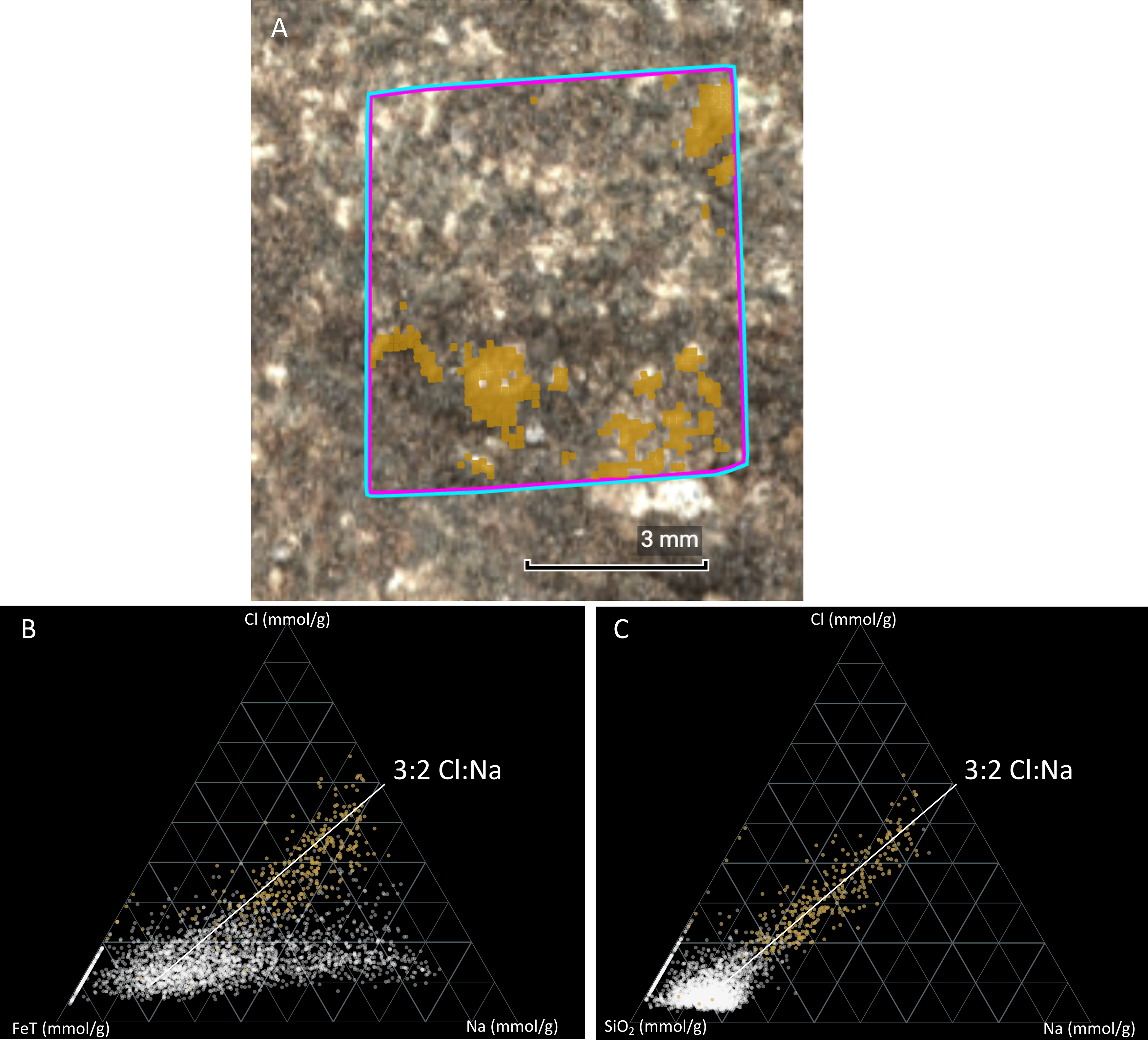
Given the identification of perchlorate by SHERLOC and SuperCam, and the widespread detection of perchlorates across Mars (Mitra, 2025; Clark and Kounaves, 2016), it is likely the Na-Cl phase in the bright white material in Guillaumes is Na-perchlorate. The occurrence of sulfates at the boundaries of the same white grains (Corpolongo et al., 2023) and minor sulfate peaks within SHERLOC perchlorate spectra indicate that these phases are closely associated, if not contemporaneous. Raman spectra from Bellegarde (in the Rochette member of Máaz [see Table 1]) also indicate the presence of sodium perchlorate (Wiens et al., 2022), which further supports that perchlorate formation occurred broadly across the Máaz formation.
The perchlorates in Guillaumes likely represent a late-stage phase of near-surface oxidation and brine evaporation. These salts may have precipitated from later fluids, distinct from those responsible for earlier sulfate deposition, as proposed for Séítah (Scheller et al., 2021). Although despujolsite and Na-perchlorate occur in close proximity within Guillaumes, their relationship is perhaps sequential rather than contemporaneous, given the possible hydrothermal origin of the despujolsite.
The Mn/Fe ratios across Jezero’s crater floor show greater Mn enrichment in Máaz (Guillaumes and Alfalfa abrasions) than in Séítah (Dourbes and Quartier abrasions) (Fig. 5). This enrichment could reflect differences in host mineralogy, fluid chemistry, redox/pH conditions, or the extent of hydrothermal alteration. In Séítah, alteration occurred in at least two stages, broken up into an early meteoric or shallow aquifer episode followed by brine infiltration at low water-to-rock ratios (Tice et al., 2022; Scheller et al., 2022). In contrast, Máaz records a more complex alteration history. Its carbonation did not form as many intergranular carbonates as in Séítah, but instead produced Fe silicates consistent with serpentinization, suggesting that the fluids interacting with the two formations were distinct. Both units, however, record late-stage sulfate deposition that likely occurred under similar oxidizing conditions. The Mn-rich sulfates in Máaz may have formed from high-temperature, low water-to-rock fluids or hypersaline brines similar to those inferred for Séítah.
Guillaumes is in a lower stratigraphic unit (Roubion), and Alfalfa is in the highest (Ch’al) (Fig. 1B), yet the extensive secondary mineralization seen in the bottom of the Máaz formation is not present in the top of the formation. Therefore, Máaz likely experienced multiple phases of aqueous alteration, with an early episode of serpentinization and a later acidic hydrothermal or alkaline lacustrine alteration. If serpentinization occurred in both members simultaneously, it likely preceded sulfate formation, since serpentinizing conditions could have altered Mn-bearing precursors. Serpentinization of ferroan olivine was likely the earliest alteration, producing pore space in the altered olivine for later sulfate deposition. The absence of serpentine minerals in terrestrial despujolsite analogs suggests serpentinization is not a prerequisite for despujolsite formation, which implies different serpentinization histories in Guillaumes and Alfalfa.
The Ca-Mn sulfate assemblage in Ch’al and the despujolsite in Guillaumes could reflect distinct but overlapping alteration stages. Both require acidic, high-temperature environments, but Mn2+ stabilizes in the reducing to mildly oxidizing waters that formed the Ca-Mn sulfate assemblage in Alfalfa, while Mn4+ in despujolsite demands stronger oxidation in Guillaumes. Additionally, the lower degree of secondary mineralization in Alfalfa suggests that the conditions that formed despujolsite in Guillaumes could be separate from the conditions that formed the Ca-Mn sulfate assemblage in Alfalfa. However, the acidic oxidizing conditions required to form the Ca-Mn sulfate assemblage in Alfalfa are similar to the acidic hydrothermal environment that could form despujolsite in Guillaumes.
The final stage of alteration in Máaz was the emplacement of Cl-bearing phases. Oxychlorine salts, identified in both Guillaumes and Alfalfa, likely represent near-surface oxidation or evaporitic concentration that postdated the sulfate-forming episodes.
Stratigraphic observations suggest a complex timing of these events. Roubion shows substantial weathering, while Ch’al does not appear to underlie the delta, which implies a time gap between their emplacements that possibly places lake activity before Ch’al emplacement (Horgan et al., 2023; Crumpler et al., 2023). Additionally, there is evidence that the Máaz formation experienced tilting after emplacement, potentially due to the uplift of Séítah (Horgan et al., 2023). Stratigraphically coherent serpentinization in Roubion and Ch’al, coupled with their shared tilt, favors alteration prior to uplift, although localized, post-uplift serpentinization restricted to Máaz due to localized fluid flow or lithologic controls cannot be ruled out. These observations support two potential alteration scenarios:
Scenario 1: Early serpentinization throughout Máaz followed by despujolsite formation
Emplacement of Roubion and Ch’al (Fig. 7A) Early serpentinization forms serpentine minerals in both and Mn-rich magnetite in Ch’al (Fig. 7B) Uplift of Séítah causes tilting of the lower Máaz formation (Fig. 7C) Acidic hydrothermal (Fig. 7D2) or hypersaline alteration (Fig. 7D2) deposits despujolsite in Roubion Supergene alteration deposits Ca sulfate associated with Mn enrichment in Ch’al (Fig. 7E) Deposition of Cl-bearing phases during late-stage oxidation (Fig. 7F)
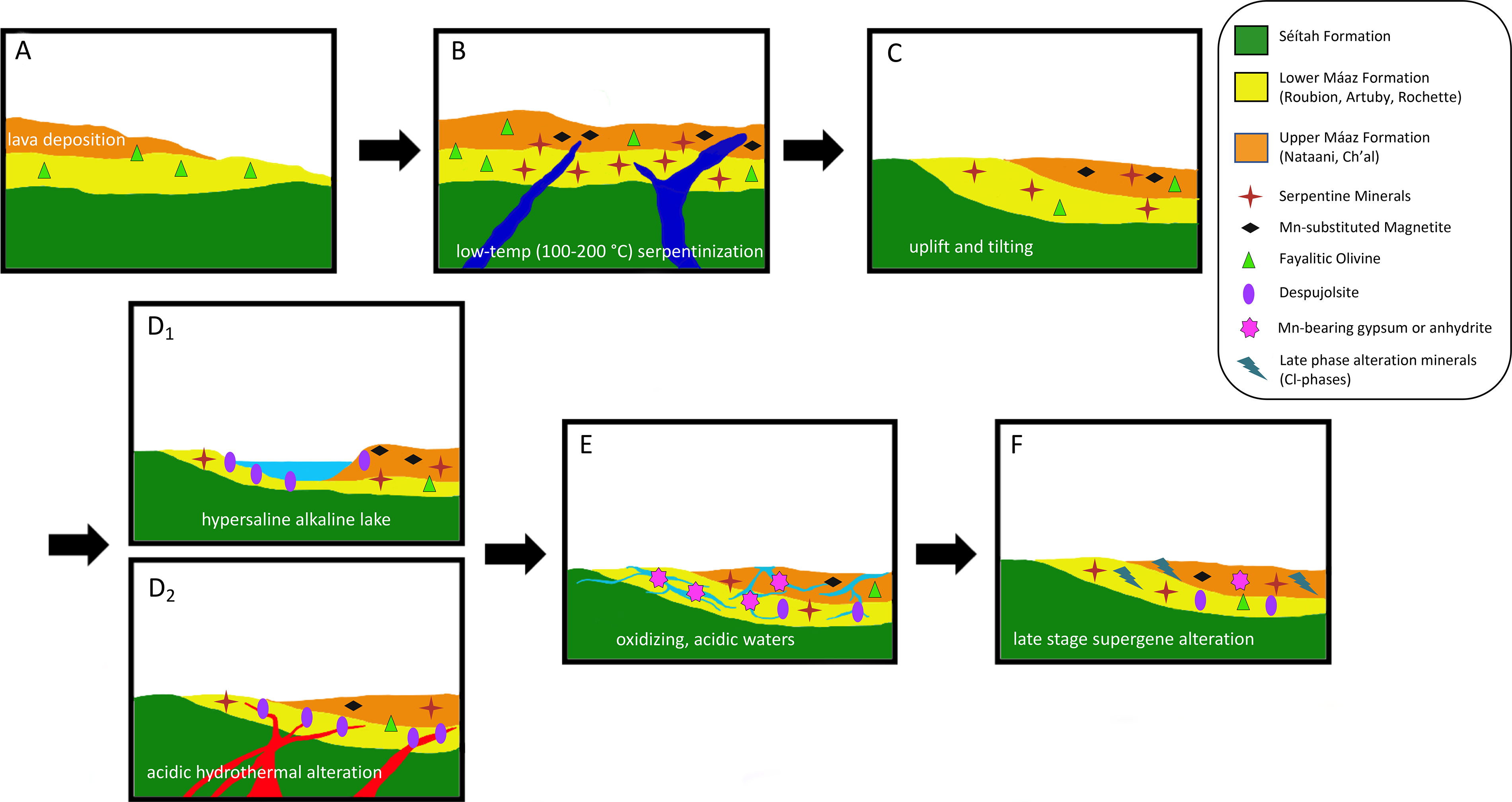
Depiction of the alteration sequence of the Máaz formation, based on the potential minerals identified in this paper.
Scenario 2: Two-stage serpentinization separated by despujolsite deposition
Emplacement of Roubion Serpentinization in Roubion, followed by uplift of Séítah and tilting of Roubion Acidic hydrothermal or hypersaline alteration deposits despujolsite in Roubion Emplacement of Ch’al, followed by serpentinization in Ch’al Supergene alteration deposits Ca sulfate associated with Mn enrichment in Ch’al Deposition of Cl-bearing phases during late-stage oxidation
Of these two scenarios, the first scenario is favored as serpentinization appears similar throughout Máaz and is likely linked to early hydrous magmatism (Tosca et al., 2025).
Several open questions remain regarding the sequence of alteration. It is uncertain whether serpentinization occurred before or after tilting of the Máaz formation and whether despujolsite and Mn-Ca sulfate asemblage could have formed during the same episode of aqueous alteration. These questions can be resolved only with returned samples to constrain the deposition timeline of the different Máaz members as well as perform precise mineralogy to compare serpentine minerals across the formation to understand the number and type of serpentinizing episodes. Additionally, as mentioned above, returned samples would be needed to resolve the environment of despujolsite formation and to determine the nature of the Mn-bearing Ca sulfate observed in Alfalfa, including whether these two unique minerals could form in the same aqueous environment.
The distinct episodes of alteration in the Máaz formation reveal not only a complex geochemical evolution but also very different conditions of habitability over the course of Jezero’s history. Colonization of each of these types of environments is common on Earth, broadly encompassing both archaeal and bacterial microbial forms, and would provide opportunities for diversification of species relative to other environments indicated at Jezero crater such as deltaic environments with discrete flooding events (Goudge et al., 2018) and carbonate deposits characterized by periodic lacustrine activity (Horgan et al., 2020). Serpentinizing episodes, although challenging, can support a variety of microorganism metabolisms (Popall et al., 2023), while hypersaline alkaline low temperature lake environments can support salinotolerant alkaliphiles, and the hydrothermal environments seen in Nicaragua and Morocco, with high temperature acidic fluids, could support acidophilic hyperthermophiles.
Conclusion
We report the first tentative identification of despujolsite, Ca3Mn4+(SO4)2(OH)6 · 3H2O, on Mars, found in the Guillaumes abrasion patch in the Máaz basalts, on the floor of Jezero crater. The mineral phase was deduced by elemental chemistry from the PIXL instrument on the Perseverance rover. We also report Mn-bearing Ca sulfate-rich PMCs in the Alfalfa abrasion patch, also in the Máaz basalts, consistent with either minor Mn incorporation into gypsum or anhydrite or mixing with adjacent Mn-rich phases. The possible presence of these minerals, combined with manganese-enriched magnetite and Cl-bearing phases, suggests a multi-stage geochemical history of alteration in the Máaz formation. The Jezero crater floor records a dynamic environment where serpentinized ultramafic rocks have been overprinted by near-surface oxidative, acidic conditions, generating sulfate minerals, and possibly evaporitic or hydrothermal fluids introducing Cl-phases.
Although the Guillaumes sample core was lost, there may be occurrences of despujolsite in other returned samples from Máaz, which can enable critical insights into the formation, environment, and habitability of Jezero. Detailed sample return analyses such as radiometric dating to understand depositional history, carbon isotope analysis to search for biosignatures, and mineral identification to distinguish between formation hypotheses presented in this study could refine the emplacement history of the Máaz formation and constrain the age of the paleolake. Thus, returning these samples could refine our knowledge of the aqueous history of Mars and bring us one step closer to the search for life in our solar system.
Authors’ Contributions
K.P.S.: Conceptualization, formal analysis, investigation, data curation, visualization, writing—original draft, writing—review and editing. B.C.C.: Investigation, formal analysis, writing—review and editing. M.W.M.J.: Formal analysis, visualization, writing—review and editing. D.C.C.: Conceptualization, supervision, writing—review and editing. W.T.E.: Methodology, supervision, writing—review and editing. Y.L.: Conceptualization, writing—review and editing.
Footnotes
Acknowledgments
This work would not be possible without the M2020 operations team acquiring the data used. PIXL data are available on the Planetary Data System (doi: 10.17189/1522645). Some of this work was conducted at the Jet Propulsion Laboratory, California Institute of Technology, under a contract with the National Aeronautics and Space Administration (80NM0018D0004). Reference herein to any specific commercial product, process, or service by trade name, trademark, manufacturer, or otherwise, does not constitute or imply its endorsement by the United States Government or the Jet Propulsion Laboratory, California Institute of Technology.
Author Disclosure Statement
No competing financial interests exist.
Funding Information
Funding was provided by the PIXL instrument under
Supplemental Material
Supplemental Material
Supplemental Material
Supplemental Material
Supplemental Material
Supplemental Material
Supplemental Material
Associate Editor: Jack Mustard
Abbreviations Used
References
Supplementary Material
Please find the following supplemental material available below.
For Open Access articles published under a Creative Commons License, all supplemental material carries the same license as the article it is associated with.
For non-Open Access articles published, all supplemental material carries a non-exclusive license, and permission requests for re-use of supplemental material or any part of supplemental material shall be sent directly to the copyright owner as specified in the copyright notice associated with the article.
