



Abstract
Voters often make decisions on ballot measures with limited information. Research shows, however, that elite endorsements can help voters overcome their information deficiencies. Using survey experiments, we evaluate the effect of a gubernatorial endorsement on three recent ballot measures. We find that identifying the governor as a proponent of a particular measure has a significant effect on respondents’ support for only one of the three ballot measures we examine: a highly publicized health initiative in 2000. For two lower profile referendums on bonds supporting higher education (in 2006) and roads (in 2011), a gubernatorial endorsement proved ineffective. These results hold even when we restrict our sample to respondents who are the most likely to be influenced by the treatment. As a result, we tentatively conclude that gubernatorial endorsements, while valuable to some voters, are highly conditional.
Introduction
Ballot measures often ask voters to make complicated policy decisions. Most voters, however, know little about politics (e.g., Delli Carpini and Keeter 1996) including ballot measures (Bowler and Donovan 1998; Burnett 2013; Lupia and Matsusaka 2004; Magleby 1984). The situation is compounded by the fact that the clues available on the ballot itself in most candidate contests—such as partisanship, incumbency, and gender—are absent in the case of initiatives and referendums. Without them, voters must rely on what they can glean from campaigns and state-sponsored election documentation.
Despite the scarcity of useful information and the strong incentive for the average individual to ignore politics (Downs 1957a), past research demonstrates that some citizens can overcome their information deficiencies with minimal effort by relying on elite endorsements as a substitute for “encyclopedic” information (for examples in direct democracy, see Karp 1998; Lupia 1994). Indeed, the utility of elite cues has become a staple in the literature on opinion formation and direct democracy (see, for example, Bratton 2003; Karp 1995; Lupia 1992; 1994; Lupia and McCubbins 1998; Paul and Brown 2001; Wells et al. 2009; Zaller 1992; see also Burnett, Garrett, and McCubbins 2010; Lewkowicz 2006). Still, we have much to learn about which, and under what conditions, cue-givers are likely to be effective.
In this study, we consider the effect of a gubernatorial endorsement—a relatively understudied elite political actor who often takes positions on policies—on three recent Arkansas ballot measures. Using survey experiments based on real electoral conditions, we test whether individuals’ use of a gubernatorial endorsement is conditional on (1) approving the governor’s job performance, (2) a shared partisan affiliation with the governor, and (3) having demographic characteristics often associated with individuals who are relatively less knowledgeable about politics.
Our experiments produce highly conditional results. Specifically, gubernatorial job approval is the only variable for which we uncover a significant effect. This effect, however, appears in just one of the three measures we examine: a highly publicized health initiative in 2000. Interestingly, we find no significant results when we examine the effect of the cue based on party identification. This lack of a result is somewhat surprising: as the governor is a partisan position, we expect that Democrats and Republicans would perceive a gubernatorial endorsement differently, depending on the party of the governor. Likewise, when we limit our sample to respondents who are likely to be uninformed about the governor’s position—and thus most likely to find a gubernatorial endorsement informative—we find support for our hypotheses only in the case of the same highly publicized initiative in 2000. In fact, when voters consider referendums on bonds supporting higher education (in 2006) and roads (in 2011), the governor’s endorsement of the ballot measures are ineffective in all scenarios. Thus, our analysis produces significant results for just one of the three measures we analyze, highlighting the need for additional inquiries into how and when cues affect individuals’ political decisions.
While inconclusive results are often lamentable, we argue our mixed findings are valuable. Chiefly, using survey experiments that capitalize on realistic election conditions to probe the effect of elite endorsements on vote choice—a phenomenon central to the debate over voter competence—is uncommon. Here, it allows us to manipulate how individuals perceive third-party endorsements and to test the Lupia and McCubbins (1998) framework outside of the laboratory. In addition, we examine whether the governor—often a state’s most prominent policy advocate—influences decisions in the same way other cues do. Finally, and perhaps most importantly, our findings suggest that elite endorsements, while valuable to some voters, appear to be more conditional than commonly believed. The fact that we observed endorsement effects in only the high-profile, citizen-initiated ballot measure, and not in the lower profile, off-cycle referendums, is perhaps illuminating. In short, our results highlight new avenues for exploring both the utility and limits of “shortcuts” in shaping voter decisions.
Ballot Measure Voting and Elite Endorsements
Doubt about voter competence has been a fixture in the debate over direct democracy’s legitimacy and effectiveness (for a thorough review, see Bowler and Donovan 1998, chaps. 1, 2). The early consensus was that voters were unprepared to consider the difficult questions posed by ballot measures—a belief that remained largely unchallenged through the 1980s. Rigorous empirical examination of the question finally emerged in the 1990s, and the results were reassuring: voters are hardly encyclopedic receptacles of policy knowledge, but—as Downs (1957a; 1957b) and Simon (1957) predicted—voters can make use of heuristics, or shortcuts, to approximate informed choices.
Specifically, Lupia’s (1994) seminal examination of five complicated, competing measures to reform California’s automobile insurance market shows that knowledge of the insurance industry’s and trial lawyers’ support for four of the measures allows individuals who otherwise knew little about the measures’ specifics to vote as competently as those who possessed greater or even full knowledge. Lupia also finds that a consumer group’s (led by Ralph Nader) support for one of the measures had a significant impact on vote choice, further buttressing the conclusion that cues “work.” While Lupia himself has argued that no one “working in this area regard[ed] information shortcuts . . . as a panacea for the potential problems that limited information can cause for direct democracy” (Lupia and Matsusaka 2004, 469), the news of an electorate that was not as ill-equipped as suspected was welcome. And this single finding became the conventional wisdom in the academic literature (albeit over the objection of Bartels 1996). Scholarly effort consequently shifted toward determining the conditions under which voter pseudo-competence was most likely to emerge.
Lupia and McCubbins (1998, chap. 2) define the necessary conditions that allow individuals to learn from third parties (i.e., endorsements). Based on Lupia’s work, they conduct a series of laboratory experiments and conclude that, for an endorsement to be persuasive, the individual receiving the information must perceive the cue-giver to be, first, knowledgeable, and, second, trustworthy. With respect to knowledge, the individual must perceive the endorser to have information the individual does not already possess. Furthermore, the individual must be unsure about her choice. If the individual does not perceive the endorser to be knowledgeable or she is already sure of her decision, the endorser will not prove persuasive.
For the endorser to establish trust, Lupia and McCubbins (1998) find that at least one of the following must be true: (1) the voter and endorser share common interests, (2) there is a threat of verification imposed on the endorser, (3) the endorser faces a penalty for lying, or (4) the endorser demonstrates an observable and costly effort to bring the message to the individual. Importantly, Lupia and McCubbins also show individuals can learn just as much, if not more, from cue-givers with whom they disagree when compared with a cue-giver with whom they agree.
Other empirical examinations of how elite endorsements influence preferences on ballot measure support these findings. Karp’s (1998) analysis of the 1991 term limits battle in Washington state reveals a robust effect for both knowledge of then-Speaker Tom Foley’s opposition to the measure and for the interaction between that knowledge and voter affect toward Foley. Bowler and Donovan (1994) draw upon several surveys to demonstrate the limited impact of high-dollar media campaigns on ballot measure outcomes relative to other factors. Respondents in Bowler and Donovan’s study report a strong interest in using elite endorsements to inform their positions on several California proposition battles. Bowler and Donovan also show that highly educated respondents as well as partisan identifiers are more likely to take advantage of these clues when compared with Independents and the less well educated.
Much of the subsequent work on endorsement effects has built upon this “gap” between sophisticated and unsophisticated voters in the successful use of endorsement cues. Lau and Redlawsk (2001; see also Bartels 1996) conclude that sophisticated voters can use shortcuts to increase the probability of casting a “correct” vote, although unsophisticated voters appear to benefit far less. Zaller (1992) argues, however, that it is the under-informed individual who is most susceptible to the influence of new information—such as an endorsement—on her decisions. Subsequent research examining the effect of information shortcuts in particular (e.g., Boudreau 2009; Druckman 2001; Kuklinski et al. 2001; Lupia 1994; Lupia and McCubbins 1998, to name but a few) has confirmed Zaller’s finding that information has a greater influence on the less sophisticated. Given the divided state of the literature, one of our goals here is to contribute to the unsettled debate about how different types of voters respond to endorsements.
In addition to further probing the conditions under which voters may find elite endorsements useful, we seek to make three contributions. First, as we note above, our survey experiments inject a degree of realism missing from survey experiments that focus on hypothetical outcomes (for a review, see McDermott 2002). While our research design still suffers some of the same critiques that accompany any laboratory experiment (e.g., manipulation of the individual’s considerations before making a choice and limited generalizability beyond our cases), our design attempts to measure the impact of a real endorsement by a real governor in the case of one initiated proposal and two referendums presented on actual statewide ballots to a sample of potential voters. Indeed, using a survey experiment allows us to “treat” individuals with knowledge of the governor’s endorsement, rather than waiting for individuals to become “treated” in the natural campaign setting (which, of course, does not happen randomly). Thus, survey experiments allow us to use real-world conditions to emulate the effect of what happens to individuals when they receive the treatment of learning an endorsement.
Second, our research adds data and analysis to an area of political behavior in which there are few studies: the potential influence of elite endorsements on actual policy proposals. The results may be particularly important for scholars of direct democracy, where the standing assumption is that voters routinely make reasoned choices on ballot measures using voting cues. Although our findings are modest and from a single state, we believe they provide evidence that “shortcuts will [not] always be sufficient to help uninformed voters overcome their lack of knowledge” (Lupia 1994, p. 63).
Finally, we examine an overlooked source of elite endorsement: governors. While the influence of party labels and, to a lesser degree, interest groups has been investigated already, the ability of a state’s chief executive—in many states, the central agenda-setter—to affect policy by endorsing ballot measures remains largely unexamined (Burnett and McCubbins 2013). The omission is surprising given that some governors have turned so overtly to the initiative process to pursue policy goals when the legislature is reluctant or uncooperative. 1
Theory and Hypotheses
Our research examines the degree to which gubernatorial endorsements can influence vote choices on ballot measures, controlling for other factors. For a governor to be influential, she must first satisfy the two Lupia and McCubbins (1998) conditions for persuasion. That is, individuals must perceive the governor to be both a knowledgeable and trustworthy source of information. As we focus on state-level ballot measures that affect public policy at that level, we assume the governor meets the knowledgeability requisite because the governor is the state’s chief agenda-setter with regard to proposing legislation (e.g., Rosenthal 1990; see also Kousser and Phillips 2012), and it is her job to understand how proposed legislation will affect the state. Indeed, it is often the governor who campaigns on a platform of proposed policy changes and will speak publicly about her policy agenda. 2 Moreover, it is the governor who is responsible for both signing legislation into law (or vetoing it) and overseeing the implementation of the state’s laws, including ballot measures. Accordingly, individuals will perceive the governor as a knowledgeable source of information about the potential effects of a statewide initiative or referendum.
Individuals also must perceive that the governor is trustworthy for her endorsement to be persuasive. Here, we examine two ways in which the governor can establish trust with voters. First, we expect—similar to Karp (1998) and Sniderman, Brody, and Tetlock (1991) who found that likeability heuristics can be powerful shortcuts for individuals—that a governor can establish trust with voters through job performance. Specifically, individuals who approve of the governor’s job performance should be more likely to trust the governor’s recommendation on a ballot measure; those who do not approve of her job performance should be less likely to trust her recommendation. As such, we focus on gubernatorial approval as a mechanism to establish trust because it is a direct measure of how individuals feel about their governor. In addition, job approval is a flexible measure of trust, as it allows us to estimate the effect of a gubernatorial endorsement on individuals of all political stripes.
Party identification is another way through which the governor can establish trust with her constituents. Here, we expect that individuals who identify with the same party as the governor will be more likely to trust her recommendation because they share similar interests and goals. By contrast, individuals who identify with the opposition party may infer from her recommendation that they would prefer the opposite outcome. We make no prediction about self-identified independent voters, as they are a heterogeneous group and serve as our comparison category.
Again, our expectation is that the governor will be a persuasive cue-giver on statewide ballot measures. Based on the Lupia and McCubbins (1998) model, we argue that the magnitude and direction of a gubernatorial endorsement’s effect will be contingent upon whether the individual shares a common interest with the governor. As just outlined, we argue that the governor can establish a common interest through a positive job performance rating or a shared partisan affiliation.
Based on the work of Zaller (1992), our final expectation is that individuals who are least likely to be informed about politics will be more susceptible to our treatment. Specifically, we anticipate that these subjects will be more likely to make use of a gubernatorial endorsement because they will be relatively uninformed about the ballot measure in question compared with individuals who are more likely to be interested in politics (and therefore less likely to find an endorsement useful).
Research Design and Data
We analyze data from three survey experiments conducted during three separate election cycles to evaluate our hypotheses. In these survey experiments, we asked eligible voters of Arkansas to consider a ballot measure that was slated to appear on their ballot during the upcoming election. Our dependent variable, then, is respondents’ support for the ballot measure under consideration. As our treatment, we varied the amount of information provided to the subjects. We conducted each experiment just weeks before Arkansans voted on these exact measures. In the treatment group, respondents received a description of the ballot measure that indicated the governor supported the proposal. In the control group, voters did not receive information about the governor’s position.
Our first expectation is that a governor can establish a common interest with her constituents through job performance. To estimate whether this expectation is correct, we interact our treatment with the respondents’ self-reported evaluation of the governor’s job performance. 3 We then estimate a logit regression where we include a dichotomous measure of gubernatorial job performance, a dichotomous measure of whether the respondent was in the treatment group or control group, and the interaction term.
Our second expectation is that shared partisan affiliation may establish a common interest between the governor and her constituents. To examine this, we run a second logit regression, where we include two dichotomous variables for self-identified Democrats and Republicans, a dichotomous treatment variable, and interactions of each dichotomous party identifier with the dichotomous treatment variable. These interactions allow us to test whether partisans vote differently when in the treatment group compared with the control group. 4
Our final expectation is that some respondents will be more susceptible to influence than others. Following Zaller (1992), we anticipate that new information will have a larger impact on individuals who are not politically sophisticated. Lacking a direct measure of political sophistication, we limit our sample to individuals who had less than a college degree and were not strong partisans. We then calculate three regressions using the gubernatorial approval model just outlined. 5 This subsample represents the most likely scenario to capture treatment effects.
The first survey experiment asked individuals about Arkansas Initiated Act 1 of 2000. A direct statutory initiative—that is, the measure qualified for the ballot after proponents collected enough signatures from registered voters—the measure sought to define how the state would allocate monetary compensation provided by the Tobacco Master Settlement Agreement. The initiative proposed to set aside funds for major capital improvement projects and for public health projects (including funds for medical research). The initiative also created a variety of other funds and commissions. Importantly, most of the money was allocated to the state’s major universities, with the exception of the two universities with the highest enrollment of African Americans, a slight that led a coalition of black politicos to petition the Arkansas Supreme Court to strike the measure from the ballot (on the grounds the measure was too long and was misleading). As a result, this initiative received a good deal of media attention. The legal challenge failed, however, and the measure passed with 64.3% of the vote. The treatment group heard the following description of the initiative:
Another issue Arkansas citizens are being asked to consider is backed by Governor Huckabee and involves how we will use our share of the recent tobacco settlement money. The proposal contains many provisions including saving some of the money in a trust fund, giving some of it to state universities for conducting health-related research or training, and using some of it to expand health programs. Given this description, do you favor or oppose this measure?
The control group received an identical description without Governor Huckabee’s endorsement.
We collected telephone survey responses (using live callers) from Arkansas adults during the period of October 17–25, 2000. Random digit dialing by the University of Arkansas’s Survey Research Center yielded 775 completed surveys (and a cooperation rate of 47%). These 775 respondents were randomly assigned to the treatment or control group. Of the completed interviews, 559 respondents provided information on all of the variables we use in our regression analysis—297 were assigned to the control group and 262 to the treatment group. A logit regression (available from the authors) shows that random assignment produced two relatively comparable groups. It is worth noting, however, that Republicans are slightly more likely to be assigned to the treatment group (the remaining four covariates we include—ideology, age, income, and education—are not significant).
The second survey experiment asked respondents about Question 1 of 2006, a bond the state legislature placed on the ballot. The legislation authorized the state to issue bonds up to $250 million to improve technology and facilities in state-funded universities: $100 million of the new bonds would pay off existing bonds, and the remaining $150 million would be distributed among the state’s 22 public colleges and universities. After the narrow failure of a nearly identical measure in late 2005, the referendum passed with 68.7% of the vote. Respondents assigned to the treatment group heard the following description of the referendum:
Referred Question 1 is backed by Governor Huckabee and deals with higher education. It allows the State of Arkansas to issue up to 250 million dollars in bonds to pay for improvements in technology and facilities at public colleges and universities. Given this description, do you favor or oppose this measure?
As above, respondents in the control group received an identical description without Governor Huckabee’s endorsement.
For the 2006 survey experiment, we collected the live-caller responses of Arkansas adults from October 8 to 17, reaching 771 eligible adults (and a cooperation rate of 38%). Before the interview began, these 771 respondents were randomly assigned to the treatment or control group. Of the 600 respondents who provided answers to all of the questions we use in our regression analysis, 308 were assigned to the treatment group and 292 were assigned to the control group. A logit regression (available from the authors) demonstrates that we achieved random assignment, as none of the five covariates (party identification, ideology, age, income, and education) are significant predictors of assignment.
The third and final survey experiment asked respondents to evaluate the Arkansas Highway Financing Act of 2011. The legislatively referred statute authorized state authorities to issue up to $575 million in bonds to finance economic projects and highway infrastructure improvements. This referendum proposed to continue a program that utilized existing gasoline taxes to improve roads in Arkansas. The measure received support from not only of Governor Beebe but also private business representatives and both the Republican and Democratic state party organizations. The measure passed, with over 80% of the voters approving the referendum. Respondents in the treatment group received the following prompt:
You might also be aware that this November, Arkansans will be asked to vote in a special election related to road bonds. Specifically, Governor Beebe has asked voters to authorize the state to renew up to 575 million dollars in bonds to continue supporting improvements to interstate highways in Arkansas; the program relies on revenue from existing fuel taxes. Given this description, do you favor or oppose this measure?
Again, voters in the treatment group received an identical blurb without the gubernatorial endorsement.
We conducted the third survey experiment on Arkansas adult respondents from October 14 to 19, 2011. A total of 800 adults completed the survey, with 20% of the respondents polled on cell phones. The overall cooperation rate was 39%. As before, respondents were randomly assigned to either the treatment or control group. Of the completed interviews, 681 respondents answered all of the questions in our regression analysis. Of the 681 respondents in our analysis, 336 and 345 were assigned to the control group and treatment group, respectively. We again achieved random assignment with this survey experiment, as a logit regression (available from the authors) demonstrates that none of our covariates are related to group assignment.
While random assignment increases internal validity, our design affords us some external validity to our population (residents of Arkansas) because we employed random digit dialing to collect our samples. While comparing our survey demographics with census estimates reveals that our samples are somewhat older, 6 more female, more Caucasian, and better educated, our samples are largely representative of Arkansas’s voters. A full comparison of demographics for all three samples is available in the appendix.
Results
We turn now to consider whether the governor’s endorsement of a ballot measure has an effect on vote choice, conditional on approving the governor’s job performance. We present these results in Table 1. For the Tobacco Settlement Initiative (Arkansas Initiated Act 1 of 2000), the regression results in the first column suggest that our treatment was persuasive: respondents who disapproved of the governor’s performance and received the treatment were significantly less likely to support the initiative. Likewise, respondents who approved of the governor’s job performance and received the treatment were significantly more likely to support the measure. Members of the control group were neither more nor less likely to support the measure. On the whole, these results support our hypotheses that gubernatorial endorsements have a significant effect on voters’ evaluations of ballot measures conditioned on the individual’s assessment of the cue-giver.
Logit Regression of Self-Reported Support for Arkansas Ballot Measures (Gubernatorial Approval Model).

Note. Excluded category is respondents who did not receive the cue and do not approve of the governor’s job performance. Standard errors in parentheses.
p < .05. **p < .01. ***p < .001.
The second and third columns in Table 1 contain the regression results for the Higher Education Bond of 2006 and the Highway Financing Act of 2011, respectively. For the Higher Education Bond, we do not find support for our hypotheses. In fact, neither the treatment nor the interacted treatment variables are significant. Thus, a gubernatorial endorsement of the education bond did not have any measurable effect on respondents’ propensity to support the referendum. With respect to the highway financing measure, the endorsement again failed to produce a meaningful difference in support for the referendum (neither the treatment nor interacted treatment variables are significant).
To facilitate interpretation of our findings, we use SPost for Stata (Long and Freese 2005) to calculate the effects of our treatment on our subjects’ propensity to favor each measure. Specifically, we estimate (1) a baseline of support for the measure (subjects who did not receive the treatment and disapproved of the governor’s job performance), (2) the probability of support when respondents approved of the governor’s job performance but did not receive the treatment, (3) disapproved of the governor and received the treatment, and (4) approved of the governor and received the treatment. Table 2 presents the estimates with 95% confidence intervals for each of the three ballot measures.
Predicted Probabilities of Support for Ballot Measures, by Gubernatorial Approval.

Note. CI = confidence interval.
Table 2 further clarifies the magnitude of the effect of our successful treatment for the Tobacco Settlement Initiative—all point estimates are significantly different from each other, indicating that the influence of the gubernatorial endorsement is conditional on approving (or disapproving) of the governor’s job performance. For the remaining two ballot measures—the 2006 Higher Education Bond and the 2011 Highway Financing Act—there is no significant difference between the treatment group and control group, as the regressions suggest.
Next, we present the logit regression results for our experiments where we interact our treatment variable with party identification. As Table 3 shows, conditioning our treatment with party identification produces no significant results. While there are strong theoretical reasons to expect that partisanship is the easiest way for a governor to establish trust with constituents, it appears, at least in our three cases, that party identification did not establish the common interest necessary to make a gubernatorial endorsement influential.
Logit Regression of Self-Reported Support for Arkansas Ballot Measures (Party Identification Model).
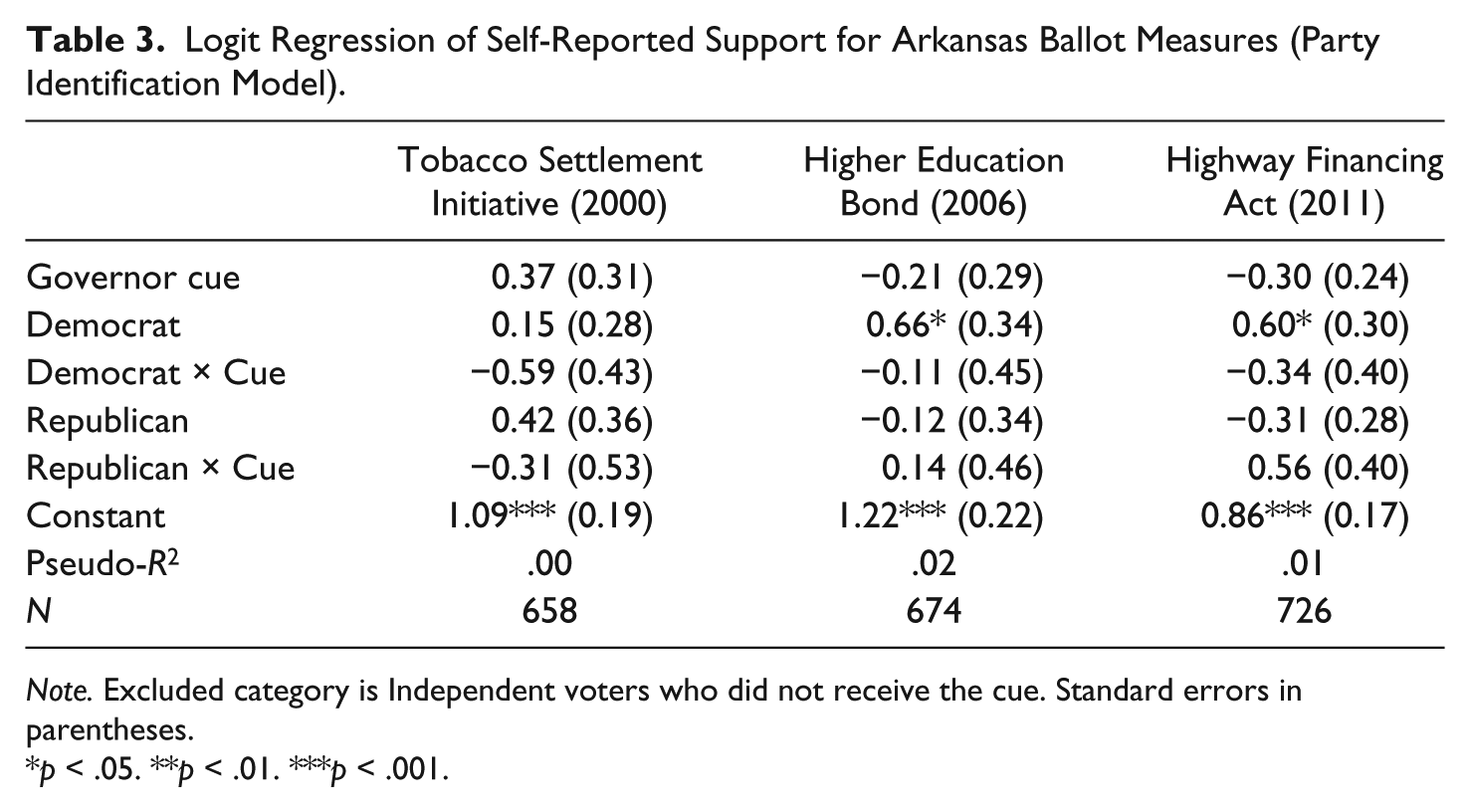
Note. Excluded category is Independent voters who did not receive the cue. Standard errors in parentheses.
p < .05. **p < .01. ***p < .001.
As before, we calculate the predicted probability of supporting the three measures by treatment group and party identification to allow interpretation of our regression results easier. As the calculations in Table 4 demonstrate, there is very little difference between treatment and control groups for any of the party conditions (Democrat, Independent, or Republican) across all three of the ballot measures. Consider, for example, the Tobacco Settlement Initiative (2000) that saw significant differences between the treatment group and control group based on job performance. By contrast, when we interact the treatment with party identification the predicted differences are negligible. For Democrats, support for the measure declines by just 4 percentage points when we include the cue in the description (the decline is expected, given that Governor Huckabee is a Republican). For Independents, support for the measure increased 6.3 percentage points. For Republicans, providing the cue leads to an increase in support for the measure by a mere 0.8 percentage points. None of these differences are statistically significant.
Predicted Probabilities of Support for Ballot Measures, by Party Identification.

Note. CI = confidence interval.
Our third and final step in our results is to examine whether the effects of our treatment are more pronounced in a subsample of respondents who are the most likely to be influenced by new information. Here, we explore whether the individuals who are the least likely to learn of an endorsement before Election Day are persuaded by our treatment (knowledge of a gubernatorial endorsement). While we did not gather explicit measures of political knowledge or interest in politics, we employ a proxy: we limit our sample to individuals who do not have a college degree (i.e., some college or less) and are not strong partisans (i.e., they do not identify as strong Democrats or strong Republicans). In line with Zaller’s (1992) research, these are precisely the individuals whom (1) we expect to be most persuaded by new information and (2) are least likely to be exposed to knowledge of the governor’s endorsement before our experiment. In other words, by removing individuals who have a college degree or higher or are strong partisans, we are conducting analysis on a subsample where we expect the effects of our treatment to be the strongest.
Table 5 reveals that the effects of our treatment were also limited among this subsample of nonsophisticates. We again find a significant effect of interacting our treatment with gubernatorial approval for our 2000 initiative. We do not uncover, however, a significant result for individuals who disapprove of the governor but received the treatment, though the result is in the expected direction. Results for the other two measures (2006 and 2011) were not significant. These results confirm that, in the three cases we analyze, individuals’ use of endorsements is limited even when we restrict the sample to people we might consider most likely to use them.
Logit Regression of Self-Reported Support for Arkansas Ballot Measures (Gubernatorial Approval Model, Restricted Sample of Nonsophisticates).

Note. Sample excludes individuals who have a college degree and/or identify themselves as a strong partisan. Excluded category is respondents who did not receive the cue and do not approve of the governor’s job performance. Standard errors in parentheses.
p < .05. **p < .01. ***p < .001.
Conclusion
The institutions of direct democracy demand much from citizens, and the conventional wisdom for decades was that most were not up to the task. The relatively recent emergence of more nuanced measures of voter competence has revealed the utility—at least under certain conditions—of shortcuts in helping voters make sound decisions based on limited information. Indeed, although much of the extant work relies on laboratory simulations or on cue-givers that we assume individuals consider knowledgeable and trustworthy, elite endorsements appear to be a potentially efficient aid for competent ballot-casting. 7
The results of our three survey experiments offer modest support for the contention that a gubernatorial endorsement is influential. For the Tobacco Settlement Initiative (2000), the treatment had a substantively interesting and significant effect on our respondents’ propensity to support the measure. Indeed, informing respondents of Governor Huckabee’s support for the measure produced a 16.6 percentage point increase in our subjects’ support for the proposal when compared with the baseline of gubernatorial approval and no treatment. For the Higher Education Bond (2006) and Highway Financing Act (2011), however, our treatment was not persuasive.
A potential explanation for why our treatment had a limited effect on our sample is that individuals simply knew the endorsement before the experiment or, in other words, had experienced “pretreatment” (see Druckman and Leeper 2012). To explore this possibility, we asked respondents in the control group to report whether they knew of Governor Beebe’s endorsement on our 2011 experiment. Our survey reveals most voters knew little about the governor’s position regarding the 2011 referendum: only 35.1% (N = 85) of our control group knew of Governor Beebe’s support. An additional 5.4% (N = 12) incorrectly believed he opposed the measure, while the majority (59.5%, N = 132) registered a “don’t know” response. This suggests most respondents in our sample did not have a priori knowledge of Governor Beebe’s position. Indeed, almost two-thirds of our sample was unaware of our treatment. While it is unclear whether this statistic is generalizable beyond this one sample, it suggests that pretreatment was likely not a confound for our studies.
We suspect that the broader election environment, including the presence of an elite consensus, the nature of the ballot measure (i.e., a citizen-driven initiated act or an establishment-driven referendum), the level of partisan disagreement associated with the ballot measure, the robustness of the campaign effort on a measure’s behalf, and/or the existence of organized opposition, for example, are likely to influence the success—and failure—of endorsements. Although we could not model such influences here, these conditions varied widely in the measures we studied. The tobacco measure—Initiated Act 1 of 2000—shared a crowded general election ballot that included not only a competitive presidential contest but also four additional ballot measures. Nearly 60% of registered voters participated in the election, many more of whom were likely to have desired information shortcuts—especially in light of the rancor among elites that dominated news coverage of the measure—than would the voters who participated in the single-issue, off-cycle election of 2011 that seemed predetermined and, consequently, drew only 7% of registered voters to the polls. The 2006 bond measure lies in the middle of these extremes. It seems reasonable to conclude that such divergent conditions would influence voters’ receptivity to endorsements on a particular ballot measure as well.
In sum, while our data represent only three cases from a single state and thus preclude us from making broad generalizations, we believe the observed conditional nature of elite endorsements as a means to improve voter competence is a subject worthy of further exploration. The use of more survey experiments that probe the effect of actual endorsements from elite actors in real election environments and their potential effects on different groups of voters under varied circumstances may prove particularly fruitful.
Footnotes
Appendix
Acknowledgements
We would like to thank Adam Brown, Tom Carsey, Jennifer Jensen, and Vladimir Kogan, as well as two anonymous reviewers for helpful comments. All errors remain our own.
Authors’ Note
A previous version of this article was presented at the Southern Political Science Association annual meeting, New Orleans, Louisiana, January 12–14, 2012.
Declaration of Conflicting Interests
The author(s) declared no potential conflicts of interest with respect to the research, authorship, and/or publication of this article.
Funding
The author(s) disclosed receipt of the following financial support for the research, authorship, and/or publication of this article: The Arkansas Poll is supported wholly through the endowment of the Diane D. Blair Center of Southern Politics and Society at the University of Arkansas.