




Abstract
How do people assign blame in the wake of significant government failures? If the role of the citizenry in a representative democracy is to discipline elected officials for failing to meet collective expectations, then this question is of paramount importance. Much research suggests that the base tendency of citizens is to simply blame the other party—a normatively concerning outcome. However, some argue that information, especially that from expert and nonpartisan sources, may push citizens to overlook their party affiliation and assign blame in a more performance-based fashion. Using an experimental design, we test this possibility, manipulating whether there is unified or divided government, the partisanship of key actors, and the nature of expert information that participants receive during a hypothetical budget crisis at the state level. We find strong evidence that party weighs heavily on individuals’ minds when assigning blame, as expected. More importantly, we find that nonpartisan expert information about the situation does not live up to its potential to sway partisans from their priors. Rather, unbiased information appears to be used as a weapon—ignored when it challenges partisan expectations and used to magnify blame of the other party when it conforms with them.
Keywords
Government failures have recently captured headlines across much of the country. A faltering economy, high unemployment, budget shortfalls, the specter of government shutdowns, and a debt crisis have highlighted the reality that governments at both state and federal level may not always operate as the citizenry desires. While government failure is nothing new on the American political landscape, questions persist with respect to how the electorate responds. How do people assign blame in the wake of significant government failures? If the role of the electorate in a representative democracy is to discipline elected officials for failure to meet citizens’ expectations, then this question is of paramount importance. Evidence that citizens attribute blame in a largely partisan fashion—pointing the finger at the opposite party and absolving members of their own party—is prevalent (e.g., Brown 2010; Malhotra 2008; Rudolph 2003a; 2003b; 2006). For representative democracy, this may be troubling.
We use an experimental design to test how the provision of nonpartisan, expert information about who is to blame in the failure influences the attribution of blame. The results demonstrate that the power of partisanship in shaping assessments of government cannot be understated. Regardless of circumstance, citizens appear to favor reprimanding the other party. Furthermore, we find that people fail to use unbiased, expert information about who is to blame to hold government accountable. Rather, information becomes a weapon for partisans who eagerly use it when it reinforces their prior beliefs and ignore it when it challenges them.
This article adds to our understanding of how citizens in a representative democracy hold their officials accountable in two ways. The first is by exploring the consequences of potentially the most promising avenue through which people are willing to overlook their party affiliations: unbiased expert testimony. We have some evidence that, when given information about actors’ responsibilities, these facts can be used to punish the responsible entity (Malhotra and Kuo 2008), but we do not know how information provided by a third party regarding who is at fault is used. This kind of information is more commonly encountered by citizens than facts pertaining to institutional responsibility. Understanding how it is used can provide us with more insight into how people use information to inform their evaluations. The second is by focusing on blame at the state level. Almost all work on citizen blame attribution focuses on the national stage, or across federal levels, while relatively little addresses state governments. This is consequential in part because people have different levels of knowledge and expectations about state governments, potentially leading to different conclusions about how partisans use information to direct blame.
How People Assign Blame When Government Fails
Our current understanding of how citizens assign blame largely presumes that the dominant tendency is to simply blame the other party when government fails (Brown 2010; Lebo and Cassino 2007; Malhotra 2008; Malhotra and Kuo 2008; Peffley and Williams 1985; Rudolph 2003a; 2003b; 2006; Stein 1990; Tilley and Hobolt 2011). The power of affective attachments to shape political views dramatically influences how citizens assign blame. Despite the consistent finding that people frequently conclude the opposite party is at fault when mistakes are made, recent research suggests that the partisan story may be more nuanced (see, for example, Atkeson and Maestas 2012). The effect of individual partisanship on blame is lessened in the face of information on role responsibility (Malhotra and Kuo 2008; Rudolph 2006), and political awareness or sophistication influences the way in which partisan motivations are turned into blame (Kam 2005; Tilley and Hobolt 2011). Although partisanship may dominate the way people view government’s mistakes, these findings imply that if there is hope for the citizen to overlook party affiliation in the assignment of blame, the best bet for that hope may lie in the provision of nonpartisan information about who is at fault.
Partisans, Motivated Reasoning, and the Use of Information
Why do we observe such striking patterns of partisan blame attribution? Party affiliation acts as a “perceptual screen” for citizens (Campbell et al. 1960), meaning that the political world is viewed through a biased lens for the partisan—typically referred to motivated reasoning (Taber and Lodge 2006). Often discussed as an alternative to a “rational” or Bayesian learning model, motivated reasoning is forwarded to explain the persistence (and polarization) of political beliefs and attitudes that we typically observe in the electorate (Kim, Taber, and Lodge 2010).
Partisan filtering shapes individuals’ issue positions (Bartels 2002; Gaines et al. 2007; Jacoby 1988; Lenz 2009; Rahn 1993), candidate evaluations (Goren 2002), and perceptions of which issues are owned by which parties (Hayes 2005). Perhaps most importantly, partisans who witness the exact same events interpret them very differently. Evaluations of the same economic circumstances often generate very different reactions between partisans (Evans and Anderson 2006), and facts regarding the Iraq War were interpreted very differently by Democrats and Republicans (Gaines et al. 2007). This “inhibits what would otherwise be a strong tendency towards convergence in political views in response to shared political experience” (Bartels 2002, 138). Instead, people view events in ways that conform with preexisting views.
The suggestion that follows is that the consistent trends we observe of partisans being disposed to blame the other party for governmental failures likely has to do with a motivated reasoning process, and specifically with how partisans interact with and process the information that they are exposed to. Many have lamented the lack of political knowledge and information that the American citizenry possesses, and because providing information about role responsibility can lessen partisan blame tendencies (Malhotra and Kuo 2008), an implication is that this dearth of information could be what is producing the partisan blame tendency. This raises the possibility that political information may hold promise, under certain circumstances, for either reducing or magnifying these partisan blame tendencies. That is, the base tendency of the electorate is partisan attribution, but it could be that under certain informational conditions, motivated reasoning is negated and partisan blame becomes less common.
Between individuals, the informed appear to behave in a different fashion than the uninformed. The politically sophisticated, for example, are better able to attribute causal explanations for political events to a variety of possible actors (Gomez and Wilson 2003; 2008; Hellwig and Coffey 2011). Those with higher levels of political awareness and information appear to use a more systematic and less heuristic-based approach to evaluating politics (Kam 2005; Wells et al. 2009), implying that we may observe largely partisan blame attribution because citizens on average lack the relevant information necessary to use more sophisticated means of evaluation (Bullock 2011). High-information individuals also more accurately perceive facts, meaning that the more informed are not necessarily the most susceptible to the polarizing effects of partisanship (Blais et al. 2010). Furthermore, when people do possess the requisite amount of information that enables them to make systematic judgments, information appears to be just as important as party cues for forming opinions (Bullock 2011).
Even though most citizens may process information in a motivated reasoning fashion, there do appear to be thresholds on this behavior, and in the face of massive amounts of challenging information, they eventually succumb and update their views (Redlawsk, Civettini, and Emmerson 2010). Kunda (1990, 483) contends that “people will come to believe what they want to believe only to the extent that reason permits. Often they will be forced to acknowledge and accept undesirable conclusions.” The suggestion is that information may be able to push partisans past their base tendency to blame the other party.
However, evidence to support this proposition is decidedly mixed and ample reason exists to be skeptical of this perspective. Motivated reasoning processes likely operate through two mechanisms: disconfirmation bias and confirmation bias (e.g., Taber and Lodge 2006). Confirmation bias is the tendency of partisans to seek out information that conforms with their prior attitudes and beliefs, often at the expense of exposure to information that challenges their existing beliefs (Taber and Lodge 2006). Disconfirmation bias occurs when the partisan is exposed to discordant information but actively discounts and counterargues the challenging perspectives (Lebo and Cassino 2007; Taber, Cann, and Kucsova 2009; Taber and Lodge 2006). This selective learning and processing results in a partisan who is more likely to retain facts and information that are congruent with her beliefs and prior attitudes and less likely to be aware of or retain information that is challenging to her partisan beliefs (Jerit and Barabas 2012). With this kind of political learning being prevalent for partisans, it should come as no surprise that the dominant tendency is to point the finger at members of the other party. More importantly, it suggests that raising levels of information may not decrease levels of partisan-based blame attribution.
One of the underlying assumptions of the information perspective is that if information matters, people should update their beliefs in a Bayesian fashion and begin to agree with one another when exposed to the same facts (e.g., Bartels 2002; Grynaviski 2006). The fact that this rarely takes place suggests that people do not update prior beliefs in light of new information. In fact, in some cases, the provision of information actually serves to increase prior ideological beliefs (Nyhan and Reifler 2010). And while threshold effects do exist where information is able to overcome motivated reasoning processes (Redlawsk, Civettini, and Emmerson 2010), most citizens do not possess these levels of information. When citizens encounter these limited amounts of information, even if they do act in a Bayesian fashion, the expectation of enduring disagreement and partisan polarization still exists (Bullock 2009).
Although there is reason to think that information, especially unbiased information, has the potential to sway people from their partisan biases and produce more normatively desirable citizens who assign blame in a less partisan and more factual manner, there is also ample reason to suspect that people do not cast aside a motivated processing of information lightly. We take the latter perspective for how partisans use information to assign blame in the wake of political failure. Of particular interest is how partisans use information from unbiased or nonpartisan sources. This type of information, by avoiding party cues, has the greatest potential to provoke a systematic processing. As such, it represents the most likely scenario to reduce partisan blame attribution. As a result, the expectation is that information—at least in the modest amounts that most citizens are exposed to—will not serve to produce less partisan blame attribution.
Research Design
To test how partisanship and objective information affect the assignment of blame, we conducted a 2 × 2 × 3 experiment where we varied both shared partisanship with two branches of government as well as the type of objective information participants confront when reading about a hypothetical budget crisis (see the appendix for full budget crisis scenario). Participants read about a state government’s failure to pass a budget that resulted in a credit downgrade. 1 We assigned participants to 1 of 12 different conditions that varied (1) whether the governor shared the participant’s partisanship, (2) whether the legislature shared the participant’s partisanship, and (3) the type of information participants learn about the reason for government’s failure to accomplish important tasks. These conditions are shown in Table 1. 2
Conditions for Experiment on Who Is Blamed When Government Fails.

Depending on which condition they were randomly assigned to, participants received no expert testimony about who was responsible for the credit downgrade or were given information that either reinforced partisan expectations (e.g., the Democrats were blamed if the respondent was a Republican) or challenged partisan expectations (e.g., the Democrats were blamed if the respondent was a Democrat).
We recruited respondents via Amazon’s Mechanical Turk from February 2 to 5, 2012, and administered the experiment using the online survey tool Qualtrics. 3 In total, 366 participants completed the experiment and gave valid responses to the key questions such as partisanship. 4 We can compare the representativeness of our sample with other convenience and national probability samples from Berinsky, Huber, and Lenz (2012). 5 The average age was 34 (SD = 11 years) with respondents ranging from 19 to 74. The median education level was an associate’s degree (3 on a 7-point scale), and respondents represented 44 states and the District of Columbia. 6 Respondents, on average, reported “moderate interest” in politics (2 on a 5-point scale) and were slightly more Democratic (45%) than Independent (30%) or Republican (22%). This appears to be a more representative sample than the convenience samples and very similar to the Mechanical Turk sample that was reported by Berinsky, Huber, and Lenz. The suggestion from this is that our Mechanical Turk sample is similar to other Mechanical Turk samples, and we can be confident that the general properties of Mechanical Turk samples—that is, that they are more representative than convenience samples but less representative than national probability samples—apply here as well. Our sample does appear to be slightly younger and more Democratic than we would expect to find in a national probability sample, though we have no reason to suspect that these differences are seriously confounding any of our results.
Measurement
Dependent Variables: Who Is Blamed and How Much Are They Blamed?
In this analysis, we use several separate but related dependent variables that measure both whom people assign blame to and how much blame they assign to a given actor. Our first measure that examines how much people blame different actors is based upon rating scales. Each respondent was asked to indicate how much blame each of several possible actors deserves for the credit downgrade using a sliding scale from “not at all to blame” (0) to “completely to blame” (100). In the analysis below, we use blame scales for the governor, the legislature, and previous officeholders, and all incumbents as dependent variables. Higher values on these scales indicate a greater amount of blame for the given actor.
To examine who is blamed, we use two different approaches. The first of these is based on coded open-ended responses to the question, “Regarding the situation that you just read about, who do you think is responsible for the budget crisis?” Responses were coded as blame for the governor (12.8%), the legislature (14.5%), all incumbents (56.8%), the economy (7.5%), or previous officeholders (8.4%). An analysis of variance indicates that responses to this question vary statistically significantly across the conditions of the experiment (F = 2.80, p < .01).
Second, to address the blame for the two actors most directly involved in the budget crisis, we use the difference in blame ratings for the governor and the legislature. A positive value on this measure indicates a respondent assigned a greater proportion of the blame to the governor and a negative value indicates the respondent assigned a greater proportion of blame to the legislature. We refer to this variable as institutional blame in the tables and figures below. Table 2 provides distributions of these measures and illustrates that each varies statistically significantly across conditions of the experiment.
Measurement and Distribution of Dependent Variables.
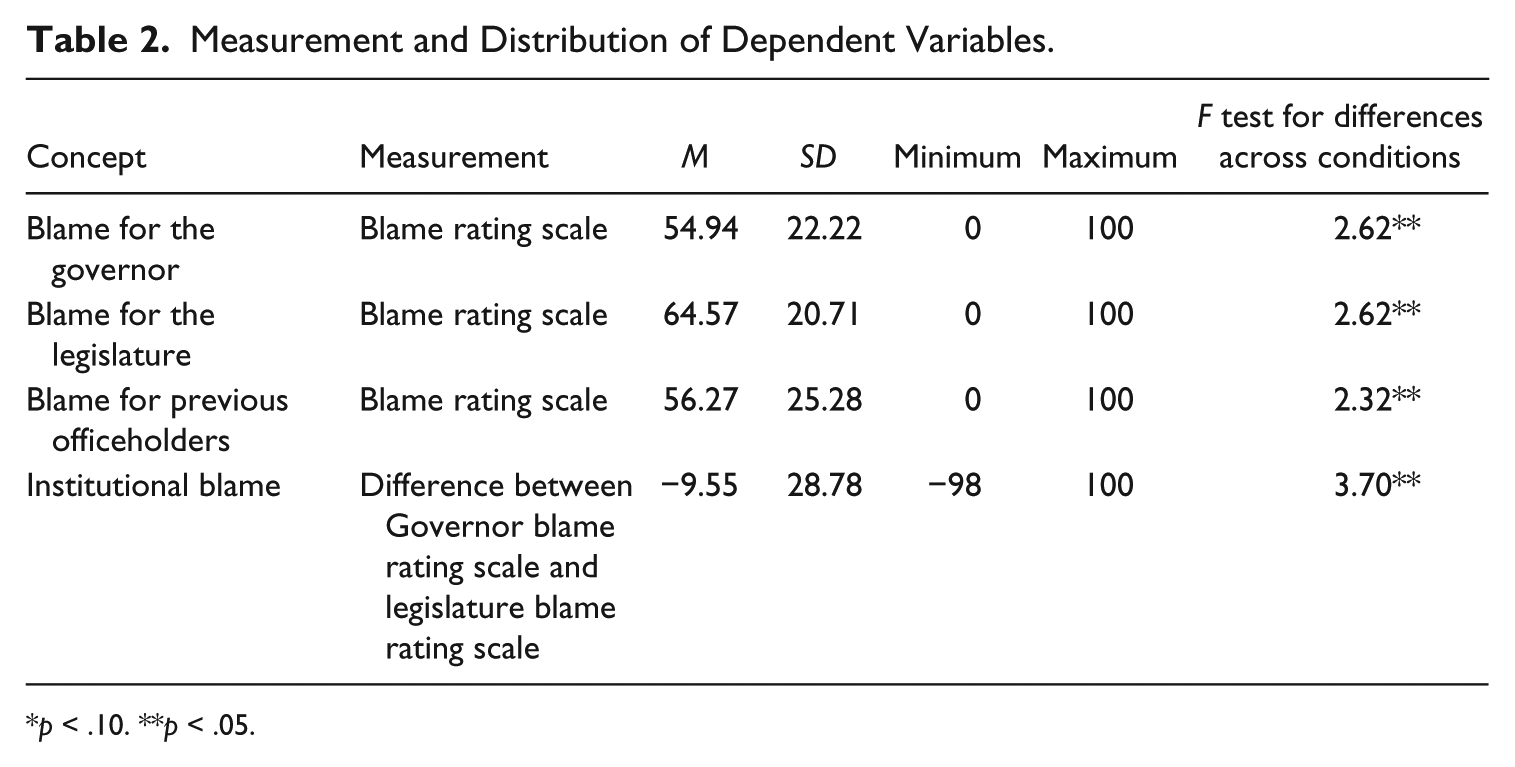
p < .10. **p < .05.
Independent Variables
Our key treatments are focused on (1) the role of shared partisanship between participants and the governor or legislature, and (2) the nature of expert testimony that each participant is exposed to. The expert either provided no information on who was responsible for the state’s budget crisis or indicated that the governor, legislature, previous officeholders, or all current officeholders were responsible. We use regression to model the interactive relationships between shared partisanship and blame, and the ways in which expert testimony influences these attributions. 7
Results
The Partisan Assignment of Blame
First, we assess the power of partisanship in evaluating responsibility for governmental failure. To evaluate how partisanship influences the attribution of blame, we use regressions of open-ended responses of who should be blamed. 8
We begin with a multinomial logit of open-ended responses where the lone independent variable is a dichotomous indicator for whether or not the respondent shared a party label with the governor or the legislature (Tables 3 and 4). As each of the models in Tables 3 and 4 indicate, simply sharing partisanship with the governor or the legislature leads respondents to assign more blame to other possible actors across all conditions. The average effect of shared partisanship with the governor is to decrease the probability of blaming the governor by 7.19% (p < .05). Similarly, sharing a party label with the legislature decreases the probability of blaming that branch by 11.47% (p < .05). As we expect, people seek other targets to blame when their copartisans are potentially responsible for the budget crisis.
Multinomial Logit Model of Who Is Blamed, Compared with the Governor.
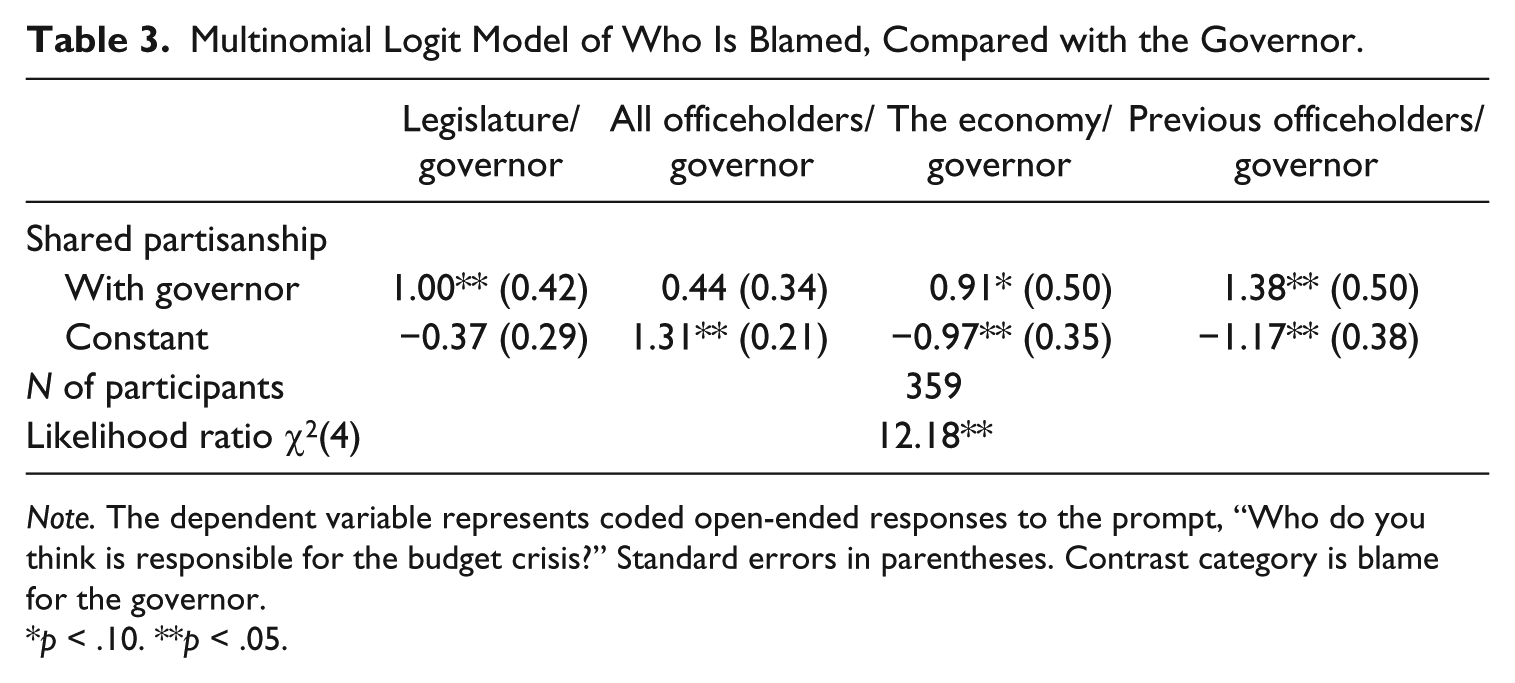
Note. The dependent variable represents coded open-ended responses to the prompt, “Who do you think is responsible for the budget crisis?” Standard errors in parentheses. Contrast category is blame for the governor.
p < .10. **p < .05.
Multinomial Logit Model of Who Is Blamed, Compared with the Legislature.
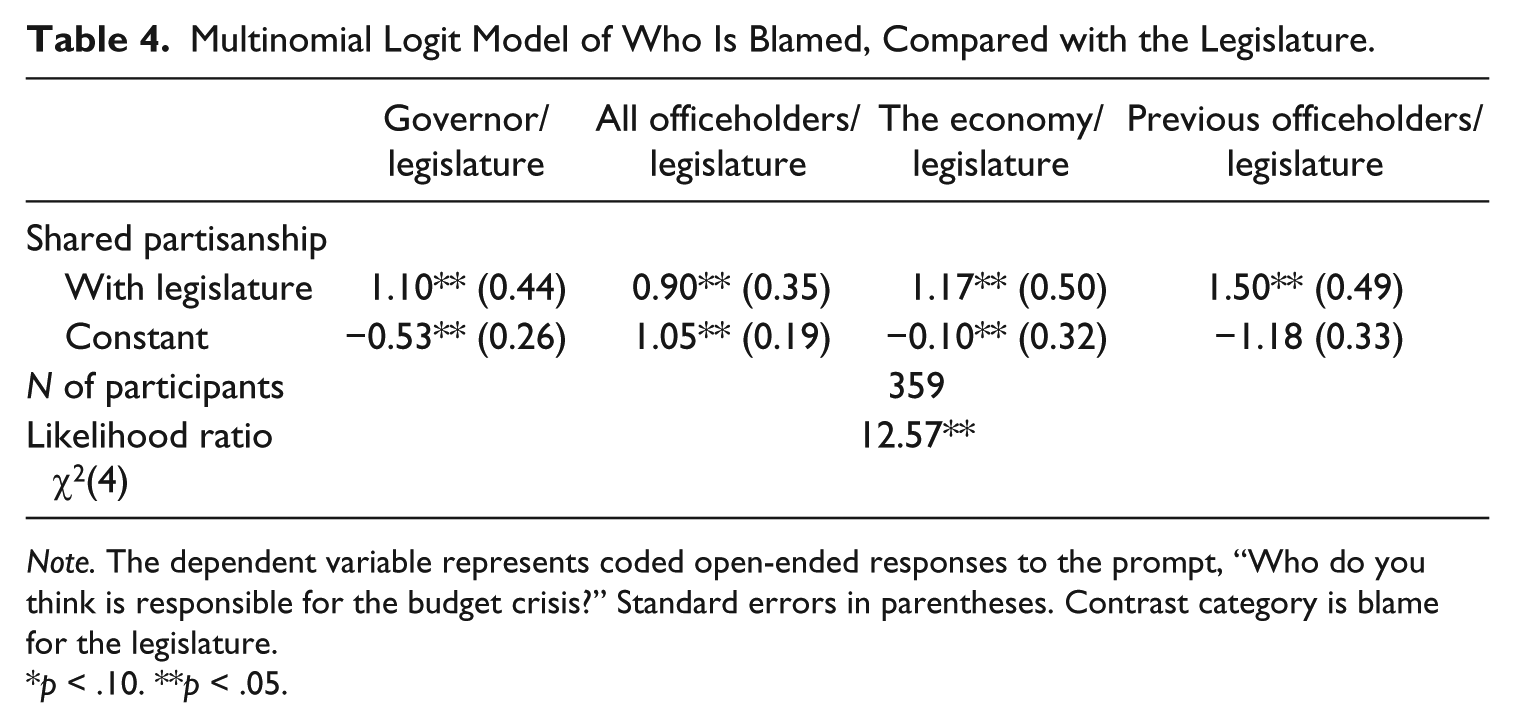
Note. The dependent variable represents coded open-ended responses to the prompt, “Who do you think is responsible for the budget crisis?” Standard errors in parentheses. Contrast category is blame for the legislature.
p < .10. **p < .05.
The Role of Expert Testimony
We now examine how information from external sources may condition the partisan biases that underlie the assignment of blame. In our conditions, we varied both whether respondents received information from an expert on who was responsible for the budget crisis as well as the target of that expert’s blame. The number of observations are roughly cut in half from the models presented in Tables 3 and 4, because each model is only exploring a certain set of conditions in terms of who the expert blames and the partisan composition of the government. First, we examine the moderating effect of expert testimony on how people assigned relative amounts of blame between the governor and the legislature when only one of the two was of the respondent’s party.
The first two columns of Table 5 regress our measure of institutional blame on shared partisanship with the governor or legislature and whether the expert blamed the governor or legislature. Second, we examine the amount of blame participants assign to each actor when told that actor was responsible. The final four columns of Table 5 use the 0 to 100 blame scales with several different actors as the dependent variable. For each, we illustrate how the relationship between shared partisanship and blame for a given actor is conditioned by the information the expert provides regarding who was responsible.
OLS Models of Who Is Blamed and Amount of Blame for Various Actors, as Conditioned by Party and Information.
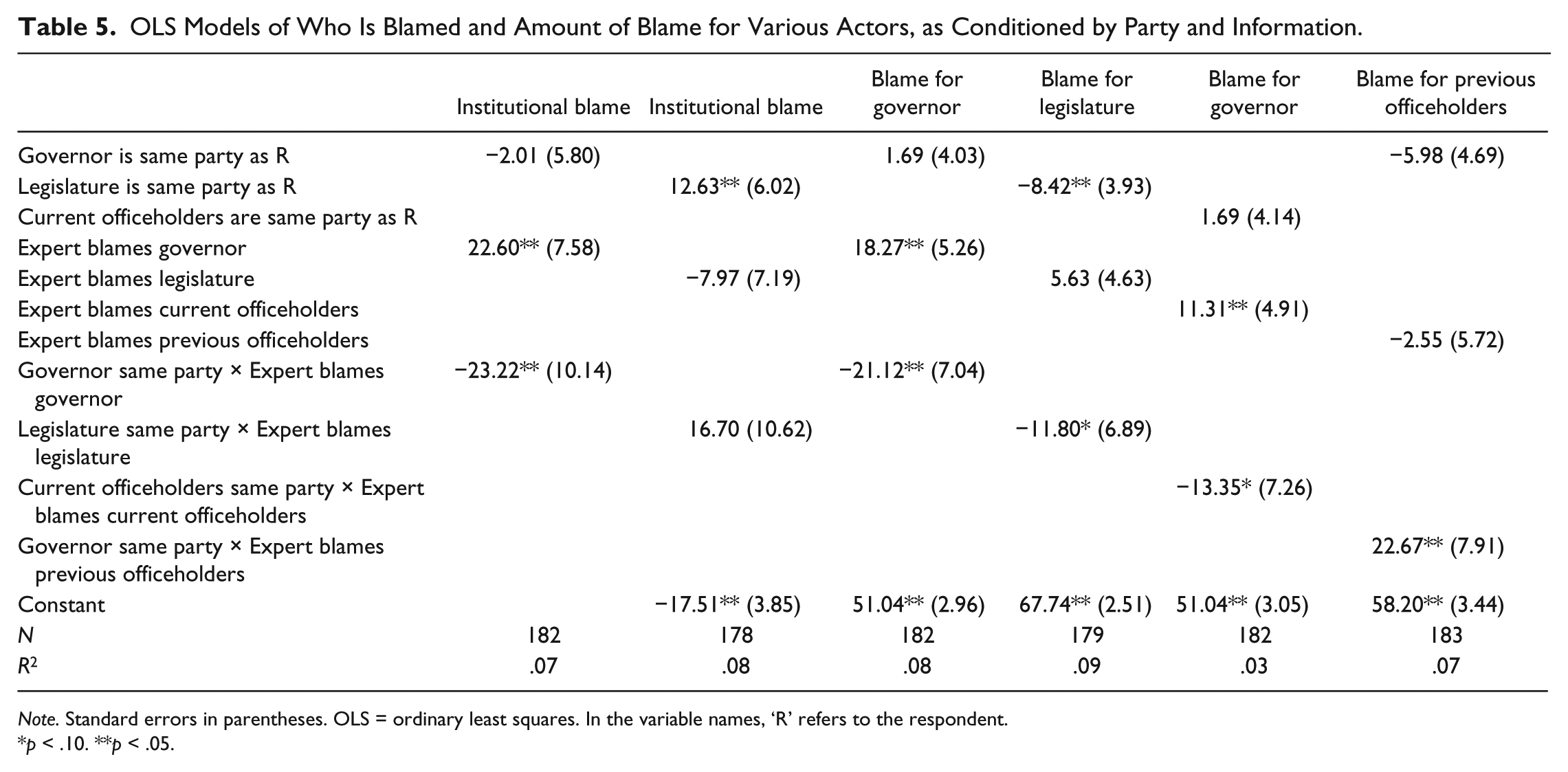
Note. Standard errors in parentheses. OLS = ordinary least squares. In the variable names, ‘R’ refers to the respondent.
p < .10. **p < .05.
Beginning with the institutional blame models from columns A and B, there are several things to note. In Model A where we assess the effects of expert testimony on blame for the governor and focus on the interaction between shared partisanship with the governor and the expert blaming the governor, we have a statistically significant and negative interaction effect. This indicates that blame for the governor increases when the expert blames that actor, but it increases much more when the governor is of the rival party. A similar pattern emerges in Model B where we have a positive, though not quite statistically significant, interaction between expert testimony and shared partisanship with the legislature. It offers suggestive evidence that citizens blame the legislature more when the expert does so, but this effect is much stronger when the legislature is of the opposing party. These effects are better illustrated in Figures 1 and 2.
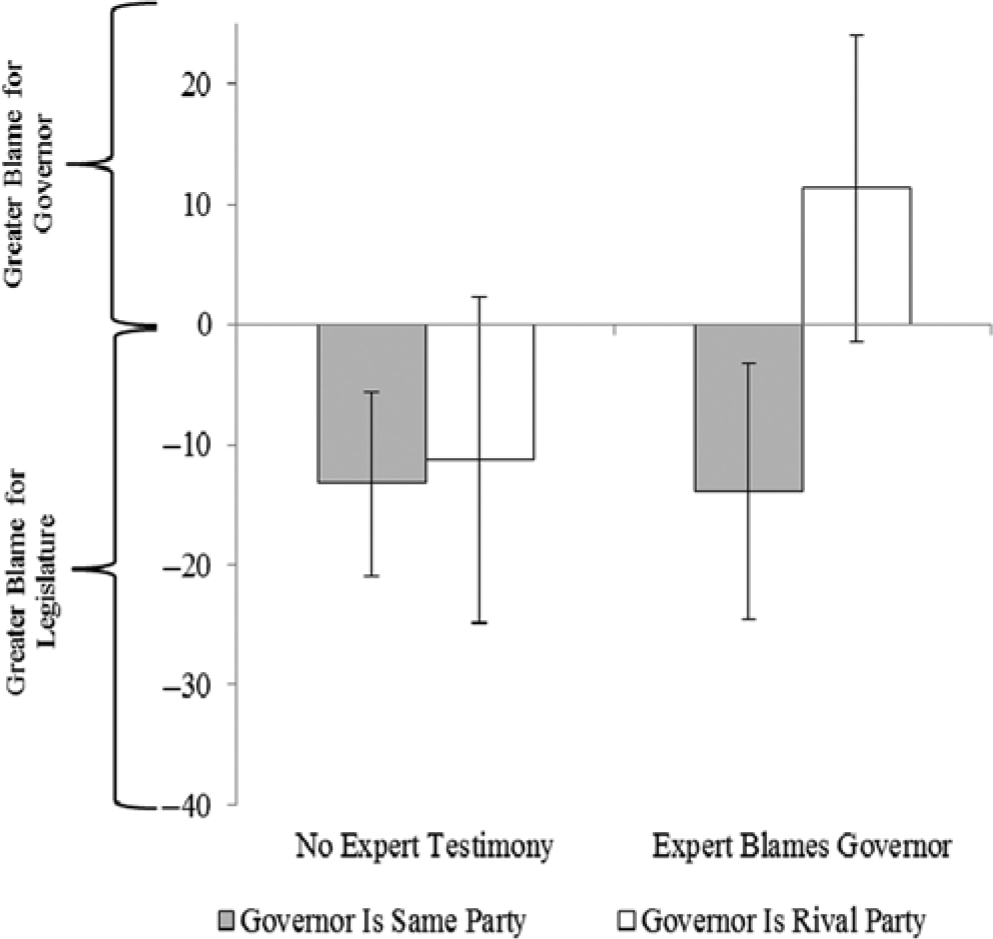
Institutional blame: By governor’s party and expert testimony.

Institutional blame: By legislature’s party and expert testimony.
In Figure 1, when no expert testimony is provided, people are more likely to blame the legislature than the governor. The average greater share of blame to the legislature is about 13 more points (or half of a standard deviation), and the 95% confidence interval does not overlap with zero. This again reflects the baseline tendency of individuals to shift blame away from their copartisan governor and onto the rival party legislature. When the expert indicates that the governor is responsible for the crisis, however, the effect of this information is different for copartisan and rival party governors. When told that a copartisan governor is responsible, people actually blame the legislature more (and at nearly the same level as when no information is provided). Alternatively, when told that a rival partisan governor is to blame, people indeed listen to the expert and blame the governor more (although the effect size is only statistically different from zero at p < .07). It appears, then, that people only attend to objective expert testimony when it reinforces their partisan priors and do not incorporate it into their attributions of blame when it does not.
We can observe a similar instance of partisan processing of expert information in the case of expert testimony about the legislature. Regardless of whether the expert indicates the budget crisis is the legislature’s fault, there are no statistically significant differences in relative blame for the legislature when it is of the participant’s party. But rival party legislatures are consistently blamed, especially when the expert also blames the legislature. Once again, the differential role of expert information is striking. When an expert blames the legislature, people only listen when the legislature is of the rival party. Otherwise, expert information does nothing to affect institutional blame.
Turning to the final four models in Table 5, we can assess the role of expert information provision on the amount of blame for specific actors. Across all four models, we have statistically significant interactions between expert testimony and shared partisanship with a range of government actors. In Model C, we see that the interaction between shared partisanship with the governor and the provision of expert information blaming the governor is negative, meaning that the effect of expert testimony for increasing blame of the governor is much higher when the governor is of the opposing party, compared with when the governor is a copartisan. Similarly, we have a negative interaction in Model D, demonstrating that the effect of expert testimony on blame for the legislature is statistically significantly larger when the legislature is of the opposing party. In Model E, we again have a negative interaction. In this case, the entire government (both governor and legislature) are of the same party. The negative interaction term means that expert testimony has a much larger effect on blame for the governor when the government is of the opposing party. Finally, in Model F, we have a positive interaction between the shared partisanship with the governor and whether the expert blames the previous administration. The positive coefficient means that expert testimony is especially powerful when the participant shares her party affiliation with the current governor. Again, this demonstrates the use of information by citizens largely when it reinforces partisan expectations. Figures 3 to 6 more clearly illustrate these patterns of blame attribution.
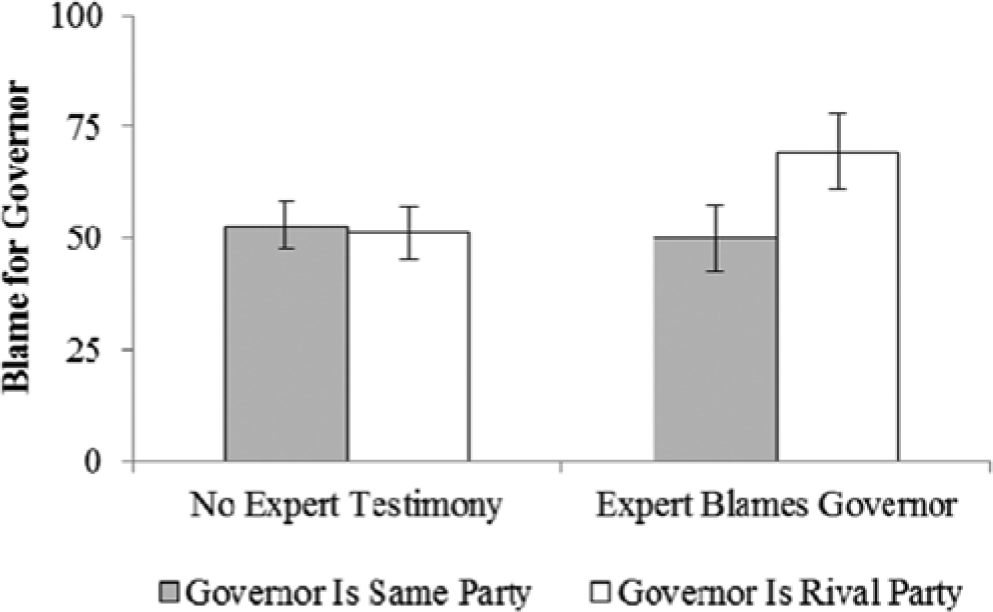
Blame for governor: By governor’s party and expert testimony.

Blame for legislature: By legislature’s party and expert testimony.
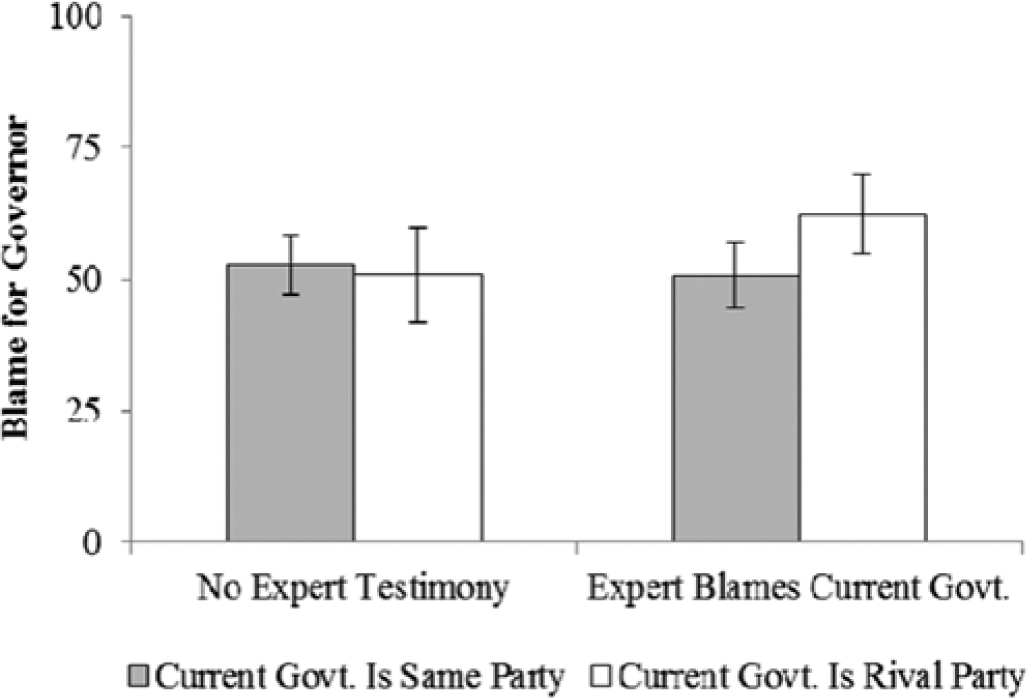
Blame for governor: By government’s party and expert testimony.
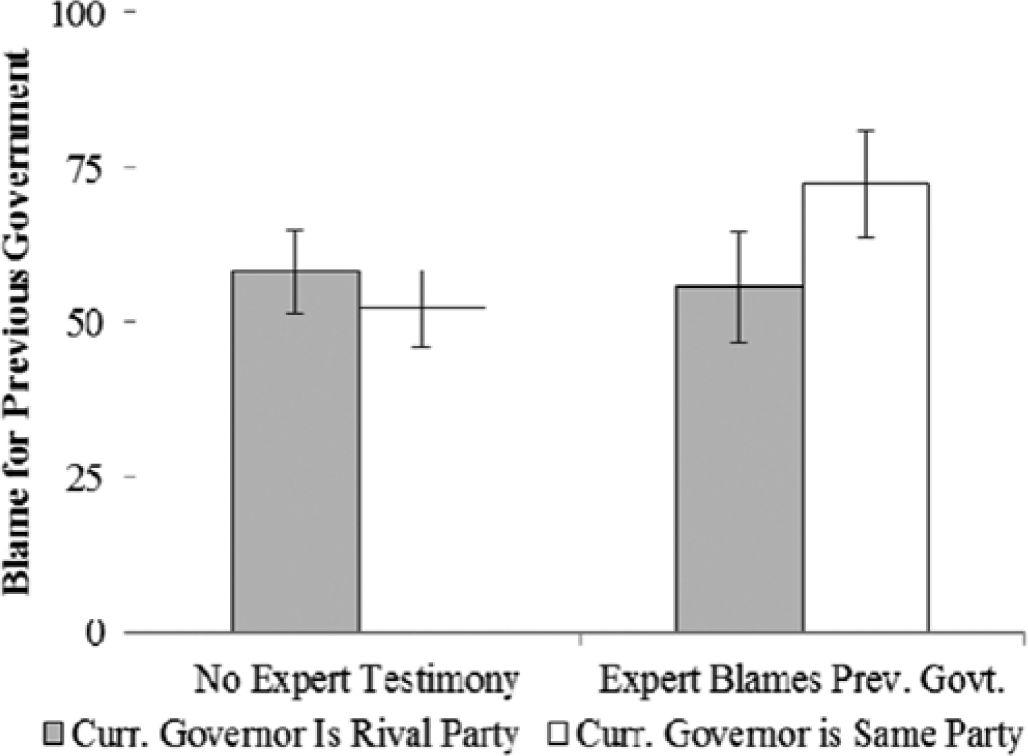
Blame for previous government: By previous government’s party and expert testimony.
In Figure 3, we can see that expert testimony only results in greater blame for the governor when the governor is of the rival party. Similarly, when the expert blames the legislature (Figure 4), there is a much higher level of blame when the legislature is of the rival party than when the legislature is of the participant’s party. Although the confidence intervals overlap slightly in the case of blame for the governor when the entire government is of the participant’s party and blame for the previous government, the substantive story is similar. Expert testimony that indicates a particular actor is responsible increases blame for that actor but only when the actor is of the rival party.
The story that emerges from these findings is normatively concerning. The use of expert information seems to only exacerbate people’s partisan tendencies. Information from an expert, in the hands of partisans, becomes a tool to reinforce prior expectations. Rather than serve as a source of objective information, expert testimony is only incorporated into people’s views when it can be used as a weapon to further target the rival party. Information that challenges one’s partisan predispositions is generally ignored, producing similar levels of blame attribution as those who receive no information.
Conclusion
Who is blamed when government fails? We weigh the extent to which partisanship colors attributions of blame, and specifically address how the provision of expert information interacts with individual partisanship to either foster a less partisan and more performance-based assessment or produce a more partisan and less performance-based assessment. We look at factors that might induce people to look past their partisanship and evaluate elected officials in a more unbiased fashion—specifically information provided by experts.
When people evaluate political information, they have two potentially conflicting goals—to arrive at the correct conclusion and to arrive at a preferred conclusion (Kunda 1990, 480). Often, people desire to fully understand a political phenomenon and objectively evaluate facts about the topic of interest. At the same time, they will often filter information to arrive at conclusions that conform to their prior preferences. In the case of assigning blame, we might expect that some are willing to objectively evaluate information and hold the most culpable party responsible. Alternatively, those with strong priors may interpret any government failure as evidence of what they already believe to be true. In the case of partisanship, the strength of one’s affective orientation toward a party may outweigh their willingness to objectively evaluate who is responsible when government fails to work properly.
Interestingly, expert information appears to only be used as a weapon by individuals, rather than as a source of facts that fosters an objective distribution of responsibility. When provided with information that supports one’s partisan prior beliefs, people react by placing even more blame on the rival party than they otherwise would. That is, they become even more partisan in their assignment of responsibility. However, when presented with information that challenges their partisan orientation by blaming their own party, people ignore the information and do not change their attribution of responsibility for policy failure. Rather than acting as a means for cultivating objectivity, expert information appears to only exacerbate individuals’ partisan tendencies.
There are several implications that follow from these findings. Party is an incredibly strong filter through which citizens interpret political events. This cue produces normatively pleasing outcomes by simplifying choices for voters and enabling (relatively) accurate decision making at the ballot box in the face of incomplete information, but it also appears to simplify other choices resulting in less desirable outcomes. Although the extant literature provides expectations that partisanship weighs heavily on blame attributions, we have demonstrated that one of the most promising venues for overcoming this tendency—expert, nonpartisan information—fails to do so. Many attribute partisan reactions to an uninformed electorate that needs a partisan heuristic to make assessments. We have shown that providing an alternative cue that is more relevant to the policy failure does not appear to outweigh the baseline partisan tendency. That is, citizens do not appear to be able or willing to use expert information about government performance in the assessment of outcomes. Rather, when such information is provided, they lean on partisan predispositions even more strongly.
Furthermore, the findings presented here expand our understanding of blame attribution by extending the focus of the question to the state level. Much of the research on the topic has focused on blame either at the national level (Rudolph 2003b) or across federal levels (Atkeson and Maestas 2012; Brown 2010; Malhotra 2008; Malhotra and Kuo 2008). We focus entirely on the state level, where there is a reason to believe that information and partisanship may act differently. Knowledge of politics at the state level is substantially lower than knowledge at the national level (Delli Carpini and Keeter 1996; Roeder 1994), meaning that citizens may be assessing policy failure with fewer priors in mind. This raises the possibility that heuristics—both partisanship and expert information—could be more influential than they are at the national level. We demonstrate that despite these differences, the partisan nature of blame attribution remains consistent and that expert testimony is unable to alter this tendency. In the low information setting of state politics, it is the partisan heuristic that appears to predominate.
This finding also appears to be somewhat incongruent with other arguments about how partisans use information to attribute blame. Some have asserted that information has the capacity to reduce partisan tendencies (e.g., Bullock 2011; Malhotra and Kuo 2008), while we find that information does the opposite—acting to amplify them. What explains this discrepancy? The two key distinctions about the scenario presented here that may explain this difference are that we are focused on state-level outcomes, and we are focused on a unique kind of information which is the provision of expert testimony. As noted, state outcomes are unique in that they represent a context more devoid of knowledge and prior beliefs than national situations or natural disasters where the prior work has centered. In more information-rich settings, it may be that information is taken as a more credible signal or is evaluated with a higher emphasis. This is consistent with Bullock’s (2011) assertions that among high-information individuals, we see information being used alongside partisanship, though it is shifting the focus from individuals to information contexts. The one piece of research we are aware of looking at the state setting and blame finds a congruent story to that presented here whereby partisanship prevails over information (Rudolph 2006).
The other possibility is that the type of information matters. Much of the prior research which finds that information can mitigate partisanship focuses on supplying respondents with job titles and information about role responsibility (e.g., Malhotra and Kuo 2008). The provision of expert testimony is a decidedly different kind of cue. Rather than objective, it is inherently subjective. Despite the fact that the expert testimony was made nonpartisan, it still represents an opinion rather than a fact, and as a result could fan partisan flames. It is likely harder for the individual to deny and challenge information about the job responsibilities that come with a certain position, but expert testimony is different. Partisans of both sides routinely disagree with “experts” across a range of issue and policy areas, so it may follow that such testimony is much less influential and can actually magnify partisan attributions of blame. Clearly, more work is needed to fully flush out the conditions under which information lessens or magnifies partisan blame.
Representative democracy requires that citizens be able to differentiate good representation and bad representation, desirable outcome and undesirable ones. Furthermore, citizens have to be willing and able to punish for poor performance and reward for good performance. However, partisanship appears to color much of the process, and providing partisans with nonpartisan information does not foster an unbiased evaluation. Expecting a partisan electorate to hold the government accountable for outcomes is akin to expecting a devout fan to officiate a football game. They will have no problem blowing the whistle, but it will only be to make calls against one team.
Footnotes
Appendix
Declaration of Conflicting Interests
The author(s) declared no potential conflicts of interest with respect to the research, authorship, and/or publication of this article.
Funding
We received a Graduate Student Summer Research Grant from the Department of Political Science at the University of Colorado at Boulder for this project.