



Abstract
Although the U.S. judiciary is designed to be an independent and counter-majoritarian arbiter of the law, many states feature electoral institutions that may expose judges to public pressure. Scholars have demonstrated that judicial elections provide a clear link between public opinion and judicial decision making that may undermine the ability of courts to act in counter-majoritarian ways to protect minority rights. We extend this line of inquiry by examining whether direct democracy institutions have a similar effect of enhancing the impact of public opinion on judicial behavior and reducing the likelihood of judges voting in favor of minority rights. Empirical results from an analysis of gay rights cases in the American states from 1981 to 2004 provide evidence that direct democracy, in conjunction with electoral retention methods, significantly increases the effect of public opinion on judicial decisions.
Keywords
Are judges in the United States influenced by public opinion? Although the judicial branch in the American political system is designed to be an independent and counter-majoritarian arbiter of the law, contemporary political scientists have called its independence into question (Barnum 1985; Mishler and Sheehan 1993). This question is particularly relevant at the state level, where many judges are selected and retained through the electoral process, providing a direct link to the public (Hall 1987). Recent research has revealed a clear tension between democratic accountability, on the one hand, and judicial independence, on the other (e.g., Brace and Boyea 2008). This tension presents a problem in cases dealing with the rights of minority groups. Indeed, the courts have long been envisioned as a “safety net” to protect minority rights against the majoritarian tendencies of the democratic system (e.g., Cover 1982). Yet if judges are influenced by public opinion, their ability to protect minority rights may be compromised (Bickel 1986).
Most scholars have examined this issue by exploring the effects of selection and retention methods of state judges, but other electoral institutions may also play a significant role in the relationship between public opinion and judicial behavior. Direct democracy institutions, such as ballot initiatives and popular referenda, may exacerbate the “counter-majoritarian difficulty” faced by judges ruling on minority rights cases (Miller 2009). This increased difficulty may be further compounded in states where judges have to face the electorate to keep their position on the bench (Manweller 2004). Thus, it is not clear how effectively state judges in the United States can protect minority rights in the face of popular pressure. Do direct democracy institutions and judicial elections make judges more responsive to majoritarian preferences and less likely to protect the rights of minority groups? In this study, we seek to address this question by analyzing judicial voting patterns on gay rights cases in the American states.
Electoral Institutions and the Counter-Majoritarian Difficulty
Although courts are often viewed as counter-majoritarian institutions, it is not immediately clear that judges are always able to act independently of public opinion. Counter-majoritarian decisions place courts in direct conflict with basic tenets of representative democracy. Thus, Bickel (1986) argues that the “root difficulty” of judicial review is that it thwarts the will of popularly elected representatives. Judges may be reluctant to overturn the policies enacted by the legislative and executive branches since doing so would effectively overrule the preferences of the people.
As many scholars have noted, state courts may face this difficulty more acutely than federal judges because many states select and retain state judges through electoral methods. In many states, not only do judges deal with public pressure in reviewing policies passed by elected officials, but they also must account for public opinion in retaining their positions on the bench. Thirty-eight states exercise some form of popular control over judges through partisan elections, nonpartisan elections, or retention elections (Engstrom and Kenny 2002). The differences in how justices are selected and retained have been found to influence judicial decision-making behavior in a variety of cases, including death penalty appeals (Brace and Boyea 2008; Brace and Hall 1997), challenges to abortion (Brace, Hall, and Langer 1999), campaign and election law, workers’ compensation laws, unemployment compensation laws, and welfare benefits (Langer 2002).
Direct Democracy and the Courts
While the election of public officials is the most prominent mechanism linking public policy with public preferences in the United States, direct democracy institutions are also designed to produce policies that are responsive to public opinion. By allowing citizens to circumvent the representative system and directly create public policy themselves, ballot initiatives and referenda should generate policies that more closely reflect public opinion (Cronin 1989).
In addition, scholars argue that direct democracy institutions can also influence the behavior of elected officials and indirectly induce increased policy responsiveness (e.g., Gerber 1996; Romer and Rosenthal 1979). Direct democracy institutions can send signals to elected officials as to the nature of public preferences, creating incentives for these policy makers to act so that they can take credit for popular policies. Ballot initiatives can also influence policy makers by serving as a credible threat by referendum supporters to enact an extreme policy. Officials may act to preempt this threat by passing a moderate version of the policy. Either way, whether through credit claiming or preemption, direct democracy alters the behavior of elected officials, making government more responsive to public opinion, especially on publicly salient issues (Arceneaux 2002; Burden 2005; Gerber 1996; 1999; Matsusaka 1995; 2004; 2010; Matsusaka and McCarty 2001). It follows that policies in direct democracy states should better reflect the preferences of the public than do policies in other states, regardless of how those policies were passed.
Given the increased responsiveness of policy in direct democracy states, judges in these states may face a more acute version of the “counter-majoritarian difficulty” (Miller 2009). Beyond potentially thwarting the will of representatives—which in theory should be a filtered version of public preferences—judicial review of laws directly or indirectly shaped by citizen legislation may challenge the public will even more directly (Eule 1990). Just as ballot initiatives and referenda campaigns can send signals to state legislators that alter their behavior, these campaigns may also be able to influence the behavior of state judges. With direct democracy institutions serving as a clear signal of public preferences, as well as an obvious indicator of organizational strength and mobilization potential, judges may be less willing to vote against popular preferences. In addition, the enhanced responsiveness of the legislature may exacerbate the “root difficulty” of judicial review, and judges may be less willing to overturn popularly supported legislation.
The potential for increased tension between judicial review and public preferences under direct democracy systems is clearly illustrated in the debate as to the most appropriate approach for judges to take when reviewing citizen legislation (Cain and Miller 2001; Miller 2009). Some scholars contend that the unfiltered nature of citizen legislation should lead to increased scrutiny by the judicial branch, especially on policies that affect minority groups (Cronin 1989; Ellis 2002; Eule 1990). Others argue that courts should be more deferential to laws passed by citizens, suggesting that it is an illegitimate exercise of power for arguably the least democratic branch of government to overrule the decisions of the people (Manweller 2004; Qvortrup 2001).
Courts tend to articulate the view that citizen legislation should be treated in the same way as traditional legislation. The U.S. Supreme Court espouses this approach in Citizens against Rent Control/Coalition for Fair Housing v. City of Berkeley (1981, 295), stating that the manner in which a law is passed is irrelevant, “because the voters may no more violate the Constitution by enacting ballot measures than a legislative body may do so by enacting legislation,” although the courts have articulated an official “equal look” approach that is consistent with the “judicial safety net,” there remains some disagreement as to the most appropriate standard for the judicial review of citizen legislation (Eule 1990; Miller 2009; Pak 1999; Qvortrup 2001). With competing standards for evaluating citizen legislation, the question of whether courts act effectively as safety nets for minority rights in direct democracy states is an empirical one, not a normative one. 1 Although judicial review of citizen legislation presents a fairly obvious example of the heightened “counter-majoritarian difficulty” in direct democracy states, we contend that this tension should extend to all policies, regardless of how they were passed.
Taken together, electoral retention methods and direct democracy institutions should jointly apply pressure on judges to follow public opinion. As seen in Figure 1, judges in most direct democracy states are subject to some sort of popular election, making them directly accountable to voters. In these states, not only is there pressure for judges to make rulings favorable to a majority of the electorate, but there is also heightened pressure against overturning legislation that clearly drew the broad support of the electorate (Miller 2009). As legal scholars have noted, it may be unwise, or even impossible, for judges to ignore the so-called “crocodile in the bathtub” (Eule 1994; Uelmen 1972). Justice Otto Kaus (California Supreme Court 1980–85) coined this phrase by comparing decision making on controversial cases while facing reelection to shaving without noticing a large, carnivorous reptile nearby—try as they might, judges cannot be expected to ignore this very clear threat. In other words, by ignoring the explicit preferences of the majority of the electorate, judges run the real risk of being targeted in their reelection bids (Grodin 1988). Recent work focusing on direct democracy entrepreneurs further underscores this risk, showing that the activists who organize and bear the costs of successful initiative campaigns often retaliate against judges who invalidate their recently passed policies by launching campaigns against these judges’ reelection campaigns (Manweller 2005).
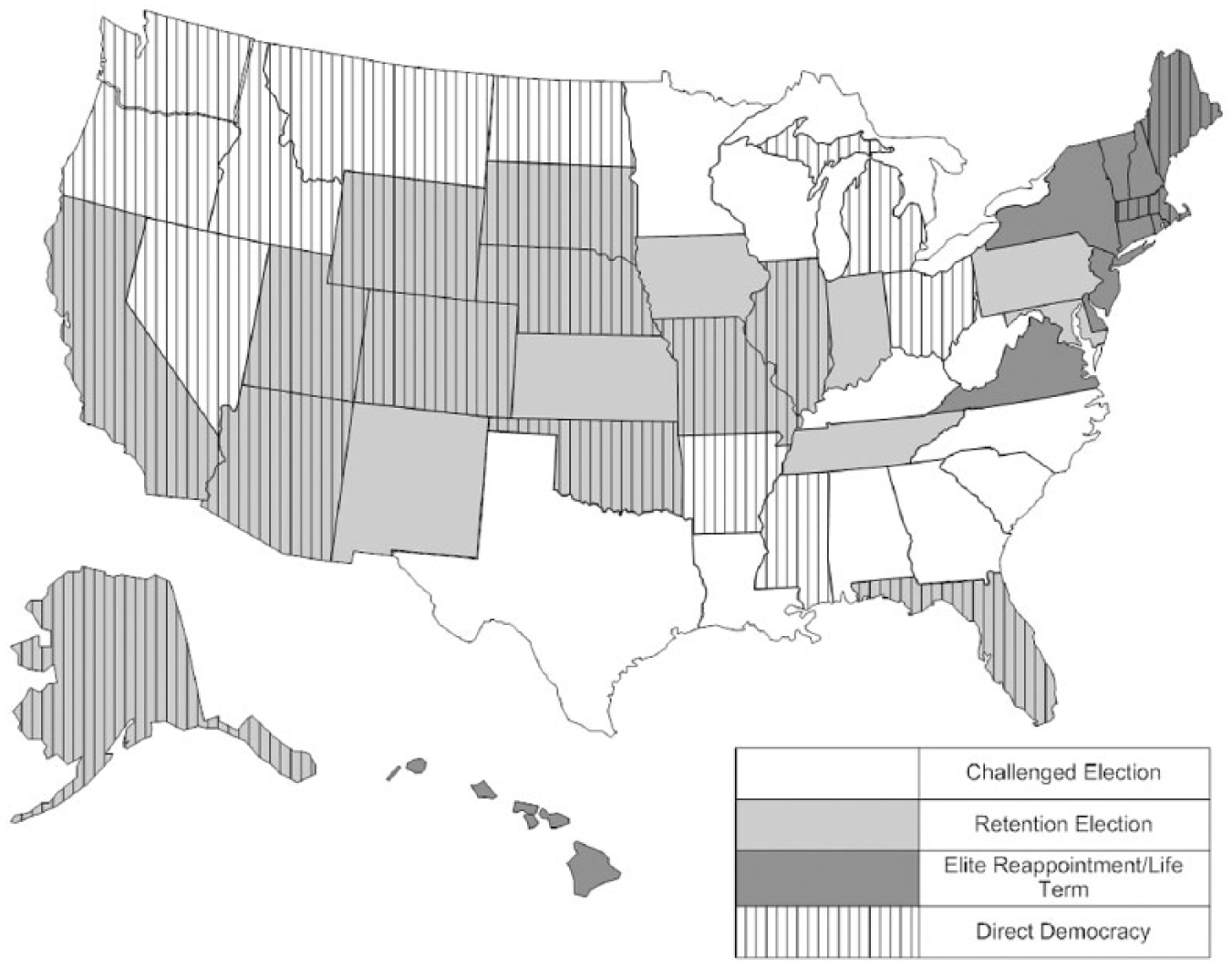
Retention methods and direct democracy institutions.
Direct Democracy, Courts and Minority Rights
The question of whether direct democracy enhances the public’s influence on judicial behavior is particularly important for minority rights issues. One of the primary criticisms of direct democracy is the propensity of these institutions to restrict minority rights (e.g., Gamble 1997). This criticism is evident in the Federalist Papers, where Madison, Hamilton, and Jay argue against the dangers of pure democracy due to its susceptibility to “ruling passions” in the form of majority factions (Madison [1787] 1999). Several contemporary empirical studies have confirmed this concern about “tyranny of the majority,” showing that direct democracy states have a higher propensity to adopt policies that restrict minority rights, regardless of how they are passed (Haider-Markel, Querze, and Lindaman 2007; Lewis 2011a; 2011b; 2013; Preuhs 2005; Schildkraut 2001). Indeed, the signaling power of ballot initiative campaigns may extend to the public itself, further stigmatizing attitudes toward minority groups beyond the specific issue on the ballot (Donovan and Tolbert 2013).
The framers preferred a representative system that could provide filtering mechanisms that would “refine” and “enlarge” public preferences through deliberation and cooperation inherent in the legislative process (Madison [1787] 1999). Separation of powers also provided an additional filter on the passions of the people; in the event that popular opinion was able to overwhelm the legislative process, the other branches of government could intervene. In this sense, the judicial branch serves as a safety net to guard against a majority ruling at the expense of the rights of minority groups. Through judicial review, courts can theoretically act in a counter-majoritarian manner to overturn policies that may infringe upon the rights of minority groups (Eule 1990; Miller 2009). Thus, the judicial “safety net” argument assumes that judges can act independently of public opinion in direct democracy states and are at least equally as likely to vote to protect minority rights as judges in other states.
However, following the discussion in the previous sections, it is not clear that judges are actually able to ignore public opinion and serve this counter-majoritarian role. In enhancing policy responsiveness to public opinion, direct democracy institutions may also be endangering the rights of minority groups—particularly in cases where the majority of the public holds anti-minority preferences (Lewis 2013). If the decisions of state judges are also affected by direct democracy institutions in a similar manner, then the “safety net” role of courts may be undermined. In sum, we expect that electoral retention methods and direct democracy institutions enhance the effect of public opinion on judicial decision making. In the context of minority rights issues, this may reduce the probability of judges voting in favor of minority groups.
Furthermore, this first hypothesis is driven by the expected conditional effect of public opinion across direct democracy institutions and judicial retention methods in the states:
Empirical Evaluation: Gay Rights Cases, 1981–2004
To test these hypotheses, our analyses focus on judicial decisions regarding gay rights from 1981 to 2004. These cases are particularly appropriate for this study because the extant literature has consistently shown evidence that the rights of the lesbian, gay, bisexual, and transgender (LGBT) community have been significantly affected by direct democracy institutions (Haider-Markel, Querze, and Lindaman 2007; Lewis 2011a; 2011b; 2013). Also, this time period coincides with significant developments in a wide variety of state policies related to LGBT rights (Haider-Markel and Meier 1996; Lupia et al. 2010; Pinello 2003; Taylor et al. 2012). As such, gay rights policies are well-suited for our purposes because they constitute a publicly salient issue that has been shaped by direct democracy and significantly affect the rights of a marginalized political minority group.
The dataset consists of all gay rights decisions made by state supreme courts from 1981 to 2004. The cases from 1990 to 2000 were initially identified by Pinello (2003). Using identical search terminology, we augmented the case list to include cases from 1981 to 2004. The legal issues in these 122 cases include discrimination with regard to family issues (child custody, visitation, adoption, and foster-care), employment, government benefits (domestic partner benefits and same-sex marriage), and the constitutionality of criminal sodomy prohibitions (see Table 1). In addition, we included several “miscellaneous” cases that centered on the role of sexual orientation in the law but do not fit cleanly into any of the categories discussed above. For example, in Gay & Lesbian Law Students Assn v. Board of Trustees (1996), a student group sought an injunction to prevent U.S. military organizations from recruiting on campus because of the military’s prohibition against gays and lesbians serving openly in the military. Cases where the sexual orientation of the parties was not the justification for discrimination or was merely tangential to the cases were not included in this analysis. Of the 122 cases, 72 had pro-gay voting majorities. In all, the dataset includes a wide variety of gay rights cases from 41 states (nearly evenly split between direct democracy and nondirect democracy states), litigated by gay rights advocates, conservative groups, and individuals. 2
Votes by Policy Issue.

After examining each case opinion, the votes of each individual justice were classified according to whether he or she voted to extend equal treatment to the group claiming discrimination or to remove the legal distinction that denied equal treatment. When the case syllabus did not explicitly list each individual justice participating, a reference list of justices serving on a court was consulted (Langer 2006). This dichotomous indicator of a judge’s vote on gay rights cases is used as the dependent variable for our analyses. The observations were pooled from a number of cases, and individual justices appear in the dataset multiple times for a total of 728 observations.
The primary explanatory variables measure electoral institutions and public opinion. First, as seen in Figure 1, twenty-four states are considered to be direct democracy states that allow citizens to initiate new policy proposals through direct initiatives, indirect initiatives, and/or popular referenda (Bowler and Donovan 2004). However, the arrangements of these direct democracy institutions vary quite a bit across the states. Some states, such as California and Oregon, allow for relatively easy access to the ballot, have few restrictions on content and legislative review, and consequently use direct democracy more often. Other states, like Mississippi and Wyoming, have much more restricted institutional arrangements and only use direct democracy sparingly. Research suggests that direct democracy has a larger impact in states with relatively easy qualification requirements, few content restrictions, little legislative review, and high use (Bowler and Donovan 2004; Pippen, Bowler, and Donovan 2002).
To account for variation among direct democracy states, we supplement the use of a simple dichotomous indicator of direct democracy institutions with a measure of direct democracy impact constructed using principle components analysis based on three commonly used measures of direct democracy: the legislative insulation and qualification difficulty indices developed by Bowler and Donovan (2004) and the number of ballot measures considered in a state each year. 3 The principle components analysis produces a single component that accounts for nearly 95% of the variance of these three measures of direct democracy institutions. As used in this study, the resultant direct democracy impact score ranges from zero for nondirect democracy states to nearly five for California (Lewis 2013). The average score for direct democracy states is just over three. Table 2 shows the direct democracy impact score generated from the principle components analysis, along with its three component measures of direct democracy. Again, higher scores indicate that direct democracy should have more of an impact on policy outcomes and the behavior of government officials. We expect that judges in high impact direct democracy states will be least likely to vote in favor of gay rights.
Measures of Direct Democracy.

Note. States not included here do not allow direct initiatives, indirect initiatives, or popular referenda, and have a direct democracy impact score of zero.
Based on Bowler and Donovan’s (2004) measures—higher scores indicate less insulation and less qualification difficulty (i.e. fewer restrictions on direct democracy).
Our second electoral variable gauges the judicial retention methods that states employ. We categorize the states into three retention types: challengeable elections, retention elections, and elite reappointment/life-like terms (see Figure 1). Challengeable elections include both partisan and nonpartisan elections that allow for incumbent judges to be opposed by challengers. 4 In states with retention elections, judges do not face a challenger but do face the voters. In our final category, we include those states that have life-like terms and those in which elite political actors may reappoint judges to set terms.
Along with the electoral institutions, our arguments also hinge upon public preferences on gay rights issues. This presents at least two challenges. First, since we analyze several different types of gay rights cases, we need to gauge public attitudes toward gay rights, broadly defined. The General Social Survey (GSS) provides a good option for our analyses, asking respondents biennially between 1980 and 2010 whether homosexual sex is always, sometimes, or never wrong. Second, since the cases extend over three decades, we need to measure public opinion at the state level in a way that allows for change. We estimate state-level public attitudes toward homosexuality in a given year with a multilevel regression and post-stratification (MRP) technique (Lax and Phillips 2009a; 2009b; 2012; Park, Gelman, and Bafumi 2004; 2006). 5 As in recent studies that have extended this approach to allow for dynamic estimates, which is particularly important for issue-specific attitudes that vary significantly over time (Enns & Koch 2013; Pacheco 2011; 2012), we then repeat the procedure for each year of GSS data.
Using the MRP approach, we estimated the percentage of the public in each state that answered “never wrong” in each year. 6 The resultant measure ranges from 1.12% (Utah in 1984) to 55.9% (Massachusetts in 2002) and has an average of just 21.38% (see Figure 2). Unsurprisingly, these measures show very little public acceptance of homosexuality and gay rights during this time period, even among states that tend to be the most liberal across other issue areas. For example, acceptance of homosexuality in Massachusetts, typically a leader in gay rights, does not reach majority levels during this time period. Indeed, only six states reached more than 50%, and these levels of acceptance were not seen until 2001. At the same time, the measure reveals a significant shift in public attitudes toward homosexuality in the state over time, states increasing acceptance of homosexuality by roughly 20 to 55 percentage points from 1980 to 2010. Note that higher estimates of acceptance of homosexuality are not strongly correlated with the direct democracy institutions (r = .119), challenged judicial elections (r = −.107), or judicial retention elections (r = −.209).
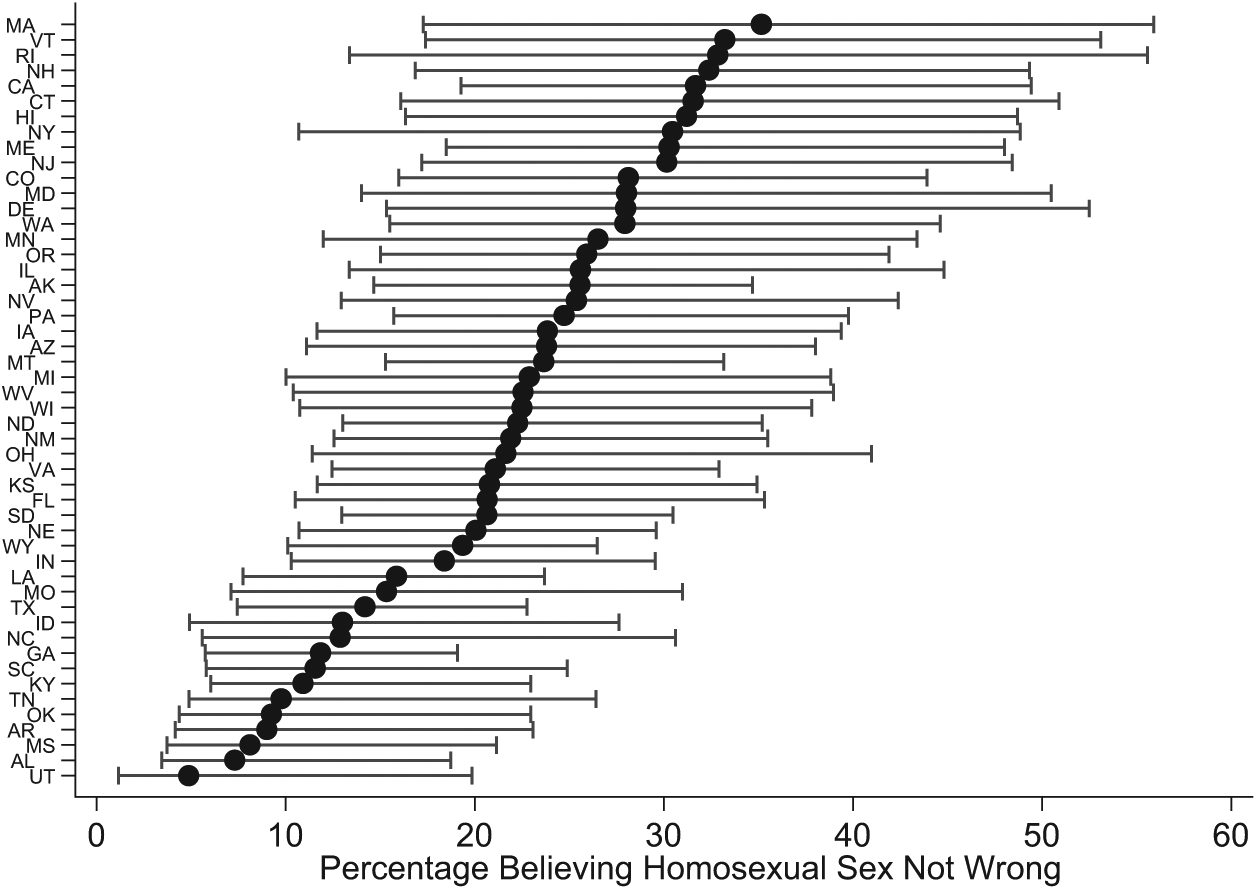
Mean and range of estimates of state attitudes toward homosexuality, 1981–2004.
In addition, the models also account for several other factors that may influence judicial decision making. We control for the political conditions in the states, including governmental ideology, party competition, and the existing legal environment as it pertains to gay rights. 7 Berry et al.’s (1998) measure of state government ideology is used to address the interdependence of the judicial branch with the legislative and executive branches. This variable should control for the preferences of the other branches that would be charged with implementing or enforcing judicial decisions. We expect judges in states with more liberal governments to be more likely to cast a pro-gay rights vote.
Prior scholarship on state high courts has found that justices in politically competitive environments are more likely to vote in a conservative manner (Brace and Hall 1997; Hall and Brace 1992). In states where there is greater competition between the two parties, we expect that a justice would be more likely to vote to uphold the discriminatory regulation so as to not create a potentially controversial vote. The level of political competition in a state is measured with a folded Ranney Index calculated at various points from 1981 to 2004 (Gray and Hanson 2004; 2008; Gray, Hanson, and Jacob 1990; Gray and Jacob 1996; Gray, Jacob, and Albritton 1999; Ranney 1976).
The analyses account for the existing legal environment in the state by including indicator variables for the presence of nondiscrimination laws that include sexual orientation and constitutional privacy clauses. These policies should provide a more protective legal environment for homosexuals, so judges are likely to be more constrained by the law to vote in favor of gay rights. 8
The models also control for the structural variation in judicial systems across the states by including an indicator of the presence of an intermediate appellate court in the state’s judicial system. A high court that does not have an intermediate appellate court acting as a filter will hear cases that are less controversial or more routine (Canon and Jaros 1970). Previous research on judicial decision making behavior has found that dissent rates are higher in those states with intermediate-level appellate courts between themselves and trial courts (Canon and Jaros 1970; Hall and Brace 1989).
In addition to these state-level political and institutional characteristics, it is also necessary to account for the individual preferences of the judges casting these votes. A long tradition of public law scholarship on the Supreme Court of the United States concludes that the attitudes of individual justices play an important role in their decision-making process (Pritchett 1948; Rohde and Spaeth 1976; Schubert 1965). Scholars have also found evidence of this attitudinal model operating on the U.S. Court of Appeals (Songer, Segal, and Cameron 1994) and, most importantly, for our study, on state supreme courts (Brace, Hall, and Langer 2000). Thus, we account for the individual justice’s attitudes using party-adjusted judge’s ideology (PAJID) scores (Brace, Hall, and Langer 2000; Langer 2006). Justices who are more liberal in their ideology should be more likely to vote to overturn a distinction based on sexual orientation.
Finally, the analyses include a series of variables designed to account for the specific details of the cases. The first is a count of the number of amicus curiae briefs—which allow outside parties to provide the court with their positions on the legal issues and provide an avenue for interest groups to demonstrate the significance of the case beyond the immediate litigants—filed for each case (Caldeira and Wright 1988; Comparato 2003). The analyses also account for whether one of the litigants was a homosexual. 9 This variable attempts to assess how directly the case affects gay rights. With a homosexual litigant, it should be clear exactly how homosexual individuals may benefit or be harmed by the courts decision. Thus, we expect judges to be more sympathetic to gay rights in these types of cases. Last, a set of variables indicating the policy issue involved in the case was also included to control for differences across the different policies under review (Epstein and Mershon 1996; Link 1995). We grouped the cases into six categories: same-sex marriage, sodomy, denial of benefits, discrimination, child custody, and a miscellaneous reference group (see Table 1).
Results
With a dichotomous dependent variable, we estimated a series of logistic regressions predicting judicial vote choice. Since many of the judges appear multiple times in our data, we cluster the robust standard errors by judge. 10 We begin our analysis with two relatively simply specified models, without any interaction terms, that provide an initial test of Hypothesis 1. We then introduce interactions between direct democracy institutions, retention methods, and public opinion to better test Hypotheses 2 and 3.
The results of our first two models are presented in Table 3. In this specification, we expect the direct democracy variables to have a negative coefficient. Indeed, the results show that judges in direct democracy states are significantly less likely to vote in favor of gay rights. On average, the probability of a judge casting a vote in favor of gay rights is reduced by nearly 16% in direct democracy states. Furthermore, Model 2 shows that judges in high impact direct democracy states are even less likely to cast a pro-gay rights vote than their counterparts in lower impact direct democracy states. On average, the probability of a judge in a high impact direct democracy state (California) casting a pro-gay rights vote is 15% lower than a comparable judge in a low impact direct democracy state (Wyoming), depending on the issue involved in the case. 11 Since most of the cases occur in state-years in which the majority of the public is not tolerant of homosexuality, these results are consistent with the argument that direct democracy institutions amplify the effect of public opinion on judicial decision making.
Logit Estimates of the Probability a Pro-gay Rights Vote, 1981–2004.

Note. Robust standard errors in parentheses; N = 728.
p < .1. *p < .05. **p < .01; p values from one-tailed tests where appropriate; two-tailed tests otherwise.
Although the results from Models 1 and 2 support our argument, a more direct test focuses on the effects of public opinion across the various arrangements of electoral institutions in the states. To this end, we estimate two models that include interaction terms between public opinion and the direct democracy variables, as well as interactions between public opinion and the retention method variables. Again, we expect these institutions to enhance the effect of public opinion on judicial voting in gay rights cases. The results from these models are shown in Table 4. Given the multiple interactions, interpretation of the effect of public opinion requires combining several coefficients. For example, the effect of public opinion for judges in direct democracy states with life-like terms of office is estimated as the combination of the public opinion coefficient and the coefficient for the interaction between direct democracy and public opinion. For judges in direct democracy states that face challenged elections, the effect of public opinion is estimated as the combination of the public opinion coefficient, the coefficient for the interaction between direct democracy and public opinion. All of the marginal effects of public attitudes toward homosexuality on judges’ votes on gay rights cases and their associated confidence intervals are shown in Figures 3 and 4.
Logit Estimates of the Probability a Pro-gay Rights Vote with Direct Democracy, Selection Method, and Public Opinion Interactions, 1981–2004.

Note. Robust standard errors in parentheses; N = 728.
p < .1. *p < .05. **p < .01; p values from one-tailed tests where appropriate; two-tailed tests otherwise.

Marginal effect of public opinion on the probability of a pro-gay rights vote, by direct democracy (DD) and retention method (Model 3).
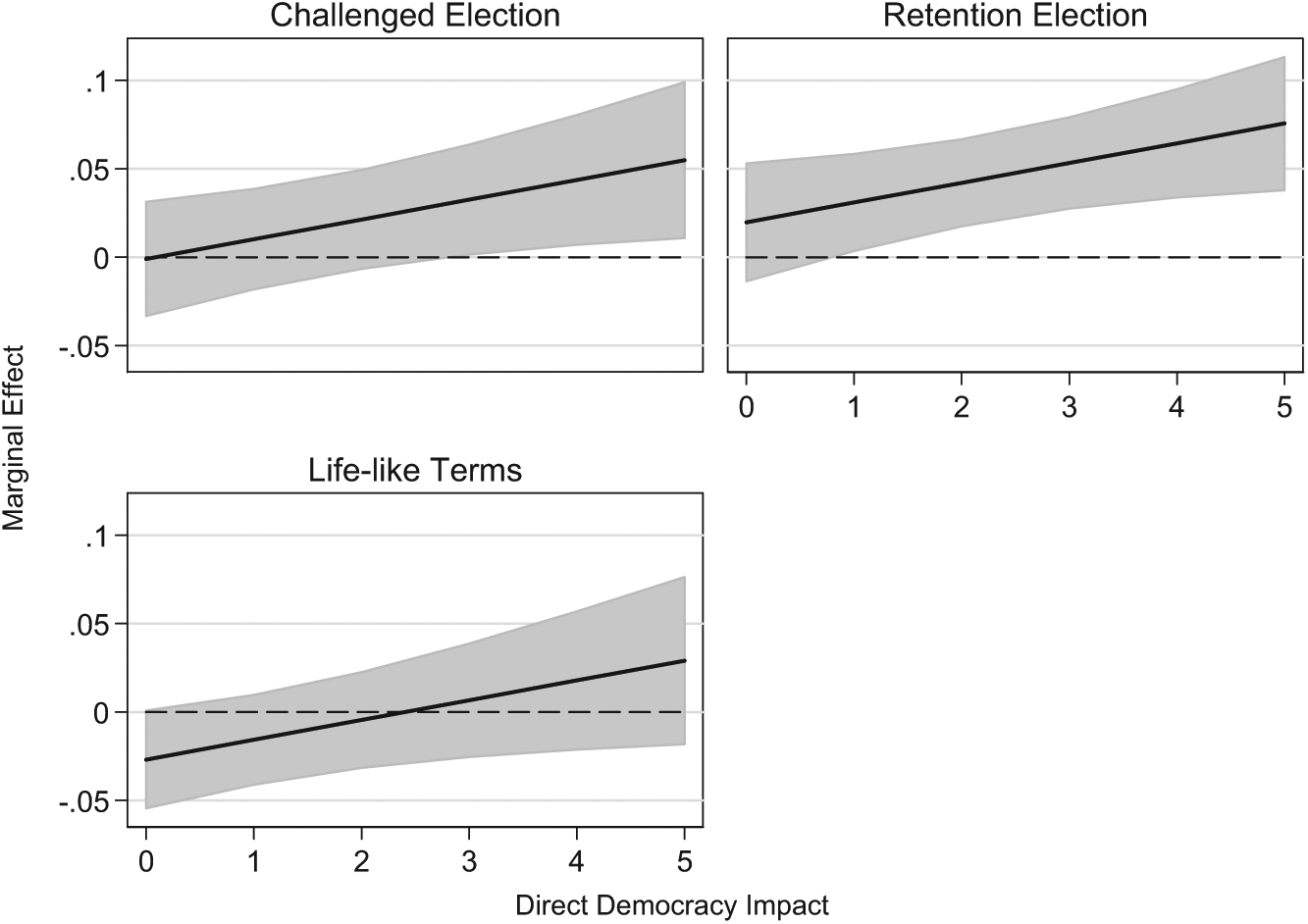
Marginal effects of public opinion on the probability of a pro-gay rights vote, by direct democracy impact score and retention method (Model 4).
Each graph reveals a consistent pattern in the effects of public opinion that reveals how the effect of public opinion changes across various combinations of electoral institutions. In states with the most insulated judiciaries (i.e., those that do not face the electorate), public opinion is not a significant factor for judges deciding gay rights cases, regardless of the presence of direct democracy institutions. In addition, the graphs show that judges who face reelection, but are not exposed to direct democracy institutions, are also not significantly affected by public opinion. Thus, in these states, judges may be able to serve the safety net role for minority groups.
However, Figure 3 shows that in states with electoral retention methods and direct democracy institutions, public opinion plays a statistically significant role in determining the votes of judges on gay rights issues. A similar pattern is produced from Model 4, where all but the most insulated direct democracy institutional arrangements, paired with judicial elections, results in a significant impact of public opinion. Importantly, the results suggest that electoral retention methods, alone, do not significantly increase the impact of public opinion. Only when they are combined with direct democracy institutions do they create a significant effect for public preferences. 12
Although this effect is clearly limited by certain institutional conditions, these conditions are met in all but 3 of the 24 direct democracy states. 13 Thus, for most direct democracy states, public opinion should be a significant factor in judicial voting. When public preferences do not align with minority groups, as is the case in most of our analyses, the presence of direct democracy significantly reduces the likelihood that judges will provide a safety net to minorities.
Conclusion
The counter-majoritarian role of the judicial branch in the United States has long been recognized as problematic for judges. These problems seem to be exacerbated in states where both direct democracy institutions and electoral retention methods are used. Not only must judges grapple with potentially overturning a policy enacted by the public’s democratically chosen representatives (and possibly a filtered version of the public will), but judges in direct democracy states must also contend with the potential of overturning policies enacted directly by the public itself or a policy that the public has signaled it prefers. By making judges accountable to the public through judicial elections and enhancing the role of the public in the policymaking process with direct democracy, the arrangement of electoral institutions in 21 states seems to make judicial decision making more responsive to public pressure.
These findings have important implications for minority rights. In particular, the argument of direct democracy advocates that the judicial branch can serve as an effective safety net for the rights of minority groups may be a suspect one under a relatively common set of institutional arrangements. The safety net argument relies on a judicial branch that carefully scrutinizes anti-minority policies or, at the very least, one that treats anti-minority polices the same as they would in nondirect democracy states. Instead, the empirical evidence regarding gay rights cases suggests that judges in direct democracy states are acting in a manner more differential to public opinion. So, while state supreme courts in direct democracy states have acted, at times, in a counter-majoritarian manner consistent with the safety net concept, our results suggest that they are less likely to do so than their counterparts in nondirect democracy states. In light of recent research showing that direct democracy states are more likely to enact anti-minority policies, such as same-sex marriage bans and official English laws, these findings further highlight the threat that direct democracy institutions can pose to minority rights.
Although the results here may have negative implications for unpopular minority groups, such as the LGBT community during the time period under investigation, it is important to note that increasing the influence of the public on policy makers (including judges) can have normatively positive outcomes as well. Our estimates of public attitudes showed a drastic shift in public attitudes toward homosexuality over time. As the public becomes more tolerant and supportive of gay rights, the effect of public opinion on judicial decision making should have a beneficial effect for the LGBT community. Indeed, recent advances in gay rights policies—from nondiscrimination laws to same-sex marriage—seem to coincide with fairly dramatic changes in public opinion on these issues (Lewis 2013).
The issue of same-sex marriage, in particular, has seen dramatic changes in both public opinion and policy recently. While Americans at both the state and local level have long opposed same-sex marriage, recent polling suggests that a majority of the public now supports marriage equality (Silver 2013). From 2008 to today, same-sex marriage has gone from being banned in nearly all the states to being legalized in 17. From this analysis, it should not be surprising that state courts have been instrumental in many of these policy changes. Indeed, the results here are consistent with the inherent tension of direct democracy institutions. When public opinion runs counter to minority rights, as is the case for the bulk of the sample analyzed here, direct democracy may present serious challenges to protecting minority rights. However, when the public is more supportive of minority groups, these same institutions may actually enhance the prospects of passing policies that protect minority rights. In other words, direct democracy can act as a double-edged sword for minority rights. These institutions not only may increase public accountability and input in the policy process, but they also create a dangerous risk associated with majoritarian systems—the restriction of minority rights.
Still, it is important to note that recent and ongoing developments in the recognition of same-sex marriage in states that tend to be less supportive of gay rights, such as Utah, Texas, and Kentucky, are being adjudicated by federal courts. Consistent with our argument, these recent victories for gay rights have been written by unelected judges that are more insulated from public opinion than many of their state counterparts. So, while the federal court may be equipped to serve as a safety net for minority groups, many state courts are less protective in the face of public pressure. And, since a vast majority of cases do not reach the federal court system, some states may be left with holes in the safety net for minority rights.
In all, the analyses presented here highlight the role of public preferences in American state courts. We find compelling evidence that electorally retained judges in direct democracy states are responsive to public opinion. As is evident from the analyses and the recent policy development in LGBT rights, this responsiveness can cut both ways. When the public is not supportive of minority rights, elected judges in direct democracy states may be hesitant to rule in favor of minority groups. But, when the public is more supportive, judicial responsiveness may provide benefits to these same groups.
Footnotes
Declaration of Conflicting Interests
The author(s) declared no potential conflicts of interest with respect to the research, authorship, and/or publication of this article.
Funding
The author(s) received no financial support for the research and/or authorship of this article.