



Abstract
Recently, many U.S. states that allow citizen initiatives have passed laws designed to make it more difficult for an initiative to qualify for the ballot (e.g., by increasing the number of signatures required to get on the ballot), thereby making it harder for citizens to bypass the legislature and make direct changes to public policy. Such laws have reduced both the number of measures that make the ballot and the number that pass on Election Day. I show that laws governing access of initiatives to the ballot also shape the policy agenda; provisions making it harder for proposals to get on the ballot decrease the complexity of the initiatives on the ballot. As less complex initiatives are more likely to be understood by voters and voters are reluctant to vote for measures they do not understand, more restrictive laws actually increase the likelihood that an initiative will pass.
Keywords
A long-standing debate in political science concerns whether election laws have an impact on public participation and policy outcomes (Leighley and Nagler 1992; 2013; Powell 2006; Rosenstone and Wolfinger 1978). This study contributes to this dialogue by investigating the influence of election laws in American states regarding one of the most hotly contested avenues for public participation in elections: direct democracy. Whereas prior works focus almost exclusively on how election laws influence voting behavior (e.g., voter registration or turnout; Burden et al. 2014; Burden and Neiheisel 2013; Hanmer 2009), I examine how these electoral instruments shape the policy agenda as well.
Nearly half of the 50 states permit citizen initiatives, which enable private groups to propose constitutional or statutory changes to state policy and have citizens vote those proposals up or down on Election Day. Many government officials have claimed—with some support from scholars—that in these states, the initiative has empowered an unqualified public to author policies that are discriminatory (Schildkraut 2001) or may financially cripple the state (Camobreco 1998; Cox 2000; McCaffery and Bowman 1978). Arguably, as a result of this criticism, since 1996, over 155 state election law changes have been made that make it more difficult for an initiative to qualify for the ballot (Cronin 1989; National Conference of State Legislatures [NCSL] 2013; Tolbert, Lowenstein, and Donovan 1998). These changes include, increasing the number of signatures required in the petitioning stage to place an initiative on the ballot, shortening the time period in which signatures must be gathered, and requiring that signatures be collected from a larger share of intrastate political jurisdictions.
There is evidence in the literature that these election law changes have had their intended effect; in states that allow initiatives, as a state makes it more difficult to place an initiative on the ballot, fewer initiatives tend to make the ballot and pass on Election Day (Banducci 1998; Boehmke 2005; Magelby 1984). Yet restrictions that make it more difficult to qualify an initiative for the ballot should affect more than just the number of measures that get on the ballot and the number that pass. I contend that election laws governing the ballot access of initiatives shape the policy agenda of a state by influencing the complexity of initiatives making the ballot.
Complexity refers to how difficult it is for a typical voter to understand the issue content (i.e., the proposal components and policy implications) of a ballot measure. The two poles of complexity, “easy” and “hard,” are drawn from Carmines and Stimson’s (1980) issue typology. Hard initiatives (e.g., those about tort reform or medical malpractice) involve issues that (1) have low ideological content, (2) have technical subject matter, and (3) relate to policy means rather than ends. Easy initiatives (e.g., those about abortion or same-sex marriage) involve issues that (1) have high ideological content, (2) are symbolic rather than technical, and (3) relate to policy ends (Carmines and Stimson 1980; Jacoby 1995). Thus, hard initiatives tend to involve complex ballot language, be difficult for voters to understand, and require voters to possess substantial policy-specific information to arrive at a decision on the desirability of the proposal. In contrast, easy initiatives generally involve simpler ballot language, are more readily understood (Alvarez 1997), and do not require voters to undertake an extensive information search (Alvarez and Brehm 2002; Lau and Redlawsk 2006).
I contend that as a state’s laws make it more difficult for initiatives to make the ballot, the initiatives that do get on the ballot will tend to have lower complexity—an assertion I call the Election Law Restrictiveness–Initiative Complexity Hypothesis. This happens partly because citizen groups—which can better overcome state-imposed obstacles to placing proposals on the ballot than economic groups—tend to sponsor easy initiatives (Gerber 1999), while economic groups tend to sponsor hard initiatives (Gray and Lowery 1996). Moreover, voters are reluctant to sign a petition supporting an initiative they cannot understand, making it so that when there are very demanding requirements about the signatures collected, any hard initiative that is sponsored has a tough time meeting the stringent requirements. Using data on all statewide initiatives that made the ballot between 1996 and 2011, I find strong support for this hypothesis.
I also consider the implications of a set of ballot initiatives skewed toward easy measures. Extant literature finds that many voters respond negatively to complex ballot language and opt to reject confusing ballot initiatives on Election Day (Bowler and Donovan 1998; Reilly and Richey 2011). This suggests the hypothesis that as the initiatives on a state’s ballot become less complex—and as a consequence involve simpler ballot language that voters find less confusing—initiatives become more likely to pass. I test this hypothesis—which I call the Initiative Complexity–Passage Hypothesis—as well, and find empirical support.
Ultimately, the results of this article imply that restrictiveness in the laws governing initiative ballot access has an indirect positive effect on initiative passage; greater restrictiveness makes it so that the proposals that get on the ballot tend to be less complex, which in turn, makes them more likely to pass. Thus, while greater election law restrictiveness reduces both the number of measures that get on the ballot and the number of measures that pass—consistent with the goals of advocates of greater restrictiveness—such restrictiveness actually increases the chances that those measures that do achieve ballot status will pass, a result likely unanticipated by these advocates.
Election Law Restrictiveness and Initiative Complexity
A total of 24 American states allow citizen initiatives. In these states, a group interested in placing an initiative on the ballot must file a proposal under a group or “committee” name. Then, in what is referred to as the petitioning or circulation stage, the sponsoring committee must mobilize public support for the proposal and collect signatures of voters who favor placing the proposal on the ballot (NCSL 2002). All states allowing initiatives establish some minimum number of signatures required for an initiative to get on the ballot, and some states specify a time period within which signatures must be gathered and/or a requirement on how the signatures must be distributed across the state. The variation in state election laws means that some states make it much more difficult for a proposed initiative to make the ballot than others. 1
I argue that state-imposed restrictions on the ballot qualification process shape both the types of interest groups that successfully sponsor ballot measures and the composition of the initiatives that make the ballot, producing a set of initiatives with low complexity. When a state requires more signatures for a measure to get on the ballot, or requires the signatures to be collected from a greater share of intrastate political jurisdictions or in a shorter amount of time, a group sponsoring a ballot measure requires more resources to get the measure on the ballot. As collecting signatures is a highly labor-intensive activity (NCSL 2010), access to individuals willing to collect signatures is an especially valuable resource for this purpose. The greater demand for labor resources resulting from highly restrictive election laws affects citizen groups and economic groups differently. 2 Citizen groups tend to have more members than economic groups and greater access to support networks at the grassroots level that can organize highly motivated volunteers to collect signatures, a strategy that is conceivably more effective in persuading voters to sign a petition than simply relying on hired hands that are not necessarily as invested in the policy (Gerber 1999; Gray and Lowery 1996; NCSL 2010). Furthermore, the economic groups that do use “outsider” strategies of influence—such as the initiative process—tend not to be the most lavishly funded of the economic groups; economic groups that are well endowed financially tend to direct their political activity toward influencing formal political institutions such as the state legislature, where money is a highly effective resource (Hall and Wayman 1990; Hojnacki and Kimball 1998). Thus, when there are highly restrictive election laws governing the ballot qualification process, citizen groups tend to be better equipped with the resources necessary to undertake a successful initiative sponsorship campaign than economic groups. This implies that greater election law restrictiveness increases the success of citizen groups (relative to economic groups) in placing initiatives on the ballot.
What are the implications of greater success by citizen groups in getting initiatives on the ballot? As citizen groups (relative to economic groups) become more successful, the composition of ballot initiatives changes, yielding a set of initiatives that tends to be less complex. This is because citizen groups tend to sponsor easy initiatives (Gerber 1999), whereas economic groups tend to sponsor hard initiatives (Gray and Lowery 1996). 3 Taking into account the anticipated causes and consequences of the success of citizen groups (relative to economic groups) in placing initiatives on the ballot, I am hypothesizing that election law restrictiveness has a positive effect on the relative success of citizen groups in getting initiatives on the ballot, which in turn has a negative effect on the complexity of ballot initiatives.
But election law restrictiveness has a second path of influence on the complexity of the initiatives making the ballot—one that relates to the willingness of interest groups to sponsor an initiative in the face of heightened ballot access restrictions. Groups have limited resources and seek to expend those resources wisely (Gerber 1999; Gray and Lowery 1996). Thus, in deciding whether to sponsor an initiative, groups assess the extent to which their investment of time and money will pay off. In other words, is their initiative likely to pass if it is able to make the ballot? To effectively manage their resources, groups must balance the costs of sponsorship with the probability of success (i.e., of obtaining their policy goal). Thus, as ballot access laws become increasingly restrictive, and the costs of sponsoring an initiative increase, groups will need to be relatively more confident that their initiative can pass.
Prior works have found that technically complex proposals are less likely to be approved on Election Day than measures pertaining to easy issues (Bowler and Donovan 1998; Reilly and Richey 2011). That is, many voters appear to penalize technical or confusing initiatives by automatically voting “no” (Reilly 2010). Thus, as sponsorship costs increase, the initiative process becomes a less desirable avenue of policy influence for technically complex proposals, which tend to pass at lower rates than easy initiatives. The end result, I argue, is that in states where qualifying a ballot measure is relatively costly, initiatives will, on average, be less complex than in states that do little to restrict ballot access. 4
To summarize, my underlying causal model assumes two routes of influence of election law restrictiveness on the complexity of ballot initiatives, as depicted in Figure 1. Restrictiveness is presumed to have an indirect negative effect on the complexity of initiatives making the ballot by increasing the success of citizen groups (relative to economic groups) in getting the initiatives they sponsor—which tend to be easy—on the ballot, and a direct negative effect on the complexity of ballot initiatives due to the reluctance of groups to incur the heightened costs of sponsorship unless they believe that there is a high probability of passage for their initiative. Unfortunately, data constraints preclude observing for each state-year the type of group (citizen or economic) sponsoring each initiative on the ballot.
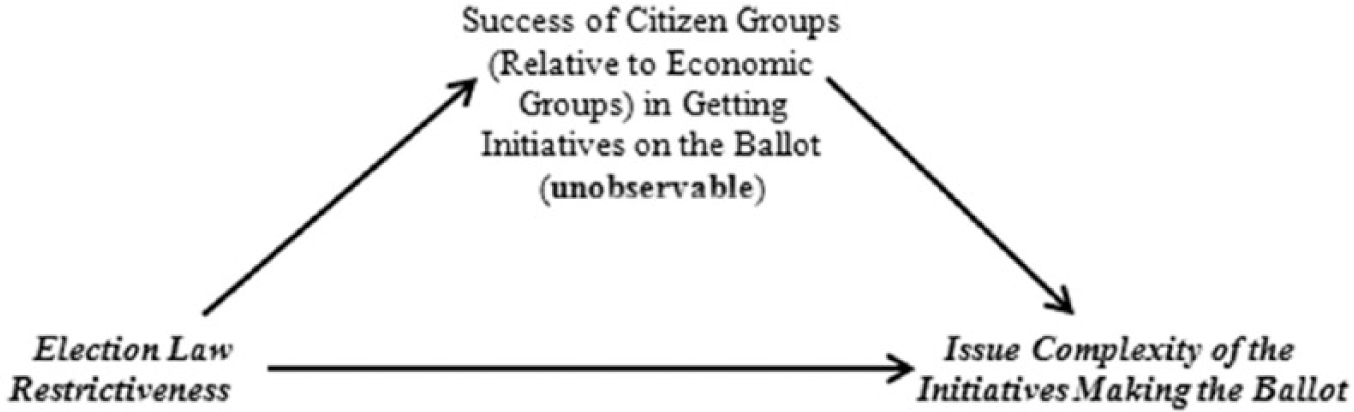
The influence of election law restrictiveness on initiative complexity.
Initiative sponsors will often cloak their identity under an appealing committee name (e.g., Citizens for a Brighter Future). It is only by researching contextual information such as local editorials or media coverage that one can uncover the true identity of sponsors. Identifying a sponsor requires that (1) there is public discourse on an initiative that outs the interest(s) at work (rather than simply arguing over policy pros and cons), (2) this discourse is covered by local media, and (3) this coverage is available through online records; requisites that are challenging, if not impossible, to meet for initiatives that occurred prior to the mid-2000s, particularly for nonsalient proposals. This prevents me from testing the expectation that election law restrictiveness increases the success of citizen groups (relative to economic groups) in placing initiatives on the ballot, or the expectation that the relative success of the two groups in placing initiatives on the ballot affects the complexity of initiatives on the ballot. 5 However, I can offer a testable hypothesis about the total effect of election law restrictiveness on the complexity of initiatives making the ballot:
Measuring Election Law Restrictiveness
In the states that allow initiatives, there are a myriad of election laws that govern the initiative petitioning process, many of which are unique to individual states. However, three types of restrictions appear in almost all initiative states. By far, the most common way states restrict the initiative process—done by all states that allow initiatives—is to set a minimum share of residential voters from which a group sponsoring a proposal must collect signatures for the proposal to get on the ballot. Signature requirements vary considerably between the states. Most states use voter turnout during the most recent gubernatorial election as a baseline for calculating a signature requirement (e.g., 6% of total votes cast in the last state election), while others use presidential election turnout (e.g., Florida) or even residential state population (e.g., North Dakota). To make these signature requirements comparable across all initiative states, I convert each requirement into a raw number of signatures needed for each year and divide this number by a state’s voting age population (multiplied by 100). The resulting quotient represents the percentage of potential state voters whose signatures are required to place an initiative on the ballot—to be denoted % Signatures Required. 6 This variable averages 3.45 across the state-years in my sample, but ranges from 1.27 to 8.19.
The second most common election law governing the initiative petitioning process specifies a time constraint on collecting required signatures. For states that impose a time constraint, the window for collecting signatures ranges from 2 to 48 months (NCSL 2009). I linearly transform the number of months—mapping 48 months into a score of 2, and 2 months into a score of 48—to create a variable, Time Constraint, in which a larger value indicates a more stringent burden on the petitioning process. The three states that impose no time constraint (Arkansas, Ohio, and Utah) are assigned a value of zero. 7
Finally, about half the states that allow initiatives have a required geographic distribution for collected signatures to prevent a small number of heavily populated areas from dominating the initiative process. States with such a restriction specify the minimum number or percentage of political jurisdictions from which at least one signature must be collected, where the specified jurisdiction is a (1) county (e.g., Nebraska), (2) congressional district (e.g., Florida), or (3) state house district (e.g., Alaska). For states that impose a county distribution requirement, the average percentage required is 46 (with the largest being 100—Nevada in 2008). For states with a congressional or state legislative district requirement, the mean percentage required is 75 or 66, with maximum values of 100 or 90, respectively. I construct an indicator of election law restrictiveness—denoted % Jurisdictions Required—that equals (1) the minimum percentage of political jurisdictions in a state in which at least one signature must be collected when state law specifies a minimum, and (2) zero when a state has no distribution requirement. 8
It should be noted that prior works have proposed an alternative measurement for ballot access difficulty. Bowler and Donovan (2004) use an additive index to represent the difficulty in ballot qualification for initiatives. The index has three primary components: whether there is a time constraint on collecting signatures, whether a geographic distribution of signatures is required, and whether the percentage of voter signatures required for qualification is “low” (i.e., less than 7% of votes cast in the most recent election), “moderately high” (i.e., between 7% and 10%), or “high” (i.e., greater than 10%). In this study, I separate Bowler and Donovan’s index into its original component parts because the collapsing of these election laws into dummy variables (denoting whether a restriction is present) masks substantial variation among those states where there are restrictions in place. For instance, both Oklahoma and Florida limit the time allowed for the collection of signatures. In Oklahoma, sponsors have a mere 90 days to collect the required signatures, whereas Florida allows up to 4 years before signatures expire and must be recollected. Similarly, about 90% of the 384 state-years in this study have a “low” (i.e., less than 7% of turnout) signature requirement. However, between 1996 and 2011, % Signatures Required has a standard deviation of 1.583. Thus, the difference between a signature requirement of 1.270 (the minimum value in the “low” category) and 6.735 (the maximum value in the “low” category) is over 3.5 standard deviations. 9
Measuring the Complexity of the Initiatives Making a State’s Ballot
Carmines and Stimson’s (1980) issue typology is binary; issues are considered “easy” or “hard.” In reality, however, there are varying degrees of complexity for initiatives. For example, although all initiatives relating to industrial and professional regulation pose hard issues, some such initiatives (e.g., those concerning medical malpractice or tort reform) should be more difficult for the public to understand than others (e.g., those that call for improvements in public transportation). In short, it is useful, both theoretically and empirically, to treat the complexity of an initiative as a continuous rather than a binary variable. Thus, to measure the complexity of a state’s ballot initiatives, I construct three continuous indicators of technical complexity, and use them to observe the complexity of each initiative on the ballot in a state-year.
In each state that permits initiatives, a state agency is required to compose a summary of each initiative on the ballot that includes its (1) policy goals, (2) fiscal impact, and (3) timeline for implementation (NCSL 2009). These state agency (SA) summaries have no minimum or maximum word count, and appear alongside an initiative’s title in publicly available voter information pamphlets published in each state. Note that SA summaries are distinct from the (often much shorter) summaries of initiatives that appear on ballots and/or petitions. I use these SA summaries to calculate three indicators of initiative complexity: word count, reading difficulty, and grade level.
Previous research has used “number of words” as an operational definition of complexity in a variety of contexts: party statutes (Selb 2009; Wellhofer 1972), congressional legislation (Huber, Shipan, and Pfahler 2001), and Federal Registrar policies (Kemp 1989). Mirroring this work, I use the word count of the SA summary of an initiative as an indicator of the complexity of that initiative, where number of words is assumed to be positively related to complexity. 10 Because hard initiatives concern issues that are technical and specify the means for achieving a policy goal, while easy initiatives involve symbolic issues and establish policy ends but not means, it is reasonable to presume that the former will require more words to summarize adequately than the latter. The median number of words in a SA summary across all 598 initiatives in my sample is 163; the mean is 313.
My second indicator of initiative complexity is the Flesch-Kincaid (FK) Reading Difficulty score for the SA summary—denoted Reading Difficulty. 11 Reading Difficulty reflects the total number of words within each sentence as well as the number of syllables per word (Osborne 2000). For most passages of text, a Reading Difficulty score will typically range from 0 to 100 (although, in theory, there are no upper or lower limits to the score), in which higher values denote that a passage of text will be difficult to read. A score of 40 or below indicates that the passage of text could be easily understood by individuals aged 15 and younger, whereas a score above 70 denotes that the passage is best understood by those with a college education. Initiatives that pertain to technically complex policy should, on average, have SA summaries that are more difficult to read than initiatives that relate to easy (i.e., symbolic) issues—as complex proposals will likely need to use industry-specific vernacular that voters may find confusing. The median Reading Difficulty score for all 598 initiatives in my sample is 37; the mean is 35.
The final indicator of initiative complexity is the FK Grade Level score for the SA summary—denoted Grade Level. A Grade Level score is a general indicator of the number of years of education required to understand a passage of text. For instance, a score above 12 is suggestive that a text will be relatively difficult to read for those without a high school education. Similar to Reading Difficulty, a Grade Level score incorporates information such as the total number of words per sentence as well as the average length of words within a given passage (Osborne 2000). Technically complex initiatives should have SA summaries with higher Grade Level scores than initiatives that pertain to easier, more accessible issues. The median Grade Level score for all 598 SA summaries in my sample is 13; the mean is 14.
Each of these three indicators of initiative complexity have been used in past works to judge how difficult it will be for the public to understand the policy implications of an initiative (Cronin 1989; Magelby 1984; Reilly and Richey 2011). However, a potential objection to this measurement strategy is that I do not use the full text of an initiative to assess its complexity. I believe that in gauging initiative complexity, the SA summary is preferable to the full text of the proposal. In a number of cases, the full text of an initiative consists entirely of strikethroughs of several words or sentences from existing laws or policies within the state (or may involve only intermittent word changes). Technically speaking, the word count (or grade level score) for the full text of these initiatives is low; yet, a low indicator score, here, is not necessarily a telltale sign of an “easy” issue. 12 In contrast to the full text of the proposal, where a five-word strikethrough would yield considerable measurement error for each of my three indicators of complexity, the state agency summaries published in the voter information pamphlets are, informally, “as long as they need to be” to summarize the policy goals and implications of ballot measures. Even if the full text of a proposal involves one or more strikethroughs (or is limited to one or two sentences’ worth of revisions to an existing policy), the state agency summary will remind voters of the underlying issues at hand and will explain the policy outcomes that are at stake. SA summaries briefly explain the current state of a policy and how the proposed change would impact that policy. By using the SA summary, I believe that each of the three complexity indicators avoids the potential pitfalls associated with using the full text of a proposal.
An important concern, however, with each of the three indicators of initiative complexity is that SA summaries written in different states and different years are composed by different individuals who may have different writing styles and different interpretations of the required content of a summary. This may lead to differences in word counts, readability, and grade level across state-years that have nothing to do with differences in the complexity of initiatives. If the resulting measurement errors were systematic, the validity of the measures would be threatened.
To assess the validity of my measures, I randomly chose one year from the 1996–2011 period of analysis: 2000. For each of the 76 initiatives on the ballot in any state in this year, I read the full text of its ballot and SA summaries. Relying on this information, I content-coded each initiative as “easy” or “hard” based on my understanding of Carmines and Stimson’s definitions of these terms. 13 I then compared values for initiatives on the three indicators of complexity with my coding of the initiatives as “easy” or “hard.”
Whereas the 21 initiatives I coded as “easy” had SA summaries averaging 138 words (standard deviation = 19), the 55 initiatives I coded as “hard” had SA summaries averaging 395 words (standard deviation = 316). This 257 (= 395 − 138) word difference in means is statistically significant in the expected direction (t = 3.68). Similarly, among those initiatives hand-coded as “easy,” the average Reading Difficulty score is approximately 5.67 points lower than “hard” initiatives (t = 1.58), and the average Grade Level score for “easy” initiatives is 1.63 grade levels lower than initiatives hand-coded as “hard” (t = 1.77).
Figure 2 provides more detail by plotting the three complexity indicators for each of the 76 initiatives. Each initiative I coded as easy is represented by an “E”; initiatives coded as hard are denoted “H.” Although Word Count, Reading Difficulty, and Grade Level do not discriminate perfectly between initiatives coded as “easy” and those scored “hard” (as not every “E” is to the left of every “H”), there is a strong relationship between the complexity indicators and the hand-coded scores—particularly with word count, as only two initiatives coded as “easy” have SA summaries with more than 250 words.
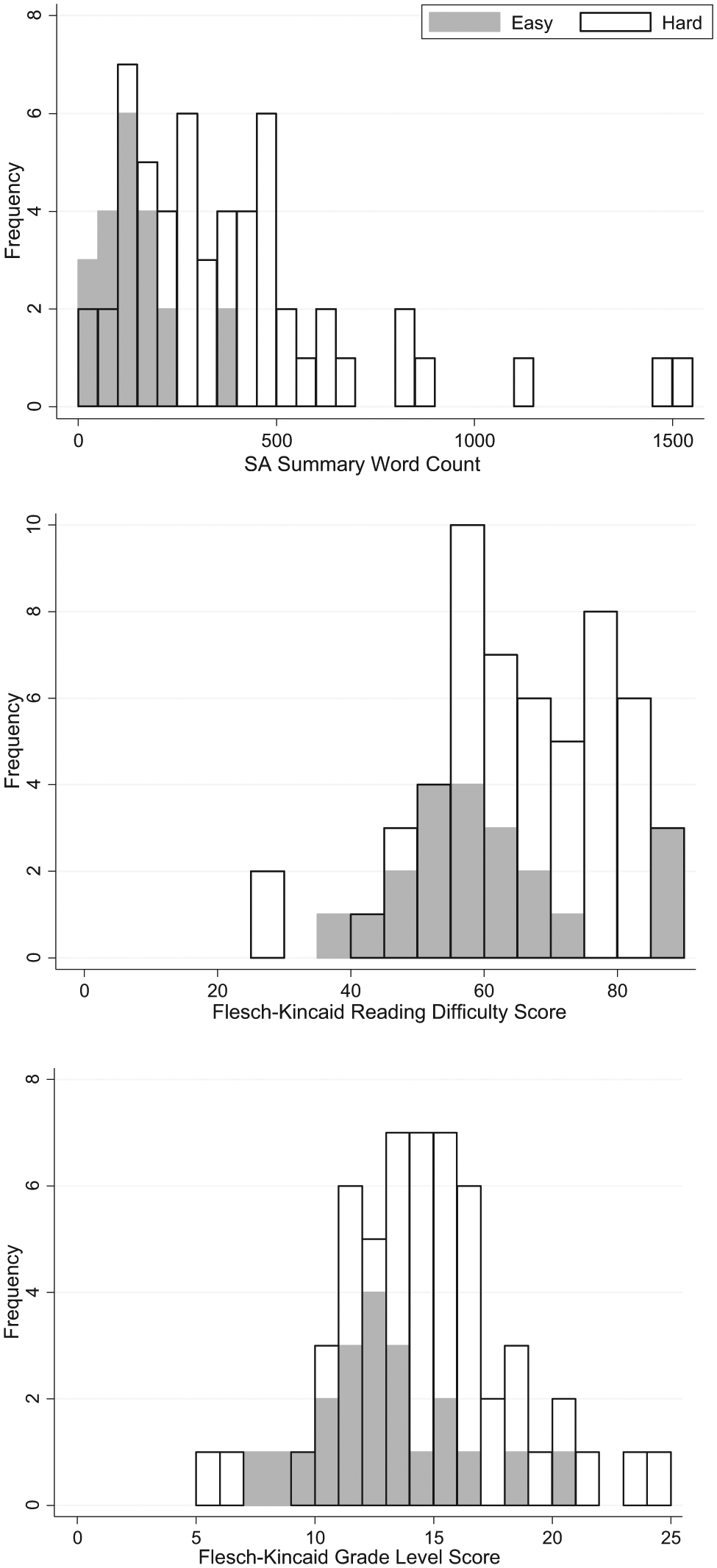
Examining the validity of three indicators of initiative complexity.
Empirical Analysis of the Effect of Election Law Restrictiveness on Initiative Complexity
My goal is to test the hypothesis that the restrictiveness of election laws governing the access of initiatives to the ballot has an inverse effect on the complexity of the initiatives that make the ballot. Thus, the dependent variable is the complexity of the initiatives making the statewide ballot as measured by three empirical indicators; calculated by observing for each initiative’s SA summary: the number of words, the FK Reading Difficulty score, and the FK Grade Level score. The key explanatory variables are the three measures of the restrictiveness of election laws governing the access of initiatives to the ballot: % Signatures Required, % Jurisdictions Required, and Time Constraint. I used a fixed-effects ordinary least squares (OLS) regression to estimate each of the three models (one model for each indicator of initiative complexity), controlling for both state and year. 14
I also include a variety of variables that have been proposed in prior work as determinants of initiative use in the states. Each is listed below along with the direction of the expected effect of the variable on initiative complexity. 15 Several of the variables relate to state institutional characteristics:
Legislative Professionalism (−) (Banducci 1998): measured by the Squire (2007) index, which ranges from 0 to 1, with higher values denoting greater professionalism. States with professional legislatures may be better equipped with the resources and policy expertise to handle complex policy problems that arise; that is, there may be less need to resolve “tough issues” outside the legislature via the initiative process.
Divided Government (+) (Dubin 2007; Magelby 1984): a dummy variable coded “1” if both state legislative chambers and the governorship are not controlled by the same party and “0” otherwise. When a state government is divided, it may be difficult to resolve complicated policy problems within the state; thus, if the legislature is gridlocked and cannot push through substantive policy reform, the public may attempt to resolve these issues through direct democracy.
Citizen-Government Distance (+) (Banducci 1998): operationalized by the absolute value of the difference between a state’s government ideology score and its citizen ideology score (both as measured by Berry et al. 1998). When the policy preferences of the state government and public do not align, particularly on salient issues such as education or taxation, the public may try to rectify this misalignment by making policy through the initiative.
Other variables reflect a state’s interest group environment:
% Citizen Groups (−) (Boehmke 2005; Gerber 1999): the percentage of a state’s registered interest groups that are citizen groups—as opposed to economic groups (Gray and Lowery 1996). States with larger citizen group populations should have initiatives that are less technically complex than states where economic groups are dominant, as citizen groups, on average, focus on issues that are easy for the public to understand (e.g., same-sex marriage, English-only, etc.).
Group Strength (+) (Boehmke 2005; Gerber 1999): a dummy variable coded “1” for states classified by Thomas and Hrebenar (1990) as having “dominant” or powerful interest groups relative to the power of the legislature and state political parties (Nownes, Thomas, and Hrebenar 2008). When interest groups are strong within a state and are highly influential in policy making, there should be less need to resolve policy problems through the initiative process. That is, the prowess of organized interests may allow groups to obtain policy change by simply lobbying the state legislature; and because economic groups are the most populous organizations within the states (Gray and Lowery 1996), this should result in lower initiative complexity.
Two variables relate to a state’s history with direct democracy:
Subject Limitation (−) (Camobreco 1998): a dummy variable coded “1” if the state forbids initiatives that pertain to specified matters and “0” otherwise. The most common types of subject limitations for initiatives preclude proposals on taxation, state budgeting, or state expenditures—issues that are decidedly complex (NCSL 2013).
Initiative Count (+) (Magelby 1984): the number of initiatives that placed on the ballot during a given year. Simply, if there are a large number of initiatives on the ballot, it is likely that one or more proposals are counterpropositions (i.e., initiatives sponsored as retaliation against a rival interest group), which may require additional debriefing or information provision in the SA summary (Bowler and Donovan 1998, 117).
Finally, I include a set of dummy variables for both states and years (24 states; 16 years) to model fixed effects.
Results
Table 1 presents the estimates from three fixed-effects OLS regression models. The first column captures the effect of the three election law variables on the Word Count of an initiative’s SA summary, whereby more words are taken to indicate greater policy complexity. In the second column, initiative complexity is represented by a Reading Difficulty score, a scale that ranges from 0 to 100—where high values indicate that the initiative’s SA summary is relatively difficult to read. Finally, the third column uses the Grade Level score to operationalize initiative complexity; values denote the grade level or educational attainment necessary to comprehend the initiative’s SA summary.
Testing the Election Law Restrictiveness–Initiative Complexity Hypothesis.

Note. Cell entries are fixed-effects OLS coefficients with robust standard errors in parentheses. State and year dummies are not shown. GS = group strength; AIC = Akaike information criterion; OLS = ordinary least squares.
p < .10. **p < .05. (one-tailed test)
Consistent with expectations, each of the three measures of the restrictiveness of election laws governing access of initiatives to the ballot is negatively associated with Word Count, Reading Difficulty, and Grade Level, and their estimated effects are statistically significant at the .10 level or lower in all but two instances; % Signatures Required has a discernible effect on Word Count but not Reading Difficulty or Grade Level. Broadly, there is strong evidence that as election law restrictiveness increases, the composition of the initiatives making the ballot changes—with initiatives becoming less complex.
In the Word Count model of Table 1, the parameter estimate of −60.277 for % Signatures Required implies that when all other independent variables are held constant, a shift from the least stringent signature requirement in the sample (i.e., 1.27% of potential state voters required as signatories) to the most stringent (i.e., 8.19%) reduces the word count of the SA summary for ballot initiatives, on average, by 417. 16 Although it is difficult to characterize precisely how much of an increase in initiative complexity is associated with any specified decrease in Word Count, 417 words is equivalent to 1.132 standard deviations of Word Count and amounts to 15.9% of the range of the variable in the sample.
Similarly, the coefficient of −1.497 for % Jurisdictions Required suggests that when other variables are held constant, a shift from the least demanding requirement in the sample about the geographic distribution of signatures (i.e., no distribution requirement) to the most demanding (i.e., a signature is required from 100% of counties, congressional districts, or state legislative districts) prompts, on average, a decrease of about 150 words in the SA summary. 17 This change in Word Count is a .41 standard deviation change, and represents about 5.7% of the range of the variable in the sample. There is a comparable story to be told across the remaining two models. As % Jurisdictions Required moves from its minimum to maximum value, an initiative’s Reading Difficulty and Grade Level decrease by 81.4 and 35.6, respectively. Notably, these changes in Reading Difficulty and Grade Level represent substantive shifts in the dependent variables; a change of 81.4 represents about 60% of the range of Reading Difficulty, while a change of 35.6 is approximately 56% of the range of Grade Level in the sample.
Of the three election law restriction variables, Time Constraint appears to have the largest effect on Word Count. The coefficient of −9.767 for Time Constraint implies that when the other covariates are held constant, a change from the least stringent time requirement in the sample (i.e., no limit in the time to gather the required signatures) to the most stringent (i.e., 2 months to obtain signatures) results, on average, in a decrease of about 469 in the number of words in an initiative’s SA summary. 18 A change of 469 in Word Count is 1.274 standard deviations, and about 18% of the range of this variable in the sample. Across the remaining two models, an increase of 48 in Time Constraint (i.e., movement from the variable’s minimum value to its maximum) yields a decrease of 101 and 41 in Reading Difficulty and Grade Level, respectfully. Once again, these values represent substantive changes in the dependent variables; a decrease of 101 in FK Difficulty represents about 67% of the range of variable, whereas a decrease of 41 in Grade Level is equal to about 92% of the range of the variable found in the sample.
In sum, changes to state election laws are associated with sizable shifts in the three indicators of initiative complexity. In other words, restrictive ballot access laws appear to do more than simply impact the number of initiatives on the ballot, as previous studies have shown; rather, these election laws appear to shape the types of initiatives that make the ballot. There is consistent evidence across three distinct empirical models that more restrictive laws governing the initiative petitioning process yield less technically complex initiatives on the ballot.
Across the three models of initiative complexity, the seven control variables—factors reflecting state institutional characteristics, state interest group environment, and state history with direct democracy—have consistent and expected signs. Initiative complexity increases with (1) citizen-government distance and (2) the number of initiatives on the ballot; and decreases when (3) legislative professionalism is high, and (4) the state adopts a subject limitation that restricts the types of policies that can be legislated through the initiative process. 19
Recall that the Election Law Restrictiveness–Initiative Complexity Hypothesis predicting this result is based partially on the assumption that citizen groups tend to sponsor easy initiatives (Gerber 1999) whereas economic groups tend to sponsor hard initiatives (Gray and Lowery 1996). I can offer some limited empirical evidence that this assumption is valid using my three indicators of initiative complexity. Although the time required to determine whether the group sponsoring a ballot initiative is a citizen group or an economic group prohibits me from observing this information for each initiative on the ballot in each state during my period of analysis, I randomly selected 50 initiatives from those on the ballot in any state between 2000 and 2011, and collected this information for the sample. For each initiative in the sample, I identified the name of the sponsoring group listed on the filing petition. Next, I searched newspapers to identify the group sponsor of the proposal. 20 Across the 20 initiatives that were sponsored by an economic group, the mean number of words in the SA ballot summary for an initiative is 414 (with a standard deviation of 387); across the 30 initiatives sponsored by a citizen group, the mean number of words is 216 (standard deviation = 182). The difference in mean number of words across the two sets of initiatives (198 = 414 − 216; t = 2.47) is significant at the .05 level. Similarly, the mean Reading Difficulty and Grade Level scores for initiatives sponsored by economic groups is 67 (standard deviation = 17) and 15 (standard deviation = 4), respectively; for citizen groups, it is 61 (standard deviation = 14) and 13 (standard deviation = 3). These mean differences of 6 (6 = 67 − 61; t = 1.51) for Reading Difficulty and 2 (2 = 15 − 13; t = 1.82) for Grade Level are significant at the .10 level. Broadly, these findings suggest that citizen groups do tend to sponsor less technically complex initiatives than economic groups, consistent with my assumption.
The Effect of Election Law Restrictiveness on Initiative Passage
I have presented evidence that greater restrictiveness of the state laws governing initiative ballot access reduces the complexity of initiatives that make the ballot. What are the implications of this reduced complexity? As noted above, Reilly (2010; see also Reilly and Richey 2011) reports that when voters on Election Day are confronted with a complex initiative—that is difficult to understand—many opt, automatically, to vote “no.”
Moreover, hard initiatives tend to have more issue dimensions than easy initiatives (Jacoby 1995); high dimensionality provides voters with more opportunities to take issue with some aspect of the proposal and reject it. For example, in 1998, California’s Proposition 9 proposed that the state prohibit assessment of utility taxes, bond payments, or surcharges to pay for nuclear power plants. As the California Attorney General explains, the adoption of Proposition 9 would also (1) limit the ability of electric companies to recover costs for nonnuclear generation plants, (2) allow for judicial review of the Public Utilities Commission, and (3) provide a modest decrease in residential electricity costs. 21 In deciding how to vote on technically complex proposals, voters must juggle multiple considerations—which may prove challenging when initiatives, such as Proposition 9, have both liberal and conservative dimensions. If a voter opposes any one of these components, he or she may decide to vote “no” on Election Day.
In sum, as initiatives become increasingly complex (i.e., longer in length or less readable), they are significantly less likely to be approved by voters. This is not to say that easy initiatives will always pass. However, on average, an easy initiative is more likely to be approved by voters than a technically complex proposal (Bowler and Donovan 1998). This implies a proposition about the impact of the complexity of initiatives on a state’s ballot:
Figure 3 depicts the relationship between state election law restrictiveness and initiative passage. If the Initiative Complexity–Passage Hypothesis is correct, together with the Election Law Restrictiveness–Initiative Complexity Hypothesis, it casts election law restrictiveness as having an indirect effect on initiative passage: a rise in the restrictiveness of a state’s election laws influences the composition of initiatives that make the ballot, decreasing the complexity of these initiatives, which in turn boosts the vote share for these proposals, making them more likely to pass on Election Day.
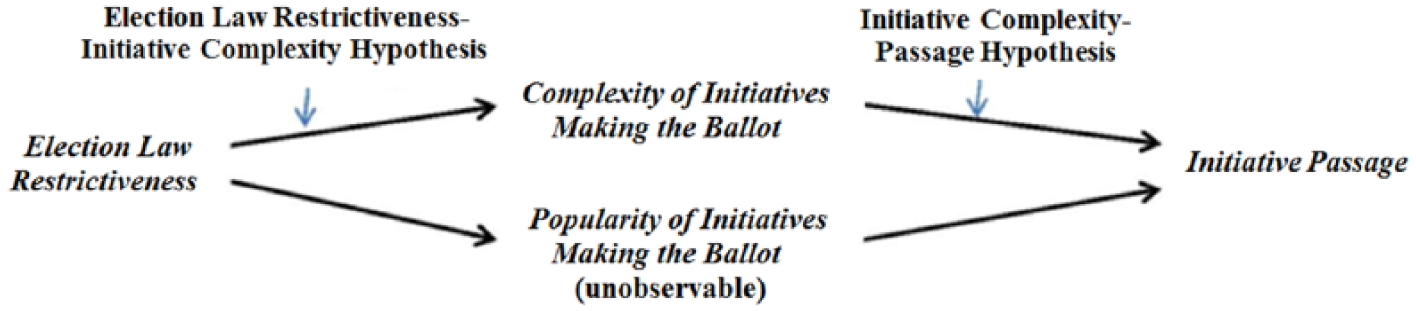
The influence of election law restrictiveness on initiative passage.
But, as Figure 3 also suggests, there is reason to believe that election law restrictiveness has an additional route of influence on initiative passage. I posit that increased restrictiveness should yield ballot initiatives with greater popular support. This is because when a state’s election laws impose a low threshold for ballot access (e.g., only a small number of signatures are required, or there is no time limit on gathering signatures), even proposals with little popular support should be able to overcome the obstacles to ballot access. But as a state’s threshold for ballot access rises, it should become more difficult for proposals without extensive popular support to overcome the impediments to ballot access, resulting in ballot initiatives that are increasingly dominated by popular proposals. 22
Moreover, highly restrictive election laws may lead some groups considering sponsoring an initiative not to move ahead if they believe their proposal will not be hugely popular. If more popular initiatives are likelier to pass on Election Day—a plausible assumption—election law restrictiveness should have a positive effect on initiative passage that is indirect through the popularity of ballot initiatives: greater restrictiveness leads to more popular ballot initiatives, which in turn makes these proposals more likely to pass on Election Day. This expectation justifies constructing a model predicting initiative passage that includes both complexity and my indicators of election law restrictiveness as covariates.
Empirical Analysis of the Determinants of Initiative Passage
In testing the Initiative Complexity–Passage Hypothesis—which predicts that the complexity of an initiative will influence its vote share—the dependent variable is the percentage of “yes” votes that each measure receives Election Day (denoted % Yes Votes). To test the Initiative Complexity–Passage Hypothesis, I include my three measures of initiative complexity, Word Count, Reading Difficulty, and Grade Level as independent variables. In light of the argument in the previous section, I also include the three indicators of election law restrictiveness—% Signatures Required, % Jurisdictions Required, and Time Constraint. These three variables account for any effect of election law restrictiveness on initiative passage that is not indirect through the complexity of a state’s initiatives (e.g., an indirect effect through the—unobservable—popularity of the initiatives on the ballot). Finally, I include the same control variables used to test the Election Law Restrictiveness–Initiative Complexity Hypothesis, as many of these variables have been shown to influence both election law restrictiveness and initiative passage (Banducci 1998; Bowler and Donovan 1998; Bowler, Donovan, and Happ 1992).
The findings are presented in Table 2. The first column includes Word Count as the indicator of initiative complexity, while the second and third columns use Reading Difficulty and Grade Level as the key explanatory variables, respectively. The coefficient for Word Count has the expected sign and is statistically significant at the .05 level. As an initiative’s Word Count decreases from its maximum to minimum value (indicating a decrease in complexity), the percentage of voters voting “yes” on the proposal increases by 7.863. 23 This increase in vote share is an approximately .58 standard deviation change in % Yes Votes and represents 11% of the range of this variable. Between 1996 and 2011, the average vote share for an initiative is about 48.273; thus, a substantive decrease in initiative complexity can easily be enough to push an initiative over the 50% threshold for approval. Even a more modest shift in complexity can help to seal the fate of a ballot measure. For instance, as an initiative’s complexity decreases from its 90th percentile value (793 words) to its 10th percentile value (55 words), the initiative’s vote share increases by about 2.214—a nontrivial effect that can still potentially make or break an initiative given the historical approval rate (48.273). Overall, this finding strongly supports the Initiative Complexity–Passage Hypothesis and is consistent with research showing that the complexity of an initiative is negatively associated with the probability that the initiative will pass, as individuals tend to penalize confusing initiatives by voting “no” (Reilly and Richey 2011).
Testing the Initiative Complexity–Passage Hypothesis.

Note. Cell entries are fixed-effects OLS coefficients with robust standard errors in parentheses. State and year dummies are not shown. GS = group strength; AIC = Akaike information criterion; OLS = ordinary least squares.
p < .10. **p < .05. (one-tailed test)
Notably, neither Reading Difficulty nor Grade Level appears to predict an initiative’s vote share. This suggests a very specific interpretation of how initiative complexity impacts passage. Initiatives that require a large number of words to summarize (i.e., hard issues) likely have more component parts to the policy proposal. To defeat an initiative, opponents need only give voters “one reason to say no” (i.e., one aspect or dimension of the proposal that is confusing or unappealing). 24 In short, “longer” initiatives give voters more opportunities to take issue with a proposal. Thus, the length of an initiative’s summary appears to be particularly important for its probability of passage.
Only one of the three election law restrictiveness variables—% Signatures Required—is statistically significant, and its coefficient is positively signed as expected across two of the three models in Table 2. If election law restrictiveness influences initiative passage solely because greater restrictiveness tends to produce less complex initiatives, which in turn are likelier to pass, the coefficient estimates for the three election law restrictiveness variables in the outcome equation should be near zero as my measures of initiative complexity—Word Count, Reading Difficulty, and Grade Level—are included among the covariates. In fact, the estimate for one election law restrictiveness variable is significantly different from zero, implying that election law restrictiveness must affect initiative passage not only because an increase in restrictiveness tends to result in less complex initiatives. I argue above that an increase in the restrictiveness of election laws produces ballot initiatives that are more popular, and, thus, more likely to pass on Election Day. My results are consistent with this assertion, but the unobservability of the popularity of a state’s ballot initiatives precludes directly testing the assertion.
Conclusion
Do election laws help to shape the policy agenda? Whereas prior works have focused almost exclusively on how election laws influence public participation in elections, this study explores the indirect effect that election laws exert on the policy agenda through the scope of participation. Specifically, I examine the effect of state election laws on direct democracy, arguably the most direct avenue for public participation in policy making in the American states. There is strong evidence that the restrictiveness of election laws governing ballot access for initiatives shapes the types of proposals that voters will decide upon on Election Day. Specifically, election law restrictiveness is found to have a negative relationship with the complexity of initiatives that place on the ballot.
Furthermore, I argue that the effect of election law restrictiveness on the types of proposals that make the ballot begets an important implication for policy outcomes. In addition to influencing the composition of initiatives on the ballot, I offer evidence that the restrictiveness of the election laws governing ballot access shapes the passage of initiatives as well. States with restrictive election laws have initiatives that are more likely to pass on Election Day than states with less restrictive laws, a result unlikely anticipated by advocates of ballot access restriction.
In sum, this study contributes to the ongoing dialogue on the importance of election laws. I explore the critical but largely unexamined issue of how election laws shape the policy agenda. Broadly, these findings suggest that election laws, particularly those that govern ballot access, may have a much more intricate relationship with states’ policy agendas and policy outcomes than previously considered.
These findings also raise several further questions for future research. First and foremost, what factors lead states to adopt restrictive ballot access laws? That is, what explains why some states make it more challenging to use the initiative process than others? This is arguably one of the most critical unanswered questions in this area of study—especially given that ballot access laws are unlikely to be entirely exogenous to initiative outcomes. Indeed, there is evidence that many of the same factors that influence initiative passage (e.g., legislative professionalism) also play a role in shaping changes to ballot access laws. Thus, the robust findings offered here—that restrictive election laws lead to less technically complex initiatives that are, in turn, more likely to be approved by voters—must be qualified by the uncertainty surrounding the determinants of election law restrictiveness.
Furthermore, if restrictive election laws lead to the placement of less technically complex measures on the ballot, might election laws also exert an indirect positive effect on voter turnout or policy knowledge? Recent studies have found that the presence of social or morality-based initiatives (e.g., same-sex marriage) on the ballot increases both turnout and policy knowledge within a state. Biggers (2012) argues that “easy” initiatives mobilize voters because they are often held as personally relevant or important to individuals; that is, these types of proposals make low-information, emotional appeals to the public and are, thus, far more effective in incentivizing turnout than technically complex proposals (e.g., bond measures). Similarly, because individuals are more likely to care about easy initiatives than hard initiatives, they are more inclined to pay attention to policy-relevant information in the political environment (Krosnick 1990). Therefore, easy ballot initiatives appear to have substantial “educative” effects on the public (Biggers 2011). These potential relationships suggest that restrictive election laws may have unexpected ripple effects that actually work to increase both voter turnout and political knowledge in the states.
Footnotes
Appendix
In testing the Initiative Complexity–Passage Hypothesis presented in this article, I rely on an assumption that restrictive election laws lead to the placement of more popular initiatives on the ballot—henceforth known as the Popularity Assumption. Ideally, I could observe public opinion data for all circulating initiatives that have not yet made the ballot. However, opinion polls for circulating measures are extremely rare. In fact, only initiative proposals that look like they are going to make the ballot (i.e., are gaining steam or public prominence in the collection of signatures) will garner any sort of media coverage or opinion polling prior to ballot placement.
To test the Popularity Assumption, I conduct a single-state analysis on Florida initiatives. Florida is an ideal choice for this analysis for two key reasons. First, Florida makes all proposed initiatives (the title, proposed ballot summary, and full text for those measures that made the ballot and those that did not) available through the Florida Secretary of State website. 25 Second, and more importantly, Florida’s Secretary of State keeps a record of the number of valid signatures that have been collected for each proposal; the availability of this information is quite unique to Florida—even high-use states such as Oregon, where records are kept of all proposed initiatives, do not keep records of the number of valid signatures that have been collected for each proposal. This is particularly valuable information for initiatives that did not make the ballot. Florida is also a relatively “moderate” state. Using the citizen ideology scores from Berry et al. (1998), which range from 0 to 100 with higher values denoting a more liberal state electorate, the Florida electorate (between 1996 and 2011) receives a score of 47.87; a score that sits almost precisely at the midpoint of the ideology scale (50). The moderate ideology of Florida, combined with its unique data availability, allows for a test of the Popularity Assumption.
To test the Popularity Assumption, I examine all proposed initiatives in the state of Florida between 2000 and 2006. 26 During this time, there were 107 proposed initiatives circulating in Florida. Of these 107 proposals, only 13 would go on to make the ballot. For each of these 107 proposals, I read the title, proposed ballot summary, and full text. Next, I content-coded the ideology of each proposal; that is, the extent to which each proposed policy change is liberal or conservative. I use a 7-point ordinal scale that ranges from 1 (Extremely Conservative) to 7 (Extremely Liberal). In coding each proposal, I assess whether each proposed policy change would entail an expansion or contraction of government involvement in a given policy area. Policies that involve expansion of government involvement are classified as liberal and those involving a contraction of government involvement are considered conservative. Table A1 contains the list of keywords used to further differentiate between liberal and conservative policies. For the 107 proposed initiatives in Florida, this is an exhaustive list of the types of policies encountered.
In testing the Initiative Complexity–Passage Hypothesis, I argue that restrictive election laws lead to (1) less complex and (2) more popular initiatives on the ballot. Thus, to examine the influence of initiative popularity on ballot placement, I must control for issue complexity. Upon reading the title, summary, and full text, I denote, for each proposed initiative, whether the underlying policy issue is “easy” or “hard,” using the Carmines and Stimson (1980) criteria. 27
Because Florida is a moderate state, it is likely that highly ideological proposals will be unpopular with voters and, thus, unlikely to make the ballot. That is, initiative sponsors should have considerable difficulty garnering public support, and, thus, voter signatures as well, for extremely liberal and extremely conservative policies. To test this, I examine the effect of a proposal’s ideology on (1) the number of valid signatures collected and (2) whether the proposal qualified for the ballot. To gauge the ideological extremism of an initiative proposal, I fold the 7-point ideology score. The resulting variable—Proposal Ideology—ranges from 0 to 3, with higher values denoting more ideologically extreme proposals; ideologically moderate proposals receive a score of “0.”
Using ordinary least squares (OLS) regression, I examine the effect of Proposal Ideology on the number of valid voter signatures collected by an initiative’s sponsor. The first column of Table A2 presents these results. As an initiative’s policy content becomes increasingly ideological—as Proposal Ideology moves from its minimum to maximum value—the proposal will garner, on average, about 295,448 fewer signatures. These results indicate that in a moderate state such as Florida, sponsors of ideologically extreme measures encounter more difficulty in collecting the required number of voter signatures than do sponsors that have proposed more moderate policies (that are in line with public preferences). Granted, ideology alone does not appear to fully explain the success or failure of signature acquisition, as Florida requires well over 600,000 voter signatures to place an initiative on the ballot.
There is also some evidence that technically complex proposals (i.e., proposals that pertain to hard political issues) encounter greater difficulty in corralling public support than do easy initiatives. An initiative that pertains to an easy issue garners, on average, over 71,000 more signatures than a hard initiative.
The second column of Table A2 contains the results of a logit regression, where the dependent variable is whether or not a proposed initiative made the ballot. Similarly, as Proposal Ideology increases from its minimum to maximum value—as an initiative’s policy content becomes more ideologically extreme—there is a .441 reduction in the probability that an initiative will make the ballot. Similarly, as an initiative moves from being “hard” to “easy,” the probability of making the ballot increases by about .110. In short, findings from both of these models suggest that as an initiative’s proposed policy falls out of line with public preferences, the initiative will have substantial difficulty garnering enough public support to make the ballot.
When states make it more difficult for initiatives to make the ballot, this should further disadvantage proposals that are out of line with the public’s ideology. For instance, in the case of Florida, as a state’s signature requirement becomes increasingly restrictive—requiring sponsors to collect a large number of voter signatures before ballot certification—initiatives that are in line with public preferences should be significantly more likely to qualify than ideologically extreme proposals, as sponsors will have an easier time collecting the additional signatures if there is widespread public support for a proposal. In sum, these results are generally supportive of the Popularity Assumption. The findings suggest that it is reasonable to expect increased election law restrictiveness to lead to the placement of more popular initiatives on the ballot.
Acknowledgements
I would like to thank Bill Berry, John Barry Ryan, Brad Gomez, and Jennifer Jerit for their extensive feedback on this project. I would also like to thank Thomas Carsey and the three anonymous reviewers for their time and helpful suggestions.
Declaration of Conflicting Interests
The author(s) declared no potential conflicts of interest with respect to the research, authorship, and/or publication of this article.
Funding
The author(s) received no financial support for the research, authorship, and/or publication of this article.
